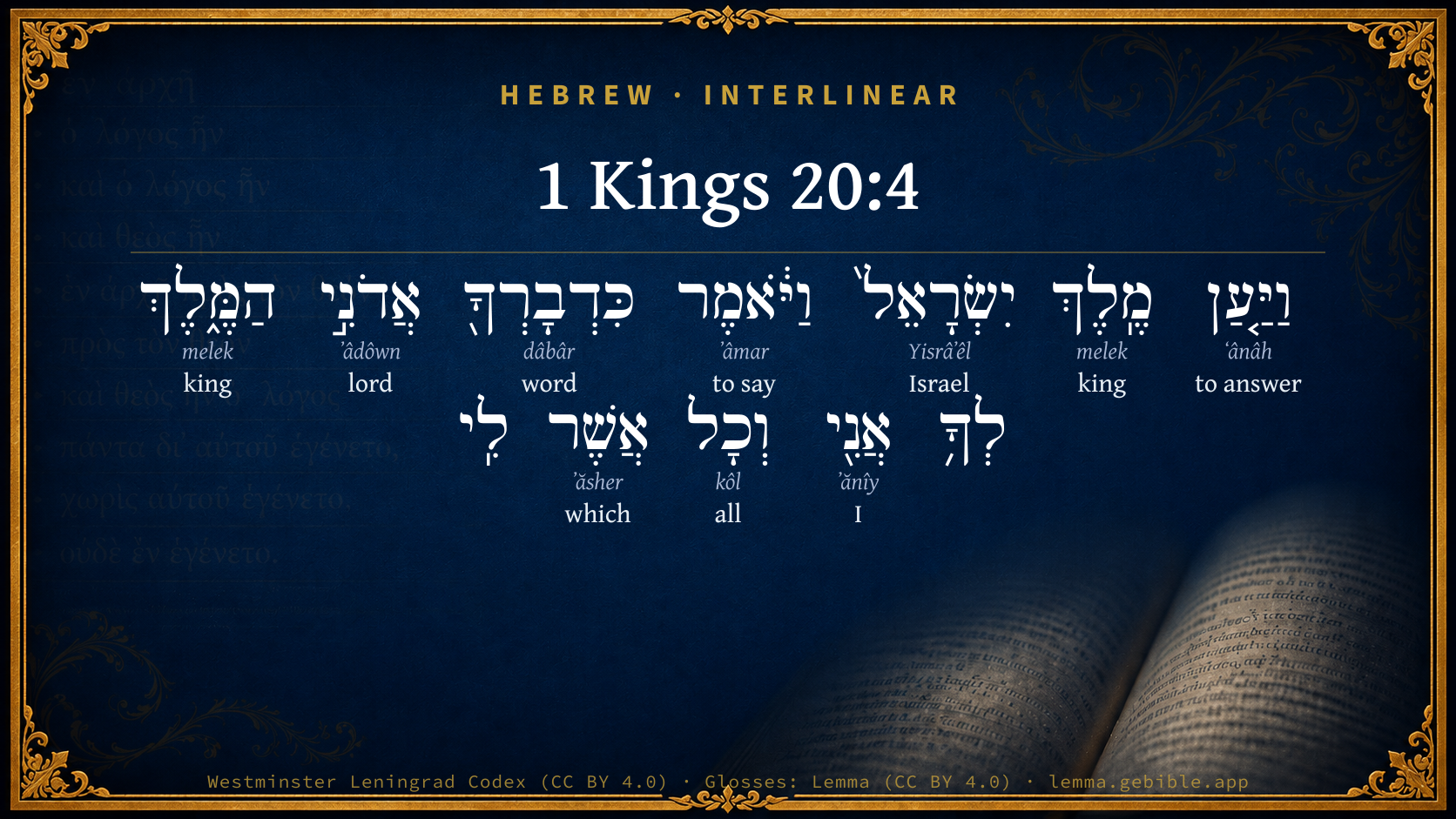
1 Kings 20:4

Hebrew (Westminster Leningrad Codex) 1 Kings 20:4 appears in the Hebrew Old Testament. The text above is from the Westminster Leningrad Codex. Each word links to its Strong’s number, a concise gloss, and parsing drawn from the Open Scriptures Hebrew Bible morphology. Click any word for its full Brown-Driver-Briggs (BDB) entry.
Download image
Cite this verse

1 Kings 20:4 (World English Bible). Public Domain. Lemma interlinear Bible study tool, https://lemma.gebible.app/v/1-kings/20/4.

Show BibTeX & RIS
BibTeX
RIS
English Translation
The king of Israel answered, It is according to your saying, my lord, O king; I am yours, and all that I have.
World English Bible · Public Domain
Download a study sheet

One document with this verse’s original text, its word-by-word gloss line, the meaning frame, cross-references with their text, attributed commentary, and full source and license credits — printable, and it pastes into notes with its structure intact.

This verse Autodidact and up

Study sheet (.html) Plain text (.txt)

A passage Seminary Student

Up to 50 verses in one chapter. A passage sheet keeps up to 6 commentary sources and 12 cross-references per verse, in the order this page ranks them, and says so on the sheet whenever that leaves anything out. Ask for a single verse and you get the Autodidact verse sheet above.

Everything on this page stays free to read, with no account — the sheet is a download of what is already on screen, not access to it.

Want to remove ads? Support Godless Engineer
Compare translations 3

The same verse in 3 English versions, stacked beneath the original-language interlinear above. Click any original word for its lexicon entry.

Each is an independent rendering of the whole verse — the interlinear is not word-aligned to these translations.

Highlighted words mark where these versions differ — a whole-verse word diff, not a word-by-word alignment.

  • World English Bible Public Domain
    The king of Israel answered, It is according to your saying, my lord, O king; I am yours, and all that I have.
  • King James Version Public Domain
    And the king of Israel answered and said, My lord, O king, according to thy saying, I am thine, and all that I have.
  • unfoldingWord Literal Text CC BY-SA 4.0
    And the king of Israel answered and said, “According to your word, my lord the king, I and all that to me to you.”

unfoldingWord Literal Text — © unfoldingWord, licensed CC BY-SA 4.0. Word-aligned USFM3 via Door43 (git.door43.org/unfoldingWord/en_ult).

Versions to compare (up to 4)

3 of 4 selected

Show all 18 translations

Every available English version of this verse, each an independent rendering of the whole verse.

  • World English Bible Public Domain
    The king of Israel answered, It is according to your saying, my lord, O king; I am yours, and all that I have.
  • Berean Standard Bible Public Domain
    And the king of Israel replied, “Just as you say, my lord the king: I am yours, along with all that I have.”
  • Majority Standard Bible Public Domain
    And the king of Israel replied, “Just as you say, my lord the king: I am yours, along with all that I have.”
  • King James Version Public Domain
    And the king of Israel answered and said, My lord, O king, according to thy saying, I am thine, and all that I have.
  • American Standard Version (1901) Public Domain
    And the king of Israel answered and said, It is according to thy saying, my lord, O king; I am thine, and all that I have.
  • Revised Version (1885) Public Domain
    And the king of Israel answered and said, It is according to thy saying, my lord, O king; I am thine, and all that I have.
  • Geneva Bible (1599) Public Domain
    And the King of Israel answered, and sayd, My lord King, according to thy saying, I am thine, and all that I haue.
  • Douay-Rheims (1899) Public Domain
    And the king of Israel answered: According to thy word, my lord 0 king, I am thine, and all that I have.
  • Young's Literal Translation Public Domain
    And the king of Israel answereth and saith, `According to thy word, my lord, O king: I `am' thine, and all that I have.'
  • Literal Standard Version CC BY-SA 4.0
    And the king of Israel answers and says, “According to your word, my lord, O king: I [am] yours, and all that I have.”
  • Unlocked Literal Bible CC BY-SA 4.0
    The king of Israel answered and said, “It is as you say, my master, king. I and all that I have are yours.”
  • unfoldingWord Literal Text CC BY-SA 4.0
    And the king of Israel answered and said, “According to your word, my lord the king, I and all that to me to you.”
  • Darby Bible Public Domain
    And the king of Israel answered and said, My lord, O king, according to thy saying, I am thine, and all that I have.
  • World Messianic Bible Public Domain
    The king of Israel answered, “It is according to your saying, my lord, O king. I am yours, and all that I have.”
  • Webster's Bible Public Domain
    And the king of Israel answered and said, My lord, O king, according to thy saying, I am thine, and all that I have.
  • Free Bible Version CC BY-SA 4.0
    “It's as you say, my lord the king,” the king of Israel replied. “I am yours, as well as everything that belongs to me.”
  • Bible in Basic English Public Domain
    And the king of Israel sent him an answer saying, As you say, my lord king, I am yours with all I have.
  • JPS Tanakh (1917) Public Domain
    And the king of Israel answered and said: 'It is according to thy saying, my lord, O king: I am thine, and all that I have.'

Literal Standard Version (2020), Covenant Press — licensed CC BY-SA 4.0. Text via the HelloAO Bible API (eBible.org). Unlocked Literal Bible (unfoldingWord) — licensed CC BY-SA 4.0. Text via the HelloAO Bible API (eBible.org). unfoldingWord Literal Text — © unfoldingWord, licensed CC BY-SA 4.0. Word-aligned USFM3 via Door43 (git.door43.org/unfoldingWord/en_ult). Free Bible Version, Dr. Jonathan Gallagher — licensed CC BY-SA 4.0. Text via the HelloAO Bible API (eBible.org).

Word by word

More ways to search: Search by grammar → Find every occurrence → Compare this word →

Practice this passage: Drill this verse → Learn its vocabulary →

וַיַּ֤עַן
ʻânâh
H6030
“and · to answer”
Conjunction + Verb, Qal, Sequential Imperfect, 3rd Person, Masculine, Singular
Part of Speech
Conjunction + Verb
Stem
Qal
Form
Sequential Imperfect
Person
3rd Person
Gender
Masculine
Number
Singular
Full BDB Definition

Origin: a primitive root

TWOT: 1650 , 1653

to answer, respond, testify, speak, shout - (Qal) - to answer, respond to - to testify, respond as a witness - (Niphal) - to make answer - to be answered, receive answer - (Qal) to sing, utter tunefully - (Qal) to dwell
  1. מֶֽלֶךְ melek H4428 “king of” Noun, Common, Masculine, Singular, Construct
  2. יִשְׂרָאֵל֙ Yisrâʼêl H3478 “Israel” Noun, Proper
  3. וַיֹּ֔אמֶר ʼâmar H559 “and · to say” Conjunction + Verb, Qal, Sequential Imperfect, 3rd Person, Masculine, Singular
  4. כִּדְבָרְךָ֖ dâbâr H1697 “like/as · word · your” Preposition + Noun, Common, Masculine, Singular, Construct + Suffix, Personal, 2nd Person, Masculine, Singular
  5. אֲדֹנִ֣י ʼâdôwn H113 “lord · my” Noun, Common, Masculine, Singular, Construct + Suffix, Personal, 1st Person, Common, Singular
  6. הַמֶּ֑לֶךְ melek H4428 “the · king” Particle, Definite Article + Noun, Common, Masculine, Singular, Absolute
  7. אֲנִ֖י ʼănîy H589 “I” Pronoun, Personal, 1st Person, Common, Singular
  8. וְכָל kôl H3605 “and · all of” Conjunction + Noun, Common, Masculine, Singular, Construct
  9. אֲשֶׁר ʼăsher H834 “which” Particle, Relative

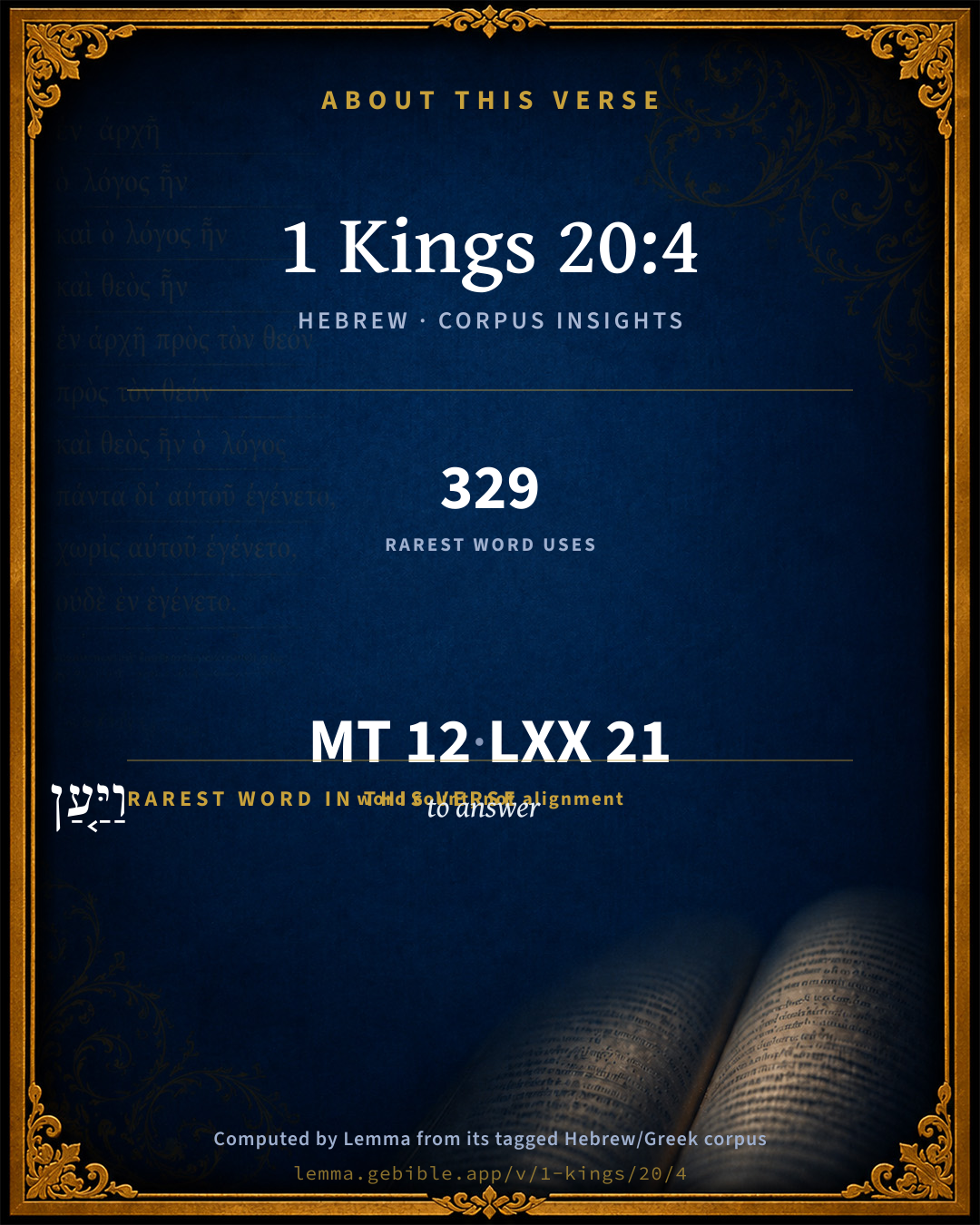
About this verse

These counts appear in no published source. They are computed here, from the morphology-tagged text and Lemma’s own curated glosses. What Lemma adds →

12
words
9
distinct lemmas
Historical
section

Grammatical profile

  • 2 verbs
  • 6 nouns
  • 1 pronoun
  • 2 prepositions
  • 1 particle

Verb forms

  • וַיַּ֤עַן Qal · Sequential Imperfect
  • וַיֹּ֔אמֶר Qal · Sequential Imperfect

Repetition

A word recurs within this verse — often emphatic in Hebrew:

  • מֶֽלֶךְ king H4428 ×2

Hebrew & Septuagint length

In English translation the verse runs 23 words from the Hebrew and 22 from the Septuagint (LXX English) — closely comparable.

A rough comparison of the two English renderings, which tokenize alike — not a word-level alignment.

Word counts can differ between the Hebrew and the Greek without any difference in meaning — e.g. the Hebrew direct-object marker אֵת has no separate Greek word, and Greek often adds the article ὁ.

In the original languages it is 12 Hebrew tokens and 21 Greek tokens — but the two are counted differently (Hebrew bundles its prefixes and suffixes into one token; the Greek is in lemma form), so that isn’t a like-for-like length.

Cross-references

5

Topical passages linked to 1 Kings 20:4 in the Treasury of Scripture Knowledge — connected by theme and wording, ordered by reader-vote popularity; previews shown in the World English Bible.

  • Leviticus 26:36 "'As for those of you who are left, I will send a faintness into their hearts in the lands of their enemies: and the sound of a driven leaf will put them to flight; and they shall flee, as one flees from the sword; and they will fall when no one pursues.
  • Deuteronomy 28:48 therefore shall you serve your enemies whom Yahweh shall send against you, in hunger, and in thirst, and in nakedness, and in want of all things: and he shall put a yoke of iron on your neck, until he have destroyed you.
  • Judges 15:11–13 Then three thousand men of Judah went down to the cleft of the rock of Etam, and said to Samson, "Don't you know that the Philistines are rulers over us? What then is this that you have done to us?" He said to them, As they did to me, so have I done to them.
  • 1 Samuel 13:6–7 When the men of Israel saw that they were in a strait (for the people were distressed), then the people did hide themselves in caves, and in thickets, and in rocks, and in coverts, and in pits.
  • 2 Kings 18:14–16 Hezekiah king of Judah sent to the king of Assyria to Lachish, saying, I have offended; return from me: that which you put on me will I bear. The king of Assyria appointed to Hezekiah king of Judah three hundred talents of silver and thirty talents of gold.

Cross-references courtesy of OpenBible.info (CC BY 4.0).

Hebrew and Greek witnesses Masoretic Hebrew ↔ Greek Septuagint

The same verse in the two great witnesses to the Old Testament, shown verse-for-verse.

These are two independent witnesses, not word-aligned to each other, and the Septuagint is shown in lemma (dictionary) form.

Hebrew 1 Kings 20:4 Masoretic · Westminster Leningrad Codex

וַיַּ֤עַן מֶֽלֶךְ יִשְׂרָאֵל֙ וַיֹּ֔אמֶר כִּדְבָרְךָ֖ אֲדֹנִ֣י הַמֶּ֑לֶךְ לְךָ֥ אֲנִ֖י וְכָל אֲשֶׁר לִֽי

The king of Israel answered, It is according to your saying, my lord, O king; I am yours, and all that I have.

World English Bible · Public Domain

Greek LXX 1 Kings 20:4 Septuagint · lemma form

καί γίγνομαι ὁ πνεῦμα αχααβ τεράσσω καί κοιμάω ἐπί ὁ κλίνη αὐτός καί συνκαλύπτω ὁ πρώσωπον αὐτός καί οὐ ἐσθίω ἄρτος

And the spirit of Achaab was troubled, and he lay down upon his bed, and covered his face, and ate no bread.

LXX2012 (modern English Septuagint) · Public Domain

Hebrew: Westminster Leningrad Codex (CC BY 4.0). Greek: Septuagint (public domain); English from LXX2012 (modern English Septuagint) (Public Domain). How the Septuagint differs from the Hebrew →

Targum (Aramaic paraphrase)

1

The Targum is the ancient Jewish Aramaic paraphrase of the Hebrew Scriptures — an interpretive translation, not the Hebrew text itself. Onkelos (literal) and Pseudo-Jonathan (expansive) render the Torah, and Jonathan the Prophets. Coverage is partial: where no permissively-licensed English translation exists for a verse, only the Aramaic is shown. This is verse-level text, not a word-by-word alignment to the Hebrew.

  1. Targum Jonathan Prophets (Joshua–Malachi)
    וַאֲתֵיב מַלְכָּא דְיִשְׂרָאֵל וַאֲמַר כְּפִתְגָמָךְ רִבּוֹנִי מַלְכָּא דִילָךְ נַפְשִׁי וְכָל דִילִי:

    (no public-domain English translation for this verse)

    Targum Jonathan — Aramaic: “Mikraot Gedolot” (public domain). English: “Sefaria Community Translation” (CC0 1.0 (public-domain dedication)); “London "Chaldee Paraphrase," 1871” (public domain). Text via Sefaria.

Commentary

Notes on 1 Kings 20:4 from classic Christian and Jewish commentators (each source and its license shown beneath its notes). The classic Christian expositions comment on the surrounding passage and are grouped to its opening verse, so a note may address several verses; the Jewish commentaries on the Tanakh (Rashi and others) are per-verse, so they appear only where the commentator wrote on this verse.

Lemma curates 59 commentaries, every one of them public domain or Creative Commons licensed, each selected and text-cleaned for this edition rather than reprinted as found. About our sources →

Trapp's Complete Commentary

John Trapp

1Ki 20:4 And the king of Israel answered and said, My lord, O king, according to thy saying, I [am] thine, and all that I have.

Ver. 4. I am thine, and all that I have.] This, say some, was responsum admodum muliebre, a very cowardly answer of Ahab. Others hold that he did well and wisely, whilst, as a reed in a tempest, he thus stoopeth to the violent charge of so potent an enemy. It is not for the overpowered to capitulate; weakness may not argue, but yield.

John Trapp, A Commentary or Exposition upon All the Books of the Old and New Testament (1647–1656) — public domain. Text from a community e-Sword module.

Geneva Bible (1599)

Geneva Bible translators

I am content to obey and pay tribute.

Geneva Bible (1599) marginal notes — public domain. Text via Bolls.life.

Adam Clarke's Commentary

Verse 4. I am thine, and all that I have.] He probably hoped by this humiliation to soften this barbarous king, and perhaps to get better conditions.

Adam Clarke's Commentary on the Bible (1810–1826) — public domain. Text from a community e-Sword/MySword module.

The Cambridge Bible for Schools and Colleges

gen. ed. J. J. S. Perowne

4. according to thy saying] The R.V. inserts It is before these words and thus brings out the division of the verse as marked in the Hebrew. The order of words in the original is ‘It is according to thy saying, my lord, O king.’

The Cambridge Bible for Schools and Colleges (gen. ed. J. J. S. Perowne; Cambridge University Press, 1878–1918) — public domain. Text from a community e-Sword module.

John Gill's Exposition

And the king of Israel answered and said, my lord, O king,.... So he said to Benhadad's messengers, representing him, as acknowledging his sovereignty over him:

according to thy saying, I am thine, and all that I have: which he understood of holding all that he had of him, by giving him homage, and paying him tribute; not that he was to deliver all his substance, and especially his wives and children, into his hands.

John Gill's Exposition of the Whole Bible (1746–1763) — public domain (CC PDM 1.0). Text via the HelloAO Bible API.

Haydock's Catholic Bible Commentary

Have. Achab is not in earnest, but strives to pacify the barbarian. (Menochius)

George Leo Haydock (1774–1849), Haydock's Catholic Family Bible and Commentary, 1859 edition — public domain. Excludes Psalms (Douay-Rheims chapter numbering differs from Protestant) and Deuterocanonical books (Catholic canon only).

Matthew Poole's English Annotations

I do so far comply with thy demand, that I will own thee for my lord, and myself for thy vassal and tributary; and will hold my wives, and children, and estate as by thy favour, and with an acknowledgment. But it is not likely that he would deliver up his wives and children into the barbarian’s hand, or that his proud and imperious wife Jezebel would permit him to do so.

Matthew Poole's English Annotations on the Holy Bible (1683–1685) — public domain. Text from a community e-Sword/MySword module.

Whedon's Commentary on the Bible

Daniel D. Whedon

4. I am thine, and all that I have — He pusillanimously agrees to make himself and his whole kingdom tributary to Ben-hadad.

Daniel D. Whedon (gen. ed.), Commentary on the Old and New Testaments (1874–1909) — public domain. Text from a community e-Sword module.

The Pulpit Commentary

And the king of Israel answered and said, My lord, O king, according to thy saying, I am thine, and all that I have. Much has been written about Ahab"s pusillanimous acquiescence in these disgraceful terms, etc. But it is not absolutely clear that he ever meant to surrender either wives or children to the invader. All that is certain is that he judged it wise, in the presence of the enormous force arrayed against him, to make every possible concession, to adopt the most subservient tone, and to cringe at the feet of Ben-hadad. But all the time he may have hoped that his soft answer would turn away wrath. It is very far from certain that had Ben-hadad sent to demand the wives and children which Ahab here seems willing to yield to him they would have been sent. When Ben-hadad threatens (ver. 6) a measure which involved much less indignity than the surrender of the entire seraglio to his lusts, Ahab stands at bay. Allowance must be made for the exaggerations of Eastern courtesy. The writer was entertained in 1861 by Jacob esh Shellabi, then sheykh of the Samaritans, who repeatedly used words very similar to these. "This house is yours," he would say; never meaning, however, that he should be taken at his word.

I am thine." "Wisely doth Ahab, as a reed in a tempest, stoop to this violent charge." "It is not for the overpowered to capitulate." Besides, who knew what the "soft answer" might effect? If smooth words could do no good, rough ones would certainly do much harm. The meek always have the best of it, and so inherit the earth.

The Pulpit Commentary (1880–1919), ed. H.D.M. Spence-Jones & Joseph S. Exell — public domain. Text from a community e-Sword module.

John Wesley's Explanatory Notes

The king said - I do so far comply with thy demand, that I will own thee for my Lord, and myself for thy vassal, and will hold my wives, and children, and estate, as by thy favour, and with an acknowledgment.

John Wesley, Explanatory Notes Upon the Whole Bible (1754–1765) — public domain. Text via the GEBible commentary corpus.

unfoldingWord translationNotes

Door43 World Missions Community

It is as you say

This is an idiom to express agreement. AT: "I agree with you" (See: Idiom)

tomorrow about this time

"tomorrow at the same time of day that it is now"

whatever pleases their eyes

Here the "eyes" represent the whole person and emphasize them looking at something and desiring it. AT: "whatever pleases them" (See: Synecdoche)

translationWords

lord

word

hand

servant

house

seize

unfoldingWord translationNotes — © Distant Shores Media and the Door43 World Missions Community, licensed CC BY-SA 4.0. Source: git.door43.org/Door43/en_tn.

Lesson kit

Teaching starters — assembled from the data on this page, not authored interpretation. Every prompt links to the verse data it draws on. Edit before teaching.

1 Kings, in the Historical, opens this verse with 12 words (9 distinct Hebrew lemmas). Its most distinctive word is ʻânâh (“to answer”). A historical commentator’s framing appears above. Read the whole chapter for the surrounding context.

Discussion questions

  1. The word ʻânâh carries the sense “to answer.” How does it shape the verse?
  2. How does Leviticus 26:36, which shares this passage’s theme, read alongside this verse?
  3. What does the repetition of “king” (2× in this one verse) do in this verse?
  4. The translations on this page render this verse differently — a whole-verse word diff, not a word-by-word alignment. What might account for the different wordings?
  5. «וַיַּ֤עַן» is a Qal Sequential Imperfect verb. How does that grammatical form shape the action described?
  6. Compare how Trapp's Complete Commentary and Geneva Bible (1599) read this verse. Where do they agree or differ?

Things to notice

Reading settings

Reading text

Shown beneath each verse's original-language words.

Old Testament
Old Testament edition

Read the OT as the Masoretic Hebrew (MT) or the Greek Septuagint (LXX).

English shown for the Greek Septuagint (in the Hebrew ↔ Greek comparison).

Comparing translations? Open the Compare panel on any verse page to stack up to four side by side.