
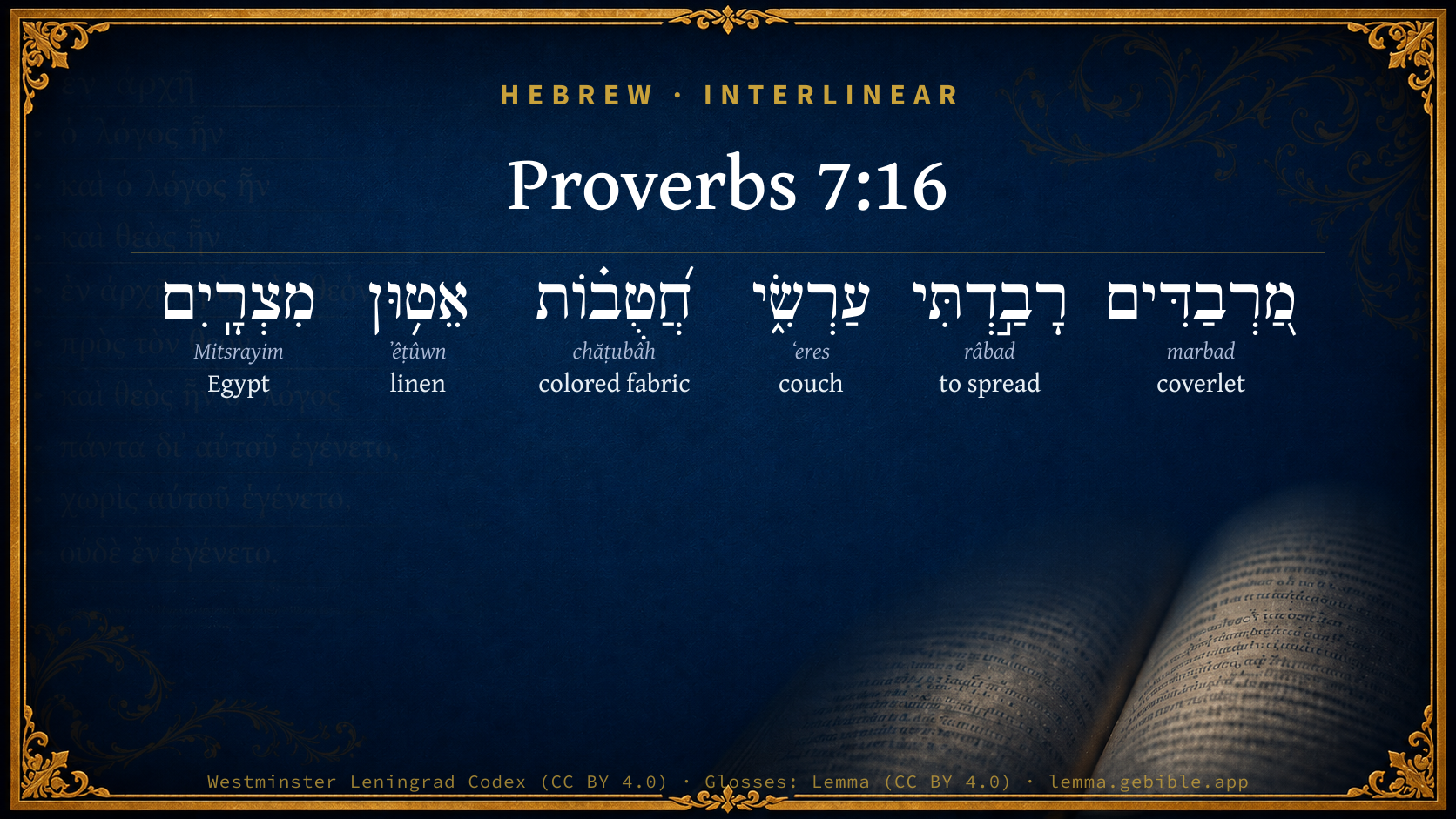
Proverbs 7:16

Hebrew (Westminster Leningrad Codex) Proverbs 7:16 appears in the Hebrew Old Testament. The text above is from the Westminster Leningrad Codex. Each word links to its Strong’s number, a concise gloss, and parsing drawn from the Open Scriptures Hebrew Bible morphology. Click any word for its full Brown-Driver-Briggs (BDB) entry.
Download image
Cite this verse

Proverbs 7:16 (World English Bible). Public Domain. Lemma interlinear Bible study tool, https://lemma.gebible.app/v/proverbs/7/16.

Show BibTeX & RIS
BibTeX
RIS
English Translation
I have spread my couch with carpets of tapestry, With striped cloths of the yarn of Egypt.
World English Bible · Public Domain
Highlights
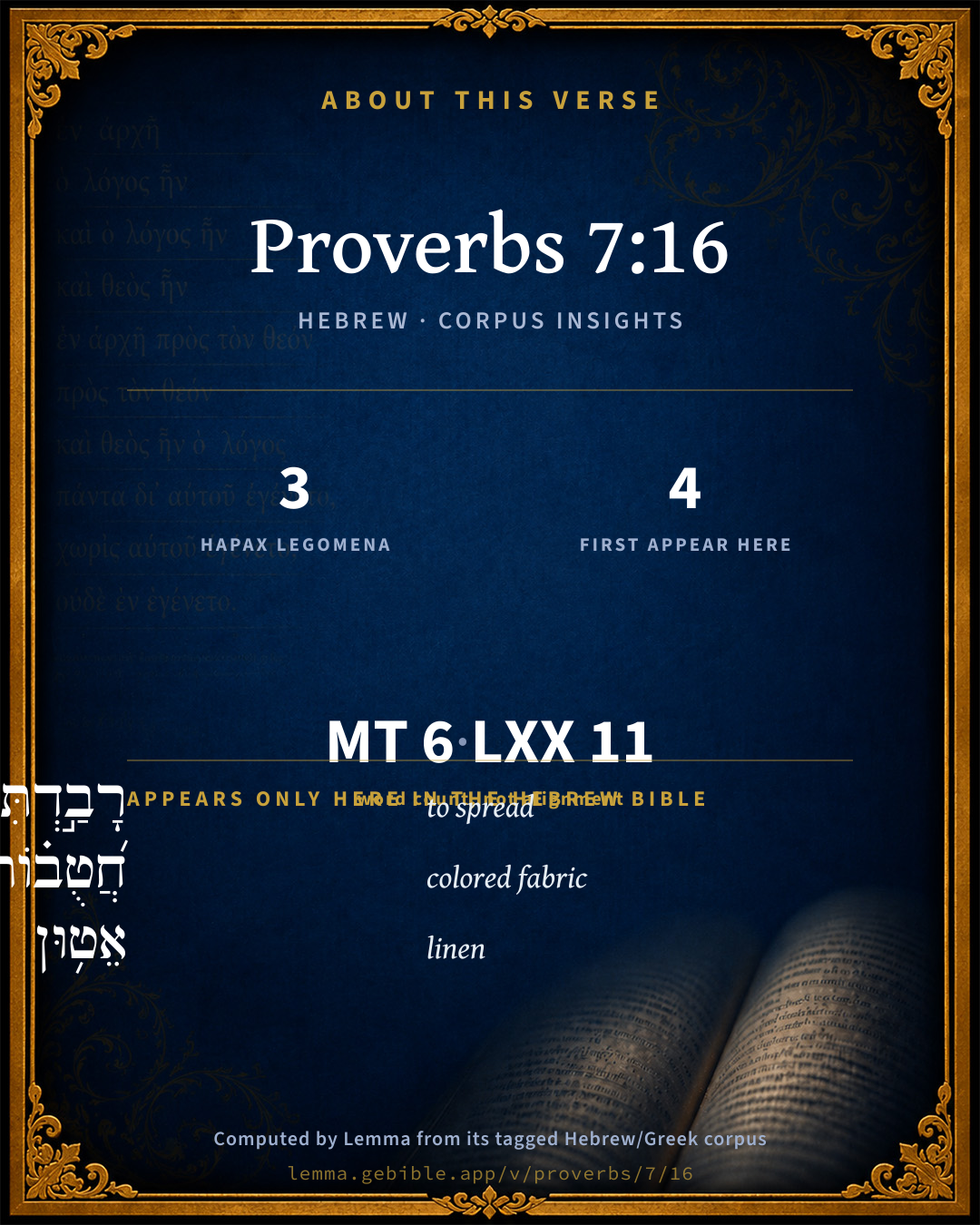
  • 3 hapax legomena — only here in the Hebrew Bible
  • 4 first appearances in the Hebrew Bible
Full analysis ↓
Download a study sheet

One document with this verse’s original text, its word-by-word gloss line, the meaning frame, cross-references with their text, attributed commentary, and full source and license credits — printable, and it pastes into notes with its structure intact.

This verse Autodidact and up

Study sheet (.html) Plain text (.txt)

A passage Seminary Student

Up to 50 verses in one chapter. A passage sheet keeps up to 6 commentary sources and 12 cross-references per verse, in the order this page ranks them, and says so on the sheet whenever that leaves anything out. Ask for a single verse and you get the Autodidact verse sheet above.

Everything on this page stays free to read, with no account — the sheet is a download of what is already on screen, not access to it.

Want to remove ads? Support Godless Engineer
Compare translations 3

The same verse in 3 English versions, stacked beneath the original-language interlinear above. Click any original word for its lexicon entry.

Each is an independent rendering of the whole verse — the interlinear is not word-aligned to these translations.

Highlighted words mark where these versions differ — a whole-verse word diff, not a word-by-word alignment.

  • World English Bible Public Domain
    I have spread my couch with carpets of tapestry, With striped cloths of the yarn of Egypt.
  • King James Version Public Domain
    I have decked my bed with coverings of tapestry, with carved works, with fine linen of Egypt.
  • unfoldingWord Literal Text CC BY-SA 4.0
    I have spread my couch coverings, colored linen of Egypt.

unfoldingWord Literal Text — © unfoldingWord, licensed CC BY-SA 4.0. Word-aligned USFM3 via Door43 (git.door43.org/unfoldingWord/en_ult).

Versions to compare (up to 4)

3 of 4 selected

Show all 18 translations

Every available English version of this verse, each an independent rendering of the whole verse.

  • World English Bible Public Domain
    I have spread my couch with carpets of tapestry, With striped cloths of the yarn of Egypt.
  • Berean Standard Bible Public Domain
    I have decked my bed with coverings, with colored linen from Egypt.
  • Majority Standard Bible Public Domain
    I have decked my bed with coverings, with colored linen from Egypt.
  • King James Version Public Domain
    I have decked my bed with coverings of tapestry, with carved works, with fine linen of Egypt.
  • American Standard Version (1901) Public Domain
    I have spread my couch with carpets of tapestry, With striped cloths of the yarn of Egypt.
  • Revised Version (1885) Public Domain
    I have spread my couch with carpets of tapestry, with striped cloths of the yarn of Egypt.
  • Geneva Bible (1599) Public Domain
    I haue deckt my bed with ornaments, carpets and laces of Egypt.
  • Douay-Rheims (1899) Public Domain
    I have woven my bed with cords, I have covered it with painted tapestry, brought from Egypt.
  • Young's Literal Translation Public Domain
    `With' ornamental coverings I decked my couch, Carved works -- cotton of Egypt.
  • Literal Standard Version CC BY-SA 4.0
    I decked my bed [with] ornamental coverings, || Carved works—cotton of Egypt.
  • Unlocked Literal Bible CC BY-SA 4.0
    I have spread coverings on my bed, colored linens from Egypt.
  • unfoldingWord Literal Text CC BY-SA 4.0
    I have spread my couch coverings, colored linen of Egypt.
  • Darby Bible Public Domain
    I have decked my bed with tapestry coverlets of variegated linen from Egypt;
  • World Messianic Bible Public Domain
    I have spread my couch with carpets of tapestry, with striped cloths of the yarn of Egypt.
  • Webster's Bible Public Domain
    I have decked my bed with coverings of tapestry, with carved works, with fine linen of Egypt.
  • Free Bible Version CC BY-SA 4.0
    My bed is made, covered with colorful linens from Egypt.
  • Bible in Basic English Public Domain
    My bed is covered with cushions of needlework, with coloured cloths of the cotton thread of Egypt;
  • JPS Tanakh (1917) Public Domain
    I have decked my couch with coverlets, with striped cloths of the yarn of Egypt.

Literal Standard Version (2020), Covenant Press — licensed CC BY-SA 4.0. Text via the HelloAO Bible API (eBible.org). Unlocked Literal Bible (unfoldingWord) — licensed CC BY-SA 4.0. Text via the HelloAO Bible API (eBible.org). unfoldingWord Literal Text — © unfoldingWord, licensed CC BY-SA 4.0. Word-aligned USFM3 via Door43 (git.door43.org/unfoldingWord/en_ult). Free Bible Version, Dr. Jonathan Gallagher — licensed CC BY-SA 4.0. Text via the HelloAO Bible API (eBible.org).

Word by word

More ways to search: Search by grammar → Find every occurrence → Compare this word →

Practice this passage: Drill this verse → Learn its vocabulary →

About this verse

These counts appear in no published source. They are computed here, from the morphology-tagged text and Lemma’s own curated glosses. What Lemma adds →

6
words
6
distinct lemmas
Wisdom
section

Notable vocabulary

3 hapax legomena — words that appear only here in the entire Hebrew Bible:

  • רָבַ֣דְתִּי to spread H7234
  • חֲ֝טֻב֗וֹת colored fabric H2405
  • אֵט֥וּן linen H330

First appearance in Scripture

These words make their first canonical appearance in the Hebrew Bible here:

  • מַ֭רְבַדִּים coverlet H4765
  • רָבַ֣דְתִּי to spread H7234
  • חֲ֝טֻב֗וֹת colored fabric H2405
  • אֵט֥וּן linen H330

Shared distinctive vocabulary

מַ֭רְבַדִּים coverlet H4765 occurs in 2 verses of the Hebrew Bible. Also found in:

Grammatical profile

  • 1 verb
  • 5 nouns

Verb forms

  • רָבַ֣דְתִּי Qal · Perfect

Hebrew & Septuagint length

In English translation the verse runs 17 words from the Hebrew and 17 from the Septuagint (LXX English) — the same length.

A rough comparison of the two English renderings, which tokenize alike — not a word-level alignment.

Word counts can differ between the Hebrew and the Greek without any difference in meaning — e.g. the Hebrew direct-object marker אֵת has no separate Greek word, and Greek often adds the article ὁ.

In the original languages it is 6 Hebrew tokens and 11 Greek tokens — but the two are counted differently (Hebrew bundles its prefixes and suffixes into one token; the Greek is in lemma form), so that isn’t a like-for-like length.

Cross-references

7

Topical passages linked to Proverbs 7:16 in the Treasury of Scripture Knowledge — connected by theme and wording, ordered by reader-vote popularity; previews shown in the World English Bible.

  • Isaiah 19:9 Moreover those who work in combed flax, and those who weave white cloth, shall be confounded.
  • Ezekiel 27:7 Of fine linen with embroidered work from Egypt was your sail, that it might be to you for an ensign; blue and purple from the isles of Elishah was your awning.
  • 1 Kings 10:28 The horses which Solomon had were brought out of Egypt; and the king's merchants received them in droves, each drove at a price.
  • Proverbs 31:22 She makes for herself carpets of tapestry. Her clothing is fine linen and purple.
  • Song of Solomon 3:7–10 Behold, it is Solomon's carriage! Sixty mighty men are around it, Of the mighty men of Israel.
  • Revelation 2:22 Behold, I will throw her into a bed, and those who commit adultery with her into great oppression, unless they repent of her works.
  • Song of Solomon 1:16 Behold, you are beautiful, my beloved, yes, pleasant; And our couch is verdant. Lover

Cross-references courtesy of OpenBible.info (CC BY 4.0).

Hebrew and Greek witnesses Masoretic Hebrew ↔ Greek Septuagint

The same verse in the two great witnesses to the Old Testament, shown verse-for-verse.

These are two independent witnesses, not word-aligned to each other, and the Septuagint is shown in lemma (dictionary) form.

Hebrew Proverbs 7:16 Masoretic · Westminster Leningrad Codex

מַ֭רְבַדִּים רָבַ֣דְתִּי עַרְשִׂ֑י חֲ֝טֻב֗וֹת אֵט֥וּן מִצְרָֽיִם

I have spread my couch with carpets of tapestry, With striped cloths of the yarn of Egypt.

World English Bible · Public Domain

Greek LXX Proverbs 7:16 Septuagint · lemma form

κειρία τείνω ὁ κλίνη ἐγώ ἀμφίταπος δέ στρωννύω ὁ ἀπό αἴγυπτος

I have spread my bed with sheets, and I have covered it with double tapestry from Egypt.

LXX2012 (modern English Septuagint) · Public Domain

On this verse, The Cambridge Bible for Schools and Colleges discusses the Septuagint’s reading. Read the note in Commentary ↓

Hebrew: Westminster Leningrad Codex (CC BY 4.0). Greek: Septuagint (public domain); English from LXX2012 (modern English Septuagint) (Public Domain). How the Septuagint differs from the Hebrew →

Commentary

Notes on Proverbs 7:16 from classic Christian and Jewish commentators (each source and its license shown beneath its notes). The classic Christian expositions comment on the surrounding passage and are grouped to its opening verse, so a note may address several verses; the Jewish commentaries on the Tanakh (Rashi and others) are per-verse, so they appear only where the commentator wrote on this verse.

Lemma curates 59 commentaries, every one of them public domain or Creative Commons licensed, each selected and text-cleaned for this edition rather than reprinted as found. About our sources →

Trapp's Complete Commentary

John Trapp

Pro 7:16 I have decked my bed with coverings of tapestry, with carved [works], with fine linen of Egypt.

Ver. 16. I have decked my bed.] Lest haply by being abroad so late he should question where to have a bed, she assures him of a dainty one, with curious curtains.

John Trapp, A Commentary or Exposition upon All the Books of the Old and New Testament (1647–1656) — public domain. Text from a community e-Sword module.

The Biblical Illustrator

Joseph S. Exell

Pro_7:16

I have decked my bed with coverings of tapestry.

A luxurious bed

I have exhausted the toil of myself and bought the toil of others to increase the luxury of my rest. Come and see the courtly elegance with which my bed is decked. Long and weary days have I laboured at the counting-house, at the workshop, or at the desk. And now my bed is decked. Come and look. Place yourself at my chamber window and tell me what you see now and what you will see next year.

1. I see thee lying on this bed which thou hast decked, fretful, restless, and miserable. Thou hast found out too late that enjoyment is more painful than expectation.

2. I see thee dying on the same bed. May God grant thee mercy! but if He does it is in spite of the luxury with which thou art surrounded.

3. I see thee lying in another bed. It is narrow, and though well quilted and smoothed, yet it has no room for the weary body to turn, or for the feverish head to lift itself. I have decked my bed with peace. And though its coverings are but scanty, and though sorrow and desolation have taken their seats by its side, yet peace remains. And there is one like unto the Son of Man whose gracious face ever shines on me from before this, my poor resting-place, so that though deserted and wretched, His love gives me a comfort this world can neither give nor take away.

Come and see. I have come, oh, saint of God! and I see three sights.

1. Destitution and pain are indeed about thee as thou liest on that rude couch; but peace and love reign there, and who shall prevail against the Lords elect?

2. I see thee in thy dying hour. Deserted and miserable thou mayest be, but angelic forms are hovering over thee, and I hear a voice speaking as man can never speak, saying, Come, thou beloved of My Father!

3. I see thee in thy narrow bed, but I see something else behind. For I see that great city, the holy Jerusalem, having the glory of God. And I hear a voice there saying, Who is this who is arrayed in white robes? and whence came he? And I say unto him, Sir, thou knowest. And the voice says, He is one of them that came out of great tribulation, etc. (Christian Treasury.)

The Biblical Illustrator, edited by Joseph S. Exell (c. 1880s–1900s) — public domain. Text from a community e-Sword module.

Tyndale Open Study Notes

Tyndale Open Resources

7:16-17 Her emphasis on her bed and exotic perfumes (myrrh, aloes, and cinnamon) is explicitly sexual (cp. Song 4:13-14).

Tyndale Open Study Notes — © Tyndale Open Resources, licensed CC BY-SA 4.0. Text via the HelloAO Bible API.

Geneva Bible (1599)

Geneva Bible translators

Or, carved work.

Geneva Bible (1599) marginal notes — public domain. Text via Bolls.life.

Jamieson, Fausset & Brown

Robert Jamieson, A. R. Fausset & David Brown

my bed--or, "couch," adorned in the costliest manner.

Jamieson, Fausset & Brown — Commentary Critical and Explanatory on the Whole Bible (1871) — public domain (CC PDM 1.0). Text via the HelloAO Bible API.

Adam Clarke's Commentary

Verse 16. I have decked my bed] ערשי arsi, "my couch or sofa;" distinguished from משכבי mishcabi, "my bed," Pr 7:17, the place to sleep on, as the other was the place to recline on at meals. The tapestry, מרבדים marbaddim, mentioned here seems to refer to the covering of the sofa; exquisitely woven and figured cloth. חטבות אטון chatuboth etun, the Targum translates painted carpets, such as were manufactured in Egypt; some kind of embroidered or embossed stuff is apparently meant.

Adam Clarke's Commentary on the Bible (1810–1826) — public domain. Text from a community e-Sword/MySword module.

Ellicott's Commentary for English Readers

(16) Carved works.—Rather, with coloured or striped coverlets. For another notice of the extravagance of the women of Jerusalem, see Isaiah 3, and for a description of the trade of Tyre, the great supplier of foreign luxuries, see Ezek. xxvii Myrrh is said to be a natural product of Arabia, aloes and cinnamon of the east coast of Africa and Ceylon.

A Bible Commentary for English Readers, edited by Charles John Ellicott (1878–1897) — public domain. Text from a community e-Sword module.

The Cambridge Bible for Schools and Colleges

gen. ed. J. J. S. Perowne

16. deckt … with. coverings] Lit. covered … with coverings, or cushioned … with cushions, the words being two forms of the same Heb. root, which does not occur elsewhere.

bed] or, couch: a different and more poetic word than that in Pro_7:17. It is used for a couch of moss and flowers, “also our couch is green,” Son_1:16.

with carved works &c.] Rather, with striped cloths of the yarn of Egypt, R.V.

If the rendering of A.V., “And king Solomon had horses brought out of Egypt and linen yarn” (1Ki_10:28), could stand, we should have an interesting historical light thrown upon this verse. It is now, however, generally thought that the Hebrew word (lit. string) does not mean yarn, but a string, or drove of horses. “And the horses which Solomon had were brought out of Egypt; and the king’s merchants received them in droves, each drove at a price,” R.V. (See note there in this Series.) The historical notice, however, is still relevant, as showing the commercial relations of Palestine with Egypt in the time of Solomon.

linen] or, yarn, R.V. The Heb. word occurs only here, and is thought by Lange and others to be akin to the Greek word ὀθόνη, fine linen in classical Greek, but in later Greek used more widely, Act_10:11; Act_11:5. The LXX. render, ἀμφιτάποις (with cloths hairy or shaggy on both sides) ἔστρωκα τοῖς ἀπʼ Αἰγύπτου.

The Cambridge Bible for Schools and Colleges (gen. ed. J. J. S. Perowne; Cambridge University Press, 1878–1918) — public domain. Text from a community e-Sword module.

John Gill's Exposition

I have perfumed my bed,.... As she had made it entertaining to the senses of seeing and feeling, it being showy and gaudy, soft and easy; so to the sense of smelling; and all to provoke lust, and draw into her embraces; by censing it with incense, as Donesh in Jarchi; or by sprinkling (s) a liquor, made of the following spices, on the head, posts, and sides of the bed, to remove all ill scents, and make it more acceptable; so the Targum, Vulgate Latin, Septuagint, and all the Oriental versions, render it, "I sprinkled my bed": or, it may be, by suffumigation, which women are said to use with their garments and bed clothes (t). Even this the harlot did,

with myrrh, aloes, and cinnamon; all odorous, and of a sweet smell: Horace (u) speaks of the anointed beds of such persons; and of the above spices ointments were made, with which the harlot's bed might be perfumed. Cinnamon, and odours, and ointments, and frankincense, are reckoned among the wares of Babylon, or the church of Rome, Rev 18:13.

(s) Plin. Nat. Hist. l. 13. c. 1. (t) Clemens Alex. Paedagog. l. 2. c. 8. p. 177. (u) "Uctis cubilibus pellicum", Epod. Ode. 5. v. 69, 70.

John Gill's Exposition of the Whole Bible (1746–1763) — public domain (CC PDM 1.0). Text via the HelloAO Bible API.

Albert Barnes' Notes on the Bible

The words point to the art and commerce which flourished under Solomon.

Carved works - Most commentators take the original as meaning “striped coverlets of linen of Egypt.”

Albert Barnes' Notes on the Bible (1834–1885) — public domain. Text from a community e-Sword/MySword module.

Haydock's Catholic Bible Commentary

Cords. For greater ease, instead of boards, (Menochius) or the curtains are hung with precious cords from Egypt. (Calmet)

George Leo Haydock (1774–1849), Haydock's Catholic Family Bible and Commentary, 1859 edition — public domain. Excludes Psalms (Douay-Rheims chapter numbering differs from Protestant) and Deuterocanonical books (Catholic canon only).

Matthew Poole's English Annotations

She designs to inflame his lust by the mention of the bed, and by its ornaments and perfumes.

Matthew Poole's English Annotations on the Holy Bible (1683–1685) — public domain. Text from a community e-Sword/MySword module.

Whedon's Commentary on the Bible

Daniel D. Whedon

16. I have decked my bed — Stuart renders, “With coverlets have I strewed my couch; with tapestry of Egyptian thread.” Zockler, “Tapestry have I spread upon my couch; variegated coverlets of Egyptian linen.” Miller, “Striped with the yarn of Egypt.”

Tapestry — Some kind of embroidered cloth, parti-coloured or figured. Egypt was famous for its fine linen, thread, and yarns. The meaning is, that she had ornamented her couch or sofa with the very best and most costly of coverings.

Carved works — Most commentators take these words to mean striped or embroidered coverlets. It is probable that the couch here means the sofa or mattress on which they reclined at meals.

Daniel D. Whedon (gen. ed.), Commentary on the Old and New Testaments (1874–1909) — public domain. Text from a community e-Sword module.

The Pulpit Commentary

She describes the preparation she has made for his entertainment. Coverings of tapestry; marbaddim, "cushions," "pillows." The expression occurs again in Pro_31:22. It is derived from dbd "to spread," and means cushions spread out ready for use. The Septuagint has keiriaiv ; Vulgate, funibus, "cords." These versions seem to regard the word as denoting a kind of delicate sacking on which the coverlets were laid. Carved works, with fine linen of Egypt; literally, striped, or variegated, coverings, Egyptian linen. The words are in apposition, but the latter point to the material used, which is Wfae, etun (apax legomenon ), "linen yarn or thread," hence equivalent to "coverlets of Egyptian thread." This was of extreme fineness, costly, and much prized. By "carved works" (Hebrew, twObfuj, chatuboth) the Authorized Version must refer to bed poles or bed boards elaborately carved and polished; but the word is better taken of coverlets striped in different colours, which give the idea of richness and luxury. Vulgate, trapetibus pictis ex Aegypto, "embroidered rugs of Egyptian work;" Septuagint, amfitapoiv toiv ap Aiguptou , "shaggy cloth of Egypt." The mention of these articles denotes the foreign commerce of the Hebrews, and their appreciation of artistic work. (comp. Isa_19:9 Eze_27:7) The Prophet Amos (Amo_6:4) denounces those that "lie upon beds of ivory, and stretch themselves upon their couches."

The Pulpit Commentary (1880–1919), ed. H.D.M. Spence-Jones & Joseph S. Exell — public domain. Text from a community e-Sword module.

Keil & Delitzsch

C. F. Keil & F. Delitzsch

Thus she found him, and described to him the enjoyment which awaited him in eating and drinking, then in the pleasures of love.

16 "My bed have I spread with cushions,

Variegated coverlets, Egyptian linen;

17 I have sprinkled my couch

With myrrh, aloes, and cinnamon.

18 Come then, we will intoxicate ourselves with love till the morning,

And will satisfy ourselves in love."

The noun ערשׂ, from ערשׂ, = Arab. 'arash, aedificare, fabricari, signifies generally the wooden frame; thus not so much the bed within as the erected bed-place (cf. Arab. 'arsh, throne, and 'arysh, arbour). This bedstead she had richly and beautifully cushioned, that it might be soft and agreeable. רבד, from רב, signifies to lay on or apply closely, thus either vincire (whence the name of the necklace, Gen 41:42) or sternere (different from רפד, Job 17:13, which acquires the meaning sternere from the root-meaning to raise up from under, sublevare), whence מרבדּים, cushions, pillows, stragulae. Bttcher punctuates מרבדּים incorrectly; the ב remains aspirated, and the connection of the syllables is looser than in מרבּה, Ewald, 88d. The צטבות beginning the second half-verse is in no case an adjective to מרבדים, in every case only appos., probably an independent conception; not derived from חטב (cogn. חצב), to hew wood (whence Arab. ḥaṭab, fire-wood), according to which Kimchi, and with him the Graec. Venet. (περιξύστοις), understands it of the carefully polished bed-poles or bed-boards, but from חטב = Arab. khaṭeba, to be streaked, of diverse colours (vid., under Psa 144:12), whence the Syriac machṭabto, a figured (striped, checkered) garment. Hitzig finds the idea of coloured or variegated here unsuitable, but without justice; for the pleasantness of a bed is augmented not only by its softness, but also by the impression which its costliness makes on the eye. The following אטוּן מצרים stands in an appositional relation to חטבות, as when one says in Arabic taub-un dı̂bâg'-un, a garment brocade = of brocade. אטוּן (after the Syr. for אטוּן, as אמוּן) signifies in the Targum the cord (e.g., Jer 38:6), like the Arab. ṭunub, Syr. (e.g., Isa 54:2) tûnob; the root is טן, not in the sense of to bind, to wind (Deitr.), but in the sense of to stretch; the thread or cord is named from the extension in regard to length, and אטון is thus thread-work, whether in weaving or spinning.

(Note: Hence perhaps the Greek ὀθόνη, which Fick in his Vergl. Wrterbuch connects with the Arab. verb-root vadh, to bind, wind, clothe, but not without making thereto interrogation marks.)

The fame of Egyptian manufactures is still expressed in the Spanish aclabtea, fine linen cloth, which is equivalent to the modern Arabic el-ḳobṭı̂je (ḳibṭije); they had there particularly also an intimate acquaintance with the dye stuffs found in the plants and fossils of the country (Klemm's Culturgeschichte, v. 308-310).

Pro 7:17-18

These verses remind us of expressions in the Canticles. There, at Pro 4:14, are found the three names for spicery as here, and one sees that מר אהלים are not to be connected genitively: there are three things, accented as in the title-verse Pro 1:3. The myrrh, מר (Balsamodendron myrrha), belongs, like the frankincense, to the species of the Amyris, which is an exotic in Palestine not less than with us; the aromatic quality in them does not arise from the flowers or leaves, so that Sol 1:13 leads us to think of a bunch of myrrh, but from the resin oozing through the bark (Gummi myrrhae or merely myrrha), consisting of bright glossy red or golden-yellow grains more or less transparent. אהלים (used by Balaam, Num 24:6) is the Semitic Old-Indian name of the alo, agaru or aguru; the aromatic quality is in the wood of the Aquilaria agallocha, especially its root (agallochum or lignum aloes) dried in the earth - in more modern use and commerce the inspissated juice of its leaves. קנּמון is κιννάμωμον (like מר, a Semitic word

(Note: Myrrh has its name מר from the bitterness of its taste, and קנם appears to be a secondary formation from קנה, whence קנה, reed; cf. the names of the cinnamon, cannella, Fr. cannelle. Cinnamum (κίνναμον) is only a shorter form for cinnamomum. Pliny, Hist. Nat. xii. 19 (42), uses both forms indiscriminately.)

that had come to the Greeks through the Phoenicians), the cinnamon, i.e., the inner rind of the Laurus cinnamomum. The myrrh is native to Arabia; the alo, as its name denotes, is Indian; the cinnamon in like manner came through Indian travellers from the east coast of Africa and Ceylon (Taprobane). All these three spices are drugs, i.e., are dry apothecaries' wares; but we are not on that account to conclude that she perfumed (Hitzig) her bed with spices, viz., burnt in a censer, an operation which, according to Sol 3:6, would rather be designated קטּרתּי. The verb נוּף (only here as Kal) signifies to lift oneself up (vid., under Psa 48:13), and transitively to raise and swing hither and thither (= חניף); here with a double accusative, to besprinkle anything out of a vessel moved hither and thither. According to this sense, we must think of the three aromas as essences in the state of solution; cf. Exo 30:22-33; Est 2:12. Hitzig's question, "Who would sprinkle bed-sheets with perfumed and thus impure water?" betrays little knowledge of the means by which even at the present day clean linen is made fragrant. The expression רוה דּודים sounds like שׁכר דודים, Sol 5:1, although there דודים is probably the voc., and not, as here, the accus.; רוה is the Kal of רוּה, Pro 5:19, and signifies to drink something copiously in full draughts. The verbal form עלס for עלץ is found besides only in Job 20:18; Job 39:13; the Hithpa. signifies to enjoy oneself greatly, perhaps (since the Hithpa. is sometimes used reciprocally, vid., under Gen 2:25) with the idea of reciprocity (Targ. חר לצד). We read boohabim with Chateph-Kametz after Ben-Asher (vid., Kimchi's Lex.); the punctuation בּאהבים is that of Ben-Naphtali.

Keil & Delitzsch — Biblical Commentary on the Old Testament (1861–1891) — public domain (CC PDM 1.0). Text via the HelloAO Bible API. (Old Testament only.)

unfoldingWord translationNotes

Door43 World Missions Community

sprinkled my bed with

"scattered on my bed"

aloes

A type of wood from a tree that smells good.

cinnamon

This is a spice made from the bark of a tree that smells and tastes good.

let us drink our fill of love

Here the pleasures of romantic love are spoken of as if they were something good to drink. AT: "let us make love to each other as much as we want" (See: Metaphor)

translationWords

Egypt

myrrh

had relations with

unfoldingWord translationNotes — © Distant Shores Media and the Door43 World Missions Community, licensed CC BY-SA 4.0. Source: git.door43.org/Door43/en_tn.

Rashi

Rabbi Shlomo Yitzchaki (Rashi)

covers Heb. מרבדים. Garments of freedom and beauty; a similar term is found at the end of the book (31:22): “She made covers for herself.”

I have bedecked my couch Heb. רבדתי, I have adorned.

with superior braided work of Egypt Heb. חטבות אטון מצרים, praiseworthy, high quality linen garments coming from Egypt, where linen is common, as it is written in the Book of Isaiah (19: 9): “And those who work at flax... shall be ashamed.” braided work Heb. אטון. The Aramaic translation of מיתריהם, their ropes (Num. 4:32), is אטוניהון.

Rashi on the Tanakh — English translations: “The Judaica Press complete Tanach with Rashi, translated by A. J. Rosenberg” (CC BY 4.0); “Pentateuch with Rashi's commentary by M. Rosenbaum and A.M. Silbermann, 1929-1934” (public domain); “The Metsudah Tanach series, Lakewood, N.J” (CC BY 4.0); and “The Book of Joshua, Metsudah Publications, 1997” (CC BY 4.0). Text via Sefaria.

Lesson kit

Teaching starters — assembled from the data on this page, not authored interpretation. Every prompt links to the verse data it draws on. Edit before teaching.

Proverbs, in the Wisdom, opens this verse with 6 words (6 distinct Hebrew lemmas). Its most distinctive word is râbad (“to spread”). A historical commentator’s framing appears above. Read the whole chapter for the surrounding context.

Discussion questions

  1. How does “to spread” (râbad) shape what this verse is saying?
  2. 3 words here appear nowhere else in the Hebrew Bible. Why might the author reach for such rare wording?
  3. 4 words make their first appearance in Scripture here. What does this debut establish?
  4. How does Proverbs 31:22, which shares the word «coverlet», read alongside this verse?
  5. The translations on this page render this verse differently — a whole-verse word diff, not a word-by-word alignment. What might account for the different wordings?
  6. «רָבַ֣דְתִּי» is a Qal Perfect verb. How does that grammatical form shape the action described?
  7. Compare how Trapp's Complete Commentary and The Biblical Illustrator read this verse. Where do they agree or differ?

Things to notice

Reading settings

Reading text

Shown beneath each verse's original-language words.

Old Testament
Old Testament edition

Read the OT as the Masoretic Hebrew (MT) or the Greek Septuagint (LXX).

English shown for the Greek Septuagint (in the Hebrew ↔ Greek comparison).

Comparing translations? Open the Compare panel on any verse page to stack up to four side by side.