

Psalms 131:3

Hebrew (Westminster Leningrad Codex) Psalms 131:3 appears in the Hebrew Old Testament. The text above is from the Westminster Leningrad Codex. Each word links to its Strong’s number, a concise gloss, and parsing drawn from the Open Scriptures Hebrew Bible morphology. Click any word for its full Brown-Driver-Briggs (BDB) entry.
Download image
Cite this verse

Psalms 131:3 (World English Bible). Public Domain. Lemma interlinear Bible study tool, https://lemma.gebible.app/v/psalms/131/3.

Show BibTeX & RIS
BibTeX
RIS
English Translation
Israel, hope in Yahweh, From this time forth and forevermore.
World English Bible · Public Domain
Download a study sheet

One document with this verse’s original text, its word-by-word gloss line, the meaning frame, cross-references with their text, attributed commentary, and full source and license credits — printable, and it pastes into notes with its structure intact.

This verse Autodidact and up

Study sheet (.html) Plain text (.txt)

A passage Seminary Student

Up to 50 verses in one chapter. A passage sheet keeps up to 6 commentary sources and 12 cross-references per verse, in the order this page ranks them, and says so on the sheet whenever that leaves anything out. Ask for a single verse and you get the Autodidact verse sheet above.

Everything on this page stays free to read, with no account — the sheet is a download of what is already on screen, not access to it.

Want to remove ads? Support Godless Engineer
Compare translations 3

The same verse in 3 English versions, stacked beneath the original-language interlinear above. Click any original word for its lexicon entry.

Each is an independent rendering of the whole verse — the interlinear is not word-aligned to these translations.

Highlighted words mark where these versions differ — a whole-verse word diff, not a word-by-word alignment.

  • World English Bible Public Domain
    Israel, hope in Yahweh, From this time forth and forevermore.
  • King James Version Public Domain
    Let Israel hope in the LORD from henceforth and for ever.
  • unfoldingWord Literal Text CC BY-SA 4.0
    Israel, hope in Yahweh from now and until forever!

unfoldingWord Literal Text — © unfoldingWord, licensed CC BY-SA 4.0. Word-aligned USFM3 via Door43 (git.door43.org/unfoldingWord/en_ult).

Versions to compare (up to 4)

3 of 4 selected

Show all 18 translations

Every available English version of this verse, each an independent rendering of the whole verse.

  • World English Bible Public Domain
    Israel, hope in Yahweh, From this time forth and forevermore.
  • Berean Standard Bible Public Domain
    O Israel, put your hope in the LORD, both now and forevermore.
  • Majority Standard Bible Public Domain
    O Israel, put your hope in the LORD, both now and forevermore.
  • King James Version Public Domain
    Let Israel hope in the LORD from henceforth and for ever.
  • American Standard Version (1901) Public Domain
    O Israel, hope in Jehovah From this time forth and for evermore. Psalm 132 A Song of Ascents.
  • Revised Version (1885) Public Domain
    O Israel, hope in the LORD from this time forth and for evermore.
  • Geneva Bible (1599) Public Domain
    Let Israel waite on the Lord from hencefoorth and for euer.
  • Douay-Rheims (1899) Public Domain
    If thou, O Lord, wilt mark iniquities: Lord, who shall stand it.
  • Young's Literal Translation Public Domain
    Israel doth wait on Jehovah, From henceforth, and unto the age!
  • Literal Standard Version CC BY-SA 4.0
    Israel waits on YHWH, || From now on, and for all time!
  • Unlocked Literal Bible CC BY-SA 4.0
    Israel, hope in Yahweh now and forever.
  • unfoldingWord Literal Text CC BY-SA 4.0
    Israel, hope in Yahweh from now and until forever!
  • Darby Bible Public Domain
    Let Israel hope in Jehovah, from henceforth and for evermore.
  • World Messianic Bible Public Domain
    Israel, hope in the LORD, from this time forward and forever more.
  • Webster's Bible Public Domain
    Let Israel hope in the LORD from henceforth and for ever.
  • Free Bible Version CC BY-SA 4.0
    Israel, hope in the Lord, now and forever!
  • Bible in Basic English Public Domain
    O Israel, have hope in the Lord, from this time and for ever.
  • JPS Tanakh (1917) Public Domain
    O Israel, hope in the LORD from this time forth and for ever.

Literal Standard Version (2020), Covenant Press — licensed CC BY-SA 4.0. Text via the HelloAO Bible API (eBible.org). Unlocked Literal Bible (unfoldingWord) — licensed CC BY-SA 4.0. Text via the HelloAO Bible API (eBible.org). unfoldingWord Literal Text — © unfoldingWord, licensed CC BY-SA 4.0. Word-aligned USFM3 via Door43 (git.door43.org/unfoldingWord/en_ult). Free Bible Version, Dr. Jonathan Gallagher — licensed CC BY-SA 4.0. Text via the HelloAO Bible API (eBible.org).

Word by word

More ways to search: Search by grammar → Find every occurrence → Compare this word →

Practice this passage: Drill this verse → Learn its vocabulary →

About this verse

These counts appear in no published source. They are computed here, from the morphology-tagged text and Lemma’s own curated glosses. What Lemma adds →

7
words
7
distinct lemmas
Wisdom
section

Shared distinctive vocabulary

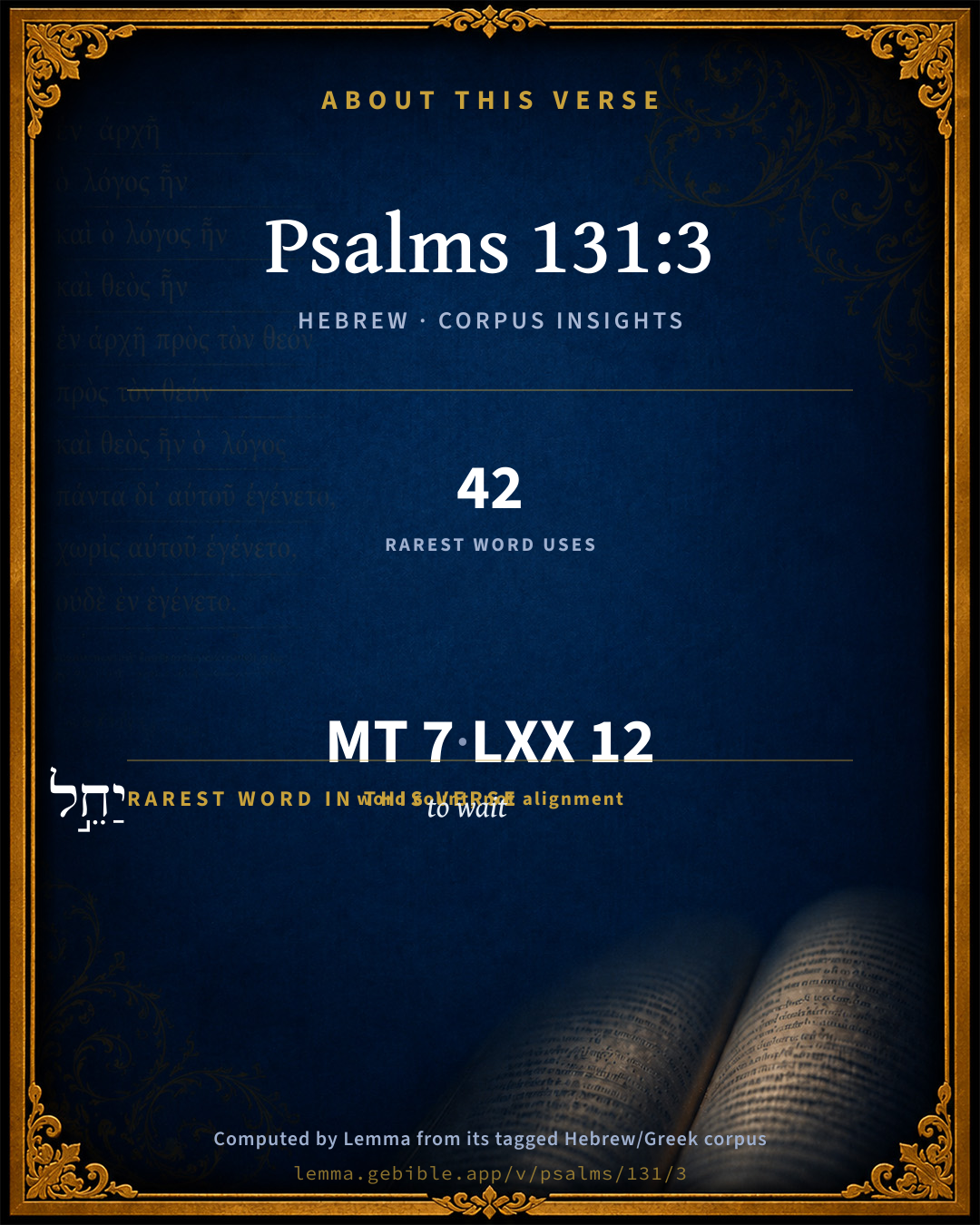
יַחֵ֣ל to wait H3176 occurs in 41 verses of the Hebrew Bible. Also found in:

Grammatical profile

  • 1 verb
  • 3 nouns
  • 2 prepositions
  • 1 adverb

Verb forms

  • יַחֵ֣ל Piel · Imperative

Hebrew & Septuagint length

In English translation the verse runs 10 words from the Hebrew and 11 from the Septuagint (LXX English) — closely comparable.

A rough comparison of the two English renderings, which tokenize alike — not a word-level alignment.

Word counts can differ between the Hebrew and the Greek without any difference in meaning — e.g. the Hebrew direct-object marker אֵת has no separate Greek word, and Greek often adds the article ὁ.

In the original languages it is 7 Hebrew tokens and 12 Greek tokens — but the two are counted differently (Hebrew bundles its prefixes and suffixes into one token; the Greek is in lemma form), so that isn’t a like-for-like length.

Cross-references

6

Topical passages linked to Psalms 131:3 in the Treasury of Scripture Knowledge — connected by theme and wording, ordered by reader-vote popularity; previews shown in the World English Bible.

  • Psalms 130:7 Israel, hope in Yahweh, For with Yahweh there is loving kindness. With him is abundant redemption.
  • Isaiah 26:4 Trust in Yahweh forever; for in Yah, Yahweh, is an everlasting Rock.
  • Psalms 146:5 Happy is he who has the God of Jacob for his help, Whose hope is in Yahweh, his God:
  • Jeremiah 17:7–8 Blessed is the man who trusts in Yahweh, and whose trust Yahweh is.
  • Psalms 115:9–11 Israel, trust in Yahweh! He is their help and their shield.
  • Psalms 115:18 But we will bless Yah, From this time forth and forevermore. Praise Yah!

Cross-references courtesy of OpenBible.info (CC BY 4.0).

Hebrew and Greek witnesses Masoretic Hebrew ↔ Greek Septuagint

The same verse in the two great witnesses to the Old Testament, shown verse-for-verse.

You’re reading Greek Psalm 130 (Hebrew Psalm 131). The Septuagint counts the superscription, so verse numbers can differ from the Hebrew — chapter-level alignment, not verse-by-verse. Numbering follows Rahlfs.

These are two independent witnesses, not word-aligned to each other, and the Septuagint is shown in lemma (dictionary) form.

Hebrew Psalms 131:3 Masoretic · Westminster Leningrad Codex

יַחֵ֣ל יִ֭שְׂרָאֵל אֶל יְהוָ֑ה מֵֽ֝עַתָּ֗ה וְעַד עוֹלָֽם

Israel, hope in Yahweh, From this time forth and forevermore.

World English Bible · Public Domain

Greek LXX Greek Psalm 130:3 Septuagint · lemma form

ἐλπίζω ἰσραήλ ἐπί ὁ κύριος ἀπό ὁ νῦν καί ἕως ὁ αἰών

Let Israel hope in the Lord, from henceforth and for ever.

LXX2012 (modern English Septuagint) · Public Domain

Hebrew: Westminster Leningrad Codex (CC BY 4.0). Greek: Septuagint (public domain); English from LXX2012 (modern English Septuagint) (Public Domain). How the Septuagint differs from the Hebrew →

Commentary

Notes on Psalms 131:3 from classic Christian and Jewish commentators (each source and its license shown beneath its notes). The classic Christian expositions comment on the surrounding passage and are grouped to its opening verse, so a note may address several verses; the Jewish commentaries on the Tanakh (Rashi and others) are per-verse, so they appear only where the commentator wrote on this verse.

Lemma curates 59 commentaries, every one of them public domain or Creative Commons licensed, each selected and text-cleaned for this edition rather than reprinted as found. About our sources →

Trapp's Complete Commentary

John Trapp

Psa 131:3 Let Israel hope in the LORD from henceforth and for ever.

Ver. 3. Let Israel hope] See Psa 130:7.

John Trapp, A Commentary or Exposition upon All the Books of the Old and New Testament (1647–1656) — public domain. Text from a community e-Sword module.

The Biblical Illustrator

Joseph S. Exell

Psa_131:3

Let Israel hope in the Lord.

Hope in the Lord

Humility is the root of hope. Hope is the blossom of meekness. As these graces of the true child develop themselves in the heart of a man, he cherishes the Divine, the sublime conviction that it is God the Spirit who is working within him, both to will and to do.

I. A large portion of experimental religion, and of the Divine life within a man, may be considered under the form of hope. Religious experience is a strong and well-grounded expectation that the promises which God has made to us will not be broken. Such expectation will triumph over the delusion of our senses, over the bitter accusations of our consciences, and the apparently stern decrees of Gods providence. We are saved by hope. A young Christian begins by hoping for salvation, and the earnest worker hopes for his reward. Gods servant bears his precious seed and casts it into the furrows, but he could not do so without the hope. All the strongest intuitions of faith are of the nature of hope. We are prisoners of hope so long as we are pent up in this durance vile of flesh and death. The essence of faith is to turn to the stronghold, and look for the changeless life beyond the reach of our present turmoil, temptations, and disappointment.

II. There are certain characteristics of hope expressed in this psalm which we can at once transfer to our own experience.

1. It is a Divine hope, hope in the Lord; hope thou in God; truly my soul waiteth upon God. The confidence of Israel in their own destiny and deliverance sprang not from their strange history, not from their own mental power, not from their value in their own esteem, not from their deserts, but from the Lord Jehovah. The root of their being was the eternal, ever-living, holy, faithful, covenant-keeping God. He could not be untrue, and He had promised.

2. It is a diffusive hope. The hope of the psalmist was strong enough to quicken the hope of all around him: he sang, Let Israel hope in the Lord. A Christians hope should be so thorough and earnest, and rational and life-giving, that he should be able to say by his very look, I hope in the Lord, why should not you? and should thus move like incarnate sunshine through this dark world, the messenger of peace to ,broken spirits, the conqueror of death to the death-doomed, the minister of joy and gladness.

3. It is a practical hope. This characteristic is to be gathered out of the words from henceforth. It takes its start from the actual circumstances in which we are placed. Some one exclaims, May I not wait until I have received some clearer evidence of the love of God? May I not wait until this mystery of His providence shall be solved? May I not wait until I see whether the promises of God are more decidedly vindicated? No! take the hint of my text, and in the hour of your deepest depression hope in the Lord from henceforth.

4. It is an eternal hope. From henceforth, even for ever, is the watchword of our psalm. Our hope should and must take the long for ever in. It has to do with unchanging realities, with an everlasting salvation; it looks forward to unseen things; it anticipates the ultimate fulfilment and accomplishment of all things that have been spoken by holy prophets since the world began. (H. R. Reynolds, D. D.)

Confidence in God

1. His nature invites our confidence. Boundless in love, He longs intensely to do us good. Infinite in knowledge, He is acquainted with every aspiration of our heart. Unsearchable in wisdom, it is easy for Him to form the best plans for accomplishing His purposes. Omnipotent in power, all agencies are at His disposal, and none can stay His hand from working.

2. His deeds also invite our confidence. They furnish the most instructive commentary on His character. He has uniformly manifested Himself as a God who delights in mercy: He has never failed to succour those who hoped in Him. (N. McMichael.)

Hope evermore

Tennyson sings of the mighty hopes which makes us men. Have you ever thought of the worst loss which can come to a man? Loss of property? That is a sad loss, but not the worst. Loss of friends? That is a sad loss, but not the worst. Loss of opportunity? Nor is that the worst of losses. Loss of hope, when the heart dies, and the courage fails, and the hands hang listlessly, and a man begins only and sadly to drudge--this, the loss of hope, is the blackest loss. Ive just got back from Washington, where Ive been since the election, trying to get an appointment, said a politician. Gave up hope, eh? said a sympathizing friend. Oh no, was the quick reply. I came home to hope. Its cheaper to hope here. I like that: hope any way. Get, if you must, the cheapest place to hope, but hope! (W. Hoyt, D. D.)

.

Psa_132:1-18

The Biblical Illustrator, edited by Joseph S. Exell (c. 1880s–1900s) — public domain. Text from a community e-Sword module.

J. A. Alexander on Psalms

Joseph Addison Alexander

3. (Psa 131:3) Hope thou, Israel, in Jehovah from now even to eternity. This is the opposite of the feeling disavowed in the preceding verses. From the first clause that of Psa 130:7 was no doubt borrowed by the later writer, who prefixed that psalm to the one before us. With the last clause compare Psa 121:8.

Joseph Addison Alexander, The Psalms Translated and Explained (1850) — public domain. Text from a community e-Sword module.

Adam Clarke's Commentary

Verse 3. Let Israel hope in the Lord] Act all as I have done; trust in him who is the God of justice and compassion; and, after you have suffered awhile, he will make bare his arm and deliver you. Short as it is, this is a most instructive Psalm. He who acts as the psalmist did, is never likely to come to mischief, or do any to others.

ANALYSIS OF THE HUNDRED AND THIRTY-FIRST PSALM

I. The psalmist, having been accused of proud and haughty conduct, protests his innocence, states his humble thoughts of himself, and the general meekness of his deportment.

II. That his confidence was in God; in him he trusted, and therefore was far from ambition.

III. And by his own example calls on Israel to trust in God as he did.

I. He protests his humility.

1. There was no pride in his heart; and he calls God to witness it: "Lord, my heart is not haughty."

2. There was no arrogance in his carriage: "Nor mine eyes lofty."

3. Nor in his undertakings: "Neither do I exercise myself in great matters." He kept himself within his own bounds and vocation, and meddled not with state affairs.

II. What preserved him from pride was humility. He brought down his desires, and wants, and views to his circumstances.

1. "Surely I have behaved and quieted myself." Have I not given every evidence of my mild and peaceable behaviour? and I certainly never permitted a high thought to rise within me.

2. I acted as the child weaned from his mother. When once deprived of my comforts, and brought into captivity, I submitted to the will of God, and brought down my mind to my circumstances.

III. He proposes his own example of humility and peaceableness for all Israel to follow.

I. "Let Israel hope." Never despair of God's mercy, nor of his gracious providence. The storm will be succeeded by fair and fine weather.

2. "Let Israel hope in the Lord." Never content yourselves with merely supposing that in the course of things these afflictions will wear out. No; look to God, and depend on him, that he may bring them to a happy conclusion.

Remember that he is Jehovah.

1. Wise to plan.

2. Good to purpose.

3. Strong to execute, and will withhold no good thing from them that walk uprightly.

4. Trust from henceforth. If you have not begun before, begin now.

5. And do not be weary; trust for ever. Your case can never be out of the reach of God's power and mercy.

Adam Clarke's Commentary on the Bible (1810–1826) — public domain. Text from a community e-Sword/MySword module.

The Cambridge Bible for Schools and Colleges

gen. ed. J. J. S. Perowne

3. Hope, Israel, in Jehovah,

From this time forth and for evermore.

In this spirit of resignation and contentment let Israel patiently wait for the development of God’s purposes. Cp. Psa_130:7.

The Cambridge Bible for Schools and Colleges (gen. ed. J. J. S. Perowne; Cambridge University Press, 1878–1918) — public domain. Text from a community e-Sword module.

John Gill's Exposition

Let Israel hope in the Lord from henceforth and for ever. What he did himself, and found it good for him to do, that he knew was good for others, and therefore exhorts and encourages to it, to hope in the Lord and wait for his salvation; and which should be done constantly, and to the end of life, or till the thing hoped for is enjoyed; see Heb 3:6. Perhaps some respect is here had to the people of Israel, especially the friends of David, who were weary of Saul's government, and impatient to have David on the throne; whom he advises to wait patiently, and not take any indirect steps to bring it about, but leave it with God, and hope and trust in him; compare with this Sa1 24:7; See Gill on Psa 130:7.

Next: Psalms Chapter 132

John Gill's Exposition of the Whole Bible (1746–1763) — public domain (CC PDM 1.0). Text via the HelloAO Bible API.

Albert Barnes' Notes on the Bible

Let Israel hope in the Lord ... - The connection would seem to require us to understand this as the assertion of him who had been accused of thoughts which seemed to be too lofty. As the result of all his reflections (of those reflections for which he was rebuked and charged with pride, but which were really conceived in a modest spirit) - as expressing what he saw that seemed to be in advance of what others saw, or to indicate a habit of thought beyond his years - he says that there were reasons why Israel should hope in the Lord; that there was a foundation for confident trust; that there was that in the divine character which was a just ground of reliance; that there was that in the course of events - in the tendencies of things - which made it proper for the people of God, for the church, to hope, to confide, to feel assured of its ultimate and permanent safety. This would indicate the nature of the suggestions which he had expressed, and which had exposed him to the charge of arrogance; and it would also indicate a ripe and mature habit of thinking, beyond what might be expected from one in very early life. All this was, probably, applicable to David in his early years, as to the reflections which might have foreshadowed what he would be in future; this was eminently applicable to David’s Descendant - greater than he - who, at twelve years of age, astonished the Hebrew doctors in the temple with “his understanding and answers” Luk 2:47; this gives a beautiful view of modesty joined with uncommon gifts in early life; this shows what is always the nature of true religion - as producing modesty, and as prompting to hope.

Albert Barnes' Notes on the Bible (1834–1885) — public domain. Text from a community e-Sword/MySword module.

Matthew Poole's English Annotations

Let all Israelites learn by my example to commit themselves to God in well-doing, and to fix all their hope and trust upon him alone.

Matthew Poole's English Annotations on the Holy Bible (1683–1685) — public domain. Text from a community e-Sword/MySword module.

The Treasury of David

Charles H. Spurgeon

Ver. 3. Let Israel hope in the LORD from henceforth and for ever. See how lovingly a man who is weaned from self thinks of others! David thinks of his people, and loses himself in his care for Israel. How he prizes the grace of hope! He has given up the things which are seen, and therefore he values the treasures which are not seen except by the eyes of hope. There is room for the largest hope when self is gone, ground for eternal hope when transient things no longer hold the mastery of our spirits. This verse is the lesson of experience: a man of God who had been taught to renounce the world and live upon the Lord alone, here exhorts all his friends and companions to do the same. He found it a blessed thing to live by hope, and therefore he would have all his kinsmen do the same. Let all the nation hope, let all their hope be in Jehovah, let them at once begin hoping "from henceforth", and let them continue hoping "for ever." Weaning takes the child out of a temporary condition into a state in which he will continue for the rest of his life: to rise above the world is to enter upon a heavenly existence which can never end. When we cease to hanker for the world we begin hoping in the Lord. O Lord, as a parent weans a child, so do thou wean me, and then shall I fix all my hope on thee alone.

Ver. 3. Let Israel hope in the LORD. After the example, therefore, of the King of Israel, who thus demeaned himself in his afflictions, lowly, contented, and resigned, casting all his care upon the Father who cared for him, and patiently waiting his time for deliverance and salvation; after this their example and pattern, let his faithful people hope and trust, not in themselves, their wisdom, or their power, but in Jehovah alone, who will not fail to exalt them, as he hath already exalted their Redeemer, if they do but follow his steps. George Horne.

Ver. 3. Let Israel hope in the LORD. Though David could himself wait patiently and quietly for tile crown designed him, yet perhaps Israel, the people whose darling he was, would be ready to attempt something in favour of him before the time; he therefore endeavours to quiet them too, and bids them, "hope in the LORD" that they should see a happy change of the face of affairs in due time. Thus "it is good to hope, and quietly to wait for the salvation of the Lord." Matthew Henry.

Ver. 3. Let Israel hope in the LORD. etc. Remember that he is Jehovah. 1. Wise to plan. 2. Good to purpose. 3. Strong to execute, and that he will withhold no good thing from them that walk uprightly.

4. Trust "from henceforth." If you have not begun before, begin now. 5. And do not be weary; trust "for ever." Your case can never be out of the reach of God's power and mercy. Adam Clarke.

Ver. 3.

1. The encouragement to hope in God.

a) As a covenant God, "the God of Israel."

b) As a covenant keeping God: "From henceforth", etc.

2. The effect of this hope.

a) The humility and dependence in the first verse.

b) The contentment and weaning in the second verse. Would Israel be thus humble and obedient as a little child? "Let Israel hope", etc. G. R.

Ver. 3. The Voice of Hope heard in the Calm.

1. Calmed souls appreciate God. Quiet favours contemplation. God's majesty, perfection, and praise so discovered.

2. Calmed souls confide in God; seen to be so worthy of trust.

3. Calmed souls look fearlessly into eternity; "from henceforth and for ever." W. B. H.

Ver. 3. Hope on, hope ever.

1. For the past warrants such confidence.

2. For the present demands such confidence.

3. For the future will justify confidence. W. H. J. P.

"Several five Sermons Upon Psalm 131", in the Works of Manton, D.D. Vol. 5., folio, pp. 961-1007; they may also be found in 21. pp. 406-462 of the new edition of Manton's Works, published by Nisbet and Co., 1874.

Charles H. Spurgeon's The Treasury of David (1869–1885) — public domain. Psalms only. Text from a community e-Sword/MySword module.

Whedon's Commentary on the Bible

Daniel D. Whedon

3. Let Israel hope in the Lord—Same as Psa_130:7, which is copied from this. Israel, no less than the psalmist, had been chastened and weaned. The discipline was effective, and should reassure the national hope in Jehovah.

Daniel D. Whedon (gen. ed.), Commentary on the Old and New Testaments (1874–1909) — public domain. Text from a community e-Sword module.

The Pulpit Commentary

Let Israel hope in the Lord from henceforth and forever. (comp. Psa_130:7) Israel is exhorted to have like confidence and trust in God as the psalmist.

Man"s personal experience may be the basis of his hope in God.

"Let Israel hope in the Lord;" let him, because he has such abundant reason for so doing, in the experience that he has had of the Lord"s gracious working. This is the refrain of several of these "songs of degrees," which, we have seen, are essentially "songs of uplifting," or calls to put trust and hope in God.

I MAN"S PERSONAL EXPERIENCE IS SELDOM, IF EVER, PRECISELY REPEATED. Froude suggests that experience is like the stern-lights of a ship, which show the way that has been taken. And he hints that experience is of practically little use for the guidance of the way that has to be taken. But this is a very partial view. It would not culture a man in the dependence and trust, which are the key-notes of his nobility, if his life were a mere succession of precise repetitions, so that he might know precisely how to act in each recurring case, and the lessons of experience were a mere routine; a fixed measure to be applied to every instance. Life with emergencies and surprises is alone a healthy life for a moral being in whom character is to be trained. It was a misanthrope who said, "The thing which hath been is, and there is nothing new under the sun." And every man will be prepared to say, on looking over his life, that nothing ever happened in his life which was a precisely imitative experience; nothing that proved to be exactly what he expected it to be. Then it may be hastily said that experience is a delusion, and cannot really help us. What we have to see is that it cannot, and never was intended to, help us as a yard-measure does. How, then, does it help?

II MAN"S PERSONAL EXPERIENCE ESTABLISHES PRINCIPLES AND BRINGS KNOWLEDGE OF WHICH MAN CAN MAKE PRACTICAL USE. Israel restored from exile had a new set of experiences, but his knowledge of God"s adaptations of grace to all previous experiences established confidence in him. It was easy to argue that God, having made adjustments to their need in forty-nine cases, was not likely to be baffled by the fiftieth. And we can always get that persuasion out of a life-experience. And we can plainly see the force of this principle all human experiences, though apparently unlike each other, go into classes. We can always find something in past experience which belongs to the same class as our present experience; and then, if we can fully apprehend the Divine intervention in some case that belongs to the class, we can confidently say to our soul, "Soul, hope thou still in God. R.T.

The Pulpit Commentary (1880–1919), ed. H.D.M. Spence-Jones & Joseph S. Exell — public domain. Text from a community e-Sword module.

Lesson kit

Teaching starters — assembled from the data on this page, not authored interpretation. Every prompt links to the verse data it draws on. Edit before teaching.

Psalms, in the Wisdom, opens this verse with 7 words (7 distinct Hebrew lemmas). Its most distinctive word is yâchal (“to wait”). A historical commentator’s framing appears above. Read the whole chapter for the surrounding context.

Discussion questions

  1. How does “to wait” (yâchal) shape what this verse is saying?
  2. Genesis 8:12 shares the word «to wait» with this verse. How do the two illuminate each other?
  3. These translations render this verse differently. What is at stake in choosing one wording over another?
  4. The verb «יַחֵ֣ל» is Piel Imperative. How does its form color the action?
  5. Reading how Trapp's Complete Commentary and The Biblical Illustrator read this verse, where do the two commentators agree and where do they part?

Things to notice

Reading settings

Reading text

Shown beneath each verse's original-language words.

Old Testament
Old Testament edition

Read the OT as the Masoretic Hebrew (MT) or the Greek Septuagint (LXX).

English shown for the Greek Septuagint (in the Hebrew ↔ Greek comparison).

Comparing translations? Open the Compare panel on any verse page to stack up to four side by side.