
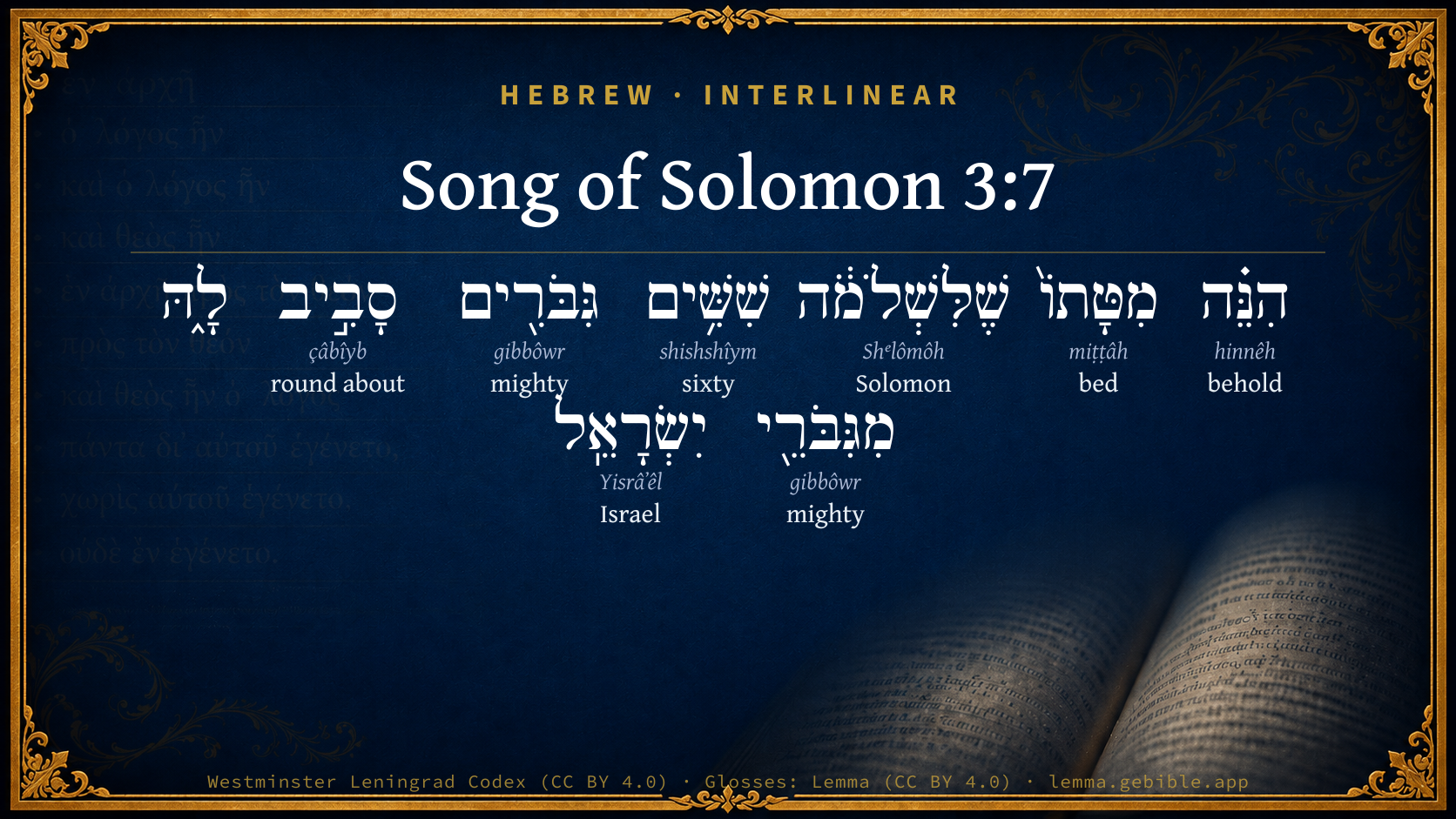
Song of Solomon 3:7

Hebrew (Westminster Leningrad Codex) Song of Solomon 3:7 appears in the Hebrew Old Testament. The text above is from the Westminster Leningrad Codex. Each word links to its Strong’s number, a concise gloss, and parsing drawn from the Open Scriptures Hebrew Bible morphology. Click any word for its full Brown-Driver-Briggs (BDB) entry.
Download image
Cite this verse

Song of Solomon 3:7 (World English Bible). Public Domain. Lemma interlinear Bible study tool, https://lemma.gebible.app/v/song-of-solomon/3/7.

Show BibTeX & RIS
BibTeX
RIS
English Translation
Behold, it is Solomon's carriage! Sixty mighty men are around it, Of the mighty men of Israel.
World English Bible · Public Domain
Download a study sheet

One document with this verse’s original text, its word-by-word gloss line, the meaning frame, cross-references with their text, attributed commentary, and full source and license credits — printable, and it pastes into notes with its structure intact.

This verse Autodidact and up

Study sheet (.html) Plain text (.txt)

A passage Seminary Student

Up to 50 verses in one chapter. A passage sheet keeps up to 6 commentary sources and 12 cross-references per verse, in the order this page ranks them, and says so on the sheet whenever that leaves anything out. Ask for a single verse and you get the Autodidact verse sheet above.

Everything on this page stays free to read, with no account — the sheet is a download of what is already on screen, not access to it.

Want to remove ads? Support Godless Engineer
Compare translations 3

The same verse in 3 English versions, stacked beneath the original-language interlinear above. Click any original word for its lexicon entry.

Each is an independent rendering of the whole verse — the interlinear is not word-aligned to these translations.

Highlighted words mark where these versions differ — a whole-verse word diff, not a word-by-word alignment.

  • World English Bible Public Domain
    Behold, it is Solomon's carriage! Sixty mighty men are around it, Of the mighty men of Israel.
  • King James Version Public Domain
    Behold his bed, which is Solomon's; threescore valiant men are about it, of the valiant of Israel.
  • unfoldingWord Literal Text CC BY-SA 4.0
    Behold—his litter, which to Solomon; 60 warriors surround it, from the warriors of Israel.

unfoldingWord Literal Text — © unfoldingWord, licensed CC BY-SA 4.0. Word-aligned USFM3 via Door43 (git.door43.org/unfoldingWord/en_ult).

Versions to compare (up to 4)

3 of 4 selected

Show all 18 translations

Every available English version of this verse, each an independent rendering of the whole verse.

  • World English Bible Public Domain
    Behold, it is Solomon's carriage! Sixty mighty men are around it, Of the mighty men of Israel.
  • Berean Standard Bible Public Domain
    Behold, it is Solomon’s carriage, escorted by sixty of the mightiest men of Israel.
  • Majority Standard Bible Public Domain
    Behold, it is Solomon’s carriage, escorted by sixty of the mightiest men of Israel.
  • King James Version Public Domain
    Behold his bed, which is Solomon's; threescore valiant men are about it, of the valiant of Israel.
  • American Standard Version (1901) Public Domain
    Behold, it is the litter of Solomon; Threescore mighty men are about it, Of the mighty men of Israel.
  • Revised Version (1885) Public Domain
    Behold, it is the litter of Solomon; threescore mighty men are about it, of the mighty men of Israel.
  • Geneva Bible (1599) Public Domain
    Beholde his bed, which is Salomons: threescore strong men are round about it, of the valiant men of Israel.
  • Douay-Rheims (1899) Public Domain
    Behold threescore valiant ones of the most valiant of Israel, surrounded the bed of Solomon?
  • Young's Literal Translation Public Domain
    Lo, his couch, that `is' Solomon's, Sixty mighty ones `are' around it, Of the mighty of Israel,
  • Literal Standard Version CC BY-SA 4.0
    Behold, his couch, that [is] of Solomon, || Sixty mighty ones [are] around it, || Of the mighty of Israel,
  • Unlocked Literal Bible CC BY-SA 4.0
    Look, it is the bed of Solomon; sixty warriors surround it, sixty soldiers of Israel.
  • unfoldingWord Literal Text CC BY-SA 4.0
    Behold—his litter, which to Solomon; 60 warriors surround it, from the warriors of Israel.
  • Darby Bible Public Domain
    Behold his couch, Solomon's own: Threescore mighty men are about it, Of the mighty of Israel.
  • World Messianic Bible Public Domain
    Behold, it is Solomon’s carriage! Sixty mighty men are around it, of the mighty men of Israel.
  • Webster's Bible Public Domain
    Behold his bed, which is Solomon's; sixty valiant men are about it, of the valiant of Israel.
  • Free Bible Version CC BY-SA 4.0
    Look, it's Solomon's sedan chair, accompanied by sixty of Israel's best warriors.
  • Bible in Basic English Public Domain
    See, it is the bed of Solomon; sixty men of war are about it, of the army of Israel,
  • JPS Tanakh (1917) Public Domain
    Behold, it is the litter of Solomon; threescore mighty men are about it, of the mighty men of Israel.

Literal Standard Version (2020), Covenant Press — licensed CC BY-SA 4.0. Text via the HelloAO Bible API (eBible.org). Unlocked Literal Bible (unfoldingWord) — licensed CC BY-SA 4.0. Text via the HelloAO Bible API (eBible.org). unfoldingWord Literal Text — © unfoldingWord, licensed CC BY-SA 4.0. Word-aligned USFM3 via Door43 (git.door43.org/unfoldingWord/en_ult). Free Bible Version, Dr. Jonathan Gallagher — licensed CC BY-SA 4.0. Text via the HelloAO Bible API (eBible.org).

Word by word

More ways to search: Search by grammar → Find every occurrence → Compare this word →

Practice this passage: Drill this verse → Learn its vocabulary →

About this verse

These counts appear in no published source. They are computed here, from the morphology-tagged text and Lemma’s own curated glosses. What Lemma adds →

9
words
7
distinct lemmas
Wisdom
section

Shared distinctive vocabulary

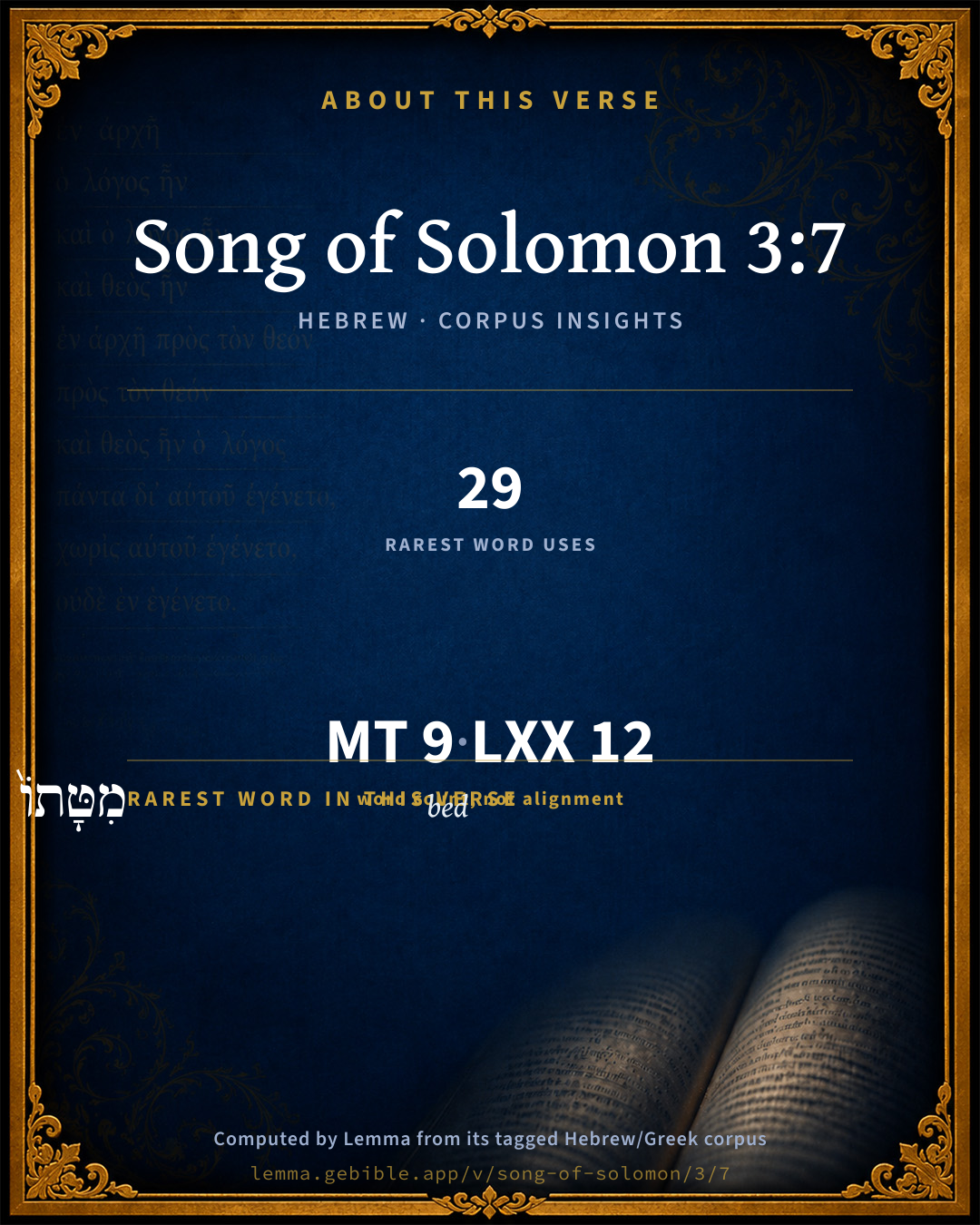
מִטָּתוֹ֙ bed H4296 occurs in 29 verses of the Hebrew Bible. Also found in:

Grammatical profile

  • 4 nouns
  • 3 adjectives
  • 1 preposition
  • 1 particle

Repetition

A word recurs within this verse — often emphatic in Hebrew:

  • גִּבֹּרִ֖ים mighty H1368 ×2

Hebrew & Septuagint length

In English translation the verse runs 17 words from the Hebrew and 16 from the Septuagint (LXX English) — closely comparable.

A rough comparison of the two English renderings, which tokenize alike — not a word-level alignment.

Word counts can differ between the Hebrew and the Greek without any difference in meaning — e.g. the Hebrew direct-object marker אֵת has no separate Greek word, and Greek often adds the article ὁ.

In the original languages it is 9 Hebrew tokens and 12 Greek tokens — but the two are counted differently (Hebrew bundles its prefixes and suffixes into one token; the Greek is in lemma form), so that isn’t a like-for-like length.

Cross-references

9

Topical passages linked to Song of Solomon 3:7 in the Treasury of Scripture Knowledge — connected by theme and wording, ordered by reader-vote popularity; previews shown in the World English Bible.

  • 1 Samuel 8:16 He will take your men-servants, and your maid-servants, and your best young men, and your donkeys, and put them to his work.
  • 1 Samuel 14:52 There was sore war against the Philistines all the days of Saul: and when Saul saw any mighty man, or any valiant man, he took him to him.
  • 1 Samuel 28:2 David said to Achish, Therefore you shall know what your servant will do. Achish said to David, Therefore will I make you keeper of my head for ever.
  • 1 Kings 9:22 But of the children of Israel did Solomon make no bondservants; but they were the men of war, and his servants, and his princes, and his captains, and rulers of his chariots and of his horsemen.
  • 1 Kings 14:27 King Rehoboam made in their place shields of brass, and committed them to the hands of the captains of the guard, who kept the door of the king's house.
  • 2 Kings 6:17 Elisha prayed, and said, Yahweh, Please open his eyes, that he may see. Yahweh opened the eyes of the young man; and he saw: and, behold, the mountain was full of horses and chariots of fire round about Elisha.
  • Song of Solomon 1:16 Behold, you are beautiful, my beloved, yes, pleasant; And our couch is verdant. Lover
  • Song of Solomon 3:9 King Solomon made himself a carriage Of the wood of Lebanon.
  • Hebrews 1:14 Aren't they all ministering spirits, sent out to do service for the sake of those who will inherit salvation?

Cross-references courtesy of OpenBible.info (CC BY 4.0).

Hebrew and Greek witnesses Masoretic Hebrew ↔ Greek Septuagint

The same verse in the two great witnesses to the Old Testament, shown verse-for-verse.

These are two independent witnesses, not word-aligned to each other, and the Septuagint is shown in lemma (dictionary) form.

Hebrew Song of Solomon 3:7 Masoretic · Westminster Leningrad Codex

הִנֵּ֗ה מִטָּתוֹ֙ שֶׁלִּשְׁלֹמֹ֔ה שִׁשִּׁ֥ים גִּבֹּרִ֖ים סָבִ֣יב לָ֑הּ מִגִּבֹּרֵ֖י יִשְׂרָאֵֽל

Behold, it is Solomon's carriage! Sixty mighty men are around it, Of the mighty men of Israel.

World English Bible · Public Domain

Greek LXX Song of Solomon 3:7 Septuagint · lemma form

ἰδού ὁ κλίνη ὁ σαλωμών ἑξήκοντα δυνατός κύκλος αὐτός ἀπό δυνατός ἰσραήλ

Behold Solomon's bed; sixty mighty men of the mighty ones of Israel are round about it.

LXX2012 (modern English Septuagint) · Public Domain

Hebrew: Westminster Leningrad Codex (CC BY 4.0). Greek: Septuagint (public domain); English from LXX2012 (modern English Septuagint) (Public Domain). How the Septuagint differs from the Hebrew →

Commentary

Notes on Song of Solomon 3:7 from classic Christian and Jewish commentators (each source and its license shown beneath its notes). The classic Christian expositions comment on the surrounding passage and are grouped to its opening verse, so a note may address several verses; the Jewish commentaries on the Tanakh (Rashi and others) are per-verse, so they appear only where the commentator wrote on this verse.

Lemma curates 59 commentaries, every one of them public domain or Creative Commons licensed, each selected and text-cleaned for this edition rather than reprinted as found. About our sources →

Trapp's Complete Commentary

John Trapp

Son 3:7 Behold his bed, which [is] Solomon’s; threescore valiant men [are] about it, of the valiant of Israel.

Ver. 7. Behold his bed, which is Solomon’s, &c.] Or, Behold the bed of Solomon, as the Greek, explaining the Hebrew, hath it. Solomon was a famous figure of Christ; of his bed we read nothing, but may well conceive it was, as everything else about him, stately and costly, and thereby is meant here heaven, say some, whither the Church is brought in ascending in the preceding verse, and by the valiant warders they understand the angels, those mighties. {Psa 103:20} But because they are said to be "valiant men of Israel," I rather assent to those that think the godly ministers are here meant by the "mighties," and the Church by Christ’s "bed," where he reposeth and "resteth in his love," {Zep 3:17} lodging "between her breasts." {Son 1:13} There is nothing more sure than that the blessed angels do watch over the Church. {Heb 1:14} What a guard by them had Jacob at Mehanaim, {Gen 32:1-2} where they made a lane for him, as the word imports, to provide for his safety! The like we may say of Elisha at Dothan, and various others. I doubt not, saith one, but as the angels waited at Christ’s sepulchre, so for his sake they watch also over our graves, called our beds. {Isa 57:2} Howbeit here understand we it of the ministers of the word that "watch for men’s souls," and are frequently called watchmen. Sixty of them they are said to be, because a great number, as the Levites were scattered up and down the tribes of Israel, as salt is strawed thick upon flesh to keep it from putrifying. Ye are the salt of the earth {Mat 5:13-16} And "valiant" they are said to be, for valour and courage invincible is necessary to a minister who shall be sure to be put hard to it, and therefore had need to be, as Athanasius was, an adamant for his resolute stout carriage, and to partake with the diamond in the high priest’s breastplate for hardness and hardiness in standing to and for the truth. Israelites also they ought to be Jews inwardly, not scoffing Ishmaelites, profane Edomites, false Philistines, but the valiants of Israel, such as David’s band of worthies was; {1Ch 11:10-47; 1Ch 12:1-37} faithful and godly patterns of piety such as will "take heed to themselves and to the flock," waiting upon the Lord’s work and "watching for men’s souls as they that must give account," &c. {Heb 13:17} It is a great matter to be of Christ’s bodyguard. Remember what David said of Abner. {1Sa 26:15}

John Trapp, A Commentary or Exposition upon All the Books of the Old and New Testament (1647–1656) — public domain. Text from a community e-Sword module.

Joseph Benson's Commentary

Son 3:7-8. Behold — The bride-men continue their speech, and from the admiration of the bride, proceed to the admiration of the bridegroom: his bed — The bed seems to denote the church, which is comely through Christ’s beauty, and safe by his protection, in which Christ is glorified, and believers enjoy sweet fellowship with him. Solomon’s — Which is the bed, not of an ordinary man, but of a great king, whom Solomon typifies, and who is greater than Solomon. Threescore valiant men are about it — Very many, a certain number being put for an uncertain. He alludes to Solomon’s guard, whereby he designs all those creatures, whether angels, princes, ministers, or others, whose ministry God uses for the protection of his church. Every man hath his sword — Is prepared and ready to fight, to prevent those dangers which are frequent in the night season. The night may denote the whole time of this life, which may well be called night, in respect of that ignorance and error wherewith it is attended, (as the future life is compared to day,) this life being the only time wherein such a guard is necessary.

Joseph Benson's Commentary on the Old and New Testaments (1811–1818) — public domain. Text from a community e-Sword module.

Geneva Bible (1599)

Geneva Bible translators

By the bed is meant the Temple which Solomon made.

Geneva Bible (1599) marginal notes — public domain. Text via Bolls.life.

Adam Clarke's Commentary

Verse 7. Threescore valiant men] These were the guards about the pavilion of the bridegroom, who were placed there because of fear in the night. The security and state of the prince required such a guard as this, and the passage is to be literally understood.

Adam Clarke's Commentary on the Bible (1810–1826) — public domain. Text from a community e-Sword/MySword module.

Ellicott's Commentary for English Readers

(7) Bed.—Heb., mitta. Probably, from context, a litter.

A Bible Commentary for English Readers, edited by Charles John Ellicott (1878–1897) — public domain. Text from a community e-Sword module.

The Cambridge Bible for Schools and Colleges

gen. ed. J. J. S. Perowne

7. Behold his bed, which is Solomon’s] This is an answer to the question of the last verse, “Who or what is this which cometh up,” &c. It should be, Behold, it is Solomon’s palanquin, and it is spoken either by the same person who asks the question, or by another bystander. The word miṭṭâh, translated ‘bed’ by the A.V., has that meaning, but it is used also of couches at table, Est_1:6 (R.V.), of sofas, Amo_3:12, and of biers, 2Sa_3:31. Here it means a litter or palanquin. The A.V. rendering, his bed, which is Solomon’s, is simply a literal translation of a pleonastic way of expressing the genitive which is constant in Aramaic, and which may have been common in the popular speech of Northern Israel.

threescore valiant men are about it, of the valiant of Israel] Gibbôr, the word translated valiant man, is the intensive of geber = ‘a man,’ and denotes a strong, bold man, hence a hero in war. Solomon’s litter is surrounded by his bodyguard.

The Cambridge Bible for Schools and Colleges (gen. ed. J. J. S. Perowne; Cambridge University Press, 1878–1918) — public domain. Text from a community e-Sword module.

Haydock's Catholic Bible Commentary

Bed. Being stationed at the door to prevent any alarm, v. 8. (Calmet) --- In the Church Christ finds his repose, and daily produces the only heirs of heaven. (Ven. Bede) --- The angels, saints and pastors watch to defend it against the spirits of darkness. (Menochius)

George Leo Haydock (1774–1849), Haydock's Catholic Family Bible and Commentary, 1859 edition — public domain. Excludes Psalms (Douay-Rheims chapter numbering differs from Protestant) and Deuterocanonical books (Catholic canon only).

Matthew Poole's English Annotations

Behold his bed: these are the words either,

1. Of the bridemen, who spake Son 3:6, and here continue their speech, and from the admiration of the bride proceed to the admiration of the Bridegroom. Or,

2. Of the spouse, who being admired by the bridemen, turns their eyes and thoughts to the Bridegroom, and directs them to the study of his excellencies, and intimates that all her comfort and safety is from him. The bed, the place of rest and conjugal converse, seems to denote the church, which is comely through Christ’s beauty, and safe by his protection, in which Christ is glorified, and believers enjoy sweet fellowship with him, both here in the church militant, and especially hereafter in the church triumphant.

Which is Solomon’s; which is the bed, not of an ordinary man, but of a great King, whom Solomon represents or typifies, and who is greater than Solomon. Nor is it hard to understand the Messias under the name of Solomon, his type and progenitor, seeing he is, upon the same reason, called David, Jer 30:9; Eze 34:23, and elsewhere, especially considering that this whole book is by the confession both of Jewish and Christian interpreters to be mystically understood.

Threescore, i.e. very many, the certain number being put for an uncertain, as is frequent.

The valiant of Israel; he alludes to Solomon’s guard, or watchmen, whereby he designs all those creatures, whether angels, princes, ministers, or others, whose ministry God useth for the protection of his church.

Matthew Poole's English Annotations on the Holy Bible (1683–1685) — public domain. Text from a community e-Sword/MySword module.

Whedon's Commentary on the Bible

Daniel D. Whedon

7. Behold… bed — Better, That is the palanquin of Solomon. A palanquin is a canopied couch used by men of rank for travelling. It is usually carried on men’s shoulders, is long enough for the person within to lie at full length, and, as it requires relays of bearers to accompany it, it is a more pretentious mode of conveyance than riding on horseback or even in a chariot. This verse is uttered by a second speaker from the throng of bystanders as a rejoinder to the first.

Daniel D. Whedon (gen. ed.), Commentary on the Old and New Testaments (1874–1909) — public domain. Text from a community e-Sword module.

The Pulpit Commentary

Behold, it is the litter of Solomon; three score mighty men are about it, of the mighty men of Israel. The litter, or palanquin, is easily recognized. The word is mittah, which is literally "bed," or "litter," but in the ninth verse we have another word, appiryon, which is a more stately word. "the royal car." It is the bringing home of the bride which is described. In the forty-fifth psalm the idea seems to be that the bridegroom betook himself to the house of the parents and fetched his bride, or that she was brought to him in festal procession, and he went forth to meet her. (see RAPC 1Ma 9:39) That was the prevailing custom, as we see in the parable of the ten virgins. (Mat_25:1-13) In this case, however, there is a vast difference in rank between the bride and bridegroom, and she is brought to him. The long journey through the wilderness is implied in the mention of the bodyguard. (cf. Isa_4:6 Isa_25:4) The intention evidently is to show how dear the bride was to Solomon. His mighty men were chosen to defend her. So the Church is surrounded with armies of guardian attendants. Her Lord is the Lord of hosts. The description reminds us of the exquisite lines in Shakespeare"s "Antony and Cleopatra," in which he describes the lovely Egyptian in her barge "like a burnished throne," lying "in her pavilion (cloth of gold, of tissue)," with the smiling cupids on each side, while "... from the barge, A strange invisible perfume hits the sense Of the adjacent wharfs. (Act 2, sc. 2)

The word mittah, "a bed, or litter," comes from a root "to stretch out," and is also used of a bier. (see 2Sa_3:21) The idea is that of a portable bed, or sitting cushion, hung round with curtains, after the manner of the Indian palanquin, such as is still found in the Turkish caiques or the Venetian gondolas. It was, of course, royal, belonging to Solomon, not to any nobleman or private person; hence its magnificence. The bearers are not named. The bodyguard, consisting of sixty chosen men, forming an escort, were one tenth part of the whole royal guard, as we see from 1Sa_27:2 1Sa_30:9. Delitzsch suggests that in the mention of the number there may be a reference to the twelve tribes of Israel 60 being a multiple of 12. The term, "mighty men," is explained in the next verse as warriors, that is, men "held fast by the sword" (brj yizijua), i.e., according to Hebrew idiom, men practised in the use of the sword; so it is explained by some; but others take it as meaning that they "handle the sword;" hence our Revised Version.

The Pulpit Commentary (1880–1919), ed. H.D.M. Spence-Jones & Joseph S. Exell — public domain. Text from a community e-Sword module.

John Wesley's Explanatory Notes

Behold - The bride-men continue their speech, and from the admiration of the bride, proceed to the admiration of the bridegroom. Bed - The bed seems to denote the church, which is comely through Christ's beauty, and safe by his protection, in which Christ is glorified, and believers enjoy sweet fellowship with him. Solomon's - Which is the bed, not of an ordinary man, but of a great king, whom Solomon typifies, and who is greater than Solomon. Threescore - Very many, the certain number being put for an uncertain. He alludes to Solomon's guard, whereby he designs all those creatures, whether angels, princes, ministers, or others, whose ministry God uses for the protection of his church.

John Wesley, Explanatory Notes Upon the Whole Bible (1754–1765) — public domain. Text via the GEBible commentary corpus.

Rashi

Rabbi Shlomo Yitzchaki (Rashi)

Behold the litter of Solomon the Tent of Meeting and the Ark, which they carried in the desert.

sixty mighty men are around it sixty myriad surround it.

of the mighty men of Israel of those who go out to the army, in addition to those under twenty [years of age] and those over sixty.

Rashi on the Tanakh — English translations: “The Judaica Press complete Tanach with Rashi, translated by A. J. Rosenberg” (CC BY 4.0); “Pentateuch with Rashi's commentary by M. Rosenbaum and A.M. Silbermann, 1929-1934” (public domain); “The Metsudah Tanach series, Lakewood, N.J” (CC BY 4.0); and “The Book of Joshua, Metsudah Publications, 1997” (CC BY 4.0). Text via Sefaria.

Lesson kit

Teaching starters — assembled from the data on this page, not authored interpretation. Every prompt links to the verse data it draws on. Edit before teaching.

Song of Solomon, in the Wisdom, opens this verse with 9 words (7 distinct Hebrew lemmas). Its most distinctive word is miṭṭâh (“bed”). A historical commentator’s framing appears above. Read the whole chapter for the surrounding context.

Discussion questions

  1. What does “bed” (miṭṭâh) contribute to the verse as a whole?
  2. How does Genesis 47:31, which shares the word «bed», read alongside this verse?
  3. What does the repetition of “mighty” (2× in this one verse) do in this verse?
  4. These translations render this verse differently; the difference is in the English rendering, not the original. What questions does that raise?
  5. Compare how Trapp's Complete Commentary and Joseph Benson's Commentary read this verse. Where do they agree or differ?

Things to notice

Reading settings

Reading text

Shown beneath each verse's original-language words.

Old Testament
Old Testament edition

Read the OT as the Masoretic Hebrew (MT) or the Greek Septuagint (LXX).

English shown for the Greek Septuagint (in the Hebrew ↔ Greek comparison).

Comparing translations? Open the Compare panel on any verse page to stack up to four side by side.