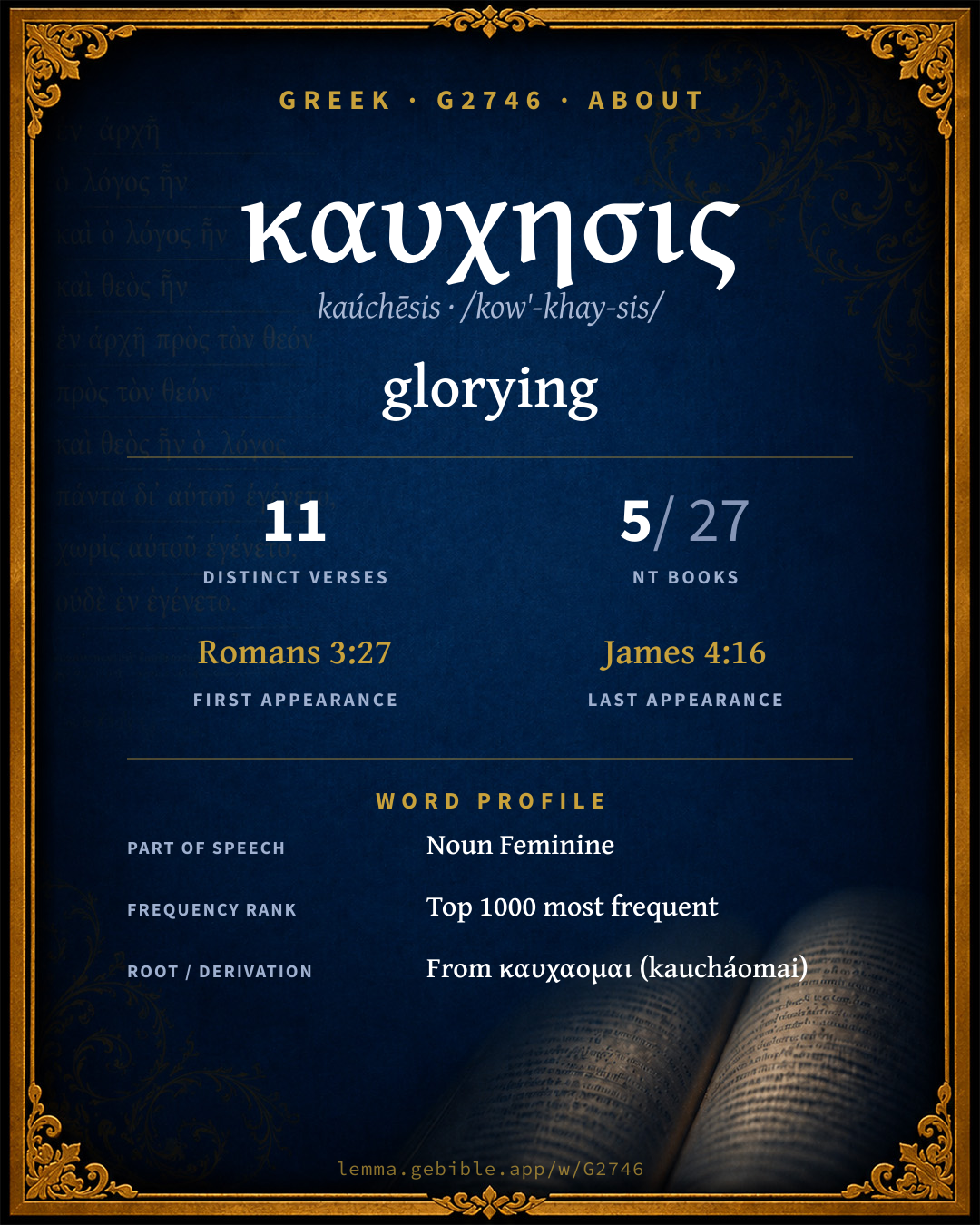
καύχησις
glorying
Full lexicon entry — Thayer's Greek Lexicon
From Thayer's Greek Lexicon
Where this word appears
See every Nominative-case word in the Greek New Testament →
Grammar key — what these labels mean
Part of speech
- Noun
- A naming word — a person, place, thing, or idea.
Case
- Nominative
- The case of the subject (and the predicate nominative).
- Genitive
- The case of source, possession, or “of” — answers “whose / from what.”
- Accusative
- The case of the direct object and of extent.
Gender
- Feminine
- Grammatically feminine.
Number
- Singular
- One.
Grammatical forms
- Noun, Nominative, Singular, Feminine 6 times (55%)
- Noun, Genitive, Singular, Feminine 3 times (27%)
- Noun, Accusative, Singular, Feminine 2 times (18%)
Parsed forms decoded from the imported morphology (Robinson–Tischendorf, public domain), counted across 11 parsed occurrences — not distinct verses.
Every verse where G2746 appears — 11 distinct verses across 5 books. Click any verse to open its interlinear word-by-word view. Verse text shown in the World English Bible for context — . Each verse’s Greek form is shown with its reference; the English is not keyword-highlighted, since the data carries no word-level English alignment. Use “Compare translations” on any verse to read it across multiple English versions. This concordance covers the Greek New Testament; Septuagint (Greek Old Testament) occurrences of this word are not indexed here.
Romans 2 verses
1 Corinthians 1 verse
2 Corinthians 6 verses
- 2 Corinthians 1:12 καύχησις n nom sg fem For our boasting is this: the testimony of our conscience, that in holiness and sincerity of God, not in fleshly wisdom but in the grace of God we behaved ourselves in the world, and more abundantly toward you.
- 2 Corinthians 7:4 καύχησις n nom sg fem Great is my boldness of speech toward you. Great is my boasting on your behalf. I am filled with comfort. I overflow with joy in all our affliction.
- 2 Corinthians 7:14 καύχησις n nom sg fem For if in anything I have boasted to him on your behalf, I was not disappointed. But as we spoke all things to you in truth, so our glorying also which I made before Titus was found to be truth.
- 2 Corinthians 8:24 καυχήσεως n gen sg fem Therefore show the proof of your love to them in front of the assemblies, and of our boasting on your behalf.
- 2 Corinthians 11:10 καύχησις n nom sg fem As the truth of Christ is in me, no one will stop me from this boasting in the regions of Achaia.
- 2 Corinthians 11:17 καυχήσεως n gen sg fem That which I speak, I don't speak according to the Lord, but as in foolishness, in this confidence of boasting.
1 Thessalonians 1 verse
James 1 verse
About this entry
At a glance — auto-summarized from this page’s data, not written by a person. Every figure links to its source below. This summary describes the numbers; it doesn’t interpret them.
“glorying” is the headline sense of the Greek noun καυχησις (kaúchēsis). More than half of its appearances fall in 2 Corinthians. It appears 11 verses across 5 books of the Greek New Testament, among its uncommon vocabulary. First canonically at Romans 3:27, it enters the text early. Related forms include καυχαομαι, καυχημα and στατηρ. See the sense tree, 11-verse concordance, and the renderings breakdown below.
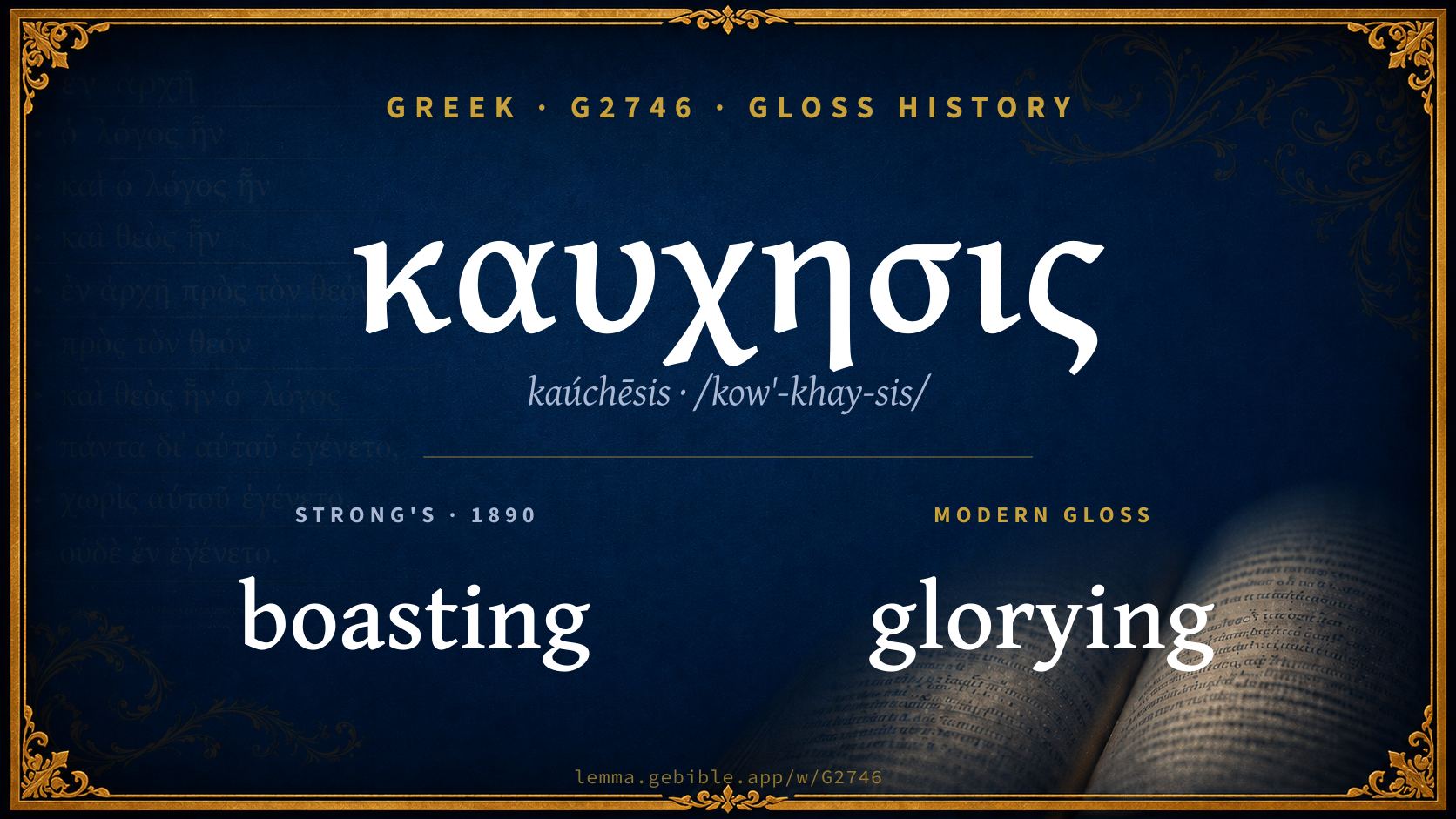
Gloss history
Strong's 1890 vs modern scholarship
About this word
Strong's G2746 catalogs a Greek word from the Greek New Testament.
These counts are not copied from any lexicon or concordance. They are computed here, from the morphology-tagged Greek New Testament. What Lemma adds →
- 11
- distinct verses
- The word appears in 11 distinct verses.
- 5 / 27
- NT books
- The word appears in 5 of 27 New Testament books.
- #978
- by frequency
- Top 1000 most frequent Greek words (rank 978 of 5,347 Greek words by occurrence).
View all 11 occurrences in the concordance →
Most concentrated in
- 2 Corinthians 6 verses 55%
- Romans 2 verses 18%
- 1 Corinthians 1 verse 9%
By section of the New Testament
By traditional corpus
Conventional, traditional groupings — biblical authorship is debated, so this is a traditional corpus grouping, not an authorship claim. Some books belong to more than one corpus (Luke is in both the Gospels and the Lukan corpus, and so on), so these shares overlap and need not total 100%. Each figure is a share of the word’s 11 distinct verses.
- Pauline corpus 10 verses · 91%
- General (Catholic) Epistles 1 verse · 9%
How translations render this word
Counts come from each version’s own published word-to-Strong’s tagging or interlinear alignment — an approximate guide to how each version renders this word, not a word-level alignment the data otherwise carries. Because each total is that version’s own tagged count, the per-version totals vary from one another and need not match the appearance or distinct-verse counts above. These counts may also differ from a printed concordance because Lemma counts each distinctly tagged rendering and does not collapse phrase taggings into a single head-word total. This is a fixed set of word-tagged versions (KJV, ASV, BSB, ULT) and does not change with the reading translation you choose elsewhere. Each version’s license is shown beside its name below (and on Sources).
- King James Version: Boasting 5×, Rejoicing 3×
- American Standard Version: Glorying 7×, Glorifying 3×, In 2×
- Berean Standard Bible: Boasting 6×
- unfoldingWord Literal Text: Boasting 10×
King James Version Public Domain
Renders G2746 across 11 tagged occurrences — most commonly:
Plus 3 renderings that appear only once — usually multi-word phrases or single function words the recovered tagging swept in, not distinct renderings. Not rendered by a distinct English word in 1 further occurrence.
American Standard Version Public Domain
Renders G2746 across 14 tagged occurrences — most commonly:
Plus 2 renderings that appear only once — usually multi-word phrases or single function words the recovered tagging swept in, not distinct renderings.
Berean Standard Bible Public Domain
Renders G2746 across 11 tagged occurrences — most commonly:
Plus 5 renderings that appear only once — usually multi-word phrases or single function words the recovered tagging swept in, not distinct renderings.
unfoldingWord Literal Text CC BY-SA 4.0
Renders G2746 across 12 tagged occurrences — most commonly:
Plus 2 renderings that appear only once — usually multi-word phrases or single function words the recovered tagging swept in, not distinct renderings.
Senses in Thayer's
The 1 sense Thayer's distinguishes for this word, in lexicon order (not ranked by frequency or importance). The full entry — with sub-senses — is in the Lexicon Entry tab.
- the act of glorying
Word origin
Derived from καυχαομαι (kaucháomai) (G2744) — to boast.
From G2744 ; boasting (properly the act; by implication the objective) in a good or a bad sense : - boasting whereof I may glory glorifying rejoicing.
— Strong’s Exhaustive Concordance (1890), public domain.
Forms in the corpus
The 3 distinct written forms G2746 takes in the Greek New Testament, most frequent first — each parse links to that case’s occurrences in the concordance.
| Form | Parsing | Example | Uses |
|---|---|---|---|
| καύχησις kaúchēsis | Noun, Nominative, Singular, Feminine | Romans 3:27 | 6 |
| καυχήσεως kauchḗseōs | Noun, Genitive, Singular, Feminine | 2 Corinthians 8:24 | 3 |
| καύχησιν kaúchēsin | Noun, Accusative, Singular, Feminine | Romans 15:17 | 2 |
Same root — word family
Other Thayer's entries built from the same root as G2746, grouped by Strong’s listed origin. These share a root / origin per the lexicon — not necessarily a shared meaning. Each links to that word’s own entry.
Derives from
Shares the same root
Derived from this word
Compare all same-root words → They share a root, not necessarily a meaning.
Septuagint usage
The same Greek word καυχησις appears 9 times in the Greek Old Testament (Septuagint), across 9 verses in 4 books.
- 9
- LXX occurrences
- Tagged occurrences of this Greek word in the Septuagint.
- 9
- verses
- Distinct Septuagint verses containing this word.
- 4 / 39
- OT books
- The word appears in 4 of the 39 Old Testament books.
Sample Septuagint occurrences
- 1 Chronicles 29:13 καύχησις
- Proverbs 16:27 καύχησις
- Jeremiah 12:13 καύχησις
- Ezekiel 16:12 καύχησις
Septuagint occurrences (same lexeme)
Every verse where the same Strong’s number (G2746) appears in the Greek Septuagint. Verse text shown in the World English Bible for context; the Greek form is the matched word — the English is not keyword-highlighted.
- 1 Chronicles 29:13 καύχησις Now therefore, our God, we thank you, and praise your glorious name.
- Proverbs 16:27 καύχησις A worthless man devises mischief. His speech is like a scorching fire.
- Jeremiah 12:13 καύχησις They have sown wheat, and have reaped thorns; they have put themselves to pain, and profit nothing: and you shall be ashamed of your fruits, because of the fierce anger of Yahweh.
- Ezekiel 16:12 καύχησις I put a ring on your nose, and ear-rings in your ears, and a beautiful crown on your head.
- Ezekiel 16:17 καύχησις You also took your beautiful jewels of my gold and of my silver, which I had given you, and made for yourself images of men, and played the prostitute with them;
- Ezekiel 16:39 καύχησις I will also give you into their hand, and they shall throw down your vaulted place, and break down your lofty places; and they shall strip you of your clothes, and take your beautiful jewels; and they shall leave you naked and bare.
- Ezekiel 23:26 καύχησις They shall also strip you of your clothes, and take away your beautiful jewels.
- Ezekiel 23:42 καύχησις The voice of a multitude being at ease was with her: and with men of the common sort were brought drunkards from the wilderness; and they put bracelets on the hands of them [twain], and beautiful crowns on their heads.
- Ezekiel 24:25 καύχησις You, son of man, shall it not be in the day when I take from them their strength, the joy of their glory, the desire of their eyes, and that whereupon they set their heart, their sons and their daughters,
These are occurrences of the same Greek lexeme (G2746) in the Septuagint — not a translation of any one Hebrew word. The store carries no word-level Hebrew↔Greek alignment, so no Hebrew original is asserted here. Counts come from the recovered LXX Strong's tagging — high-frequency vocabulary is well covered, while rare or late forms may be untagged — so they reflect tagged occurrences and may slightly undercount.