
2 Corinthians 10:16

Greek (Tischendorf 8th ed.) 2 Corinthians 10:16 appears in the Greek New Testament. The text above is from the Tischendorf 8th edition. Each word links to its Strong’s number and a concise gloss. Click any word for its full Thayer’s Greek Lexicon entry.
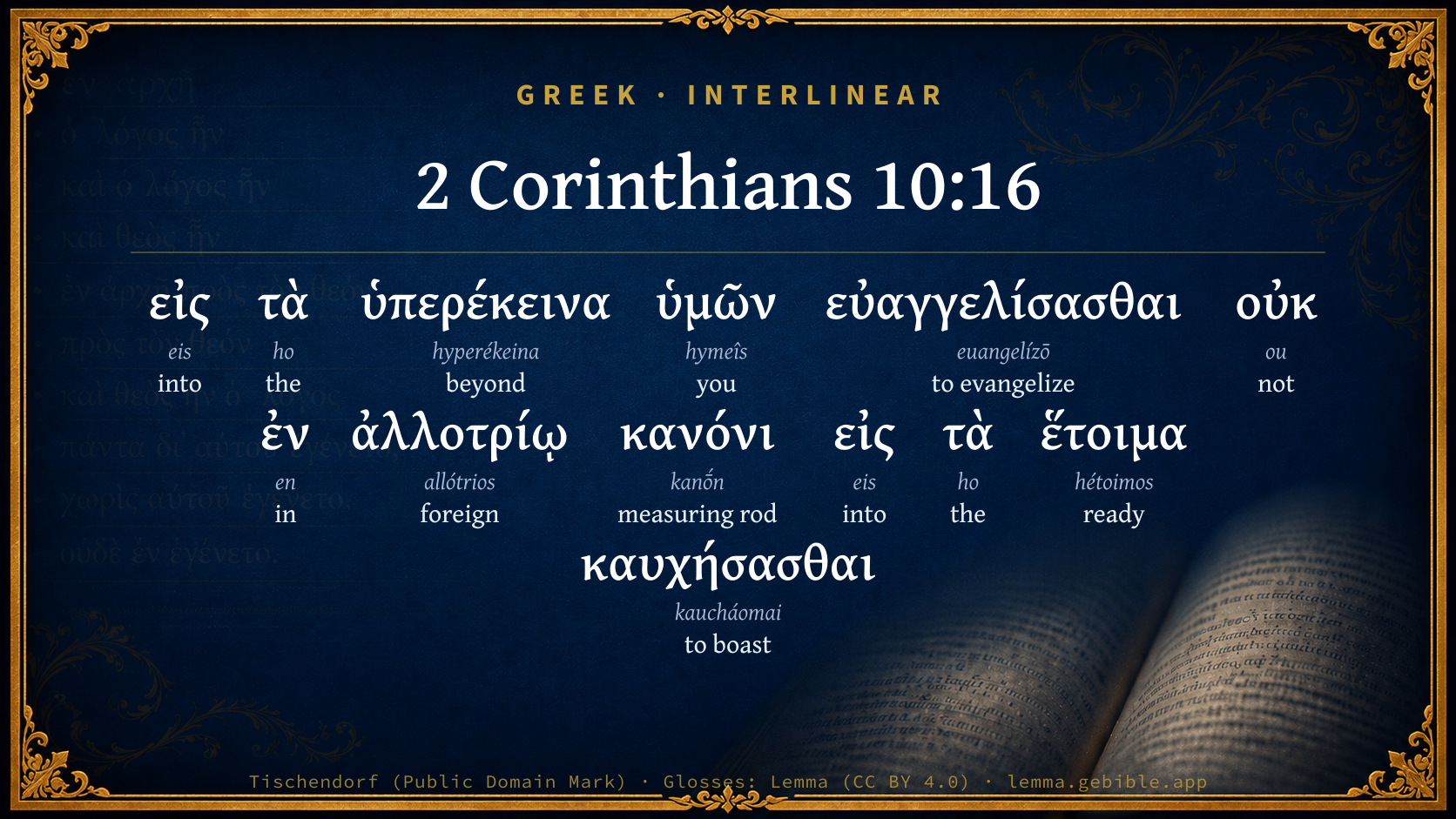
Download image
Cite this verse

2 Corinthians 10:16 (World English Bible). Public Domain. Lemma interlinear Bible study tool, https://lemma.gebible.app/v/2-corinthians/10/16.

Show BibTeX & RIS
BibTeX
RIS
English Translation
so as to preach the Gospel even to the parts beyond you, not to boast in what someone else has already done.
World English Bible · Public Domain
Highlights
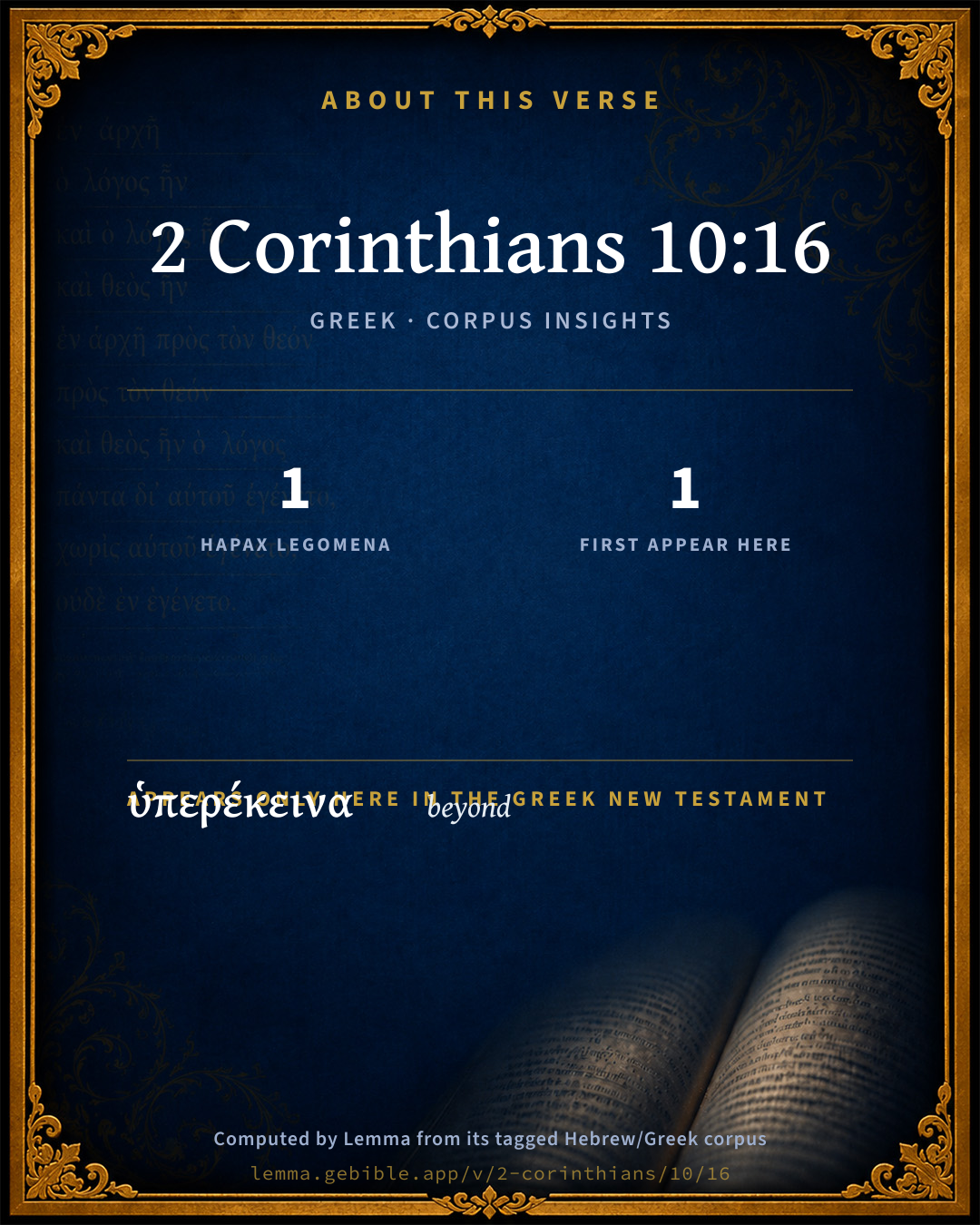
  • 1 hapax legomenon — only here in the Greek New Testament
  • 1 first appearance in the Greek New Testament
Full analysis ↓
Download a study sheet

One document with this verse’s original text, its word-by-word gloss line, the meaning frame, cross-references with their text, attributed commentary, and full source and license credits — printable, and it pastes into notes with its structure intact.

This verse Autodidact and up

Study sheet (.html) Plain text (.txt)

A passage Seminary Student

Up to 50 verses in one chapter. A passage sheet keeps up to 6 commentary sources and 12 cross-references per verse, in the order this page ranks them, and says so on the sheet whenever that leaves anything out. Ask for a single verse and you get the Autodidact verse sheet above.

Everything on this page stays free to read, with no account — the sheet is a download of what is already on screen, not access to it.

Want to remove ads? Support Godless Engineer
Compare translations 3

The same verse in 3 English versions, stacked beneath the original-language interlinear above. Click any original word for its lexicon entry.

Each is an independent rendering of the whole verse — the interlinear is not word-aligned to these translations.

Highlighted words mark where these versions differ — a whole-verse word diff, not a word-by-word alignment.

  • World English Bible Public Domain
    so as to preach the Gospel even to the parts beyond you, not to boast in what someone else has already done.
  • King James Version Public Domain
    To preach the gospel in the regions beyond you, and not to boast in another man's line of things made ready to our hand.
  • unfoldingWord Literal Text CC BY-SA 4.0
    to preach the gospel in the beyond you—not to boast in the things accomplished in another’s area.

unfoldingWord Literal Text — © unfoldingWord, licensed CC BY-SA 4.0. Word-aligned USFM3 via Door43 (git.door43.org/unfoldingWord/en_ult).

Versions to compare (up to 4)

3 of 4 selected

Show all 19 translations

Every available English version of this verse, each an independent rendering of the whole verse.

  • World English Bible Public Domain
    so as to preach the Gospel even to the parts beyond you, not to boast in what someone else has already done.
  • Berean Standard Bible Public Domain
    so that we can preach the gospel in the regions beyond you. Then we will not be boasting in the work already done in another man’s territory.
  • Majority Standard Bible Public Domain
    so that we can preach the gospel in the regions beyond you. Then we will not be boasting in the work already done in another man’s territory.
  • King James Version Public Domain
    To preach the gospel in the regions beyond you, and not to boast in another man's line of things made ready to our hand.
  • American Standard Version (1901) Public Domain
    so as to preach the gospel even unto the parts beyond you, `and' not to glory in another's province in regard of things ready to our hand.
  • Revised Version (1885) Public Domain
    so as to preach the gospel even unto the parts beyond you, and not to glory in another’s province in regard of things ready to our hand.
  • Geneva Bible (1599) Public Domain
    And to preache the Gospel in those regions which are beyonde you: not to reioyce in another mans line, that is, in the thinges that are prepared alreadie.
  • Douay-Rheims (1899) Public Domain
    Yea, unto those places that are beyond you, to preach the gospel, not to glory in another man's rule, in those things that are made ready to our hand.
  • Young's Literal Translation Public Domain
    in the `places' beyond you to proclaim good news, not in another's line in regard to the things made ready, to boast;
  • Literal Standard Version CC BY-SA 4.0
    to proclaim good news in the [places] beyond you, not in another’s line in regard to the things made ready, to boast;
  • Unlocked Literal Bible CC BY-SA 4.0
    We hope for this, so that we may preach the gospel even in regions beyond you. We will not boast about the work being done in another's area.
  • unfoldingWord Literal Text CC BY-SA 4.0
    to preach the gospel in the beyond you—not to boast in the things accomplished in another’s area.
  • Darby Bible Public Domain
    to announce the glad tidings to that [which is] beyond you, not to be boasting in another's rule of things made ready to hand.
  • World Messianic Bible Public Domain
    so as to proclaim the Good News even to the parts beyond you, not to boast in what someone else has already done.
  • Webster's Bible Public Domain
    To preach the gospel in the regions beyond you, and not to boast in another man's line of things made ready to our hand.
  • Free Bible Version CC BY-SA 4.0
    Then we can share the good news in places way beyond you, without boasting about what's already been done where someone else has worked.
  • Bible in Basic English Public Domain
    So that we may be able to go on and take the good news to countries still farther away than you are, and not take credit for another man's work in making things ready to our hand.
  • Text-Critical English NT CC BY 4.0
    so that we can preach the gospel in the regions beyond you, without boasting about work already done in someone else's area of ministry.
  • Tyndale New Testament (1534) Public Domain
    and to preache the gospell in those regions which are beyode you: and not to reioyce of that which is by another mans measure prepared all redy.

Literal Standard Version (2020), Covenant Press — licensed CC BY-SA 4.0. Text via the HelloAO Bible API (eBible.org). Unlocked Literal Bible (unfoldingWord) — licensed CC BY-SA 4.0. Text via the HelloAO Bible API (eBible.org). unfoldingWord Literal Text — © unfoldingWord, licensed CC BY-SA 4.0. Word-aligned USFM3 via Door43 (git.door43.org/unfoldingWord/en_ult). Free Bible Version, Dr. Jonathan Gallagher — licensed CC BY-SA 4.0. Text via the HelloAO Bible API (eBible.org).

Word by word

More ways to search: Search by grammar → Find every occurrence → Compare this word →

Practice this passage: Drill this verse → Learn its vocabulary →

About this verse

These counts appear in no published source. They are computed here, from the morphology-tagged text and Lemma’s own curated glosses. What Lemma adds →

13
words
11
distinct lemmas
Pauline Epistles
section

Notable vocabulary

1 hapax legomenon — a word that appears only here in the entire Greek New Testament:

  • ὑπερέκεινα beyond G5238

First appearance in Scripture

This word makes its first canonical appearance in the Greek New Testament here:

  • ὑπερέκεινα beyond G5238

Shared distinctive vocabulary

κανόνι measuring rod G2583 occurs in 4 verses of the Greek New Testament. Also found in:
Repetition

Words recur within this verse:

Cross-references

2

Topical passages linked to 2 Corinthians 10:16 in the Treasury of Scripture Knowledge — connected by theme and wording, ordered by reader-vote popularity; previews shown in the World English Bible.

  • Romans 15:24–28 whenever I journey to Spain, I will come to you. For I hope to see you on my journey, and to be helped on my way there by you, if first I may enjoy your company for a while.
  • Acts 19:21 Now after these things had ended, Paul determined in the spirit, when he had passed through Macedonia and Achaia, to go to Jerusalem, saying, "After I have been there, I must also see Rome."

Cross-references courtesy of OpenBible.info (CC BY 4.0).

Commentary

Notes on 2 Corinthians 10:16 from classic Christian and Jewish commentators (each source and its license shown beneath its notes). The classic Christian expositions comment on the surrounding passage and are grouped to its opening verse, so a note may address several verses; the Jewish commentaries on the Tanakh (Rashi and others) are per-verse, so they appear only where the commentator wrote on this verse.

Lemma curates 59 commentaries, every one of them public domain or Creative Commons licensed, each selected and text-cleaned for this edition rather than reprinted as found. About our sources →

Bengel's Gnomon

Johann Albrecht Bengel

2Co 10:16. Εἰς, to) or in relation to. The antitheses are, in the places beyond you, and, as to the things (places) that are ready to our hand.—τὰ ὑπερέκεινα, those places, which are beyond) to which no person has yet come with the Gospel, towards the south and west; for he had come from Athens to Corinth, Act 18:1.—οὐκ ἐν ἀλλοτρίῳ, not in another man’s) The antithesis is, according to our rule [2Co 10:15].—εἰς) to intrude ourselves by boasting into [as to] those things (places) which are ready to our hand.—ἓτοιμα, ready. It denotes even more than ἡτοιμασμένα.[71]

[71] Made ready for an occasion. But ἓτοιμα in a state of readiness, habitually ready.—ED.

Bengel's Gnomon of the New Testament — English translation (T&T Clark, Edinburgh, 1860) — public domain. Text from a community e-Sword module.

Meyer's Critical & Exegetical Commentary

Heinrich August Wilhelm Meyer

2Co_10:16. Infinitive without a connecting καί, and all the less therefore dependent in its turn on ἐλπίδα δὲ ἔχοντες, but rather infinitive of the aim: we hope to become exceedingly large among you, in order to preach the gospel unto the lands lying beyond you,[316] not within the boundary-line of another to boast of what is already done. This negative part is a side-glance at the opponents who in Corinth, which lay within the range of the line drawn for Paul, and so ἐν ἀλλοτρίῳ κανόνι, had boasted in regard to the circumstances of the church there, which they had, in fact, found already shaped before they came, consequently εἰς τὰ ἕτοιμα. Comp. Calvin: quum Paulus militasset, illi triumphum agebant. Beza and Billroth, also de Wette and Hofmann (who thinks all three infinitives dependent on ἐλπ. ἔχ.), take the infinitive as epexegesis of μεγαλυνθ. by adding an id est; but this is precluded by the correct connection of ἐν ὑμῖν with μεγαλυνθ. For, if Paul hopes to become large among the Corinthians, this cannot mean the same thing as to preach away beyond Corinth (εἰς τὰ ὑπερέκεινα ὑμ. εὐαγγ.). No; that μεγαλυνθ. denotes the becoming capable for further extended working, the being put into a position for it, and accordingly the aim of this is: εἰς τὰ ὑπερέκεινα ὑμῶν εὐαγγ. Ewald would make the infinitives εὐαγγ. and καυχ. dependent on κατὰ τ. κανόνα ἡμ., so that they would explain in what more precisely this rule consists; but this is forbidden by the fact that εἰς περισσ. is not placed before κατὰ τ. κ. ἡμ.

The adverb ὑπερέκεινα, ultra, is bad Greek. See Thomas Magister, p 336: ἐπέκεινα ῥήτορες λέγουσι … ὑπερέκεινα δὲ μόνοι οἱ σύρφακες (the rabble). Comp. Bos, Ellips., ed. Schaef. pp. 288, 290.

εἰς before ὑπερέκ. does stand for ἐν (Flatt and others), but comp. 1Pe_1:25; Joh_8:26 1Th_2:9.

οὐκ ἐν ἀλλοτρ. κανόνι] οὐκ, not μή, is here used quite according to rule (in opposition to Rückert), since the οὐκ ἐν ἀλλ. καν. is correlative to the εἰς τὰ ὑπερέκεινα ὑμῶν as contrast (Hartung, Partikell. II. p. 125 f.). And this correlation demands that ἐν be understood not of the object of καυχᾶσθαι (Hofmann), but locally, to which also the very notion of κανών (2Co_10:13) points: within the measuring-line drawn for another, i.e. as to substance: in the field of activity divinely destined for another.

On εἰς with καυχ., in reference to, comp. Arist. Pol. v. 10.

[316] Meridiem versus et occidentem; nam Athenis Corinthum venerat, Act_18:1, Bengel.

Meyer — Critical and Exegetical Commentary on the New Testament — English translation by Peter Christie, edited by Frederick Crombie (T&T Clark, 1880) — public domain. Text from a community e-Sword module.

Expositor's Greek Testament

ed. W. Robertson Nicoll

2Co 10:16 . εἰς τὰ ὑπερέκεινα κ . τ . λ .: so as to preach the Gospel in the regions beyond you, i.e. (if we are to press the idea of direction in ὑπερέκεινα ), the western parts of Greece, Rome and Spain, which were “beyond,” if viewed from Jerusalem, the home of Christianity, whence St. Paul, like the other early preachers, received his “mission” (more probably, however, ὑπερέκεινα is used quite vaguely as ἐπέκεινα is in Amo 5:27 , where the idea of direction cannot be read into it), and not to glory in another’s “line” about things made ready to our hand . This is what the intruders had done at Corinth, whose Church St. Paul had founded (1Co 3:6 ).

The Expositor's Greek Testament, edited by W. Robertson Nicoll (1897–1910) — public domain. Text from a community e-Sword module.

Geneva Bible (1599)

Geneva Bible translators

In countries which other men have prepared and husbanded with the preaching of the Gospel.

Geneva Bible (1599) marginal notes — public domain. Text via Bolls.life.

Jamieson, Fausset & Brown

Robert Jamieson, A. R. Fausset & David Brown

To--that is, so as to preach . . . beyond you (and) not to boast, &c.

in another man's line of things made ready to our hand--Do not connect "line of things," &c.; but "boast of things," &c. To make this clearer, arrange the words thus, "Not to boast as to things (already made by the preaching of others) ready to our hand in another man's line (that is, within the line, or sphere of labor, apportioned by God to another)."

Jamieson, Fausset & Brown — Commentary Critical and Explanatory on the Whole Bible (1871) — public domain (CC PDM 1.0). Text via the HelloAO Bible API.

Adam Clarke's Commentary

Verse 16. To preach the Gospel in the regions beyond you] He probably refers to those parts of the Morea, such as Sparta, c., that lay southward of them and to Italy, which lay on the west; for it does not appear that he considered his measure or province to extend to Libya, or any part of Africa. See the Introduction, sec. xii.

Not to boast in another man's line] So very scrupulous was the apostle not to build on another man's foundation, that he would not even go to those places where other apostles were labouring. He appears to think that every apostle had a particular district or province of the heathen world allotted to him, and which God commissioned him to convert to the Christian faith. No doubt every apostle was influenced in the same way; and this was a wise order of God; for by these means the Gospel was more quickly spread through the heathen provinces than it otherwise would have been. The apostles had deacons or ministers with them whose business it was to water the seed sown; but the apostles alone, under Christ, sowed and planted.

Adam Clarke's Commentary on the Bible (1810–1826) — public domain. Text from a community e-Sword/MySword module.

Ellicott's Commentary for English Readers

(16) To preach the gospel in the regions beyond you.—It is clear, from Rom_15:19-24, that he is thinking (1) of Western Greece, (2) of Rome, (3, and chiefly) of Spain. There, apparently, he could hope to preach the gospel without even the risk of its being said that he was building on another man’s foundation.

And not to boast in another man’s line . . .—The words, like those of 2Co_10:15, are at once an answer to a charge and a tu quoque retort. “Spain! Illyricum!” he seems to say within himself. “Will you say that I am transgressing boundaries and working on another man’s lines there? Can you say that you are free from that charge in your work at Corinth?”

A Bible Commentary for English Readers, edited by Charles John Ellicott (1878–1897) — public domain. Text from a community e-Sword module.

The Cambridge Bible for Schools and Colleges

gen. ed. J. J. S. Perowne

16. to preach the gospel in the regions beyond you] i.e. the rest of Greece, Italy and Spain. Cf. Rom_15:19; Rom_15:24; Rom_15:28. St Paul here attributes his further progress in the Gospel not to his own energy, but to their faith, another instance of his identification of himself with those in whom the same life dwelt. Cf. ch. 2Co_1:11.

and not to boast in another man’s line] Literally, and not to have boasted. Both this word and the words translated enlarged and preach the gospel are in the past tense. St Paul here again reflects indirectly, but most severely upon his opponents. Our hope is first that your faith may increase, and then that we may congratulate ourselves on having carried the good tidings of the Gospel to those who as yet have not heard them, not, as others do, on the successes which by intruding into another man’s work, we have found ready made for us.

The Cambridge Bible for Schools and Colleges (gen. ed. J. J. S. Perowne; Cambridge University Press, 1878–1918) — public domain. Text from a community e-Sword module.

Trapp's Complete Commentary

John Trapp

16 To preach the gospel in the regions beyond you, and not to boast in another man’s line of things made ready to our hand.

Ver. 16. In the regions beyond you] This was a piece of the braggadocio false apostles’ vain boasting, as it is now of the Jesuits, those Circulatores and Agyrtae, that compass sea and land, crack of what conversions they have wrought in India and Africa, and, Lampadius-like, take it ill at any man’s hand that commend them not every time they spit upon the ground. (Amm. Marcell.) Gaius Caligula the emperor was ready to destroy the whole senate, because they did not deify him for marching with his whole army to the ocean, and fetching thence a few oyster shells, Quibus spoliis acceptis magnifice gloriabatur, quasi oceano subacto. (Dio, in Vita Caligulae.)

John Trapp, A Commentary or Exposition upon All the Books of the Old and New Testament (1647–1656) — public domain. Text from a community e-Sword module.

Albert Barnes' Notes on the Bible

To preach the gospel in the regions beyond you - What regions are referred to here can be only a matter of conjecture. It may be that he wished to preach in other parts of Greece, and that he designed to go to Arcadia or Lacedaemon. Rosenmuller supposes that as the Corinthians were engaged in commerce, the apostle hoped that by them some tidings of the gospel would reach the countries with which they were engaged in traffic. But I think it most probable that he alludes to Italy and Spain. It is certain that he had formed the design of visiting Spain Rom 15:24, Rom 15:28; and he doubtless wished the Corinthians to aid him in that purpose, and was anxious to do this as soon as the condition of the eastern churches would allow it.

And not to boast in another man’s line of things ... - Margin, “Rule,” the same word (κανὼν kanōn) which occurs in 2Co 10:13. The meaning is, that Paul did not mean to boast of what properly belonged to others. He did not claim what they had done as his own. He did not intend to labor within what was properly their bounds, and then to claim the field and the result of the labor as his. He probably means here to intimate that this had been done by the false teachers of Corinth; but so far was he from designing to do this, that he meant soon to leave Corinth, which was properly within his limits, and the church which he had founded there, to go and preach the gospel to other regions. Whether Paul ever went to Spain has been a question (see the note on Rom 15:24); but it is certain that he went to Rome, and that he preached the gospel in many other places after this besides Corinth.

Albert Barnes' Notes on the Bible (1834–1885) — public domain. Text from a community e-Sword/MySword module.

Haydock's Catholic Bible Commentary

The words, measure, rule, &c. signify through the whole of this chapter a share, or an allotment of any place to cultivate. St. Paul never gloried like the persons whom he is here blaming, that he entered into other men’s labours. But still neither those persons who have come to you, nor we who first preached the gospel to you, have any right to glory, except in God alone. (Calmet) --- We still hope, that your faith every day increasing, we shall be able to extend our measure much further, and carry the gospel to nations far beyond you, without interfering with any other, by glorying of having built on what they had already prepared. (Bible de Vence)

George Leo Haydock (1774–1849), Haydock's Catholic Family Bible and Commentary, 1859 edition — public domain. Excludes Psalms (Douay-Rheims chapter numbering differs from Protestant) and Deuterocanonical books (Catholic canon only).

Matthew Poole's English Annotations

To preach the gospel in the regions beyond you; the apostle here expoundeth what he meaneth by the term magnified, or enlarged, in the preceding verse, viz. to have a door opened to preach the gospel in places whither it was not yet come. God honoureth persons when he maketh them instruments to bring any to an acquaintance with, and to the embracing of, his gospel, who formerly had been ignorant of it, and not acquainted with it.

And not to boast in another man’s line of things made ready to our hand: he here seemeth to reflect on the false teachers crept into this church, who had nothing to boast in but a pretended building, upon other men’s foundations, and carrying on a work by others made ready to their hands; and seemeth to prefer the work of conversion, and an instrumentality in that, before an instrumentality merely in edification, and carrying on the work of God already begun in people’s souls.

Matthew Poole's English Annotations on the Holy Bible (1683–1685) — public domain. Text from a community e-Sword/MySword module.

Whedon's Commentary on the Bible

Daniel D. Whedon

16. To preach the gospel—It is for this that he would like to be magnified to a giant’s stature.

Regions beyond you—A decidedly extended field!

Another man’s line—As the Christines were doing.

Made ready to our hand—A comfortable nest built by a preceding bird.

Daniel D. Whedon (gen. ed.), Commentary on the Old and New Testaments (1874–1909) — public domain. Text from a community e-Sword module.

The Pulpit Commentary

In the regions beyond you. Even to Rome and Spain. (Rom_15:19, Rom_15:24, Rom_15:28)

The gospel for the regions beyond.

preach the gospel in the regions beyond you". (comp. Rom_15:19-24) The apostle, filled with the true missionary spirit, was longing to be free from the care of Churches already founded, so that he might be free to go again upon his journeyings, and preach the gospel in Western Greece, in Rome, and even away in distant Spain. St. Paul was first and chiefly a missionary. The genius of the missionary is a Divine restlessness, a constant impulse forward into new spheres, a passion for finding some one else to whom the gospel message might be told. The men who settle down in Churches situated in heathen districts are ministers and pastors and clergymen; they cannot properly be called missionaries, since these are men who are always hearing a call from "regions beyond," saying, "Come over and help us.

I MISSIONARY WORK AS HERALDING A MESSAGE, The word for "preaching" properly means "heralding going forth to make a royal proclamation. Explain the work of the Eastern herald. He would go through the land, and, wherever he could find people, deliver the king"s message. We need a fuller and worthier impression of the gospel, as the royal proclamation of the King of kings, entrusted to us for delivery to "all the world," to "every creature.

II HERALDING WORK AS TEMPORARY. It is done when the message is declared and delivered. The herald as a herald has no more to do there; he must pass on his way. There is abundant work left behind for others to do; but his is over. And we are told that the gospel heralds will not have gone all over the world when the kingdom shall come. So we need fear no lack of work for missionaries and heralds.

III HERALD"S DUTY TO FIND REGIONS BEYOND. A glance at the map of our world will show what vast masses of mankind have never heard of the true God, the redeeming Son, and the eternal life. We rejoice that, especially in Africa and China, the Christian Church is showing that it keeps the true missionary idea, and is ever reaching out to "regions beyond. R.T.

The Pulpit Commentary (1880–1919), ed. H.D.M. Spence-Jones & Joseph S. Exell — public domain. Text from a community e-Sword module.

John Wesley's Explanatory Notes

In the regions beyond you - To the west and south, where the gospel had not yet been preached.

John Wesley, Explanatory Notes Upon the Whole Bible (1754–1765) — public domain. Text via the GEBible commentary corpus.

McGarvey & Pendleton's Commentaries

J. W. McGarvey

so as to preach the gospel even unto the parts beyond you, and not to glory in another's province in regard of things ready to our hand . [Though God gave us so vast a bishopric, we indeed filled so much of it as to reach you. We were not so much smaller than this bishopric which God gave to us, that we had to stretch ourselves to cover it. To make a show of covering our territory we did not need to take possession of other men's labors and claim the fruits of their ministry, as though they wrought as our agents. If we had done this, we would indeed be glorying beyond our measure. But thus far (i. e., as far as unto you) we have covered the province assigned to us and we have hope that as your faith groweth, and ye become subject to Christ through being subject to his true ministers, we ourselves shall grow and be magnified so that we shall more nearly attain to the magnitude of our great province. At present your vacillation and infidelity confine our labors to you. Having taken you as a fortress for Christ, we can not leave you assailed by Satan and half surrendered to him. When you are again established in the faith I expect to go on into Italy and into Spain, and do work in those parts of my province which lie far beyond you. It is no part of my plan or intention to take possession of some other man's labor and glory in it, as you false leaders have done by coming to Corinth and taking possession of the church which I left there ready to your hand.]

J. W. McGarvey (with Philip Y. Pendleton), Commentaries on the New Testament (The Fourfold Gospel, 1914; Acts; and the epistles) — public domain. Text from a community e-Sword/MySword module.

The People's New Testament

B. W. Johnson

16. To preach the gospel … beyond you. Where no man has yet preached.

B. W. Johnson's The People's New Testament with Notes (1889–1891) — public domain. Electronic text from the Christian Classics Ethereal Library (CCEL) ThML edition.

Alford’s Greek Testament

Henry Alford

16.] [so as] (with a view) to preach the gospel as far as (see on εἰς τὰ ἄμ., ver. 15) the parts beyond you (Wetstein quotes from Thomas Magister, ἐπέκεινα ῥήτορες λέγουσι.… ὑπερεκεῖνα δὲ μόνοι οἱ σύρφακες, la canaille),—not (with a view) to boast ourselves within another man’s line (κανών throughout seems to be used of a measuring line: according to the metaphor so common among us, ‘in his line,’—i.e. ‘within the line which Providence has marked out for him’) with regard to (or, ‘to the extent of;’ ‘to extend our boasting to’) things ready made to our hands.

Henry Alford, The Greek Testament (1849–1861) — public domain. Text from a community e-Sword module.

International Critical Commentary

16. εἰς τὰ ὑπερέκεινα ὑμῶν. The expression may be coined for the occasion, for ὑπερέκεινα has been found nowhere else.* It may have been a current popular word which has not found its way into literature; ἐπέκεινα (Act 7:43 and LXX) is classical. A little later St Paul had intentions of going to Rome and Spain (Rom 15:24, Rom 15:28), and such ideas may have been in his mind when he wrote this letter. Regarding Antioch as his original centre, he might vaguely describe such regions as τὰ ὑπερέκεινα in reference to Corinth. But, if these chapters are part of the severe letter written at Ephesus, ‘the parts beyond Corinth’ would be a natural expression for Rome and Spain. See Introduction, p. xxxiii.

εὐαγγελίσασθαι. In these verses (14-16) we have εὐαγγέλιον and εὐαγγελίζομαι, expressions and ideas which are in a high degree Pauline. The former occurs in all groups of the Epistles, 60 times in all, and indeed in every Epistle, excepting that to Titus. The latter is found chiefly in this group, but also in 1 Thess. and Eph., 20 times in all, and its usual meaning is ‘preach the Gospel,’ whether εὐαγγέλιον be added (11:7) or not; but in a few passages it means simply ‘preach,’ and hardly differs from κηρύσσω (Gal 1:23; Eph 2:17, Eph 2:3:8; 1Th 3:6). Εὐαγγέλιον more often than not has no defining adjective or genitive, as here and 8:18; contrast 2:12, 4:4, 9:13, 11:7; and seeing that the verb is a technical word to indicate the work of a Christian missionary, the noun indicates the substance or contents of mission preaching. In other words, it is “God’s plan of salvation, contained in the O.T. as a promise, and realized through Jesus Christ” (Harnack, Constitution and Law of the Church, pp. 292 f.).

εἰς τὰ ἕτοιμα καυχήσασθαι. ‘To glory in respect of things ready to our hand,’ i.e. ‘done by other persons before we came on the scene and claimed the credit of it,’ a condensed expression, the meaning of which would be obscure without the context. The constr. κανχ. εἰς is found in Arist. Pol. v. x. 16. We know that St Paul on principle avoided centres where other missionaries had been working (Rom 15:20); he was commissioned to be always a pioneer, and he regarded his extraordinary success as a proof that he was commissioned by God. It was never his desire to find things ready to his hand, still less to claim the merit for what had been already done. Indeed there was no merit to be claimed even when, in the province apportioned to him, great results were produced. Therefore he again quotes (see on 1Co 1:31) an adaptation of Jer 9:24.

International Critical Commentary — older volumes (1896–1929), various authors — public domain. Text from a community e-Sword module.

Vincent's Word Studies in the New Testament

Marvin R. Vincent

In another man's line [εν αλλοτριω κανονι] . Line is the word previously rendered rule. He will not boast within the line drawn for another; in another's field of activity. 155

Marvin R. Vincent, Word Studies in the New Testament (1887–1900) — public domain. Text from a community e-Sword/MySword module.

Lesson kit

Teaching starters — assembled from the data on this page, not authored interpretation. Every prompt links to the verse data it draws on. Edit before teaching.

2 Corinthians, in the Pauline Epistles, opens this verse with 13 words (11 distinct Greek lemmas). Its most distinctive word is hyperékeina (“beyond”). A historical commentator’s framing appears above. Read the whole chapter for the surrounding context.

Discussion questions

  1. What does “beyond” (hyperékeina) contribute to the verse as a whole?
  2. This verse holds 1 word here found nowhere else in the Greek New Testament. What might the rare word draw attention to?
  3. The word “beyond” first appears here in Scripture. What is being introduced at this debut?
  4. 2 Corinthians 10:13 shares the word «measuring rod» with this verse. How do the two illuminate each other?
  5. “into” occurs 2× in this one verse. What is the effect of the repetition?
  6. These translations render this verse differently. What is at stake in choosing one wording over another?
  7. Reading how Bengel's Gnomon and Meyer's Critical & Exegetical Commentary read this verse, where do the two commentators agree and where do they part?

Things to notice

  • 1 word in this verse appears nowhere else in the Greek New Testament.
  • 1 word makes its first canonical appearance in Scripture here.
  • These translations choose different wording for 21 words in this verse.
  • “into” occurs 2× in this single verse.
  • 11 distinct Greek lemmas span 13 words in this verse.

Reading settings

Reading text

Shown beneath each verse's original-language words.

Old Testament
Old Testament edition

Read the OT as the Masoretic Hebrew (MT) or the Greek Septuagint (LXX).

English shown for the Greek Septuagint (in the Hebrew ↔ Greek comparison).

Comparing translations? Open the Compare panel on any verse page to stack up to four side by side.