
Romans 2:23

Greek (Tischendorf 8th ed.) Romans 2:23 appears in the Greek New Testament. The text above is from the Tischendorf 8th edition. Each word links to its Strong’s number and a concise gloss. Click any word for its full Thayer’s Greek Lexicon entry.
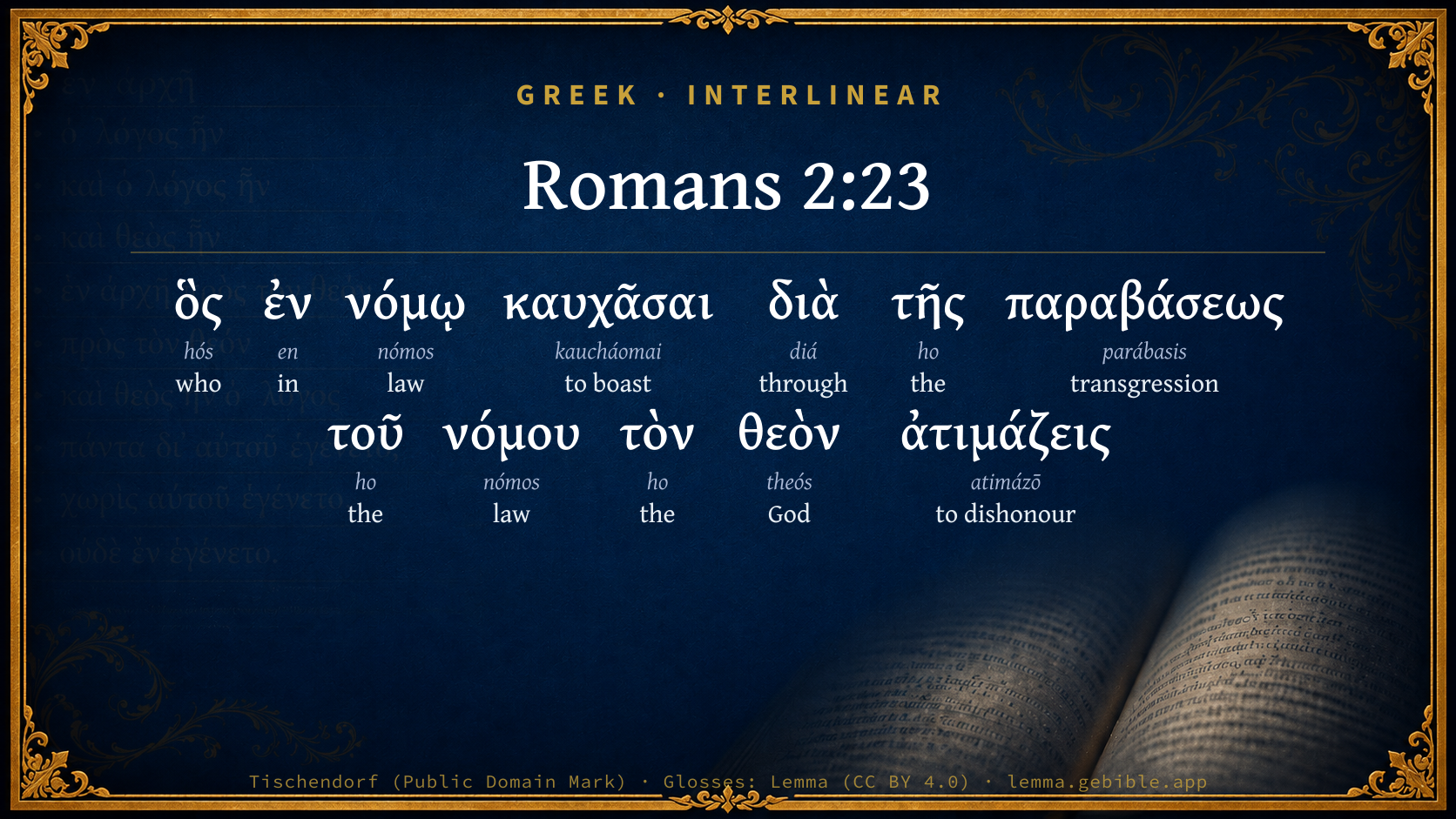
Download image
Cite this verse

Romans 2:23 (World English Bible). Public Domain. Lemma interlinear Bible study tool, https://lemma.gebible.app/v/romans/2/23.

Show BibTeX & RIS
BibTeX
RIS
English Translation
You who glory in the law, through your disobedience of the law do you dishonor God?
World English Bible · Public Domain
Highlights
  • 1 first appearance in the Greek New Testament
Full analysis ↓
Download a study sheet

One document with this verse’s original text, its word-by-word gloss line, the meaning frame, cross-references with their text, attributed commentary, and full source and license credits — printable, and it pastes into notes with its structure intact.

This verse Autodidact and up

Study sheet (.html) Plain text (.txt)

A passage Seminary Student

Up to 50 verses in one chapter. A passage sheet keeps up to 6 commentary sources and 12 cross-references per verse, in the order this page ranks them, and says so on the sheet whenever that leaves anything out. Ask for a single verse and you get the Autodidact verse sheet above.

Everything on this page stays free to read, with no account — the sheet is a download of what is already on screen, not access to it.

Want to remove ads? Support Godless Engineer
Compare translations 3

The same verse in 3 English versions, stacked beneath the original-language interlinear above. Click any original word for its lexicon entry.

Each is an independent rendering of the whole verse — the interlinear is not word-aligned to these translations.

Highlighted words mark where these versions differ — a whole-verse word diff, not a word-by-word alignment.

  • World English Bible Public Domain
    You who glory in the law, through your disobedience of the law do you dishonor God?
  • King James Version Public Domain
    Thou that makest thy boast of the law, through breaking the law dishonourest thou God?
  • unfoldingWord Literal Text CC BY-SA 4.0
    You, who boast in the law, do you dishonor God through the transgression of the law?

unfoldingWord Literal Text — © unfoldingWord, licensed CC BY-SA 4.0. Word-aligned USFM3 via Door43 (git.door43.org/unfoldingWord/en_ult).

Versions to compare (up to 4)

3 of 4 selected

Show all 19 translations

Every available English version of this verse, each an independent rendering of the whole verse.

  • World English Bible Public Domain
    You who glory in the law, through your disobedience of the law do you dishonor God?
  • Berean Standard Bible Public Domain
    You who boast in the law, do you dishonor God by breaking the law?
  • Majority Standard Bible Public Domain
    You who boast in the law, do you dishonor God by breaking the law?
  • King James Version Public Domain
    Thou that makest thy boast of the law, through breaking the law dishonourest thou God?
  • American Standard Version (1901) Public Domain
    thou who gloriest in the law, through thy transgression of the law dishonorest thou God?
  • Revised Version (1885) Public Domain
    thou who gloriest in the law, through thy transgression of the law dishonourest thou God?
  • Geneva Bible (1599) Public Domain
    Thou that gloriest in the Lawe, through breaking the Lawe, dishonourest thou God?
  • Douay-Rheims (1899) Public Domain
    Thou that makest thy boast of the law, by transgression of the law dishonourest God.
  • Young's Literal Translation Public Domain
    thou who in the law dost boast, through the transgression of the law God dost thou dishonour?
  • Literal Standard Version CC BY-SA 4.0
    You who boast in the Law, through the transgression of the Law do you dishonor God?
  • Unlocked Literal Bible CC BY-SA 4.0
    You who boast in the law, do you dishonor God by breaking the law?
  • unfoldingWord Literal Text CC BY-SA 4.0
    You, who boast in the law, do you dishonor God through the transgression of the law?
  • Darby Bible Public Domain
    thou who boastest in law, dost thou by transgression of the law dishonour God?
  • World Messianic Bible Public Domain
    You who glory in the law, do you dishonor God by disobeying the law?
  • Webster's Bible Public Domain
    Thou that makest thy boast of the law, through breaking the law dishonorest thou God?
  • Free Bible Version CC BY-SA 4.0
    You boast about having the law, but don't you misrepresent God by breaking it?
  • Bible in Basic English Public Domain
    You who take pride in the law, are you doing wrong to the honour of God by behaviour which is against the law?
  • Text-Critical English NT CC BY 4.0
    Yoʋ who boast in the law, do yoʋ dishonor God by transgressing the law?
  • Tyndale New Testament (1534) Public Domain
    Thou reioysest in the lawe and thorow breakinge the lawe dishonourest God.

Literal Standard Version (2020), Covenant Press — licensed CC BY-SA 4.0. Text via the HelloAO Bible API (eBible.org). Unlocked Literal Bible (unfoldingWord) — licensed CC BY-SA 4.0. Text via the HelloAO Bible API (eBible.org). unfoldingWord Literal Text — © unfoldingWord, licensed CC BY-SA 4.0. Word-aligned USFM3 via Door43 (git.door43.org/unfoldingWord/en_ult). Free Bible Version, Dr. Jonathan Gallagher — licensed CC BY-SA 4.0. Text via the HelloAO Bible API (eBible.org).

Word by word

More ways to search: Search by grammar → Find every occurrence → Compare this word →

Practice this passage: Drill this verse → Learn its vocabulary →

παραβάσεως
parábasis
G3847
“transgression”
Noun, Genitive, Singular, Feminine
Part of Speech
Noun
Case
Genitive
Number
Singular
Gender
Feminine
Full Thayer's Definition

Origin: from G3845

TDNT: 17:19,8

1. a going over 2. metaph. a disregarding, violating a. of the Mosaic law b. the breach of a definite, promulgated, ratified law c. to create transgressions, i.e. that sins might take on the character of transgressions, and thereby the consciousness of sin be intensified and the desire for redemption be aroused
  1. ὃς hós G3739 “who” Relative pronoun, Nominative, Singular, Masculine
  2. ἐν en G1722 “in” Preposition
  3. νόμῳ nómos G3551 “law” Noun, Dative, Singular, Masculine
  4. καυχᾶσαι kaucháomai G2744 “to boast” Verb, Present, Middle or Passive deponent, Indicative, 2nd person, Singular
  5. διὰ diá G1223 “through” Preposition
  6. τῆς ho G3588 “the” Article, Genitive, Singular, Feminine
  7. τοῦ ho G3588 “the” Article, Genitive, Singular, Masculine
  8. νόμου nómos G3551 “law” Noun, Genitive, Singular, Masculine
  9. τὸν ho G3588 “the” Article, Accusative, Singular, Masculine
  10. θεὸν theós G2316 “God” Noun, Accusative, Singular, Masculine
  11. ἀτιμάζεις atimázō G818 “to dishonour” Verb, Present, Active, Indicative, 2nd person, Singular

About this verse

These counts appear in no published source. They are computed here, from the morphology-tagged text and Lemma’s own curated glosses. What Lemma adds →

12
words
9
distinct lemmas
Pauline Epistles
section

Notable vocabulary

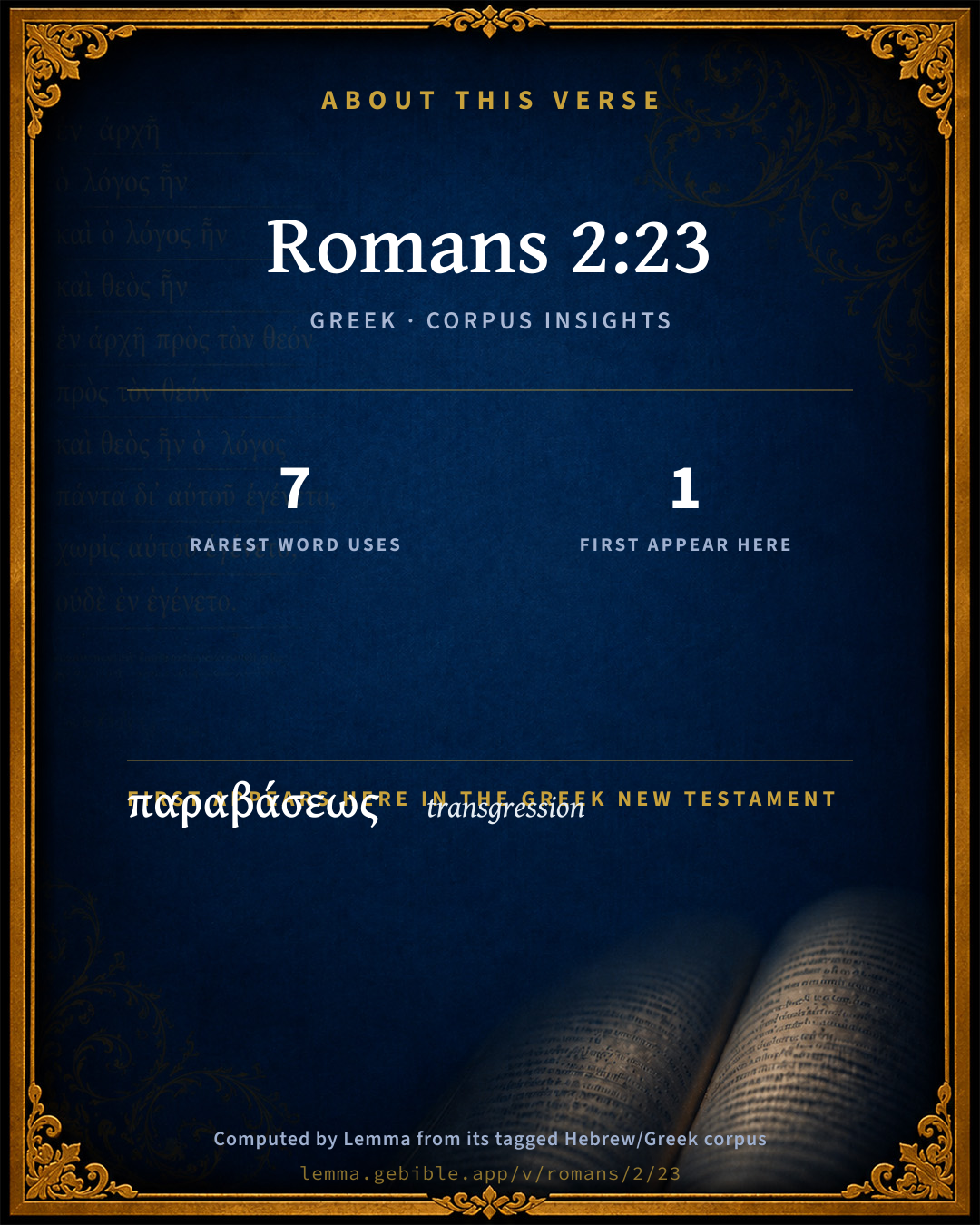
The rarest word here is παραβάσεως transgression G3847 — appearing just 7 times in the whole Greek New Testament.

First appearance in Scripture

This word makes its first canonical appearance in the Greek New Testament here:

  • παραβάσεως transgression G3847

Shared distinctive vocabulary

παραβάσεως transgression G3847 occurs in 7 verses of the Greek New Testament. Also found in:
Repetition

Words recur within this verse:

Cross-references

11

Topical passages linked to Romans 2:23 in the Treasury of Scripture Knowledge — connected by theme and wording, ordered by reader-vote popularity; previews shown in the World English Bible.

  • James 4:16–17 But now you glory in your boasting. All such boasting is evil.
  • Romans 2:17 Indeed you bear the name of a Jew, and rest on the law, and glory in God,
  • John 5:45 "Don't think that I will accuse you to the Father. There is one who accuses you, even Moses, on whom you have set your hope.
  • Romans 3:2 Much in every way! Because first of all, they were entrusted with the oracles of God.
  • Romans 9:4 who are Israelites; whose is the adoption, the glory, the covenants, the giving of the law, the service, and the promises;
  • Jeremiah 8:8–9 How do you say, We are wise, and the law of Yahweh is with us? But, behold, the false pen of the scribes has worked falsely.
  • Matthew 19:17–20 He said to him, "Why do you call me good? No one is good but one, that is, God. But if you want to enter into life, keep the commandments."
  • Luke 10:26–29 He said to him, "What is written in the law? How do you read it?"
  • Luke 18:11 The Pharisee stood and prayed to himself like this: 'God, I thank you, that I am not like the rest of men, extortioners, unrighteous, adulterers, or even like this tax collector.
  • John 9:28–29 They insulted him and said, "You are his disciple, but we are disciples of Moses.
  • James 1:22–27 But be doers of the word, and not only hearers, deluding your own selves.

Cross-references courtesy of OpenBible.info (CC BY 4.0).

Commentary

Notes on Romans 2:23 from classic Christian and Jewish commentators (each source and its license shown beneath its notes). The classic Christian expositions comment on the surrounding passage and are grouped to its opening verse, so a note may address several verses; the Jewish commentaries on the Tanakh (Rashi and others) are per-verse, so they appear only where the commentator wrote on this verse.

Lemma curates 59 commentaries, every one of them public domain or Creative Commons licensed, each selected and text-cleaned for this edition rather than reprinted as found. About our sources →

Meyer's Critical & Exegetical Commentary

Heinrich August Wilhelm Meyer

Rom_2:23 gives to the four questions of reproachful astonishment the decisive categorical answer. See above on Rom_2:17-24.

διὰ τῆς παραβ. τ. νόμου] To this category belonged especially the ἱεροσυλεῖν; for in Deu_7:25 f. the destruction of heathen statues is enjoined, but the robbery of their gold and silver is repudiated.

τὸν θεὸν ἀτιμάζεις] How? is shown in Rom_2:24.

τὸν θεὸν] who has given the law.

Meyer — Critical and Exegetical Commentary on the New Testament — English translation by Peter Christie, edited by Frederick Crombie (T&T Clark, 1880) — public domain. Text from a community e-Sword module.

Expositor's Greek Testament

ed. W. Robertson Nicoll

Rom 2:23 . Here again the construction is changed, and probably the use of the relative instead of the participle suggests that the sentence is to be read, not as interrogative, but as declaratory. “Thou who makest it thy boast that thou possessest a law, by the transgressing of that law dishonourest God: that is the sum of the whole matter, and thy sole distinction in contrast with the heathen.”

The Expositor's Greek Testament, edited by W. Robertson Nicoll (1897–1910) — public domain. Text from a community e-Sword module.

Hodge's Commentary on Romans, Ephesians & First Corinthians

Charles Hodge

Rom_2:23, Rom_2:24

Another striking instance of the inconsistency between their principles and their conduct was, that while they made a boast of the law, they so disregarded its precepts as to lead the heathen to think and speak evil of that God who gave the law, of whose character they judged by the conduct of his people. This charge he expresses in the language of their own prophets; see Isa_52:5 and Eze_36:20, Eze_36:23. In the former passage we find in the lxx, nearly the same words as those used by the apostle: δἰ ὑμᾶς διαπαντὸς τὸ ὄνομά μου βλασφημεῖται ἐν τοῖς ἓθνεσι. Both Isaiah and Ezekiel, indeed, refer to that blaspheming of God by the heathen, which arose from the misery of his people, whose God they were thus led to regard as unable to protect his worshippers. This, however, does not render the reference of the apostle less appropriate; for it is the mere fact that Gods name was blasphemed among the Gentiles, on account of the Jews, that the apostle means to confirm by this reference to the Scriptures. And besides, as their sins were the cause of their captivity, their sins were the cause also of the evil speaking of God, of which their sufferings were the immediate occasion.

Charles Hodge — Commentary on Romans (1835), First Corinthians (1857), and Ephesians (1856) — public domain. Text from a community e-Sword module.

John Calvin's Commentaries

23. Thou who gloriest in the law, etc. Though every transgressor dishonors God, (for we are all born for this end — to serve him in righteousness and holiness;) yet he justly imputes in this respect a special fault to the Jews; for as they avowed God as their Lawgiver, and yet had no care to form their life according to his rule, they clearly proved that the majesty of their God was not so regarded by them, but that they easily despised him. In the same manner do they at this day dishonor Christ, by transgressing the gospel, who prattle idly about its doctrine, while yet they tread it under foot by their unbridled and licentious mode of living.

John Calvin's Commentaries (1540-1563) — public domain. Text from the Calvin Translation Society English edition (1840s-50s) via the Christian Classics Ethereal Library (ccel.org). Calvin's coverage is partial (roughly two-thirds of the Bible); uncommented books and verses are honest gaps, never fabricated. The 19th-century editor's footnotes and remarks are omitted so the notes are faithfully Calvin's own voice.

Ellicott's Commentary for English Readers

(23) Dishonourest thou God?—This verse has been regarded, not as a question, but as a summary answer to the previous questions, “You, who make all this boast in the Law, by breaking the Law, dishonour God.” There is a certain force in this view, but the structure of the clause is so similar to those that have gone before that it seems best, perhaps, upon the whole, to take it in the ordinary way.

A Bible Commentary for English Readers, edited by Charles John Ellicott (1878–1897) — public domain. Text from a community e-Sword module.

The Cambridge Bible for Schools and Colleges

gen. ed. J. J. S. Perowne

23. dishonourest] disgracest. The crimes of Jews made their Lord’s “name to be blasphemed among the Gentiles;” as, alas, the name of Christ is, for exactly similar reasons, often blasphemed among the heathen now.

The Cambridge Bible for Schools and Colleges (gen. ed. J. J. S. Perowne; Cambridge University Press, 1878–1918) — public domain. Text from a community e-Sword module.

John Gill's Exposition

For circumcision verily profiteth,.... The plea from circumcision in favour of the Jews, and their acceptance with God, and justification before him, is here, and in the following verses, considered. The apostle allows that circumcision was profitable; which must be understood whilst it was in force, before the abrogation of it, for since, it is not profitable but pernicious; and then it was only profitable, in case the law was kept:

if thou keepest the law; that is, perfectly; for circumcision obliged persons to keep the whole law. Now the circumcised Jews did not keep it in such sense; wherefore circumcision was of no use to them, but, on the contrary, was an handwriting against them.

But if thou be a breaker of the law, thy circumcision is made uncircumcision; that is, it is not accounted circumcision; it is of no avail; such a man was all one as an uncircumcised Gentile, and appeared to be uncircumcised in a spiritual sense: the apostle perhaps alludes to a practice among some of the Jews, to bring on and draw over the foreskin, after they had been circumcised; See Gill on Co1 7:18.

John Gill's Exposition of the Whole Bible (1746–1763) — public domain (CC PDM 1.0). Text via the HelloAO Bible API.

Trapp's Complete Commentary

John Trapp

23 Thou that makest thy boast of the law, through breaking the law dishonourest thou God?

Ver. 23. Through breaking] By shooting short, or beyond, or wide of the mark; by omission, commission, or failing in the manner.

John Trapp, A Commentary or Exposition upon All the Books of the Old and New Testament (1647–1656) — public domain. Text from a community e-Sword module.

Albert Barnes' Notes on the Bible

Makest thy boast ... - To boast in the Law implied their conviction of its excellence and obligation, as a man does not boast of what he esteems to be of no value.

Dishonourest thou God - By boasting of the Law, they proclaimed their conviction that it was from God. By breaking it, they denied it. And as actions are a true test of man’s real opinions, their breaking the Law did it more dishonor than their boasting of it did it honor. This is always the case. It matters little what a man’s speculative opinions may be; his practice may do far more to disgrace religion than his profession does to honor it. It is the life and conduct, and not merely the profession of the lips, that does real honor to the true religion. Alas, with what pertinency and force may this question be put to many who call themselves Christians!

Albert Barnes' Notes on the Bible (1834–1885) — public domain. Text from a community e-Sword/MySword module.

Matthew Poole's English Annotations

Dost thou bring a reproach upon religion, and give occasion to the Gentiles to blaspheme his name? So it follows in the next words. See Rom 2:24.

Matthew Poole's English Annotations on the Holy Bible (1683–1685) — public domain. Text from a community e-Sword/MySword module.

Whedon's Commentary on the Bible

Daniel D. Whedon

23. Dishonourest thou God—This verse embraces the sum total of all the previous questions as well as of all similar ones that they justly suggest. The entire charge is, that the Jew dishonours God, by breaking the law entrusted to him by God; whereas it was his true mission by a beautiful obedience to spread the glory of God abroad through the earth.

Daniel D. Whedon (gen. ed.), Commentary on the Old and New Testaments (1874–1909) — public domain. Text from a community e-Sword module.

The Pulpit Commentary

Vers. 23, 24. Thou that makest thy boast in law, through thy transgression of the Law dishonourest thou God? (or, thou dishonourest God). For the name of God is blasphemed among the Gentiles because of you, as it is written. The reference is to Isa_52:5, where the LXX has Di umav diapanto onoma mou blasfhmeitai en toiv eynesi . The passage is not quoted as a prophecy now fulfilled, or as in its original reference exactly applicable, but only as serving to express well how the character of the Jews had brought their very religion into disrepute (el. Tacitus, "Hist.." 5:4, etc.). The remainder of the chapter is devoted to a clear and final exposition of the principle, involved throughout all the previous verses, that Jewish privileges were of no profit in themselves, or without their meaning and purpose being understood and acted on. The thought now passes exclusively to circumcision, as being the original token of the covenant, and the Jew"s rite of initiation into his whole privileged position. (Ge 17) When Jew had come to be the peculiar designation of the children of the covenant, persons were said to become Jews by circumcision. Thus Est_8:17, "And many of the people of the land became Jews," where the LXX has, Kai polloi twn eynwn perietemnonto kai Ioudaizon . It may be here observed that the known fact of other races as well as the Jews having practised, and still practising, circumcision is not subversive of the scriptural view of its being a peculiarly Jewish rite. For to the Jew alone it had a peculiar significance.

The Pulpit Commentary (1880–1919), ed. H.D.M. Spence-Jones & Joseph S. Exell — public domain. Text from a community e-Sword module.

Scofield Reference Notes

C. I. Scofield

breaking the law

Sin. (See Scofield "Rom 3:23").

The Scofield Reference Bible (1917 edition), notes by C. I. Scofield — public domain. Text from a community e-Sword module.

Godbey's Commentary on the New Testament

William B. Godbey

23. “Who boastest in the law, and through the transgression of the law dishonorest God.” I have that all round me till I turn heart-sick, e. g., people claiming to be paragon saints, boasting over their legal obedience in outward ordinances and churchisms, loudly condemning others, and at the same time showing by their unspiritual, carnal and frequently even profligate lives, their own utter ignorance of God and His salvation.

William B. Godbey, Commentary on the New Testament (1896–1900) — public domain. Text from a community e-Sword module.

McGarvey & Pendleton's Commentaries

J. W. McGarvey

thou who gloriest in the law, through thy transgression of the law dishonorest thou god? [These questions bring out the flagrant inconsistencies between Jewish preaching and practice. Teaching others not to steal, the Jew, though probably not often guilty of technical theft, was continually practically guilty of it in his business dealings, wherein, by the use of false weights, extortion, cheating, etc., he gathered money for which he had returned no just equivalent. Unchastity was also a besetting sin of the Jews, showing itself in the corrupt practice of permitting divorces without reasonable or righteous cause ( Mat_19:8-9 ). Some of the most celebrated Rabbis are, in the Talmud, charged with adultery. Paul's accusation, that the Jews robbed temples, has been a puzzle to many. This robbing of the temple, according to the context of his argument, must have been a species of idolatry, for he is charging the Jews with doing the very things which they condemned. They condemned stealing, and stole; they denounced adultery, and committed it; they abhorred idols, yet robbed the temples of them that they might worship them. Such is the clear meaning, according to the context. But we have no evidence that the Jews of Paul's day did such a thing. The charge is doubtless historic. The Jewish history, in which they gloried, showed that the fathers, in whom they had taken so much pride, had done this thing over and over again, and the same spirit was in their children, though more covertly concealed (comp. Mat_23:29-32 ). The last question sums up the Jewish misconduct: glorying in the law, as is shown in Rom 2:17-20; they yet dishonored the God of the law by transgressing it, as is shown in this paragraph.]

J. W. McGarvey (with Philip Y. Pendleton), Commentaries on the New Testament (The Fourfold Gospel, 1914; Acts; and the epistles) — public domain. Text from a community e-Sword/MySword module.

The People's New Testament

B. W. Johnson

23. Dishonorest thou God? The first part of this verse is a summary of the claims of the Jews as given in verses 17–20; the last part is a decisive answer, in an interrogative form, of the four reproachful questions just asked. Through the whole passage privilege and practice are contrasted.

B. W. Johnson's The People's New Testament with Notes (1889–1891) — public domain. Electronic text from the Christian Classics Ethereal Library (CCEL) ThML edition.

unfoldingWord translationNotes

Door43 World Missions Community

You who boast in the law, do you dishonor God by breaking the law?

Paul uses a question to scold his listener. You can translate this as a strong statement. AT: "It is wicked that you claim to be proud of the law, while at the same time you disobey it and bring shame to God!" (See: Rhetorical Question)

the name of God is blasphemed among the Gentiles

You can translate this in an active form. AT: "many Gentiles blaspheme the name of God" (See: Active or Passive)

name of God

The word "name" is a metonym that refers to the entirety of God, not just his name. (See: Metonymy)

translationWords

proud

joy

law

transgress

Gentile

written

unfoldingWord translationNotes — © Distant Shores Media and the Door43 World Missions Community, licensed CC BY-SA 4.0. Source: git.door43.org/Door43/en_tn.

Cambridge Greek Testament for Schools and Colleges

23. ἀτιμάζεις; S. H. and Giff. support ἀτιμάζεις. and treat it as a direct statement summing up the points of the preceding questions. Yet the interrogative form is more forcible here too. The claim explicitly brings the Jews under the same imputation as the Gentiles, Rom 1:21.

Cambridge Greek Testament for Schools and Colleges (Cambridge University Press, 1896; 21 vols, various authors incl. Carr, Maclear, Plummer, Farrar, Lumby, Moule, M. R. James, Simcox) — public domain. Text from a community e-Sword module.

Alford’s Greek Testament

Henry Alford

23.] ἐν νόμῳ, see above (ver. 17) for the omission of the art.—but it is not διὰ παραβάσεως νόμου, because a παράβασις is τοῦ νόμου, the law being broken as a whole (see Jas 2:10: and on παραβάτης νόμου below, ver. 25). And τῆς παρ. τ. νόμ., is thy breaking of the law.

This question comprehends the previous ones.

Henry Alford, The Greek Testament (1849–1861) — public domain. Text from a community e-Sword module.

International Critical Commentary

23. It is probably best not to treat this verse as a question. The questions which go before are collected by a summary accusation. Gif., with a delicate sense of Greek composition, sees a hint of this in the change from participles to the relative and indic. (ὁ διδάσκων … ὁς καυχᾶσαι).

International Critical Commentary — older volumes (1896–1929), various authors — public domain. Text from a community e-Sword module.

Vincent's Word Studies in the New Testament

Marvin R. Vincent

Transgression [παραβασεως] . Trench remarks upon "the mournfully numerous group of words" which express the different aspects of sin. It is aJmartia the missing of a mark; parabasiv the overpassing of a line; parakoh the disobedience to a voice; paraptwma a falling when one should have stood; ajgnohma ignorance of what one should know; htthma a diminishing of what should be rendered in full measure; ajnomia or paranomia non - observance of law; plhmmeleia discord.

The primary sense of the preposition para is beside or by, with reference to a line or extended surface. Hence it indicates that which is not on its true line but beside it, either in the way of falling short or of going beyond. Thus, in the sense of going beyond, Rom 12:3, to think more highly than he ought [παρ ο δει] , where the sense of beyond is fixed by uJperfronein to think beyond or over. "So Luk 13:2. In the sense of falling short, Thucydides, 3, 49" Mitylene came near such peril "[παρα τοσουτο κινδυνου] , as if parallel to the danger but not touching it. Hence parabasiv differs from the Homeric uJperbasia transgression, in that the latter carries only the idea of going beyond or over. A mark or line as a standard is thus implied. Transgression implies something to transgress. With the law came in the possibility off transgressing the law." Where there is no law there is no transgression " (Rom 4:15). Hence Adam 's sin is called a transgression (Rom 5:14), because it was the violation of a definite command. Paul habitually uses the word and its kindred parabathv transgressor, of the transgression of a commandment distinctly given (Gal 3:19; 1Ti 2:14, Rom 2:25, 27). Hence it is peculiarly appropriate here of one who boasts in the law. It thus differs from aJmartia sin (see on sins, Mt 1:21), in that one may sin without being under express law. See Romans 5. Sin [αμαρτια] was in the world until the law; i e. during the period prior to the law. Death reigned from Adam to Moses over those who had not sinned [αμαρτησαντας] after the similitude of Adam 's transgression [παραβασεως] . The sin is implicit, the transgression explicit.

Marvin R. Vincent, Word Studies in the New Testament (1887–1900) — public domain. Text from a community e-Sword/MySword module.

Lesson kit

Teaching starters — assembled from the data on this page, not authored interpretation. Every prompt links to the verse data it draws on. Edit before teaching.

Romans, in the Pauline Epistles, opens this verse with 12 words (9 distinct Greek lemmas). Its most distinctive word is parábasis (“transgression”). A historical commentator’s framing appears above. Read the whole chapter for the surrounding context.

Discussion questions

  1. The word parábasis carries the sense “transgression.” How does it shape the verse?
  2. This is the first place “transgression” appears in Scripture (first appears here). What does its debut here establish?
  3. How does Romans 4:15, which shares the word «transgression», read alongside this verse?
  4. What does the repetition of “law” (2× in this one verse) do in this verse?
  5. These translations render this verse differently. What is at stake in choosing one wording over another?
  6. Compare how Meyer's Critical & Exegetical Commentary and Expositor's Greek Testament read this verse. Where do they agree or differ?

Things to notice

  • 1 word makes its first canonical appearance in Scripture here.
  • These translations choose different wording for 11 words in this verse.
  • “law” occurs 2× in this single verse.
  • 9 distinct Greek lemmas span 12 words in this verse.

Reading settings

Reading text

Shown beneath each verse's original-language words.

Old Testament
Old Testament edition

Read the OT as the Masoretic Hebrew (MT) or the Greek Septuagint (LXX).

English shown for the Greek Septuagint (in the Hebrew ↔ Greek comparison).

Comparing translations? Open the Compare panel on any verse page to stack up to four side by side.