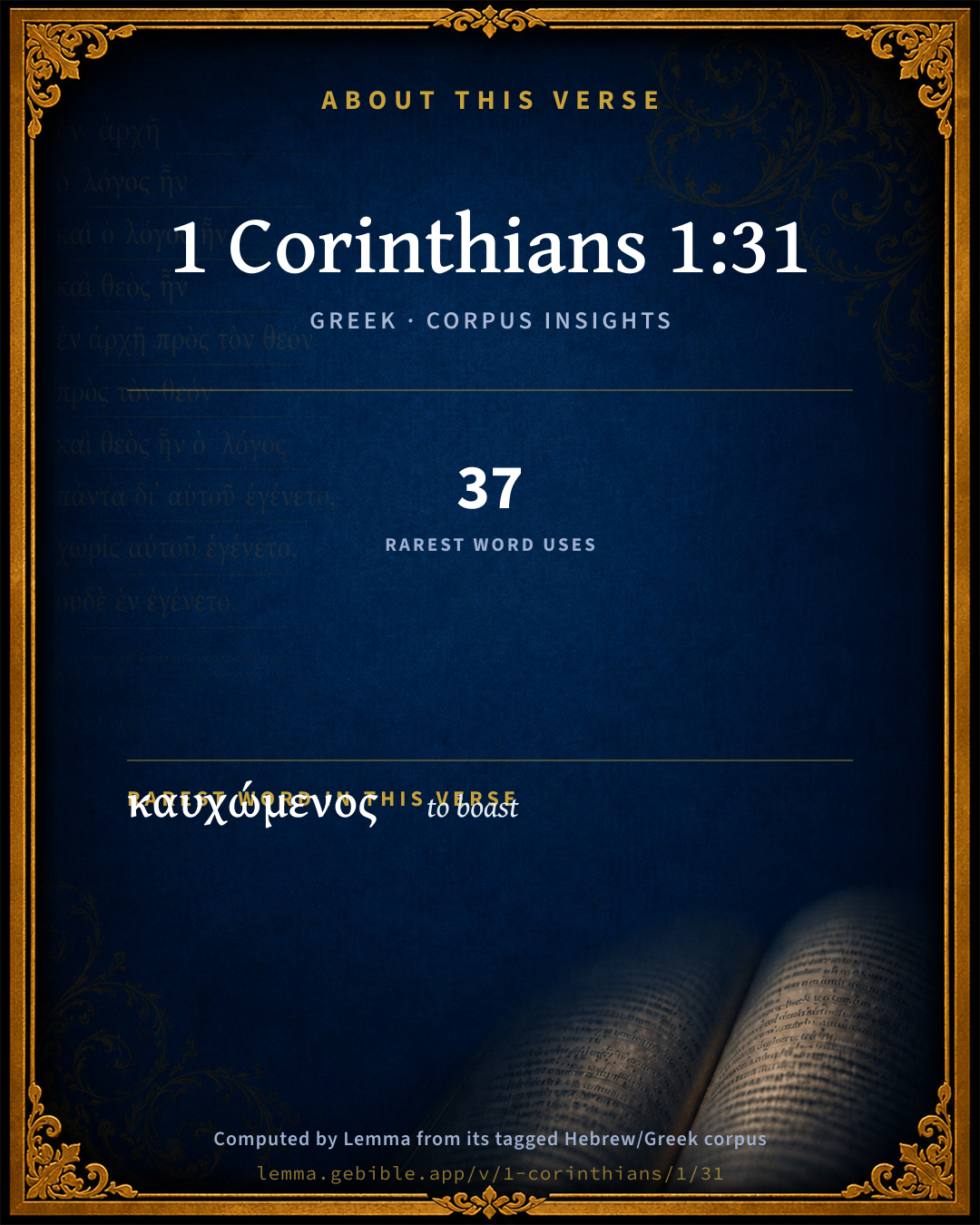
1 Corinthians 1:31

Greek (Tischendorf 8th ed.) 1 Corinthians 1:31 appears in the Greek New Testament. The text above is from the Tischendorf 8th edition. Each word links to its Strong’s number and a concise gloss. Click any word for its full Thayer’s Greek Lexicon entry.
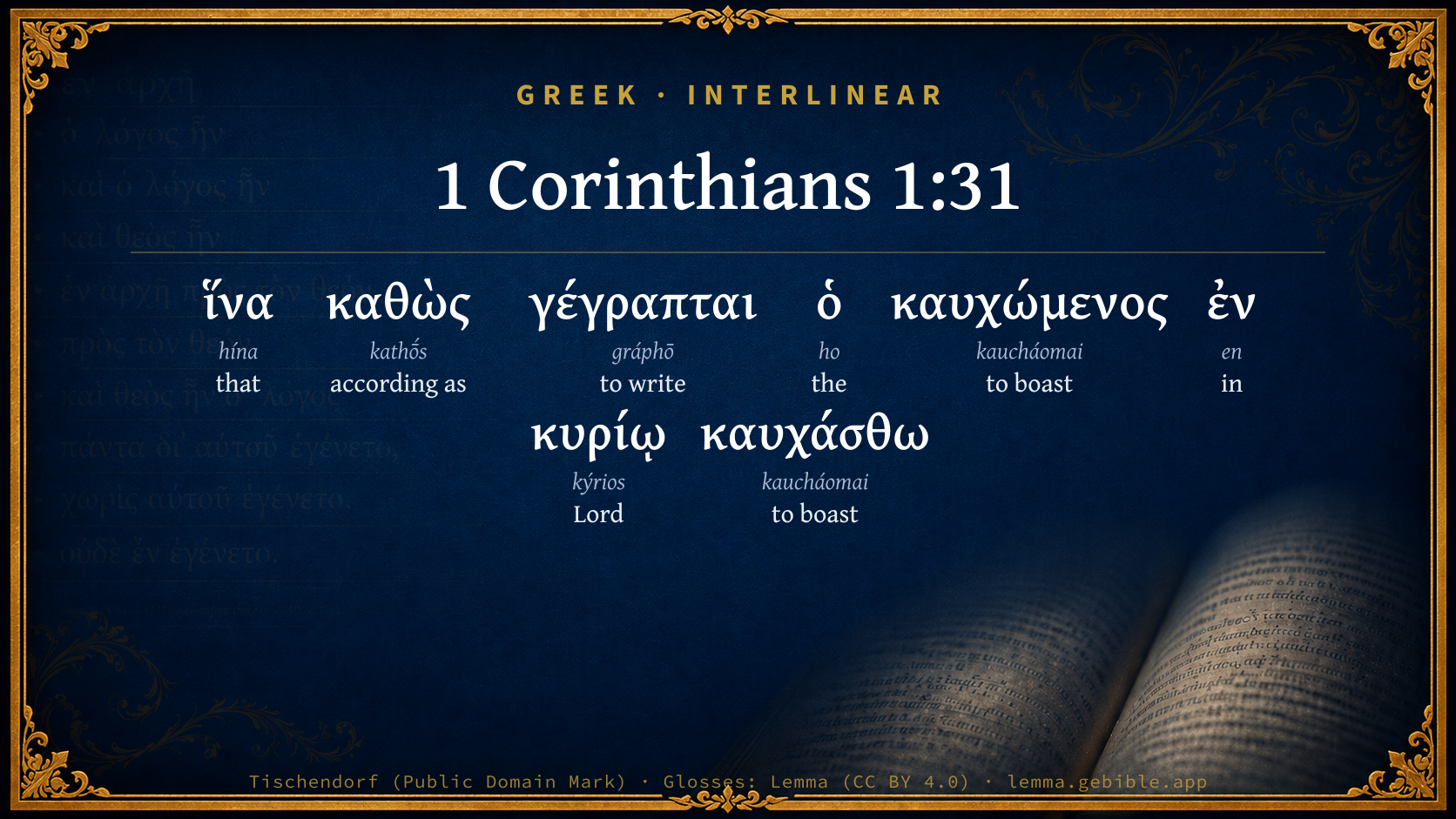
Download image
Cite this verse

1 Corinthians 1:31 (World English Bible). Public Domain. Lemma interlinear Bible study tool, https://lemma.gebible.app/v/1-corinthians/1/31.

Show BibTeX & RIS
BibTeX
RIS
English Translation
that, according as it is written, "He who boasts, let him boast in the Lord."
World English Bible · Public Domain
Download a study sheet

One document with this verse’s original text, its word-by-word gloss line, the meaning frame, cross-references with their text, attributed commentary, and full source and license credits — printable, and it pastes into notes with its structure intact.

This verse Autodidact and up

Study sheet (.html) Plain text (.txt)

A passage Seminary Student

Up to 50 verses in one chapter. A passage sheet keeps up to 6 commentary sources and 12 cross-references per verse, in the order this page ranks them, and says so on the sheet whenever that leaves anything out. Ask for a single verse and you get the Autodidact verse sheet above.

Everything on this page stays free to read, with no account — the sheet is a download of what is already on screen, not access to it.

Want to remove ads? Support Godless Engineer
Compare translations 3

The same verse in 3 English versions, stacked beneath the original-language interlinear above. Click any original word for its lexicon entry.

Each is an independent rendering of the whole verse — the interlinear is not word-aligned to these translations.

Highlighted words mark where these versions differ — a whole-verse word diff, not a word-by-word alignment.

  • World English Bible Public Domain
    that, according as it is written, "He who boasts, let him boast in the Lord."
  • King James Version Public Domain
    That, according as it is written, He that glorieth, let him glory in the Lord.
  • unfoldingWord Literal Text CC BY-SA 4.0
    so that, just as it is written, “Let the one boasting, boast in the Lord.”

unfoldingWord Literal Text — © unfoldingWord, licensed CC BY-SA 4.0. Word-aligned USFM3 via Door43 (git.door43.org/unfoldingWord/en_ult).

Versions to compare (up to 4)

3 of 4 selected

Show all 19 translations

Every available English version of this verse, each an independent rendering of the whole verse.

  • World English Bible Public Domain
    that, according as it is written, "He who boasts, let him boast in the Lord."
  • Berean Standard Bible Public Domain
    Therefore, as it is written: “Let him who boasts boast in the Lord.”
  • Majority Standard Bible Public Domain
    Therefore, as it is written: “Let him who boasts boast in the Lord.”
  • King James Version Public Domain
    That, according as it is written, He that glorieth, let him glory in the Lord.
  • American Standard Version (1901) Public Domain
    that, according as it is written, He that glorieth, let him glory in the Lord.
  • Revised Version (1885) Public Domain
    that, according as it is written, He that glorieth, let him glory in the Lord.
  • Geneva Bible (1599) Public Domain
    That, according as it is written, Hee that reioyceth, let him reioyce in the Lord.
  • Douay-Rheims (1899) Public Domain
    That, as it is written: He that glorieth, may glory in the Lord.
  • Young's Literal Translation Public Domain
    that, according as it hath been written, `He who is glorying -- in the Lord let him glory.'
  • Literal Standard Version CC BY-SA 4.0
    that, according as it has been written: “He who is glorying—let him glory in the LORD.”
  • Unlocked Literal Bible CC BY-SA 4.0
    As a result, as scripture says, “Let the one who boasts, boast in the Lord.”
  • unfoldingWord Literal Text CC BY-SA 4.0
    so that, just as it is written, “Let the one boasting, boast in the Lord.”
  • Darby Bible Public Domain
    that according as it is written, He that boasts, let him boast in [the] Lord.
  • World Messianic Bible Public Domain
    that, as it is written, “He who boasts, let him boast in the Lord.”
  • Webster's Bible Public Domain
    That, according as it is written, He that glorieth, let him glory in the Lord.
  • Free Bible Version CC BY-SA 4.0
    So as Scripture says, “Whoever wants to boast, let them boast in the Lord.”
  • Bible in Basic English Public Domain
    So that, as it is said in the holy Writings, Whoever has a desire for glory, let his glory be in the Lord.
  • Text-Critical English NT CC BY 4.0
    Therefore, as it is written, “Let him who boasts, boast in the Lord.”
  • Tyndale New Testament (1534) Public Domain
    That accordinge as it is written: he which reioyseth shulde reioyce in the Lorde.

Literal Standard Version (2020), Covenant Press — licensed CC BY-SA 4.0. Text via the HelloAO Bible API (eBible.org). Unlocked Literal Bible (unfoldingWord) — licensed CC BY-SA 4.0. Text via the HelloAO Bible API (eBible.org). unfoldingWord Literal Text — © unfoldingWord, licensed CC BY-SA 4.0. Word-aligned USFM3 via Door43 (git.door43.org/unfoldingWord/en_ult). Free Bible Version, Dr. Jonathan Gallagher — licensed CC BY-SA 4.0. Text via the HelloAO Bible API (eBible.org).

Word by word

More ways to search: Search by grammar → Find every occurrence → Compare this word →

Practice this passage: Drill this verse → Learn its vocabulary →

About this verse

These counts appear in no published source. They are computed here, from the morphology-tagged text and Lemma’s own curated glosses. What Lemma adds →

8
words
7
distinct lemmas
Pauline Epistles
section

Shared distinctive vocabulary

καυχώμενος to boast G2744 occurs in 32 verses of the Greek New Testament. Also found in:

Repetition

A word recurs within this verse:

  • καυχώμενος to boast G2744 ×2

Cross-references

10

Topical passages linked to 1 Corinthians 1:31 in the Treasury of Scripture Knowledge — connected by theme and wording, ordered by reader-vote popularity; previews shown in the World English Bible.

  • Jeremiah 9:23–24 Thus says Yahweh, Don't let the wise man glory in his wisdom, neither let the mighty man glory in his might, don't let the rich man glory in his riches;
  • 2 Corinthians 10:17 But "he who boasts, let him boast in the Lord."
  • Philippians 3:3 For we are the circumcision, who worship God in the Spirit, and rejoice in Christ Jesus, and have no confidence in the flesh;
  • Psalms 105:3 Glory in his holy name. Let the heart of those who seek Yahweh rejoice.
  • Isaiah 41:16 You shall winnow them, and the wind shall carry them away, and the whirlwind shall scatter them; and you shall rejoice in Yahweh, you shall glory in the Holy One of Israel.
  • 1 Chronicles 16:10 Glory you in his holy name; Let the heart of them rejoice who seek Yahweh.
  • Isaiah 45:25 In Yahweh shall all the seed of Israel be justified, and shall glory.
  • Jeremiah 4:2 and you shall swear, As Yahweh lives, in truth, in justice, and in righteousness; and the nations shall bless themselves in him, and in him shall they glory.
  • Galatians 6:13–14 For even they who receive circumcision don't keep the law themselves, but they desire to have you circumcised, that they may boast in your flesh.
  • 1 Chronicles 16:35 Say you, Save us, God of our salvation, Gather us together and deliver us from the nations, To give thanks to your holy name, To triumph in your praise.

Cross-references courtesy of OpenBible.info (CC BY 4.0).

Commentary

Notes on 1 Corinthians 1:31 from classic Christian and Jewish commentators (each source and its license shown beneath its notes). The classic Christian expositions comment on the surrounding passage and are grouped to its opening verse, so a note may address several verses; the Jewish commentaries on the Tanakh (Rashi and others) are per-verse, so they appear only where the commentator wrote on this verse.

Lemma curates 59 commentaries, every one of them public domain or Creative Commons licensed, each selected and text-cleaned for this edition rather than reprinted as found. About our sources →

The Biblical Illustrator

Joseph S. Exell

1Co_1:31

He that glorieth, let him glory in the Lord.

Glorying in the Lord

here is an irresistible tendency in us to glory in something or other. All classes of men glory. Good people have the tendency to glory, and sometimes they glory in unworthy objects, and therefore God has prepared a cure for it--not by repressing the instinct, but by giving it a worthy subject. The prevention or cure of glorying in men, in riches, and in self, is glorying in the Lord. Let us--

I. Glory only in the Lord. Because--

1. The theme is too great to admit of another. If God fills all in all, there can be no other god; and if the glory of God be infinite, then there can be no second glory.

2. Any other object highly provokes the Most High. He has said, My glory will I not give to another, nor My praise to graven images. Where the ark of the Lord is, Dagon must come down. God will be all, or nothing. Think of Nebuchadnezzar, Belshazzar, and Herod.

3. There is no other fit ground for glorying.

(1) If there were some other object in which we thought we could glory, yet since it came from Him it would be idle to glory in the streams, we had better boast in the fountain-head from which the stream descends.

(2) Moreover, all things in this world are fleeting, and wherefore should we glory in that which to-day is, and to-morrow will pass away? Let your glory be in that which will last as long as your own being.

(3) Besides, there is nothing in this world worth glorying in, in comparison with God. He is the sun; the stars must hide their heads when He appears. Let us bless the eternal ocean of all-sufficient glory and goodness, and not turn aside to magnify our little Abanas and Pharpars.

4. When we do so we shall be in accord with the true order of the universe.

(1) With creation The heavens are telling the glory of God. All Thy works praise Thee, O God. Creation is a temple in which every one speaks of His glory.

(2) With Providence. For of Him and through Him and to Him are all things, to whom be the glory for ever.

(3) With the angels. What is their song? Glory to God in the highest.

(4) With the Divine Trinity; for what does the Father do but glorify the Son? What does the Son aim at when He says, Father, glorify Thy Son ? It is, that Thy Son also may glorify Thee. What does the Holy Spirit do when He takes of the things of Christ, and shows them unto us? Has not Jesus said of Him, He shall glorify Me ?

II. Glory heartily in the Lord. Because of--

1. His love. Glory in--

(1) Its antiquity. I have loved thee with an everlasting love!

(2) In its wonderful benefactions.

(3) In its freeness. He loved us because He would love us; not because we were lovely, but because He was love. Glory in it, therefore, all the day long, for well you may. He loved me, and gave Himself for me.

2. His faithfulness. Whom once He loves He never leaves, but loves them to the end.

3. His holiness. Bless the Lord, O my soul, and All that is within me, bless--His gracious name, is it? No. His loving name? No; but His holy name, because the whole includes all the parts, and the holiness, or the wholeness of God is a grander thing than any one of the distinct attributes which make up His character. Glory in the holiness of God, for there is none holy as the Lord. It is this which angels glory in, for as they veil their faces, they say, Holy, holy, holy, Lord God of hosts.

4. His all-sufficiency, and the liberality with which He distributes His mercies among His chosen. In Christ Jesus is not one good thing given to us, but every good thing. Do we need to be instructed? Christ is oar wisdom. Do we need to be clothed in the sight of God with a righteousness that shall render us acceptable? Christ is our righteousness. Do we need to be purified and cleansed? Christ is our sanctification. And do we need to be set free and delivered from all bondage? Christ is our redemption.

5. The nearness and dearness of the relationship which God holds to us. The mar, who can bow his knee, and say from his heart, Our Father, has more to glory in than the emperor of the grandest nations. Is Christ my Brother? I am ennobled by that relationship.

III. Glory in the Lord growingly. That is to say, we should glory in God in proportion as we learn more of Him, and receive more from Him. Glory growingly in the Lord as you know more of Him--

1. By revelation. And as you see more of Him, go and tell abroad more of Him, and let others know what a glorious God you serve.

2. By experience. Never let a special season pass without praising Him; and as answers to prayer increase, as grace is given to you in times of need, and as you see converting work going on in others glorify Him more. By and by, as time rolls on, we shall know more of the Lord, and get to be more like Him, and approach nearer to the glory itself. Beholding that glory, as in a glass, we are changed from glory to glory, as by the image of the Lord.

IV. Glory in the Lord practically.

1. By owning that you belong to Him. A man does not hide away that which he glories in. Charge a veteran with having been at Waterloo, and he will glory in it. Accuse an artist of being a Royal Academician, and he will own the charge. Abuse me for loving my wife and children, and I smile at you. Why, then, blush to be called a follower of Jesus?

2. By talking about Him on all fit occasions. We are too reticent in our piety. As the rose betrays itself by its perfume, and the glowworm by its shining, so should our glorying in the Lord discover us to all observers. A foreigner may speak English well, but he is known by his accent, and the accent of grace is quite as marked as that of nature.

3. By standing up for Him when He is opposed. If you hear the proud ones ridicule His gospel, and despise His people, put in a word for Jesus.

4. By being calm under your troubles.

5. By having a contempt for those things which others value so much. Do not be greedy after the world. (C. H. Spurgeon.)

True glorying

Man--

I. Loves to glory.

II. Has nothing in himself of which he can glory.

III. Should glory in the Lord--who--

1. Has given him all.

2. Redeemed all.

3. Is become his portion for ever. (J. Lyth, D. D.)

God exalted and creatures humbled by the gospel

That men are sinners I shall assume. If, then, there is any salvation for them, it must be by grace. And such a salvation cannot fail to exalt God and humble the sinner. None will deny that the world are proud. The tendency of the gospel to exalt God and humble the creature appears--

I. In its outward administration. This includes--

1. The humble appearance of Christ in our world. When we understand the reasons of this humble appearance of Christ, we see in it the wisdom of God; but had it been left to us beforehand, we should have assigned Him the most magnificent state. Thus did the wisdom of man pronounce. Indeed, the pride of man, showing itself in lofty pretensions to the omniscience of wisdom, was seen to be the most intrepid enemy which the religion of heaven had to encounter. It therefore was a main point in the outset to overwhelm this enemy with convictions of his own ignorance and folly and of the far superior wisdom of God. In all these proud pretensions reason aspires to a place for which it was never designed. It is not its province to penetrate the mysteries of the universe by its own ken, but to work up into judgments materials furnished by information. It is the eye, but it cannot see without, light. In no other science but that which relates to the incomprehensible God and to the interests and government of the universe, does reason attempt to build on its own independent discoveries. The anatomist does not presume to tell you how a man ought to be made, but with all submission proceeds to examine the animal system which God has exposed to his view. And why does man act so differently in this case from what he does in all others? Because in other sciences he wishes to obtain accurate knowledge; in this, relief to his conscience and fears and mortified pride. He does not like God, and wishes to modify Him after his own taste.

2. Another way in which the outward administration of the gospel took the pride of the world, was in the weakness of the instruments employed, the simplicity of their preaching, and their triumphant success. Instead of angels or Jewish doctors or Grecian philosophers, Christ chose fishermen.

II. The same tendency appears in the texture of the gospel. This is noticed in our text and the preceding verse. But of him are ye in Christ Jesus, who of God is made unto us wisdom and righteousness and sanctification and redemption; that, according as it is written, He that glorieth let him glory in the Lord.

1. Our wisdom. Instead of ignorant and prejudiced reason, on which the wise men of the world proudly rested for the discovery of God, Christ, the great Prophet of the world, was appointed to lay open the secrets of the eternal mind, and to bring life and immortality to light; No man hath seen God at any time; the only begotten Son, which is in the bosom of the Father, He hath declared Him.

2. Our righteousness. There is nothing to which men more strongly adhere than to the claims of their own merit. The whole texture of the gospel is fitted to put down this arrogant pretender, to annihilate the last lurking pride of man.

(1) The atonement.

(2) The obedience of Christ.

(3) The intercession of Christ.

But the soul-humbling and God-exalting process is not yet ended. Not only are the atonement, obedience, and intercession of Christ thus provided, in a way to support the rights and claims and government of God, to condemn sin, and cover pride with eternal confusion; but no man is allowed to share in this salvation until, from the bottom of his heart, he has approved of all these measures and all their expressions; until he has taken back all his proud speeches against God, and bent his imperious head to his Makers feet. Even pardon itself buries the sinner still lower in the dust. This is none of that poverty of spirit which involves degradation. It is only viewing things according to truth.

III. The same tendency of the gospel appears in its application. Christ is made of God unto us sanctification, that, according as it is written, He that glorieth let him glory in the Lord. As the race were condemned by the law to the curse of eternal abandonment, the Spirit could not come to men without the mediation of Christ. The heathen philosophers depended on the self-determining power of the will for all their personal virtue, and on their self-Caught ethics for the reformation of the world. In opposition to all these proud aspirations, the gospel casts the world fur sanctification on the Spirit of God and the purchase of Christ. Nor is this all. In their spiritual death it finds nothing in them to aid their resurrection, and ascribes to God, not only the whole power, but a conquering power, the working of mighty power, as great as that which He wrought in Christ when He raised Him from the dead and set Him at His own right hand in the heavenly places. Thus every part of the gospel is calculated to abase the pride of man, to break and subdue and humble the sinner, to support the rights, the claims, the government of God, and to give all the glory to Him. Whatever light or holiness or title to salvation we possess, comes from God through the Redeemer. Whatever brings out God to view, exalts Him, abases sinners, and humbles and blesses the creation. Let us, then, see what and how much of God is revealed in the plan of salvation. In the first place, the Father, Son, and Holy Ghost are brought out to view in their own proper and infinitely important characters; a distinction never whispered to the universe in any of His other works. In the next place, His inflexible resolution, at all hazards, to support His moral empire over the creation, comes out; disclosing His infinite attachment to all the principles of His law and to the happiness which it subserves, and thus manifesting His holiness, justice, and benevolence. In the next place, His amazing compassion and mercy and patience and condescension and accessibleness and truth are brought to light; His power, too, in subduing the carnal heart, in restraining, bounding, and defeating all the machinations of Satan. But the wisdom elicited is that on which I wish chiefly to dwell. This wonderful plan of the Incarnation was the forming of a connecting link between finite and infinite natures, and filling up the whole chasm between God and us. He confounded the wisdom of men by the triumphs of that very weakness which provoked their contempt, and by making, in various ways, the most unpromising means lead to the most splendid success. He so shaped the gospel, that, in every part, it should be at war with pride, and touch it in every tender spot, and call into the field every arm of that foe, and exhibit it before heaven and earth in the hideous attitude of warring against all the love and authority of the gospel. He pressed into the service of His cause all the agents in the wicked world; the policy of kings, the pride of philosophers, the craft of priests, and the very ferocity of bloody persecution. He defeated all the stratagems ,of Satan and effectually bruised the serpents head. Elect man is a gainer by his own ruin. His sin is made the occasion of higher advances in holiness; for to whom much is forgiven the same loveth much. His misery is made the occasion of his greater blessedness. And finally, the wisdom of God appears in that capital measure to vindicate His own impartiality, the appointment of the Friend and Brother of man to be his Judge. The Father hath given Him authority to execute judgment also because He is the Son of man. Why should you think that this grandest of all the exhibitions of God will be shut up in the nut-shell of a single world? (E. D. Griffin,. D. D.)

.

The Biblical Illustrator, edited by Joseph S. Exell (c. 1880s–1900s) — public domain. Text from a community e-Sword module.

Tyndale Open Study Notes

Tyndale Open Resources

1:31 This quotation is a paraphrase of Jer 9:24 (cp. 2 Cor 10:17). Because salvation is a result of God’s sovereign power (1 Cor 2:5) and his decision to save his people, there is absolutely no room for human pride (see 1:29).

Tyndale Open Study Notes — © Tyndale Open Resources, licensed CC BY-SA 4.0. Text via the HelloAO Bible API.

Bengel's Gnomon

Johann Albrecht Bengel

1Co 1:31. Ἵνα, that) viz. it may be.—ὁ καυχώμενος, he who glories) It is not the privilege of all to glory.—ἐν Κυρίῳ, in the Lord) not in himself, not in the flesh, not in the world.

Bengel's Gnomon of the New Testament — English translation (T&T Clark, Edinburgh, 1860) — public domain. Text from a community e-Sword module.

Meyer's Critical & Exegetical Commentary

Heinrich August Wilhelm Meyer

1Co_1:31. The fact that God is the author of your connection with Christ, and thereby of the blessings you receive as Christians (1Co_1:30), should, according to the divine purpose (ἵνα), determine you to comply with that word of Scripture which calls for the true lowly καυχᾶσθαι: he that boasteth himself, let him boast himself in the Lord, praise his own privileges only as Gods work, boast himself only as the object of His grace.

That the Κύριος is not Christ (Rückert) but God, and not Christ and God (Hofmann), is proved by the emphatic ἐξ αὐτοῦ, 1Co_1:30, and ἐνώπ. τ. Θεοῦ, 1Co_1:29. Comp on 2Co_10:17.

The apostle quotes Jer_9:24, abbreviating quite freely, after the LXX. The construction, however, is anacoluthic; for Paul purposely retains the scriptural saying unaltered in its strong imperative form, and leaves it to the reader to supply the change from the imperative to the subjunctive, which the syntax, properly speaking, would require. Comp on Rom_15:3.

Meyer — Critical and Exegetical Commentary on the New Testament — English translation by Peter Christie, edited by Frederick Crombie (T&T Clark, 1880) — public domain. Text from a community e-Sword module.

Expositor's Greek Testament

ed. W. Robertson Nicoll

1Co 1:31 . “In order that, as it stands written, he who glories, in the Lord let him glory;” by “the Lord” the readers could only understand Christ , already five times thus titled; so, manifestly, in 2Co 10:17 f., where the citation reappears. Paul quotes the passage as a general Scriptural principle, which eminently applies to the relations of Christians to Christ; ἐν Κυρίῳ belongs to his adaptation of the original: God will have no flesh (see note, 1Co 1:29 ) exult in his wisdom, strength, high birth ( cf. the objects of false glorying in Jer [284] ) before Him; He will have men exult in “the Lord of glory” (1Co 2:8 ; cf. Phi 2:9 ff.), whom He sent as His own “wisdom” and “power unto salvation” (1Co 1:24 ; 1Co 1:30 ). What grieves the Ap. most and appears most fatal in the party strifes of Cor [285] , is the extolling of human names by the side of Christ’s and at his expense (see notes on 12 15; also 1Co 3:5 ; 1Co 3:21-23 , and 2Co 4:5 , Gal 6:14 ). Christians are specifically οἱ καυχώμενοι ἐν Χ . Ἰ ., Phi 3:3 . The irregularity of mood after ἵνα καυχάσθω for subj. καυχᾶται s accounted for in two ways: either as in anacoluthon , the impv [286] of the origina. being transplanted in lively quotation ( cf Rom 15:3 ; Rom 15:21 ); or as an ellipsis , with γένηται or πληρωθῇ mentally supplied ( cf. Rom 4:16 , Gal 2:9 , 2Co 8:13 ) explanations not materially different. Clem. Rom. (§ 13) quotes the text with the same peculiarity.

[284] Jerome, Hieronymus.

[285] Corinth, Corinthian or Corinthians.

[286] imperative mood.

The Expositor's Greek Testament, edited by W. Robertson Nicoll (1897–1910) — public domain. Text from a community e-Sword module.

Hodge's Commentary on Romans, Ephesians & First Corinthians

Charles Hodge

1Co_1:31

That, according as it is written, He that glorieth, let him glory in the Lord.

That, i.e. in order that. The design of God in making wisdom, righteousness, sanctification, and redemption dependent on union with Christ, and union with Christ dependent, not on our merit, but on his own good pleasure, is that we should glory only in him; that is, that our confidence should be in him and not in ourselves, and that all the glory of our salvation should be ascribed to him and not to us. Such being the design of God in the work of redemption, it is obvious we must conform to it in order to be saved. We must seek wisdom, righteousness, sanctification, and redemption only in Christ; and we must seek union with Christ as an undeserved favor.

The passage quoted is probably Jer_9:23, Jer_9:24 the sense of which is condensed. In quoting the Old Testament the apostle frequently cites the words as they stand, without so modifying them as to make them grammatically cohere with the context. As in the Septuagint, which he quotes, the imperative mood is used, the apostle here retains it, and instead of saying, In order that he who glories should glory in the Lord, he says That, He that glories let him glory in the Lord. Comp. Jer_2:9. Rom_15:3.

Charles Hodge — Commentary on Romans (1835), First Corinthians (1857), and Ephesians (1856) — public domain. Text from a community e-Sword module.

Geneva Bible (1599)

Geneva Bible translators

Let him yield all to God and give him thanks: and so by this place is man’s free will beaten down, which the Papist so dream of.

Geneva Bible (1599) marginal notes — public domain. Text via Bolls.life.

Jamieson, Fausset & Brown

Robert Jamieson, A. R. Fausset & David Brown

glory in . . . Lord-- (Jer 9:23-24) --in opposition to "flesh glorying in His presence" (Co1 1:29). In contrast to morbid slavish self-abasement, Paul joins with humility the elevating consciousness of our true dignity in Christ. He who glories is to glory in the Lord, not in the flesh, nor in the world.

Next: 1 Corinthians Chapter 2

Jamieson, Fausset & Brown — Commentary Critical and Explanatory on the Whole Bible (1871) — public domain (CC PDM 1.0). Text via the HelloAO Bible API.

Adam Clarke's Commentary

Verse 31. According as it is written] In Jer 9:23-24: Thus saith the Lord, Let not the wise man glory in his wisdom, neither let the mighty man glory in his might; let not the rich man glory in his riches; but let him that glorieth glory in this: That he understandeth and knoweth me, that I am the Lord, which exercise loving-kindness, judgment, and righteousness, in the earth. So then, as all good is of and from God, let him that has either wisdom, strength, riches, pardon, holiness, or any other blessing, whether temporal or spiritual, acknowledge that he has nothing but what he has received; and that, as he has cause of glorying (boasting or exultation) in being made a partaker of these benefits and mercies of his Creator and Redeemer, let him boast in God alone, by whom, through Christ Jesus, he has received the whole.

1. THIS is an admirable chapter, and drawn up with great skill and address. The divided state of the Corinthian Church we have already noticed, and it appears that in these factions the apostle's authority had been set at nought by some, and questioned by many. St. Paul begins his letter with showing his authority; he had it immediately through Christ Jesus himself, by the will of God. And indeed the success of his preaching was a sufficient proof of the Divinity of his call. Had not God been with him he never could have successfully opposed the whole system of the national religion of the Corinthians, supported as it was by the prejudice of the people, the authority of the laws, and the eloquence and learning of their most eminent philosophers. It was necessary, therefore, that he should call the attention of this people to the Divine origin of his mission, that they might acknowledge that the excellency of the power was of God, and not of man.

2. It was necessary also that he should conciliate their esteem, and therefore speak as favourably concerning them as truth would allow; hence he shows them that they were a Church of God, sanctified in Christ Jesus, and called to be saints; that they abounded and even excelled in many extraordinary gifts and graces; and that they were not inferior to any Church of God in any gift. And he shows them that they received all these through God's confirmation of that testimony which he had delivered among them, 1Co 1:4-7.

3. When he had thus prepared their minds to receive and profit by his admonitions he proceeds to their schisms, which he mentions and reprehends in the most delicate manner, so that the most obstinate and prejudiced could take no offence.

4. Having gained this point, he gently leads them to consider that, as God is the fountain of all good, so their good had all come from him; and that none of them should rest in the gift, but in the giver; nor should they consider themselves as of particular consequence on account of possessing such gifts, because all earthly good is transitory, and those who trust in power, wisdom, or wealth, are confounded and brought to nought; and that they alone are safe who receive every thing as from the hand of God, and, in the strength of his gifts, glorify him who is the donor of all good. He who can read this chapter without getting much profit has very little spirituality in his soul, and must be utterly unacquainted with the work of God in the heart.

Adam Clarke's Commentary on the Bible (1810–1826) — public domain. Text from a community e-Sword/MySword module.

John Calvin's Commentaries

31. He that glorieth let him glory in the Lord Mark the end that God has in view in bestowing all things upon us in Christ — that we may not claim any merit to ourselves, but may give him all the praise. For God does not despoil with the view of leaving us bare, but forthwith clothes us with his glory — yet on this condition, that whenever we would glory we must go out of ourselves. In short, man, brought to nothing in his own estimation, and acknowledging that there is nothing good anywhere but in God alone, must renounce all desire for his own glory, and with all his might aspire and aim at the glory of God exclusively. This is also more clearly apparent from the context in the writings of the Prophet, from whom Paul has borrowed this testimony; for in that passage the Lord, after stripping all mankind of glory in respect of strength, wisdom, and riches, commands us to glory only in knowing him, (Jeremiah 9:23, 24.) Now he would have us know him in such a way as to know that it is he that exercises judgment, righteousness, and mercy For this knowledge produces in us at once confidence in him and fear of him. If therefore a man has his mind regulated in such a manner that, claiming no merit to himself, he desires that God alone be exalted; if he rests with satisfaction on his grace, and places his entire happiness in his fatherly love, and, in fine, is satisfied with God alone, that man truly “glories in the Lord.” I say truly, for even hypocrites on false grounds glory in him, as Paul declares, (Romans 2:17,) when being either puffed up with his gifts, or elated with a base confidence in the flesh, or abusing his word, they nevertheless take his name upon them.

John Calvin's Commentaries (1540-1563) — public domain. Text from the Calvin Translation Society English edition (1840s-50s) via the Christian Classics Ethereal Library (ccel.org). Calvin's coverage is partial (roughly two-thirds of the Bible); uncommented books and verses are honest gaps, never fabricated. The 19th-century editor's footnotes and remarks are omitted so the notes are faithfully Calvin's own voice.

Ellicott's Commentary for English Readers

(31) That.—So that it might be as the prophet wrote, “He that boasteth, let him boast in the Lord.” This is not a literal quotation, but only an adaptation and paraphrase from the LXX. of Jer_9:23-24. Our only true boasting before God is that we are in Christ, that all we have we owe entirely to Him; we can only glory in, not ourselves or what we have or are, but in the fact that He is our benefactor. Thus, in St. Chrysostom’s quaint words, Paul “always fasteneth them on with nails to the name of Christ.”

This concludes St. Paul’s general explanation of God’s method, and he then turns to his own conduct, to show how entirely it was in harmony with God’s plan, which he has just explained and vindicated.

A Bible Commentary for English Readers, edited by Charles John Ellicott (1878–1897) — public domain. Text from a community e-Sword module.

The Cambridge Bible for Schools and Colleges

gen. ed. J. J. S. Perowne

31. He that glorieth, let him glory in the Lord] The whole work of salvation is of God. The Corinthians, like many others since, were inclined to take some of the credit to themselves. The Apostle reminds them to Whom it is due. These words are a paraphrase of Jer_9:23-24.

The Cambridge Bible for Schools and Colleges (gen. ed. J. J. S. Perowne; Cambridge University Press, 1878–1918) — public domain. Text from a community e-Sword module.

John Gill's Exposition

That, according as it is written,.... Jer 9:23.

He that glorieth, let him glory in the Lord; not in his own wisdom, riches, and strength; but in Christ, as his wisdom, righteousness, sanctification, and redemption.

Next: 1 Corinthians Chapter 2

John Gill's Exposition of the Whole Bible (1746–1763) — public domain (CC PDM 1.0). Text via the HelloAO Bible API.

Trapp's Complete Commentary

John Trapp

31 That, according as it is written, He that glorieth, let him glory in the Lord.

Ver. 31. Glory in the Lord] Acquiesce and exult in him, which is the end why God hath done all this for us in Christ.

John Trapp, A Commentary or Exposition upon All the Books of the Old and New Testament (1647–1656) — public domain. Text from a community e-Sword module.

Albert Barnes' Notes on the Bible

As it is written - This is evidently a quotation made from Jer 9:23-24. It is not made literally; but the apostle has “condensed” the sense of the prophet into a few words, and has retained essentially his idea.

He that glorieth - He that boasts or exults.

In the Lord - Not ascribing his salvation to human abilities, or learning, or rank, but entirely to God. And from this we see:

(1) That the design of the plan of salvation is to exalt God in view of the mind.

(2) That the design is to make us humble; and this is the design also of all his works no less than of the plan of salvation. All just views of the creation tend to produce true humility.

(3) It is an evidence of piety when we are thus disposed to exalt God, and to be humble. It shows that the heart is changed; and that we are truly disposed to honor him.

(4) We may rejoice in God. We have no strength, and no righteousness of which to boast; but we may rejoice in him. He is full of goodness and mercy. He is able to save us. He can redeem us out of the hand of all our enemies. And when we are conscious that we are poor, and feeble, and helpless; when oppressed with a sense of sin, we may rejoice in him as our God; and exult in him as our Saviour and Redeemer. True piety will delight to come and lay everything at his feet; and whatever may be our rank, or talent, or learning, we shall rejoice to come with the temper of the humblest child of poverty, and sorrow, and lack, and to say, “not unto us, not unto us, but unto thy name give glory for thy mercy, and for thy truth’s sake,” Psa 115:1.

“Not to our names, thou only just and true,

Not to our worthless names is glory due;

Thy power and grace, thy truth and justice claim.

Immortal honours to thy sovereign name.”

Watts.

Albert Barnes' Notes on the Bible (1834–1885) — public domain. Text from a community e-Sword/MySword module.

Matthew Poole's English Annotations

God doth this, or hath done this, for this end, that man should have nothing to glory in, neither wisdom, nor righteousness, nor sanctification, nor redemption, but should glory in the Lord; acknowledging that whatsoever wisdom, righteousness, or holiness he hath, it is all from God, in and through the Lord Jesus Christ.

Matthew Poole's English Annotations on the Holy Bible (1683–1685) — public domain. Text from a community e-Sword/MySword module.

Whedon's Commentary on the Bible

Daniel D. Whedon

31. Written—According to the Septuagint, Jer_9:24.

In the Lord—That is, in Jehovah, and not in any human unreality, in the face of all the power, aristocracy, wealth, philosophy, and vice of Corinth, the believer is taught by Paul calmly to rest in the consciousness that he possesses a gift and a glory before which these were pompous nothings.

Daniel D. Whedon (gen. ed.), Commentary on the Old and New Testaments (1874–1909) — public domain. Text from a community e-Sword module.

The Pulpit Commentary

As it is written. A compressed quotation from the Septuagint Version of Jer_9:23, Jer_9:24; 1Sa_2:10. Let him glory in the Lord. The word rendered "glory" is more literally, boast. The reference is Jer_9:23, Jer_9:24; 1Sa_2:10 (LXX). The prevalence of "boasting" among the Corinthians and their teachers drove St. Paul to dwell much on this word from which he so greatly shrinks in, 2Co_10:12. (where the word occurs twenty times) and to insist that the only true object in which a Christian can glory is the cross, (Gal_6:14) not in himself, or in the world, or in men.

Glorying in the Lord.

The one condition of spiritual blessing, upon which Scripture universally insists, is humility. The lowly are assured of acceptance, and the proud and self confident are condemned to rejection. The terms of Christianity correspond with the teaching of the Old Testament; for it is to the poor in spirit and to the meek, to the child like in character and disposition, that the blessings of the new covenant are assigned. The same spirit which is a means of obtaining the blessings of Christianity is distinctive of those who possess these blessings. They have received all they enjoy from the free grace of God, and it is their delight to abase themselves and to exalt him from whom they have derived their spiritual privileges and prospects. They may glory, but it is not in anything which is their own; it is in him of whom and to whom are all things.

I CHRISTIANS REPUDIATE ALL GLORYING IN SELF.

1. In their own possessions anal powers. There is a natural tendency to think highly of self, and to depreciate our fellow men and their gifts, and to forget our God the Giver of all. But the very fact that we are Christians is conclusive against the lawfulness of such moral habits. God has made us; Christ has redeemed us, and we are not our own.

2. In the gifts of God"s providence. To boast of wealth, or nationality, or family, is to overlook the great question, "What hast thou that thou didst not receive?

3. In their privileges. This the Jews were constantly in the habit of doing; they boasted that they were Abraham"s children, and Moses" disciples, etc. If highly favoured by Christian privilege, let Christ s people be upon their watch lest they claim credit for what they owe to the free grace of God.

4. In their attainments. The Corinthians seem to have been in special danger of falling into this snare. Human learning and philosophy may very possibly become an occasion of stumbling and reproach.

5. In their virtues. This was the Pharisaic spirit, and should be checked by the remembrance that "we are unprofitable servants.

II CHRISTIANS CULTIVATE THE HABIT OF GLORYING IN THEIR LORD.

1. This is a just and reasonable habit. Reflection assures every true and spiritual Christian that he is indebted to the mercy of God in Christ, first for his redemption from sin, and then for every grace, all help, all counsel, all comfort, through which he is what he is. Therefore in the Author of salvation and life he is bound to rejoice.

2. This is a profitable habit. To glory in the Lord is a sure preservative against ingratitude and murmuring, and will help in maintaining a cheerful and happy tone and temper of mind. It is, moreover, an evident and beautiful preparation for the employments of heaven.

3. This is a habit for which we have the apostolic example and precedent. It was the habit of Paul"s mind to glory, not in man, but in God. He could glory in his own infirmities; he could glory in the blessing God bestowed upon his labours, though then he "became a fool in glorying." But this was the prevailing sentiment of his spirit: "God forbid that I should glory, save in the cross of Christ Jesus my Lord! T.

The Pulpit Commentary (1880–1919), ed. H.D.M. Spence-Jones & Joseph S. Exell — public domain. Text from a community e-Sword module.

John Wesley's Explanatory Notes

Let him glory in the Lord - Not in himself, not in the flesh, not in the world. Jer. ix, 23, 24

John Wesley, Explanatory Notes Upon the Whole Bible (1754–1765) — public domain. Text via the GEBible commentary corpus.

Scofield Reference Notes

C. I. Scofield

Lord

Jehovah. Jer 9:24

The Scofield Reference Bible (1917 edition), notes by C. I. Scofield — public domain. Text from a community e-Sword module.

Godbey's Commentary on the New Testament

William B. Godbey

31. “In order as has been written: “Let him that glorieth, glory in the Lord.” We see from these Scriptures the absolute necessity of letting the Holy Ghost manage the church in every respect, select the preacher, pastor, elder, deacon, receive the members into the church, sanctify them, and conduct all the services. If the members will not freely volunteer in the testimony, prayer and all other work for the salvation of souls and the glory of God, their place is down at the altar, seeking the Divine blessing and equipage. The regime of humanized, formulated, starchy church services is really an insult to the Holy Ghost, grieving Him away and letting them fall into the hands of the devil. I always have to break it all up, when I begin work in a church, before we can have the Holy Ghost come on the people and start a revival.

William B. Godbey, Commentary on the New Testament (1896–1900) — public domain. Text from a community e-Sword module.

McGarvey & Pendleton's Commentaries

J. W. McGarvey

that, according as it is written [ Jer_9:24 ], He that glorieth, let him glory in the Lord . [By the power of God, therefore, and not by the human wisdom of preachers, were the Corinthians brought into Christ, in whom they had found a wisdom of God superior to all worldly wisdom, and also the blessings of righteousness and sanctification and redemption, which no philosophy could obtain for them; so that every one who gloried in being a Christian was properly directed by the Scripture to glory in the Author of his salvation, and not in the humble nobody whom God had used as a messenger of grace. Glorying in men is even more sinful in us than it was in the Corinthians, for we have more light.]

J. W. McGarvey (with Philip Y. Pendleton), Commentaries on the New Testament (The Fourfold Gospel, 1914; Acts; and the epistles) — public domain. Text from a community e-Sword/MySword module.

The People's New Testament

B. W. Johnson

31. He that glorieth, etc. (Jer. 9:23). As Christ is our all, imparts every grace that we enjoy, and bestows every blessing, there is no ground for glorying in Paul, Apollos or Cephas, but in the Lord alone.

B. W. Johnson's The People's New Testament with Notes (1889–1891) — public domain. Electronic text from the Christian Classics Ethereal Library (CCEL) ThML edition.

Cambridge Greek Testament for Schools and Colleges

31. ἵνα. The sentence is incomplete. We must supply γένηται or some equivalent word.

ὁ καυχώμενος, ἐν κυρίῳ καυχάσθω. The whole work of salvation is of God. The Corinthians, like many others since, were inclined to take some of the credit to themselves. The Apostle reminds them to Whom it is due. These words are a paraphrase of Jer 9:23-24. They occur again in 2Co 10:17. The whole passage teaches us that humanity is nothing in the sight of God, except it be created anew in Christ Jesus. By virtue of His Incarnation He becomes to us wisdom, not by means of human research, but by Divine Revelation; righteousness, not by works done in obedience to law, but by the infusion of a Spirit of righteousness into the soul by Christ; sanctification (i.e. the setting apart to the working of a principle of holiness), not by human merit, but by a Divine law of growth; redemption (i.e. the paying the price of our deliverance from the captivity in which we were held by sin), because we were lost but for the Atonement made by Christ.

Cambridge Greek Testament for Schools and Colleges (Cambridge University Press, 1896; 21 vols, various authors incl. Carr, Maclear, Plummer, Farrar, Lumby, Moule, M. R. James, Simcox) — public domain. Text from a community e-Sword module.

Alford’s Greek Testament

Henry Alford

31.] The construction is an anacoluthon, the citation being retained in the original imperative, though the ἵνα required a subjunctive. It is freely made from the LXX. This verse declaring, in opposition to ver. 29, the only true ground of boasting, viz. in God and His mercies to us in Christ, closes the description of God’s dealing in this matter. He now reverts to the subject of his own preaching.

Henry Alford, The Greek Testament (1849–1861) — public domain. Text from a community e-Sword module.

International Critical Commentary

31. ἵνα καθὼς γέγραπται. Cf. 2:9. We have here a case either of broken construction, a direct being substituted for a dependent clause (9:15), or of ellipse, a verb like γένηται being understood (4:6, 11:24; 2Th 2:3; Gal 1:20, etc.).

ὀ καυχώμενος. A free quotation, combining the LXX of Jer 9:23, Jer 9:24 with 1Sa 2:10, which resembles it. Jer 9:23, Jer 9:24 runs, μὴ κανχάσθω ὁ σοφὸς ἐν τῇ σοφίᾳ αὐτοῦ καὶ μὴ καυχάσθω ὁ ἰσχυρὸς ἐν τῇ ἰσχΰι αὐτοῦ καὶ μὴ καυχάσθω ὁ πλούσιος ἐν τῷ πλούτῳ αὐτοῦ, ἀλλʼ ἢ ἐν τούτῳ καυχάσθω ὁ καυχώμενος, συνιεῖν καὶ γινώσκειν ὅτι ἐγώ εἰμι Κύριος ὁ ποιῶν ἔλεος. In 1Sa 2:10 we have δυνατός and δυνάμει for ἰσχυρός and ἰσχΰι with the ending, γινώσκειν τὸν Κύριον καὶ ποιεῖν κρίμα καὶ δικαιοσύνην ἐν μέσῳ τῆς γῆς. The occurrence of ‘the wise’ and ‘the strong’ and ‘the rich’ (as in v. 26 here) makes the quotation very apt.

Clement of Rome (Cor. 13) quotes the same passage, but ends thus; ἀλλʼ ἢ ὁ καυχώμενος ἐν Κυρίῳ καυχάσθω τοῦ ἐκζητεῖν αὐτὸν καὶ ποιεῖν κρίμα καὶ δικαλοσύνην, thus approximating to St Paul’s quotation. Probably he quotes the LXX and unconsciously assimilates his quotation to St Paul’s. Lightfoot suggests that both the Apostle and Clement may have had a Greek version of 1 Sam. which differed from the LXX. For a false ‘glorying in God’ see Rom 2:17, and for a true glorying, Ecclus. 39:8, 50:20.

Bachmann remarks that this is one of the remarkable quotations in which, by a free development of O.T. ideas and expressions, Christ takes the place of Jehovah; and he quotes as other instances in Paul, 2:16, 10:22; 2Co 10:17; Php 2:11; Rom 10:13. Hort’s remarks on 1Pe 2:3, where ὁ Κύριος in Psa 34:8 is transferred by the Apostle to Christ, will fit this and other passages. “It would be rash, however, to conclude that he meant to identify Jehovah with Christ. No such identification can be clearly made out in the N.T. St Peter is not here making a formal quotation, but merely borrowing O.T. language, and applying it in his own manner. His use, though different from that of the Psalm, is not at variance with it, for it is through the χρηστότης of the Son that the χρηστότης of the Father is clearly made known to Christians.” The Father is glorified in the Son (Joh 14:13), and therefore language about glorifying the Father may, without irreverence, be transferred to the Son; but the transfer to Christ would have been irreverent if St Paul had not believed that Jesus was what He claimed to be.

Deissmann (New Light on the N.T., p. 7) remarks that the testimony of St Paul at the close of this chapter, “as to the origin of his congregations in the lower class of the great towns, is one of the most important historical witnesses to Primitive Christianity.” See also, Light from the Anc. East, pp. 7, 14, 60, 142.

* Cf. Isa 6:8, Isa 6:9; Jer 1:4, Jer 1:5. See W. E. Chadwick. The Pastoral Teaching of St Paul, p. 76. 1.

* Chrysostom identifies Sosthenes with Crispus, and assumes that he was beaten for having become a Christian. Both conjectures are very improbable. That he headed the deputation to Gallio is very probable, and that he is the Corathian Jew is also very probable.

A A (Fifth century.) The Codex Alexandrinus; now at the British Museum.

D D (Sixth century.) Codex Clarmontanus; now at Paris. A Graeco-Latin MS. 14:13 διο͂ ὁ λαλῶν-22 σημεῖον ἐστίν is supplied by a later but ancient hand. Many subsequent hands (sixth to ninth centuries) have corrected the MS. (See Gregory, Prolegomena , pp. 418-422).

E E (Ninth century). At Petrograd. A copy of D, and unimportant

B B (Fourth century.) The Vatican MS.

F F (Late ninth century). Codex Augiensis (from Reichenau); now at Trin. Coll. Cambr. Probably a copy of G in any case, secondary to G, from which it very rarely varies (see Gregory, p. 429).

G G (Late ninth century). Codex Boernerianus; at Dresden. Interlined with the Latin (in minluscules). Lacks 1Co 3:8-16, 1Co 6:7-14 (F).

17 17. (Ev. 33, Act_13. Ninth century.) At Paris (Nat. Gr. 14). See Westcott and Hort., Introd. §§ 211, 212.

אԠא (Fourth century.) The Sinaitic MS., now at St Petersburg, the only MS. containing the whole N.T.

L L (Ninth century). Codex Angelicus; At Rome.

P P (Ninth century). Porfirianus Chiovensis. A palimpsest acquired in the East by Porphyrius Bishop of Kiew. Lacks 7:15 ὑμᾶς ὁ θεός-17 περιπάτει: 12:23 τοῦ σώματος-13:5 οὐ λογί-: 14:23 τὸ λαλεῖν μή. A good type of text in St Paul’s Epistles.

C C (Fifth century). The Codex Ephraem, a Palimpsest; now at Paris. Lacks 7:18 ἐν ἀκροβυστίᾳ-9:6 τοῦ μὴ ἐργάζεσθαι: 13:8 παύσονται-14:40 ἀλλὰ ἕτερα.

* St Paul does not hesitate to treat γνῶσις as a divine gift (12:8, 13:2, 14:6), and this use is very rate in N. T., except in this Epistles and in 2 Pet. When St John wrote, the word had worse associations. This is the earliest use of it in N. T. In the Sapiential Books of O. t. it is very frequent

* Deissmann (Bible Studies, p. 104 f.) thinks that the meaning of “a legal guarantee,” which βεβαίωσις has in papyri, lies at the basis of the expression

* “As though that were the highest gift of all; as if that attitude of expectation were the highest posture that can be attained herre by ther Christian” (F. W. Robertson).

† The doctrine of the approach of the end is constantly in the Apostle’s thoughts; 3:13, 4:5, 6:2, 3, 7:29, 11:26, 15:51, 16:22. We have ἕως τέλους in 2Co 1:13 with the same meaning as here, and in 1Th 2:16 the more common εἰς τέλος with a different meaning. See Abbott. Johannine Grammar, 2322.

* See Basil, De Spiritu, 5:10.

d d The Latin text of D

f f The Latin text of F

g g The Latin text of G

* It is a skilful stroke that the offender’s own words are quoted, and each appears as bearing witness against himself. What each glories in becomes his own condemnation; ἐκ τοῦ στόματός σου.

* The conjecture that the original reading was έγὼ δὲ Κρίσπου is not very intelligent. Could Crispus have been made the rival of Paul, Apollos, and Peter? Could Clement have been made the rival of Paul, Apollos, and Peter ? Could Clement of Rome have failed to mention the Crispus party, if there had been one ? He mentions the other three. And see vv. 13 and 14.

* “Most of the names of Corinthian Christians indicate either a Roman or a servile origin (e.g. Gaius, Crispus, Fortunatus, Achaicus, 16:17; Tertius, Rom 16:22; Quartus, Rom 16:23; Justus, Act 18:7)” (Ency. Bibl. 898). It was because of the importance of such converts that the Apostle baptized Crispus and Gaius himself. We do not know whether Gaius was Jew or Gentile; but the opposition of the Jews in Corinth to St Paul was so bitter that probably most of his first converts were heathen.

67 67. (Act 66, Apoc. 34. Eleventh century.) At Vienna. The marginal corrections (67**) embody very early readings, akin to those of M (supra). See Westcott and Hort, Introd.§ 212.

*

The translation of εὐαγγελίζεσθαι varies even in RV.; here, ‘preach the gospel’ ; Act 13:32, Act 13:14:15, ‘bring good tidings’; Act 15:35, Gal 1:16, Gal 1:23, ‘preach’;

The old explanation, that missionary preaching requires a special gift, whereas baptizing can be performed by any one, is probably right.

* Both Irenaeus (I. 3:5) and Marcion (Tert. Marc. 5:5) omit the ήμῖν, and Marcion seems to have read δύναμις καὶ σοφία θεοῦ ὲστίν. To omit the ἡμῖν is to omit a characteristic touch; and to insert καὶ σοφία rather spoils the point.

* He quotes from Isa_29 in Col 2:22 and Rom 9:20. Our Lord quotes from it Mat 11:5, Mat 15:8 f.

† He may have in his mind Isa 19:12, ποῦ εἰσιν νῦν οἱ σοφοί σου; and Isa 33:18, ποῦ εἰσιν οἱ γραμματικοί; ποῦ εἰσιν οἱ συμβουλεύοντες; Nowhere else in N.T., outside Gospels and Acts, does γραμματεύς occur. Bachmann shows that there is a parallel between the situation in Isaiah and the situation here; but τοῦ αἰῶνος τούτου goes beyond the former.

* St Paul uses κόσμος nearly fifty times, and very often in 1 and 2 Cor. With him the use of the word in an ethical sense, of what in the main is evil, is not rare (2:12, 3:19, 5:10, 11:32). See Hobhouse, Bampton Lectures, pp. 352 f.

* Graios, qui vera requirunt (Luer. 1:641).

† See also biblical essays, pp. 150f., and Edwards ad loc.

‡ Yet he interprets it in a plural sense, Eichhorn more consistently interprets it of a wordly Messiah, Mosheim of a miraculus deliverance of Jesus from erucifixion.

* “This means that Christ stands for God’s wisdom upon earth and exetcises God’s power among men. Such a view implies a very close relation with the Godhead. But it should also be noted that this is still connected in St Paul’s mind with the Mission that has been laid upon Jesus, rather than regarded as the outcome of His essential nature” (Durel, The Self-revelation of Our Lord, p. 150). On the order of the words Benbgel remarks that we recognize God’s power before we recognize His wisdom.

* A century later it was a comon reproach that christanity was a religion of the vulgar, and Apologists were content to imitate St Paul and glory in the fact, rather than deny it. But the charge became steadily less and less true. In Pliny’s famous letter to Trajan he speaks of multi omnis ordinis being Christians. See Harnack, Mission and Expansion of Christanity, bk. 4 ch. 2; Lightfoot, Clement 1 p. 30. Gelsus, who urges this reproach, would not have written a serious traties against the faith, if people of cuture and position were not beginning to adopt it. See Glover, Conflict of Religions in the roman Empire, ch. 9.

* Renan (S. Paul, p. 233) give καυχάομαι as an instance of the way in which a word gets a hold on the Apostle’s mind so that he keeps on repeating it; un not l’obsdè; il le ramèna dans une page à fout propos; not for want of vocabulary, but because he cares so much more about his meaning than his style (v. 17). Cf. v. 31, 3:21, 4:7, 5:6, 9:15, 16, 15:31.

* See Deissmann, Dis neutestamentliche Formel ‘in Christ Jesus.’ Chrysostom remarks how St Paul keeps “nailing them to the Name of christ.”

† It was probably in order to co-ordinate all four that L, Vulg. Syrr. Copt. Arm. have ἡμῖν before σοφία.

International Critical Commentary — older volumes (1896–1929), various authors — public domain. Text from a community e-Sword module.

Vincent's Word Studies in the New Testament

Marvin R. Vincent

He that glorieth, etc. From Jer 9:23, 24, abridged after the Septuagint.

Marvin R. Vincent, Word Studies in the New Testament (1887–1900) — public domain. Text from a community e-Sword/MySword module.

Godet's Commentaries

Frédéric Louis Godet

Vv. 31. In 1Co 1:29 all human glorying has been declared to be excluded; in this, the apostle invites the new people, the wise and mighty whom God has raised up by preaching, to strike up a song of praise, but of praise relating to God alone.

The term κύριος, Lord, in the passage of Jer 9:23-24, quoted by the apostle, denotes Jehovah; but it could hardly fail in the mind of Paul to be applied at the same time to Christ, by whom the Lord has done this work, and who has so often received the title in this chapter.

Here is no commonplace exhortation to glorify the Lord. What we have to see in these words is a hidden antithesis, which is sufficiently explained by the passage, 1Co 3:21-22: “Therefore let no man glory in men; for all things are yours, whether Paul, or Apollos, or Cephas; and ye are Christ’s, and Christ is God’s.” What they have become by the gospel, they owe to the Lord alone, and not to His instruments. For as to what they have been able to do, it is He who has done it by them; therefore it is He only who is to be glorified. The imperative καυχάσθω does not correspond grammatically to the conjunction ἵνα, in order that. But the apostle directly transforms the logical conclusion into the moral exhortation contained in the prophetic saying.

This last word sums up the dominant idea of the whole passage from 1Co 1:13: viz. Christ’s unique place in relation to the Church. Let others be teachers, He alone is κύριος; for He alone has paid the ransom. To Him alone be the praise!

As God in the salvation of humanity has set aside human wisdom, first of all by the mode of salvation which He has chosen, then by the mode of propagation which He has adopted for the Church, the apostle has also set it aside in his mode of preaching; such is the idea which he develops in closing this passage, 1Co 2:1-5. Thus all is harmonious in the Divine work: the gospel, the work, the preacher.

Frédéric Louis Godet — Commentaries on Luke, John, Romans, and 1 Corinthians — English translation (T&T Clark, Edinburgh, 1870s–1890s) — public domain. Text from a community e-Sword module.

Lesson kit

Teaching starters — assembled from the data on this page, not authored interpretation. Every prompt links to the verse data it draws on. Edit before teaching.

1 Corinthians, in the Pauline Epistles, opens this verse with 8 words (7 distinct Greek lemmas). Its most distinctive word is kaucháomai (“to boast”). A historical commentator’s framing appears above. Read the whole chapter for the surrounding context.

Discussion questions

  1. How does “to boast” (kaucháomai) shape what this verse is saying?
  2. Romans 2:17 shares the word «to boast» with this verse. How do the two illuminate each other?
  3. “to boast” occurs 2× in this one verse. What is the effect of the repetition?
  4. The translations on this page render this verse differently — a whole-verse word diff, not a word-by-word alignment. What might account for the different wordings?
  5. Reading how The Biblical Illustrator and Tyndale Open Study Notes read this verse, where do the two commentators agree and where do they part?

Things to notice

  • These translations choose different wording for 10 words in this verse.
  • “to boast” occurs 2× in this single verse.
  • 7 distinct Greek lemmas span 8 words in this verse.

Reading settings

Reading text

Shown beneath each verse's original-language words.

Old Testament
Old Testament edition

Read the OT as the Masoretic Hebrew (MT) or the Greek Septuagint (LXX).

English shown for the Greek Septuagint (in the Hebrew ↔ Greek comparison).

Comparing translations? Open the Compare panel on any verse page to stack up to four side by side.