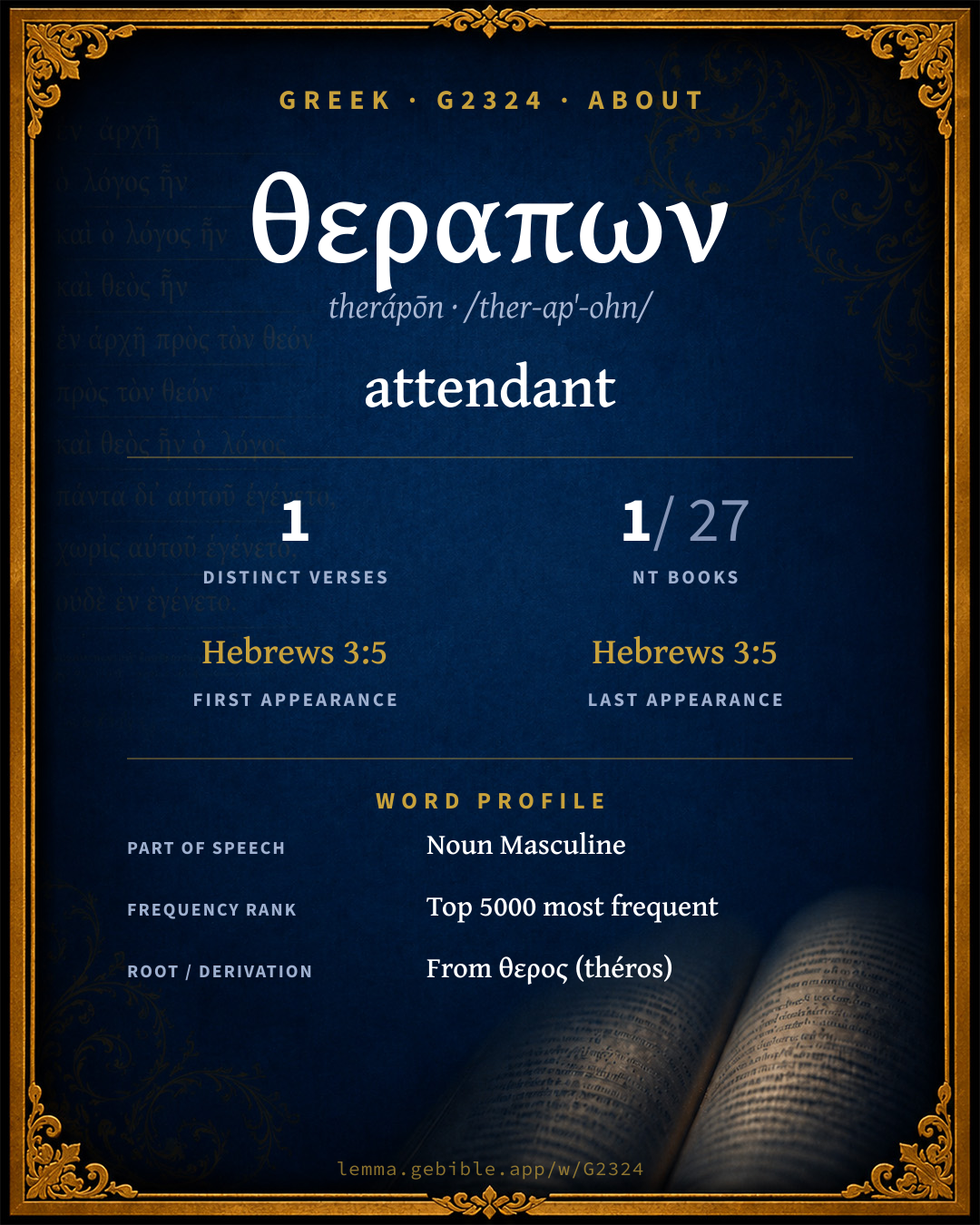
θεράπων
attendant
Full lexicon entry — Thayer's Greek Lexicon
From Thayer's Greek Lexicon
Where this word appears
Grammar key — what these labels mean
Part of speech
- Noun
- A naming word — a person, place, thing, or idea.
Case
- Nominative
- The case of the subject (and the predicate nominative).
Gender
- Masculine
- Grammatically masculine.
Number
- Singular
- One.
Every verse where G2324 appears — 1 distinct verse across 1 book. Click any verse to open its interlinear word-by-word view. Verse text shown in the World English Bible for context — . Each verse’s Greek form is shown with its reference; the English is not keyword-highlighted, since the data carries no word-level English alignment. Use “Compare translations” on any verse to read it across multiple English versions. This concordance covers the Greek New Testament; Septuagint (Greek Old Testament) occurrences of this word are not indexed here.
Hebrews 1 verse
About this entry
At a glance — auto-summarized from this page’s data, not written by a person. Every figure links to its source below. This summary describes the numbers; it doesn’t interpret them.
“attendant” is the headline sense of the Greek noun θεραπων (therápōn). It is rare — just 1 verse in the entire Greek New Testament. More than three-quarters of its appearances fall in Hebrews. It occurs only once, in Hebrews 3:5. Related forms include θερος, θεριζω and θερμη. See the sense tree, 1-verse concordance, and the renderings breakdown below.
Gloss history
Strong's 1890 vs modern scholarship

About this word
Strong's G2324 catalogs a Greek word from the Greek New Testament.
These counts are not copied from any lexicon or concordance. They are computed here, from the morphology-tagged Greek New Testament. What Lemma adds →
- 1
- distinct verses
- The word appears in 1 distinct verse.
- 1 / 27
- NT books
- The word appears in 1 of 27 New Testament books.
- #3,503
- by frequency
- Top 5000 most frequent Greek words (rank 3,503 of 5,347 Greek words by occurrence).
View all 1 occurrence in the concordance →
Most concentrated in
- Hebrews 1 verse 100%
By section of the New Testament
By traditional corpus
Conventional, traditional groupings — biblical authorship is debated, so this is a traditional corpus grouping, not an authorship claim. Some books belong to more than one corpus (Luke is in both the Gospels and the Lukan corpus, and so on), so these shares overlap and need not total 100%. Each figure is a share of the word’s 1 distinct verse.
- Hebrews 1 verse · 100%
How translations render this word
Counts come from each version’s own published word-to-Strong’s tagging or interlinear alignment — an approximate guide to how each version renders this word, not a word-level alignment the data otherwise carries. Because each total is that version’s own tagged count, the per-version totals vary from one another and need not match the appearance or distinct-verse counts above. These counts may also differ from a printed concordance because Lemma counts each distinctly tagged rendering and does not collapse phrase taggings into a single head-word total. This is a fixed set of word-tagged versions (KJV, ASV, BSB, ULT) and does not change with the reading translation you choose elsewhere. Each version’s license is shown beside its name below (and on Sources).
- King James Version: Servant 1×
- American Standard Version: Servant 1×
- Berean Standard Bible: Servant 1×
- unfoldingWord Literal Text: Servant 1×
King James Version Public Domain
Renders G2324 across 1 tagged occurrence — most commonly:
American Standard Version Public Domain
Renders G2324 across 1 tagged occurrence — most commonly:
Berean Standard Bible Public Domain
Renders G2324 across 1 tagged occurrence — most commonly:
unfoldingWord Literal Text CC BY-SA 4.0
Renders G2324 across 1 tagged occurrence — most commonly:
Senses in Thayer's
The 1 sense Thayer's distinguishes for this word, in lexicon order (not ranked by frequency or importance). The full entry — with sub-senses — is in the Lexicon Entry tab.
- an attendant, servant: of God
Word origin
Derived from θερος (théros) (G2330) — summer.
Apparently a participle from an otherwise obsolete derivation of the base of G2330 ; a menial attendant (as if cherishing ): - servant.
— Strong’s Exhaustive Concordance (1890), public domain.
Same root — word family
Other Thayer's entries built from the same root as G2324, grouped by Strong’s listed origin. These share a root / origin per the lexicon — not necessarily a shared meaning. Each links to that word’s own entry.
Derives from
Shares the same root
Derived from this word
Compare all same-root words → Showing 4 of 5 — not the complete family. They share a root, not necessarily a meaning.
Septuagint usage
The same Greek word θεραπων appears 53 times in the Greek Old Testament (Septuagint), across 49 verses in 8 books.
- 53
- LXX occurrences
- Tagged occurrences of this Greek word in the Septuagint.
- 49
- verses
- Distinct Septuagint verses containing this word.
- 8 / 39
- OT books
- The word appears in 8 of the 39 Old Testament books.
Sample Septuagint occurrences
- Genesis 24:44 θεράπων
- Exodus 4:10 θεράπων
- Numbers 11:11 θεράπων
- Deuteronomy 3:24 θεράπων
- Joshua 1:2 θεράπων
- 1 Chronicles 16:40 θεράπων
- Job 2:3 θεράπων
- Proverbs 18:14 θεράπων
Septuagint occurrences (same lexeme)
Every verse where the same Strong’s number (G2324) appears in the Greek Septuagint. Verse text shown in the World English Bible for context; the Greek form is the matched word — the English is not keyword-highlighted.
- Genesis 24:44 θεράπων She will tell me, "Drink, and I will also draw for your camels." Let the same be the woman whom Yahweh has appointed for my master's son.'
- Genesis 50:17 θεράπων "So you shall tell Joseph, 'Now please forgive the disobedience of your brothers, and their sin, because they did evil to you.' Now, please forgive the disobedience of the servants of the God of your father." Joseph wept when they spoke to him.
- Exodus 4:10 θεράπων Moses said to Yahweh, "Oh, Lord, I am not eloquent, neither before now, nor since you have spoken to your servant; for I am slow of speech, and of a slow tongue."
- Exodus 5:21 θεράπων and they said to them, "May Yahweh look at you, and judge, because you have made us a stench to be abhorred in the eyes of Pharaoh, and in the eyes of his servants, to put a sword in their hand to kill us."
- Exodus 7:9 θεράπων "When Pharaoh speaks to you, saying, 'Perform a miracle!' then you shall tell Aaron, 'Take your rod, and cast it down before Pharaoh, that it become a serpent.'"
- Exodus 7:10 θεράπων Moses and Aaron went in to Pharaoh, and they did so, as Yahweh had commanded: and Aaron cast down his rod before Pharaoh and before his servants, and it became a serpent.
- Exodus 7:20 θεράπων Moses and Aaron did so, as Yahweh commanded; and he lifted up the rod, and struck the waters that were in the river, in the sight of Pharaoh, and in the sight of his servants; and all the waters that were in the river were turned to blood.
- Exodus 7:28 θεράπων
- Exodus 7:29 θεράπων
- Exodus 8:5 θεράπων Yahweh said to Moses, "Tell Aaron, 'Stretch forth your hand with your rod over the rivers, over the streams, and over the pools, and cause frogs to come up on the land of Egypt.'"
- Exodus 8:7 θεράπων The magicians did in like manner with their enchantments, and brought up frogs on the land of Egypt.
- Exodus 8:17 θεράπων They did so; and Aaron stretched out his hand with his rod, and struck the dust of the earth, and there were lice on man, and on animal; all the dust of the earth became lice throughout all the land of Egypt.
- Exodus 8:20 θεράπων Yahweh said to Moses, "Rise up early in the morning, and stand before Pharaoh; behold, he comes forth to the water; and tell him, 'This is what Yahweh says, "Let my people go, that they may serve me.
- Exodus 8:25 θεράπων Pharaoh called for Moses and for Aaron, and said, "Go, sacrifice to your God in the land!"
- Exodus 8:27 θεράπων We will go three days' journey into the wilderness, and sacrifice to Yahweh our God, as he shall command us."
- Exodus 9:8 θεράπων Yahweh said to Moses and to Aaron, "Take to you handfuls of ashes of the furnace, and let Moses sprinkle it toward the sky in the sight of Pharaoh.
- Exodus 9:14 θεράπων For this time I will send all my plagues against your heart, against your officials, and against your people; that you may know that there is none like me in all the earth.
- Exodus 9:20 θεράπων Those who feared the word of Yahweh among the servants of Pharaoh made their servants and their cattle flee into the houses.
- Exodus 9:30 θεράπων But as for you and your servants, I know that you don't yet fear Yahweh God."
- Exodus 9:34 θεράπων When Pharaoh saw that the rain and the hail and the thunders were ceased, he sinned yet more, and hardened his heart, he and his servants.
- Exodus 10:1 θεράπων Yahweh said to Moses, "Go in to Pharaoh, for I have hardened his heart, and the heart of his servants, that I may show these my signs in the midst of them,
- Exodus 10:6 θεράπων Your houses shall be filled, and the houses of all your servants, and the houses of all the Egyptians; as neither your fathers nor your fathers' fathers have seen, since the day that they were on the earth to this day.'" He turned, and went out from Pharaoh.
- Exodus 10:7 θεράπων Pharaoh's servants said to him, "How long will this man be a snare to us? Let the men go, that they may serve Yahweh, their God. Don't you yet know that Egypt is destroyed?"
- Exodus 11:3 θεράπων Yahweh gave the people favor in the sight of the Egyptians. Moreover the man Moses was very great in the land of Egypt, in the sight of Pharaoh's servants, and in the sight of the people.
- Exodus 12:30 θεράπων Pharaoh rose up in the night, he, and all his servants, and all the Egyptians; and there was a great cry in Egypt, for there was not a house where there was not one dead.
- Exodus 14:5 θεράπων It was told the king of Egypt that the people had fled; and the heart of Pharaoh and of his servants was changed towards the people, and they said, "What is this we have done, that we have let Israel go from serving us?"
- Exodus 14:8 θεράπων Yahweh hardened the heart of Pharaoh king of Egypt, and he pursued after the children of Israel; for the children of Israel went out with a high hand.
- Exodus 14:31 θεράπων Israel saw the great work which Yahweh did to the Egyptians, and the people feared Yahweh; and they believed in Yahweh, and in his servant Moses.
- Exodus 33:11 θεράπων Yahweh spoke to Moses face to face, as a man speaks to his friend. He turned again into the camp, but his servant Joshua, the son of Nun, a young man, didn't depart out of the Tent.
- Numbers 11:11 θεράπων Moses said to Yahweh, Why have you dealt ill with your servant? and why haven't I found favor in your sight, that you lay the burden of all this people on me?
- Numbers 12:7 θεράπων My servant Moses is not so; he is faithful in all my house:
- Numbers 12:8 θεράπων with him will I speak mouth to mouth, even manifestly, and not in dark speeches; and the form of Yahweh shall he see: why then were you not afraid to speak against my servant, against Moses?
- Numbers 32:31 θεράπων The children of Gad and the children of Reuben answered, saying, As Yahweh has said to your servants, so will we do.
- Deuteronomy 3:24 θεράπων Lord Yahweh, you have begun to show your servant your greatness, and your strong hand: for what god is there in heaven or in earth, that can do according to your works, and according to your mighty acts?
- Deuteronomy 9:27 θεράπων Remember your servants, Abraham, Isaac, and Jacob; don't look to the stubbornness of this people, nor to their wickedness, nor to their sin,
- Deuteronomy 29:1 θεράπων These are the words of the covenant which Yahweh commanded Moses to make with the children of Israel in the land of Moab, besides the covenant which he made with them in Horeb.
- Deuteronomy 34:11 θεράπων in all the signs and the wonders, which Yahweh sent him to do in the land of Egypt, to Pharaoh, and to all his servants, and to all his land,
- Joshua 1:2 θεράπων Moses my servant is dead; now therefore arise, go over this Jordan, you, and all this people, to the land which I do give to them, even to the children of Israel.
- Joshua 9:2 θεράπων that they gathered themselves together, to fight with Joshua and with Israel, with one accord.
- 1 Chronicles 16:40 θεράπων to offer burnt offerings to Yahweh on the altar of burnt offering continually morning and evening, even according to all that is written in the law of Yahweh, which he commanded to Israel;
- Job 2:3 θεράπων Yahweh said to Satan, "Have you considered my servant Job? For there is none like him in the earth, a blameless and an upright man, one who fears God, and turns away from evil. He still maintains his integrity, although you incited me against him, to ruin him without cause."
- Job 3:19 θεράπων The small and the great are there. The servant is free from his master.
- Job 7:2 θεράπων As a servant who earnestly desires the shadow, As a hireling who looks for his wages,
- Job 19:16 θεράπων I call to my servant, and he gives me no answer; I beg him with my mouth.
- Job 31:13 θεράπων "If I have despised the cause of my man-servant Or of my maid-servant, When they contended with me;
- Job 42:7 θεράπων It was so, that after Yahweh had spoken these words to Job, Yahweh said to Eliphaz the Temanite, "My wrath is kindled against you, and against your two friends; for you have not spoken of me the thing that is right, as my servant Job has.
- Job 42:8 θεράπων Now therefore, take to yourselves seven bulls and seven rams, and go to my servant Job, and offer up for yourselves a burnt offering; and my servant Job shall pray for you, for I will accept him, that I not deal with you according to your folly. For you have not spoken of me the thing that is right, as my servant Job has."
- Proverbs 18:14 θεράπων A man's spirit will sustain him in sickness, But a crushed spirit, who can bear?
- Proverbs 27:27 θεράπων There will be plenty of goats' milk for your food, For your family's food, And for the nourishment of your servant girls.
These are occurrences of the same Greek lexeme (G2324) in the Septuagint — not a translation of any one Hebrew word. The store carries no word-level Hebrew↔Greek alignment, so no Hebrew original is asserted here. Counts come from the recovered LXX Strong's tagging — high-frequency vocabulary is well covered, while rare or late forms may be untagged — so they reflect tagged occurrences and may slightly undercount.