
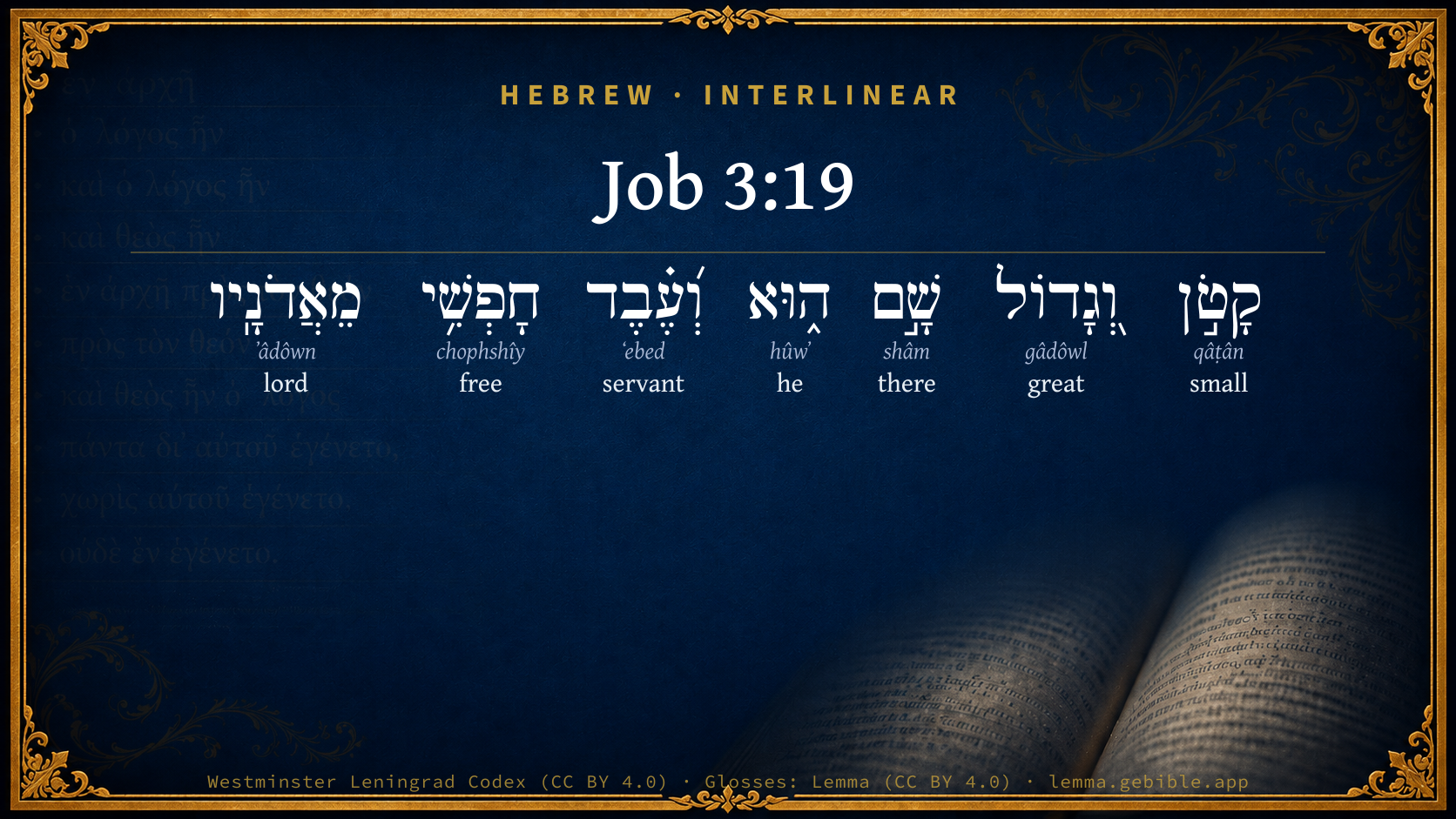
Job 3:19

Hebrew (Westminster Leningrad Codex) Job 3:19 appears in the Hebrew Old Testament. The text above is from the Westminster Leningrad Codex. Each word links to its Strong’s number, a concise gloss, and parsing drawn from the Open Scriptures Hebrew Bible morphology. Click any word for its full Brown-Driver-Briggs (BDB) entry.
Download image
Cite this verse

Job 3:19 (World English Bible). Public Domain. Lemma interlinear Bible study tool, https://lemma.gebible.app/v/job/3/19.

Show BibTeX & RIS
BibTeX
RIS
English Translation
The small and the great are there. The servant is free from his master.
World English Bible · Public Domain
Download a study sheet

One document with this verse’s original text, its word-by-word gloss line, the meaning frame, cross-references with their text, attributed commentary, and full source and license credits — printable, and it pastes into notes with its structure intact.

This verse Autodidact and up

Study sheet (.html) Plain text (.txt)

A passage Seminary Student

Up to 50 verses in one chapter. A passage sheet keeps up to 6 commentary sources and 12 cross-references per verse, in the order this page ranks them, and says so on the sheet whenever that leaves anything out. Ask for a single verse and you get the Autodidact verse sheet above.

Everything on this page stays free to read, with no account — the sheet is a download of what is already on screen, not access to it.

Want to remove ads? Support Godless Engineer
Compare translations 3

The same verse in 3 English versions, stacked beneath the original-language interlinear above. Click any original word for its lexicon entry.

Each is an independent rendering of the whole verse — the interlinear is not word-aligned to these translations.

Highlighted words mark where these versions differ — a whole-verse word diff, not a word-by-word alignment.

  • World English Bible Public Domain
    The small and the great are there. The servant is free from his master.
  • King James Version Public Domain
    The small and great are there; and the servant is free from his master.
  • unfoldingWord Literal Text CC BY-SA 4.0
    Small and great there the same, and a servant free from his master.

unfoldingWord Literal Text — © unfoldingWord, licensed CC BY-SA 4.0. Word-aligned USFM3 via Door43 (git.door43.org/unfoldingWord/en_ult).

Versions to compare (up to 4)

3 of 4 selected

Show all 18 translations

Every available English version of this verse, each an independent rendering of the whole verse.

  • World English Bible Public Domain
    The small and the great are there. The servant is free from his master.
  • Berean Standard Bible Public Domain
    Both small and great are there, and the slave is freed from his master.
  • Majority Standard Bible Public Domain
    Both small and great are there, and the slave is freed from his master.
  • King James Version Public Domain
    The small and great are there; and the servant is free from his master.
  • American Standard Version (1901) Public Domain
    The small and the great are there: And the servant is free from his master.
  • Revised Version (1885) Public Domain
    The small and great are there; and the servant is free from his master.
  • Geneva Bible (1599) Public Domain
    There are small and great, and the seruant is free from his master.
  • Douay-Rheims (1899) Public Domain
    The small and great are there, and the servant is free from his master.
  • Young's Literal Translation Public Domain
    Small and great `are' there the same. And a servant `is' free from his lord.
  • Literal Standard Version CC BY-SA 4.0
    Small and great [are] the same there. And a servant [is] free from his lord.
  • Unlocked Literal Bible CC BY-SA 4.0
    Both small and great people are there; the servant is free from his master there.
  • unfoldingWord Literal Text CC BY-SA 4.0
    Small and great there the same, and a servant free from his master.
  • Darby Bible Public Domain
    The small and great are there, and the bondman freed from his master.
  • World Messianic Bible Public Domain
    The small and the great are there. The servant is free from his master.
  • Webster's Bible Public Domain
    The small and great are there; and the servant is free from his master.
  • Free Bible Version CC BY-SA 4.0
    Both small and great are there, and slaves are freed from their masters.
  • Bible in Basic English Public Domain
    The small and the great are there, and the servant is free from his master.
  • JPS Tanakh (1917) Public Domain
    The small and great are there alike; and the servant is free from his master.

Literal Standard Version (2020), Covenant Press — licensed CC BY-SA 4.0. Text via the HelloAO Bible API (eBible.org). Unlocked Literal Bible (unfoldingWord) — licensed CC BY-SA 4.0. Text via the HelloAO Bible API (eBible.org). unfoldingWord Literal Text — © unfoldingWord, licensed CC BY-SA 4.0. Word-aligned USFM3 via Door43 (git.door43.org/unfoldingWord/en_ult). Free Bible Version, Dr. Jonathan Gallagher — licensed CC BY-SA 4.0. Text via the HelloAO Bible API (eBible.org).

Word by word

More ways to search: Search by grammar → Find every occurrence → Compare this word →

Practice this passage: Drill this verse → Learn its vocabulary →

About this verse

These counts appear in no published source. They are computed here, from the morphology-tagged text and Lemma’s own curated glosses. What Lemma adds →

7
words
7
distinct lemmas
Wisdom
section

Notable vocabulary

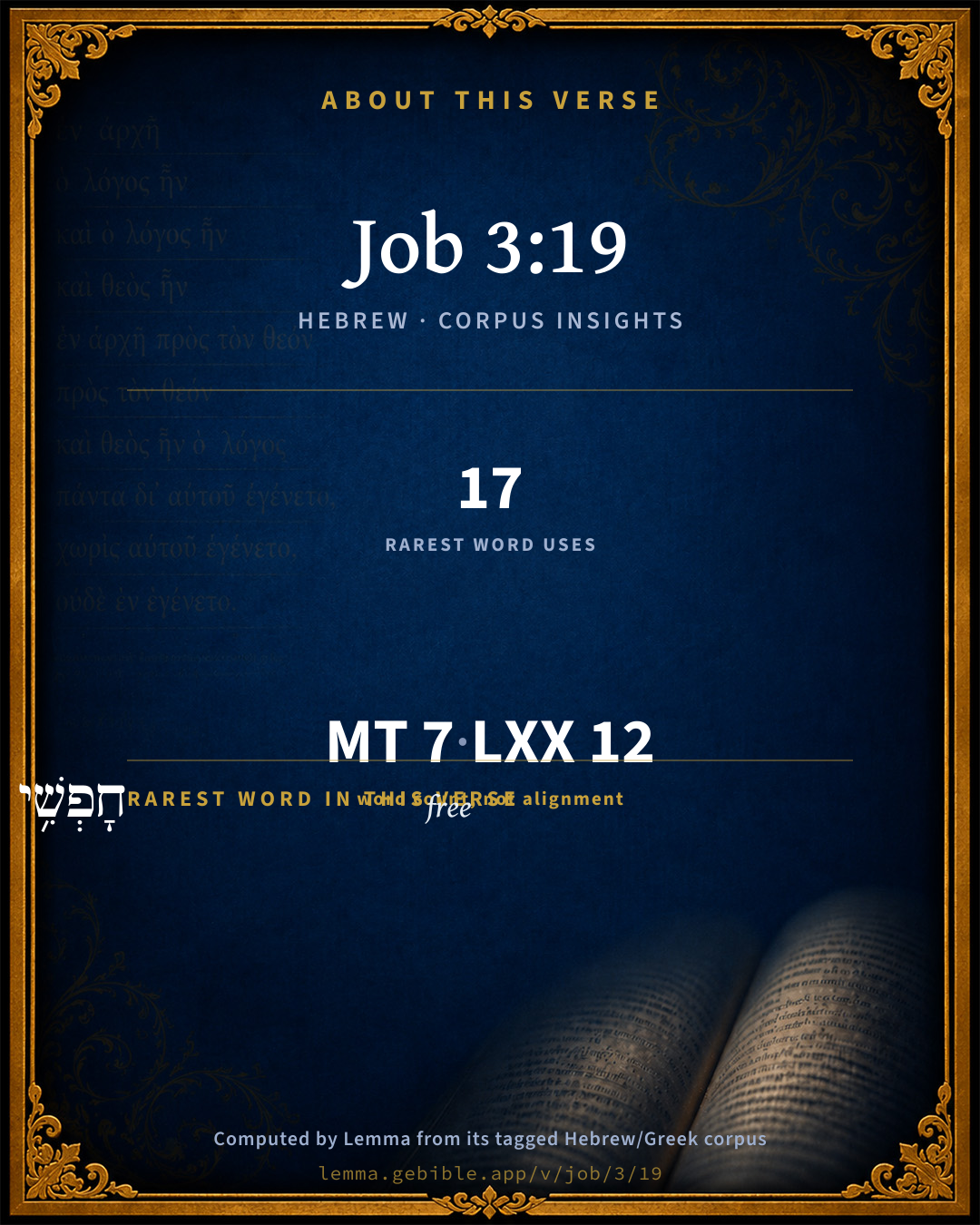
The rarest word here is חָפְשִׁ֥י free H2670 — appearing just 17 times in the whole Hebrew Bible.

Shared distinctive vocabulary

חָפְשִׁ֥י free H2670 occurs in 17 verses of the Hebrew Bible. Also found in:

Grammatical profile

  • 2 nouns
  • 3 adjectives
  • 1 pronoun
  • 1 adverb

Hebrew & Septuagint length

In English translation the verse runs 14 words from the Hebrew and 13 from the Septuagint (LXX English) — closely comparable.

A rough comparison of the two English renderings, which tokenize alike — not a word-level alignment.

Word counts can differ between the Hebrew and the Greek without any difference in meaning — e.g. the Hebrew direct-object marker אֵת has no separate Greek word, and Greek often adds the article ὁ.

In the original languages it is 7 Hebrew tokens and 12 Greek tokens — but the two are counted differently (Hebrew bundles its prefixes and suffixes into one token; the Greek is in lemma form), so that isn’t a like-for-like length.

Cross-references

9

Topical passages linked to Job 3:19 in the Treasury of Scripture Knowledge — connected by theme and wording, ordered by reader-vote popularity; previews shown in the World English Bible.

  • Job 30:23 For I know that you will bring me to death, To the house appointed for all living.
  • Ecclesiastes 8:8 There is no man who has power over the spirit to contain the spirit; neither does he have power over the day of death. There is no discharge in war; neither shall wickedness deliver those who practice it.
  • Ecclesiastes 12:7 And the dust returns to the earth as it was, And the spirit returns to God who gave it.
  • Psalms 49:2 Both low and high, Rich and poor together.
  • Psalms 49:6–10 Those who trust in their wealth, And boast in the multitude of their riches--
  • Psalms 49:14–20 They are appointed as a flock for Sheol. Death shall be their shepherd. The upright shall have dominion over them in the morning. Their beauty shall decay in Sheol, Far from their mansion.
  • Ecclesiastes 12:5 Yes, they shall be afraid of heights, And terrors will be in the way; And the almond tree shall blossom, And the grasshopper shall be a burden, And desire shall fail; Because man goes to his everlasting home, And the mourners go about the streets:
  • Luke 16:22–23 It happened that the beggar died, and that he was carried away by the angels to Abraham's bosom. The rich man also died, and was buried.
  • Hebrews 9:27 Inasmuch as it is appointed for men to die once, and after this, judgment,

Cross-references courtesy of OpenBible.info (CC BY 4.0).

Hebrew and Greek witnesses Masoretic Hebrew ↔ Greek Septuagint

The same verse in the two great witnesses to the Old Testament, shown verse-for-verse.

These are two independent witnesses, not word-aligned to each other, and the Septuagint is shown in lemma (dictionary) form.

Hebrew Job 3:19 Masoretic · Westminster Leningrad Codex

קָטֹ֣ן וְ֭גָדוֹל שָׁ֣ם ה֑וּא וְ֝עֶ֗בֶד חָפְשִׁ֥י מֵאֲדֹנָֽיו

The small and the great are there. The servant is free from his master.

World English Bible · Public Domain

Greek LXX Job 3:19 Septuagint · lemma form

μικρός καί μέγας ἐκεῖ εἰμί καί θεράπων οὐ δείδω ὁ κύριος αὐτός

The small and great are there, and the servant that feared his lord.

LXX2012 (modern English Septuagint) · Public Domain

Hebrew: Westminster Leningrad Codex (CC BY 4.0). Greek: Septuagint (public domain); English from LXX2012 (modern English Septuagint) (Public Domain). How the Septuagint differs from the Hebrew →

Commentary

Notes on Job 3:19 from classic Christian and Jewish commentators (each source and its license shown beneath its notes). The classic Christian expositions comment on the surrounding passage and are grouped to its opening verse, so a note may address several verses; the Jewish commentaries on the Tanakh (Rashi and others) are per-verse, so they appear only where the commentator wrote on this verse.

Lemma curates 59 commentaries, every one of them public domain or Creative Commons licensed, each selected and text-cleaned for this edition rather than reprinted as found. About our sources →

Trapp's Complete Commentary

John Trapp

Job 3:19 The small and great are there; and the servant [is] free from his master.

Ver. 19. The small and the great are there] In Calvary are skulls of all sizes, say the Hebrews. Stat sua cuique dies (Virg. Aeneid, lib. 1 0). It is appointed for all once to die, be they great or small, low or high. Mors sceptra ligonibus aequat, death makes no difference; kings and captives, lords and lowlies come, then under an equal parity; death takes away all distinctions. William the Conqueror’s corpse lay unburied three days; his interment was hindered by one that claimed the ground to be his (Daniel). King Stephen was interred at Feversham monastery; but since his body, for the gain of the lead, wherein it was coffined, was cast into the river, where at length it rested; as did likewise the dead corpse of Edward V, and his brother, smothered in the Tower by Richard III, and cast into a place called the black deeps at the Thames’ mouth (Speed.).

The servant is free from his master] Servant is a name of office. He is not his own to dispose of, but the master’s instrument, saith Aristotle, and wholly his, till he please to free him: if he do not, yet death will; and by taking away his life, give him his liberty. His body resteth from all servile offices for a season howsoever: and if with good will he hath done service as to the Lord, and not to men, he shall receive of the Lord the reward of inheritance, even a child’s part, Col 3:24.

John Trapp, A Commentary or Exposition upon All the Books of the Old and New Testament (1647–1656) — public domain. Text from a community e-Sword module.

The Biblical Illustrator

Joseph S. Exell

Job_3:19

The small and great axe there.

The common lot

Notice the sameness of all men in their birth. One and all are equal by nature. All inherit the sin of their first parents. The necessary consequence following from this truth is that there is a need of a new birth for everyone that would inherit everlasting life. There is, however, a distinction among men in their lives. There is a vast difference between men, both in spiritual and in temporal things. The inferences are simply these. If we look at men in matters temporal, and receive the truth that God makes one man great and another man small, we learn to be contented in whatsoever position of life God Himself has placed us. We learn that God is willing to make man that which man ought to be, even though He has to work with such wretched materials as we are made of. But whatever mens differences in life, there is nevertheless a similarity in their death. The small and the great are there. Whether young or old, all must come to this. He seeth that wise men die, likewise the fool and the brutish person perish. Man being in honour, abideth not. (H. M. Villiers, M. A.)

Small and great in death

1. Death seizeth equally upon all sorts and degrees of men. The small and the great are there. The small cannot escape the hands, or slip through the fingers of death, because they are little; the greatest cannot rescue themselves from the power, or break out of the hands of death, because they are big.

2. That death makes all men equal; or, that all are equal in death. As there is one glory of the sun, and another glory of the moon, and another glory of the stars: for one star differeth from another star in glory (1Co_15:41). So there is one terrestrial glory of kings, and another glory of nobles, and another glory of the common people, and these have not the same glory in common; even among them, one man differs from another man in this worldly glory; but when death comes, there is an end of all degrees, of all distinctions; there the small and the great are the same. There is but one distinction that will outlive death; and death cannot take it away; the distinction of holy and unholy, clean and unclean, believer and an infidel; these distinctions remain after death, and shall remain forever. (J. Caryl.)

The Biblical Illustrator, edited by Joseph S. Exell (c. 1880s–1900s) — public domain. Text from a community e-Sword module.

Joseph Benson's Commentary

Job 3:19. The small and great are there — It should rather be rendered, are equal there; persons of all qualities and conditions, whether higher or lower, are in the same circumstances. There is no distinction in the grave, but the meanest and most despised peasant is in a situation equal to that of his rich and powerful neighbour. The man of birth and fortune appears there to no advantage: he commands no place; he usurps no authority; neither does he lord it over the poorest or meanest of the human race. And the servant is free from his master — The most contemptible slave, who was entirely subject to the impositions and exactions of his owner, has got his discharge, and is now free from the power of him that tyrannized over him: a good reason this, why those who have power should use it moderately, and why those that are in subjection should take it patiently.

Joseph Benson's Commentary on the Old and New Testaments (1811–1818) — public domain. Text from a community e-Sword module.

Jamieson, Fausset & Brown

Robert Jamieson, A. R. Fausset & David Brown

servant--The slave is there manumitted from slavery.

Jamieson, Fausset & Brown — Commentary Critical and Explanatory on the Whole Bible (1871) — public domain (CC PDM 1.0). Text via the HelloAO Bible API.

Adam Clarke's Commentary

Verse 19. The small and great are there.] All sorts and conditions of men are equally blended in the grave, and ultimately reduced to one common dust; and between the bond and free there is no difference. The grave is

"The appointed place of rendezvous, where all

These travellers meet."

Equality is absolute among the sons of men in their entrance into and exit from the world: all the intermediate state is disparity. All men begin and end life alike; and there is no difference between the king and the cottager.

A contemplation of this should equally humble the great and the small.

The saying is trite, but it is true: -

Pallida mors aequo pulsat pede pauperum tabernas,

Regumque turres.

HOR. Odar. lib. i., Od. iv., ver. 13.

"With equal pace impartial Fate

Knocks at the palace as the cottage gate."

Death is that state,

"Where they an equal honour share

Who buried or unburied are.

Where Agamemnon knows no more

Than Irus he contemn'd before.

Where fair Achilles and Thersites lie,

Equally naked, poor, and dry."

And why do not the living lay these things to heart?

There is a fine saying in Seneca ad Marciam, cap. 20, on this subject, which may serve as a comment on this place: MORS-servitutem invito domino remittit; haec captivorum catenas levat; haec e carcere eduxit, quos exire imperium impotens vetuerat. Haec est in quo nemo humilitatem suam sensit; haec quae nulli paruit; haec quae nihil quicquam alieno fecit arbitrio. Haec, ubi res communes fortuna male divisit, et aequo jure genitos alium alii donavit, exaequat omnia.

"Death, in spite of the master, manumits the slave. It loosens the chains of the prisoners. It brings out of the dungeon those whom impotent authority had forbidden to go at large. This is the state in which none is sensible of his humiliation. Death obeys no man. It does nothing according to the will of another. It reduces, by a just law, to a state of equality, all who in their families and circumstances had unequal lots in life."

Adam Clarke's Commentary on the Bible (1810–1826) — public domain. Text from a community e-Sword/MySword module.

The Cambridge Bible for Schools and Colleges

gen. ed. J. J. S. Perowne

19. small and great are there] i. e. are there alike, the same.

The Cambridge Bible for Schools and Colleges (gen. ed. J. J. S. Perowne; Cambridge University Press, 1878–1918) — public domain. Text from a community e-Sword module.

John Gill's Exposition

The small and great are there,.... Both as to age, and with respect to bulk and strength of body, and also to estate and dignity; children and men, or those of low and high stature, or in a mean or more exalted state of life, as to riches and honour, these all come to the grave without any difference, and lie there without any distinction (y) "little and great are there all one"; as Mr. Broughton renders the words, see Rev 20:12,

and the servant is free from his master; death dissolves all relations among men, and takes away the power that one has legally over another, as the husband over the wife, who at death is loosed from the law and power of her husband, Rom 7:2; and so parents over their children, and masters over their servants; there the master and the servant are together, without any superiority of the one to the other: the consideration of all the above things made death and the state of the dead in the grave appear to Job much more preferable than life in his present circumstances; and therefore, since it had not seized on him sooner, and as soon as he before had wished it had, he desires it might not be long before it came upon him, as in Job 3:20.

(y) "Grandia cum parvis Orcus metit". Horat. Ep. l. 2. ep. 2. ver. 178. "----Mista senum ac juvenum densantur funera". Horat. Carmin. l. 1. Ode. 28.

John Gill's Exposition of the Whole Bible (1746–1763) — public domain (CC PDM 1.0). Text via the HelloAO Bible API.

Albert Barnes' Notes on the Bible

The small and the great are there - The old and the young, the high and the low. Death levels all. It shows no respect to age; it spares none because they are vigorous, young, or beautiful. This sentiment has probably been expressed in various forms in all languages, for all people are made deeply sensible of its truth. The Classic reader will recall the ancient proverb,

Mors sceptra ligonibus aequat,

And the language of Horace:

Aequae lege Necessitas

Sortitur insignes et imos.

Omne capax movet urna nomen.

Tristis unda scilicet omnibus,

Quicunque terrae munere vescimur,

Enaviganda, sive reges,

Sive inopes erimus coloni.

Divesne prisco natus ab lnacho

Nil interest, an pauper et infima

De gente sub dio moreris

Victima nil miserantis Orci.

Omnes codem cogimur. Omnium

Versatur urna. Serius, ocyus,

Sors exitura.

- Omnes una manet nox,

Et calcauda semel via leti. (Nullum)

Mista senum acjuvenum densantur funera.

Saeva caput Proserpina lugit. (tabernas)

Pallida mors aequo pulsat pede pauperum

Regumque turres.

And the servant is free from his master - Slavery is at an end in the grave. The master can no longer tax the powers of the slave, can no longer scourge him or exact his uncompensated toil. Slavery early existed, and there is evidence here that it was known in the time of Job. But Job did not regard it as a desirable institution; for assuredly that is not desirable from which death would be regarded as a “release,” or where death would be preferable. Men often talk about slavery as a valuable condition of society, and sometimes appeal even to the Scriptures to sustain it; but Job felt that “it was worse than death,” and that the grave was to be preferred because there the slave would be free from his master. The word used here and rendered “free” (חפשׁי chophshı̂y) properly expresses manumission from slavery. See it explained at length in my the notes at Isa 58:6.

Albert Barnes' Notes on the Bible (1834–1885) — public domain. Text from a community e-Sword/MySword module.

Matthew Poole's English Annotations

The small and great, i.e. persons of all qualifies and conditions, whether higher or lower.

Are there, in the same place and state, all those kinds of distinctions and differences being for ever abolished.

Matthew Poole's English Annotations on the Holy Bible (1683–1685) — public domain. Text from a community e-Sword/MySword module.

Whedon's Commentary on the Bible

Daniel D. Whedon

19. The first clause reads, literally, “The small and great, there (is) he,” in the sense that they are the same, or on the same level. So in Psa_22:9. “Thou art he,” that is, the same. (Isa_41:4.)

Daniel D. Whedon (gen. ed.), Commentary on the Old and New Testaments (1874–1909) — public domain. Text from a community e-Sword module.

The Pulpit Commentary

The small and great are there; i.e. "all are there, the small and great alike;" for Omnes eodem cogimur, cranium Versatur urna serius ocius Sors exitura, et nos in aeternum Exilium impositura cymbae. (Her., "Od.")

And the servant is free from his master; rather, the slave.

Death, the leveler.

No thought is more hackneyed than the idea that the present inequalities of life end at death. Yet the practical significance of this idea is never fully realized and acted on. Let us consider its lessons. What does death the leveler teach us?

I IT TEACHES HUMILITY. The master of an empire will soon own but six feet of soil The worms will shortly feed on one to whom princes bowed as slaves. "O mighty Caesar! dost thou lie so low? Are all thy conquests, glories, triumphs, spoils, Shrunk to this little measure? But yesterday the word of Caesar might Have stood against the world: now lies he there, And none so poor to do him reverence.

II IT WARNS AGAINST INJUSTICE. The oppressor"s sway is but brief. After a few swift years the rod will fall from his hand, and he will lie exactly on a level with the oppressed. How will he face his victims when he and they are in equal state? Christ bids his disciples make themselves friends by means of the mammon of unrighteousness, that at the end they may receive them into everlasting habitations. There is a generous way of using money and influence that helps to win true friends among our brethren. They who have acted in the opposite way must expect a friendless future.

III IT ENCOURAGES PATIENCE. The injustice is but temporary. The hard servitude will cease with death. The slave may look forward to his complete liberation. Hope may be the present inspiration of those whose lot is the most bitter, if only they can be assured of a portion in the life beyond the grave.

IV IT POINTS TO HIGHER THAN EARTHLY THINGS FOR TRUE GREATNESS. If there were nothing above the words of our text, Job"s thought would suggest a cynical contempt for all ambition and aspiration, because, if all must end at last in the low plain of death, nothing can be of permanent value. But if there is another world, the collapse of this world should urge us the more to store our treasures in that heavenly region. This does not mean that we are simply to live in preparation for the future beyond death; for we may have heaven in the present life; but it means that we should find true greatness in heavenly things, in spiritual grace and service.

V IT CALLS US INTO TRUE BROTHERHOOD. Why should we wait for death to abolish the shams and pretensions, the unjust claims and cruel oppressions, of earth? The large liberty of the future should be a type and pattern for more fair dealings in the present. Already we might begin the process of liberation and justice which death will ultimately accomplish. We need not resort to the violent levelling processes of the anarchist. Nihilism is not Christianity. But it is incumbent upon us to do all that is in our power to establish a state of society which recognizes the brotherhood of man. W.F.A.

The Pulpit Commentary (1880–1919), ed. H.D.M. Spence-Jones & Joseph S. Exell — public domain. Text from a community e-Sword module.

John Wesley's Explanatory Notes

Small and great - Persons of all qualities and conditions. Are there - In the same place and state, all those distinctions being forever abolished. A good reason, why those who have power should use it moderately, and those that are in subjection should take it patiently.

John Wesley, Explanatory Notes Upon the Whole Bible (1754–1765) — public domain. Text via the GEBible commentary corpus.

Rashi

Rabbi Shlomo Yitzchaki (Rashi)

Small and great are there There it is obvious who is esteemed and who is humble, and since that greatness is perpetual greatness, and that humility is perpetual humility...

Rashi on the Tanakh — English translations: “The Judaica Press complete Tanach with Rashi, translated by A. J. Rosenberg” (CC BY 4.0); “Pentateuch with Rashi's commentary by M. Rosenbaum and A.M. Silbermann, 1929-1934” (public domain); “The Metsudah Tanach series, Lakewood, N.J” (CC BY 4.0); and “The Book of Joshua, Metsudah Publications, 1997” (CC BY 4.0). Text via Sefaria.

Lesson kit

Teaching starters — assembled from the data on this page, not authored interpretation. Every prompt links to the verse data it draws on. Edit before teaching.

Job, in the Wisdom, opens this verse with 7 words (7 distinct Hebrew lemmas). Its most distinctive word is chophshîy (“free”). A historical commentator’s framing appears above. Read the whole chapter for the surrounding context.

Discussion questions

  1. The word chophshîy carries the sense “free.” How does it shape the verse?
  2. Exodus 21:2 shares the word «free» with this verse. How do the two illuminate each other?
  3. These translations render this verse differently; the difference is in the English rendering, not the original. What questions does that raise?
  4. Reading how Trapp's Complete Commentary and The Biblical Illustrator read this verse, where do the two commentators agree and where do they part?

Things to notice

Reading settings

Reading text

Shown beneath each verse's original-language words.

Old Testament
Old Testament edition

Read the OT as the Masoretic Hebrew (MT) or the Greek Septuagint (LXX).

English shown for the Greek Septuagint (in the Hebrew ↔ Greek comparison).

Comparing translations? Open the Compare panel on any verse page to stack up to four side by side.