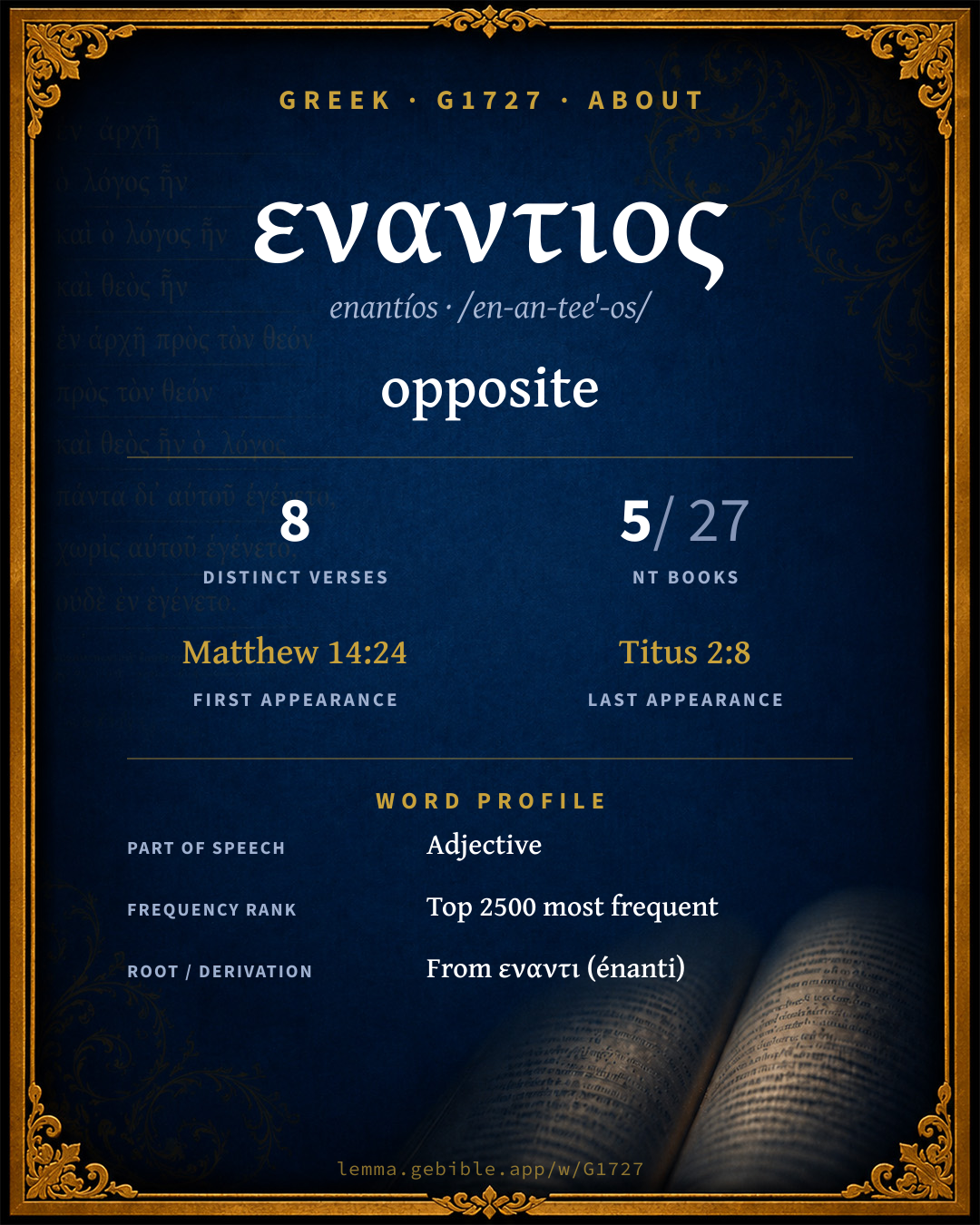
ἐναντίος
opposite
‘opposite’ is one of 2 main senses fuller range ↓
Full lexicon entry — Thayer's Greek Lexicon
From Thayer's Greek Lexicon
Where this word appears
See every Accusative-case word in the Greek New Testament →
Grammar key — what these labels mean
Part of speech
- Adjective
- A word that describes or qualifies a noun.
Case
- Genitive
- The case of source, possession, or “of” — answers “whose / from what.”
- Nominative
- The case of the subject (and the predicate nominative).
- Accusative
- The case of the direct object and of extent.
Gender
- Feminine
- Grammatically feminine.
- Masculine
- Grammatically masculine.
- Neuter
- Grammatically neuter.
Number
- Singular
- One.
- Plural
- More than one.
2 distinct verses where G1727 appears in the Nominative case, across 2 books. Filtered view — show all forms. Click any verse to open its interlinear word-by-word view. Verse text shown in the World English Bible for context — . Each verse’s Greek form is shown with its reference; the English is not keyword-highlighted, since the data carries no word-level English alignment. Use “Compare translations” on any verse to read it across multiple English versions. This concordance covers the Greek New Testament; Septuagint (Greek Old Testament) occurrences of this word are not indexed here.
Matthew 1 verse
Mark 1 verse
About this entry
At a glance — auto-summarized from this page’s data, not written by a person. Every figure links to its source below. This summary describes the numbers; it doesn’t interpret them.
The Greek adjective εναντιος centers on the idea of “opposite.” Its earliest occurrence is Matthew 14:24. It turns up in 8 verses across 5 books, an uncommon footprint. The word gravitates to Acts (38%), then Mark and Matthew. Thayer's distinguishes 2 senses for it. For the data behind this summary, explore the sense tree and the renderings breakdown below.
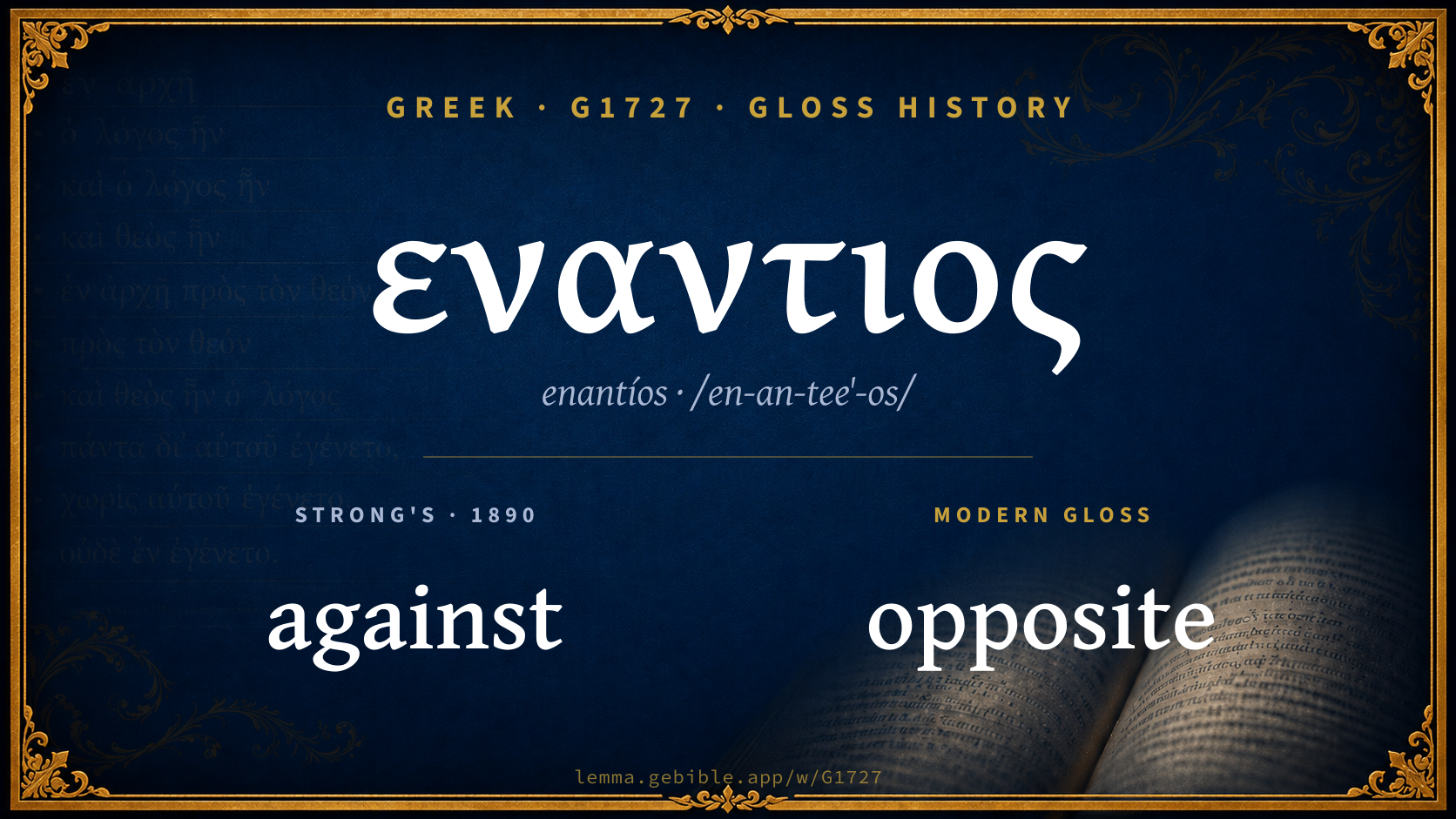
Gloss history
Strong's 1890 vs modern scholarship
About this word
Strong's G1727 catalogs a Greek word from the Greek New Testament.
These counts are not copied from any lexicon or concordance. They are computed here, from the morphology-tagged Greek New Testament. What Lemma adds →
- 8
- distinct verses
- The word appears in 8 distinct verses.
- 5 / 27
- NT books
- The word appears in 5 of 27 New Testament books.
- #1,240
- by frequency
- Top 2500 most frequent Greek words (rank 1,240 of 5,347 Greek words by occurrence).
View all 8 occurrences in the concordance →
By section of the New Testament
By traditional corpus
Conventional, traditional groupings — biblical authorship is debated, so this is a traditional corpus grouping, not an authorship claim. Some books belong to more than one corpus (Luke is in both the Gospels and the Lukan corpus, and so on), so these shares overlap and need not total 100%. Each figure is a share of the word’s 8 distinct verses.
- Gospels 3 verses · 38%
- Lukan (Luke–Acts) 3 verses · 38%
- Pauline corpus 2 verses · 25%
How translations render this word
Counts come from each version’s own published word-to-Strong’s tagging or interlinear alignment — an approximate guide to how each version renders this word, not a word-level alignment the data otherwise carries. Because each total is that version’s own tagged count, the per-version totals vary from one another and need not match the appearance or distinct-verse counts above. These counts may also differ from a printed concordance because Lemma counts each distinctly tagged rendering and does not collapse phrase taggings into a single head-word total. This is a fixed set of word-tagged versions (KJV, ASV, BSB, ULT) and does not change with the reading translation you choose elsewhere. Each version’s license is shown beside its name below (and on Sources).
- King James Version: Contrary 4×, Against 2×
- American Standard Version: Contrary 4×, Against 2×
- Berean Standard Bible: Against 2×
- unfoldingWord Literal Text: Against 2×, Opposed 2×
King James Version Public Domain
Renders G1727 across 8 tagged occurrences — most commonly:
Plus 2 renderings that appear only once — usually multi-word phrases or single function words the recovered tagging swept in, not distinct renderings.
American Standard Version Public Domain
Renders G1727 across 8 tagged occurrences — most commonly:
Plus 2 renderings that appear only once — usually multi-word phrases or single function words the recovered tagging swept in, not distinct renderings.
Berean Standard Bible Public Domain
Renders G1727 across 8 tagged occurrences — most commonly:
Plus 6 renderings that appear only once — usually multi-word phrases or single function words the recovered tagging swept in, not distinct renderings.
unfoldingWord Literal Text CC BY-SA 4.0
Renders G1727 across 9 tagged occurrences — most commonly:
Plus 5 renderings that appear only once — usually multi-word phrases or single function words the recovered tagging swept in, not distinct renderings.
Senses in Thayer's
The 2 senses Thayer's distinguishes for this word, in lexicon order (not ranked by frequency or importance). The full entry — with sub-senses — is in the Lexicon Entry tab.
- over against, opposite
- metaph.
Word origin
Derived from εναντι (énanti) (G1725) — before.
From G1725 ; opposite ; figuratively antagonistic : - (over) against contrary.
— Strong’s Exhaustive Concordance (1890), public domain.
Forms in the corpus
The 6 distinct written forms G1727 takes in the Greek New Testament, most frequent first — each parse links to that case’s occurrences in the concordance.
| Form | Parsing | Example | Uses |
|---|---|---|---|
| ἐναντίας enantías | Adjective, Genitive, Singular, Feminine | Mark 15:39 | 2 |
| ἐναντίος enantíos | Adjective, Nominative, Singular, Masculine | Matthew 14:24 | 2 |
| ἐναντία enantía | Adjective, Accusative, Plural, Neuter | Acts 26:9 | 1 |
| ἐναντίον enantíon | Adjective, Accusative, Singular, Neuter | Acts 28:17 | 1 |
| ἐναντίους enantíous | Adjective, Accusative, Plural, Masculine | Acts 27:4 | 1 |
| ἐναντίων enantíōn | Adjective, Genitive, Plural, Masculine | 1 Thessalonians 2:15 | 1 |
Same root — word family
Other Thayer's entries built from the same root as G1727, grouped by Strong’s listed origin. These share a root / origin per the lexicon — not necessarily a shared meaning. Each links to that word’s own entry.
Derives from
Derived from this word
Compare all same-root words → They share a root, not necessarily a meaning.
Septuagint usage
The same Greek word εναντιος appears 53 times in the Greek Old Testament (Septuagint), across 51 verses in 18 books.
- 53
- LXX occurrences
- Tagged occurrences of this Greek word in the Septuagint.
- 51
- verses
- Distinct Septuagint verses containing this word.
- 18 / 39
- OT books
- The word appears in 18 of the 39 Old Testament books.
Sample Septuagint occurrences
- Exodus 14:2 ἐναντίος
- Numbers 2:2 ἐναντίος
- Joshua 8:11 ἐναντίος
- Judges 1:10 ἐναντίος
- Ruth 4:4 ἐναντίος
- 1 Samuel 10:10 ἐναντίος
- 2 Samuel 10:9 ἐναντίος
- 1 Kings 20:10 ἐναντίος
- 2 Kings 2:7 ἐναντίος
- 1 Chronicles 19:11 ἐναντίος
- 2 Chronicles 14:11 ἐναντίος
- Ezra 13:25 ἐναντίος
Septuagint occurrences (same lexeme)
Every verse where the same Strong’s number (G1727) appears in the Greek Septuagint — showing the first 50 of 51. Verse text shown in the World English Bible for context; the Greek form is the matched word — the English is not keyword-highlighted.
- Exodus 14:2 ἐναντίος "Speak to the children of Israel, that they turn back and encamp before Pihahiroth, between Migdol and the sea, before Baal Zephon. You shall encamp opposite it by the sea.
- Exodus 14:9 ἐναντίος The Egyptians pursued after them: all the horses and chariots of Pharaoh, his horsemen, and his army; and overtook them encamping by the sea, beside Pihahiroth, before Baal Zephon.
- Exodus 36:25 ἐναντίος For the second side of the tent, on the north side, he made twenty boards,
- Numbers 2:2 ἐναντίος "The children of Israel shall encamp every man by his own standard, with the ensigns of their fathers' houses: at a distance from the tent of meeting shall they encamp around it."
- Joshua 8:11 ἐναντίος All the people, [even] the [men of] war who were with him, went up, and drew near, and came before the city, and encamped on the north side of Ai: now there was a valley between him and Ai.
- Joshua 19:12 ἐναντίος and it turned from Sarid eastward toward the sunrise to the border of Chisloth Tabor; and it went out to Daberath, and went up to Japhia;
- Joshua 19:13 ἐναντίος and from there it passed along eastward to Gath Hepher, to Eth-kazin; and it went out at Rimmon which stretches to Neah;
- Judges 1:10 ἐναντίος Judah went against the Canaanites who lived in Hebron (now the name of Hebron before was Kiriath Arba); and they struck Sheshai, and Ahiman, and Talmai.
- Judges 9:17 ἐναντίος (for my father fought for you, and adventured his life, and delivered you out of the hand of Midian:
- Judges 20:34 ἐναντίος There came over against Gibeah ten thousand chosen men out of all Israel, and the battle was sore; but they didn't know that evil was close on them.
- Ruth 4:4 ἐναντίος I thought to disclose it to you, saying, Buy it before those who sit here, and before the elders of my people. If you will redeem it, redeem it: but if you will not redeem it, then tell me, that I may know; for there is none to redeem it besides you; and I am after you. He said, I will redeem it.
- 1 Samuel 10:10 ἐναντίος When they came there to the hill, behold, a band of prophets met him; and the Spirit of God came mightily on him, and he prophesied among them.
- 1 Samuel 13:5 ἐναντίος The Philistines assembled themselves together to fight with Israel, thirty thousand chariots, and six thousand horsemen, and people as the sand which is on the sea-shore in multitude: and they came up, and encamped in Michmash, eastward of Beth Aven.
- 1 Samuel 17:2 ἐναντίος Saul and the men of Israel were gathered together, and encamped in the valley of Elah, and set the battle in array against the Philistines.
- 1 Samuel 17:8 ἐναντίος He stood and cried to the armies of Israel, and said to them, Why are you come out to set your battle in array? am I not a Philistine, and you servants to Saul? choose you a man for you, and let him come down to me.
- 1 Samuel 26:20 ἐναντίος Now therefore, don't let my blood fall to the earth away from the presence of Yahweh: for the king of Israel is come out to seek a flea, as when one does hunt a partridge in the mountains.
- 2 Samuel 10:9 ἐναντίος Now when Joab saw that the battle was set against him before and behind, he chose of all the choice men of Israel, and put them in array against the Syrians:
- 2 Samuel 10:10 ἐναντίος The rest of the people he committed into the hand of Abishai his brother; and he put them in array against the children of Ammon.
- 2 Samuel 11:15 ἐναντίος He wrote in the letter, saying, Set Uriah in the forefront of the hottest battle, and retire you from him, that he may be struck, and die.
- 2 Samuel 12:11 ἐναντίος This is what Yahweh says: 'Behold, I will raise up evil against you out of your own house; and I will take your wives before your eyes, and give them to your neighbor, and he will lie with your wives in the sight of this sun.
- 2 Samuel 12:12 ἐναντίος For you did it secretly, but I will do this thing before all Israel, and before the sun.'"
- 2 Samuel 18:6 ἐναντίος So the people went out into the field against Israel: and the battle was in the forest of Ephraim.
- 2 Samuel 18:13 ἐναντίος Otherwise if I had dealt falsely against his life (and there is no matter hid from the king), then you yourself would have set yourself against [me].
- 2 Samuel 22:13 ἐναντίος At the brightness before him Coals of fire were kindled.
- 1 Kings 20:10 ἐναντίος Ben Hadad sent to him, and said, The gods do so to me, and more also, if the dust of Samaria shall suffice for handfuls for all the people who follow me.
- 1 Kings 20:13 ἐναντίος Behold, a prophet came near to Ahab king of Israel, and said, Thus says Yahweh, Have you seen all this great multitude? behold, I will deliver it into your hand this day; and you shall know that I am Yahweh.
- 1 Kings 21:27 ἐναντίος It happened, when Ahab heard those words, that he tore his clothes, and put sackcloth on his flesh, and fasted, and lay in sackcloth, and went softly.
- 1 Kings 22:35 ἐναντίος The battle increased that day: and the king was stayed up in his chariot against the Syrians, and died at even; and the blood ran out of the wound into the bottom of the chariot.
- 2 Kings 2:7 ἐναντίος Fifty men of the sons of the prophets went, and stood over against them afar off: and they two stood by the Jordan.
- 2 Kings 2:15 ἐναντίος When the sons of the prophets who were at Jericho over against him saw him, they said, The spirit of Elijah does rest on Elisha. They came to meet him, and bowed themselves to the ground before him.
- 2 Kings 3:22 ἐναντίος They rose up early in the morning, and the sun shone on the water, and the Moabites saw the water over against them as red as blood:
- 1 Chronicles 19:11 ἐναντίος The rest of the people he committed into the hand of Abishai his brother; and they put themselves in array against the children of Ammon.
- 1 Chronicles 19:17 ἐναντίος It was told David; and he gathered all Israel together, and passed over the Jordan, and came on them, and set the battle in array against them. So when David had put the battle in array against the Syrians, they fought with him.
- 2 Chronicles 14:11 ἐναντίος Asa cried to Yahweh his God, and said, Yahweh, there is none besides you to help, between the mighty and him who has no strength: help us, Yahweh our God; for we rely on you, and in your name are we come against this multitude. Yahweh, you are our God; don't let man prevail against you.
- 2 Chronicles 18:34 ἐναντίος The battle increased that day: however the king of Israel stayed himself up in his chariot against the Syrians until the even; and about the time of the going down of the sun he died.
- Ezra 13:25 ἐναντίος
- Ezra 13:27 ἐναντίος
- Ezra 13:28 ἐναντίος
- Ezra 13:29 ἐναντίος
- Ezra 13:30 ἐναντίος
- Psalms 22:5 ἐναντίος They cried to you, and were delivered. They trusted in you, and were not disappointed.
- Psalms 34:3 ἐναντίος Oh magnify Yahweh with me. Let us exalt his name together.
- Psalms 37:12 ἐναντίος The wicked plots against the just, And gnashes at him with his teeth.
- Proverbs 14:7 ἐναντίος Stay away from a foolish man, For you won't find knowledge on his lips.
- Ezekiel 17:15 ἐναντίος But he rebelled against him in sending his ambassadors into Egypt, that they might give him horses and much people. Shall he prosper? shall he escape who does such things? shall he break the covenant, and yet escape?
- Ezekiel 18:18 ἐναντίος As for his father, because he cruelly oppressed, robbed his brother, and did that which is not good among his people, behold, he shall die in his iniquity.
- Ezekiel 47:3 ἐναντίος When the man went forth eastward with the line in his hand, he measured one thousand cubits, and he caused me to pass through the waters, waters that were to the ankles.
- Obadiah 1:11 ἐναντίος In the day that you stood on the other side, in the day that strangers carried away his substance, and foreigners entered into his gates, and cast lots for Jerusalem, even you were like one of them.
- Nahum 1:11 ἐναντίος There is one gone forth out of you, who devises evil against Yahweh, who counsels wickedness.
- Habakkuk 1:3 ἐναντίος Why do you show me iniquity, and look at perversity? For destruction and violence are before me. There is strife, and contention rises up.
These are occurrences of the same Greek lexeme (G1727) in the Septuagint — not a translation of any one Hebrew word. The store carries no word-level Hebrew↔Greek alignment, so no Hebrew original is asserted here. Counts come from the recovered LXX Strong's tagging — high-frequency vocabulary is well covered, while rare or late forms may be untagged — so they reflect tagged occurrences and may slightly undercount.