
2 Chronicles 29:5

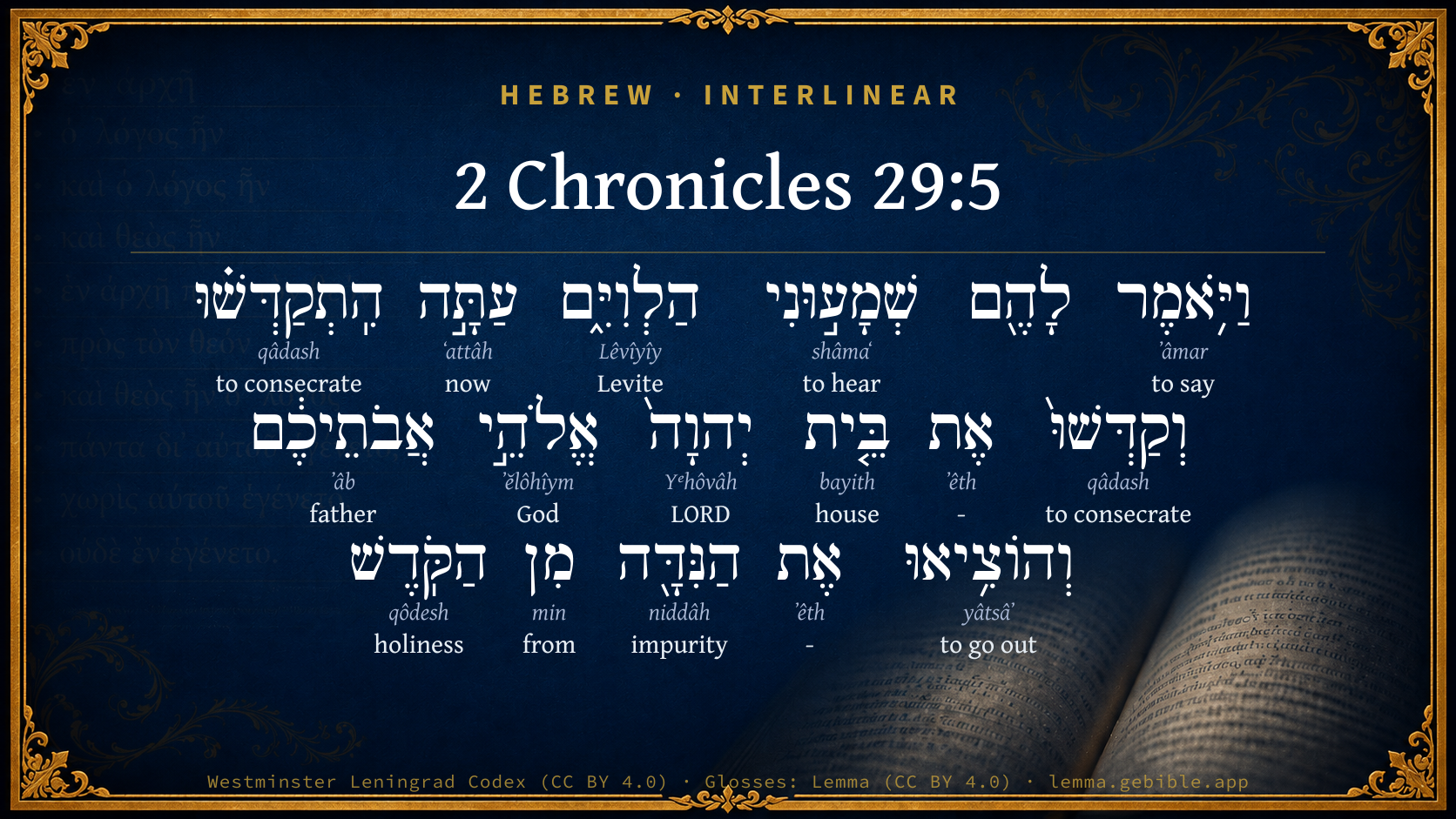
Hebrew (Westminster Leningrad Codex) 2 Chronicles 29:5 appears in the Hebrew Old Testament. The text above is from the Westminster Leningrad Codex. Each word links to its Strong’s number, a concise gloss, and parsing drawn from the Open Scriptures Hebrew Bible morphology. Click any word for its full Brown-Driver-Briggs (BDB) entry.
Download image
Cite this verse

2 Chronicles 29:5 (World English Bible). Public Domain. Lemma interlinear Bible study tool, https://lemma.gebible.app/v/2-chronicles/29/5.

Show BibTeX & RIS
BibTeX
RIS
English Translation
and said to them, Hear me, you Levites; now sanctify yourselves, and sanctify the house of Yahweh, the God of your fathers, and carry forth the filthiness out of the holy place.
World English Bible · Public Domain
Download a study sheet

One document with this verse’s original text, its word-by-word gloss line, the meaning frame, cross-references with their text, attributed commentary, and full source and license credits — printable, and it pastes into notes with its structure intact.

This verse Autodidact and up

Study sheet (.html) Plain text (.txt)

A passage Seminary Student

Up to 50 verses in one chapter. A passage sheet keeps up to 6 commentary sources and 12 cross-references per verse, in the order this page ranks them, and says so on the sheet whenever that leaves anything out. Ask for a single verse and you get the Autodidact verse sheet above.

Everything on this page stays free to read, with no account — the sheet is a download of what is already on screen, not access to it.

Want to remove ads? Support Godless Engineer
Compare translations 3

The same verse in 3 English versions, stacked beneath the original-language interlinear above. Click any original word for its lexicon entry.

Each is an independent rendering of the whole verse — the interlinear is not word-aligned to these translations.

Highlighted words mark where these versions differ — a whole-verse word diff, not a word-by-word alignment.

  • World English Bible Public Domain
    and said to them, Hear me, you Levites; now sanctify yourselves, and sanctify the house of Yahweh, the God of your fathers, and carry forth the filthiness out of the holy place.
  • King James Version Public Domain
    And said unto them, Hear me, ye Levites, sanctify now yourselves, and sanctify the house of the LORD God of your fathers, and carry forth the filthiness out of the holy place.
  • unfoldingWord Literal Text CC BY-SA 4.0
    And he said to them, “Hear me, Levites! Now, consecrate yourselves and consecrate the house of Yahweh, the God of your fathers, and bring out the defilement from the holy place.

unfoldingWord Literal Text — © unfoldingWord, licensed CC BY-SA 4.0. Word-aligned USFM3 via Door43 (git.door43.org/unfoldingWord/en_ult).

Versions to compare (up to 4)

3 of 4 selected

Show all 18 translations

Every available English version of this verse, each an independent rendering of the whole verse.

  • World English Bible Public Domain
    and said to them, Hear me, you Levites; now sanctify yourselves, and sanctify the house of Yahweh, the God of your fathers, and carry forth the filthiness out of the holy place.
  • Berean Standard Bible Public Domain
    “Listen to me, O Levites,” he said. “Consecrate yourselves now and consecrate the house of the LORD, the God of your fathers. Remove from the Holy Place every impurity.
  • Majority Standard Bible Public Domain
    “Listen to me, O Levites,” he said. “Consecrate yourselves now and consecrate the house of the LORD, the God of your fathers. Remove from the Holy Place every impurity.
  • King James Version Public Domain
    And said unto them, Hear me, ye Levites, sanctify now yourselves, and sanctify the house of the LORD God of your fathers, and carry forth the filthiness out of the holy place.
  • American Standard Version (1901) Public Domain
    and said unto them, Hear me, ye Levites; now sanctify yourselves, and sanctify the house of Jehovah, the God of your fathers, and carry forth the filthiness out of the holy place.
  • Revised Version (1885) Public Domain
    and said unto them, Hear me, ye Levites; now sanctify yourselves, and sanctify the house of the LORD, the God of your fathers, and carry forth the filthiness out of the holy place.
  • Geneva Bible (1599) Public Domain
    And said vnto them, Heare me, ye Leuites: sanctifie nowe your selues, and sanctifie the house of the Lord God of your fathers, and cary forth the filthinesse out of the Sanctuarie.
  • Douay-Rheims (1899) Public Domain
    And he said to them: Hear me, ye Levites, and be sanctified, purify the house of the Lord the God of your fathers, and take away all filth out of the sanctuary.
  • Young's Literal Translation Public Domain
    And he saith to them, `Hear me, O Levites, now, sanctify yourselves, and sanctify the house of Jehovah, God of your fathers, and bring out the impurity from the sanctuary,
  • Literal Standard Version CC BY-SA 4.0
    And he says to them, “Hear me, O Levites, now sanctify yourselves, and sanctify the house of YHWH, God of your fathers, and bring out the impurity from the holy place,
  • Unlocked Literal Bible CC BY-SA 4.0
    He said to them, “Listen to me, you Levites! Consecrate yourselves, and consecrate the house of Yahweh, the God of your ancestors, and carry away the filthiness from the holy place.
  • unfoldingWord Literal Text CC BY-SA 4.0
    And he said to them, “Hear me, Levites! Now, consecrate yourselves and consecrate the house of Yahweh, the God of your fathers, and bring out the defilement from the holy place.
  • Darby Bible Public Domain
    and he said to them, Hear me, ye Levites: hallow yourselves now, and hallow the house of Jehovah the God of your fathers, and carry forth the filthiness out of the sanctuary.
  • World Messianic Bible Public Domain
    and said to them, “Listen to me, you Levites! Now sanctify yourselves, and sanctify the house of the LORD, the God of your fathers, and carry the filthiness out of the holy place.
  • Webster's Bible Public Domain
    And said to them, Hear me, ye Levites, sanctify now yourselves, and sanctify the house of the LORD God of your fathers, and carry forth the filthiness out of the holy place.
  • Free Bible Version CC BY-SA 4.0
    He told them, “Listen to me, Levites. Purify yourselves now and purify the Temple of the Lord, the God of your forefathers. Take away from the Holy Place everything that is filthy.
  • Bible in Basic English Public Domain
    And said to them, Give ear to me, O Levites: now make yourselves holy, and make holy the house of the Lord, the God of your fathers, and take away everything unclean from the holy place.
  • JPS Tanakh (1917) Public Domain
    and said unto them: 'Hear me, ye Levites: now sanctify yourselves, and sanctify the house of the LORD, the God of your fathers, and carry forth the filthiness out of the holy place.

Literal Standard Version (2020), Covenant Press — licensed CC BY-SA 4.0. Text via the HelloAO Bible API (eBible.org). Unlocked Literal Bible (unfoldingWord) — licensed CC BY-SA 4.0. Text via the HelloAO Bible API (eBible.org). unfoldingWord Literal Text — © unfoldingWord, licensed CC BY-SA 4.0. Word-aligned USFM3 via Door43 (git.door43.org/unfoldingWord/en_ult). Free Bible Version, Dr. Jonathan Gallagher — licensed CC BY-SA 4.0. Text via the HelloAO Bible API (eBible.org).

Word by word

More ways to search: Search by grammar → Find every occurrence → Compare this word →

Practice this passage: Drill this verse → Learn its vocabulary →

הַנִּדָּ֖ה
niddâh
H5079
“the · impurity”
Particle, Definite Article + Noun, Common, Feminine, Singular, Absolute
Part of Speech
Particle + Noun
Type
Common
Gender
Feminine
Number
Singular
State
Absolute
Full BDB Definition

Origin: from H5074

TWOT: 1302a

impurity, filthiness, menstruous, set apart - impurity - of ceremonial impurity - of menstruation - impure thing (figuratively) - of idolatry, immorality
  1. וַיֹּ֥אמֶר ʼâmar H559 “and · to say” Conjunction + Verb, Qal, Sequential Imperfect, 3rd Person, Masculine, Singular
  2. שְׁמָע֣וּנִי shâmaʻ H8085 “hear · me” Verb, Qal, Imperative, 2nd Person, Masculine, Plural + Suffix, Personal, 1st Person, Common, Singular
  3. הַלְוִיִּ֑ם Lêvîyîy H3881 “the · Levites” Particle, Definite Article + Noun, Gentilic, Masculine, Plural, Absolute
  4. עַתָּ֣ה ʻattâh H6258 “now” Adverb
  5. הִֽתְקַדְּשׁ֗וּ qâdash H6942 “consecrate” Verb, Hithpael, Imperative, 2nd Person, Masculine, Plural
  6. וְקַדְּשׁוּ֙ qâdash H6942 “and · consecrate” Conjunction + Verb, Piel, Imperative, 2nd Person, Masculine, Plural
  7. אֶת ʼêth H853 “-” Particle, Direct Object
  8. בֵּ֤ית bayith H1004 “house of” Noun, Common, Masculine, Singular, Construct
  9. יְהוָה֙ Yᵉhôvâh H3068 “LORD” Noun, Proper
  10. אֱלֹהֵ֣י ʼĕlôhîym H430 “God(s) of” Noun, Common, Masculine, Plural, Construct
  11. אֲבֹתֵיכֶ֔ם ʼâb H1 “fathers · your” Noun, Common, Masculine, Plural, Construct + Suffix, Personal, 2nd Person, Masculine, Plural
  12. וְהוֹצִ֥יאוּ yâtsâʼ H3318 “and · go out” Conjunction + Verb, Hiphil, Imperative, 2nd Person, Masculine, Plural
  13. אֶת ʼêth H853 “-” Particle, Direct Object
  14. מִן min H4480 “from” Preposition
  15. הַקֹּֽדֶשׁ qôdesh H6944 “the · holiness” Particle, Definite Article + Noun, Common, Masculine, Singular, Absolute

About this verse

These counts appear in no published source. They are computed here, from the morphology-tagged text and Lemma’s own curated glosses. What Lemma adds →

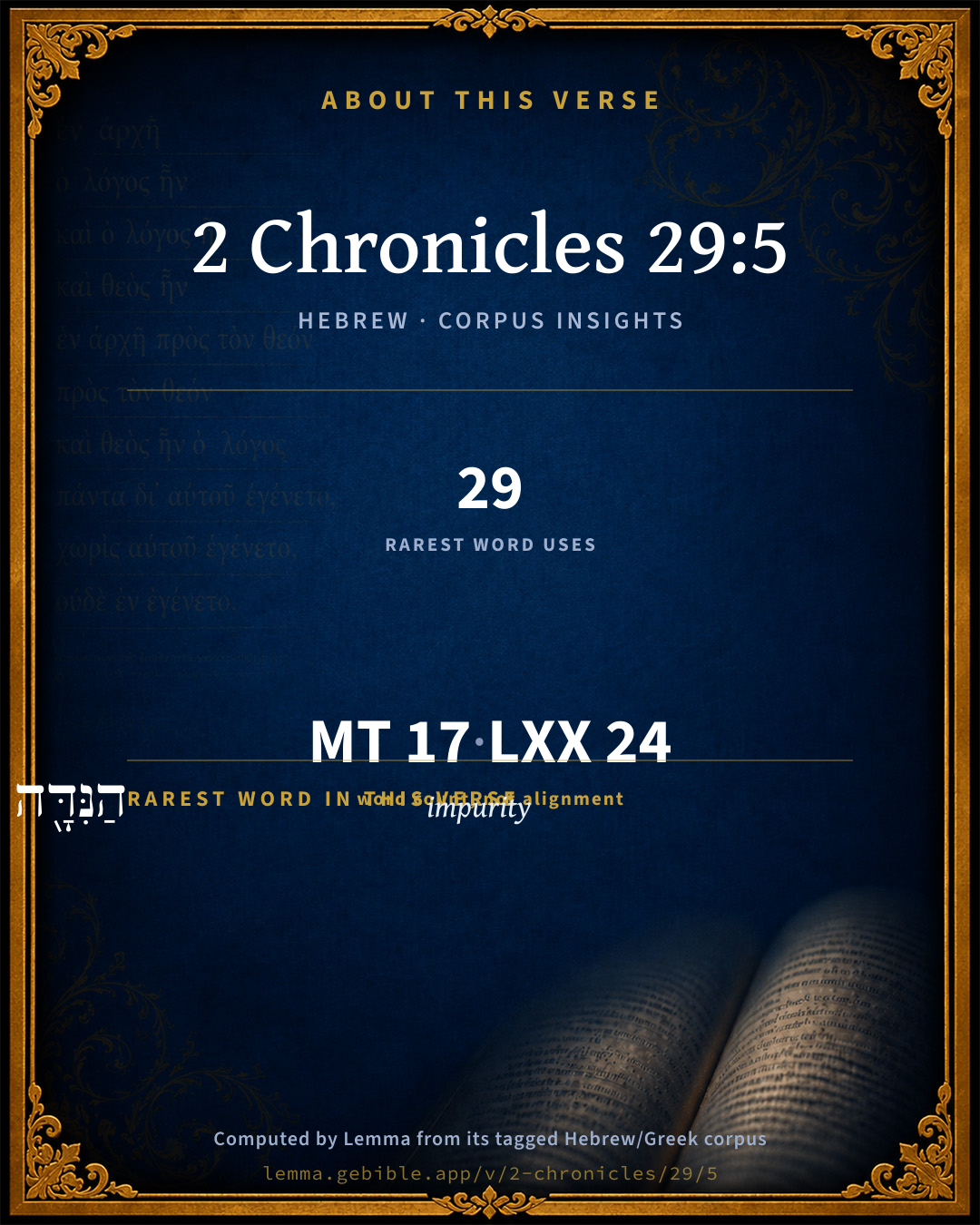
17
words
14
distinct lemmas
Historical
section

Shared distinctive vocabulary

הַנִּדָּ֖ה impurity H5079 occurs in 24 verses of the Hebrew Bible. Also found in:

Grammatical profile

  • 5 verbs
  • 7 nouns
  • 2 prepositions
  • 1 adverb
  • 2 particles

Verb forms

  • וַיֹּ֥אמֶר Qal · Sequential Imperfect
  • שְׁמָע֣וּנִי Qal · Imperative
  • הִֽתְקַדְּשׁ֗וּ Hithpael · Imperative
  • וְקַדְּשׁוּ֙ Piel · Imperative
  • וְהוֹצִ֥יאוּ Hiphil · Imperative

Repetition

A word recurs within this verse — often emphatic in Hebrew:

  • הִֽתְקַדְּשׁ֗וּ to consecrate H6942 ×2

Hebrew & Septuagint length

In English translation the verse runs 32 words from the Hebrew and 30 from the Septuagint (LXX English) — closely comparable.

A rough comparison of the two English renderings, which tokenize alike — not a word-level alignment.

Word counts can differ between the Hebrew and the Greek without any difference in meaning — e.g. the Hebrew direct-object marker אֵת has no separate Greek word, and Greek often adds the article ὁ.

In the original languages it is 17 Hebrew tokens and 24 Greek tokens — but the two are counted differently (Hebrew bundles its prefixes and suffixes into one token; the Greek is in lemma form), so that isn’t a like-for-like length.

Cross-references

15

Topical passages linked to 2 Chronicles 29:5 in the Treasury of Scripture Knowledge — connected by theme and wording, ordered by reader-vote popularity; previews shown in the World English Bible.

  • 2 Chronicles 35:6 Kill the Passover, and sanctify yourselves, and prepare for your brothers, to do according to the word of Yahweh by Moses.
  • 1 Corinthians 3:16–17 Don't you know that you are a temple of God, and that God's Spirit lives in you?
  • 1 Chronicles 15:12 and said to them, You are the heads of the fathers' [houses] of the Levites: sanctify yourselves, both you and your brothers, that you may bring up the ark of Yahweh, the God of Israel, to [the place] that I have prepared for it.
  • 2 Chronicles 34:3–8 For in the eighth year of his reign, while he was yet young, he began to seek after the God of David his father; and in the twelfth year he began to purge Judah and Jerusalem from the high places, and the Asherim, and the engraved images, and the molten images.
  • Ezekiel 8:9–18 He said to me, Go in, and see the wicked abominations that they do here.
  • 2 Chronicles 29:15–16 They gathered their brothers, and sanctified themselves, and went in, according to the commandment of the king by the words of Yahweh, to cleanse the house of Yahweh.
  • 2 Chronicles 29:34 But the priests were too few, so that they could not flay all the burnt offerings: therefore their brothers the Levites helped them, until the work was ended, and until the priests had sanctified themselves; for the Levites were more upright in heart to sanctify themselves than the priests.
  • 2 Corinthians 7:1 Having therefore these promises, beloved, let us cleanse ourselves from all defilement of flesh and spirit, perfecting holiness in the fear of God.
  • Exodus 19:10 Yahweh said to Moses, "Go to the people, and sanctify them today and tomorrow, and let them wash their garments,
  • Exodus 19:15 He said to the people, "Be ready by the third day. Don't have sexual relations with a woman."
  • Ezekiel 8:3 He put forth the form of a hand, and took me by a lock of my head; and the Spirit lifted me up between earth and the sky, and brought me in the visions of God to Jerusalem, to the door of the gate of the inner [court] that looks toward the north; where was the seat of the image of jealousy, which provokes to jealousy.
  • Ezekiel 36:25 I will sprinkle clean water on you, and you shall be clean: from all your filthiness, and from all your idols, will I cleanse you.
  • Matthew 21:12–13 Jesus entered into the temple of God, and drove out all of those who sold and bought in the temple, and overthrew the money-changers' tables and the seats of those who sold the doves.
  • 2 Corinthians 6:16 What agreement has a temple of God with idols? For you are a temple of the living God. Even as God said, "I will dwell in them, and walk in them; and I will be their God, and they will be my people."
  • Ephesians 5:26–27 that he might sanctify it, having cleansed it by the washing of water with the word,

Cross-references courtesy of OpenBible.info (CC BY 4.0).

Hebrew and Greek witnesses Masoretic Hebrew ↔ Greek Septuagint

The same verse in the two great witnesses to the Old Testament, shown verse-for-verse.

These are two independent witnesses, not word-aligned to each other, and the Septuagint is shown in lemma (dictionary) form.

Hebrew 2 Chronicles 29:5 Masoretic · Westminster Leningrad Codex

וַיֹּ֥אמֶר לָהֶ֖ם שְׁמָע֣וּנִי הַלְוִיִּ֑ם עַתָּ֣ה הִֽתְקַדְּשׁ֗וּ וְקַדְּשׁוּ֙ אֶת בֵּ֤ית יְהוָה֙ אֱלֹהֵ֣י אֲבֹתֵיכֶ֔ם וְהוֹצִ֥יאוּ אֶת הַנִּדָּ֖ה מִן הַקֹּֽדֶשׁ

and said to them, Hear me, you Levites; now sanctify yourselves, and sanctify the house of Yahweh, the God of your fathers, and carry forth the filthiness out of the holy place.

World English Bible · Public Domain

Greek LXX 2 Chronicles 29:5 Septuagint · lemma form

καί εἶπον αὐτός ἀδούω ὁ λευείτης νῦν ἁγνίζω καί ἁγνίζω ὁ οἶκος κύριος θεός ὁ πατήρ σύ καί ἐκβάλλω ὁ ἀκαθαρσία ἐκ ὁ ἅγιος

and said to them, Hear, you⌃ Levites: now sanctify yourselves, and sanctify the house of the Lord God of your fathers, and cast out the impurity from the holy places.

LXX2012 (modern English Septuagint) · Public Domain

Hebrew: Westminster Leningrad Codex (CC BY 4.0). Greek: Septuagint (public domain); English from LXX2012 (modern English Septuagint) (Public Domain). How the Septuagint differs from the Hebrew →

Commentary

Notes on 2 Chronicles 29:5 from classic Christian and Jewish commentators (each source and its license shown beneath its notes). The classic Christian expositions comment on the surrounding passage and are grouped to its opening verse, so a note may address several verses; the Jewish commentaries on the Tanakh (Rashi and others) are per-verse, so they appear only where the commentator wrote on this verse.

Lemma curates 59 commentaries, every one of them public domain or Creative Commons licensed, each selected and text-cleaned for this edition rather than reprinted as found. About our sources →

Trapp's Complete Commentary

John Trapp

2Ch 29:5 And said unto them, Hear me, ye Levites, sanctify now yourselves, and sanctify the house of the LORD God of your fathers, and carry forth the filthiness out of the holy [place].

Ver. 5. And he said unto them, Hear me.] He makes a speech to them, full of faith and piety in every passage.

Ye Levites.] He beginneth his reformation at the ministry. Incipiendum a Minoritis, said one of the council of Basil; Imo vero a Maioritis, said another. The priests are here comprised under the name of Levites.

Sanctify now yourselves.] By legal rites, but especially by repentance, faith, and new obedience, fit yourselves for your respective employments.

And carry forth the filthiness.] The idols, and all their trinkets and trash. Nothing must be left behind that might make idolaters hope for a desired day.

John Trapp, A Commentary or Exposition upon All the Books of the Old and New Testament (1647–1656) — public domain. Text from a community e-Sword module.

The Biblical Illustrator

Joseph S. Exell

2Ch_29:5

Sanctify now yourselves and sanctify the house of the Lord God of your fathers.

Personal consecration

I. What is involved in this personal dedication? Thomas Aquinas made three kinds of baptism: Sanguinis, fluminis, fiaminis--the blood, the flood, the fire! By repentance and faith in Christs atonement the sinner is saved, and by water-baptism received into the visible Church. But, to be wholly prepared for the Masters work, there must be the baptism of the Holy Ghost and of fire. The aim of Christianity is to lead us from the material to the spiritual; from the instrumental and accidental to the absolute and eternal. This house is an instrument in the service of God. Its best consecration is the consecration of its occupants, and this is accomplished by the radical work of the Holy Spirit. The tongue of the preacher, the pen of the author, the lips of the singer, the fingers of the musician, and the brush of the painter, are servants of a governing purpose--channels through which thought and feeling, genius and culture, express themselves. If the soul that controls these instruments be consecrated, then they are hallowed. As the wondrous river we read of in ancient fable turned to gold the very sand its currents washed, so does the fountain of a holy heart, pouring forth its enriching flood in speech and effort, dignify the humblest employment or surroundings. With this spirit of consecration enter and occupy this sanctuary, and you will make the place, indeed, holy.

II. What are the fruits of this radical, hearty, and permanent consecration? The people by this spirit of high consecration, are set free from the bondage of low and false views, prevalent in worldly circles. And, finally, if the pure and holy spirit of self-dedication, thus outlined, prevails, genuine revivals of religion will surely follow, healthful growth in activity, love, and liberality will be seen, and true Christian unity will be fostered among all who really love our Lord Jesus Christ. (Prof. E. P. Thwing.)

Reformation must be thorough

A reformation to be worth much must be thorough. Half-way work in this line is of little value. Again and again the kings of Judah, when they swept away all idol worship, left untouched the high places where Jehovah was sacrificed to irregularly; and, because of their failure at completeness, their people went quickly back to gross idolatry. So in all partial attempts at reform. The man who proposes to give up drinking, or gambling, or profanity, or dishonest courses, without surrendering himself wholly to the Lord, is not likely to succeed even to the extent of his attempts. And it is with the house of the Lord as it is with persons. Unless it is wholly the Lords, it does little honour to Him. H it is in use for religious purposes on Sunday, and for concerts and fairs and lectures and shows during the week; or if part of it is for a house of worship, and part for shops of trade--it is at the best a much abused sanctuary. Carry forth the filthiness out of the holy place. (H. Clay Trumbull.)

The Biblical Illustrator, edited by Joseph S. Exell (c. 1880s–1900s) — public domain. Text from a community e-Sword module.

Joseph Benson's Commentary

2Ch 29:5. Hear me, ye Levites; carry forth the filthiness — That filthy altar which Ahaz had put in the place of God’s altar, (2Ki 16:11,) and the idols, or other abominable things, which were there; out of the holy place — The temple, or the priests’ court, which also is often called a holy place.

Joseph Benson's Commentary on the Old and New Testaments (1811–1818) — public domain. Text from a community e-Sword module.

Tyndale Open Study Notes

Tyndale Open Resources

29:5-11 Hezekiah’s speech used vocabulary typical of exile to describe the failure of the nation. As in the days of the separation under Rehoboam (12:1; see 13:10), the people had been unfaithful when they abandoned the Lord.

Tyndale Open Study Notes — © Tyndale Open Resources, licensed CC BY-SA 4.0. Text via the HelloAO Bible API.

Geneva Bible (1599)

Geneva Bible translators

Meaning, all the idols, altars, groves and whatsoever was occupied in their service, and wherewith the Temple was polluted.

Geneva Bible (1599) marginal notes — public domain. Text via Bolls.life.

Ellicott's Commentary for English Readers

(5) Hear me.—2Ch_15:2; 2Ch_20:15.

Sanctify now yourselves.—See Note on 1Ch_15:12; 1Ch_15:14.

Sanctify the house.—By removing all symbols of idolatry.

Carry forth the filthiness.—Niddah denotes personal impurity (Lev_12:2; Eze_18:6); and so anything loathsome (Eze_7:19); here probably idols, and things connected with their worship.

A Bible Commentary for English Readers, edited by Charles John Ellicott (1878–1897) — public domain. Text from a community e-Sword module.

The Cambridge Bible for Schools and Colleges

gen. ed. J. J. S. Perowne

5. sanctify now yourselves] Cp. Exo_19:10-15.

The Cambridge Bible for Schools and Colleges (gen. ed. J. J. S. Perowne; Cambridge University Press, 1878–1918) — public domain. Text from a community e-Sword module.

John Gill's Exposition

For our fathers have transgressed, and done that which was evil in the eyes of the Lord our God,.... Meaning their more immediate ancestors, his father and theirs, who had committed idolatry; which is a great trespass, and than which there is not a greater evil in the sight of God, nor more provoking to him:

and have forsaken him; his word, worship, and ordinances:

and have turned away their faces from the habitation of the Lord; the temple, by neglecting that, and the service of it, and attending the high places: and turned their backs; upon it; though some think this refers to a rite or custom, introduced by Ahaz before he shut up the temple, that instead of looking to the west, when they worshipped, where was the ark of the Lord, he ordered them to turn their faces to the east, where his altar stood.

John Gill's Exposition of the Whole Bible (1746–1763) — public domain (CC PDM 1.0). Text via the HelloAO Bible API.

Albert Barnes' Notes on the Bible

Sanctify now yourselves - Compare the marginal reference. Hezekiah follows David’s example, knowing, probably, that the priests had in the preceding time of idolatry contracted many defilements.

The “filthiness,” or “uncleanness” 2Ch 29:16, might consist, in part, of mere dust and dirt, in part, of idolatrous objects introduced by Ahaz before he finally shut up the temple 2Ki 16:10-16.

Albert Barnes' Notes on the Bible (1834–1885) — public domain. Text from a community e-Sword/MySword module.

Haydock's Catholic Bible Commentary

Sanctuary, or temple, v. 7. The Jews suppose that idols had been placed in the very sanctuary: (Lyranus) but why then were the doors shut? C.

George Leo Haydock (1774–1849), Haydock's Catholic Family Bible and Commentary, 1859 edition — public domain. Excludes Psalms (Douay-Rheims chapter numbering differs from Protestant) and Deuterocanonical books (Catholic canon only).

Matthew Poole's English Annotations

That filthy altar, which Ahaz had put in the place of God’s altar, 2Ki 16:11, &c., and the idols or other abominable or polluting things which were there.

Out of the holy place; the temple, or the priests’ court, which also is called a holy place, Lev 6:16; 10:13; Num 28:7.

Matthew Poole's English Annotations on the Holy Bible (1683–1685) — public domain. Text from a community e-Sword/MySword module.

Whedon's Commentary on the Bible

Daniel D. Whedon

5. Sanctify now yourselves — That is, ceremonially, by purifying yourselves from all legal defilement. This was necessary in order that they might properly sanctify the house of the Lord by removing from it all its defilements. Comp. 1Ch_15:12-14.

Carry forth the filthiness — The abominations of idolatry which Ahaz had introduced, and also the dust and dirt that had accumulated there. Comp. 2Ch_29:16, note.

Daniel D. Whedon (gen. ed.), Commentary on the Old and New Testaments (1874–1909) — public domain. Text from a community e-Sword module.

The Pulpit Commentary

Sanctify yourselves; Hebrew, WvDqthi. Note the absence of any such direction in 1Ch 13, and see 2Ch_15:11-14, with our note on ver. 12 in particular. The filthiness; Hebrew, hDiGhAta,. This word occurs twenty-seven times, and is rendered "separation" fifteen times, "flowers" twice, "put apart" three times, "uncleanness" or "filthiness" six times, and "menstruous" once. The term, therefore, is among the strongest that could be used, and glances probably at the abominations, of whatsoever sort, that Ahaz"s idolatries had entailed (comp. ver. 16).

The Pulpit Commentary (1880–1919), ed. H.D.M. Spence-Jones & Joseph S. Exell — public domain. Text from a community e-Sword module.

John Wesley's Explanatory Notes

Filthiness - That filthy altar, which Ahaz had put in the place of God's altar, 2 Kings xvi, 11, and the idols, or other abominable things which were there.

John Wesley, Explanatory Notes Upon the Whole Bible (1754–1765) — public domain. Text via the GEBible commentary corpus.

Rashi

Rabbi Shlomo Yitzchaki (Rashi)

and remove the ‘menstruant’ The Midrash Aggadah (source unknown) states: ‘The corpse’ is not stated here, but ‘the menstruant,’ which is more repugnant than the corpse. It is compared to the uncleanness of the menstruant, because menstrual blood is repugnant.

Rashi on the Tanakh — English translations: “The Judaica Press complete Tanach with Rashi, translated by A. J. Rosenberg” (CC BY 4.0); “Pentateuch with Rashi's commentary by M. Rosenbaum and A.M. Silbermann, 1929-1934” (public domain); “The Metsudah Tanach series, Lakewood, N.J” (CC BY 4.0); and “The Book of Joshua, Metsudah Publications, 1997” (CC BY 4.0). Text via Sefaria.

Lesson kit

Teaching starters — assembled from the data on this page, not authored interpretation. Every prompt links to the verse data it draws on. Edit before teaching.

2 Chronicles, in the Historical, opens this verse with 17 words (14 distinct Hebrew lemmas). Its most distinctive word is niddâh (“impurity”). A historical commentator’s framing appears above. Read the whole chapter for the surrounding context.

Discussion questions

  1. The word niddâh carries the sense “impurity.” How does it shape the verse?
  2. Leviticus 12:2 shares the word «impurity» with this verse. How do the two illuminate each other?
  3. “to consecrate” occurs 2× in this one verse. What is the effect of the repetition?
  4. These translations render this verse differently. What is at stake in choosing one wording over another?
  5. The verb «וַיֹּ֥אמֶר» is Qal Sequential Imperfect. How does its form color the action?
  6. Reading how Trapp's Complete Commentary and The Biblical Illustrator read this verse, where do the two commentators agree and where do they part?

Things to notice

Reading settings

Reading text

Shown beneath each verse's original-language words.

Old Testament
Old Testament edition

Read the OT as the Masoretic Hebrew (MT) or the Greek Septuagint (LXX).

English shown for the Greek Septuagint (in the Hebrew ↔ Greek comparison).

Comparing translations? Open the Compare panel on any verse page to stack up to four side by side.