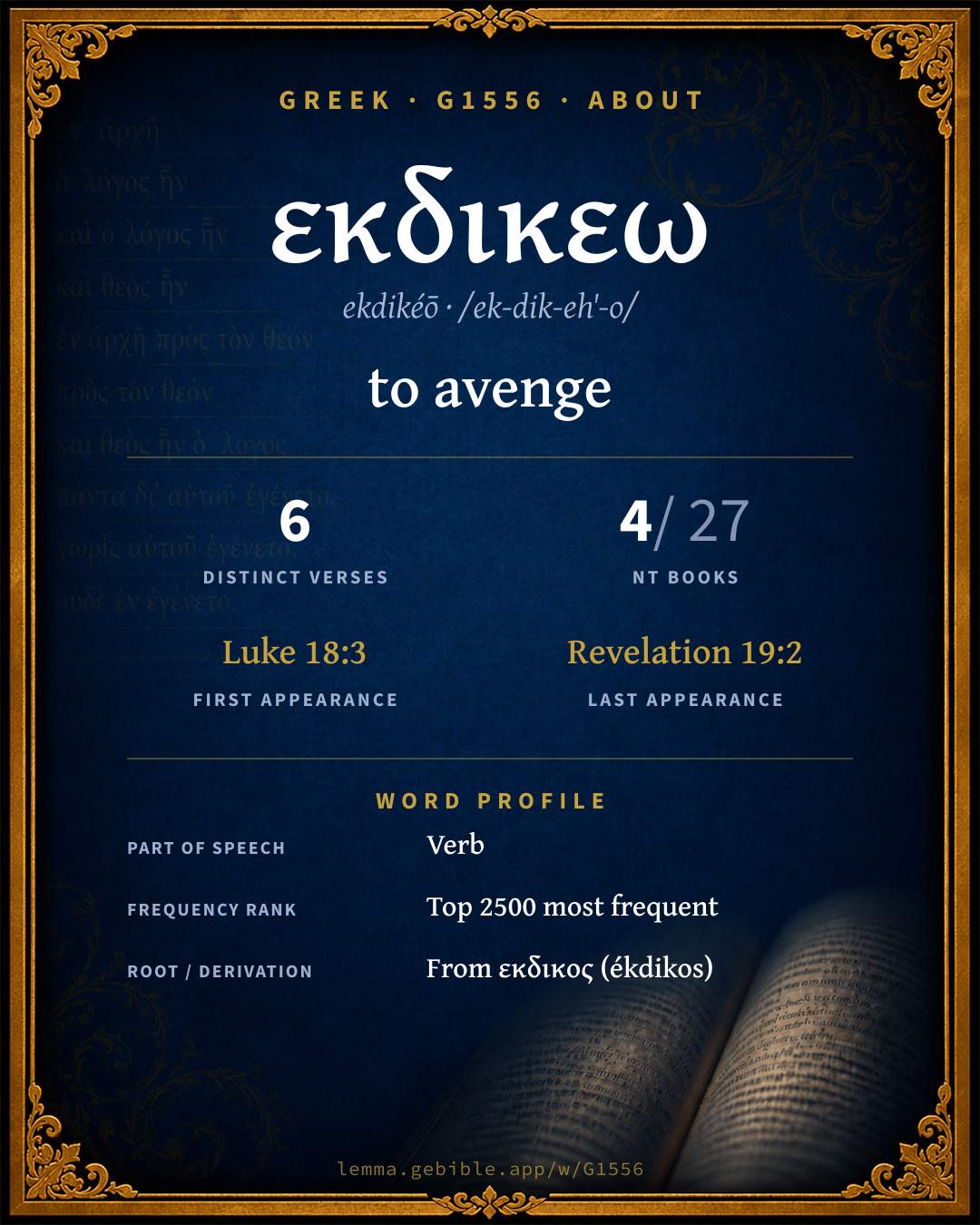
ἐκδικέω
to avenge
‘to avenge’ is one of 2 main senses fuller range ↓
Full lexicon entry — Thayer's Greek Lexicon
From Thayer's Greek Lexicon
Where this word appears
See every Aorist-tense verb in the Greek New Testament →
Grammar key — what these labels mean
Part of speech
- Verb
- An action or state-of-being word.
Tense
- Aorist
- Action viewed as a simple whole, without regard to duration — often past (perfective aspect).
- Future
- Action expected in future time.
- Present
- Ongoing or general action in present time (imperfective aspect).
Voice
- Active
- The subject performs the action.
Mood
- Indicative
- States a fact or asks a factual question (the mood of reality).
- Imperative
- Expresses a command or request.
- Infinitive
- A verbal noun (“to write”), unmarked for person or number.
- Participle
- A verbal adjective (“writing,” “having written”).
Case
- Nominative
- The case of the subject (and the predicate nominative).
Person
- 3rd person
- The one spoken about (“he / she / it / they”).
- 2nd person
- The one addressed (“you”).
- 1st person
- The speaker (“I / we”).
Gender
- Masculine
- Grammatically masculine.
Number
- Singular
- One.
- Plural
- More than one.
Grammatical forms
- Verb, Aorist, Active, Indicative, 3rd person, Singular 1 time (17%)
- Verb, Aorist, Active, Imperative, 2nd person, Singular 1 time (17%)
- Verb, Aorist, Active, Infinitive 1 time (17%)
- Verb, Future, Active, Indicative, 1st person, Singular 1 time (17%)
- Verb, Present, Active, Indicative, 2nd person, Singular 1 time (17%)
- Verb, Present, Active, Participle, Nominative, Plural, Masculine 1 time (17%)
Parsed forms decoded from the imported morphology (Robinson–Tischendorf, public domain), counted across 6 parsed occurrences — not distinct verses.
Every verse where G1556 appears — 6 distinct verses across 4 books. Click any verse to open its interlinear word-by-word view. Verse text shown in the World English Bible for context — . Each verse’s Greek form is shown with its reference; the English is not keyword-highlighted, since the data carries no word-level English alignment. Use “Compare translations” on any verse to read it across multiple English versions. This concordance covers the Greek New Testament; Septuagint (Greek Old Testament) occurrences of this word are not indexed here.
Luke 2 verses
Romans 1 verse
2 Corinthians 1 verse
Revelation 2 verses
- Revelation 6:10 ἐκδικεῖς pres act ind 2sg They cried with a loud voice, saying, "How long, Master, the holy and true, until you judge and avenge our blood on those who dwell on the earth?"
- Revelation 19:2 ἐξεδίκησεν aor act ind 3sg for true and righteous are his judgments. For he has judged the great prostitute, who corrupted the earth with her sexual immorality, and he has avenged the blood of his servants at her hand."
About this entry
At a glance — auto-summarized from this page’s data, not written by a person. Every figure links to its source below. This summary describes the numbers; it doesn’t interpret them.
εκδικεω (ekdikéō) is a Greek verb most often rendered “to avenge.” First canonically at Luke 18:3, it enters the text early. With 6 verses in 4 books, it is an uncommon word in the Greek New Testament. It concentrates in Luke, which alone accounts for 33% of its uses. Lexicons map it across 2 senses. See the sense tree, 6-verse concordance, and the renderings breakdown below.
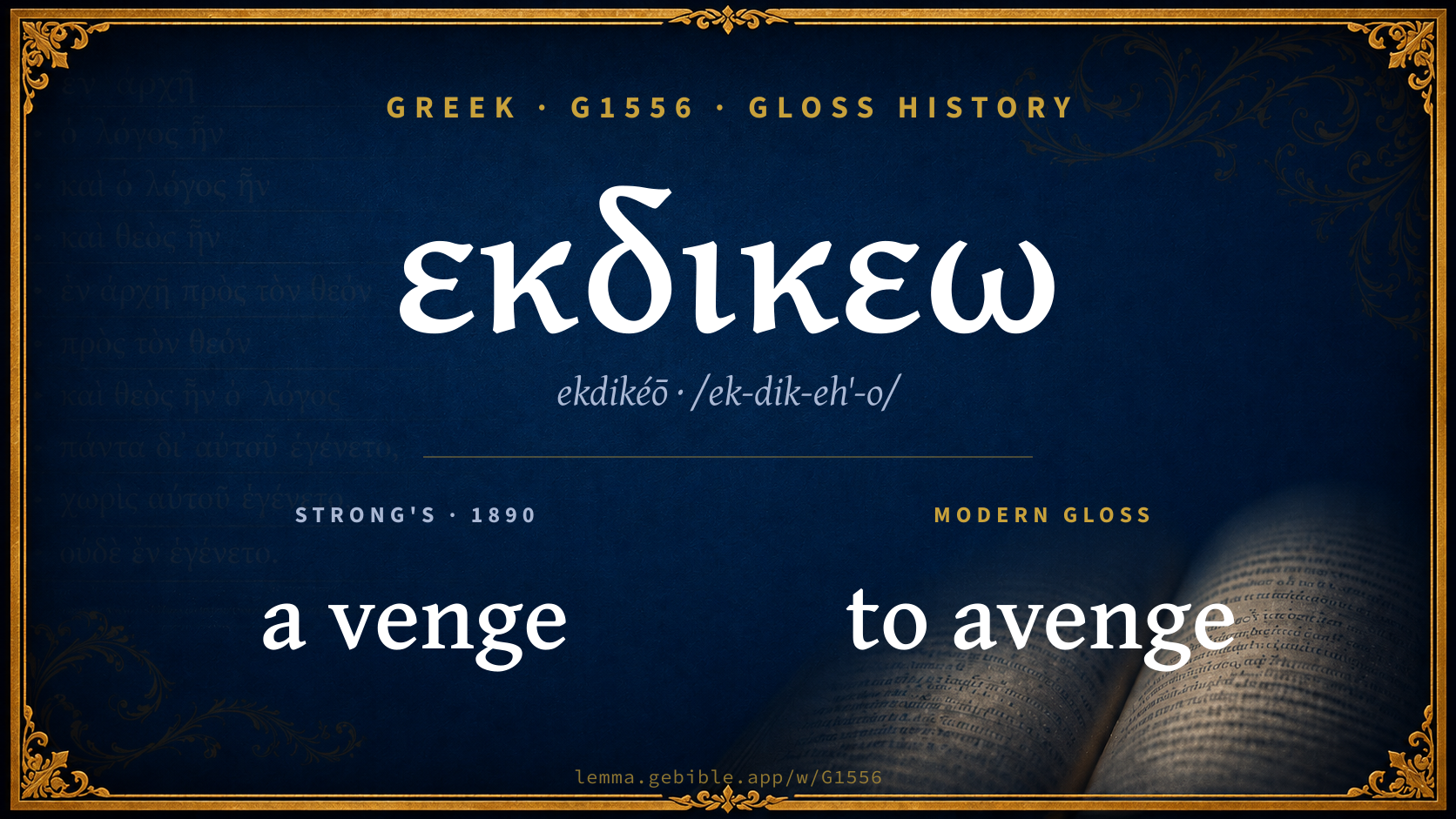
Gloss history
Strong's 1890 vs modern scholarship
About this word
Strong's G1556 catalogs a Greek word from the Greek New Testament.
These counts are not copied from any lexicon or concordance. They are computed here, from the morphology-tagged Greek New Testament. What Lemma adds →
- 6
- distinct verses
- The word appears in 6 distinct verses.
- 4 / 27
- NT books
- The word appears in 4 of 27 New Testament books.
- #1,476
- by frequency
- Top 2500 most frequent Greek words (rank 1,476 of 5,347 Greek words by occurrence).
View all 6 occurrences in the concordance →
Most concentrated in
- Luke 2 verses 33%
- Revelation 2 verses 33%
- Romans 1 verse 17%
By section of the New Testament
By traditional corpus
Conventional, traditional groupings — biblical authorship is debated, so this is a traditional corpus grouping, not an authorship claim. Some books belong to more than one corpus (Luke is in both the Gospels and the Lukan corpus, and so on), so these shares overlap and need not total 100%. Each figure is a share of the word’s 6 distinct verses.
- Gospels 2 verses · 33%
- Lukan (Luke–Acts) 2 verses · 33%
- Johannine 2 verses · 33%
- Pauline corpus 2 verses · 33%
- Revelation 2 verses · 33%
How translations render this word
Counts come from each version’s own published word-to-Strong’s tagging or interlinear alignment — an approximate guide to how each version renders this word, not a word-level alignment the data otherwise carries. Because each total is that version’s own tagged count, the per-version totals vary from one another and need not match the appearance or distinct-verse counts above. These counts may also differ from a printed concordance because Lemma counts each distinctly tagged rendering and does not collapse phrase taggings into a single head-word total. This is a fixed set of word-tagged versions (KJV, ASV, BSB, ULT) and does not change with the reading translation you choose elsewhere. Each version’s license is shown beside its name below (and on Sources).
- King James Version: Avenge 3×
- American Standard Version: Avenge 4×
- Berean Standard Bible: Avenge 2×
- unfoldingWord Literal Text: Avenge 2×
King James Version Public Domain
Renders G1556 across 6 tagged occurrences — most commonly:
Plus 3 renderings that appear only once — usually multi-word phrases or single function words the recovered tagging swept in, not distinct renderings.
American Standard Version Public Domain
Renders G1556 across 6 tagged occurrences — most commonly:
Plus 2 renderings that appear only once — usually multi-word phrases or single function words the recovered tagging swept in, not distinct renderings.
Berean Standard Bible Public Domain
Renders G1556 across 6 tagged occurrences — most commonly:
Plus 4 renderings that appear only once — usually multi-word phrases or single function words the recovered tagging swept in, not distinct renderings.
unfoldingWord Literal Text CC BY-SA 4.0
Renders G1556 across 6 tagged occurrences — most commonly:
Plus 4 renderings that appear only once — usually multi-word phrases or single function words the recovered tagging swept in, not distinct renderings.
Senses in Thayer's
The 2 senses Thayer's distinguishes for this word, in lexicon order (not ranked by frequency or importance). The full entry — with sub-senses — is in the Lexicon Entry tab.
- to vindicate one's right, do one justice
- to punish a person for a thing
Word origin
Derived from εκδικος (ékdikos) (G1558) — without justice.
From G1558 ; to vindicate retaliate punish : - a (re-) venge.
— Strong’s Exhaustive Concordance (1890), public domain.
Forms in the corpus
The 6 distinct written forms G1556 takes in the Greek New Testament, most frequent first — each parse links to that tense’s occurrences in the concordance.
| Form | Parsing | Example | Uses |
|---|---|---|---|
| ἐκδίκησόν ekdíkēsón | Verb, Aorist, Active, Imperative, 2nd person, Singular | Luke 18:3 | 1 |
| ἐκδικήσω ekdikḗsō | Verb, Future, Active, Indicative, 1st person, Singular | Luke 18:5 | 1 |
| ἐκδικεῖς ekdikeîs | Verb, Present, Active, Indicative, 2nd person, Singular | Revelation 6:10 | 1 |
| ἐκδικοῦντες ekdikoûntes | Verb, Present, Active, Participle, Nominative, Plural, Masculine | Romans 12:19 | 1 |
| ἐκδικῆσαι ekdikē̂sai | Verb, Aorist, Active, Infinitive | 2 Corinthians 10:6 | 1 |
| ἐξεδίκησεν exedíkēsen | Verb, Aorist, Active, Indicative, 3rd person, Singular | Revelation 19:2 | 1 |
Same root — word family
Other Thayer's entries built from the same root as G1556, grouped by Strong’s listed origin. These share a root / origin per the lexicon — not necessarily a shared meaning. Each links to that word’s own entry.
Derives from
Derived from this word
Compare all same-root words → They share a root, not necessarily a meaning.
Septuagint usage
The same Greek word εκδικεω appears 66 times in the Greek Old Testament (Septuagint), across 60 verses in 20 books.
- 66
- LXX occurrences
- Tagged occurrences of this Greek word in the Septuagint.
- 60
- verses
- Distinct Septuagint verses containing this word.
- 20 / 39
- OT books
- The word appears in 20 of the 39 Old Testament books.
Sample Septuagint occurrences
- Genesis 4:15 ἐκδικέω
- Exodus 7:4 ἐκδικέω
- Leviticus 26:25 ἐκδικέω
- Numbers 31:2 ἐκδικέω
- Deuteronomy 18:19 ἐκδικέω
- Judges 15:7 ἐκδικέω
- 1 Samuel 3:13 ἐκδικέω
- 2 Kings 9:7 ἐκδικέω
- 2 Chronicles 22:8 ἐκδικέω
- Psalms 98:8 ἐκδικέω
- Isaiah 57:16 ἐκδικέω
- Jeremiah 5:9 ἐκδικέω
Septuagint occurrences (same lexeme)
Every verse where the same Strong’s number (G1556) appears in the Greek Septuagint — showing the first 50 of 60. Verse text shown in the World English Bible for context; the Greek form is the matched word — the English is not keyword-highlighted.
- Genesis 4:15 ἐκδικέω Yahweh said to him, "Therefore whoever slays Cain, vengeance will be taken on him sevenfold." Yahweh appointed a sign for Cain, lest any finding him should strike him.
- Genesis 4:24 ἐκδικέω If Cain will be avenged seven times, Truly Lamech seventy-seven times."
- Exodus 7:4 ἐκδικέω But Pharaoh will not listen to you, and I will lay my hand on Egypt, and bring forth my hosts, my people the children of Israel, out of the land of Egypt by great judgments.
- Exodus 21:20 ἐκδικέω "If a man strikes his servant or his maid with a rod, and he dies under his hand, he shall surely be punished.
- Exodus 21:21 ἐκδικέω Notwithstanding, if he gets up after a day or two, he shall not be punished, for he is his property.
- Leviticus 26:25 ἐκδικέω I will bring a sword upon you, that will execute the vengeance of the covenant; and you will be gathered together within your cities: and I will send the pestilence among you; and you will be delivered into the hand of the enemy.
- Numbers 31:2 ἐκδικέω Avenge the children of Israel of the Midianites: afterward you shall be gathered to your people.
- Deuteronomy 18:19 ἐκδικέω It shall happen, that whoever will not listen to my words which he shall speak in my name, I will require it of him.
- Deuteronomy 32:43 ἐκδικέω Rejoice, you nations, [with] his people: For he will avenge the blood of his servants, Will render vengeance to his adversaries, Will make expiation for his land, for his people.
- Judges 15:7 ἐκδικέω Samson said to them, If you do after this manner, surely I will be avenged of you, and after that I will cease.
- 1 Samuel 3:13 ἐκδικέω For I have told him that I will judge his house forever, for the iniquity which he knew, because his sons did bring a curse on themselves, and he didn't restrain them.
- 1 Samuel 14:24 ἐκδικέω The men of Israel were distressed that day; for Saul had adjured the people, saying, Cursed be the man who eats any food until it be evening, and I be avenged on my enemies. So none of the people tasted food.
- 1 Samuel 15:2 ἐκδικέω Thus says Yahweh of Hosts, I have marked that which Amalek did to Israel, how he set himself against him in the way, when he came up out of Egypt.
- 1 Samuel 18:15 ἐκδικέω When Saul saw that he behaved himself very wisely, he stood in awe of him.
- 1 Samuel 24:13 ἐκδικέω As says the proverb of the ancients, Out of the wicked comes forth wickedness; but my hand shall not be on you.
- 2 Kings 9:7 ἐκδικέω You shall strike the house of Ahab your master, that I may avenge the blood of my servants the prophets, and the blood of all the servants of Yahweh, at the hand of Jezebel.
- 2 Chronicles 22:8 ἐκδικέω It happened, when Jehu was executing judgment on the house of Ahab, that he found the princes of Judah, and the sons of the brothers of Ahaziah, ministering to Ahaziah, and killed them.
- Psalms 98:8 ἐκδικέω Let the rivers clap their hands. Let the mountains sing for joy together.
- Isaiah 57:16 ἐκδικέω For I will not contend forever, neither will I be always angry; for the spirit would faint before me, and the souls who I have made.
- Jeremiah 5:9 ἐκδικέω Shall I not visit for these things? says Yahweh; and shall not my soul be avenged on such a nation as this?
- Jeremiah 5:29 ἐκδικέω Shall I not visit for these things? says Yahweh; shall not my soul be avenged on such a nation as this?
- Jeremiah 9:8 ἐκδικέω Their tongue is a deadly arrow; it speaks deceit: one speaks peaceably to his neighbor with his mouth, but in his heart he lays wait for him.
- Jeremiah 15:3 ἐκδικέω I will appoint over them four kinds, says Yahweh: the sword to kill, and the dogs to tear, and the birds of the sky, and the animals of the earth, to devour and to destroy.
- Jeremiah 23:2 ἐκδικέω Therefore thus says Yahweh, the God of Israel, against the shepherds who feed my people: You have scattered my flock, and driven them away, and have not visited them; behold, I will visit on you the evil of your doings, says Yahweh.
- Jeremiah 23:34 ἐκδικέω As for the prophet, and the priest, and the people, who shall say, The burden of Yahweh, I will even punish that man and his house.
- Jeremiah 25:12 ἐκδικέω It shall happen, when seventy years are accomplished, that I will punish the king of Babylon, and that nation, says Yahweh, for their iniquity, and the land of the Chaldeans; and I will make it desolate forever.
- Jeremiah 26:10 ἐκδικέω When the princes of Judah heard these things, they came up from the king's house to the house of Yahweh; and they sat in the entry of the new gate of Yahweh's [house].
- Jeremiah 26:25 ἐκδικέω
- Jeremiah 27:15 ἐκδικέω For I have not sent them, says Yahweh, but they prophesy falsely in my name; that I may drive you out, and that you may perish, you, and the prophets who prophesy to you.
- Jeremiah 27:18 ἐκδικέω But if they be prophets, and if the word of Yahweh be with them, let them now make intercession to Yahweh of Hosts, that the vessels which are left in the house of Yahweh, and in the house of the king of Judah, and at Jerusalem, don't go to Babylon.
- Jeremiah 27:21 ἐκδικέω yes, thus says Yahweh of Hosts, the God of Israel, concerning the vessels that are left in the house of Yahweh, and in the house of the king of Judah, and at Jerusalem:
- Jeremiah 28:36 ἐκδικέω
- Jeremiah 28:44 ἐκδικέω
- Jeremiah 28:52 ἐκδικέω
- Ezekiel 7:7 ἐκδικέω Your doom is come to you, inhabitant of the land: the time is come, the day is near, [a day of] tumult, and not [of] joyful shouting, on the mountains.
- Ezekiel 7:27 ἐκδικέω The king shall mourn, and the prince shall be clothed with desolation, and the hands of the people of the land shall be troubled: I will do to them after their way, and according to their deserts will I judge them; and they shall know that I am Yahweh.
- Ezekiel 16:38 ἐκδικέω I will judge you, as women who break wedlock and shed blood are judged; and I will bring on you the blood of wrath and jealousy.
- Ezekiel 19:12 ἐκδικέω But it was plucked up in fury, it was cast down to the ground, and the east wind dried up its fruit: its strong rods were broken off and withered; the fire consumed them.
- Ezekiel 20:4 ἐκδικέω Will you judge them, son of man, will you judge them? Cause them to know the abominations of their fathers;
- Ezekiel 23:24 ἐκδικέω They shall come against you with weapons, chariots, and wagons, and with a company of peoples; they shall set themselves against you with buckler and shield and helmet round about; and I will commit the judgment to them, and they shall judge you according to their judgments.
- Ezekiel 23:45 ἐκδικέω Righteous men, they shall judge them with the judgment of adulteresses, and with the judgment of women who shed blood; because they are adulteresses, and blood is in their hands.
- Ezekiel 24:8 ἐκδικέω That it may cause wrath to come up to take vengeance, I have set her blood on the bare rock, that it should not be covered.
- Ezekiel 25:12 ἐκδικέω Thus says the Lord Yahweh: Because Edom has dealt against the house of Judah by taking vengeance, and has greatly offended, and revenged himself on them;
- Hosea 1:4 ἐκδικέω Yahweh said to him, "Call his name Jezreel; for yet a little while, and I will avenge the blood of Jezreel on the house of Jehu, and will cause the kingdom of the house of Israel to cease.
- Hosea 2:15 ἐκδικέω I will give her vineyards from there, And the valley of Achor for a door of hope; And she will respond there, As in the days of her youth, And as in the day when she came up out of the land of Egypt.
- Hosea 4:9 ἐκδικέω It will be, like people, like priest; And I will punish them for their ways, And will repay them for their deeds.
- Hosea 8:13 ἐκδικέω As for the sacrifices of my offerings, they sacrifice flesh and eat it; But Yahweh doesn't accept them. Now he will remember their iniquity, And punish their sins. They will return to Egypt.
- Hosea 9:9 ἐκδικέω They have deeply corrupted themselves, As in the days of Gibeah. He will remember their iniquity. He will punish them for their sins.
- Hosea 12:3 ἐκδικέω In the womb he took his brother by the heel; And in his manhood he had power with God.
- Joel 4:21 ἐκδικέω
These are occurrences of the same Greek lexeme (G1556) in the Septuagint — not a translation of any one Hebrew word. The store carries no word-level Hebrew↔Greek alignment, so no Hebrew original is asserted here. Counts come from the recovered LXX Strong's tagging — high-frequency vocabulary is well covered, while rare or late forms may be untagged — so they reflect tagged occurrences and may slightly undercount.