1 Samuel 24:13

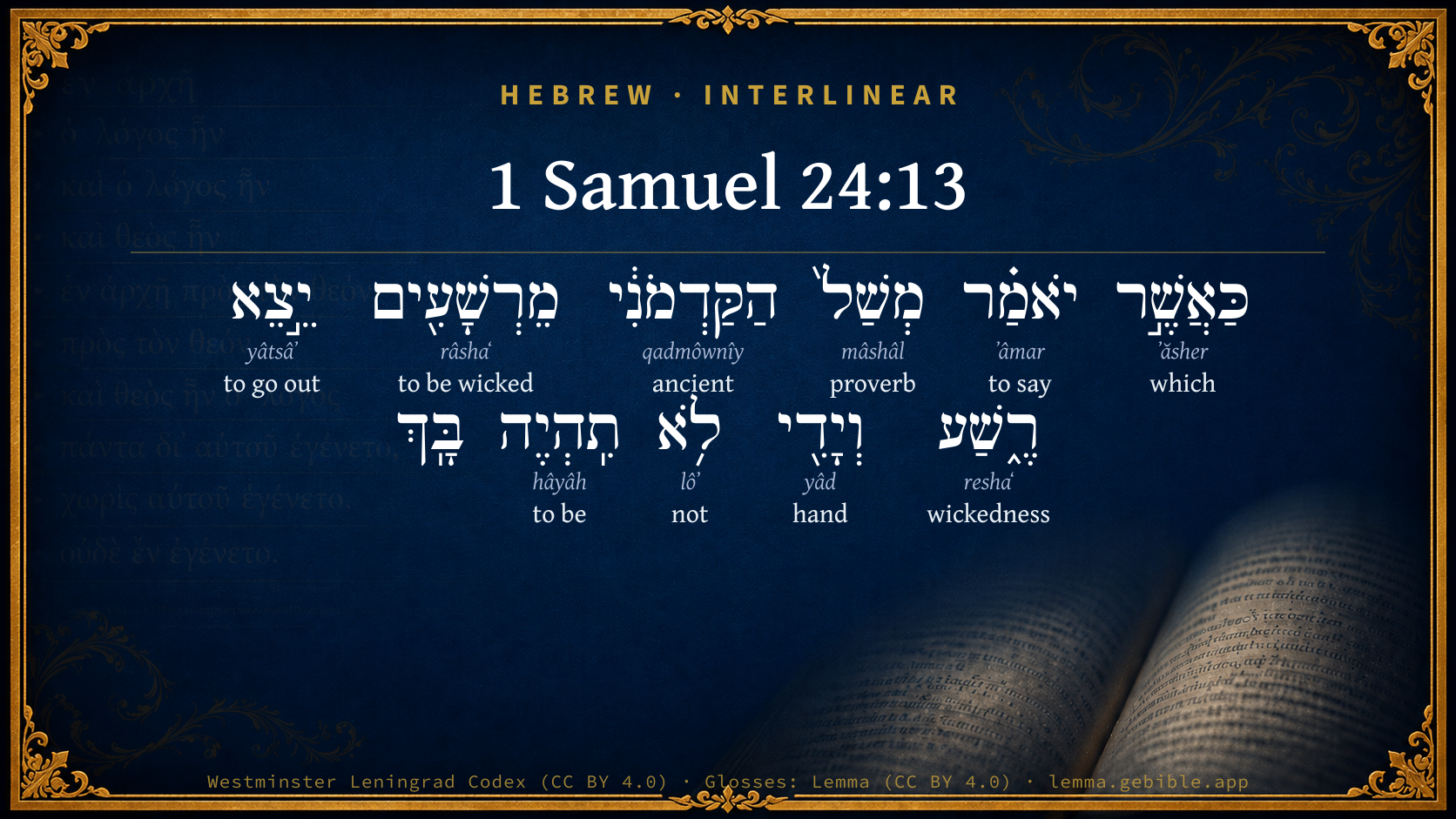
Hebrew (Westminster Leningrad Codex) 1 Samuel 24:13 appears in the Hebrew Old Testament. The text above is from the Westminster Leningrad Codex. Each word links to its Strong’s number, a concise gloss, and parsing drawn from the Open Scriptures Hebrew Bible morphology. Click any word for its full Brown-Driver-Briggs (BDB) entry.
Download image
Cite this verse

1 Samuel 24:13 (World English Bible). Public Domain. Lemma interlinear Bible study tool, https://lemma.gebible.app/v/1-samuel/24/13.

Show BibTeX & RIS
BibTeX
RIS
English Translation
As says the proverb of the ancients, Out of the wicked comes forth wickedness; but my hand shall not be on you.
World English Bible · Public Domain
Highlights
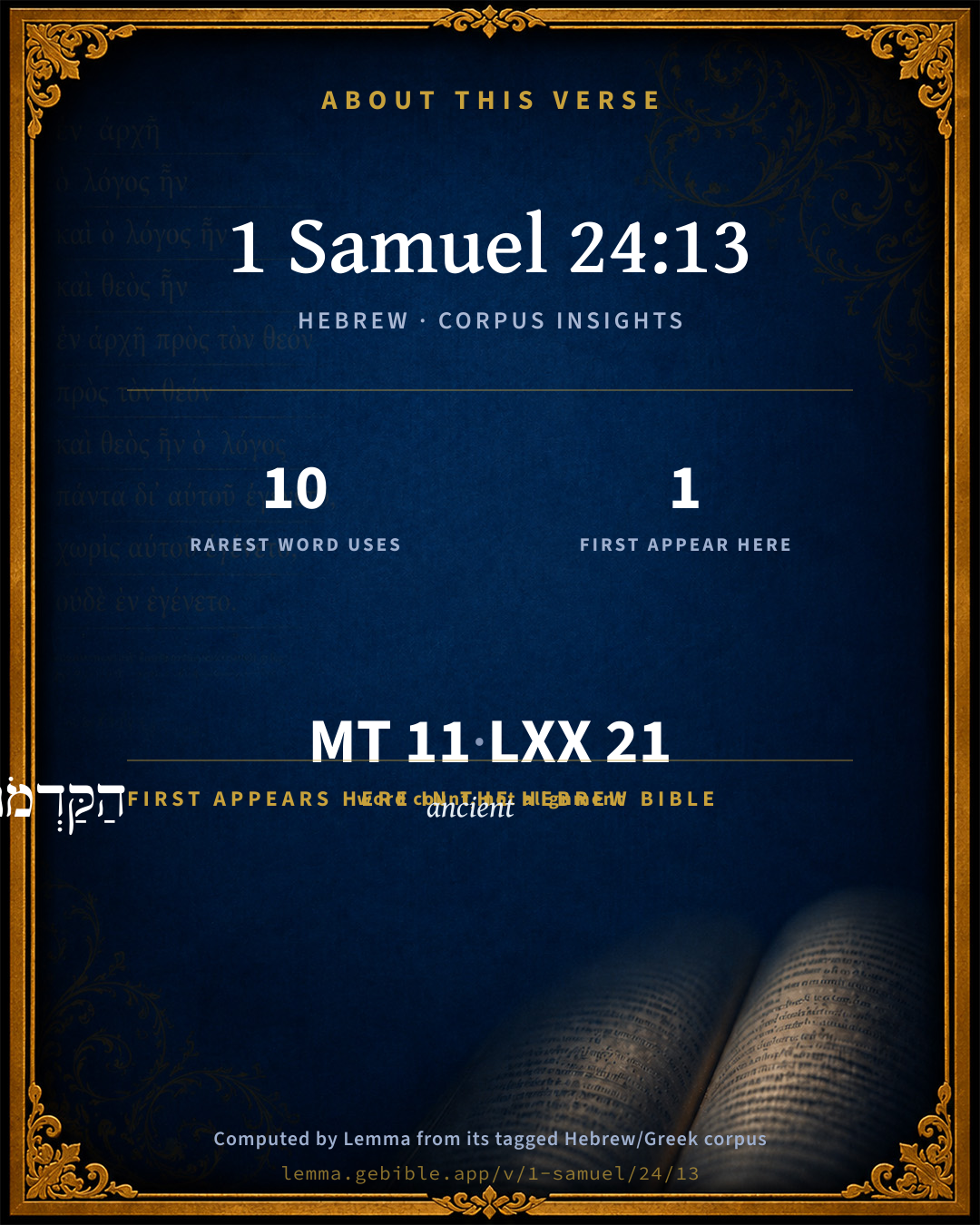
  • 1 first appearance in the Hebrew Bible
Full analysis ↓
Download a study sheet

One document with this verse’s original text, its word-by-word gloss line, the meaning frame, cross-references with their text, attributed commentary, and full source and license credits — printable, and it pastes into notes with its structure intact.

This verse Autodidact and up

Study sheet (.html) Plain text (.txt)

A passage Seminary Student

Up to 50 verses in one chapter. A passage sheet keeps up to 6 commentary sources and 12 cross-references per verse, in the order this page ranks them, and says so on the sheet whenever that leaves anything out. Ask for a single verse and you get the Autodidact verse sheet above.

Everything on this page stays free to read, with no account — the sheet is a download of what is already on screen, not access to it.

Want to remove ads? Support Godless Engineer
Compare translations 3

The same verse in 3 English versions, stacked beneath the original-language interlinear above. Click any original word for its lexicon entry.

Each is an independent rendering of the whole verse — the interlinear is not word-aligned to these translations.

Highlighted words mark where these versions differ — a whole-verse word diff, not a word-by-word alignment.

  • World English Bible Public Domain
    As says the proverb of the ancients, Out of the wicked comes forth wickedness; but my hand shall not be on you.
  • King James Version Public Domain
    As saith the proverb of the ancients, Wickedness proceedeth from the wicked: but mine hand shall not be upon thee.
  • unfoldingWord Literal Text CC BY-SA 4.0
    As the proverb of the ancient says, ‘From the wicked comes out wickedness.’ But my hand will not be against you.

unfoldingWord Literal Text — © unfoldingWord, licensed CC BY-SA 4.0. Word-aligned USFM3 via Door43 (git.door43.org/unfoldingWord/en_ult).

Versions to compare (up to 4)

3 of 4 selected

Show all 18 translations

Every available English version of this verse, each an independent rendering of the whole verse.

  • World English Bible Public Domain
    As says the proverb of the ancients, Out of the wicked comes forth wickedness; but my hand shall not be on you.
  • Berean Standard Bible Public Domain
    As the old proverb says, ‘Wickedness proceeds from the wicked.’ But my hand will never be against you.
  • Majority Standard Bible Public Domain
    As the old proverb says, ‘Wickedness proceeds from the wicked.’ But my hand will never be against you.
  • King James Version Public Domain
    As saith the proverb of the ancients, Wickedness proceedeth from the wicked: but mine hand shall not be upon thee.
  • American Standard Version (1901) Public Domain
    As saith the proverb of the ancients, Out of the wicked cometh forth wickedness; but my hand shall not be upon thee.
  • Revised Version (1885) Public Domain
    As saith the proverb of the ancients, Out of the wicked cometh forth wickedness: but mine hand shall not be upon thee.
  • Geneva Bible (1599) Public Domain
    The Lord be iudge betweene thee and me, and the Lord auenge me of thee, and let not mine hand be vpon thee.
  • Douay-Rheims (1899) Public Domain
    The Lord judge between me and thee, and the Lord revenge me of thee: but my hand shall not be upon thee.
  • Young's Literal Translation Public Domain
    as saith the simile of the ancients, From the wicked goeth out wickedness, and my hand is not on thee.
  • Literal Standard Version CC BY-SA 4.0
    as the allegory of the ancients says, Wickedness goes out from the wicked, and my hand is not on you.
  • Unlocked Literal Bible CC BY-SA 4.0
    As the proverb of the ancients says, 'Out of the wicked comes wickedness.' But my hand will not be against you.
  • unfoldingWord Literal Text CC BY-SA 4.0
    As the proverb of the ancient says, ‘From the wicked comes out wickedness.’ But my hand will not be against you.
  • Darby Bible Public Domain
    As saith the proverb of the ancients, Wickedness proceedeth from the wicked; but my hand shall not be upon thee.
  • World Messianic Bible Public Domain
    As the proverb of the ancients says, ‘Out of the wicked comes wickedness;’ but my hand will not be on you.
  • Webster's Bible Public Domain
    \\24:12\\The LORD judge between me and thee, and the LORD avenge me of thee: but my hand shall not be upon thee.
  • Free Bible Version CC BY-SA 4.0
    As the old saying goes, ‘From the wicked comes wickedness,’ but I myself will never try to harm you.
  • Bible in Basic English Public Domain
    May the Lord be judge between me and you, and may the Lord give me my rights against you, but my hand will never be lifted up against you.
  • JPS Tanakh (1917) Public Domain
    (24-14) As saith the proverb of the ancients: Out of the wicked cometh forth wickedness; but my hand shall not be upon thee.

Literal Standard Version (2020), Covenant Press — licensed CC BY-SA 4.0. Text via the HelloAO Bible API (eBible.org). Unlocked Literal Bible (unfoldingWord) — licensed CC BY-SA 4.0. Text via the HelloAO Bible API (eBible.org). unfoldingWord Literal Text — © unfoldingWord, licensed CC BY-SA 4.0. Word-aligned USFM3 via Door43 (git.door43.org/unfoldingWord/en_ult). Free Bible Version, Dr. Jonathan Gallagher — licensed CC BY-SA 4.0. Text via the HelloAO Bible API (eBible.org).

Word by word

More ways to search: Search by grammar → Find every occurrence → Compare this word →

Practice this passage: Drill this verse → Learn its vocabulary →

הַקַּדְמֹנִ֔י
qadmôwnîy
H6931
“the · ancient”
Particle, Definite Article + Adjective, Adjective, Masculine, Singular, Absolute
Part of Speech
Particle + Adjective
Type
Adjective
Gender
Masculine
Number
Singular
State
Absolute
Full BDB Definition

Origin: from H6930

TWOT: 1988f

former, ancient, eastern - former, ancient - eastern
  1. כַּאֲשֶׁ֣ר ʼăsher H834 “like/as · which” Preposition + Particle, Relative
  2. יֹאמַ֗ר ʼâmar H559 “to say” Verb, Qal, Imperfect, 3rd Person, Masculine, Singular
  3. מְשַׁל֙ mâshâl H4912 “proverb of” Noun, Common, Masculine, Singular, Construct
  4. מֵרְשָׁעִ֖ים râshaʻ H7561 “from · wicked” Preposition + Adjective, Adjective, Masculine, Plural, Absolute
  5. יֵ֣צֵא yâtsâʼ H3318 “to go out” Verb, Qal, Imperfect, 3rd Person, Masculine, Singular
  6. רֶ֑שַׁע reshaʻ H7562 “wickedness” Noun, Common, Masculine, Singular, Absolute
  7. וְיָדִ֖י yâd H3027 “and · hand · my” Conjunction + Noun, Common, Both, Singular, Construct + Suffix, Personal, 1st Person, Common, Singular
  8. לֹ֥א lôʼ H3808 “not” Particle, Negative
  9. תִֽהְיֶה hâyâh H1961 “to be” Verb, Qal, Imperfect, 3rd Person, Feminine, Singular

About this verse

These counts appear in no published source. They are computed here, from the morphology-tagged text and Lemma’s own curated glosses. What Lemma adds →

11
words
10
distinct lemmas
Historical
section

Notable vocabulary

The rarest word here is הַקַּדְמֹנִ֔י ancient H6931 — appearing just 10 times in the whole Hebrew Bible.

First appearance in Scripture

This word makes its first canonical appearance in the Hebrew Bible here:

  • הַקַּדְמֹנִ֔י ancient H6931

Shared distinctive vocabulary

הַקַּדְמֹנִ֔י ancient H6931 occurs in 10 verses of the Hebrew Bible. Also found in:

Grammatical profile

  • 3 verbs
  • 3 nouns
  • 2 adjectives
  • 1 preposition
  • 2 particles

Verb forms

  • יֹאמַ֗ר Qal · Imperfect
  • יֵ֣צֵא Qal · Imperfect
  • תִֽהְיֶה Qal · Imperfect

Hebrew & Septuagint length

In English translation the verse runs 22 words from the Hebrew and 22 from the Septuagint (LXX English) — the same length.

A rough comparison of the two English renderings, which tokenize alike — not a word-level alignment.

Word counts can differ between the Hebrew and the Greek without any difference in meaning — e.g. the Hebrew direct-object marker אֵת has no separate Greek word, and Greek often adds the article ὁ.

In the original languages it is 11 Hebrew tokens and 21 Greek tokens — but the two are counted differently (Hebrew bundles its prefixes and suffixes into one token; the Greek is in lemma form), so that isn’t a like-for-like length.

Cross-references

4

Topical passages linked to 1 Samuel 24:13 in the Treasury of Scripture Knowledge — connected by theme and wording, ordered by reader-vote popularity; previews shown in the World English Bible.

  • Matthew 7:20 Therefore, by their fruits you will know them.
  • Matthew 7:16–18 By their fruits you will know them. Do you gather grapes from thorns, or figs from thistles?
  • Matthew 12:33–34 "Either make the tree good, and its fruit good, or make the tree corrupt, and its fruit corrupt; for the tree is known by its fruit.
  • Matthew 15:19 For out of the heart come forth evil thoughts, murders, adulteries, sexual sins, thefts, false testimony, and blasphemies.

Cross-references courtesy of OpenBible.info (CC BY 4.0).

Hebrew and Greek witnesses Masoretic Hebrew ↔ Greek Septuagint

The same verse in the two great witnesses to the Old Testament, shown verse-for-verse.

These are two independent witnesses, not word-aligned to each other, and the Septuagint is shown in lemma (dictionary) form.

Hebrew 1 Samuel 24:13 Masoretic · Westminster Leningrad Codex

כַּאֲשֶׁ֣ר יֹאמַ֗ר מְשַׁל֙ הַקַּדְמֹנִ֔י מֵרְשָׁעִ֖ים יֵ֣צֵא רֶ֑שַׁע וְיָדִ֖י לֹ֥א תִֽהְיֶה בָּֽךְ

As says the proverb of the ancients, Out of the wicked comes forth wickedness; but my hand shall not be on you.

World English Bible · Public Domain

Greek LXX 1 Samuel 24:13 Septuagint · lemma form

δικάζω κύριος ἀνά μέσος ἐγώ καί σύ καί ἐκδικέω ἐγώ κύριος ἐκ σύ καί ὁ χείρ ἐγώ οὐ εἰμί ἐπί σύ

The Lord judge between me and you, and the Lord requite you on yourself: but my hand shall not be upon you.

LXX2012 (modern English Septuagint) · Public Domain

Hebrew: Westminster Leningrad Codex (CC BY 4.0). Greek: Septuagint (public domain); English from LXX2012 (modern English Septuagint) (Public Domain). How the Septuagint differs from the Hebrew →

Targum (Aramaic paraphrase)

1

The Targum is the ancient Jewish Aramaic paraphrase of the Hebrew Scriptures — an interpretive translation, not the Hebrew text itself. Onkelos (literal) and Pseudo-Jonathan (expansive) render the Torah, and Jonathan the Prophets. Coverage is partial: where no permissively-licensed English translation exists for a verse, only the Aramaic is shown. This is verse-level text, not a word-by-word alignment to the Hebrew.

  1. Targum Jonathan Prophets (Joshua–Malachi)
    יְדִין יְיָ בֵּינָא וּבֵינָךְ וְיִתְפְּרַע לִי יְיָ מִנָךְ וִידִי לָא תְהִי בָךְ:

    (no public-domain English translation for this verse)

    Targum Jonathan — Aramaic: “Mikraot Gedolot” (public domain). English: “Sefaria Community Translation” (CC0 1.0 (public-domain dedication)); “London "Chaldee Paraphrase," 1871” (public domain). Text via Sefaria.

Commentary

Notes on 1 Samuel 24:13 from classic Christian and Jewish commentators (each source and its license shown beneath its notes). The classic Christian expositions comment on the surrounding passage and are grouped to its opening verse, so a note may address several verses; the Jewish commentaries on the Tanakh (Rashi and others) are per-verse, so they appear only where the commentator wrote on this verse.

Lemma curates 59 commentaries, every one of them public domain or Creative Commons licensed, each selected and text-cleaned for this edition rather than reprinted as found. About our sources →

Trapp's Complete Commentary

John Trapp

1Sa 24:13 As saith the proverb of the ancients, Wickedness proceedeth from the wicked: but mine hand shall not be upon thee.

Ver. 13. Wickedness proceedeth from the wicked.] They are carried away even as they are led, {1Co 12:2} they act as they are acted and agitated by the devil {Eph 2:2} and their lusts. {Tit 3:3} If a graceless man "find his enemy, will he let him go well away?" {1Sa 24:19} But my hand shall not be upon thee, far I am an honest man; and as thou never hast, so thou never shalt find me otherwise. He that is once wicked, is presumed to be so always, as occasion serveth him. But "the counsel of the wicked is far from me," {Job 21:16} therefore thou needest not fear any hurt from me. I abhor the motion.

John Trapp, A Commentary or Exposition upon All the Books of the Old and New Testament (1647–1656) — public domain. Text from a community e-Sword module.

Joseph Benson's Commentary

1Sa 24:13. Wickedness proceedeth from the wicked — That is, men may be known by their actions; wicked men will do wicked actions; among which, this is one, to kill their sovereign lord and king; and, therefore, if I were so wicked a person as I am represented by thy courtiers to be, I should now have shown it, I should have made no conscience of laying violent hands upon thee.

Joseph Benson's Commentary on the Old and New Testaments (1811–1818) — public domain. Text from a community e-Sword module.

Tyndale Open Study Notes

Tyndale Open Resources

24:13 The proverb vindicates David and indicts Saul. David refrained from evil deeds, such as killing Saul. Saul, however, repeatedly tried to kill David.

Tyndale Open Study Notes — © Tyndale Open Resources, licensed CC BY-SA 4.0. Text via the HelloAO Bible API.

Adam Clarke's Commentary

Verse 13. Wickedness proceeded from the wicked] This proverb may be thus understood: He that does a wicked act, gives proof thereby that he is a wicked man. From him who is wicked, wickedness will proceed; he who is wicked will add one iniquity to another. Had I conspired to dethrone thee, I should have taken thy life when it was in my power, and thus added wickedness to wickedness.

Adam Clarke's Commentary on the Bible (1810–1826) — public domain. Text from a community e-Sword/MySword module.

Ellicott's Commentary for English Readers

(13) The proverb of the ancients.—Clericus, quoted by Lange, explains these words: “David means to say, that if he had been guilty of conspiracy against the king, he would not have neglected this favourable opportunity to kill him, since men usually indulge their feelings, and from a mind guilty of conspiracy nothing but corresponding deeds could come forth.” So Grotius, who writes how “actions usually correspond to the quality of the mind.” Erdmann quotes a Greek proverb: “From a bad raven comes a bad egg.”

A Bible Commentary for English Readers, edited by Charles John Ellicott (1878–1897) — public domain. Text from a community e-Sword module.

The Cambridge Bible for Schools and Colleges

gen. ed. J. J. S. Perowne

13. Wickedness, &c.] A man’s character is known by his actions. If I were wicked at heart, I should have shewn it by killing you. Cp. Mat_7:16-20.

but mine hand shall not be upon thee] It is not clear whether this is part of the proverb or David’s own utterance. In the first case the proverb is a general disclaimer of a desire for vengeance: in the second, David reaffirms his resolution not to touch Saul as a consequence of his moral integrity.

The Cambridge Bible for Schools and Colleges (gen. ed. J. J. S. Perowne; Cambridge University Press, 1878–1918) — public domain. Text from a community e-Sword module.

John Gill's Exposition

As saith the proverb of the ancients,.... It is an old saying, has been long in use, and may be applied to the present case; or the "proverb of the ancient one"; of the oldest man, the first man Adam, and of all others after him, so Kimchi; or of the Ancient One of the world, the Ancient of days, the Lord himself; so in the Talmud (d):

wickedness proceedeth from the wicked; as is a man, so are his actions; if he is a wicked man, he will do wicked things; a corrupt tree brings forth evil fruits, an evil man out of the evil treasure of his heart brings forth evil things; and as if David should say, if I had been the wicked man as I am represented, I should have committed wickedness; I should have made no conscience of taking away thy life when it was in my power; but my heart would not suffer me to do it:

but, or "and"

my hand shall not be upon thee; as it has not been upon thee, because of the fear of God in me, so neither shall it be hereafter: or the sense of the proverb may be, the wickedness that comes from a wicked man, that will kill him, or be the cause of his ruin, or he will be slain by wicked men such as himself; and this may be thy case, O king, unless thou repentest: but be that as it may, which I leave with the righteous Judge, this I am determined on, "mine hand shall not be upon thee"; to take away thy life.

(d) T. Bab. Maccot, fol. 10. 2.

John Gill's Exposition of the Whole Bible (1746–1763) — public domain (CC PDM 1.0). Text via the HelloAO Bible API.

Haydock's Catholic Bible Commentary

Revenge me of thee; or, as it is in the Hebrew, will revenge me. The meaning is, that he refers his whole cause to God, to judge and punish according to his justice; yet so as to keep himself, in the mean time, from all personal hatred to Saul, or desire of gratifying his own passion, by seeking revenge. So far from it, that when Saul was afterwards slain, we find that, instead of rejoicing at his death, he mourned most bitterly for him. (Challoner) --- If it be lawful to seek redress from a magistrate, much more may we appeal to the Sovereign Judge! (Menochius)

George Leo Haydock (1774–1849), Haydock's Catholic Family Bible and Commentary, 1859 edition — public domain. Excludes Psalms (Douay-Rheims chapter numbering differs from Protestant) and Deuterocanonical books (Catholic canon only).

Matthew Poole's English Annotations

i.e. Wicked men will do wicked actions, among which this is one, to kill their sovereign lord and king; as David implied above, 1Sa 24:6, and more fully expresseth, 1Sa 26:9. And therefore if I were so wicked and vile a person as thy courtiers represent me to thee, I should make no conscience of laying wicked and violent hands upon thee, but should assassinate thee when I had opportunity; which because I have now neglected and refused to do, though moved to it by some of my wicked soldiers, know therefore that I am not guilty of any wicked designs against thee, but am just and innocent towards thee. Or thus, Wicked actions (such as that would have been if I had killed thee) proceed only from the wicked, of which number I am none, and therefore my hand shall not be upon thee.

Matthew Poole's English Annotations on the Holy Bible (1683–1685) — public domain. Text from a community e-Sword/MySword module.

Whedon's Commentary on the Bible

Daniel D. Whedon

13. Wickedness proceedeth from the wicked — And therefore were I the wicked man that some represent me, (1Sa_24:9,) I would have wrought wickedness against the king when it lay in my power. But the fact that I leave Jehovah to avenge me, and refuse to lift my hand against the king, shows that wickedness proceedeth not from me. These words of David also contain a tacit implication that wickedness was proceeding from Saul.

Daniel D. Whedon (gen. ed.), Commentary on the Old and New Testaments (1874–1909) — public domain. Text from a community e-Sword module.

The Pulpit Commentary

Vers. 13-15. (ENGEDI)

A proverb of the ancients.

proceedeth from the wicked (ver. 13). Proverbs are brief and apt sayings expressive of the general experience of men. They have been described as "the wisdom of many and the wit of one" (Russell); and, more poetically, "jewels five words long, which on the stretched forefinger of time sparkle forever" (Tennyson). The most valuable of "the words of the wise" were uttered by Solomon, and are contained in the Book of Proverbs. But this saying was already ancient in the days of David. It is also "true and faithful" and very instructive. Consider

I ITS MEANING. "Ill men do ill things." "Actions usually correspond to the quality of the mind" (Grotius).

1. An evil disposition is possessed by some men. The ancients noticed the distinction between evil actions (as well as good) and evil character (as well as good). There is in some men, in contrast to others, a selfish and bad disposition. All men, it is true, are sinful; but some, instead of striving against sin and overcoming it, are the slaves of sin; their supreme affection is set upon unworthy objects, and the ruling principle of their life is wrong. This is due to many causes previous voluntary acts, wilful neglect of Divine aid, etc.; but the fact is certain. Their nature differs from that of good men just as (though not so necessarily or to the same extent) the serpent from the dove, and the thistle from the vine.

2. An evil disposition expresses itself in corresponding actions. It uses power and opportunity according to its nature (ver. 19), and turns to evil the same circumstances which a good disposition turns to good (ver. 6). This is in harmony with the established order of things in the world. "A good tree bringeth not forth corrupt fruit; neither doth a corrupt tree bring forth good fruit". (Luk_6:43) "Do men gather grapes of thorns? "etc. (Mat_6:16-20 Mat_12:35) "Doth a fountain send forth at the same place sweet water and bitter?" etc. (Jam_3:11-13; Pro_13:16)

3. An evil disposition is plainly proved by evil actions. It is so especially when they are performed deliberately, habitually, and on occasions of decisive trial. "By their fruits ye shall know them." The proof is perfectly reliable, easily perceivable, and generally applicable.

II ITS APPLICATION (ver. 11). "But my hand shall not be upon thee" (vers. 12, 13). "David means to say that if he had been guilty of conspiracy against the king he would not have neglected this favourable opportunity to kill him, since men usually indulge their feelings, and from a mind guilty of conspiracy nothing but corresponding deeds could come forth" (Clericus). The application may be made to the conduct of others, but it should be made first and chiefly to our own; and it should lead us

1. To test our character by our actions, and to prove to others when it is suspected and calumniated that it is good, and not evil. As wickedness proceedeth from the wicked, so goodness proceedeth from the good.

2. To feel increased aversion to evil, to act according to the integrity we assert of ourselves, to resolve to do nothing wrong, and to endeavour to prevent others from doing wrong (ver. 14).

3. To appeal to God, who searches the heart, and, in the consciousness of sincerity and innocence, to put confidence in his righteous and merciful aid (ver. 15). "Beloved, if our heart condemn us not, then have we confidence toward God". (1Jn_3:21)

In the review of the subject let us bear in mind that

1. Men are responsible for the character they possess.

2. An evil character may be transformed into a good one by the power ofDivine grace and the use of proper means. "I will give you a new heart." "Make you a new heart.

3. We ought to strive continually to attain the highest degree of virtue andgoodness possible.

Such is this steep ascent, That it is ever difficult at first, But more" a man proceeds less evil grows. When pleasant it shall seem to thee, so much That upward going shall be easy to thee, As in a vessel to go down the tide, Then of this path thou wilt have reached this end. There hope to rest thee from thy toil". ("Purg." 4. ) D.

The Pulpit Commentary (1880–1919), ed. H.D.M. Spence-Jones & Joseph S. Exell — public domain. Text from a community e-Sword module.

John Wesley's Explanatory Notes

Wickedness, &c. - That is, wicked men will do wicked actions, among which this is one, to kill their sovereign Lord and king; and therefore if I were so wicked a person as thy courtiers represent me, I should make no conscience of laying violent hands upon thee.

John Wesley, Explanatory Notes Upon the Whole Bible (1754–1765) — public domain. Text via the GEBible commentary corpus.

Lesson kit

Teaching starters — assembled from the data on this page, not authored interpretation. Every prompt links to the verse data it draws on. Edit before teaching.

1 Samuel, in the Historical, opens this verse with 11 words (10 distinct Hebrew lemmas). Its most distinctive word is qadmôwnîy (“ancient”). A historical commentator’s framing appears above. Read the whole chapter for the surrounding context.

Discussion questions

  1. How does “ancient” (qadmôwnîy) shape what this verse is saying?
  2. The word “ancient” first appears here in Scripture. What is being introduced at this debut?
  3. Job 18:20 shares the word «ancient» with this verse. How do the two illuminate each other?
  4. These translations render this verse differently; the difference is in the English rendering, not the original. What questions does that raise?
  5. The verb «יֹאמַ֗ר» is Qal Imperfect. How does its form color the action?
  6. Reading how Trapp's Complete Commentary and Joseph Benson's Commentary read this verse, where do the two commentators agree and where do they part?

Things to notice

Reading settings

Reading text

Shown beneath each verse's original-language words.

Old Testament
Old Testament edition

Read the OT as the Masoretic Hebrew (MT) or the Greek Septuagint (LXX).

English shown for the Greek Septuagint (in the Hebrew ↔ Greek comparison).

Comparing translations? Open the Compare panel on any verse page to stack up to four side by side.