Jeremiah 23:34

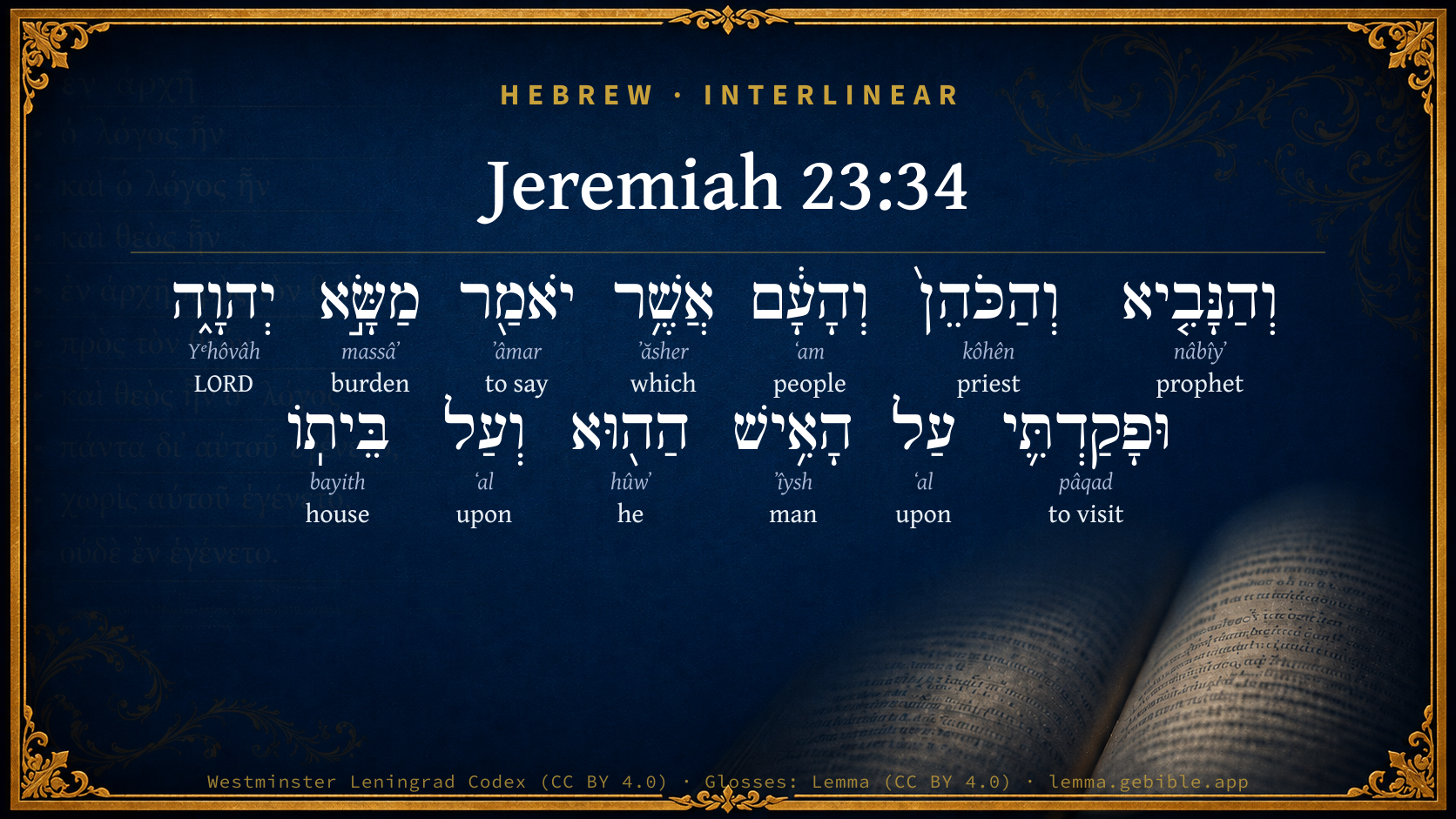
Hebrew (Westminster Leningrad Codex) Jeremiah 23:34 appears in the Hebrew Old Testament. The text above is from the Westminster Leningrad Codex. Each word links to its Strong’s number, a concise gloss, and parsing drawn from the Open Scriptures Hebrew Bible morphology. Click any word for its full Brown-Driver-Briggs (BDB) entry.
Download image
Cite this verse

Jeremiah 23:34 (World English Bible). Public Domain. Lemma interlinear Bible study tool, https://lemma.gebible.app/v/jeremiah/23/34.

Show BibTeX & RIS
BibTeX
RIS
English Translation
As for the prophet, and the priest, and the people, who shall say, The burden of Yahweh, I will even punish that man and his house.
World English Bible · Public Domain
Download a study sheet

One document with this verse’s original text, its word-by-word gloss line, the meaning frame, cross-references with their text, attributed commentary, and full source and license credits — printable, and it pastes into notes with its structure intact.

This verse Autodidact and up

Study sheet (.html) Plain text (.txt)

A passage Seminary Student

Up to 50 verses in one chapter. A passage sheet keeps up to 6 commentary sources and 12 cross-references per verse, in the order this page ranks them, and says so on the sheet whenever that leaves anything out. Ask for a single verse and you get the Autodidact verse sheet above.

Everything on this page stays free to read, with no account — the sheet is a download of what is already on screen, not access to it.

Want to remove ads? Support Godless Engineer
Compare translations 3

The same verse in 3 English versions, stacked beneath the original-language interlinear above. Click any original word for its lexicon entry.

Each is an independent rendering of the whole verse — the interlinear is not word-aligned to these translations.

Highlighted words mark where these versions differ — a whole-verse word diff, not a word-by-word alignment.

  • World English Bible Public Domain
    As for the prophet, and the priest, and the people, who shall say, The burden of Yahweh, I will even punish that man and his house.
  • King James Version Public Domain
    And as for the prophet, and the priest, and the people, that shall say, The burden of the LORD, I will even punish that man and his house.
  • unfoldingWord Literal Text CC BY-SA 4.0
    “And the prophet and the priest and the people who say, ‘The burden of Yahweh,’ I will punish that man and his house.

unfoldingWord Literal Text — © unfoldingWord, licensed CC BY-SA 4.0. Word-aligned USFM3 via Door43 (git.door43.org/unfoldingWord/en_ult).

Versions to compare (up to 4)

3 of 4 selected

Show all 18 translations

Every available English version of this verse, each an independent rendering of the whole verse.

  • World English Bible Public Domain
    As for the prophet, and the priest, and the people, who shall say, The burden of Yahweh, I will even punish that man and his house.
  • Berean Standard Bible Public Domain
    As for the prophet or priest or anyone who claims, ‘This is the burden of the LORD,’ I will punish that man and his household.
  • Majority Standard Bible Public Domain
    As for the prophet or priest or anyone who claims, ‘This is the burden of the LORD,’ I will punish that man and his household.
  • King James Version Public Domain
    And as for the prophet, and the priest, and the people, that shall say, The burden of the LORD, I will even punish that man and his house.
  • American Standard Version (1901) Public Domain
    And as for the prophet, and the priest, and the people, that shall say, The burden of Jehovah, I will even punish that man and his house.
  • Revised Version (1885) Public Domain
    And as for the prophet, and the priest, and the people, that shall say, The burden of the LORD, I will even punish that man and his house.
  • Geneva Bible (1599) Public Domain
    And the prophet, or the Priest, or the people that shall say, The burden of the Lord, I will euen visite euerie such one, and his house.
  • Douay-Rheims (1899) Public Domain
    And as for the prophet, and the priest, and the people that shall say: The burden of the Lord: I will visit upon that man, and upon his house.
  • Young's Literal Translation Public Domain
    And the prophet, and the priest, and the people, That saith, The burden of Jehovah, I have seen after that man, and after his house.
  • Literal Standard Version CC BY-SA 4.0
    “And the prophet, and the priest, and the people, || That says, The burden of YHWH, || I have seen after that man, and after his house.
  • Unlocked Literal Bible CC BY-SA 4.0
    As for the prophets, priests, and people who are saying, 'This is the burden of Yahweh' I will punish that man and his house.
  • unfoldingWord Literal Text CC BY-SA 4.0
    “And the prophet and the priest and the people who say, ‘The burden of Yahweh,’ I will punish that man and his house.
  • Darby Bible Public Domain
    And as for the prophet, and the priest, and the people, that shall say, The burden of Jehovah, I will even punish that man and his house.
  • World Messianic Bible Public Domain
    As for the prophet, the priest, and the people, who say, ‘The message from the LORD,’ I will even punish that man and his household.
  • Webster's Bible Public Domain
    And as for the prophet, and the priest, and the people that shall say, The burden of the LORD, I will even punish that man and his house.
  • Free Bible Version CC BY-SA 4.0
    If a prophet or priest or anyone else claims, “This is the burden of the Lord,” I will punish that person and their family.
  • Bible in Basic English Public Domain
    And as for the prophet and the priest and the people who say, A word of weight from the Lord! I will send punishment on that man and on his house.
  • JPS Tanakh (1917) Public Domain
    And as for the prophet, and the priest, and the people, that shall say: 'The burden of the LORD', I will even punish that man and his house.

Literal Standard Version (2020), Covenant Press — licensed CC BY-SA 4.0. Text via the HelloAO Bible API (eBible.org). Unlocked Literal Bible (unfoldingWord) — licensed CC BY-SA 4.0. Text via the HelloAO Bible API (eBible.org). unfoldingWord Literal Text — © unfoldingWord, licensed CC BY-SA 4.0. Word-aligned USFM3 via Door43 (git.door43.org/unfoldingWord/en_ult). Free Bible Version, Dr. Jonathan Gallagher — licensed CC BY-SA 4.0. Text via the HelloAO Bible API (eBible.org).

Word by word

More ways to search: Search by grammar → Find every occurrence → Compare this word →

Practice this passage: Drill this verse → Learn its vocabulary →

מַשָּׂ֣א
massâʼ
H4853
“burden of”
Noun, Common, Masculine, Singular, Construct
Part of Speech
Noun
Type
Common
Gender
Masculine
Number
Singular
State
Construct
Full BDB Definition

Origin: from H5375

TWOT: 1421d , 1421e

Massa = "burden" - load, bearing, tribute, burden, lifting (noun masculine) - load, burden - lifting, uplifting, that to which the soul lifts itself up - bearing, carrying - tribute, that which is carried or brought or borne - utterance, oracle, burden (noun masculine) - a son of Ishmael (noun proper masculine)
  1. וְהַנָּבִ֤יא nâbîyʼ H5030 “and · the · prophet” Conjunction + Particle, Definite Article + Noun, Common, Masculine, Singular, Absolute
  2. וְהַכֹּהֵן֙ kôhên H3548 “and · the · priest” Conjunction + Particle, Definite Article + Noun, Common, Masculine, Singular, Absolute
  3. וְהָעָ֔ם ʻam H5971 “and · the · people” Conjunction + Particle, Definite Article + Noun, Common, Masculine, Singular, Absolute
  4. אֲשֶׁ֥ר ʼăsher H834 “which” Particle, Relative
  5. יֹאמַ֖ר ʼâmar H559 “to say” Verb, Qal, Imperfect, 3rd Person, Masculine, Singular
  6. יְהוָ֑ה Yᵉhôvâh H3068 “LORD” Noun, Proper
  7. וּפָקַדְתִּ֛י pâqad H6485 “and · to visit” Conjunction + Verb, Qal, Sequential Perfect, 1st Person, Common, Singular
  8. עַל ʻal H5921 “upon” Preposition
  9. הָאִ֥ישׁ ʼîysh H376 “the · man” Particle, Definite Article + Noun, Common, Masculine, Singular, Absolute
  10. הַה֖וּא hûwʼ H1931 “the · he” Particle, Definite Article + Pronoun, Personal, 3rd Person, Masculine, Singular
  11. וְעַל ʻal H5921 “and · upon” Conjunction + Preposition
  12. בֵּיתֽוֹ bayith H1004 “house · his” Noun, Common, Masculine, Singular, Construct + Suffix, Personal, 3rd Person, Masculine, Singular

About this verse

These counts appear in no published source. They are computed here, from the morphology-tagged text and Lemma’s own curated glosses. What Lemma adds →

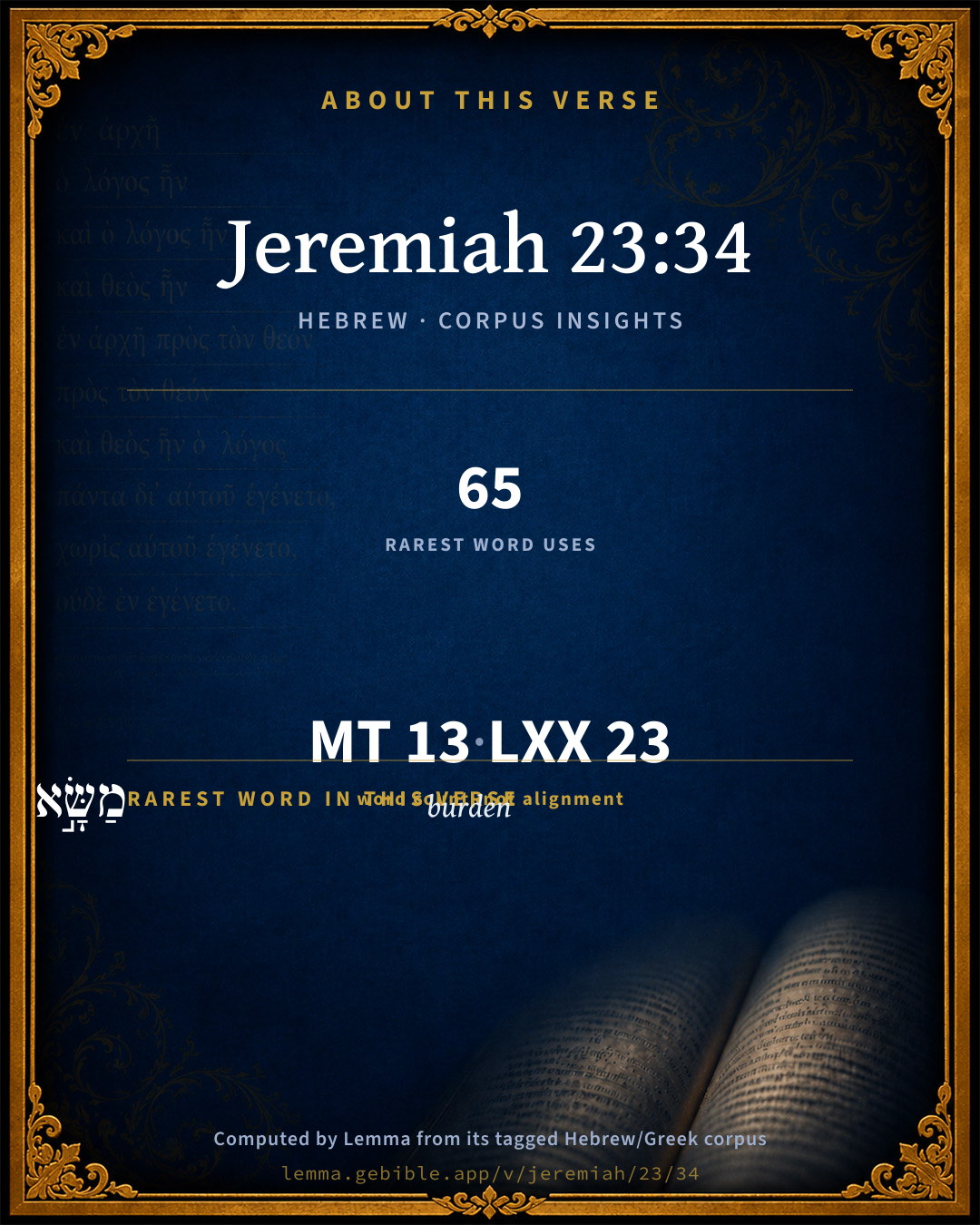
13
words
12
distinct lemmas
Prophets
section

Grammatical profile

  • 2 verbs
  • 7 nouns
  • 1 pronoun
  • 2 prepositions
  • 1 particle

Verb forms

  • יֹאמַ֖ר Qal · Imperfect
  • וּפָקַדְתִּ֛י Qal · Sequential Perfect

Repetition

A word recurs within this verse — often emphatic in Hebrew:

Hebrew & Septuagint length

In the original languages it is 13 Hebrew tokens and 23 Greek tokens — but the two are counted differently (Hebrew bundles its prefixes and suffixes into one token; the Greek is in lemma form), so that isn’t a like-for-like length.

Cross-references

2

Topical passages linked to Jeremiah 23:34 in the Treasury of Scripture Knowledge — connected by theme and wording, ordered by reader-vote popularity; previews shown in the World English Bible.

  • Zechariah 13:3 It will happen that, when anyone still prophesies, then his father and his mother who bore him will tell him, 'You must die, because you speak lies in the name of Yahweh;' and his father and his mother who bore him will stab him when he prophesies.
  • Lamentations 2:14 Your prophets have seen for you false and foolish visions; They have not uncovered your iniquity, to bring back your captivity, But have seen for you false oracles and causes of banishment.

Cross-references courtesy of OpenBible.info (CC BY 4.0).

Hebrew and Greek witnesses Masoretic Hebrew ↔ Greek Septuagint

The same verse in the two great witnesses to the Old Testament, shown verse-for-verse.

These are two independent witnesses, not word-aligned to each other, and the Septuagint is shown in lemma (dictionary) form.

Hebrew Jeremiah 23:34 Masoretic · Westminster Leningrad Codex

וְהַנָּבִ֤יא וְהַכֹּהֵן֙ וְהָעָ֔ם אֲשֶׁ֥ר יֹאמַ֖ר מַשָּׂ֣א יְהוָ֑ה וּפָקַדְתִּ֛י עַל הָאִ֥ישׁ הַה֖וּא וְעַל בֵּיתֽוֹ

As for the prophet, and the priest, and the people, who shall say, The burden of Yahweh, I will even punish that man and his house.

World English Bible · Public Domain

Greek LXX Structure differs

In the Septuagint, Jeremiah is about an eighth shorter than the Hebrew and arranges its material differently — the Oracles Against the Nations (Hebrew chapters 46–51) appear in the middle of the Greek book, after 25:13. Because the chapter and verse boundaries do not line up, a verse-for-verse comparison with the Hebrew is not shown.

A verse-for-verse comparison isn’t shown here because the chapters and verses don’t line up. Switch to the LXX edition with the MT / LXX toggle above to read the Greek directly.

Hebrew: Westminster Leningrad Codex (CC BY 4.0). Greek: Septuagint (public domain); English from a public-domain English Septuagint. How the Septuagint differs from the Hebrew →

Targum (Aramaic paraphrase)

1

The Targum is the ancient Jewish Aramaic paraphrase of the Hebrew Scriptures — an interpretive translation, not the Hebrew text itself. Onkelos (literal) and Pseudo-Jonathan (expansive) render the Torah, and Jonathan the Prophets. Coverage is partial: where no permissively-licensed English translation exists for a verse, only the Aramaic is shown. This is verse-level text, not a word-by-word alignment to the Hebrew.

  1. Targum Jonathan Prophets (Joshua–Malachi)
    וְסָפַר וְכָהֵן וְעַמָא דְיֵמַר נְבוּאֲתָא בִּשְׁמָא דַייָ וְאַסְעֵר עַל גַבְרָא הַהוּא וְעַל בֵּיתֵיהּ:

    (no public-domain English translation for this verse)

    Targum Jonathan — Aramaic: “Mikraot Gedolot” (public domain). English: “Sefaria Community Translation” (CC0 1.0 (public-domain dedication)); “London "Chaldee Paraphrase," 1871” (public domain). Text via Sefaria.

Commentary

Notes on Jeremiah 23:34 from classic Christian and Jewish commentators (each source and its license shown beneath its notes). The classic Christian expositions comment on the surrounding passage and are grouped to its opening verse, so a note may address several verses; the Jewish commentaries on the Tanakh (Rashi and others) are per-verse, so they appear only where the commentator wrote on this verse.

Lemma curates 59 commentaries, every one of them public domain or Creative Commons licensed, each selected and text-cleaned for this edition rather than reprinted as found. About our sources →

Trapp's Complete Commentary

John Trapp

Jer 23:34 And [as for] the prophet, and the priest, and the people, that shall say, The burden of the LORD, I will even punish that man and his house.

Ver. 34. That shall say, The burden of the Lord.] Nempe per ludibrium, in contempt and derision. See 2Ch 36:16.

John Trapp, A Commentary or Exposition upon All the Books of the Old and New Testament (1647–1656) — public domain. Text from a community e-Sword module.

Tyndale Open Study Notes

Tyndale Open Resources

23:34-35 Someone might falsely brag that he had heard a prophecy from the Lord. However, such a person and his entire family would be punished (cp. Num 16:27-32; Josh 7:24-25).

Tyndale Open Study Notes — © Tyndale Open Resources, licensed CC BY-SA 4.0. Text via the HelloAO Bible API.

Geneva Bible (1599)

Geneva Bible translators

Because this word was brought to contempt and derision, he will teach them another manner of speech, and will cause this word burden to cease, and teach them to ask with reverence, What saith the Lord?

Geneva Bible (1599) marginal notes — public domain. Text via Bolls.life.

Jamieson, Fausset & Brown

Robert Jamieson, A. R. Fausset & David Brown

The burden--Whoever shall in mockery call the Lord's word "a burden," shall be visited (Margin) in wrath.

Jamieson, Fausset & Brown — Commentary Critical and Explanatory on the Whole Bible (1871) — public domain (CC PDM 1.0). Text via the HelloAO Bible API.

John Calvin's Commentaries

Prophecy might indeed have been called a burden, when anything sad was announced; but it might also have been so called, when men were aroused to fear God, or when they were exhorted to repent. But God has a reference here to that wicked impiety, when men dared in ridicule to call any prophecy a burden. And hence it appears, that they were all so given up to their sins, that the very name of God’s judgment was hated by them. We now then perceive the Prophet’s meaning when he said, that God would punish all those who called his word a burden; for the Prophets themselves were wont to speak thus; and we find that Jeremiah in many places used this word. He does not then speak here generally, but points out, as by the finger, a vice which prevailed; for the Jews had so hardened themselves in hatred to sound doctrine, that they said, “He! these Prophets do nothing but terrify us by threatenings and by denouncing ruin on us; and what will be the end of all this?” God says, that he would take punishment on all who thus spoke and on all their families. It hence appears how much he abominated this blasphemy; and hence also we see how precious to God is the honor of his word; for it is not of every kind of sin that God speaks when he extends his vengeance to posterity. It is the same thing as though Jeremiah had said, “It is altogether intolerable, when men became irritated and exasperated against God’s word.” And yet this evil is not an evil of one age only. We see that the Israelites ever complained of God’s rigor; hence that saying,

“The ways of the Lord are not tortuous, but rather your ways, O house of Israel.” (Ezekiel 18:25.)

And here we must notice the wickedness of the human mind; for God, as it has been before stated, has nothing else in view by calling us to himself, but to make us partakers of eternal life and salvation. It is then God’s design to receive us for the purpose or saving us; this is the end intended by, all the prophets; and hence the Prophet called before the word of God wheat; but what is done by men? They despise this favor; and not only so, but turn food into poison and cease not to provoke God’s wrath. He was, therefore, constrained to threaten them. When he finds us teachable, he allures us to himself even with paternal kindness. But when we provoke him to wrath, we in a manner force him to put on another character, according to what he says, that he will be refractory towards the refractory. (Psalm 18:26.) Yet we complain when God deals rigidly with us. We cease not to carry on war with him; but when he restrains and checks our insolence, we immediately expostulate with him, as though he were too severe and his word offended us. Whence is this offense? even from our obstinate wickedness. Were men to put an end to their sinful course, the Lord would change his manner of dealing with them, and gently treat them and foster them as chickens under his wings; but this they suffer not; nay, they reject such a treatment as much as they can. Hence it is, that they abhor the name of God and his word. What then is the excuse for the complaint, when they say that God is too rigorous, as though his word were a burden? There is none; for they are themselves refractory against God, and thus his word becomes a hammer to break their heads, to shatter and destroy them. We now see the reason why God not only declares that he was angry with these ungodly despisers of his word, but also denounces the same vengeance on their posterity.

John Calvin's Commentaries (1540-1563) — public domain. Text from the Calvin Translation Society English edition (1840s-50s) via the Christian Classics Ethereal Library (ccel.org). Calvin's coverage is partial (roughly two-thirds of the Bible); uncommented books and verses are honest gaps, never fabricated. The 19th-century editor's footnotes and remarks are omitted so the notes are faithfully Calvin's own voice.

Ellicott's Commentary for English Readers

(34) That shall say, The burden of the Lord.—The language thus put into the mouths of the false prophets is not that of derision, but of boastful assumption. It is for that the boaster will, in due time, be punished.

A Bible Commentary for English Readers, edited by Charles John Ellicott (1878–1897) — public domain. Text from a community e-Sword module.

John Gill's Exposition

And as for the prophet, and the priest, and the people,.... Be they one or the other, or all of them; no regard will be had to their character and office, rank and dignity:

that shall say, the burden of the Lord; using that phrase in a bantering and ludicrous manner:

I will even punish that man and his house; not only he, but his family, shall suffer for it. This shows how much it is resented by the Lord, and what a dangerous thing it is to lampoon the word of God, to make a jest of Scripture phrases, or to joke with them; this is foolish jesting, which is not convenient, yea, impious and abominable. It is also hard jesting with edge tools.

John Gill's Exposition of the Whole Bible (1746–1763) — public domain (CC PDM 1.0). Text via the HelloAO Bible API.

Haydock's Catholic Bible Commentary

Burden of the Lord. This expression is here rejected and disallowed, at least for those times: because it was then used in mockery and contempt by the false prophets, and unbelieving people, who ridiculed the repeated threats of Jeremias under the name of his burdens. (Challoner)

George Leo Haydock (1774–1849), Haydock's Catholic Family Bible and Commentary, 1859 edition — public domain. Excludes Psalms (Douay-Rheims chapter numbering differs from Protestant) and Deuterocanonical books (Catholic canon only).

Matthew Poole's English Annotations

That is, that shall in derision say thus, mocking at my threatenings and judgments. I will not only punish him, but his whole family.

Matthew Poole's English Annotations on the Holy Bible (1683–1685) — public domain. Text from a community e-Sword/MySword module.

John Wesley's Explanatory Notes

That shall say - That is, that shall in derision say thus, mocking at my threatenings. And his house - I will not only punish him, but his whole family.

John Wesley, Explanatory Notes Upon the Whole Bible (1754–1765) — public domain. Text via the GEBible commentary corpus.

Lesson kit

Teaching starters — assembled from the data on this page, not authored interpretation. Every prompt links to the verse data it draws on. Edit before teaching.

Jeremiah, in the Prophets, opens this verse with 13 words (12 distinct Hebrew lemmas). Its most distinctive word is massâʼ (“burden”). A historical commentator’s framing appears above. Read the whole chapter for the surrounding context.

Discussion questions

  1. How does “burden” (massâʼ) shape what this verse is saying?
  2. How does Zechariah 13:3, which shares this passage’s theme, read alongside this verse?
  3. What does the repetition of “upon” (2× in this one verse) do in this verse?
  4. These translations render this verse differently; the difference is in the English rendering, not the original. What questions does that raise?
  5. «יֹאמַ֖ר» is a Qal Imperfect verb. How does that grammatical form shape the action described?
  6. Compare how Trapp's Complete Commentary and Tyndale Open Study Notes read this verse. Where do they agree or differ?

Things to notice

Reading settings

Reading text

Shown beneath each verse's original-language words.

Old Testament
Old Testament edition

Read the OT as the Masoretic Hebrew (MT) or the Greek Septuagint (LXX).

English shown for the Greek Septuagint (in the Hebrew ↔ Greek comparison).

Comparing translations? Open the Compare panel on any verse page to stack up to four side by side.