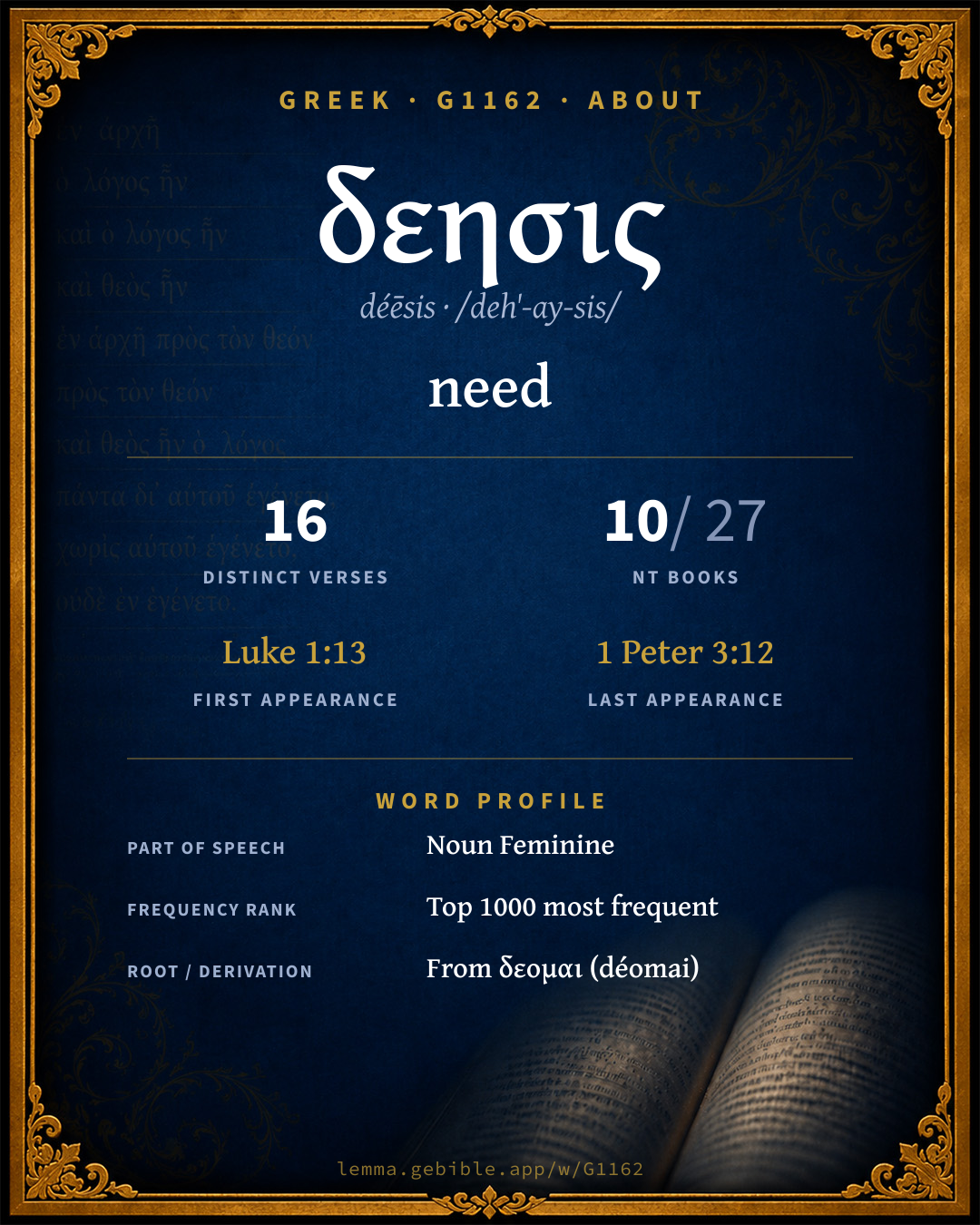
δέησις
need
also: indigence, want, privation, penury fuller range ↓
Full lexicon entry — Thayer's Greek Lexicon
From Thayer's Greek Lexicon
Where this word appears
See every Accusative-case word in the Greek New Testament →
Grammar key — what these labels mean
Part of speech
- Noun
- A naming word — a person, place, thing, or idea.
Case
- Dative
- The case of the indirect object, means, or location — “to / for / with / in.”
- Accusative
- The case of the direct object and of extent.
- Nominative
- The case of the subject (and the predicate nominative).
- Genitive
- The case of source, possession, or “of” — answers “whose / from what.”
Gender
- Feminine
- Grammatically feminine.
Number
- Singular
- One.
- Plural
- More than one.
Every verse where G1162 appears in the Book of 1 Timothy — 2 distinct verses. Click any verse to open its interlinear word-by-word view. Verse text shown in the World English Bible for context — . Each verse’s Greek form is shown with its reference; the English is not keyword-highlighted, since the data carries no word-level English alignment. Use “Compare translations” on any verse to read it across multiple English versions. This concordance covers the Greek New Testament; Septuagint (Greek Old Testament) occurrences of this word are not indexed here.
1 Timothy
- 1 Timothy 2:1 δεήσεις n acc pl fem I exhort therefore, first of all, that petitions, prayers, intercessions, and givings of thanks, be made for all men:
- 1 Timothy 5:5 δεήσεσιν n dat pl fem Now she who is a widow indeed, and desolate, has her hope set on God, and continues in petitions and prayers night and day.
About this entry
At a glance — auto-summarized from this page’s data, not written by a person. Every figure links to its source below. This summary describes the numbers; it doesn’t interpret them.
At its core, δεησις (déēsis) means “need.” First canonically at Luke 1:13, it enters the text early. It appears 16 verses across 10 books of the Greek New Testament, among its uncommon vocabulary. Not a single-sense word, it carries 2 senses, among them “indigence”, “want”, and “privation”. Each statement above links to its evidence; the full detail follows below.
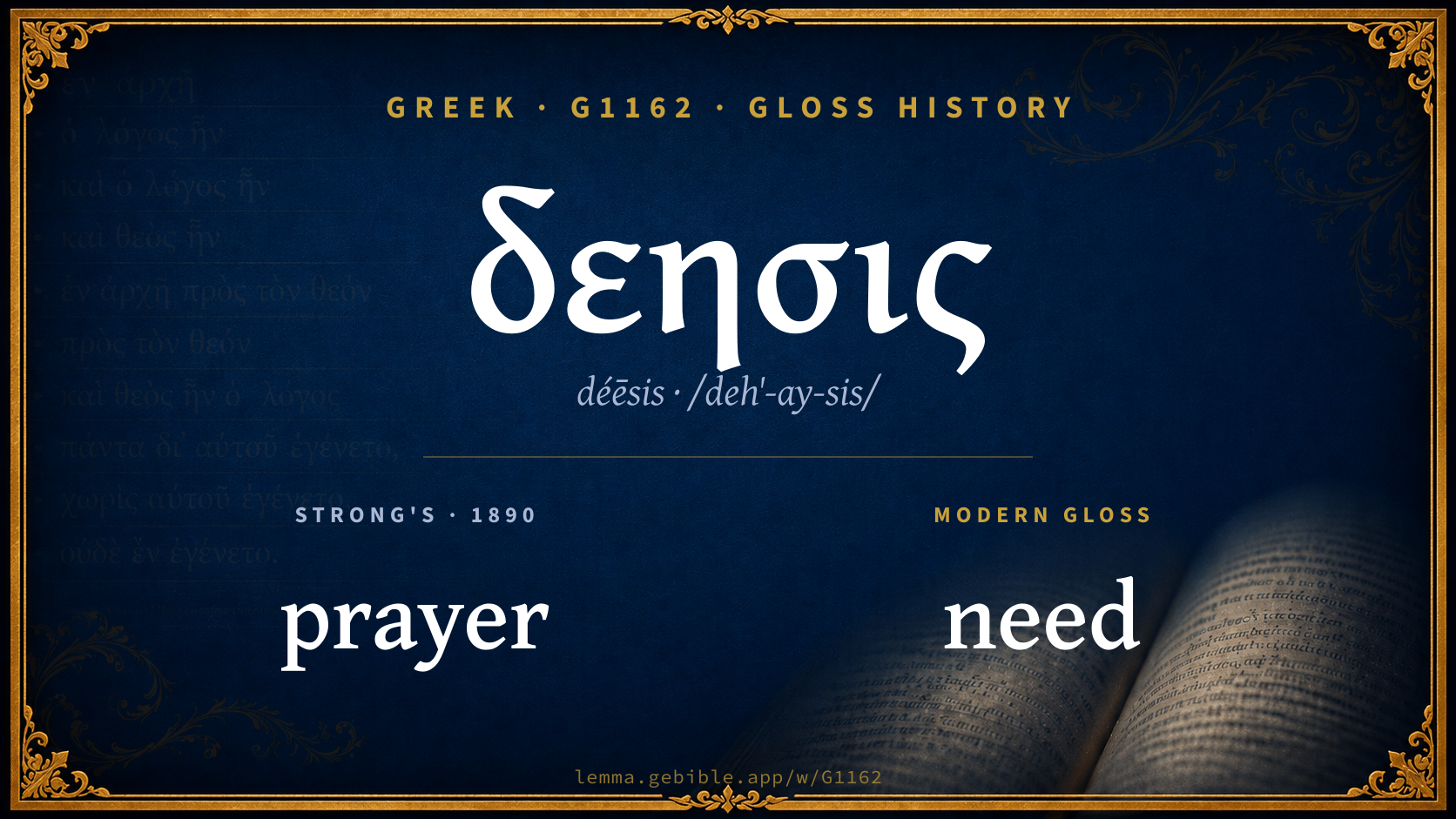
Gloss history
Strong's 1890 vs modern scholarship
About this word
Strong's G1162 catalogs a Greek word from the Greek New Testament.
These counts are not copied from any lexicon or concordance. They are computed here, from the morphology-tagged Greek New Testament. What Lemma adds →
- 16
- distinct verses
- The word appears in 16 distinct verses.
- 10 / 27
- NT books
- The word appears in 10 of 27 New Testament books.
- #664
- by frequency
- Top 1000 most frequent Greek words (rank 664 of 5,347 Greek words by occurrence).
View all 16 occurrences in the concordance →
Most concentrated in
- Luke 3 verses 19%
- Philippians 3 verses 19%
- 2 Corinthians 2 verses 13%
By section of the New Testament
By traditional corpus
Conventional, traditional groupings — biblical authorship is debated, so this is a traditional corpus grouping, not an authorship claim. Some books belong to more than one corpus (Luke is in both the Gospels and the Lukan corpus, and so on), so these shares overlap and need not total 100%. Each figure is a share of the word’s 16 distinct verses.
- Pauline corpus 10 verses · 63%
- Gospels 3 verses · 19%
- Lukan (Luke–Acts) 3 verses · 19%
- General (Catholic) Epistles 2 verses · 13%
- Hebrews 1 verse · 6%
How translations render this word
Counts come from each version’s own published word-to-Strong’s tagging or interlinear alignment — an approximate guide to how each version renders this word, not a word-level alignment the data otherwise carries. Because each total is that version’s own tagged count, the per-version totals vary from one another and need not match the appearance or distinct-verse counts above. These counts may also differ from a printed concordance because Lemma counts each distinctly tagged rendering and does not collapse phrase taggings into a single head-word total. This is a fixed set of word-tagged versions (KJV, ASV, BSB, ULT) and does not change with the reading translation you choose elsewhere. Each version’s license is shown beside its name below (and on Sources).
- King James Version: Prayer 7×, Prayers 5×, Supplication 4×
- American Standard Version: Supplication 10×, Supplications 5×
- Berean Standard Bible: Prayers 6×, Prayer 5×, Petition 2×
- unfoldingWord Literal Text: Prayer 6×, Prayers 5×, Requests 3×
King James Version Public Domain
Renders G1162 across 19 tagged occurrences — most commonly:
Plus 1 rendering that appears only once — usually multi-word phrases or single function words the recovered tagging swept in, not distinct renderings.
American Standard Version Public Domain
Renders G1162 across 17 tagged occurrences — most commonly:
Plus 2 renderings that appear only once — usually multi-word phrases or single function words the recovered tagging swept in, not distinct renderings.
Berean Standard Bible Public Domain
Renders G1162 across 18 tagged occurrences — most commonly:
Plus 1 rendering that appears only once — usually multi-word phrases or single function words the recovered tagging swept in, not distinct renderings.
unfoldingWord Literal Text CC BY-SA 4.0
Renders G1162 across 20 tagged occurrences — most commonly:
Plus 4 renderings that appear only once — usually multi-word phrases or single function words the recovered tagging swept in, not distinct renderings.
Senses in Thayer's
The 2 senses Thayer's distinguishes for this word, in lexicon order (not ranked by frequency or importance). The full entry — with sub-senses — is in the Lexicon Entry tab.
- need, indigence, want, privation, penury
- a seeking, asking, entreating, entreaty to God or to man
Word origin
Derived from δεομαι (déomai) (G1189) — to ask.
From G1189 ; a petition : - prayer request supplication.
— Strong’s Exhaustive Concordance (1890), public domain.
Forms in the corpus
The 9 distinct written forms G1162 takes in the Greek New Testament, most frequent first — each parse links to that case’s occurrences in the concordance.
| Form | Parsing | Example | Uses |
|---|---|---|---|
| δεήσει deḗsei | Noun, Dative, Singular, Feminine | 2 Corinthians 1:11 | 5 |
| δεήσεις deḗseis | Noun, Accusative, Plural, Feminine | Luke 5:33 | 3 |
| δέησιν déēsin | Noun, Accusative, Singular, Feminine | Philippians 1:4 | 2 |
| δέησις déēsis | Noun, Nominative, Singular, Feminine | Romans 10:1 | 2 |
| δεήσεως deḗseōs | Noun, Genitive, Singular, Feminine | Ephesians 6:18 | 2 |
| δέησίς déēsís | Noun, Nominative, Singular, Feminine | Luke 1:13 | 1 |
| δεήσεσίν deḗsesín | Noun, Dative, Plural, Feminine | 2 Timothy 1:3 | 1 |
| δεήσεσι deḗsesi | Noun, Dative, Plural, Feminine | Luke 2:37 | 1 |
| δεήσεσιν deḗsesin | Noun, Dative, Plural, Feminine | 1 Timothy 5:5 | 1 |
Septuagint usage
The same Greek word δεησις appears 56 times in the Greek Old Testament (Septuagint), across 54 verses in 8 books.
- 56
- LXX occurrences
- Tagged occurrences of this Greek word in the Septuagint.
- 54
- verses
- Distinct Septuagint verses containing this word.
- 8 / 39
- OT books
- The word appears in 8 of the 39 Old Testament books.
Sample Septuagint occurrences
- 1 Kings 8:28 δέησις
- 2 Chronicles 6:19 δέησις
- Job 8:6 δέησις
- Psalms 5:3 δέησις
- Isaiah 1:15 δέησις
- Jeremiah 3:21 δέησις
- Lamentations 3:56 δέησις
- Daniel 2:18 δέησις
Septuagint occurrences (same lexeme)
Every verse where the same Strong’s number (G1162) appears in the Greek Septuagint — showing the first 50 of 54. Verse text shown in the World English Bible for context; the Greek form is the matched word — the English is not keyword-highlighted.
- 1 Kings 8:28 δέησις Yet have respect for the prayer of your servant, and for his supplication, Yahweh my God, to listen to the cry and to the prayer which your servant prays before you this day;
- 1 Kings 8:30 δέησις Listen you to the supplication of your servant, and of your people Israel, when they shall pray toward this place: yes, hear in heaven, your dwelling-place; and when you hear, forgive.
- 1 Kings 8:38 δέησις whatever prayer and supplication be made by any man, [or] by all your people Israel, who shall know every man the plague of his own heart, and spread forth his hands toward this house:
- 1 Kings 8:45 δέησις then hear in heaven their prayer and their supplication, and maintain their cause.
- 1 Kings 8:52 δέησις that your eyes may be open to the supplication of your servant, and to the supplication of your people Israel, to listen to them whenever they cry to you.
- 1 Kings 8:54 δέησις It was so, that when Solomon had made an end of praying all this prayer and supplication to Yahweh, he arose from before the altar of Yahweh, from kneeling on his knees with his hands spread forth toward heaven.
- 1 Kings 9:3 δέησις Yahweh said to him, I have heard your prayer and your supplication, that you have made before me: I have made this house holy, which you have built, to put my name there forever; and my eyes and my heart shall be there perpetually.
- 2 Chronicles 6:19 δέησις Yet have you respect to the prayer of your servant, and to his supplication, Yahweh my God, to listen to the cry and to the prayer which your servant prays before you;
- 2 Chronicles 6:21 δέησις Listen you to the petitions of your servant, and of your people Israel, when they shall pray toward this place: yes, hear from your dwelling-place, even from heaven; and when you hear, forgive.
- 2 Chronicles 6:29 δέησις whatever prayer and supplication be made by any man, or by all your people Israel, who shall know every man his own plague and his own sorrow, and shall spread forth his hands toward this house:
- 2 Chronicles 6:35 δέησις then hear from heaven their prayer and their supplication, and maintain their cause.
- 2 Chronicles 6:39 δέησις then hear from heaven, even from your dwelling-place, their prayer and their petitions, and maintain their cause, and forgive your people who have sinned against you.
- 2 Chronicles 6:40 δέησις Now, my God, let, I beg you, your eyes be open, and let your ears be attentive, to the prayer that is made in this place.
- Job 8:6 δέησις If you were pure and upright, Surely now he would awaken for you, And make the habitation of your righteousness prosperous.
- Job 16:20 δέησις My friends scoff at me. My eyes pour out tears to God,
- Job 27:9 δέησις Will God hear his cry, When trouble comes on him?
- Job 36:19 δέησις Would your wealth sustain you in distress, Or all the might of your strength?
- Job 40:27 δέησις
- Psalms 5:3 δέησις Yahweh, in the morning you shall hear my voice. In the morning I will lay my requests before you, and will watch expectantly.
- Psalms 6:10 δέησις May all my enemies be ashamed and dismayed. They shall turn back, they shall be disgraced suddenly.
- Psalms 16:1 δέησις Preserve me, God, for in you do I take refuge.
- Psalms 21:25 δέησις
- Psalms 27:2 δέησις When evil-doers came at me to eat up my flesh, Even my adversaries and my foes, they stumbled and fell.
- Psalms 27:6 δέησις Now my head will be lifted up above my enemies around me. I will offer sacrifices of joy in his tent. I will sing, yes, I will sing praises to Yahweh.
- Psalms 30:23 δέησις
- Psalms 33:16 δέησις There is no king saved by the multitude of a host. A mighty man is not delivered by great strength.
- Psalms 38:13 δέησις But I, as a deaf man, don't hear. I am as a mute man who doesn't open his mouth.
- Psalms 39:2 δέησις I was mute with silence. I held my peace, even from good. My sorrow was stirred.
- Psalms 54:2 δέησις Hear my prayer, God. Listen to the words of my mouth.
- Psalms 60:2 δέησις You have made the land tremble. You have torn it. Mend its fractures, For it quakes.
- Psalms 65:19 δέησις
- Psalms 85:6 δέησις Won't you revive us again, That your people may rejoice in you?
- Psalms 87:3 δέησις Glorious things are spoken about you, city of God. Selah.
- Psalms 101:1 δέησις I will sing of loving kindness and justice. To you, Yahweh, I will sing praises.
- Psalms 101:18 δέησις
- Psalms 105:44 δέησις He gave them the lands of the nations. They took the labor of the peoples in possession,
- Psalms 114:1 δέησις When Israel went forth out of Egypt, The house of Jacob from a people of foreign language;
- Psalms 118:169 δέησις
- Psalms 129:2 δέησις Many times they have afflicted me from my youth up, Yet they have not prevailed against me.
- Psalms 139:7 δέησις Where could I go from your Spirit? Or where could I flee from your presence?
- Psalms 140:1 δέησις Deliver me, Yahweh, from the evil man. Preserve me from the violent man;
- Psalms 141:3 δέησις Set a watch, Yahweh, before my mouth. Keep the door of my lips.
- Psalms 141:7 δέησις "As when one plows and breaks up the earth, Our bones are scattered at the mouth of Sheol."
- Psalms 142:1 δέησις I cry with my voice to Yahweh. With my voice, I ask Yahweh for mercy.
- Psalms 144:19 δέησις
- Isaiah 1:15 δέησις When you spread forth your hands, I will hide my eyes from you; Yes, when you make many prayers, I will not hear. Your hands are full of blood.
- Jeremiah 3:21 δέησις A voice is heard on the bare heights, the weeping [and] the petitions of the children of Israel; because they have perverted their way, they have forgotten Yahweh their God.
- Jeremiah 11:14 δέησις Therefore don't you pray for this people, neither lift up cry nor prayer for them; for I will not hear them in the time that they cry to me because of their trouble.
- Jeremiah 14:12 δέησις When they fast, I will not hear their cry; and when they offer burnt offering and meal-offering, I will not accept them; but I will consume them by the sword, and by the famine, and by the pestilence.
- Lamentations 3:56 δέησις You heard my voice; don't hide your ear at my breathing, at my cry.
These are occurrences of the same Greek lexeme (G1162) in the Septuagint — not a translation of any one Hebrew word. The store carries no word-level Hebrew↔Greek alignment, so no Hebrew original is asserted here. Counts come from the recovered LXX Strong's tagging — high-frequency vocabulary is well covered, while rare or late forms may be untagged — so they reflect tagged occurrences and may slightly undercount.