
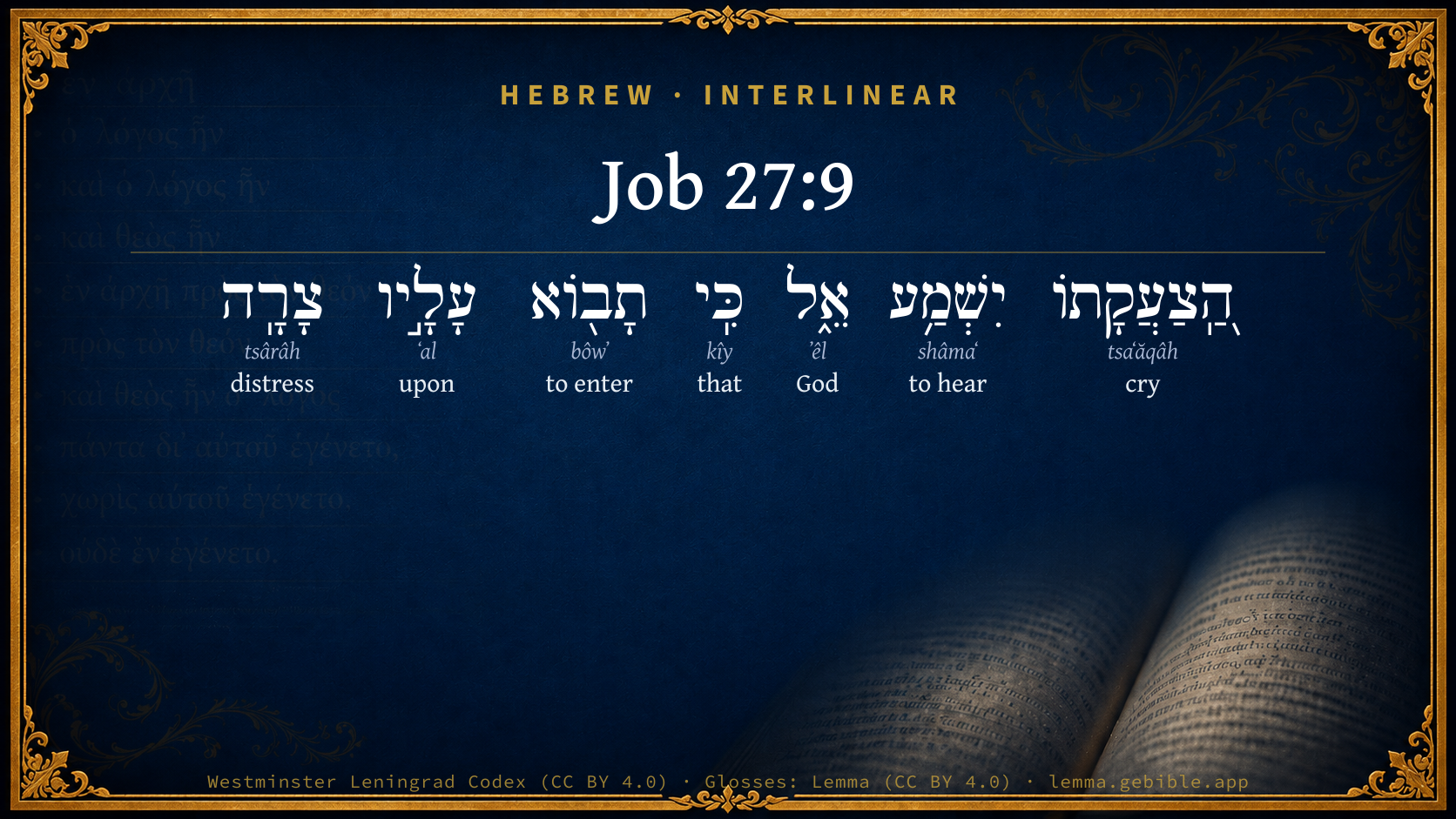
Job 27:9

Hebrew (Westminster Leningrad Codex) Job 27:9 appears in the Hebrew Old Testament. The text above is from the Westminster Leningrad Codex. Each word links to its Strong’s number, a concise gloss, and parsing drawn from the Open Scriptures Hebrew Bible morphology. Click any word for its full Brown-Driver-Briggs (BDB) entry.
Download image
Cite this verse

Job 27:9 (World English Bible). Public Domain. Lemma interlinear Bible study tool, https://lemma.gebible.app/v/job/27/9.

Show BibTeX & RIS
BibTeX
RIS
English Translation
Will God hear his cry, When trouble comes on him?
World English Bible · Public Domain
Download a study sheet

One document with this verse’s original text, its word-by-word gloss line, the meaning frame, cross-references with their text, attributed commentary, and full source and license credits — printable, and it pastes into notes with its structure intact.

This verse Autodidact and up

Study sheet (.html) Plain text (.txt)

A passage Seminary Student

Up to 50 verses in one chapter. A passage sheet keeps up to 6 commentary sources and 12 cross-references per verse, in the order this page ranks them, and says so on the sheet whenever that leaves anything out. Ask for a single verse and you get the Autodidact verse sheet above.

Everything on this page stays free to read, with no account — the sheet is a download of what is already on screen, not access to it.

Want to remove ads? Support Godless Engineer
Compare translations 3

The same verse in 3 English versions, stacked beneath the original-language interlinear above. Click any original word for its lexicon entry.

Each is an independent rendering of the whole verse — the interlinear is not word-aligned to these translations.

Highlighted words mark where these versions differ — a whole-verse word diff, not a word-by-word alignment.

  • World English Bible Public Domain
    Will God hear his cry, When trouble comes on him?
  • King James Version Public Domain
    Will God hear his cry when trouble cometh upon him?
  • unfoldingWord Literal Text CC BY-SA 4.0
    Will God hear his cry when trouble comes upon him?

unfoldingWord Literal Text — © unfoldingWord, licensed CC BY-SA 4.0. Word-aligned USFM3 via Door43 (git.door43.org/unfoldingWord/en_ult).

Versions to compare (up to 4)

3 of 4 selected

Show all 18 translations

Every available English version of this verse, each an independent rendering of the whole verse.

  • World English Bible Public Domain
    Will God hear his cry, When trouble comes on him?
  • Berean Standard Bible Public Domain
    Will God hear his cry when distress comes upon him?
  • Majority Standard Bible Public Domain
    Will God hear his cry when distress comes upon him?
  • King James Version Public Domain
    Will God hear his cry when trouble cometh upon him?
  • American Standard Version (1901) Public Domain
    Will God hear his cry, When trouble cometh upon him?
  • Revised Version (1885) Public Domain
    Will God hear his cry, when trouble cometh upon him?
  • Geneva Bible (1599) Public Domain
    Will God heare his cry, when trouble commeth vpon him?
  • Douay-Rheims (1899) Public Domain
    Will God hear his cry, when distress shall come upon him?
  • Young's Literal Translation Public Domain
    His cry doth God hear, When distress cometh on him?
  • Literal Standard Version CC BY-SA 4.0
    [Does] God hear his cry, || When distress comes on him?
  • Unlocked Literal Bible CC BY-SA 4.0
    Will God hear his cry when trouble comes upon him?
  • unfoldingWord Literal Text CC BY-SA 4.0
    Will God hear his cry when trouble comes upon him?
  • Darby Bible Public Domain
    Will ùGod hear his cry when distress cometh upon him?
  • World Messianic Bible Public Domain
    Will God hear his cry when trouble comes on him?
  • Webster's Bible Public Domain
    Will God hear his cry when trouble cometh upon him?
  • Free Bible Version CC BY-SA 4.0
    When times of trouble come to them, will God hear their cry for help?
  • Bible in Basic English Public Domain
    Will his cry come to the ears of God when he is in trouble?
  • JPS Tanakh (1917) Public Domain
    Will God hear his cry, when trouble cometh upon him?

Literal Standard Version (2020), Covenant Press — licensed CC BY-SA 4.0. Text via the HelloAO Bible API (eBible.org). Unlocked Literal Bible (unfoldingWord) — licensed CC BY-SA 4.0. Text via the HelloAO Bible API (eBible.org). unfoldingWord Literal Text — © unfoldingWord, licensed CC BY-SA 4.0. Word-aligned USFM3 via Door43 (git.door43.org/unfoldingWord/en_ult). Free Bible Version, Dr. Jonathan Gallagher — licensed CC BY-SA 4.0. Text via the HelloAO Bible API (eBible.org).

Word by word

More ways to search: Search by grammar → Find every occurrence → Compare this word →

Practice this passage: Drill this verse → Learn its vocabulary →

About this verse

These counts appear in no published source. They are computed here, from the morphology-tagged text and Lemma’s own curated glosses. What Lemma adds →

7
words
7
distinct lemmas
Wisdom
section

Notable vocabulary

The rarest word here is הַֽ֭צַעֲקָתוֹ cry H6818 — appearing just 21 times in the whole Hebrew Bible.

Shared distinctive vocabulary

הַֽ֭צַעֲקָתוֹ cry H6818 occurs in 20 verses of the Hebrew Bible. Also found in:

Grammatical profile

  • 2 verbs
  • 3 nouns
  • 1 preposition
  • 1 conjunction

Verb forms

  • יִשְׁמַ֥ע Qal · Imperfect
  • תָב֖וֹא Qal · Imperfect

Hebrew & Septuagint length

In English translation the verse runs 10 words from the Hebrew and 12 from the Septuagint (LXX English) — closely comparable.

A rough comparison of the two English renderings, which tokenize alike — not a word-level alignment.

Word counts can differ between the Hebrew and the Greek without any difference in meaning — e.g. the Hebrew direct-object marker אֵת has no separate Greek word, and Greek often adds the article ὁ.

In the original languages it is 7 Hebrew tokens and 10 Greek tokens — but the two are counted differently (Hebrew bundles its prefixes and suffixes into one token; the Greek is in lemma form), so that isn’t a like-for-like length.

Cross-references

16

Topical passages linked to Job 27:9 in the Treasury of Scripture Knowledge — connected by theme and wording, ordered by reader-vote popularity; previews shown in the World English Bible.

  • Jeremiah 14:12 When they fast, I will not hear their cry; and when they offer burnt offering and meal-offering, I will not accept them; but I will consume them by the sword, and by the famine, and by the pestilence.
  • Proverbs 1:28 Then will they call on me, but I will not answer. They will seek me diligently, but they will not find me;
  • Isaiah 1:15 When you spread forth your hands, I will hide my eyes from you; Yes, when you make many prayers, I will not hear. Your hands are full of blood.
  • Job 35:12–13 There they cry, but none gives answer, Because of the pride of evil men.
  • Psalms 18:41 They cried, but there was none to save; Even to Yahweh, but he didn't answer them.
  • Micah 3:4 Then they will cry to Yahweh, But he will not answer them. Yes, he will hide his face from them at that time, Because they made their deeds evil."
  • Psalms 66:18 If I cherished sin in my heart, The Lord wouldn't have listened.
  • Proverbs 28:9 He who turns away his ear from hearing the law, Even his prayer is an abomination.
  • Jeremiah 11:11 Therefore thus says Yahweh, Behold, I will bring evil on them, which they shall not be able to escape; and they shall cry to me, but I will not listen to them.
  • Ezekiel 8:18 Therefore will I also deal in wrath; my eye shall not spare, neither will I have pity; and though they cry in my ears with a loud voice, yet will I not hear them.
  • Hosea 7:14 They haven't cried to me with their heart, But they howl on their beds. They assemble themselves for grain and new wine. They turn away from me.
  • Zechariah 7:13 It has come to pass that, as he called, and they refused to listen, so they will call, and I will not listen," said Yahweh of Hosts;
  • James 4:3 You ask, and don't receive, because you ask with wrong motives, so that you may spend it for your pleasures.
  • Psalms 109:7 When he is judged, let him come forth guilty. Let his prayer be turned into sin.
  • Luke 13:25 When once the master of the house has risen up, and has shut the door, and you begin to stand outside, and to knock at the door, saying, 'Lord, Lord, open to us!' then he will answer and tell you, 'I don't know you or where you come from.'
  • John 9:31 We know that God doesn't listen to sinners, but if anyone is a worshipper of God, and does his will, he listens to him.

Cross-references courtesy of OpenBible.info (CC BY 4.0).

Hebrew and Greek witnesses Masoretic Hebrew ↔ Greek Septuagint

The same verse in the two great witnesses to the Old Testament, shown verse-for-verse.

These are two independent witnesses, not word-aligned to each other, and the Septuagint is shown in lemma (dictionary) form.

Hebrew Job 27:9 Masoretic · Westminster Leningrad Codex

הַֽ֭צַעֲקָתוֹ יִשְׁמַ֥ע אֵ֑ל כִּֽי תָב֖וֹא עָלָ֣יו צָרָֽה

Will God hear his cry, When trouble comes on him?

World English Bible · Public Domain

Greek LXX Job 27:9 Septuagint · lemma form

ἦ ὁ δέησις αὐτός εἰςἀκούω κύριος ἤ ἐπιἔρχομαι αὐτός ἀνάγκη

Will God hear his prayer? or, when distress has come upon him,

LXX2012 (modern English Septuagint) · Public Domain

Hebrew: Westminster Leningrad Codex (CC BY 4.0). Greek: Septuagint (public domain); English from LXX2012 (modern English Septuagint) (Public Domain). How the Septuagint differs from the Hebrew →

Commentary

Notes on Job 27:9 from classic Christian and Jewish commentators (each source and its license shown beneath its notes). The classic Christian expositions comment on the surrounding passage and are grouped to its opening verse, so a note may address several verses; the Jewish commentaries on the Tanakh (Rashi and others) are per-verse, so they appear only where the commentator wrote on this verse.

Lemma curates 59 commentaries, every one of them public domain or Creative Commons licensed, each selected and text-cleaned for this edition rather than reprinted as found. About our sources →

Trapp's Complete Commentary

John Trapp

Job 27:9 Will God hear his cry when trouble cometh upon him?

Ver. 9. Will God hear his cry] Here is another distinctive note between a hypocrite and an honest man. As many are said in Daniel to cleave to the better side by flattery, so many false signs will come in, and flatter a man (when he is in health and prosperity), and give their testimony, speak the same thing that true evidences do; but this will not always hold.

When trouble cometh upon him?] Then the hypocrite will cry, and make pitiful moans; as a prisoner at the bar begs for his life. Then Joab and Adonijah will run to the horns of the altar, who till then little cared to come there. But with as ill success they cry to God as Saul did, 1Sa 28:15, and as other of David’s enemies did, Psa 18:41; for either God answereth them not at all, Eze 21:2-3, or else he answereth them according to the idols of their hearts, Eze 14:3, gives them bitter answers, as Jdg 10:13-14. Or if better, it is for the good of others, and for a further mischief to themselves, that he may snatch away his own and be gone, Hos 2:9, and that he may consume them after he hath done them good, Jos 24:20 : their preservation proverb but a reservation.

John Trapp, A Commentary or Exposition upon All the Books of the Old and New Testament (1647–1656) — public domain. Text from a community e-Sword module.

The Biblical Illustrator

Joseph S. Exell

Job_27:9-10

Will God hear his cry when trouble cometh upon him?

The privations of godnessness

I. He has no refuge in trouble. When trouble cometh upon him he cannot cry unto God with any hope of being heard and answered (Job_27:9)

. What shall we think of the man who, in the ordering of his life, does not take trouble into his account? He is like the captain who sets sail upon the sea without readiness for a storm, or the general who goes out into the open unprepared to meet the enemy. To be unprovided for it is to be cruelly negligent of one of our greatest needs. But what refuge has the godless man in trouble? Can he hide himself in God as in a sure rock? To the godly man the nearness (Psa_23:4), the sympathy (Psa_31:7; Psa_103:13-14; Heb_4:15), and the delivering grace of God (Psa_91:15; Psa_138:7) are of priceless value. But the godless man only remembers God to be troubled by the thought that, having forsaken Him in prosperity, he cannot claim His succour on the dark day of adversity. Yet is there here one qualifying truth. It may be that trouble brings the unholy man to God in penitence, to Jesus Christ in faith and self-surrender. Then he may cry, and he will most surely be heard; but then he is a godless man no longer.

II. He has no hope in death. What is his hope when God taketh away his soul? As there is uncertainty as to the measure and the character of our trouble, so is there also as to the time of our death. But there is no uncertainty as to the fact of its coming.

III. He has no joy in God. Will he delight himself in the Almighty? Job evidently thinks that the true man might and should do that. It is an advanced and elevated thought. To delight in God--not merely to look for favours from Him, but to find our heritage in Him, in all that He is in Himself and in all that He is to us; in--

(1) Our sense of His near presence with us; in

(2) Our realisation of His close relationship to us as our Divine Father; in

(3) Our keen appreciation of His watchful care of us, and of His acceptance of our every act of obedience and submission; in

(4) Our joy in the fellowship we have with Him in His glorious work of redeeming love. Of course the godless man misses this mark entirely. He has no conception of it, much less any participation in it.

IV. He lives without the privilege of prayer. Will the godless man call upon God at all times? The value of prayer is two fold.

1. It is a constant source of blessing to our heart and life. To live in daily, even hourly communion with God must be a spiritual condition charged with highest good, must exert an elevating and purifying influence upon us of the finest order and of the greatest strength.

2. It is our one resource in special need. How great is the destitution of that mans spirit, who, when his heart is breaking, cannot go unto Him who binds up the broken heart, and heals the wounded spirit! In the face of all these privations, what a poor thing is the gain of the godless. (The Thinker.)

Will he always call upon God?--

The hypocrite discovered

A hypocrite may be a very neat imitation of a Christian. He professes to know God, to converse with Him, to be dedicated to His service, and to invoke His protection; he even practises prayer, or at least feigns it. Yet the cleverest counterfeit fails somewhere, and may be discovered by certain signs. The test is here Will he always call upon God?

I. Will he pray at all seasons of prayer? Will he pray in private? Or is he dependent upon the human eye, and the applause of men? Will he pray if forbidden? Daniel did so. Will he? Will he pray in business? Will he practise ejaculatory prayer? Will he look for hourly guidance? Will he pray in pleasure? Will he have a holy fear of offending with his tongue? Or will company make him forget his God? Will he pray in darkness of soul? Or will he sulk in silence?

II. Will he pray constantly? If he exercises the occasional act of prayer, will he possess the spirit of prayer which never ceases to plead with the Lord? We ought to be continually in prayer, because we are always dependent for life, both temporal and spiritual, upon God. Always needing something, nay, a thousand things. Always receiving, and therefore always needing, fresh grace wherewith to use the blessing worthily. Always in danger. Seen or unseen danger is always near, and none but God can cover our head. Always weak, inclined to evil, apt to catch every infection of soul sickness, ready to perish (Isa_27:13)

. Always needing strength, for suffering, learning, song, or service. Always sinning. Even in our holy things sin defiles us, and we need constant washing. Always weighted with other mens needs. Especially if rulers, pastors, teachers, parents. Always having the cause of God near our heart if we are right; and in its interests finding crowds of reasons for prayer.

III. Will he pray importunately? If no answer comes, will he persevere? If a rough answer comes, will he plead on? Does he know how to wrestle with the angel, and give tug for tug? If no one else prays, will he be singular, and pray on against wind and tide? If God answers him by disappointment and defeat, will he feel that delays are not denials, and still pray?

IV. Will he continue to pray throughout the whole of life? The hypocrite will soon give up prayer under certain circumstances. If he is in trouble, he will not pray, but will run to human helpers. If he gets out of trouble, he will not pray, but quite forget his vows. If men laugh at him, he will not dare to pray. If men smile on him, he will not care to pray.

1. He grows formal He is half asleep, not watchful for the answer. He falls into a dead routine of forms and words.

2. He grows weary. He can make a spurt, but he cannot keep it up. Short prayers are sweet to him.

3. He grows secure. Things go well, and he sees no need of prayer; or he is too holy to pray.

4. He grows infidel, and fancies it is all useless, dreams that prayer is not philosophical. (C. H. Spurgeon.)

The hypocrite detected by his prayers

By the word hypocrite, Job meant everyone whose religion is merely nominal--i.e., every insincere and inconsistent professor--all who are not in practice what they are in profession. The emphasis in text place on the second question, Will he always call upon God? It is implied that he will sometimes; it is denied that he will always. So perseverance in prayer, the persisting in prayer under all variety of circumstances, is given as a test by which to try the sincerity, the reality of religion. The man whose religion is of the heart, prays always; any other, who has but the outside of religion, will pray, but not always, only on some contingency. There is an instinct in our nature which prompts man to prayer, even if you keep out of sight the tendencies derived from a Christian education. We may ask whether the mere formal prayers of those whose religion is a name, should be called prayers at all; for, unless the heart go along with the lip, there is undoubtedly nothing of acceptable petition. There must be true religion, the religion of the heart, religion ingrained in the inner man, before there can be the true calling upon God always. All prayer supposes a sense of wants to be supplied, and a consciousness that the supply must come from God. There may be a praying by fits and starts. Under particular circumstances, all men feel wants. There is not a habit of prayer, except as there is a constant sense of wants, requiring a constant supply. There is a close connection between the two parts of the text. It is because he does not delight himself in the Almighty, that the hypocrite or the formalist will not always call upon God. There is here a very broad and a very important difference between the real and the nominal Christian. With the gift, the nominal Christian is satisfied. Nothing can satisfy the real and sincere Christian but God Himself. (Henry Melvill, B. D.)

The hypocrites inconstancy in prayer explained

The term hypocrite, as here used, comprehends every insincere, self-deluding professor of religion, though not supposed to act a part for the purpose of imposing on others.

1. It is supposed that such a person may for a time observe the practice of prayer. Prayer, on certain occasions, appears to be almost all instinct of nature. But if prayer is the voice of nature in the hour of extremity, still more may it be expected from those who live under the light of revelation. As prayer is merely an instrumental duty, it may be more or less spiritual and earnest.

2. The chief want of the hypocrite is the want of constancy and perseverance in this sacred exercise. Consider why those who are unconverted in heart are thus essentially defective.

(1) They want the Spirit of God, which is the Spirit of grace and supplications.

(2) The hypocrite does not delight in God. Those in whom we take delight we frequently approach; those in whose converse we find no pleasure, we avoid.

(3) Hypocrites do not feel their wants. The poor in spirit, who feel their spiritual wants, are the true disciples of Christ.

(4) Hypocrites neglect prayer because they cannot reconcile its exercise with the practice of sin. Sin repented is an urgent incentive to prayer; but sin indulged is the quenching of the spirit of prayer.

(5) The prayers of the hypocrite tend to their own extinction. In such prayers there is no principle of vitality. Such a person merely wants to gain a smooth opinion of his state, a false peace. The hypocrite would have his wound healed slightly. (R. Hall, M. A.)

The hypocrite

I. A melancholy fact expressed. That the hypocrite will not always, that is habitually, pray. He lives in the total neglect, if not of the external acts, yet certainly of the spirit of prayer. Desire impetuously moves in every channel but that which might lead him to heaven. Why?

1. Because his heart is not in the business of religion at all. Untouched, unsanctified, unrenewed.

2. Because he is experimentally a stranger to those views of the Divine character which render devotion a delight. Will he delight in God? Intimating that a man must delight in God, before he can habitually desire communion with Him.

3. Because the progressive influence of sin assumes a predominant and prevailing ascendency.

4. Because he is judicially resigned to hardness and impenitence of heart.

II. A solemn warning, tacitly presented.

1. Consider the danger and guilt of such a state. It is the symptom of something bad--omen of worse. It warrants most humiliating inferences as to our spiritual state. If we do not cry, we do not feel. Guard against the first symptoms. It inflicts a grievous loss; it is the forerunner of a heavy doom.

2. See how far the miseries of the ungodly extend. God will not answer their prayers in trial. Because I called, etc. Even in prosperous hours there is no security. In the fulness of sufficiency--straits. He looked for much, but, etc.

3. See how long the doom of the ungodly lasts. Forever. God takes away the soul.

4. Anticipate the fearful disclosures of the last day.

5. Contrast with them the Christians hope. (The Evangelist.)

The hypocrite

There are often impressions of a religious kind made upon the mind which are of a very fleeting nature. This is often stated, and abundantly exemplified in Scripture. A melancholy catalogue. This is very natural, and to be expected.

1. The incentives to sin are not always equally violent, so that there is often a season for reflection.

2. A feeling of fear is occasionally awakened, and prompts to outward acts of devotion.

3. The conscience is sometimes roused into a kind of paroxysm, after the commission of some great sin, etc.

4. A species of sentimentality is sometimes cultivated, which fills up the intervals between gross worldliness.

5. In revenge upon the world which has disappointed them, men sometimes, for a season, practise austerity.

6. At stated sacramental seasons men are often unusually devout.

7. Under the most just views of Divine truth, some for a while act, and then fall away.

8. Affliction. As the test and sample of such religious declension, we shall at present look only to the habit of prayer.

The restraining of prayer is one of the first and surest indications of a departure from God. The restraining of prayer is one of the main causes of religious declension. But in the text, it is not spoken of as showing that the heart has backslidden from God, but that the individual is a hypocrite. The truth of this text may easily be made apparent. The hypocrite does not continue in prayer.

I. Because he has not the spirit of supplications.

1. The Spirit produces intensity in prayer.

2. In like manner, and for like reasons, He causes perseverance in prayer.

3. He who has not the Spirit, shows neither intensity nor perseverance.

II. Because he has no abiding sense of spiritual wants.

III. Because he neither understands nor values the blessings promised in Christ.

IV. Because by it human esteem cannot be always obtained.

1. The hypocrite is concerned about his standing among men (Joh_5:44).

2. Everything is trifling which affects it not.

3. Hence there is social, though often no secret prayer.

V. Because he does not find time and opportunities.

VI. Because Gods fellowship is not relished.

1. The believer--God. The hypocrite--ordinances.

2. Ordinances disliked, because they suggest God.

(1) Recent guilt.

(2) Thinks well of himself. (James Stewart.)

The Biblical Illustrator, edited by Joseph S. Exell (c. 1880s–1900s) — public domain. Text from a community e-Sword module.

Joseph Benson's Commentary

Job 27:9. Will God hear his cry when trouble cometh? — When any calamity comes upon him; or, when his conscience accuses him, and his guilt flies in his face? Will God pay any regard to the cries of one who regarded him so little?

Joseph Benson's Commentary on the Old and New Testaments (1811–1818) — public domain. Text from a community e-Sword module.

Tyndale Open Study Notes

Tyndale Open Resources

27:9-23 Some interpreters see a new speech here and ascribe it to Zophar because otherwise Zophar has no speech in this cycle.

Tyndale Open Study Notes — © Tyndale Open Resources, licensed CC BY-SA 4.0. Text via the HelloAO Bible API.

Jamieson, Fausset & Brown

Robert Jamieson, A. R. Fausset & David Brown

(Psa 66:18).

Jamieson, Fausset & Brown — Commentary Critical and Explanatory on the Whole Bible (1871) — public domain (CC PDM 1.0). Text via the HelloAO Bible API.

John Gill's Exposition

Will God hear his cry when trouble cometh, upon him? No, he will not, he heareth not sinners, and such as regard iniquity in their hearts, Psa 66:18; every man has trouble more or less in this life, even the best of men; and generally speaking they have the most, and wicked men the least; but when death comes, he is a king of terrors to them, and they find sorrow and trouble; and especially at the day of judgment, when they will cry for mercy; and hypocrites, as the foolish virgins, will cry, "Lord, Lord, open unto us", Mat 25:11; but when they call for mercy, the Lord will not answer, but laugh at their calamity, and mock when their fear cometh, Pro 1:26; but God hears the cries of his people when in, trouble, whether in, life, or, in death, and is a present help unto them; and when, strength and heart fail, he is their portion, and will be so for evermore; and though sometimes they think he does not hear them, as Job sometimes complains, yet he makes it appear that he does sooner or later, and so Job describes himself as one that "calleth upon God, and he answereth him", Job 12:4; and therefore might conclude he was no hypocrite.

; and therefore might conclude he was no hypocrite.

Job 27:10

job 27:10

job 27:10

job 27:10Will he delight himself in the Almighty?.... That is, the hypocrite; no, he will not; he may seem to delight in, him, but he does not truly and sincerely; not in him as the Almighty, or in his omnipotence, into whose hands it is a fearful thing to fall, and who is able to destroy soul and body in hell; nor his omniscience, who, searches and knows the hearts of all men, and the insincerity of the hypocrite, covert to men soever he is; nor in his holiness, which at heart he loves not; nor in his ways and worship, word, ordinances, and people, though he makes a show of it, Isa 58:2;

will he always call upon God? God only is to be called upon, and it becomes all men to call upon him for all blessings, temporal and spiritual; and this should be done in faith, with fervency, in sincerity and uprightness of soul, and with constancy, always, at all times both of prosperity and adversity; but an hypocrite does not, and cannot call upon God in a sincere and spiritual manner; nor is he constant in this work, only by fits and starts, when it is for his worldly interest and external honour so to do. Now Job was one that delighted in God, was uneasy at his absence, longed for communion with him, sought earnestly after him, frequently and constantly called upon him, though he was wrongly charged with casting off the fear of God, and restraining prayer before him, and therefore no hypocrite. Some understand (f) all this as affirmed of the hypocrite, setting forth his present seeming state of happiness; as that he has a hope of divine favour, and of eternal felicity; has much peace and tranquillity of mind in life, and at death; is heard of God when trouble comes, and so gets out of it, and enjoys great prosperity; professes much delight and pleasure in God, and his ways, and is a constant caller upon him, and keeps close to the external duties of religion; and yet, notwithstanding all this, is in the issue, when death comes, exceeding miserable, as the following part of the chapter shows.

(f) Schultens.

John Gill's Exposition of the Whole Bible (1746–1763) — public domain (CC PDM 1.0). Text via the HelloAO Bible API.

Albert Barnes' Notes on the Bible

Will God hear his cry when trouble cometh upon him? - Coverdale has rendered this Job 27:8-9 so as to make excellent sense, though not strictly in accordance with the original. “What hope hath the hypocrite though he have great good, and though God give him riches after his heart’s desire? Doth God hear him the sooner, when he crieth unto him in his necessity?” The object of the verse is to show the miserable condition of a wicked man or a hypocrite. This is shown by the fact which Job asserts, that God will not hear his cry when he feels his need of aid, and when he is induced to call upon him. This is true only when his object in calling upon God is merely for help. If he has no relentings for his sin, and no real confidence in God; if he calls upon him in trouble, intending to return to his sins as soon as the trouble is over, or if such is the state of his mind that God sees that he would return to his sins as soon as his calamities cease, then he cannot be expected to hear him. But if he comes with a penitent heart, and with a sincere purpose to forsake his sins and to devote himself to God, there is no reason to doubt that he would bear him. The argument of Job is in the main sound. It is, that if a man wishes the favor of God, and the assurance that he will hear his prayer, he must lead a holy life. A hypocrite cannot expect his favor: compare the notes at Isa 1:15.

Albert Barnes' Notes on the Bible (1834–1885) — public domain. Text from a community e-Sword/MySword module.

Haydock's Catholic Bible Commentary

Him. Like Antiochus, the wicked pray only through fear of punishment, and their request is therefore rejected, 2 Machabees ix. 13. (Menochius)

George Leo Haydock (1774–1849), Haydock's Catholic Family Bible and Commentary, 1859 edition — public domain. Excludes Psalms (Douay-Rheims chapter numbering differs from Protestant) and Deuterocanonical books (Catholic canon only).

Matthew Poole's English Annotations

A hypocrite doth not pray to God with comfort, or any solid hope that God will hear him, as I know he will hear me, though not in the way which you think.

When trouble cometh upon him; when his guilty conscience will fly in his face, so as he dare not pray; and accuse him to God, so as God will not hear him.

Matthew Poole's English Annotations on the Holy Bible (1683–1685) — public domain. Text from a community e-Sword/MySword module.

The Pulpit Commentary

Will God hear his cry when trouble cometh upon Him? Can he expect that in the day of trouble, "when distress and anguish come upon him", (Pro_1:27) God will hear his cry, and respond to it, and give him relief? No; conscious hypocrisy living a lie cuts off from God, severs between a man and his Maker, makes all prayers for help vain, until it is repented of and put away from us. The man who dies in it is in a desperate case.

The Pulpit Commentary (1880–1919), ed. H.D.M. Spence-Jones & Joseph S. Exell — public domain. Text from a community e-Sword module.

Lesson kit

Teaching starters — assembled from the data on this page, not authored interpretation. Every prompt links to the verse data it draws on. Edit before teaching.

Job, in the Wisdom, opens this verse with 7 words (7 distinct Hebrew lemmas). Its most distinctive word is tsaʻăqâh (“cry”). A historical commentator’s framing appears above. Read the whole chapter for the surrounding context.

Discussion questions

  1. The word tsaʻăqâh carries the sense “cry.” How does it shape the verse?
  2. How does Genesis 18:21, which shares the word «cry», read alongside this verse?
  3. These translations render this verse differently; the difference is in the English rendering, not the original. What questions does that raise?
  4. «יִשְׁמַ֥ע» is a Qal Imperfect verb. How does that grammatical form shape the action described?
  5. Compare how Trapp's Complete Commentary and The Biblical Illustrator read this verse. Where do they agree or differ?

Things to notice

Reading settings

Reading text

Shown beneath each verse's original-language words.

Old Testament
Old Testament edition

Read the OT as the Masoretic Hebrew (MT) or the Greek Septuagint (LXX).

English shown for the Greek Septuagint (in the Hebrew ↔ Greek comparison).

Comparing translations? Open the Compare panel on any verse page to stack up to four side by side.