
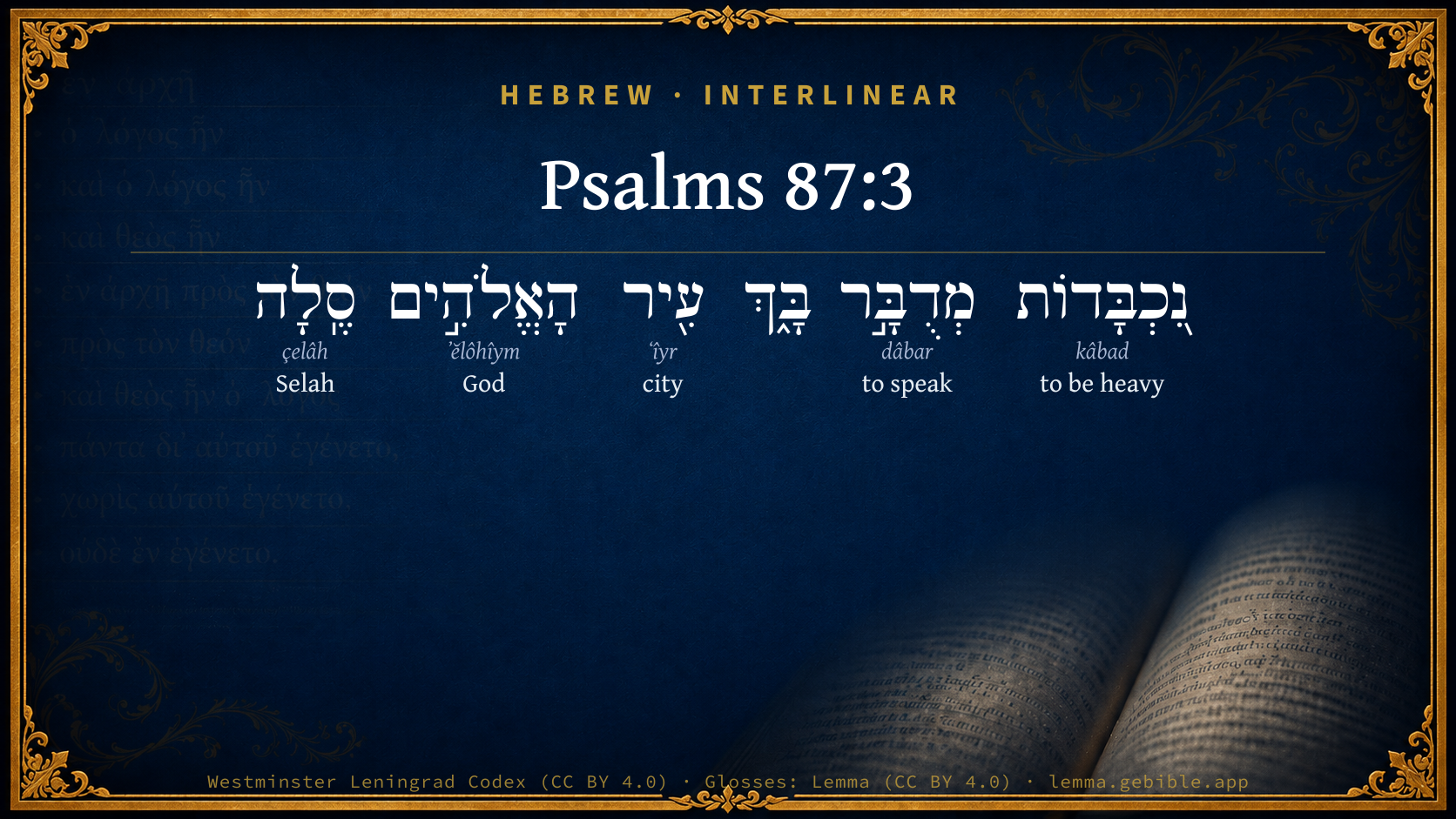
Psalms 87:3

Hebrew (Westminster Leningrad Codex) Psalms 87:3 appears in the Hebrew Old Testament. The text above is from the Westminster Leningrad Codex. Each word links to its Strong’s number, a concise gloss, and parsing drawn from the Open Scriptures Hebrew Bible morphology. Click any word for its full Brown-Driver-Briggs (BDB) entry.
Download image
Cite this verse

Psalms 87:3 (World English Bible). Public Domain. Lemma interlinear Bible study tool, https://lemma.gebible.app/v/psalms/87/3.

Show BibTeX & RIS
BibTeX
RIS
English Translation
Glorious things are spoken about you, city of God. Selah.
World English Bible · Public Domain
Download a study sheet

One document with this verse’s original text, its word-by-word gloss line, the meaning frame, cross-references with their text, attributed commentary, and full source and license credits — printable, and it pastes into notes with its structure intact.

This verse Autodidact and up

Study sheet (.html) Plain text (.txt)

A passage Seminary Student

Up to 50 verses in one chapter. A passage sheet keeps up to 6 commentary sources and 12 cross-references per verse, in the order this page ranks them, and says so on the sheet whenever that leaves anything out. Ask for a single verse and you get the Autodidact verse sheet above.

Everything on this page stays free to read, with no account — the sheet is a download of what is already on screen, not access to it.

Want to remove ads? Support Godless Engineer
Compare translations 3

The same verse in 3 English versions, stacked beneath the original-language interlinear above. Click any original word for its lexicon entry.

Each is an independent rendering of the whole verse — the interlinear is not word-aligned to these translations.

Highlighted words mark where these versions differ — a whole-verse word diff, not a word-by-word alignment.

  • World English Bible Public Domain
    Glorious things are spoken about you, city of God. Selah.
  • King James Version Public Domain
    Glorious things are spoken of thee, O city of God. Selah.
  • unfoldingWord Literal Text CC BY-SA 4.0
    Glorious things are spoken of you, city of God. Selah

unfoldingWord Literal Text — © unfoldingWord, licensed CC BY-SA 4.0. Word-aligned USFM3 via Door43 (git.door43.org/unfoldingWord/en_ult).

Versions to compare (up to 4)

3 of 4 selected

Show all 18 translations

Every available English version of this verse, each an independent rendering of the whole verse.

  • World English Bible Public Domain
    Glorious things are spoken about you, city of God. Selah.
  • Berean Standard Bible Public Domain
    Glorious things are ascribed to you, O city of God. Selah
  • Majority Standard Bible Public Domain
    Glorious things are ascribed to you, O city of God. Selah
  • King James Version Public Domain
    Glorious things are spoken of thee, O city of God. Selah.
  • American Standard Version (1901) Public Domain
    Glorious things are spoken of thee, O city of God. Selah
  • Revised Version (1885) Public Domain
    Glorious things are spoken of thee, O city of God. Selah
  • Geneva Bible (1599) Public Domain
    Glorious things are spoken of thee, O citie of God. Selah.
  • Douay-Rheims (1899) Public Domain
    Glorious things are said of thee, O city of God.
  • Young's Literal Translation Public Domain
    Honourable things are spoken in Thee, O city of God. Selah.
  • Literal Standard Version CC BY-SA 4.0
    Honorable things are spoken in You, || O city of God. Selah.
  • Unlocked Literal Bible CC BY-SA 4.0
    Glorious things are said of you, city of God. Selah
  • unfoldingWord Literal Text CC BY-SA 4.0
    Glorious things are spoken of you, city of God. Selah
  • Darby Bible Public Domain
    Glorious things are spoken of thee, O city of God. Selah.
  • World Messianic Bible Public Domain
    Glorious things are spoken about you, city of God. Selah.
  • Webster's Bible Public Domain
    Glorious things are spoken of thee, O city of God. Selah.
  • Free Bible Version CC BY-SA 4.0
    Many wonderful things are said of you, city of God! Selah.
  • Bible in Basic English Public Domain
    Noble things are said of you, O town of God. (Selah.)
  • JPS Tanakh (1917) Public Domain
    Glorious things are spoken of Thee, O city of God. Selah

Literal Standard Version (2020), Covenant Press — licensed CC BY-SA 4.0. Text via the HelloAO Bible API (eBible.org). Unlocked Literal Bible (unfoldingWord) — licensed CC BY-SA 4.0. Text via the HelloAO Bible API (eBible.org). unfoldingWord Literal Text — © unfoldingWord, licensed CC BY-SA 4.0. Word-aligned USFM3 via Door43 (git.door43.org/unfoldingWord/en_ult). Free Bible Version, Dr. Jonathan Gallagher — licensed CC BY-SA 4.0. Text via the HelloAO Bible API (eBible.org).

Word by word

More ways to search: Search by grammar → Find every occurrence → Compare this word →

Practice this passage: Drill this verse → Learn its vocabulary →

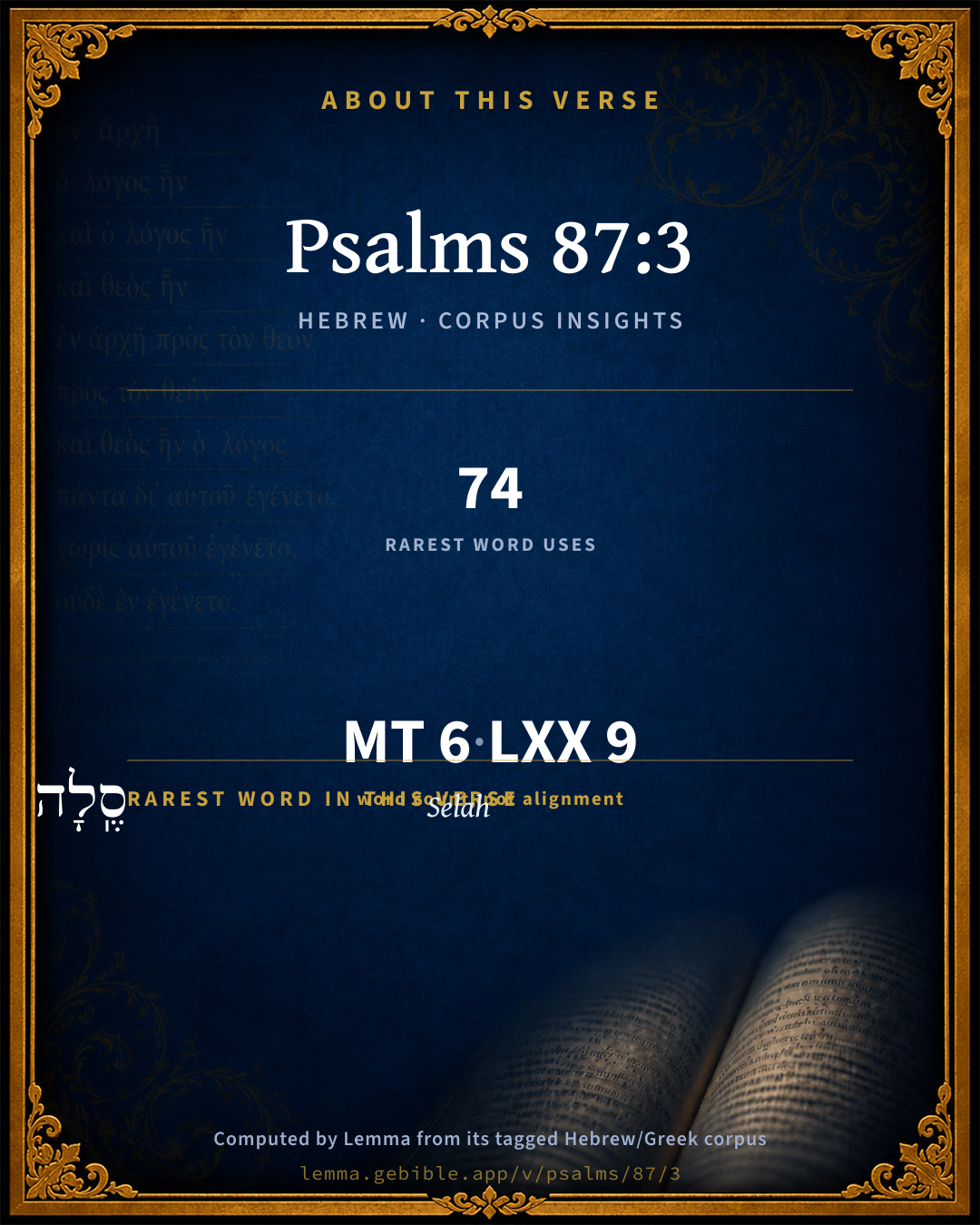
About this verse

These counts appear in no published source. They are computed here, from the morphology-tagged text and Lemma’s own curated glosses. What Lemma adds →

6
words
5
distinct lemmas
Wisdom
section

Grammatical profile

  • 2 verbs
  • 2 nouns
  • 1 preposition
  • 1 particle

Verb forms

  • נִ֭כְבָּדוֹת Niphal · Participle Active
  • מְדֻבָּ֣ר Pual · Participle Passive

Hebrew & Septuagint length

In English translation the verse runs 10 words from the Hebrew and 12 from the Septuagint (LXX English) — closely comparable.

A rough comparison of the two English renderings, which tokenize alike — not a word-level alignment.

Word counts can differ between the Hebrew and the Greek without any difference in meaning — e.g. the Hebrew direct-object marker אֵת has no separate Greek word, and Greek often adds the article ὁ.

In the original languages it is 6 Hebrew tokens and 9 Greek tokens — but the two are counted differently (Hebrew bundles its prefixes and suffixes into one token; the Greek is in lemma form), so that isn’t a like-for-like length.

Cross-references

19

Topical passages linked to Psalms 87:3 in the Treasury of Scripture Knowledge — connected by theme and wording, ordered by reader-vote popularity; previews shown in the World English Bible.

  • Ezekiel 37:27–28 My tent also shall be with them; and I will be their God, and they shall be my people.
  • Ezekiel 36:11–38 and I will multiply on you man and animal; and they shall increase and be fruitful; and I will cause you to be inhabited after your former estate, and will do better [to you] than at your beginnings: and you shall know that I am Yahweh.
  • Psalms 48:2–3 Beautiful in elevation, the joy of the whole earth, Is Mount Zion, on the north sides, The city of the great King.
  • Revelation 21:10–27 He carried me away in the Spirit to a great and high mountain, and showed me the holy city, Jerusalem, coming down out of heaven from God,
  • Jeremiah 31:12–13 They shall come and sing in the height of Zion, and shall flow to the goodness of Yahweh, to the grain, and to the new wine, and to the oil, and to the young of the flock and of the herd: and their soul shall be as a watered garden; and they shall not sorrow any more at all.
  • Hebrews 12:22–23 But you have come to Mount Zion, and to the city of the living God, the heavenly Jerusalem, and to innumerable hosts of angels,
  • Revelation 14:1 I saw, and behold, the Lamb standing on Mount Zion, and with him a number, one hundred forty-four thousand, having his name, and the name of his Father, written on their foreheads.
  • Psalms 46:4 There is a river, the streams of which make the city of God glad, The holy place of the tents of the Most High.
  • Psalms 48:11–13 Let Mount Zion be glad! Let the daughters of Judah rejoice, Because of your judgments.
  • Psalms 125:1–2 Those who trust in Yahweh are as Mount Zion, Which can't be moved, but remains forever.
  • Isaiah 12:6 Cry aloud and shout, you inhabitant of Zion; for great in the midst of you is the Holy One of Israel!"
  • Isaiah 49:14–26 But Zion said, Yahweh has forsaken me, and the Lord has forgotten me.
  • Isaiah 54:2–10 Enlarge the place of your tent, and let them stretch forth the curtains of your habitations; don't spare: lengthen your cords, and strengthen your stakes.
  • Isaiah 59:20–60:22 A Redeemer will come to Zion, and to those who turn from disobedience in Jacob, says Yahweh.
  • Isaiah 61:3–62:12 to appoint to those who mourn in Zion, to give to them a garland for ashes, the oil of joy for mourning, the garment of praise for the spirit of heaviness; that they may be called trees of righteousness, the planting of Yahweh, that he may be glorified.
  • Jeremiah 3:14–17 Return, backsliding children, says Yahweh; for I am a husband to you: and I will take you one of a city, and two of a family, and I will bring you to Zion:
  • Ezekiel 36:2 Thus says the Lord Yahweh: Because the enemy has said against you, Aha! and, The ancient high places are ours in possession;
  • Ezekiel 40:1–49 In the five and twentieth year of our captivity, in the beginning of the year, in the tenth [day] of the month, in the fourteenth year after that the city was struck, in the same day, the hand of Yahweh was on me, and he brought me there.
  • Ezekiel 48:1–35 Now these are the names of the tribes: From the north end, beside the way of Hethlon to the entrance of Hamath, Hazar Enan at the border of Damascus, northward beside Hamath, (and they shall have their sides east [and] west), Dan, one [portion].

Cross-references courtesy of OpenBible.info (CC BY 4.0).

Hebrew and Greek witnesses Masoretic Hebrew ↔ Greek Septuagint

The same verse in the two great witnesses to the Old Testament, shown verse-for-verse.

You’re reading Greek Psalm 86 (Hebrew Psalm 87). The Septuagint counts the superscription, so verse numbers can differ from the Hebrew — chapter-level alignment, not verse-by-verse. Numbering follows Rahlfs.

These are two independent witnesses, not word-aligned to each other, and the Septuagint is shown in lemma (dictionary) form.

Hebrew Psalms 87:3 Masoretic · Westminster Leningrad Codex

נִ֭כְבָּדוֹת מְדֻבָּ֣ר בָּ֑ךְ עִ֖יר הָאֱלֹהִ֣ים סֶֽלָה

Glorious things are spoken about you, city of God. Selah.

World English Bible · Public Domain

Greek LXX Greek Psalm 86:3 Septuagint · lemma form

δοξάζω λαλέω περί σύ ὁ πόλις ὁ θεός διάψαλμα

Glorious things have been spoken of you, O city of God. Pause.

LXX2012 (modern English Septuagint) · Public Domain

Hebrew: Westminster Leningrad Codex (CC BY 4.0). Greek: Septuagint (public domain); English from LXX2012 (modern English Septuagint) (Public Domain). How the Septuagint differs from the Hebrew →

Commentary

Notes on Psalms 87:3 from classic Christian and Jewish commentators (each source and its license shown beneath its notes). The classic Christian expositions comment on the surrounding passage and are grouped to its opening verse, so a note may address several verses; the Jewish commentaries on the Tanakh (Rashi and others) are per-verse, so they appear only where the commentator wrote on this verse.

Lemma curates 59 commentaries, every one of them public domain or Creative Commons licensed, each selected and text-cleaned for this edition rather than reprinted as found. About our sources →

Trapp's Complete Commentary

John Trapp

Psa 87:3 Glorious things are spoken of thee, O city of God. Selah.

Ver. 3. Glorious things are spoken of thee] Dicta et praedicta, told and foretold of thee, Heb. in thee, sc. by the holy prophets, especially concerning the Christian Church. See Isa 60:1-5, to the end of that prophecy. Nihil honorificum non praedicatur de te; et nihil praedicatur de te quin sit honorificentissimum (Jun.).

Thou city of God] The glory of God, Act 7:1, the great King, Mat 5:35, the only potentate, 1Ti 6:15, who maketh his Church the place of his residence, &c.

Selah] O rem dignam perpetua admiratione, Oh wonderful!

John Trapp, A Commentary or Exposition upon All the Books of the Old and New Testament (1647–1656) — public domain. Text from a community e-Sword module.

The Biblical Illustrator

Joseph S. Exell

Psa_87:3

Glorious things are spoken of thee, O city of God.

The glorious city

The inspired singer had the ransomed Church in view, and his soul was stirred by a vision of the new Jerusalem, its regenerated myriads gathered from every nation, and its crucified King, when he broke forth into this eulogy.

I. There are glorious things with respect to the erection of the city.

1. The plan of its erection. Faultless, complete, wonderful for beauty and grandeur, worthy of its Divine Architect and of the end in view, viz. to rear a city for Him to dwell in.

2. The site. The sure decree, the Divine perfections, the promise of Him that cannot lie, and the incarnate Son Himself, are the holy mountains, whose summits are gloriously crowned by the city of the great King. There the city sits securely, beautiful for situation, the joy of the whole earth.

3. The date of its erection. It is older than any of the cities of the ancient world--Rome--Nineveh--Babylon; it reaches a higher antiquity than any of them all. It was standing before the flood; Noah, Enoch, Abel, dwelt in it. It is almost as old as the creation.

II. There are glorious things to tell of the defences of the city. It is well fortified--encircled by the sleepless providence of Jehovah, girt about with the power of the Almighty. When its bulwarks were reared, He that made them saw that they were good; and He said, No weapon that is formed against thee shall prosper.

III. There are glorious things in connection with the stores and supplies on which the city depends.

1. The excellence of the citys supplies. It is little to say that there is the best of everything--the finest of wheat, honey from the rock, water clear as crystal. The bread, the water, the wine, the milk, and the pleasant fruits, are without a parallel.

2. The abundance of the citys supplies. There is enough for all the citizens. He, every one that thirsteth, come ye to the waters, etc.

3. The source whence the supplies are derived.

(1) They do not come from without. Its well-springs are not in the world. The corn, and the wine, and the oil, are grown where the foe is without any power.

(2) There is a river that maketh glad the city of God. Yes, the city has a river--a pure river of the water of life, clear as crystal. But cannot Satan do to the river of our city as Cyrus did to the river of Babylon? The river is beyond his reach. The fountain whence it issues is within the city walls. The river-head, the perennial spring of the stream of life, is in the heart of the fortress, and in the very throne of the King.

(3) The windows of heaven are right above the city; and the windows of heaven are frequently opened, and manna and other celestial products showered down, till there is not room enough in the magazines of the city to receive them.

IV. There are glorious things respecting the King of the city.

1. He is glorious in Himself.

(1) His name--Wonderful. He is Adam, Jacob, David, Israel; Jesus, Immanuel, Shiloh, Christ; the Second Man, the Mighty God; the Lamb, the Shepherd, the Lion of the Tribe of Judah; the Branch, the Plant of Renown, the Rose of Sharon; the Morning Star, the Sun of Righteousness, the Word of God, the Alpha and the Omega, the Amen. And these are not the whole. There are many titles and appellations behind.

(2) His person--full of grace and dignity.

(3) His character.

2. There are glorious things respecting the King, when we consider Him in connection with the city.

(1) His choice of the city is one of these. He made choice of the city before the foundation of the world; yea, the city itself was not built when it became the object of His choice, He foreknew the city; raising the curtain of futurity in the past beginning, He saw the city, He fixed upon it His love, and resolved to be its King.

(2) The circumstance that He dwells in the city is glorious.

(3) His sufferings for the city are glorious.

(4) His victories for the city are glorious.

V. There are glorious things in connection with the citizens of the city.

1. The Dumber of the citizens. It was foretold long since that they of the city should flourish like grass of the earth, and that they should be like the stars of heaven for multitude. The population of the city is increasing accordingly. Sometimes its progress is greater, and sometimes it is less, but it is always advancing.

2. The rank of the citizens. All of them are princes--the Kings own kinsmen. They are born of God, and the glorious King is their elder brother!

3. The circumstances of the citizens. In other places some are rich and some are poor. But here all the citizens are poor. To this man will I look, says the King, to him that is poor, and of a contrite spirit, etc.

4. The character of the citizens. All of them are on the way to perfection. They are being fashioned to the pattern of the character of the King. The climate in which they live, the atmosphere which they breathe, the diet on which they are fed, and the exercises they engage in, have a powerful tendency to produce a resemblance between them and Him, and to conform them to His image. The beauty of the Lord descends upon them more and more.

5. The employment of the citizens.

6. The privileges of the citizens.

(1) They are served and protected by the Kings attendants and guards.

(2) They are permitted to eat fruit in the Kings garden.

(3) They may enter the Kings palace, and approach His throne. (Andrew Gray.)

The glory of the Church

Glorious things are spoken of our New Testament Zion--

1. As a magnificent city.

I. It is populous. The polished European is there, and the rude islander from the great Pacific; the dark Ethiopian on whom the sun has looked down; and the wild dweller under the North Star from his dreary regions of perpetual snow. The philosopher is in Zion with his extensive learning and habits of independent thought, in humble submission to the Cross. The cottager is there, who has read and known little but his Bible; and the child, who, receiving the Gospel in its simplicty to his infant heart, has been set forth as a pattern to the older by Him who said, Of such is the kingdom of heaven.

2. It is increasing; but its past triumphs are not to be compared with its future glory. A time is coming when the Gospel shall be preached to all, when the true light shall shine in the dark places of the earth, and the isles shall wait for His law.

3. Zion is a magnificent, because a well planned city. Glorious things are spoken of its situation. It has not an unhealthy site by the slough of despond, or a disagreeable position beside the habitations of horrid cruelty: His foundation is in the holy mountains. Many cities are overcrowded, and while their best streets are beautiful and spacious, their alleys are the abodes of misery and the nurseries of disease: but this city has abundant convenience and blessings for all.

II. As the seat of the great King. Many cities are beautiful in themselves, but want the honour of the metropolis. This is the capital of the dominions of a Monarch who is higher than the kings of the earth--God in the person of Jesus Christ. He is great--

1. In His character.

2. In His dominions.

3. In His actions.

4. In His speech. His decrees and revelations are not only superior to any statements to be found elsewhere in their cheering and instructive nature, but in the length of their duration. The edicts of other kings soon pass out of date; those of the King of Zion are eternal.

III. As the abode of a happy people.

1. Zion is the abode of a people who are happy, because they are well governed. The first element in a good government is a strong mutual affection between the prince and the people.

2. The inhabitants of Zion are happy, because well conducted. A realm whose inhabitants are idle can never be a happy one: and Christians, besides being taught not to be slothful in the common business of life, are told likewise to be active in their Masters work.

3. Zion is the abode of a people who are happy because all their wants are abundantly supplied. There is never a famine of spiritual food in that glorious and happy place. (W. Dickson.)

The city of God

I. The designation.

1. A city, well-built and fortified.

2. It is the city of God.

(1) He is its Architect and Builder.

(2) He dwells in it.

(3) He reigns over it.

II. The excellences ascribed to this city.

1. Its purity. There is no guilt there; for the people that dwell therein are forgiven their iniquities. There is no defilement there; for they have washed their robes, and made them white in the blood of the Lamb. There are no remains of transgression there; for they are without fault before the throne of God. The place itself is holy, and all who dwell in it are holy, in every possible respect. Their actions, conversation, desires, and thoughts, are all holy. Nor is it merely by the absence of sin the city is distinguished. There all the fruits of righteousness abound, and in every member of its glorified community the Spirit takes up His abode, filling him with light, and life, and love.

2. Its magnificence. There is the throne of God and of the Lamb. If He were not there, it would be like a city wrapped in night; but because He is there, it shines with the brightness of perpetual day. Hence He is the object on which all eyes gaze.

3. Its opulence. Universal plenty. No toil, no anxious cares, nor disappointed hopes. Its inhabitants have for their portion God Himself, who is all in all. They are His people, and He is their God, and from the boundless resources of His nature they are ever supplied with the richest blessings.

4. Its permanence. It is an abiding city; a city that hath foundations; a house not made with hands, eternal in the heavens; an inheritance incorruptible and undefiled, and that fadeth not away.

III. Practical lessons.

1. The necessity of personal holiness.

2. Learn, while dwelling in the vale below, to live as citizens of heaven.

3. Learn what estimate to put upon the things of time and sense. They are evanescent as the vapour which appeareth for a little time and then passeth away. There is nothing certain but death; there is nothing true but God; there is nothing permanent but heaven. (Thornley Smith.)

The city of God

Glorious things are spoken of--

1. Its Founder.

2. Its privileges, Pardon, instruction, comfort.

3. Its eminent characters.

4. Its perpetual security.

5. Its future extent and magnificence. (J. Jowett, M. A.)

Mother Church

By universal consent Zion is regarded as type of the Christian Church.

I. This mother is glorious is her reputation. (Verse 3). She has the reputation--

1. For the highest intelligence. To her are committed the oracles of God. She is the receptacle and the revealer of heavenly intelligence.

2. For self-sacrificing love. The love which she possesses is of the same kind as that which the Son of God exemplifies--an unconquerable love for souls.

3. For the most beneficent achievements. She has created Christendom. All the arts that bless and adorn the civilized world must he ascribed to her. Her great work is to save souls.

II. This mother is Divine in her resources (Psa_87:5). She has had her enemies. Her continuance can only be ascribed to Divine support.

1. In what does God establish the Church? In truth and love. She is like a tree which He roots and grounds in love; like a vessel which He fastens in the firmest anchorage; like a house which He builds upon a rock.

2. How does God establish the Church? He thus gives her power, love, and a sound mind.

III. This mother is illustrious in her family. 1 Her children are men. This and that man was born there. Many call her mother whom she disowns.

2. Her children have their birth divinely registered. When He writeth up.

3. Her children are distinguished by every variety of mind (Psa_87:7). There is the impulsive Peter, the heroic Paul, and the scientific Luke, and the lamb-like John. There is no monotony in her domestic circle. (Homilist.)

The city of God

I. In their literal reference to the Jewish metropolis, Jerusalem was truly the city of God; the city which He particularly chose--to which He paid especial regard. Hence glorious things were spoken of her.

1. There was the seat of the civil government.

2. There the Divine ordinances were celebrated

3. There was the general rendezvous of all the Israelitish tribes.

4. This city received a glorious name, vision of peace; and was at length honoured with the presence of our Lord, the Prince of Peace.

II. in their spiritual application to the Church of Christ. St. Paul styles this Jerusalem which is from above, which is the mother of us all--of all believers (Gal_4:26). Hence Christians are represented as fellow-citizens (Eph_2:19) Now of this spiritual city, the antitype of Zion, glorious things are spoken:--

1. That she is gloriously founded by the living God.

2. That she possesses glorious privileges.

3. That she contains glorious inhabitants.

4. That glorious promises shall be accomplished in her (Isa_55:1-13.).

III. In their grandest typical reference to heaven itself. (Sketches of Four Hundred Sermons.)

The city of God

Glorious things are spoken of--

1. Its security.

2. Its beauty.

3. The privileges enjoyed by its inhabitants. Theirs are the present and palpable advantages connected with a life of piety; evil things are sent them in mercy, and of the good things of life they have the real benefit and enjoyment, and possess them with Gods blessing. Theirs is the inheritance of grace; theirs the heirship of glory.

4. Its enlargement, and the increase of its inhabitants.

5. Its durability. (James Kirkwood.)

The Church and the city of God

I. A ransomed city.

II. A holy city.

III. A united city.

IV. An enlarging city.

V. An everlasting city. (J. Smyth, D. D.)

Zions glories

I. First on the catalogue is the fact of Gods intimate connection with the Church. His foundation in the holy mountains. God and His people cannot be separated. The Spirit dwells within the Church, aye, and tabernacles within the very body of each believer.

II. The second glory is found in the fact that God Himself has established the Church. The Divine attributes and perfections are as the foundations of the city.

III. An equally glorious fact is to be found in the special favour God has towards His Church.

IV. The most glorious thing of all is the promise of increase, and the fulfilment of that promise. Certain nations are spoken of here. I will make mention of Rahab and Babylon to them that know me: behold Philistia, and Tyre, with Ethiopia; this man was born there. Whole nations, you see! Yes, for a nation shall be born in a day, and men shall come to Christ as doves fly to their windows. The character of the people is here indicated. These are heathen nations, Rahab, Babylon, Philistia, Tyre and Ethiopia. Thank God for the missionary work at home and abroad, for home missionaries and city missionaries, as well as for foreign missionaries, since the heathen are at our very doors. But though nations are made mention of, it is very evident that individuals are dealt with. This man was born there, This and that man was born there. Yes, salvation is an individual matter after all. You cannot be saved with the crowd, though you can be saved in a crowd. It must be Gods own Spirit working on heart and causing it to be new-born. Praise the Lord for this individual work among the people. (T. Spurgeon.)

Glorious things of the city of God

1. Her redemption and salvation through Christ.

2. Her spiritual life and beauty.

3. Her increase and enlargement..

4. Her relation to the kingdom of this world.

5. Her millennial happiness.

6. Her duration on earth.

7. Her future eternal glory. (E. Ritchie.)

The Biblical Illustrator, edited by Joseph S. Exell (c. 1880s–1900s) — public domain. Text from a community e-Sword module.

Joseph Benson's Commentary

Psa 87:3. Glorious things are spoken of thee, O city of God — “As the prophet began, in a rapture, to speak of the holy city, so now, in a fresh transport, he changes the person, and suddenly addresses himself to it. The old Jerusalem was the city of God, and glorious things were therefore said of it by the Spirit. “Pleasant for situation, and magnificent in its buildings, it was the delight of nations, the joy of the whole earth; there was the royal residence of the kings of Judah; there were the temple, and the ark, and the glory, and the king of heaven dwelling in the midst of her: her streets were honoured with the footsteps of the Redeemer of men; there he preached and wrought his miracles, lived, died, and rose again; thither he sent down his Spirit, and there he first laid the foundation of his church.” — Horne. Yet of this church of Christ, the gospel church, more glorious things are spoken. It is the spouse of Christ, the purchase of his blood, a peculiar people, a holy nation, a royal priesthood, the light of the world, the salt of the earth, the holy place of the tabernacles of the Most High, the temple of God, and a habitation of God through the Spirit. And he, the Holy One of Israel, is said to be in the midst of her, and that therefore she shall not be moved; for he is mighty, and will save her; yea, he will rejoice over her with joy; he will rest in his love, he will joy over her with singing, 1Pe 2:9; Psa 46:5; Eph 2:21-22; Zep 3:17. Let us not be ashamed, then, of this church, in its meanest condition, nor of any that belong to it: let us not disown our relation to it, though it be turned never so much to our reproach, since such glorious things are spoken of it, and not one iota or tittle of what is said shall fall to the ground. We must remember, many base and ill things were spoken of Jerusalem by its enemies, to render it mean and odious; but by Him whose judgment is according to truth, glorious things were spoken of it; and therefore its genuine citizens, believing what God had spoken, rather than the slanders of its enemies, were not ashamed of it; and shall we be ashamed of that church, of which Jerusalem was but a type, and of which things so much more glorious are spoken by Him who cannot lie?

Joseph Benson's Commentary on the Old and New Testaments (1811–1818) — public domain. Text from a community e-Sword module.

J. A. Alexander on Psalms

Joseph Addison Alexander

3. (Psa 87:3) Glorious things (have been) spoken in thee, 0 City of God. Selah. Glorious or honourable things, in the way of prophecy and promise, the fulfilment of which is here implied. As if he had said, the promises respecting thee are great, but they are or shall be fully verified. So too in the other clause the meaning is, thou art well called the city of God, for he is in thee, to protect and honour thee. See above, on Psa 46:4; Psa 48:1; Psa 48:8. Instead of in thee some read of thee, but the former is entitled to the preference: first, because it is the strict sense, and therefore not to be rejected without reason; then, because it really includes the other, but is not included in it; lastly, because it suggests the additional idea of the holy city as the scene, no less than the theme, of the prophetic visions.

Joseph Addison Alexander, The Psalms Translated and Explained (1850) — public domain. Text from a community e-Sword module.

Geneva Bible (1599)

Geneva Bible translators

Though thy glorious estate does not yet appear, yet wait with patience, and God will accomplish his promise.

Geneva Bible (1599) marginal notes — public domain. Text via Bolls.life.

Adam Clarke's Commentary

Verse 3. Glorious things are spoken of thee] Or, there are glorious words or doctrines in thee. Does this refer to the glorious doctrines of the Christian Church? These are glorious sayings indeed.

Adam Clarke's Commentary on the Bible (1810–1826) — public domain. Text from a community e-Sword/MySword module.

John Calvin's Commentaries

3 Glorious things are spoken of thee, O city of God! The reading literally is, That which is spoken in thee are glorious things. We must consider the design of the prophet, or rather the object of the Spirit of God, speaking by the mouth of the prophet. From the low and despised condition of the whole people, from the many and terrible enemies who pressed hard upon them on all sides, from the small number who had sufficient courage to surmount the obstacles in their way, from the new and unlooked-for changes which were daily springing up, from the danger there was lest the state of affairs gradually sinking more and more into decay, should at length become desperate, it was difficult to cherish the hope that the holy city would be restored. That despair might not overcome the hearts of the faithful, and cause them to fail, there is set before them the supporting and consolatory consideration, that the Lord hath spoken differently concerning the future condition of the Church. Their attention, there can be no doubt, is called away from the present aspect of things, and directed to the promises which inspired them with the hope of the wonderful glory with which she should be adorned. Although, therefore, nothing appeared to the eye of sense and reason, calculated greatly to rejoice the heart, yet the prophet would have them encouraged by the word to stand as it were on a watch-tower, waiting patiently for the fulfillment of what God had promised. In this way they were admonished, first, to direct their attention to the ancient prophecies, and to keep in remembrance, especially those which are contained in Isaiah from the fortieth chapter (Isaiah 40) to the end of the book; and, secondly, to give ear to the servants of God, who at that time preached the kingdom of Jesus Christ. Whence it follows that a right judgment cannot be formed of the happiness of the Church, except when we estimate it according to the standard of God’s word.

John Calvin's Commentaries (1540-1563) — public domain. Text from the Calvin Translation Society English edition (1840s-50s) via the Christian Classics Ethereal Library (ccel.org). Calvin's coverage is partial (roughly two-thirds of the Bible); uncommented books and verses are honest gaps, never fabricated. The 19th-century editor's footnotes and remarks are omitted so the notes are faithfully Calvin's own voice.

Ellicott's Commentary for English Readers

(3) The meaning of this verse is obvious in spite of its many grammatical difficulties. The praise of Zion had found many tongues, but the poet implies that he is going to swell the chorus.

A Bible Commentary for English Readers, edited by Charles John Ellicott (1878–1897) — public domain. Text from a community e-Sword module.

The Cambridge Bible for Schools and Colleges

gen. ed. J. J. S. Perowne

3. Glorious things are spoken of thee] This need not be limited to the utterance of Psa_87:4 ff., but may include the great prophetic promises generally, such as Isa_2:2 ff; Isa_11:10; Isa_19:20 ff.; and, if the Psalm is post-exilic, Psa_60:1 ff. O city of God] Of His choice, His love, His care. Cp. Psa_46:4; Psa_48:1-2; Psa_48:8.

The Cambridge Bible for Schools and Colleges (gen. ed. J. J. S. Perowne; Cambridge University Press, 1878–1918) — public domain. Text from a community e-Sword module.

John Gill's Exposition

Glorious things are spoken of thee, O city of God. Which is to be understood not of the city of Jerusalem literally, which was a magnificent city, compact together, full of inhabitants, and spacious houses, the metropolis of Judea, and seat of the kings of Judah; and what was most glorious of all that could be said of it, it was the city of God; and so Jarchi interprets it, the glory spoken of it is, that it is the city of God; here the temple was built, and many glorious things were in it; here God granted his presence, and his worship was kept up: and besides, there were other and more glorious things spoken of it, by way of prophecy; as, that the Messiah should come in person into it, as the owner of it, and give it a greater glory than the first temple had; here he was to preach his doctrines, and do his miracles, which he accordingly did; near this city he suffered, died, and was buried; rose again, ascended to heaven; and here he poured forth the gifts of the Holy Spirit in an extraordinary manner: but rather this is to be interpreted of the church of God, comparable to a city, and which is of God's building, and where he dwells; See Gill on Psa 48:1 of which glorious things are spoken for the present; as, that it is the city of the King of kings, the name of which is "Jehovah Shammah", the Lord is there; its foundation is Christ; its walls and bulwarks are salvation; its gates are praise; glorious ordinances are administered in it, and glorious truths are preached here; and so the words may be rendered, "glorious things are spoken in thee" (x): and of it also glorious things are spoken, by way of prophecy, as, what shall be in the latter day; a great effusion of the Spirit upon it; the gracious presence of Christ in it in a more visible manner; a great increase of converts both among Jews and Gentiles, which shall flock into it; and the great spread of the Gospel, which shall be the means of it; the unity, harmony, and concord of professors of religion; the holiness of their lives and conversation; and the very great peace and prosperity which will everywhere abound; and especially glorious things are spoken of the New Jerusalem, the city of our God; of which see Rev 21:1.

Selah. See Gill on Psa 3:2.

(x) "in te", Montanus, Tigurine version, Cocceius, Schmidt, Syr. vers.

John Gill's Exposition of the Whole Bible (1746–1763) — public domain (CC PDM 1.0). Text via the HelloAO Bible API.

Albert Barnes' Notes on the Bible

Glorious things are spoketh of thee, O city of God - Jerusalem, called the “city of God” as being the place of his unique home on earth. The word rendered “are spoken” may mean either “have been spoken,” or “are to be spoken;” that is, either, such things have been said, or they may be said. They have been placed on record; or, they may now be put on record concerning thee. Probably the former is the true meaning; and the language would embrace such points as these:

(1) Those things which had been spoken as to its beauty of situation; its magnificence and splendor. Compare Psa 48:2-3, notes; Psa 48:12-13, notes.

(2) Such things as had been spoken or recorded in regard to its future prosperity, its triumphs, and its influence in the world; the promises which had been made in reference to the prosperity of Zion, and the spread of the true religion from that point as a center.

Compare the notes at Isa 2:3. The Old Testament abounds with promises concerning the future glory of Zion - the “glorious things” that are spoken respecting the final triumph of religion in the world. Of this the statement here is to be mainly understood, where Zion is referred to as the seat of the true religion, and as therefore the representative of the true church on earth. It is that of which the real record has been made, and not merely of Jerusalem or Zion as a city. That might pass away; the church, of which that was the representative, will endure forever. Compare Isa 54:1-3; 60; Rev 21:2-4.

Albert Barnes' Notes on the Bible (1834–1885) — public domain. Text from a community e-Sword/MySword module.

Matthew Poole's English Annotations

O Jerusalem, though thou and thy temple are yet in some sort in your ruins, and desolate and contemptible not only to thine enemies, but also in the eyes of thine own people, yet comfort thyself with these great and glorious things foretold concerning thee in the holy prophets, as Isa 62:1,7; 65:18, &c.; Isa 66:10, &c.; Zec 1:14, &c.; Zec 2:4,12; 8:3, &c. Zec 12:2, &c. Among other things, it was foretold that the glory of the latter house should be greater than of the former, Hag 2:9. All which prophecies are to be understood, as this place also is, of a spiritual and evangelical glory accruing to Jerusalem; as by the birth and presence of Christ in it, so also by the accession of all people and nations to it, of which he speaks in the next verse.

Matthew Poole's English Annotations on the Holy Bible (1683–1685) — public domain. Text from a community e-Sword/MySword module.

The Treasury of David

Charles H. Spurgeon

Ver. 3. Glorious things are spoken of the people of God. Take the church for a visible congregation, a mixed congregation; glorious things are spoken of that. It is the house of God. Take it as visible, `the vessels of honour and dishonour', 2Ti 2:20, and the field, the `tares and the wheat', Mt 13:1 etc., it is God's field. Though we take the church as visible, it hath a glorious name for the good that is in it, especially for the wheat. But take the church of God for the company of his children that are gathered by the means of grace, dwelling in the visible church, enjoying the ordinances: so they are the house and temple of Christ, `the temple of the Holy Ghost, the body of Christ, the spouse of Christ.' They are God's delight, they are spiritual kings and priests, etc. The most glorious things that can be, all other excellencies in the world are but titular things, mere shadows of things. There is some little reality in earthly things, but it is nothing in comparison, it is scarce worth the name of reality, but Solomon calls them "vanity of vanities." In comparison of the excellencies of the church all is nothing. I might be large in these particulars. It is enough to give you the generals of the delights and excellencies of God's house, "the beauty of the Lord." Richard Sibbes.

Ver. 3. The glories of the wilderness are in thee. The Schechinah, which appeared upon Sinai, and marshalled the army of the Israelites upon their journey through the wilderness, has now fixed its residence in thee, O city of God. Compare Ps 68:17. Samuel Horsley

Ver. 3. The idea of the text presents the Church as "the city of God": let us touch upon some of the "glorious things" that are spoken of it.

1. There are glorious things with respect to the erection of the city.

(a) There is the plan of its erection. There was never a

plan so faultless, so complete, so wonderful for its

beauty and grandeur. The gates, the walls, the

buildings, the streets, the monuments, the fountains,

the gardens, unite to proclaim it a master piece of

skill. The Architect was he who built the skies.

(b) There is the site where the city is erected. See

Ps 87:1.

(c) There is the date of the city's erection. A halo

and a glory attach, in a case like this, to great

antiquity. Now it is long since the city was built.

It was standing in the days of Paul "Ye are come unto

the city of the living God." Heb 12:22. David

was well acquainted with it. Ps 46:1-11.

(d) It was standing before the flood. Noah, Enoch, Abel,

dwelt in it. It is almost as old as the creation.

2. There are glorious things to tell of the defences of the city. It has been besieged ever since it was a city at all, and it is not taken to this hour. "We have a strong city", etc.

3. There are glorious things in connection with the stores and supplies on which the city depends;

(a) their excellence;

(b) their abundance;

(c) their source.

4. There are glorious things respecting the King of the city; his name, person, character, etc.

5. There are glorious things in connection with the citizens of the day. Andrew Gray, 1805-1861.

Ver. 3.

1. Observe, that a city is not like a flower, a tree, or a plantsomething that grows out of the earth, and is nourished from the earth, and dependent wholly on its juices. It is an artificial thing, constructed by wisdom and raised by power, as it was designed by genius and forethought.

2. A city upon earth is surrounded generally by walls.

3. Jerusalem (the most celebrated of cities, from which this figure is obviously drawn) was built upon the brow of a hill, an extremely conspicuous and beautiful object.

4. In a city there are various buildings, and structures of various shapes, materials and value: illustrate by the different denominations, & c.

5. A city has municipal laws.

6. It has also trade, traffic, & c.

7. The figure, as applied to the Church of Christ, involves the idea of safety or security, honour, & c.

8. There is also the idea of fewness. John Cumming, 1843.

Ver. 3. The things "spoken" of the city of God.

1. It shall be the permanent and the peculiar residence of God.

2. It shall be the scene of delightful privileges and blessings.

3. It shall be invested with absolute and inviolable security.

4. It shall possess renown and empire throughout the whole world.

5. Its institutions and existence shall be perfected in the celestial state. James Parsons, 1839.

Psalms 87:4*

Charles H. Spurgeon's The Treasury of David (1869–1885) — public domain. Psalms only. Text from a community e-Sword/MySword module.

Whedon's Commentary on the Bible

Daniel D. Whedon

3. Glorious things are spoken of thee—Not only in history, and in national ballads and traditions of the great past, (see Ezr_4:19-20; 1Ki_4:20-21,) but in prophecy and promise connecting with the unfolding plan of redemption, and the everlasting kingdom of Messiah. But it is Zion in its New Testament sense—the Church, as “the birthplace of all nations”—which is here chiefly denoted. From the Hebrew rendered “glorious things,” it has been supposed Paul took his expression, “weight of glory,” 2Co_4:17

Daniel D. Whedon (gen. ed.), Commentary on the Old and New Testaments (1874–1909) — public domain. Text from a community e-Sword module.

The Pulpit Commentary

Glorious things are spoken of thee, O city of God. The psalmist probably refers in part to the predictions of older prophets, but also in part to the revelations made to himself, which he is on the point of recording (vers. 4-7).

The glory of the Church.

"Glorious things," etc. It is a glorious thing to be a real Christian. Glorious because of the relation such a one holds to God and to Christ a child of God by faith in Christ Jesus. (Gal_4:7 Rom_8:16, Rom_8:17) Glorious also because of his relation to the Church of God a citizen of the heavenly city, a member of the fellowship of saints, the brotherhood of the faithful, the spiritual body of which Christ is the living Head. (Col_1:18 1Co_12:13) But it is a glory hid from worldly eyes one of "the things of the Spirit of God" which are "spiritually discerned". (1Co_2:14) Hence St. Paul"s prayer. (Eph_1:18)

I THE GLORY OF THE CHURCH"S HISTORY. If we would earnestly and wisely study the history which the Scriptures record, the inspiration of the Scriptures would speak for itself. Because history is written on different principles here from anywhere else. In these points (to name no others):

1. Everywhere the hand of God is seen as the supreme factor in human affairs. Not in miracle, except at those special crises and occasions where miracles were the fittest means. These, not scattered at random, but ha groups, at certain junctures. But the constant presence and exercise of God"s knowledge, purpose, power, goodness; like the pressure of the atmosphere, never felt, never absent.

2. Under God, character, personal and national, is seen to be the decisive force in human life. The great men of the world have been great by ability, force of will, genius, circumstances. Some distinguished men of genius, rulers, etc., have been eminent saints; but this is not the rule. Bible heroes are spiritual heroes. Their sins, faithfully portrayed, were their weakness; their victory was always the victory of faith, prayer, godly sincerity. (see Heb 11) "Faith not opinion, creed, speculation, but undoubting trust in God, proved by and producing fearless obedience. This psalm refers, of course, in its first meaning to the earthly Jerusalem. But it is full of predictions to be fulfilled only by the gospel of Christ and the outpouring of the Spirit "on all flesh." The great lesson of the history of ancient Israel is in reality not that which lies on the surface, in the political and national form of the Church, its rigid Jaws, the glories of David and Solomon, the priestly rites and material splendour of temple worship, but that which our Saviour taught, "My kingdom is not of this world." Spiritual, not material forms govern human life.

II THE LIVING, ABIDING PRESENCE OF GOD. (Psa_46:5) Under the old dispensation, every possible means was used to impress and to symbolize this central truth; and at the same time to surround and guard it with an awe and majesty, without which it would have been vulgarized and rendered spiritually powerless. Israel was never suffered to forget that their God was also God of the whole earth, Almighty Creator, universal Lord. The New Testament doctrine and promise of the Divine Presence is given by our Saviour in a double form

(1) to individual believers; (Joh_14:21, Joh_14:23)

(2) to his Church. (ver. 18; Mat_18:20)

In the New Testament there are, in fact, four antitypes or spiritual realities typified by the tabernacle or temple;

(1) our Lord"s human nature; (Joh_2:19-21)

(2) the person of every true Christian; (1Co_6:19)

(3) the Christian Church; (Eph_2:20-22)

(4) heaven. (Heb_9:11, Heb_9:12, Heb_9:24)

III ITS MEMBERSHIP. Christians are citizens. (Php_3:20, Revised Version; Eph_2:19 Heb_12:22 Gal_4:26) To an ancient Israelite, the glory of his citizenship was its exclusiveness; yet this psalm predicts the time when heathens and foes should become "fellow citizens," not by national subjection, but individual regeneration. This truth, plentifully foretold by the Holy Spirit and the prophets, was yet so inscrutable to the Jewish mind, that St. Paul calls it "the mystery hid from the beginning"; (Eph_3:4-6, Eph_3:9) and the Christian Church at Jerusalem was overwhelmed with amazement when these predictions were fulfilled. (see Ac 10 Ac 11; especially Act_10:10, Act_10:28, 45 11:3, 18) It is a shame that Christians have such narrow, ignoble views of the Church of God. True views would be the death of sectarianism. The New Testament gives two canons of membership in the universal Church one inclusive, one exclusive.

(1) "By one Spirit are we all baptized into one body;

(2) "If any have not the Spirit of Christ, he is none of his.

IV THE FINAL AND ETERNAL GLORY. (Eph_5:27) Typified by "the bride of the Lamb," "the holy city, New Jerusalem". (Re 21 Re 22)

What can be said for our Jerusalem?

"Glorious things are spoken of thee, O city of God." In this joyous exclamation the poet of Hezekiah"s time gathers up the joy of the kingdoms round Palestine, which were relieved of their anxiety by Jehovah"s humiliation of Assyria. Jerusalem became the praise of everybody. It had become the champion deliverer of the nations. Its God had brought it glory. To it every eye was gratefully turned. We may think what things were then said; and let them suggest things that may rightly be said now of our "city of God.

I GLORIOUS THINGS WERE BEING SAID OF THE CITY ITSELF. Events had turned everybody"s eyes towards it, and everybody began to see that "beautiful for situation, the joy of the whole earth, is Mount Zion." Give account of the very striking position of the city; its remarkable hills, precipices, and valleys; and, according to the taste of the age, the architectural grandeur of its temple, its palaces, and its towers. When we feel kindly towards a place or person, it is astonishing what excellent and lovely things we can find in them. The church building in which we worship may really be a very plain and poor building, but if it proves the house of God to us, we soon think it beautiful, and almost worship its very stones.

II GLORIOUS THINGS WERE BEING SAID OF THE GOD OF THE CITY. Recall the idea of the age, that the gods were limited to particular cities and countries. So outsiders associated Jehovah with Jerusalem and the Israelites, and, in recognizing the deliverance which came to them through Israel, recognized it as the work of Israel"s God. See by way of illustration, how Nebuchadnezzar demands praise of Jehovah, when some mighty work has shown his superiority to all surrounding gods. Work out what things the nations round were likely to say of the God of Hezekiah. His power was declared. His concern for his people was declared. His sovereign rights were declared. His mercy was declared. God as Deliverer and Redeemer was declared. So now, if the attention of men is directed to us, to our example, our enterprise, our energy, our success, it should be our supreme anxiety that the glorious things they say of us should really be said of our God, and of his grace in us. Observe this, too, that the triumph over Sennacherib was not something which Hezekiah"s people had accomplished in their own strength, but something which Jehovah had accomplished through them and for them. They had, therefore, no right to take the "glorious things that were spoken" to themselves. Nor have we. Look as we may on what has been accomplished, we are compelled to say, "What hath God wrought?" And all the glorious things spoken of us we turn away, and have spoken of him. R.T.

The Pulpit Commentary (1880–1919), ed. H.D.M. Spence-Jones & Joseph S. Exell — public domain. Text from a community e-Sword module.

Rashi

Rabbi Shlomo Yitzchaki (Rashi)

Glorious things are said about you You, Jerusalemwords of glory were spoken about you from the mouth of the Holy One, blessed be He. Now what are the words of glory? That you are the city of God forever.

Rashi on the Tanakh — English translations: “The Judaica Press complete Tanach with Rashi, translated by A. J. Rosenberg” (CC BY 4.0); “Pentateuch with Rashi's commentary by M. Rosenbaum and A.M. Silbermann, 1929-1934” (public domain); “The Metsudah Tanach series, Lakewood, N.J” (CC BY 4.0); and “The Book of Joshua, Metsudah Publications, 1997” (CC BY 4.0). Text via Sefaria.

Lesson kit

Teaching starters — assembled from the data on this page, not authored interpretation. Every prompt links to the verse data it draws on. Edit before teaching.

Psalms, in the Wisdom, opens this verse with 6 words (5 distinct Hebrew lemmas). Its most distinctive word is çelâh (“Selah”). A historical commentator’s framing appears above. Read the whole chapter for the surrounding context.

Discussion questions

  1. What does “Selah” (çelâh) contribute to the verse as a whole?
  2. Ezekiel 37:27–28 shares this passage’s theme. How do the two illuminate each other?
  3. The translations on this page render this verse differently — a whole-verse word diff, not a word-by-word alignment. What might account for the different wordings?
  4. The verb «נִ֭כְבָּדוֹת» is Niphal Participle Active. How does its form color the action?
  5. Reading how Trapp's Complete Commentary and The Biblical Illustrator read this verse, where do the two commentators agree and where do they part?

Things to notice

Reading settings

Reading text

Shown beneath each verse's original-language words.

Old Testament
Old Testament edition

Read the OT as the Masoretic Hebrew (MT) or the Greek Septuagint (LXX).

English shown for the Greek Septuagint (in the Hebrew ↔ Greek comparison).

Comparing translations? Open the Compare panel on any verse page to stack up to four side by side.