
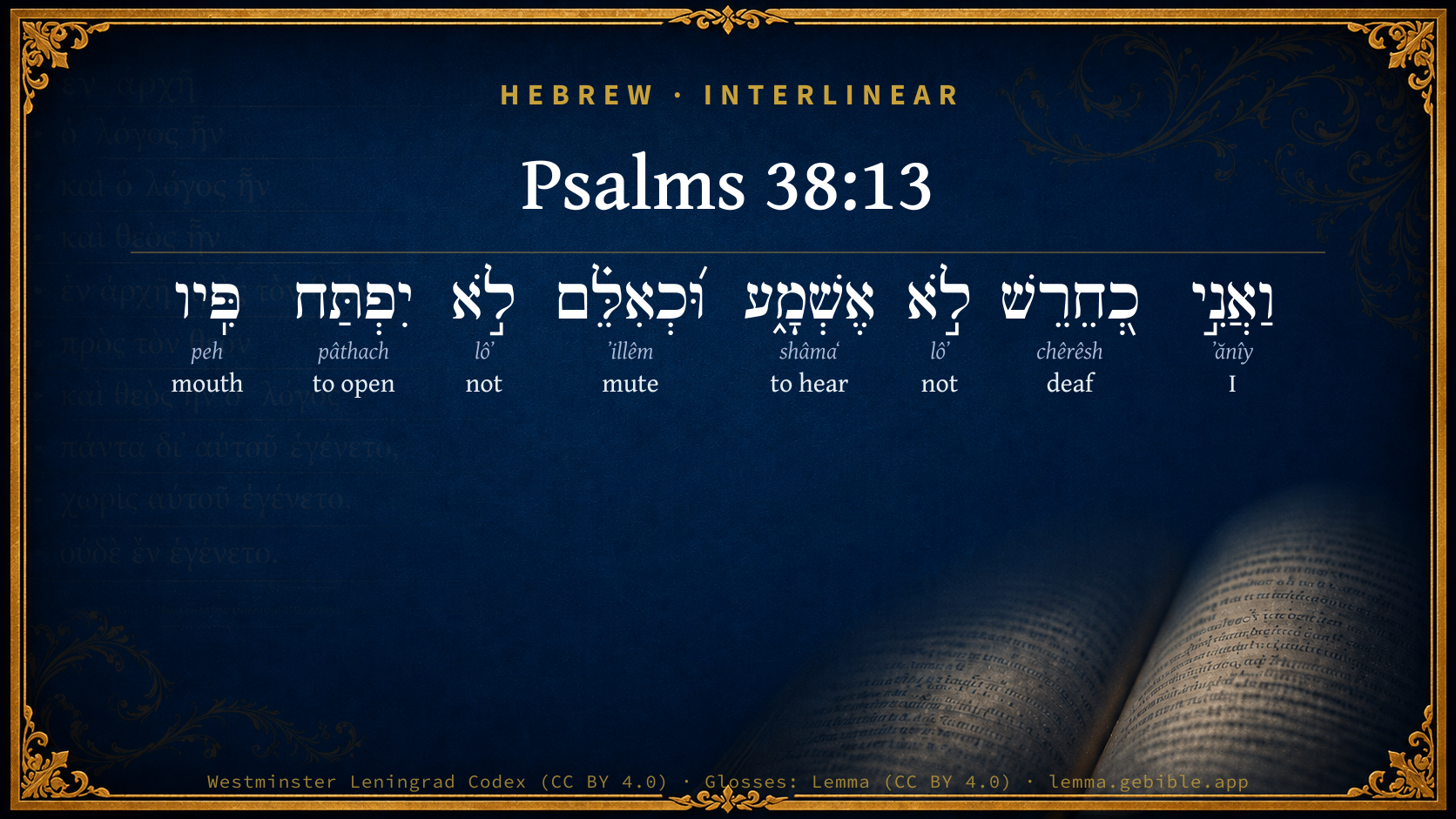
Psalms 38:13

Hebrew (Westminster Leningrad Codex) Psalms 38:13 appears in the Hebrew Old Testament. The text above is from the Westminster Leningrad Codex. Each word links to its Strong’s number, a concise gloss, and parsing drawn from the Open Scriptures Hebrew Bible morphology. Click any word for its full Brown-Driver-Briggs (BDB) entry.
Download image
Cite this verse

Psalms 38:13 (World English Bible). Public Domain. Lemma interlinear Bible study tool, https://lemma.gebible.app/v/psalms/38/13.

Show BibTeX & RIS
BibTeX
RIS
English Translation
But I, as a deaf man, don't hear. I am as a mute man who doesn't open his mouth.
World English Bible · Public Domain
Download a study sheet

One document with this verse’s original text, its word-by-word gloss line, the meaning frame, cross-references with their text, attributed commentary, and full source and license credits — printable, and it pastes into notes with its structure intact.

This verse Autodidact and up

Study sheet (.html) Plain text (.txt)

A passage Seminary Student

Up to 50 verses in one chapter. A passage sheet keeps up to 6 commentary sources and 12 cross-references per verse, in the order this page ranks them, and says so on the sheet whenever that leaves anything out. Ask for a single verse and you get the Autodidact verse sheet above.

Everything on this page stays free to read, with no account — the sheet is a download of what is already on screen, not access to it.

Want to remove ads? Support Godless Engineer
Compare translations 3

The same verse in 3 English versions, stacked beneath the original-language interlinear above. Click any original word for its lexicon entry.

Each is an independent rendering of the whole verse — the interlinear is not word-aligned to these translations.

Highlighted words mark where these versions differ — a whole-verse word diff, not a word-by-word alignment.

  • World English Bible Public Domain
    But I, as a deaf man, don't hear. I am as a mute man who doesn't open his mouth.
  • King James Version Public Domain
    But I, as a deaf man, heard not; and I was as a dumb man that openeth not his mouth.
  • unfoldingWord Literal Text CC BY-SA 4.0
    But I like a deaf man; I do not hear, and like a mute man—he does not open his mouth.

unfoldingWord Literal Text — © unfoldingWord, licensed CC BY-SA 4.0. Word-aligned USFM3 via Door43 (git.door43.org/unfoldingWord/en_ult).

Versions to compare (up to 4)

3 of 4 selected

Show all 18 translations

Every available English version of this verse, each an independent rendering of the whole verse.

  • World English Bible Public Domain
    But I, as a deaf man, don't hear. I am as a mute man who doesn't open his mouth.
  • Berean Standard Bible Public Domain
    But like a deaf man, I do not hear; and like a mute man, I do not open my mouth.
  • Majority Standard Bible Public Domain
    But like a deaf man, I do not hear; and like a mute man, I do not open my mouth.
  • King James Version Public Domain
    But I, as a deaf man, heard not; and I was as a dumb man that openeth not his mouth.
  • American Standard Version (1901) Public Domain
    But I, as a deaf man, hear not; And I am as a dumb man that openeth not his mouth.
  • Revised Version (1885) Public Domain
    But I, as a deaf man, hear not; and I am as a dumb man that openeth not his mouth.
  • Geneva Bible (1599) Public Domain
    But I as a deafe man heard not, and am as a dumme man, which openeth not his mouth.
  • Douay-Rheims (1899) Public Domain
    And they that sought my soul used violence. And they that sought evils to me spoke vain things, and studied deceits all the day long.
  • Young's Literal Translation Public Domain
    And I, as deaf, hear not. And as a dumb one who openeth not his mouth.
  • Literal Standard Version CC BY-SA 4.0
    And I, as deaf, do not hear. And as a mute one who does not open his mouth.
  • Unlocked Literal Bible CC BY-SA 4.0
    But I, I am like a deaf man and hear nothing; I am like a mute man who says nothing.
  • unfoldingWord Literal Text CC BY-SA 4.0
    But I like a deaf man; I do not hear, and like a mute man—he does not open his mouth.
  • Darby Bible Public Domain
    But I, as a deaf [man], hear not; and am as a dumb man that openeth not his mouth.
  • World Messianic Bible Public Domain
    But I, as a deaf man, don’t hear. I am as a mute man who doesn’t open his mouth.
  • Webster's Bible Public Domain
    \\38:12\\They also that seek after my life lay snares for me: and they that seek my hurt speak mischievous things, and imagine deceits all the day long.
  • Free Bible Version CC BY-SA 4.0
    I act as if I'm deaf to what they're saying, and pretend to be dumb so I don't have to speak.
  • Bible in Basic English Public Domain
    But I kept my ears shut like a man without hearing; like a man without a voice, never opening his mouth.
  • JPS Tanakh (1917) Public Domain
    (38-14) But I am as a deaf man, I hear not; and I am as a dumb man that openeth not his mouth.

Literal Standard Version (2020), Covenant Press — licensed CC BY-SA 4.0. Text via the HelloAO Bible API (eBible.org). Unlocked Literal Bible (unfoldingWord) — licensed CC BY-SA 4.0. Text via the HelloAO Bible API (eBible.org). unfoldingWord Literal Text — © unfoldingWord, licensed CC BY-SA 4.0. Word-aligned USFM3 via Door43 (git.door43.org/unfoldingWord/en_ult). Free Bible Version, Dr. Jonathan Gallagher — licensed CC BY-SA 4.0. Text via the HelloAO Bible API (eBible.org).

Word by word

More ways to search: Search by grammar → Find every occurrence → Compare this word →

Practice this passage: Drill this verse → Learn its vocabulary →

About this verse

These counts appear in no published source. They are computed here, from the morphology-tagged text and Lemma’s own curated glosses. What Lemma adds →

8
words
7
distinct lemmas
Wisdom
section

Notable vocabulary

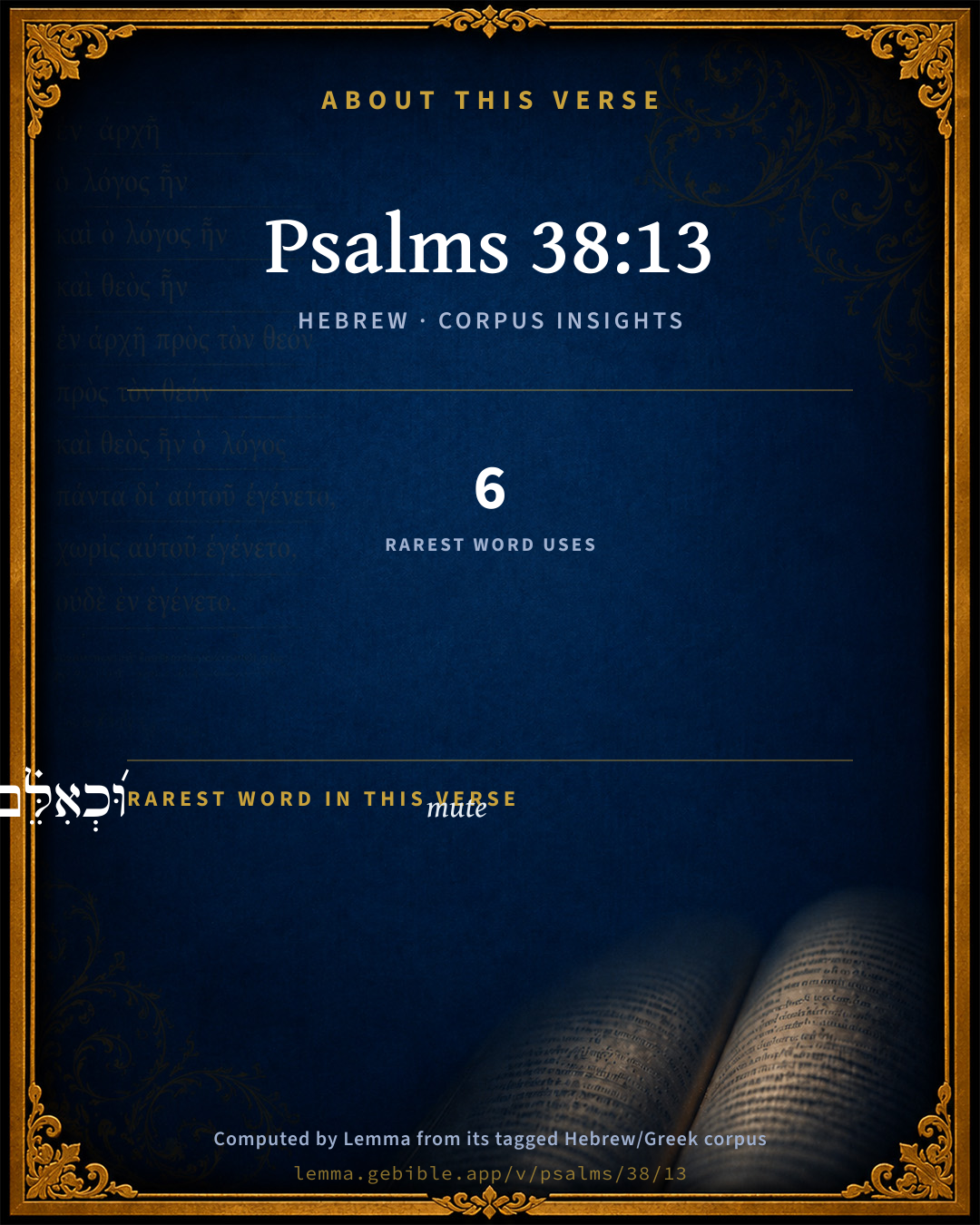
The rarest word here is וּ֝כְאִלֵּ֗ם mute H483 — appearing just 6 times in the whole Hebrew Bible.

Shared distinctive vocabulary

וּ֝כְאִלֵּ֗ם mute H483 occurs in 6 verses of the Hebrew Bible. Also found in:

Grammatical profile

  • 2 verbs
  • 1 noun
  • 2 adjectives
  • 1 pronoun
  • 2 particles

Verb forms

  • אֶשְׁמָ֑ע Qal · Imperfect
  • יִפְתַּח Qal · Imperfect

Repetition

A word recurs within this verse — often emphatic in Hebrew:

Hebrew & Septuagint length

In English translation the verse runs 19 words from the Hebrew and 18 from the Septuagint (LXX English) — closely comparable.

A rough comparison of the two English renderings, which tokenize alike — not a word-level alignment.

Word counts can differ between the Hebrew and the Greek without any difference in meaning — e.g. the Hebrew direct-object marker אֵת has no separate Greek word, and Greek often adds the article ὁ.

Cross-references

5

Topical passages linked to Psalms 38:13 in the Treasury of Scripture Knowledge — connected by theme and wording, ordered by reader-vote popularity; previews shown in the World English Bible.

  • Psalms 39:9 I was mute. I didn't open my mouth, Because you did it.
  • Isaiah 53:7 He was oppressed, yet when he was afflicted he didn't open his mouth; as a lamb that is led to the slaughter, and as a sheep that before its shearers is mute, so he didn't open his mouth.
  • Psalms 39:2 I was mute with silence. I held my peace, even from good. My sorrow was stirred.
  • 1 Peter 2:23 Who, when he was cursed, didn't curse back. When he suffered, didn't threaten, but committed himself to him who judges righteously;
  • 2 Samuel 16:10–12 The king said, What have I to do with you, you sons of Zeruiah? Because he curses, and because Yahweh has said to him, Curse David; who then shall say, Why have you done so?

Cross-references courtesy of OpenBible.info (CC BY 4.0).

Hebrew and Greek witnesses Masoretic Hebrew ↔ Greek Septuagint

The same verse in the two great witnesses to the Old Testament, shown verse-for-verse.

You’re reading Greek Psalm 37 (Hebrew Psalm 38). The Septuagint counts the superscription, so verse numbers can differ from the Hebrew — chapter-level alignment, not verse-by-verse. Numbering follows Rahlfs.

These are two independent witnesses, not word-aligned to each other, and the Septuagint is shown in lemma (dictionary) form.

Hebrew Psalms 38:13 Masoretic · Westminster Leningrad Codex

וַאֲנִ֣י כְ֭חֵרֵשׁ לֹ֣א אֶשְׁמָ֑ע וּ֝כְאִלֵּ֗ם לֹ֣א יִפְתַּח פִּֽיו

But I, as a deaf man, don't hear. I am as a mute man who doesn't open his mouth.

World English Bible · Public Domain

Greek LXX Greek Psalm 37:13 Septuagint · lemma form

καί ἐκβιάζω ὁ ζητέω ὁ ψυχή ἐγώ καί ὁ ζητέω ὁ κακός ἐγώ λαλέω ματαιότης καί δολιότης ὅλος ὁ ἡμέρα μελετάω

But I, as a deaf man, heard not; and was as a dumb man not opening his mouth.

LXX2012 (modern English Septuagint) · Public Domain

Hebrew: Westminster Leningrad Codex (CC BY 4.0). Greek: Septuagint (public domain); English from LXX2012 (modern English Septuagint) (Public Domain). How the Septuagint differs from the Hebrew →

Commentary

Notes on Psalms 38:13 from classic Christian and Jewish commentators (each source and its license shown beneath its notes). The classic Christian expositions comment on the surrounding passage and are grouped to its opening verse, so a note may address several verses; the Jewish commentaries on the Tanakh (Rashi and others) are per-verse, so they appear only where the commentator wrote on this verse.

Lemma curates 59 commentaries, every one of them public domain or Creative Commons licensed, each selected and text-cleaned for this edition rather than reprinted as found. About our sources →

Trapp's Complete Commentary

John Trapp

Psa 38:13 But I, as a deaf [man], heard not; and [I was] as a dumb man [that] openeth not his mouth.

Ver. 13. But I, as a deaf man, heard not] But possessed any soul in patience; in quietness and confidence was my strength, Isa 30:15. As they were masters of their tongues, so was I of mine ears. He that cannot bear calumnies, reproaches, and injuries, cannot live, saith Chytraeus; let him even make up his pack, and get him out of the world. Virus Theodorus sends to advise with Melancthon what to do when Osiander preached against him? Melancthon desired him for God’s sake to make no reply, but to behave himself as a deaf man, that heard not. Virus writeth back that this was very hard; yet he would obey. Another bravely answered one that railed upon him, Facile est in me dicere, cum non sim responsurus, Thou mayest speak what thou wilt, but I will hear no more than I wish, and punish thee with silence, or rather with a merry contempt. Princes use not to chide when ambassadors offer them indecencies, but to deny them audience. That man certainly enjoyeth a brave composedness who setteth himself above the flight of the injurious claw.

And I was as a dumb man, &c.] He answered them by silence and taciturnity; which is the best answer to words of scorn and petulance. Thus Isaac answered his brother Ishmael; and our Saviour Pilate, Herod, and Caiaphas; and Giles of Brussels, when the barking friars reviled him, held his peace continually; insomuch that those blasphemers would say abroad that he had a dumb devil in him. This is a great victory, not to render evil for evil, or railing for railing, 1Pe 3:9. Nihil fortius, nihil magis egregium quam audire noxia, et non respondere contraria, saith Cassiodore, Nothing is more courageous, or egregious, than to hear reproaches and return no answer. As, on the contrary, In rixa is inferior est qui victor est, In a brawl he goes by the worst that hath the better, saith Basil. And, Sile, et funestam dedisti plagam, saith Chrysostom, Say nothing in such a case, and thou thereby giveth thine adversary a deadly blow.

John Trapp, A Commentary or Exposition upon All the Books of the Old and New Testament (1647–1656) — public domain. Text from a community e-Sword module.

J. A. Alexander on Psalms

Joseph Addison Alexander

14. (Psa 38:13). And I, as a deaf (man), will not hear (or who heareth not), and as a dumb (man) will not open his mouth. This is at the same time an aggravation of his sufferings and a declaration of his patience under them. He is obliged to hear their calumnies and blasphemies as though he heard them not, being neither able to silence them nor willing to dispute them. The same two Hebrew words for deaf and dumb are used together in Exo 4:11. Not only the idea, but the form of expression in this sentence, is copied by Isaiah in his prophetical description of Christ's sufferings (Isa 53:7), and seems to have been present to our Saviour's own mind when he "held his peace" before the High Priest (Mat 26:62-63), and "gave no answer" to the Roman Governor (Joh 19:9).

Joseph Addison Alexander, The Psalms Translated and Explained (1850) — public domain. Text from a community e-Sword module.

Tyndale Open Study Notes

Tyndale Open Resources

38:13 The psalmist suffers quietly before his opponents (see Isa 53:7).

Tyndale Open Study Notes — © Tyndale Open Resources, licensed CC BY-SA 4.0. Text via the HelloAO Bible API.

Geneva Bible (1599)

Geneva Bible translators

For I can have no audience before men, and therefore patiently wait for the help of God.

Geneva Bible (1599) marginal notes — public domain. Text via Bolls.life.

Jamieson, Fausset & Brown

Robert Jamieson, A. R. Fausset & David Brown

He patiently submits, uttering no reproaches or replies (Joh 19:9) to their insulting speeches;

Jamieson, Fausset & Brown — Commentary Critical and Explanatory on the Whole Bible (1871) — public domain (CC PDM 1.0). Text via the HelloAO Bible API.

Adam Clarke's Commentary

Verse 13. But I, as a deaf man] I was conscious of my guilt, I could not vindicate myself; and I was obliged in silence to bear their insults.

Adam Clarke's Commentary on the Bible (1810–1826) — public domain. Text from a community e-Sword/MySword module.

John Calvin's Commentaries

13 But I, as a deaf man, hear not, etc. The inspired writer here compares himself to a dumb and deaf man, for two reasons. In the first place, he intimates that he was so overwhelmed with the false and wicked judgments of his enemies, that he was not even permitted to open his mouth in his own defense. In the second place, he alleges before God his own patience, as a plea to induce God the more readily to have pity upon him; for such meekness and gentleness, not only with good reason, secures favor to the afflicted and the innocent, but it is also a sign of true piety. Those who depend upon the world, and have respect only to men, if they cannot avenge the injuries that are done them, plainly show by their loud complaints the burning rage and fury of their hearts. In order, therefore, that a man may quietly and patiently endure the insolence, violence, calumny, and deceit of his enemies, it is necessary that he trust in God. The man who is fully persuaded in his own heart that God is his defender, will cherish his hope in silence, and, calling upon him for help, will lay a restraint upon his own passions. Accordingly, Paul, in Romans 12:19, very properly says, that we “give place unto wrath” when, oppressed before the world, we nevertheless still repose on God. On the other hand, whoever gives loose reins to his passions, takes away as much as he can from God, to whom alone it belongs, the right of taking vengeance, and deprives himself of his assistance. It is indeed certain, that if David had obtained a hearing, he would have been ready to defend his own innocence; but perceiving that it availed him nothing, nay, that he was shut out and debarred from all defense of his cause, he humbly submitted, waiting patiently for the heavenly Judge. He therefore says that he held his peace, as if he had already been convicted and struck dumb. And it is indeed very difficult, when we are conscious of our own innocence, patiently and silently to bear an unjust condemnation, as if all argument had failed us, and we had no excuse or reply left us.

John Calvin's Commentaries (1540-1563) — public domain. Text from the Calvin Translation Society English edition (1840s-50s) via the Christian Classics Ethereal Library (ccel.org). Calvin's coverage is partial (roughly two-thirds of the Bible); uncommented books and verses are honest gaps, never fabricated. The 19th-century editor's footnotes and remarks are omitted so the notes are faithfully Calvin's own voice.

The Cambridge Bible for Schools and Colleges

gen. ed. J. J. S. Perowne

13, 14. Conscious of guilt he must keep silence and commit his cause to God, resigned and patient as though he did not hear the insults, or had no power to answer them. Cp. Psa_39:9; Isa_53:7; 1Pe_2:23.

But I &c.] R.V. But I, as a deaf man, hear not; and I am as a dumb man, &c. He is describing his present situation.

The Cambridge Bible for Schools and Colleges (gen. ed. J. J. S. Perowne; Cambridge University Press, 1878–1918) — public domain. Text from a community e-Sword module.

John Gill's Exposition

Thus I was as a man that heareth not,.... Any thing that is said unto him; he took no more notice of it than if he had never heard it; but bore all the railings and calumnies of men with calmness and patience;

and in whose mouth are no reproofs; as if he had nothing to say for himself, in vindication of his character, and to the refutation of his enemies; as if he had no arguments to make use of, for the conviction and reproof of his adversaries.

John Gill's Exposition of the Whole Bible (1746–1763) — public domain (CC PDM 1.0). Text via the HelloAO Bible API.

Albert Barnes' Notes on the Bible

But I, as a deaf man, heard not - I was as if I had been deaf, and did not hear them or know what they were about. I took no notice of what they did anymore than if I had not heard them. That is, he did not reply to them; he did not become angry; he was as calm and patient as if they had said nothing.

And I was as a dumb man that openeth not his mouth - As if I were a man that could not speak. I was perfectly silent under all this persecution. Compare 2Sa 16:10. How eminently true was this of the Saviour! Isa 53:7; 1Pe 2:23; Mat 26:63; Mat 27:12, Mat 27:14.

Albert Barnes' Notes on the Bible (1834–1885) — public domain. Text from a community e-Sword/MySword module.

Matthew Poole's English Annotations

I carried myself towards them as if I had no ears to hear what they said either to me or for me, nor a tongue to answer or reprove them for their reproaches and calumnies; which he did not for, want of just answers to them, but to testify his humiliation for his sins, and his patient submission to and acceptation of the punishment which he had brought upon himself; of which see an instance, 2Sa 16:10-12; wherein also he was an eminent type of Christ, who, when he was reviled, reviled not again, 1Pe 2:23.

Matthew Poole's English Annotations on the Holy Bible (1683–1685) — public domain. Text from a community e-Sword/MySword module.

The Treasury of David

Charles H. Spurgeon

Ver. 13. But I, as a deaf man, heard not. Well and bravely was this done. A sacred indifference to the slanders of malevolence is true courage and wise policy. It is well to be as if we could not hear or see. Perhaps the psalmist means that this deafness on his part was unavoidable because he had no power to answer the taunts of the cruel, but felt much of the truth of their ungenerous accusations. And I was as a dumb man that openeth not his mouth. David was bravely silent, and herein was eminently typical of our Lord Jesus, whose marvellous silence before Pilate was far more eloquent than words. To abstain from self defence is often most difficult, and frequently most wise.

Ver. 13. But I, as a deaf man, heard not; and I was as a dumb man that openeth not his mouth. For why should I hear when I meant not to speak? and why should I speak when I knew beforehand I should not be heard? I knew by contesting I should but provoke them, and make them more guilty that were guilty too much before. I therefore thought it better myself to be silent than to set them a roaring and make them grow outrageous. No doubt a great wisdom in David, to know that to be deaf and dumb was in this case his best course, but yet a far greater virtue that knowing it, he was able to do it. Oh, how happy should we be, if we could always do that which we know is best to be done, and if our wills were as ready to act, as our reason is able to enact; we should then decline many rocks we now run upon, we should then avoid many errors we now run into. To be deaf and dumb are indeed great inabilities and defects, when they be natural; but when they be voluntary, and I may say artificial, they are them great abilities, or rather perfections. Sir Richard Baker.

Ver. 13. But I, as a deaf man, heard not. The inspired writer here compares himself to a dumb and deaf man for two reasons. In the first place, he intimates that he was so overwhelmed with the false and wicked judgments of his enemies, that he was not even permitted to open his mouth in his own defence. In the second place, he alleges before God his own patience, as a plea to induce God the more readily to have pity upon him; for such meekness and gentleness, not only with good reason, secures favour to the afflicted and the innocent, but it is also a sign of true piety. John Calvin.

Ver. 13. The wisdom, dignity, power, and difficulty of silence.

Psalms 38:14*

Charles H. Spurgeon's The Treasury of David (1869–1885) — public domain. Psalms only. Text from a community e-Sword/MySword module.

Whedon's Commentary on the Bible

Daniel D. Whedon

13. I, as a deaf man, heard not—His silence arose from a deep consciousness that the judgment was of God, on account of sin, and a firm belief that it could not proceed beyond the divine purpose.

Daniel D. Whedon (gen. ed.), Commentary on the Old and New Testaments (1874–1909) — public domain. Text from a community e-Sword module.

The Pulpit Commentary

But I, as a deaf man, heard not. I took no notice, i.e. I made as if I was deaf. And I was as a dumb man that openeth not his mouth. So far this psalmist, whether David or another, was a type of Christ. (see Isa_53:7 Mat_26:63 Mat_27:14 1Pe_2:23)

The Pulpit Commentary (1880–1919), ed. H.D.M. Spence-Jones & Joseph S. Exell — public domain. Text from a community e-Sword module.

John Wesley's Explanatory Notes

Dumb - Was silent, to testify his humiliation for his sins, and his acceptation of the punishment which he had brought upon himself.

John Wesley, Explanatory Notes Upon the Whole Bible (1754–1765) — public domain. Text via the GEBible commentary corpus.

unfoldingWord translationNotes

Door43 World Missions Community

I am like a deaf man ... hear nothing ... does not hear

The first lines of verse 13 and 14 use a simile to present the same image of the deaf man. The writer is so sick that he cannot hear. (See: Parallelism and Simile)

I am like a mute man ... says nothing ... has no reply

The second lines of verses 13 and 14 use a simile to present the image of the mute man. The writer is so sick that he cannot speak. (See: Parallelism and Simile)

a mute man

a person who cannot speak

unfoldingWord translationNotes — © Distant Shores Media and the Door43 World Missions Community, licensed CC BY-SA 4.0. Source: git.door43.org/Door43/en_tn.

Rashi

Rabbi Shlomo Yitzchaki (Rashi)

And those who seek my life lay traps They seek traps for me.

Rashi on the Tanakh — English translations: “The Judaica Press complete Tanach with Rashi, translated by A. J. Rosenberg” (CC BY 4.0); “Pentateuch with Rashi's commentary by M. Rosenbaum and A.M. Silbermann, 1929-1934” (public domain); “The Metsudah Tanach series, Lakewood, N.J” (CC BY 4.0); and “The Book of Joshua, Metsudah Publications, 1997” (CC BY 4.0). Text via Sefaria.

Lesson kit

Teaching starters — assembled from the data on this page, not authored interpretation. Every prompt links to the verse data it draws on. Edit before teaching.

Psalms, in the Wisdom, opens this verse with 8 words (7 distinct Hebrew lemmas). Its most distinctive word is ʼillêm (“mute”). A historical commentator’s framing appears above. Read the whole chapter for the surrounding context.

Discussion questions

  1. What does “mute” (ʼillêm) contribute to the verse as a whole?
  2. How does Exodus 4:11, which shares the word «mute», read alongside this verse?
  3. What does the repetition of “not” (2× in this one verse) do in this verse?
  4. These translations render this verse differently; the difference is in the English rendering, not the original. What questions does that raise?
  5. «אֶשְׁמָ֑ע» is a Qal Imperfect verb. How does that grammatical form shape the action described?
  6. Compare how Trapp's Complete Commentary and J. A. Alexander on Psalms read this verse. Where do they agree or differ?

Things to notice

Reading settings

Reading text

Shown beneath each verse's original-language words.

Old Testament
Old Testament edition

Read the OT as the Masoretic Hebrew (MT) or the Greek Septuagint (LXX).

English shown for the Greek Septuagint (in the Hebrew ↔ Greek comparison).

Comparing translations? Open the Compare panel on any verse page to stack up to four side by side.