

Revelation 9:21
Greek (Tischendorf 8th ed.) Revelation 9:21 appears in the Greek New Testament. The text above is from the Tischendorf 8th edition. Each word links to its Strong’s number and a concise gloss. Click any word for its full Thayer’s Greek Lexicon entry.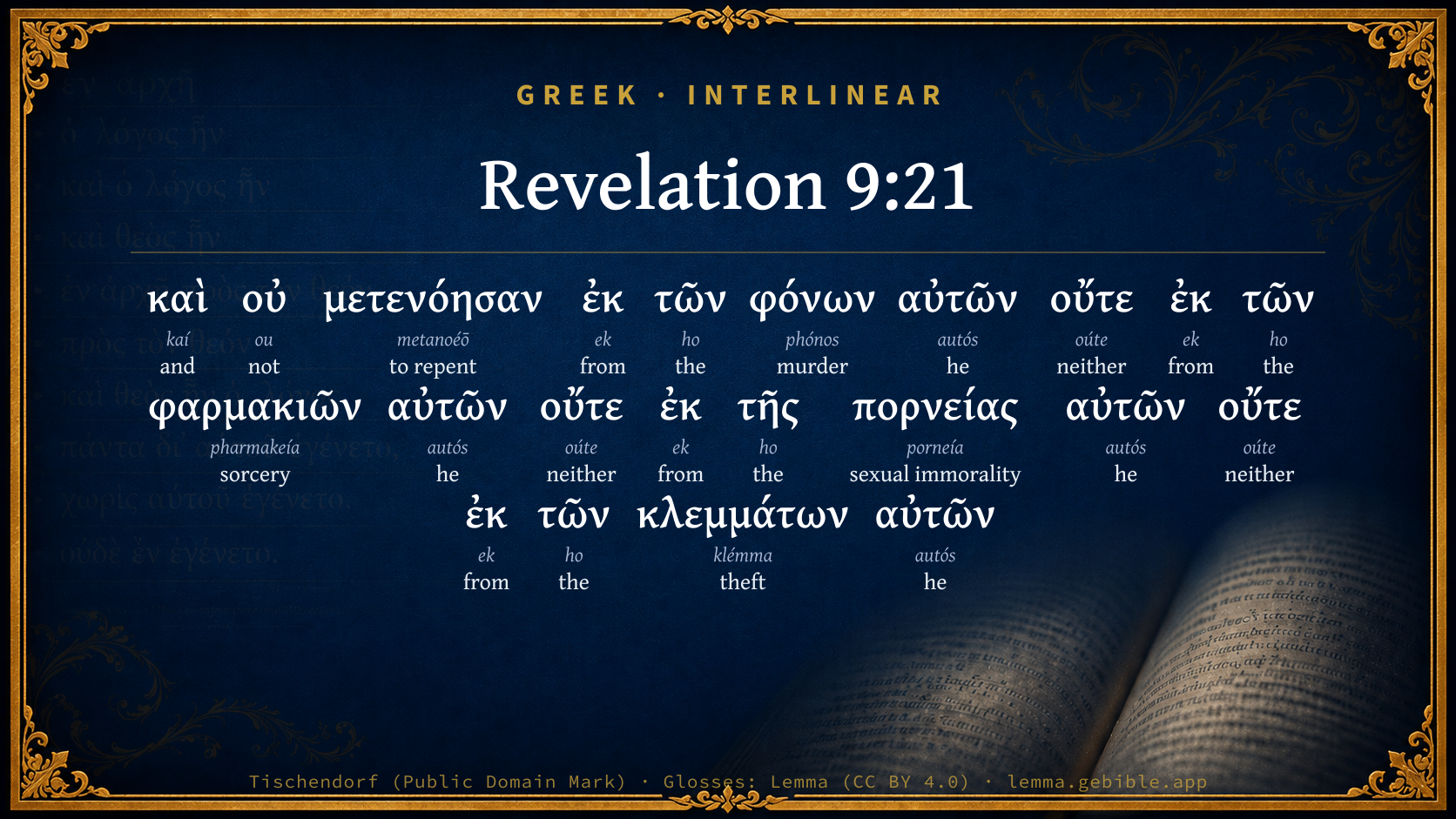
They didn't repent of their murders, nor of their sorceries, nor of their sexual immorality, nor of their thefts.
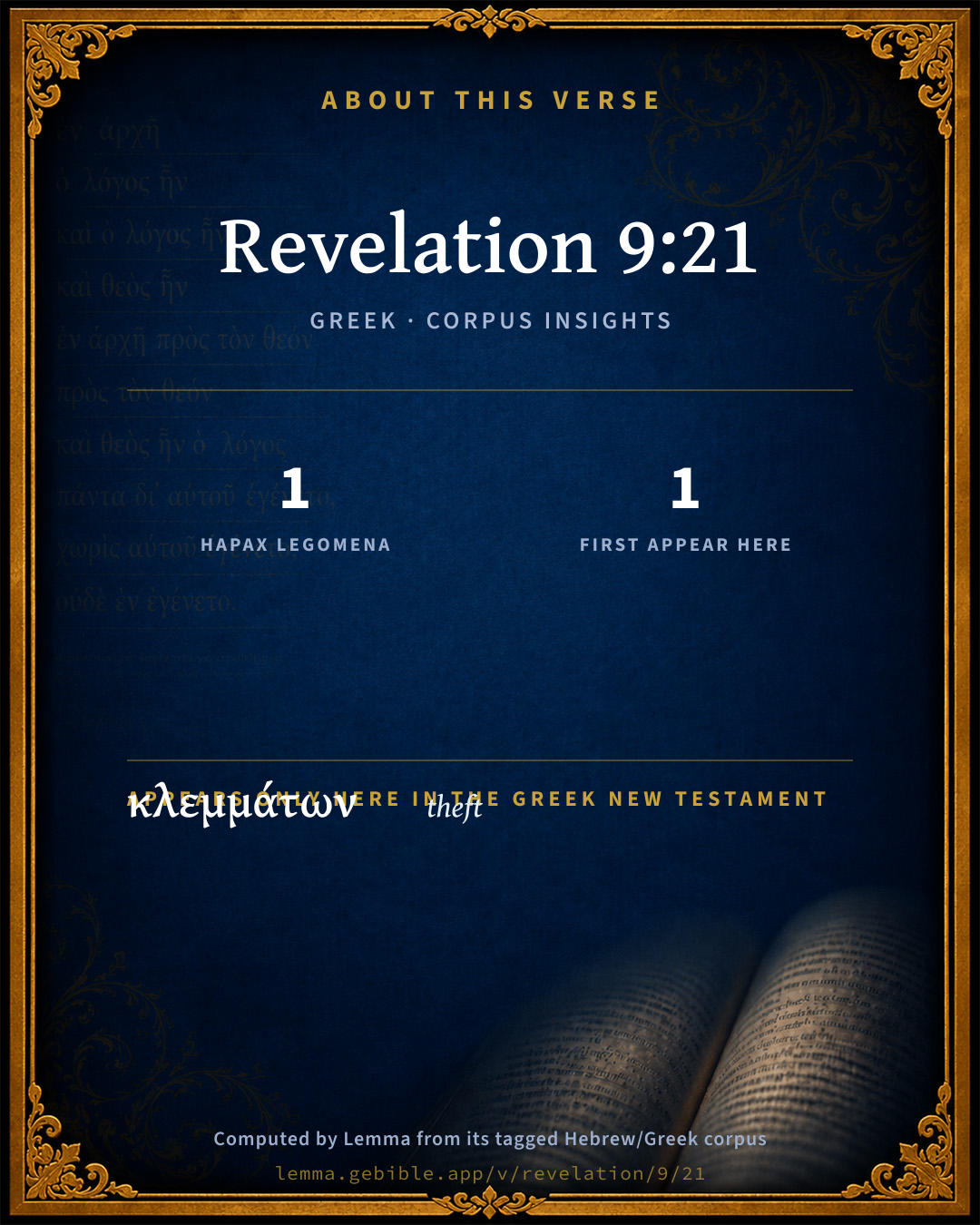
- 1 hapax legomenon — only here in the Greek New Testament
- 1 first appearance in the Greek New Testament
Download a study sheet
One document with this verse’s original text, its word-by-word gloss line, the meaning frame, cross-references with their text, attributed commentary, and full source and license credits — printable, and it pastes into notes with its structure intact.
This verse Autodidact and up
A passage Seminary Student
Up to 50 verses in one chapter. A passage sheet keeps up to 6 commentary sources and 12 cross-references per verse, in the order this page ranks them, and says so on the sheet whenever that leaves anything out. Ask for a single verse and you get the Autodidact verse sheet above.
Everything on this page stays free to read, with no account — the sheet is a download of what is already on screen, not access to it.
Compare translations 3
The same verse in 3 English versions, stacked beneath the original-language interlinear above. Click any original word for its lexicon entry.
Each is an independent rendering of the whole verse — the interlinear is not word-aligned to these translations.
Highlighted words mark where these versions differ — a whole-verse word diff, not a word-by-word alignment.
-
World English Bible Public Domain
They didn't repent of their murders, nor of their sorceries, nor of their sexual immorality, nor of their thefts.
-
King James Version Public Domain
Neither repented they of their murders, nor of their sorceries, nor of their fornication, nor of their thefts.
-
unfoldingWord Literal Text CC BY-SA 4.0
And they did not repent of their murders, nor of their sorceries, nor of their sexual immorality, nor of their thefts.
unfoldingWord Literal Text — © unfoldingWord, licensed CC BY-SA 4.0. Word-aligned USFM3 via Door43 (git.door43.org/unfoldingWord/en_ult).
Show all 19 translations
Every available English version of this verse, each an independent rendering of the whole verse.
-
World English Bible Public Domain
They didn't repent of their murders, nor of their sorceries, nor of their sexual immorality, nor of their thefts.
-
Berean Standard Bible Public Domain
Furthermore, they did not repent of their murder, sorcery, sexual immorality, and theft.
-
Majority Standard Bible Public Domain
Furthermore, they did not repent of their murder, sorcery, sexual immorality, and theft.
-
King James Version Public Domain
Neither repented they of their murders, nor of their sorceries, nor of their fornication, nor of their thefts.
-
American Standard Version (1901) Public Domain
and they repented not of their murders, nor of their sorceries, nor of their fornication, nor of their thefts.
-
Revised Version (1885) Public Domain
and they repented not of their murders, nor of their sorceries, nor of their fornication, nor of their thefts.
-
Geneva Bible (1599) Public Domain
Also they repented not of their murder, and of their sorcerie, neither of their fornication, nor of their theft.
-
Douay-Rheims (1899) Public Domain
Neither did they penance from their murders, nor from their sorceries, nor from their fornication, nor from their thefts.
-
Young's Literal Translation Public Domain
yea they did not reform from their murders, nor from their sorceries, nor from their whoredoms, nor from their thefts.
-
Literal Standard Version CC BY-SA 4.0
and they did not convert from their murders, nor from their sorceries, nor from their whoredoms, nor from their thefts.
-
Unlocked Literal Bible CC BY-SA 4.0
Neither did they repent of their murders, their sorcery, their sexual immorality or their acts of theft.
-
unfoldingWord Literal Text CC BY-SA 4.0
And they did not repent of their murders, nor of their sorceries, nor of their sexual immorality, nor of their thefts.
-
Darby Bible Public Domain
And they repented not of their murders, nor of their witchcrafts, nor of their fornication, nor of their thefts.
-
World Messianic Bible Public Domain
They didn’t repent of their murders, their sorceries, their sexual immorality, or their thefts.
-
Webster's Bible Public Domain
Neither repented they of their murders, nor of their sorceries, nor of their lewdness, nor of their thefts.
-
Free Bible Version CC BY-SA 4.0
They did not repent of their murders, their witchcraft, their sexual sins, or their thefts.
-
Bible in Basic English Public Domain
And they had no regret for putting men to death, or for their use of secret arts, or for the evil desires of the flesh, or for taking the property of others.
-
Text-Critical English NT CC BY 4.0
Nor did they repent of their murders, sorceries, fornication, or thefts.
-
Tyndale New Testament (1534) Public Domain
Also they repented not of their murther and of their sorcery nether of their fornacion nether of their thefte.
Literal Standard Version (2020), Covenant Press — licensed CC BY-SA 4.0. Text via the HelloAO Bible API (eBible.org). Unlocked Literal Bible (unfoldingWord) — licensed CC BY-SA 4.0. Text via the HelloAO Bible API (eBible.org). unfoldingWord Literal Text — © unfoldingWord, licensed CC BY-SA 4.0. Word-aligned USFM3 via Door43 (git.door43.org/unfoldingWord/en_ult). Free Bible Version, Dr. Jonathan Gallagher — licensed CC BY-SA 4.0. Text via the HelloAO Bible API (eBible.org).
Word by word
More ways to search: Search by grammar → Find every occurrence → Compare this word →
Practice this passage: Drill this verse → Learn its vocabulary →
- Appears 1× in the Greek New Testament
- First appears here
- Part of Speech
- Noun
- Case
- Genitive
- Number
- Plural
- Gender
- Neuter
Full Thayer's Definition
- καὶ kaí G2532 “and” Conjunction
- οὐ ou G3756 “not” Particle, Negative
- μετενόησαν metanoéō G3340 “to repent” Verb, Aorist, Active, Indicative, 3rd person, Plural
- ἐκ ek G1537 “from” Preposition
- τῶν ho G3588 “the” Article, Genitive, Plural, Masculine
- φόνων phónos G5408 “murder” Noun, Genitive, Plural, Masculine
- αὐτῶν autós G846 “he” Personal pronoun, Genitive, Plural, Masculine
- οὔτε oúte G3777 “neither” Conjunction, Negative
- ἐκ ek G1537 “from” Preposition
- τῶν ho G3588 “the” Article, Genitive, Plural, Feminine
- φαρμακιῶν pharmakeía G5331 “sorcery” Noun, Genitive, Plural, Feminine
- αὐτῶν autós G846 “he” Personal pronoun, Genitive, Plural, Masculine
- οὔτε oúte G3777 “neither” Conjunction, Negative
- ἐκ ek G1537 “from” Preposition
- τῆς ho G3588 “the” Article, Genitive, Singular, Feminine
- πορνείας porneía G4202 “sexual immorality” Noun, Genitive, Singular, Feminine
- αὐτῶν autós G846 “he” Personal pronoun, Genitive, Plural, Masculine
- οὔτε oúte G3777 “neither” Conjunction, Negative
- ἐκ ek G1537 “from” Preposition
- τῶν ho G3588 “the” Article, Genitive, Plural, Neuter
- κλεμμάτων klémma G2809 “theft” Noun, Genitive, Plural, Neuter
- αὐτῶν autós G846 “he” Personal pronoun, Genitive, Plural, Masculine
About this verse
These counts appear in no published source. They are computed here, from the morphology-tagged text and Lemma’s own curated glosses. What Lemma adds →
- 22
- words
- 11
- distinct lemmas
- Revelation
- section
Notable vocabulary
1 hapax legomenon — a word that appears only here in the entire Greek New Testament:
- κλεμμάτων theft G2809
First appearance in Scripture
This word makes its first canonical appearance in the Greek New Testament here:
- κλεμμάτων theft G2809
Shared distinctive vocabulary
φαρμακιῶν sorcery G5331 occurs in 3 verses of the Greek New Testament. Also found in:
Cross-references
22Topical passages linked to Revelation 9:21 in the Treasury of Scripture Knowledge — connected by theme and wording, ordered by reader-vote popularity; previews shown in the World English Bible.
- Revelation 21:8 But for the cowardly, unbelieving, sinners, abominable, murderers, sexually immoral, sorcerers, idolaters, and all liars, their part is in the lake that burns with fire and sulfur, which is the second death."
- 2 Corinthians 12:21 that again when I come my God would humble me before you, and I would mourn for many of those who have sinned before now, and not repented of the uncleanness and sexual immorality and lustfulness which they committed.
- Revelation 17:5 And on her forehead a name was written, "MYSTERY, BABYLON THE GREAT, THE MOTHER OF THE PROSTITUTES AND OF THE ABOMINATIONS OF THE EARTH."
- Revelation 22:15 Outside are the dogs, the sorcerers, the sexually immoral, the murderers, the idolaters, and everyone who loves and practices falsehood.
- Revelation 17:2 with whom the kings of the earth committed sexual immorality, and those who dwell in the earth were made drunken with the wine of her sexual immorality."
- Isaiah 47:9 but these two things shall come to you in a moment in one day, the loss of children, and widowhood; in their full measure shall they come on you, in the multitude of your sorceries, and the great abundance of your enchantments.
- Revelation 18:3 For all the nations have drunk of the wine of the wrath of her sexual immorality, the kings of the earth committed sexual immorality with her, and the merchants of the earth grew rich from the abundance of her luxury."
- Revelation 18:23–24 The light of a lamp will shine no more at all in you. The voice of the bridegroom and of the bride will be heard no more at all in you; for your merchants were the princes of the earth; for with your sorcery all the nations were deceived.
- Isaiah 47:12 Stand now with your enchantments, and with the multitude of your sorceries, in which you have labored from your youth; if so be you shall be able to profit, if so be you may prevail.
- Isaiah 57:3 But draw near here, you sons of the sorceress, the seed of the adulterer and the prostitute.
- Galatians 5:20 idolatry, sorcery, hatred, strife, jealousies, outbursts of anger, rivalries, divisions, heresies,
- Revelation 14:8 Another, a second angel, followed, saying, "Babylon the great has fallen, which has made all the nations to drink of the wine of the wrath of her sexual immorality."
- Revelation 16:6 For they poured out the blood of the saints and the prophets, and you have given them blood to drink. They deserve this."
- Daniel 7:21–25 I saw, and the same horn made war with the saints, and prevailed against them;
- Daniel 11:33 Those who are wise among the people shall instruct many; yet they shall fall by the sword and by flame, by captivity and by spoil, [many] days.
- Malachi 3:5 I will come near to you to judgment; and I will be a swift witness against the sorcerers, and against the adulterers, and against the perjurers, and against those who oppress the hireling in his wages, the widow, and the fatherless, and who deprive the foreigner of justice, and don't fear me," says Yahweh of Hosts.
- Matthew 15:19 For out of the heart come forth evil thoughts, murders, adulteries, sexual sins, thefts, false testimony, and blasphemies.
- Revelation 11:7–9 When they have finished their testimony, the beast that comes up out of the abyss will make war with them, and overcome them, and kill them.
- Revelation 13:15 It was given to him to give breath to it, to the image of the beast, that the image of the beast should both speak, and cause as many as wouldn't worship the image of the beast to be killed.
- Revelation 19:2 for true and righteous are his judgments. For he has judged the great prostitute, who corrupted the earth with her sexual immorality, and he has avenged the blood of his servants at her hand."
- Revelation 13:7 It was given to him to make war with the saints, and to overcome them. Authority over every tribe, people, language, and nation was given to him.
- Revelation 13:13 He performs great signs, even making fire come down out of the sky to the earth in the sight of people.
Cross-references courtesy of OpenBible.info (CC BY 4.0).
Lesson kit
Teaching starters — assembled from the data on this page, not authored interpretation. Every prompt links to the verse data it draws on. Edit before teaching.
Revelation, in the Revelation, opens this verse with 22 words (11 distinct Greek lemmas). Its most distinctive word is klémma (“theft”). A historical commentator’s framing appears above. Read the whole chapter for the surrounding context.
Discussion questions
- The word klémma carries the sense “theft.” How does it shape the verse?
- 1 word here appears nowhere else in the Greek New Testament. Why might the author reach for such rare wording?
- This is the first place “theft” appears in Scripture (first appears here). What does its debut here establish?
- How does Galatians 5:20, which shares the word «sorcery», read alongside this verse?
- What does the repetition of “neither” (3× in this one verse) do in this verse?
- The translations on this page render this verse differently — a whole-verse word diff, not a word-by-word alignment. What might account for the different wordings?
- Compare how Meyer's Critical & Exegetical Commentary and Jamieson, Fausset & Brown read this verse. Where do they agree or differ?
Things to notice
- 1 word in this verse appears nowhere else in the Greek New Testament.
- 1 word makes its first canonical appearance in Scripture here.
- These translations choose different wording for 8 words in this verse.
- “neither” occurs 3× in this single verse.
- 11 distinct Greek lemmas span 22 words in this verse.
Commentary
Notes on Revelation 9:21 from classic Christian and Jewish commentators (each source and its license shown beneath its notes). The classic Christian expositions comment on the surrounding passage and are grouped to its opening verse, so a note may address several verses; the Jewish commentaries on the Tanakh (Rashi and others) are per-verse, so they appear only where the commentator wrote on this verse.
Lemma curates 59 commentaries, every one of them public domain or Creative Commons licensed, each selected and text-cleaned for this edition rather than reprinted as found. About our sources →
Meyer's Critical & Exegetical Commentary
Heinrich August Wilhelm Meyer
Meyer — Critical and Exegetical Commentary on the New Testament — English translation by Peter Christie, edited by Frederick Crombie (T&T Clark, 1880) — public domain. Text from a community e-Sword module.
Jamieson, Fausset & Brown
Robert Jamieson, A. R. Fausset & David Brown
Jamieson, Fausset & Brown — Commentary Critical and Explanatory on the Whole Bible (1871) — public domain (CC PDM 1.0). Text via the HelloAO Bible API.
Adam Clarke's Commentary
Adam Clarke's Commentary on the Bible (1810–1826) — public domain. Text from a community e-Sword/MySword module.
The Cambridge Bible for Schools and Colleges
gen. ed. J. J. S. Perowne
The Cambridge Bible for Schools and Colleges (gen. ed. J. J. S. Perowne; Cambridge University Press, 1878–1918) — public domain. Text from a community e-Sword module.
John Gill's Exposition
John Gill's Exposition of the Whole Bible (1746–1763) — public domain (CC PDM 1.0). Text via the HelloAO Bible API.
Trapp's Complete Commentary
John Trapp
John Trapp, A Commentary or Exposition upon All the Books of the Old and New Testament (1647–1656) — public domain. Text from a community e-Sword module.
Matthew Poole's English Annotations
Matthew Poole's English Annotations on the Holy Bible (1683–1685) — public domain. Text from a community e-Sword/MySword module.
Whedon's Commentary on the Bible
Daniel D. Whedon
Daniel D. Whedon (gen. ed.), Commentary on the Old and New Testaments (1874–1909) — public domain. Text from a community e-Sword module.
The Pulpit Commentary
The Pulpit Commentary (1880–1919), ed. H.D.M. Spence-Jones & Joseph S. Exell — public domain. Text from a community e-Sword module.
John Wesley's Explanatory Notes
John Wesley, Explanatory Notes Upon the Whole Bible (1754–1765) — public domain. Text via the GEBible commentary corpus.
The People's New Testament
B. W. Johnson
B. W. Johnson's The People's New Testament with Notes (1889–1891) — public domain. Electronic text from the Christian Classics Ethereal Library (CCEL) ThML edition.
Cambridge Greek Testament for Schools and Colleges
Cambridge Greek Testament for Schools and Colleges (Cambridge University Press, 1896; 21 vols, various authors incl. Carr, Maclear, Plummer, Farrar, Lumby, Moule, M. R. James, Simcox) — public domain. Text from a community e-Sword module.
Vincent's Word Studies in the New Testament
Marvin R. Vincent
Marvin R. Vincent, Word Studies in the New Testament (1887–1900) — public domain. Text from a community e-Sword/MySword module.