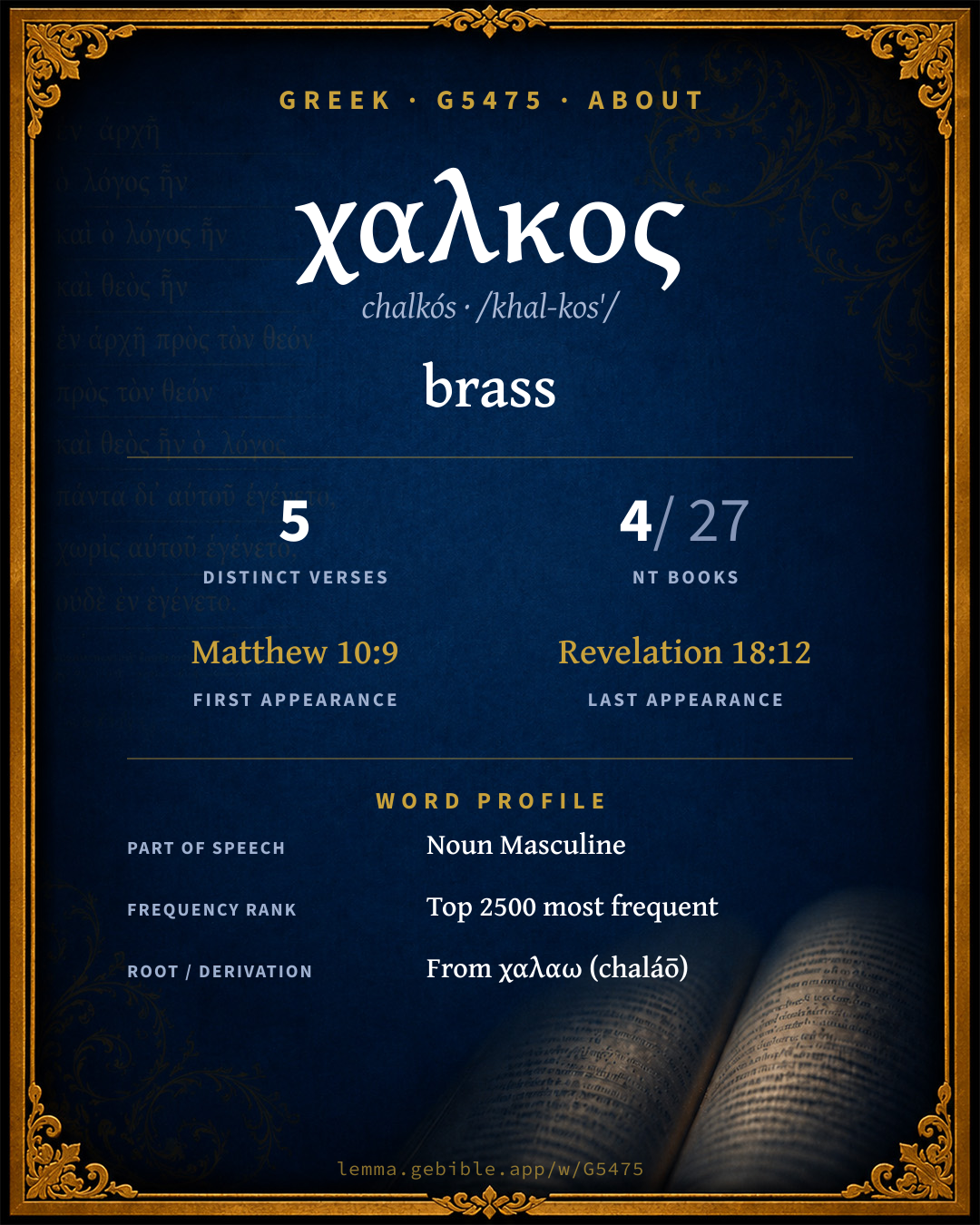
χαλκός
brass
‘brass’ is one of 2 main senses fuller range ↓
Full lexicon entry — Thayer's Greek Lexicon
From Thayer's Greek Lexicon
Where this word appears
See every Accusative-case word in the Greek New Testament →
Grammar key — what these labels mean
Part of speech
- Noun
- A naming word — a person, place, thing, or idea.
Case
- Accusative
- The case of the direct object and of extent.
- Genitive
- The case of source, possession, or “of” — answers “whose / from what.”
- Nominative
- The case of the subject (and the predicate nominative).
Gender
- Masculine
- Grammatically masculine.
Number
- Singular
- One.
Grammatical forms
- Noun, Accusative, Singular, Masculine 3 times (60%)
- Noun, Genitive, Singular, Masculine 1 time (20%)
- Noun, Nominative, Singular, Masculine 1 time (20%)
Parsed forms decoded from the imported morphology (Robinson–Tischendorf, public domain), counted across 5 parsed occurrences — not distinct verses.
Every verse where G5475 appears — 5 distinct verses across 4 books. Click any verse to open its interlinear word-by-word view. Verse text shown in the World English Bible for context — . Each verse’s Greek form is shown with its reference; the English is not keyword-highlighted, since the data carries no word-level English alignment. Use “Compare translations” on any verse to read it across multiple English versions. This concordance covers the Greek New Testament; Septuagint (Greek Old Testament) occurrences of this word are not indexed here.
Matthew 1 verse
Mark 2 verses
- Mark 6:8 χαλκόν n acc sg masc He charged them that they should take nothing for their journey, except a staff only: no bread, no wallet, no money in their purse,
- Mark 12:41 χαλκὸν n acc sg masc Jesus sat down opposite the treasury, and saw how the multitude cast money into the treasury. Many who were rich cast in much.
1 Corinthians 1 verse
Revelation 1 verse
About this entry
At a glance — auto-summarized from this page’s data, not written by a person. Every figure links to its source below. This summary describes the numbers; it doesn’t interpret them.
“brass” is the headline sense of the Greek noun χαλκος (chalkós). The Greek New Testament uses it only 5 verses. More than a third of its appearances fall in Mark. Scripture first uses it in Matthew 10:9. Catalogued under 2 senses, its meaning is not single-sense. The sections below give every sense, occurrence, and version rendering.
Gloss history
Strong's 1890 vs modern scholarship
About this word
Strong's G5475 catalogs a Greek word from the Greek New Testament.
These counts are not copied from any lexicon or concordance. They are computed here, from the morphology-tagged Greek New Testament. What Lemma adds →
- 5
- distinct verses
- The word appears in 5 distinct verses.
- 4 / 27
- NT books
- The word appears in 4 of 27 New Testament books.
- #1,648
- by frequency
- Top 2500 most frequent Greek words (rank 1,648 of 5,347 Greek words by occurrence).
View all 5 occurrences in the concordance →
Most concentrated in
- Mark 2 verses 40%
- Matthew 1 verse 20%
- 1 Corinthians 1 verse 20%
By section of the New Testament
By traditional corpus
Conventional, traditional groupings — biblical authorship is debated, so this is a traditional corpus grouping, not an authorship claim. Some books belong to more than one corpus (Luke is in both the Gospels and the Lukan corpus, and so on), so these shares overlap and need not total 100%. Each figure is a share of the word’s 5 distinct verses.
- Gospels 3 verses · 60%
- Johannine 1 verse · 20%
- Pauline corpus 1 verse · 20%
- Revelation 1 verse · 20%
How translations render this word
Counts come from each version’s own published word-to-Strong’s tagging or interlinear alignment — an approximate guide to how each version renders this word, not a word-level alignment the data otherwise carries. Because each total is that version’s own tagged count, the per-version totals vary from one another and need not match the appearance or distinct-verse counts above. These counts may also differ from a printed concordance because Lemma counts each distinctly tagged rendering and does not collapse phrase taggings into a single head-word total. This is a fixed set of word-tagged versions (KJV, ASV, BSB, ULT) and does not change with the reading translation you choose elsewhere. Each version’s license is shown beside its name below (and on Sources).
- King James Version: Brass 3×, Money 2×
- American Standard Version: Brass 3×, Money 2×
- Berean Standard Bible: Money 2×
- unfoldingWord Literal Text: Money 2×
King James Version Public Domain
Renders G5475 across 5 tagged occurrences — most commonly:
American Standard Version Public Domain
Renders G5475 across 5 tagged occurrences — most commonly:
Berean Standard Bible Public Domain
Renders G5475 across 5 tagged occurrences — most commonly:
Plus 3 renderings that appear only once — usually multi-word phrases or single function words the recovered tagging swept in, not distinct renderings.
unfoldingWord Literal Text CC BY-SA 4.0
Renders G5475 across 6 tagged occurrences — most commonly:
Plus 4 renderings that appear only once — usually multi-word phrases or single function words the recovered tagging swept in, not distinct renderings.
Senses in Thayer's
The 2 senses Thayer's distinguishes for this word, in lexicon order (not ranked by frequency or importance). The full entry — with sub-senses — is in the Lexicon Entry tab.
- brass
- what is made of brass, money, coins of brass (also of silver and gold)
Word origin
Derived from χαλαω (chaláō) (G5465) — to relax.
Perhaps from G5465 through the idea of hollowing out as a vessel (this metal being chiefly used for that purpose); copper (the substance or some implement or coin made of it): - brass money.
— Strong’s Exhaustive Concordance (1890), public domain.
Forms in the corpus
The 4 distinct written forms G5475 takes in the Greek New Testament, most frequent first — each parse links to that case’s occurrences in the concordance.
| Form | Parsing | Example | Uses |
|---|---|---|---|
| χαλκὸν chalkòn | Noun, Accusative, Singular, Masculine | Matthew 10:9 | 2 |
| χαλκοῦ chalkoû | Noun, Genitive, Singular, Masculine | Revelation 18:12 | 1 |
| χαλκόν chalkón | Noun, Accusative, Singular, Masculine | Mark 6:8 | 1 |
| χαλκὸς chalkòs | Noun, Nominative, Singular, Masculine | 1 Corinthians 13:1 | 1 |
Same root — word family
Other Thayer's entries built from the same root as G5475, grouped by Strong’s listed origin. These share a root / origin per the lexicon — not necessarily a shared meaning. Each links to that word’s own entry.
Derives from
Shares the same root
Derived from this word
- χαλκεος chálkeos G5470 brazen
- χαλκευς chalkeús G5471 smith
- χαλκηδων chalkēdṓn G5472 chalcedony
- χαλκιον chalkíon G5473 bronze vessel
- χαλκολιβανον chalkolíbanon G5474 precious metal
Compare all same-root words → Showing 4 of 10 — not the complete family. They share a root, not necessarily a meaning.
Septuagint usage
The same Greek word χαλκος appears 33 times in the Greek Old Testament (Septuagint), across 32 verses in 15 books.
- 33
- LXX occurrences
- Tagged occurrences of this Greek word in the Septuagint.
- 32
- verses
- Distinct Septuagint verses containing this word.
- 15 / 39
- OT books
- The word appears in 15 of the 39 Old Testament books.
Sample Septuagint occurrences
- Genesis 4:22 χαλκός
- Exodus 25:3 χαλκός
- Leviticus 6:21 χαλκός
- Numbers 31:22 χαλκός
- Deuteronomy 8:9 χαλκός
- Joshua 6:19 χαλκός
- 2 Samuel 8:8 χαλκός
- 2 Kings 25:13 χαλκός
- 1 Chronicles 18:8 χαλκός
- Job 28:2 χαλκός
- Isaiah 60:17 χαλκός
- Jeremiah 6:28 χαλκός
Septuagint occurrences (same lexeme)
Every verse where the same Strong’s number (G5475) appears in the Greek Septuagint. Verse text shown in the World English Bible for context; the Greek form is the matched word — the English is not keyword-highlighted.
- Genesis 4:22 χαλκός Zillah also gave birth to Tubal Cain, the forger of every cutting instrument of brass and iron. Tubal Cain's sister was Naamah.
- Exodus 25:3 χαλκός This is the offering which you shall take from them: gold, silver, brass,
- Exodus 31:4 χαλκός to devise skillful works, to work in gold, and in silver, and in brass,
- Exodus 35:5 χαλκός 'Take from among you an offering to Yahweh. Whoever is of a willing heart, let him bring it, Yahweh's offering: gold, silver, brass,
- Exodus 35:24 χαλκός Everyone who did offer an offering of silver and brass brought Yahweh's offering; and everyone, with whom was found acacia wood for any work of the service, brought it.
- Exodus 35:32 χαλκός and to make skillful works, to work in gold, in silver, in brass,
- Exodus 39:6 χαλκός They worked the onyx stones, enclosed in settings of gold, engraved with the engravings of a signet, according to the names of the children of Israel.
- Leviticus 6:21 χαλκός It shall be made with oil in a baking pan. When it is soaked, you shall bring it in. You shall offer the meal offering in baked pieces for a sweet savor to Yahweh.
- Numbers 31:22 χαλκός however the gold, and the silver, the brass, the iron, the tin, and the lead,
- Deuteronomy 8:9 χαλκός a land in which you shall eat bread without scarceness, you shall not lack anything in it; a land whose stones are iron, and out of whose hills you may dig copper.
- Deuteronomy 33:25 χαλκός Your bars shall be iron and brass; As your days, so shall your strength be.
- Joshua 6:19 χαλκός But all the silver, and gold, and vessels of brass and iron, are holy to Yahweh: they shall come into the treasury of Yahweh.
- Joshua 6:24 χαλκός They burnt the city with fire, and all that was therein; only the silver, and the gold, and the vessels of brass and of iron, they put into the treasury of the house of Yahweh.
- 2 Samuel 8:8 χαλκός From Betah and from Berothai, cities of Hadadezer, king David took exceeding much brass.
- 2 Kings 25:13 χαλκός The pillars of brass that were in the house of Yahweh, and the bases and the brazen sea that were in the house of Yahweh, did the Chaldeans break in pieces, and carried the brass of them to Babylon.
- 1 Chronicles 18:8 χαλκός From Tibhath and from Cun, cities of Hadarezer, David took very much brass, with which Solomon made the brazen sea, and the pillars, and the vessels of brass.
- 1 Chronicles 22:3 χαλκός David prepared iron in abundance for the nails for the doors of the gates, and for the couplings; and brass in abundance without weight;
- 1 Chronicles 22:14 χαλκός Now, behold, in my affliction I have prepared for the house of Yahweh one hundred thousand talents of gold, and one thousand thousand talents of silver, and of brass and iron without weight; for it is in abundance: timber also and stone have I prepared; and you may add to them.
- 1 Chronicles 29:2 χαλκός Now I have prepared with all my might for the house of my God the gold for the [things of] gold, and the silver for the [things of] silver, and the brass for the [things of] brass, the iron for the [things of] iron, and wood for the [things of] wood; onyx stones, and [stones] to be set, stones for inlaid work, and of various colors, and all manner of precious stones, and marble stones in abundance.
- Job 28:2 χαλκός Iron is taken out of the earth, And copper is smelted out of the ore.
- Job 41:19 χαλκός Out of his mouth go burning torches, Sparks of fire leap forth.
- Isaiah 60:17 χαλκός For brass I will bring gold, and for iron I will bring silver, and for wood brass, and for stones iron. I will also make your officers peace, and righteousness your ruler.
- Jeremiah 6:28 χαλκός They are all grievous rebels, going about with slanders; they are brass and iron: they all of them deal corruptly.
- Jeremiah 52:17 χαλκός The pillars of brass that were in the house of Yahweh, and the bases and the brazen sea that were in the house of Yahweh, did the Chaldeans break in pieces, and carried all the brass of them to Babylon.
- Lamentations 3:7 χαλκός He has walled me about, that I can't go forth; he has made my chain heavy.
- Ezekiel 1:7 χαλκός Their feet were straight feet; and the sole of their feet was like the sole of a calf's foot; and they sparkled like burnished brass.
- Ezekiel 16:36 χαλκός Thus says the Lord Yahweh, Because your filthiness was poured out, and your nakedness uncovered through your prostitution with your lovers; and because of all the idols of your abominations, and for the blood of your children, that you gave to them;
- Ezekiel 22:20 χαλκός As they gather silver and brass and iron and lead and tin into the midst of the furnace, to blow the fire on it, to melt it; so will I gather you in my anger and in my wrath, and I will lay you there, and melt you.
- Ezekiel 24:11 χαλκός Then set it empty on the coals of it, that it may be hot, and the brass of it may burn, and that the filthiness of it may be molten in it, that the rust of it may be consumed.
- Daniel 2:35 χαλκός Then was the iron, the clay, the brass, the silver, and the gold, broken in pieces together, and became like the chaff of the summer threshing floors; and the wind carried them away, so that no place was found for them: and the stone that struck the image became a great mountain, and filled the whole earth.
- Daniel 2:45 χαλκός Because you saw that a stone was cut out of the mountain without hands, and that it broke in pieces the iron, the brass, the clay, the silver, and the gold; the great God has made known to the king what shall happen hereafter: and the dream is certain, and the interpretation of it sure.
- Daniel 10:6 χαλκός his body also was like the beryl, and his face as the appearance of lightning, and his eyes as flaming torches, and his arms and his feet like burnished brass, and the voice of his words like the voice of a multitude.
These are occurrences of the same Greek lexeme (G5475) in the Septuagint — not a translation of any one Hebrew word. The store carries no word-level Hebrew↔Greek alignment, so no Hebrew original is asserted here. Counts come from the recovered LXX Strong's tagging — high-frequency vocabulary is well covered, while rare or late forms may be untagged — so they reflect tagged occurrences and may slightly undercount.