
1 Thessalonians 4:15

Greek (Tischendorf 8th ed.) 1 Thessalonians 4:15 appears in the Greek New Testament. The text above is from the Tischendorf 8th edition. Each word links to its Strong’s number and a concise gloss. Click any word for its full Thayer’s Greek Lexicon entry.
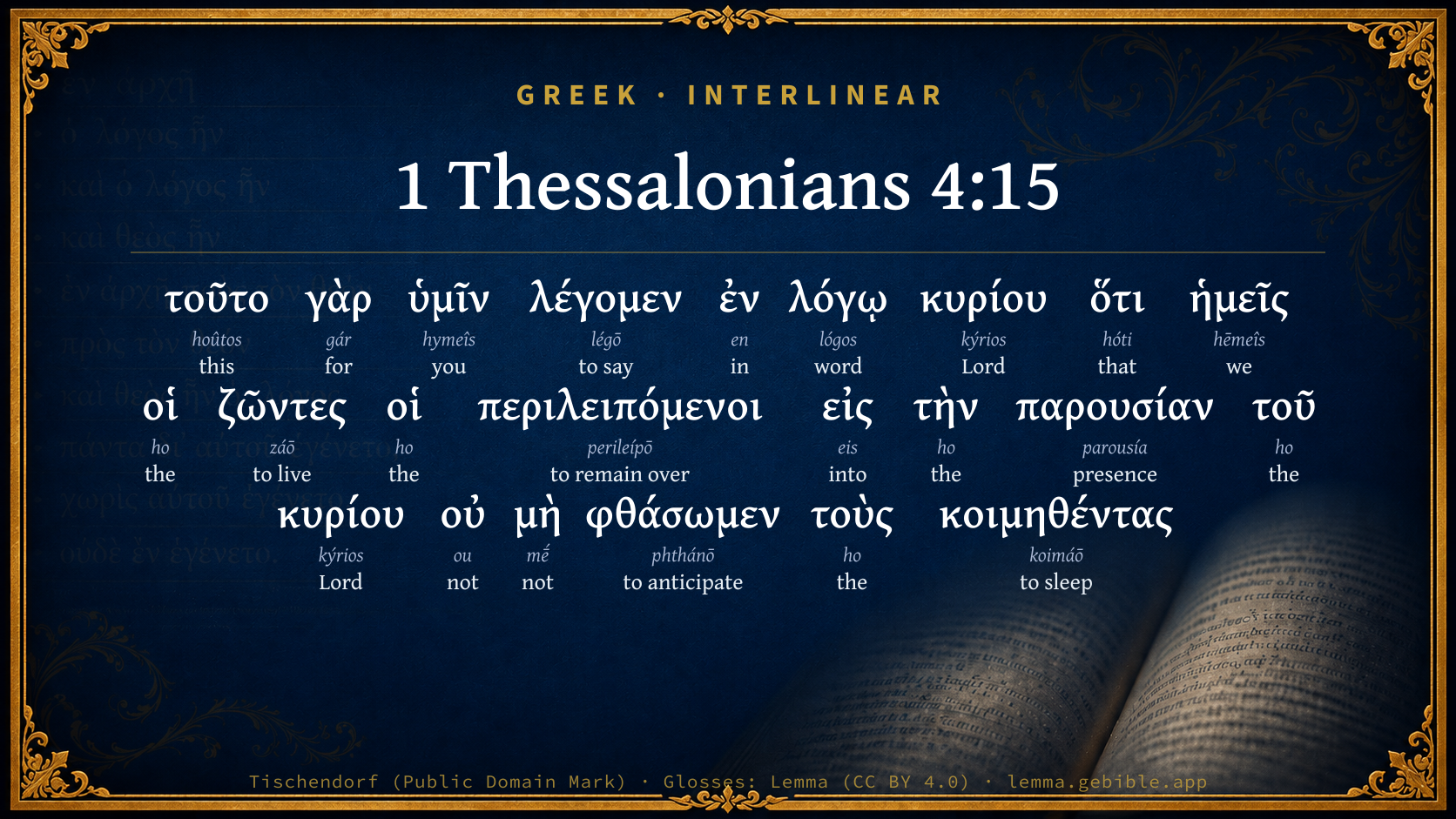
Download image
Cite this verse

1 Thessalonians 4:15 (World English Bible). Public Domain. Lemma interlinear Bible study tool, https://lemma.gebible.app/v/1-thessalonians/4/15.

Show BibTeX & RIS
BibTeX
RIS
English Translation
For this we tell you by the word of the Lord, that we who are alive, who are left to the coming of the Lord, will in no way precede those who have fallen asleep.
World English Bible · Public Domain
Highlights
  • 1 first appearance in the Greek New Testament
Full analysis ↓
Download a study sheet

One document with this verse’s original text, its word-by-word gloss line, the meaning frame, cross-references with their text, attributed commentary, and full source and license credits — printable, and it pastes into notes with its structure intact.

This verse Autodidact and up

Study sheet (.html) Plain text (.txt)

A passage Seminary Student

Up to 50 verses in one chapter. A passage sheet keeps up to 6 commentary sources and 12 cross-references per verse, in the order this page ranks them, and says so on the sheet whenever that leaves anything out. Ask for a single verse and you get the Autodidact verse sheet above.

Everything on this page stays free to read, with no account — the sheet is a download of what is already on screen, not access to it.

Want to remove ads? Support Godless Engineer
Compare translations 3

The same verse in 3 English versions, stacked beneath the original-language interlinear above. Click any original word for its lexicon entry.

Each is an independent rendering of the whole verse — the interlinear is not word-aligned to these translations.

Highlighted words mark where these versions differ — a whole-verse word diff, not a word-by-word alignment.

  • World English Bible Public Domain
    For this we tell you by the word of the Lord, that we who are alive, who are left to the coming of the Lord, will in no way precede those who have fallen asleep.
  • King James Version Public Domain
    For this we say unto you by the word of the Lord, that we which are alive and remain unto the coming of the Lord shall not prevent them which are asleep.
  • unfoldingWord Literal Text CC BY-SA 4.0
    For this we say to you in a word of the Lord, that we, the ones living, the ones surviving to the coming of the Lord, will certainly not go before the ones having slept.

unfoldingWord Literal Text — © unfoldingWord, licensed CC BY-SA 4.0. Word-aligned USFM3 via Door43 (git.door43.org/unfoldingWord/en_ult).

Versions to compare (up to 4)

3 of 4 selected

Show all 19 translations

Every available English version of this verse, each an independent rendering of the whole verse.

  • World English Bible Public Domain
    For this we tell you by the word of the Lord, that we who are alive, who are left to the coming of the Lord, will in no way precede those who have fallen asleep.
  • Berean Standard Bible Public Domain
    By the word of the Lord, we declare to you that we who are alive and remain until the coming of the Lord will by no means precede those who have fallen asleep.
  • Majority Standard Bible Public Domain
    By the word of the Lord, we declare to you that we who are alive and remain until the coming of the Lord will by no means precede those who have fallen asleep.
  • King James Version Public Domain
    For this we say unto you by the word of the Lord, that we which are alive and remain unto the coming of the Lord shall not prevent them which are asleep.
  • American Standard Version (1901) Public Domain
    For this we say unto you by the word of the Lord, that we that are alive, that are left unto the coming of the Lord, shall in no wise precede them that are fallen asleep.
  • Revised Version (1885) Public Domain
    For this we say unto you by the word of the Lord, that we that are alive, that are left unto the coming of the Lord, shall in no wise precede them that are fallen asleep.
  • Geneva Bible (1599) Public Domain
    For this say we vnto you by the worde of the Lord, that we which liue, and are remayning in the comming of the Lord, shall not preuent them which sleepe.
  • Douay-Rheims (1899) Public Domain
    For the Lord himself shall come down from heaven with commandment, and with the voice of an archangel, and with the trumpet of God: and the dead who are in Christ, shall rise first.
  • Young's Literal Translation Public Domain
    for this to you we say in the word of the Lord, that we who are living -- who do remain over to the presence of the Lord -- may not precede those asleep,
  • Literal Standard Version CC BY-SA 4.0
    for we say this to you in the word of the LORD, that we who are living—who remain over to the coming of the LORD—may not precede those asleep,
  • Unlocked Literal Bible CC BY-SA 4.0
    For this we say to you by the word of the Lord, that we who are alive, who are left at the coming of the Lord, will surely not go before those who have fallen asleep.
  • unfoldingWord Literal Text CC BY-SA 4.0
    For this we say to you in a word of the Lord, that we, the ones living, the ones surviving to the coming of the Lord, will certainly not go before the ones having slept.
  • Darby Bible Public Domain
    (For this we say to you in [the] word of [the] Lord, that *we*, the living, who remain to the coming of the Lord, are in no way to anticipate those who have fallen asleep;
  • World Messianic Bible Public Domain
    For this we tell you by the word of the Lord, that we who are alive, who are left until the coming of the Lord, will in no way precede those who have fallen asleep.
  • Webster's Bible Public Domain
    For this we say to you by the word of the Lord, that we who are alive and remain to the coming of the Lord shall not precede them who are asleep.
  • Free Bible Version CC BY-SA 4.0
    What we're telling you comes from the Lord: Those of us who are alive and still here when the Lord comes certainly won't precede those who have died.
  • Bible in Basic English Public Domain
    For this we say to you by the word of the Lord, that we who are still living at the coming of the Lord, will not go before those who are sleeping.
  • Text-Critical English NT CC BY 4.0
    According to the word of the Lord, we declare to you that we who are alive, who are left behind until the coming of the Lord, will certainly not precede those who have fallen asleep.
  • Tyndale New Testament (1534) Public Domain
    And this saye we vnto you in the worde of the Lorde that we which live and are remayninge in the comminge of the Lorde shall not come yerre they which slepe.

Literal Standard Version (2020), Covenant Press — licensed CC BY-SA 4.0. Text via the HelloAO Bible API (eBible.org). Unlocked Literal Bible (unfoldingWord) — licensed CC BY-SA 4.0. Text via the HelloAO Bible API (eBible.org). unfoldingWord Literal Text — © unfoldingWord, licensed CC BY-SA 4.0. Word-aligned USFM3 via Door43 (git.door43.org/unfoldingWord/en_ult). Free Bible Version, Dr. Jonathan Gallagher — licensed CC BY-SA 4.0. Text via the HelloAO Bible API (eBible.org).

Word by word

More ways to search: Search by grammar → Find every occurrence → Compare this word →

Practice this passage: Drill this verse → Learn its vocabulary →

περιλειπόμενοι
perileípō
G4035
“to remain over”
Verb, Present, Passive deponent, Participle, Nominative, Plural, Masculine
Part of Speech
Verb
Tense
Present
Voice
Passive deponent
Mood
Participle
Case
Nominative
Number
Plural
Gender
Masculine
Full Thayer's Definition

Origin: from G4012 and G3007

TDNT: 4:194,*

1. to leave over 2. to remain over, to survive
  1. τοῦτο hoûtos G3778 “this” Demonstrative pronoun, Accusative, Singular, Neuter
  2. γὰρ gár G1063 “for” Conjunction
  3. ὑμῖν hymeîs G5210 “you” Personal pronoun, 2nd person, Dative, Plural
  4. λέγομεν légō G3004 “to say” Verb, Present, Active, Indicative, 1st person, Plural
  5. ἐν en G1722 “in” Preposition
  6. λόγῳ lógos G3056 “word” Noun, Dative, Singular, Masculine
  7. κυρίου kýrios G2962 “Lord” Noun, Genitive, Singular, Masculine
  8. ὅτι hóti G3754 “that” Conjunction
  9. ἡμεῖς hēmeîs G2249 “we” Personal pronoun, 1st person, Nominative, Plural
  10. οἱ ho G3588 “the” Article, Nominative, Plural, Masculine
  11. ζῶντες záō G2198 “to live” Verb, Present, Active, Participle, Nominative, Plural, Masculine
  12. οἱ ho G3588 “the” Article, Nominative, Plural, Masculine
  13. εἰς eis G1519 “into” Preposition
  14. τὴν ho G3588 “the” Article, Accusative, Singular, Feminine
  15. παρουσίαν parousía G3952 “presence” Noun, Accusative, Singular, Feminine
  16. τοῦ ho G3588 “the” Article, Genitive, Singular, Masculine
  17. κυρίου kýrios G2962 “Lord” Noun, Genitive, Singular, Masculine
  18. οὐ ou G3756 “not” Particle, Negative
  19. μὴ mḗ G3361 “not” Particle, Negative
  20. φθάσωμεν phthánō G5348 “to anticipate” Verb, Aorist, Active, Subjunctive, 1st person, Plural
  21. τοὺς ho G3588 “the” Article, Accusative, Plural, Masculine
  22. κοιμηθέντας koimáō G2837 “to sleep” Verb, Aorist, Passive, Participle, Accusative, Plural, Masculine

About this verse

These counts appear in no published source. They are computed here, from the morphology-tagged text and Lemma’s own curated glosses. What Lemma adds →

23
words
18
distinct lemmas
Pauline Epistles
section

Notable vocabulary

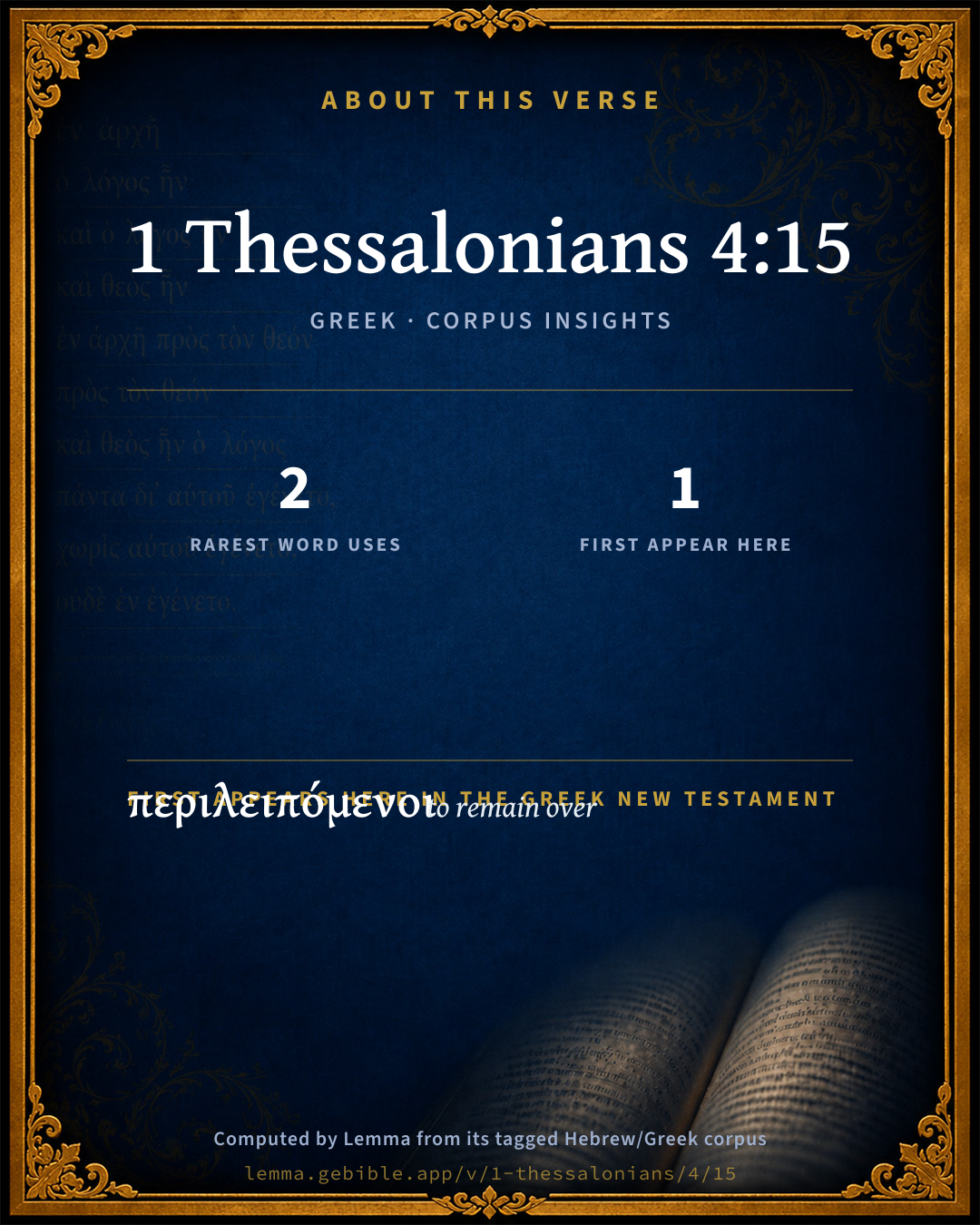
The rarest word here is περιλειπόμενοι to remain over G4035 — appearing just 2 times in the whole Greek New Testament.

First appearance in Scripture

This word makes its first canonical appearance in the Greek New Testament here:

  • περιλειπόμενοι to remain over G4035

Shared distinctive vocabulary

περιλειπόμενοι to remain over G4035 occurs in 2 verses of the Greek New Testament. Also found in:
Repetition

Words recur within this verse:

Cross-references

3

Topical passages linked to 1 Thessalonians 4:15 in the Treasury of Scripture Knowledge — connected by theme and wording, ordered by reader-vote popularity; previews shown in the World English Bible.

  • 1 Corinthians 15:51–53 Behold, I tell you a mystery. We will not all sleep, but we will all be changed,
  • 2 Corinthians 4:14 knowing that he who raised the Lord Jesus will raise us also with Jesus, and will present us with you.
  • 1 Thessalonians 2:19 For what is our hope, or joy, or crown of rejoicing? Isn't it even you, before our Lord Jesus at his coming?

Cross-references courtesy of OpenBible.info (CC BY 4.0).

Commentary

Notes on 1 Thessalonians 4:15 from classic Christian and Jewish commentators (each source and its license shown beneath its notes). The classic Christian expositions comment on the surrounding passage and are grouped to its opening verse, so a note may address several verses; the Jewish commentaries on the Tanakh (Rashi and others) are per-verse, so they appear only where the commentator wrote on this verse.

Lemma curates 59 commentaries, every one of them public domain or Creative Commons licensed, each selected and text-cleaned for this edition rather than reprinted as found. About our sources →

The Cambridge Bible for Schools and Colleges

gen. ed. J. J. S. Perowne

15. For this we say unto you by the word of the Lord] Lit., in a word of the Lord,—in the character of a message coming from “the mouth of the Lord;” comp. 1Co_7:10, “I give charge,—not I, but the Lord;” and ch. 1Th_2:13 above, “not men’s word, but God’s.” The “word” that follows (1Th_4:15-17) can hardly be explained as a traditional saying of Christ, unrecorded in the Gospels, like Act_20:35; nor as an inference from the teaching of Jesus on the subject of His return. St Paul claims to have received this communication directly from Christ, “the Lord” of His Church, as a revelation to himself (comp. Gal_2:2, Eph_3:3 for similar instances), given to him expressly in order to allay the fears of his readers. The Lord is manifestly Christ, as it is four times in the immediate sequel. St Paul applies to Christ’s word the same august phrase that in the O. T. denotes “the word of God” Himself; comp. note on ch. 1Th_1:8.

that we which are alive and remain unto the coming of the Lord] This should be: we that are alive, that remain (or survive) unto the coming of the Lord. The second designation qualifies the first,—“those (I mean) who survive till the Lord comes.” St Paul did not count on any very near approach of the second Advent: comp. 2Th_2:1-2. At the same time, his language implies the possibility of the great event taking place within his lifetime, or that of the present generation. This remained an open question, or rather a matter on which questioning was forbidden (see Act_1:7; Mat_24:36). “Concerning the times and seasons” nothing was definitely known (ch. 1Th_5:1, see note). The Apostles “knew in part” and “prophesied in part” (1Co_13:12); and until further light came, it was natural for the Church, ever sighing “Come Lord Jesus, come quickly!” to speak as St Paul does here. The same “we” occurs in this connection in 1Co_15:51-52. But from the time of the dangerous illness recorded in 2Co_1:8-9, the prospect of death occupied the foreground in the Apostle’s thoughts of his own future, and he never afterwards writes “we that remain.”

shall not prevent] “Prevent” is obsolete in this sense: comp. the Collect, “Prevent us in all our doings with Thy most gracious favour.” Better, shall in no wise precede (or anticipate) those that fell asleep. The shadow which the event of their premature death had cast over the fate of the sleeping Thessalonian believers was wholly imaginary, and should be dismissed at once from the minds of their sorrowing friends. Instead of their having no place, they will have, as Christ now reveals to His Apostle, the foremost place in His triumphant return. Though dead, they are “dead in Christ” (1Th_4:16),—departed to “be with Christ”—“absent from the body” but “at home with the Lord,” as St Paul subsequently teaches (2Co_5:6-8; Php_1:23). So it cannot be that those who are found in the flesh when He comes again, will be beforehand with them in this reunion. “God will bring them with Him,” for they are with Him already.

The Apostle proceeds to support this assurance by a description of Christ’s coming, derived from the revelation, or “word of the Lord,” to which he has just appealed. This was one of the most remarkable of the many “visions and revelations” which St Paul experienced (comp. 2Co_12:1-5).

The Cambridge Bible for Schools and Colleges (gen. ed. J. J. S. Perowne; Cambridge University Press, 1878–1918) — public domain. Text from a community e-Sword module.

The Biblical Illustrator

Joseph S. Exell

1Th_4:15

This we say unto you by the Word of the Lord, that we which are alive and remain

The waiting congregation of the redeemed

It is important here to observe that the apostles language is not to be pedantically restricted as if we were necessarily to be taken literally.

It is the broad, emotional, imaginative, not the restricted and historical we--the we not of him who associates himself with some accidental and arbitrary class, but of him who believes in the Holy Catholic Church, the communion of saints--the we of a true member of the supernatural community. He writes as a living man to living men, from the point of view of intimate communion with them; with that prophetic sympathy with the Church of the future which makes his pulses throb in unison with the waiting congregation of the redeemed. He puts himself in the same attitude with those who shall be alive at the Great Advent, All who are alive on earth as we now are. Speaking as the mouthpiece of a generation which, like each of its successors, represents those who shall be alive at the Lords coming, he says, We--we, the living, the left over--a word which is not without a tinge of sadness, in subtle harmony with the purpose Paul had in view. The fear which the Thessalonians had for their beloved ones was lest they might have suffered loss. They pitied them because they were taken. By this twice-repeated word, the pathetic refrain of this wonderful dirge (1Th_4:15; 1Th_4:17), the apostle seems to say--not that they are to be pitied; rather we who are left over, left without them in the world. If there is any leaving out in the case, it is we who are left out, not they. (Bp. Alexander.)

The Second Advent of Christ

Among the words of consolation in the valedictory discourse of Christ is the promise that He would come again and receive His people unto Himself. Time has sped noiselessly along. For nearly nineteen hundred years the Churchs eyes have been strained with intense expectancy; but it has not lost confidence in the promise. Faith in the Second Advent of Christ is more widely spread and firmly held than ever. Long waiting has sharpened the longing, brightened the hope, and clarified the vision. Observe--

I. That the second advent of Christ is the subject of Divine revelation. By the Word of the Lord. In a subject of such vast moment Paul was anxious to show that he spoke on the most incontrovertible authority. He had a special revelation, and spoke under the immediate inspiration of the Divine Spirit. The Second Advent is emphatically taught in the Scriptures.

II. That the second advent of Christ will be distinguished by signal tokens of terrible majesty.

1. There will be the triumphant shout of the Divine Redeemer (1Th_4:16). Just before Jesus expired on the cross He cried with a loud voice, and, though there was the ring of victory in that cry, it sounded more like a conscious relief from unutterable suffering. But the shout of Jesus on His second coming will be like the battle shout of a Great Conqueror. It will break the silence of the ages, startle the universe into attention, raise the dead, and summon all people to the presence of the victorious Messiah. Formerly He did not cry (Isa_42:2). But now is the revelation of His power (Psa_50:3-4).

2. There will be the voice of the archangel (1Th_4:16), the chief of the heavenly multitude. In response to the majestic shout of the descending Lord, he lifts up his voice, like the loud cry of a herald, announcing the glorious advent, and the sound is caught up and prolonged by the vast hosts of celestial attendants.

3. There will be the trumpet blast. With the trump of God (Mat_24:31; 1Co_15:52). Among the Hebrews, Greeks, and Latins it was the custom to summon the people with the trumpet. In this way God is said to gather His people together (Isa_27:13; Jer_4:5; Jer_6:1). The whole passage is designed to show that the Second Advent of King Messiah will be attended by the most imposing evidences of pomp and regal splendour.

III. That the second advent of Christ will be followed by important consequences to the people of God--living and dead.

1. The pious dead shall be raised (1Th_4:15-16). The living at that day shall have no advantage over the dead. Before any change takes place in the living, to fit them for the new condition of things, the dead in Christ shall rise first, and be clothed with immortality and incorruptible splendour. Whatever disadvantages may be the lot of some of Gods people over others, they are ever recompensed by some special privilege. The best state for us is that in which God places us. And yet every man thinks anothers condition happier than his own. Rare, indeed, is the man who thinks his own state and condition in every respect best for him.

2. The living and the raised shall unite in a simultaneous greeting of their descending Lord (1Th_4:17). The living, after passing through the wondrous change, shall not anticipate the newly-raised bodies of the pious dead, but together with them--in one reunited, loving, inseparable company--shall be caught away in the chariot of clouds, to meet the Lord in the air, and greet Him in the descent. He comes to fulfil His promise (Joh_14:3).

3. All believers in Christ shall be assured of eternal felicity with Him. And so shall we ever be with the Lord (1Th_4:17)--in familiar companionship, in rapturous communion, in impending glory, in ever-enchanting revelations. With Him, not occasionally, or for an age, or a millennium, but uninterruptedly, forever. How great the contrast with the brightest experiences of this changeful life! There are three things which eminently distinguish the heavenly life of the soul--perfection, perpetuity, immutability. The exact locality is not mentioned. It is enough to be assured that we are to abide with Jesus in some place where parting is unknown.

IV. That the contemplation of the second advent of Christ is calculated to minister consolation to the sorrowing (1Th_4:18). The best consolation is that which is drawn from Gods Word. The bereaved were sorrowing for their loved ones, and were full of uncertainty about the future. The teaching of inspiration assures them that their departed relatives shall be rescued from the power of death, that they shall meet again in glory to be forever with each other and with the Lord. The wants and distresses of certain individuals may be the occasion for the revelation of given truths, and the truths once revealed remain in the Church forever. Lessons:

1. The Church is justified in looking for the Second Advent.

2. That Advent will bring an everlasting recompense for the sorrow of the present life.

3. The record which reveals that Advent should be prized and pondered. (G. Barlow.)

The Biblical Illustrator, edited by Joseph S. Exell (c. 1880s–1900s) — public domain. Text from a community e-Sword module.

Joseph Benson's Commentary

1Th 4:15. For this we say unto you by the word of the Lord — By a particular revelation from him. No words, as Dr. Doddridge observes, can more plainly assert that, in what follows, the apostle declares precisely what God revealed to him, and consequently that there can be no room for any such interpretation of this passage, as supposed him to be at all mistaken in any circumstance of the account he gives. That we who are alive and remain — This manner of speaking intimates the fewness of those who will be then alive, compared with the multitude of the dead. It is well observed, says Whitby, by the Greek scholiasts, that the apostle speaks these words, not of himself, but of the Christians that should be found alive at the second coming of Christ: so Chrysostom, Theodoret, Œcumenius, and Theophylact; for he well knew that he was not to live till the resurrection: yea, he himself expected a resurrection, saying to the Corinthians, He that raised up the Lord Jesus, shall raise up us also by Jesus, and present us with you, 2Co 4:14. He laboured that he might attain to the resurrection of the dead, Php 3:11. Yet some divines have inferred, from this and some other places in the epistles, that the apostles themselves thought and taught, that they might live until the second coming of Christ; and that St. Paul afterward changed his opinion on this subject, and admonished the Thessalonians of it, 2Th 2:2-6. But this certainly is a dangerous mistake, and highly prejudicial to the authority of the apostles, and therefore to the Christian faith. Indeed, if the churches of Christ had once received this doctrine from them, and afterward had understood, even from their own confession, that it was a mistake, this would naturally have led them to conceive that the apostles might have been mistaken also in any other doctrine, and to suspect the truth of all that was contained in their epistles. This the apostle seems to insinuate, 2Th 2:1-2. But that this apostle taught no such doctrine in either of his epistles to the Thessalonians, will be exceeding evident, 1st, From the following words in that chapter, 1Th 4:3, Let no man deceive you by any means, declaring them deceivers who either taught this doctrine, or imposed it on them as taught by the apostles; and also having said, in opposition to such an opinion, that day was not to come till there was a falling away first, adding, Remember you not that when I was yet with you I told you these things? He therefore had taught them the contrary before he had written either of these epistles, and, of consequence, cannot rationally be supposed to contradict himself. 2d, From the very words used in proof of this opinion, which are introduced with this solemn declaration, This we say unto you by the word of the Lord, that we who are alive, &c., in which words he most plainly vouches the authority of Christ for the truth of what he says; and therefore, if he were mistaken, either our Lord himself must have erred with him, or the apostle must vouch Christ’s word, and his authority, when Christ had spoken no such word, and given him no authority to declare such doctrine in his name; both which assertions overthrow the certainty and truth of all St. Paul’s epistles. And hence it follows that the apostle could not deliver this assertion in any other of his epistles, for all the learned agree in this, that these epistles to the Thessalonians were the first epistles St. Paul wrote; whence it must follow that he could not deliver, in his following writings to that church, or any other churches, that doctrine which he had so industriously before confuted, and declared very dangerous, in his epistle to the church of Thessalonica.

The truth is, such expressions as these, we who are alive, (1Th 4:15,) we shall not all sleep, but we shall all be changed, &c., (1Co 15:51,) are not to be understood of the writers themselves: they are mere figures of speech used by the best authors to draw their readers’ attention, or to soften some harsh or disagreeable sentiment; without intending to represent themselves either as of the number, or of the character, of the persons with whom they class themselves. Thus Hosea says, (Hos 12:4,) God spake with US in Bethel; and the psalmist, (Psa 66:6,) WE rejoiced, namely, at the Red sea, when divided; and, (Psa 81:5,) I heard a language I understood not, that is, in Egypt, though neither were in existence at the times when the facts referred to happened. This figure in the mouth of Christ’s disciples has a singular propriety, because all of them making but one collective body, of which Christ is the Head, and which is united by the mutual love of all the members, individuals may consider every thing happening to the members of this body, as happening to themselves. We shall not prevent — Or anticipate; them who are asleep — Shall not receive our glorified bodies before them.

Joseph Benson's Commentary on the Old and New Testaments (1811–1818) — public domain. Text from a community e-Sword module.

The Preacher's Complete Homiletical Commentary

Joseph S. Exell (gen. ed.)

CRITICAL AND EXPLANATORY NOTES

1Th_4:15. We which are alive and remain unto the coming of the Lord.—“We must recognise that Paul here includes himself, along with the Thessalonians, among those who will be alive at the advent of Christ. Certainly this can only have been a hope, only a subjective expectation on the part of the apostle” (Huther). Shall not prevent.—The meaning of “prevent” is “to go before.” But the connotation came to have more prominence than the meaning, so it came to signify to stop (by standing in the way). R.V. gives, “shall not precede.” It is the same word as in 1Th_2:16 (in another tense). The apostle says, “We shall not arrive before them.”

1Th_4:16. With a shout.—Like the ring of command heard over the noise of battle. “We must not look for literal exactness where things are depicted beyond the reach of sense” (Findlay). With the tramp of God.—The trumpet here, like that in 1Co_15:52, is the military trumpet.

1Th_4:17. Shall be caught up.—The idea conveyed by the word is that of sudden or violent seizure, as when the fiery messengers carried off the prophet Elijah, or as when St. Paul was “caught up” to the third heaven.

MAIN HOMILETICS OF THE PARAGRAPH.—1Th_4:15-18

The Second Advent of Christ.

Among the words of consolation in the valedictory discourse of Christ to His disciples was the promise, after His departure, He would come again and receive them unto Himself. Time has sped noiselessly along; events of vast magnitude have rapidly succeeded each other, and left their lessons for the ages to ponder; nations have passed through the throes of suffering and revolution; generation after generation has gone down to the grave; for nearly nineteen hundred years the Church has been strained with profound, intense, and anxious expectancy: but still the promise remains unfulfilled. Will He come? Are the hopes of the Church doomed to be for ever unsatisfied? Must the bodies of the pious dead be for ever shut down in the sepulchres of land and sea? Will the wrongs of the universe never be redressed? If questions like these flit for a moment across the mind, it is not that the Church has lost confidence in the promise. Faith in the second advent of Christ is more widely spread and more firmly held to-day than ever. Long waiting has sharpened the longing, brightened the hope, and clarified the vision. In these words the apostle assures the Thessalonians of the second coming of Christ, furnishes some important particulars of the event, and points out the bearing of the glorious doctrine in consoling the sorrow of the bereaved.

I. That the second advent of Christ is the subject of divine revelation.—“For this we say unto you by the word of the Lord” (1Th_4:15). In a subject of such vast moment the apostle was anxious to show that he had the highest and most incontrovertible authority for the statements he uttered. He had a special revelation from heaven, and spoke under the direct and immediate inspiration of the divine Spirit. The second advent of Christ is emphatically taught in the Holy Scriptures (cf. Mat_24:3; Mat_25:31; Mar_8:3; Joh_14:3; Act_1:2; Act_3:19-20; Rom_8:17; 1Co_1:8; 2Ti_4:1; Tit_2:13; 1Pe_1:5; 2Pe_3:12; Jud_1:14).

II. That the second advent of Christ will be distinguished by signal tokens of terrible majesty.—

1. There will be the triumphant shout of the divine Redeemer. “For the Lord Himself shall descend from heaven with a shout” (1Th_4:16). Just before Jesus expired on the cross He cried with a loud voice, and though there was the ring of victory in that cry, it sounded more like a conscious relief from unutterable suffering. But the shout of Jesus on his second coming will be like the loud, clear, joyous battle shout of a great Conqueror. That shout will break the silence of the ages, will startle the universe into attention, will raise the dead, and summon all people into the presence of the victorious Messiah. Formerly He did “not cry, nor lift up, nor cause His voice to be heard in the street” (Isa_42:2). But now is the revelation of His power. “Our God shall come, and shall not keep silence” (Psa_50:3-4).

2. There will be the voice of the archangel (1Th_4:16).—The angelic hosts are arranged in an hierarchy of various ranks and orders. The archangel is the chief of the heavenly multitude. In response to the majestic shout of the descending Lord, the archangel lifts up his voice, like the loud cry of the herald announcing the glorious advent, and the sound is caught up and prolonged by the vast hosts of celestial attendants.

3. There will be the trumpet-blast.—“With the trump of God,” with trumpet sounded by the command of God—such a trumpet, perhaps, as is used in the service of God in heaven. Besides the shout of Jesus and the voice of the archangel, the sound of the trumpet will also be heard in the host. It is called in 1Co_15:52 “the last trumpet”; and in Mat_24:31 we read, “He shall send His angels with a great sound of a trumpet, and they shall gather together His elect.” Among the Hebrews, Greeks, and ancient Latins it was the custom to summon the people with the trumpet. In this way God is said to gather His people together (Isa_27:13; Jer_4:5; Jer_6:1). The whole passage is designed to show that the second advent of King Messiah will be attended by the most imposing evidences of pomp and regal splendour.

III. That the second advent of Christ will be followed by important consequences to the people of God, living and dead.—

1. The pious dead shall be raised. “We which are alive, and remain unto the coming of the Lord, shall not prevent them which are asleep. And the dead in Christ shall rise first” (1Th_4:15-16). The living at that day—who, it would seem, would be spared the necessity of dying and seeing corruption—shall, nevertheless, have no advantage over the dead. Before any change takes place in the living to fit them for the new condition of things, the dead in Christ shall rise first, and be clothed with immortality and incorruptible splendour. Whatever disadvantages may be the lot of some of God’s people over others, they are ever recompensed by some special privilege or prerogative. The best state for us is that in which God places us. And yet every man thinks another’s condition happier than his own. Rare indeed is the man who thinks his own state and condition in every respect best for him.

2. The living and the raised shall unite in a simultaneous greeting of their descending Lord.—“Then we which are alive and remain shall be caught up together with them in the clouds to meet the Lord in the air” (1Th_4:17). The living, after passing through the wondrous change from mortal to immortal, shall not anticipate for a single moment the newly raised bodies of the pious dead, but together with them, in one reunited, loving, inseparable company, shall be caught away in chariots of clouds, to meet the Lord in the air, and greet Him in the descent. He comes to fulfil His promise (Joh_14:3)

3. All believers in Christ shall be assured of eternal felicity with Him.—“And so shall we ever be with the Lord” (1Th_4:17). For ever with the Lord in familiar companionship—in rapturous communion, in impending glory, in ever-enchanting revelations. With Him, not occasionally, or for an age, or a millennium, but uninterruptedly for ever, without the possibility of separation. How great the contrast with the brightest experiences of this changeful life! There are three things which eminently distinguish the heavenly life of the soul—perfection, perpetuity, immutability.

IV. That the contemplation of the second advent of Christ is calculated to minister consolation to the sorrowing.—“Therefore comfort one another with these words” (1Th_4:18). A community in suffering creates a community in sympathy. “If a thorn be in the foot, the back bows, the eye is busy to pry into the hurt, the hands do their best to pluck out the cause of anguish; even so we are members one of another. To him that is afflicted, pity should be showed from his friend” (Job_6:14). The best consolation is that which is drawn from the revelations of God’s word. There are no comforts like Scripture comforts. The bereaved were sorrowing for their loved ones who had been smitten down by death, and were full of anxiety and uncertainty about the future. Shall they meet again, or are they parted for ever? The teaching of inspiration on the second coming of Christ assures them that their departed relatives shall be rescued from the power of death, that they shall meet again, meet in glory, meet to part no more, to be for ever with each other and with the Lord.

Lessons.—

1. The Church is justified in looking for the second advent of Christ.

2. The second advent of Christ will bring an everlasting recompense for the suffering and sorrow of the present life.

3. The record that reveals the second advent of Christ should be fondly prized and constantly pondered.

GERM NOTES ON THE VERSES

1Th_4:15-18. The Second Coming of Christ and Sorrow for the Dead.

I. The final period of the world the apostles left undetermined.

II. Though ignorant of the final period of the world, they were confident it should not come till the prophecies respecting the destiny of the Church were accomplished.

III. The Church, being ignorant of the day in which Christ should come to judge the world, should be always ready for that event.

IV. Sorrow for the dead is compatible with the hope of a Christian.—

1. When it proceeds from sympathy.

2. From the dictates of nature.

3. From repentance.—Saurin.

1Th_4:18. The Duty of comforting One Another.

I. We must observe a rule and method in this duty.

II. This method is taught not in the school of nature, but of Christ.—

1. In general we must comfort one another with the word of God.

2. We must comfort one another with the Scripture teaching on the coming of the Lord and the resurrection of the dead.—Farindon.

The Preacher's Complete Homiletical Commentary (gen. ed. Joseph S. Exell; Funk & Wagnalls, c. 1892) — public domain (pre-1929). A full-Bible homiletical/sermon-outline anthology covering 65 of 66 books (2 John is absent from the source module). Text from a community e-Sword module.

Tyndale Open Study Notes

Tyndale Open Resources

4:15 directly from the Lord: Jesus’ own teaching provided the source of Paul’s assurance for the Thessalonians (see Matt 24:29-31, 40-41) • not . . . ahead: Paul wants the Thessalonians to know that, when the Lord returns, the dead will not be at a disadvantage but will participate equally in the resurrection. • In referring to Jesus’ coming, Paul uses a Greek term (parousia) commonly used to describe the coming of the emperor to a city with great pomp and celebration (see 1 Thes 4:17).

Tyndale Open Study Notes — © Tyndale Open Resources, licensed CC BY-SA 4.0. Text via the HelloAO Bible API.

Bengel's Gnomon

Johann Albrecht Bengel

1Th 4:15. Ὑμῖν) To you, who are worthy of knowing this.—λέγομεν ἐν λόγῳ Κυρίου, we say by the word of the Lord) The Lord, the Christ, has spoken to us; we have spoken to you: comp. 1Ki 20:35, בדבר יהוה, ἐν λόγῳ Κυρίου, by the word of the Lord. Phrases such as these are used in respect of a matter which is now for the first time opened up (disclosed), [Many matters connected with an altogether extraordinary subject, which would be in vain sought for elsewhere, are here discussed.—V. g.]—ἡμεῖς, we) The saints, by speaking thus in their own age, have greatly added to the obligation resting on those of following ages to look for the Lord. The we is presently explained by the following words, who are alive, and further on, who remain.—οἱ ζῶντες οἱ περιλειπόμενοι, who live, who remain [who live, surviving]) So also 1Th 4:17. This is equivalent to an apposition. Who live, is an antithesis to, who sleep. There is at the same time intimated the small number of those who live, compared with the multitude of the dead; likewise the good condition of those who are asleep, so that the living may desire to be gathered to them. Men of all ages conjointly have a lively anticipation of [realize to themselves the immediate fulfilment of] some one thing;[20] and so believers, who are now long waiting, and who regard themselves in the light of persons who are to live at the coming of the Lord, have spoken in accordance with this their character (spake in the manner that became the character they represented, viz. those who shall be alive at the Lord’s coming). Those who live, and those who remain till the coming of the Lord, are the same, and these are denoted by the pronoun we. Each generation, which lives at this or that time, occupies, during that period of their life, the place of those who are to live at the time of the coming of the Lord.[21] So the we is put here, as elsewhere the names Cajus and Titius,[22] and that, too, with the greater propriety, because believers of that age [i.e. of each successive past age] have not yet been allowed distinctly to know the vast period of time to elapse till the end of the world. The present tense in both participles is in reference to [i.e. in order to suit] the coming of the Lord itself, as in Act 10:42 [παρήγγειλεν κηρῦξαι ὅτι αὐτός ἐστιν], and elsewhere frequently. Hence Paul has not hereby asserted that the day of Christ is so near; see 2Th 2:2-3. A similar phrase is found at Rom 13:11; 1Co 15:51; Jas 5:9; 1Pe 4:5-6; Mat 24:42, note.—ΤΟῦ ΚΥΡΊΟΥ, of the Lord) Jesus Christ.—οὐ μὴ φθάσωμεν, we shall not [prevent] get before or anticipate) This assurance sweetly counteracts the fear of the survivors regarding the dead, and reckons the advantage of the former, including himself, not to be greater than that of those who are asleep.

[20] Or ‘repræsentant’ means, Men of different ages aiming conjointly at some one object (for instance, the House of Commons in successive ages seeking civil liberty and good government) are joint representatives of that one idea: and so the men of each particular age might regard themselves as the representatives of it in their particular age.—ED.

[21] That is, they are called on to live in daily and hourly expectation of the Lord’s coming in their time, since the time of His coming was left uncertain for that very purpose, Mat 25:13. Such ‘watchers’ in each generation are representatives of those who shall actually be found alive when He comes.—ED.

[22] Imaginary persons put in law as representatives to exemplify some principle.—ED.

Bengel's Gnomon of the New Testament — English translation (T&T Clark, Edinburgh, 1860) — public domain. Text from a community e-Sword module.

Meyer's Critical & Exegetical Commentary

Heinrich August Wilhelm Meyer

1Th_4:15. A solemn confirmation of the comforting truth τοὺς κοιμηθέντας ἄξει σὺν αὐτῷ, by bringing forward the equality between those living at the advent and those already asleep. Koppe, Flatt, and Koch erroneously assume a reference to 1Th_4:13, making the γάρ in 1Th_4:14 parallel to the γάρ in 1Th_4:15, and finding in 1Th_4:15 a new reason for comfort.

τοῦτο] refers not to the preceding, but is an emphatic introduction to what follows the first ὅτι: this, namely, we say to you, ἐν λόγῳ κυρίου, that we, the living, etc.

ἐν λόγῳ κυρίου] in or by means of a word of the Lord (comp. בִּדְבַר הַמֶּלֶךְ, Est_1:12; בִּדְבַר יְהֹוָה, 1Ki_20:35), that is, the following statement on the relation of the living to those who are asleep at the advent does not rest on my (the apostles) subjective opinion, but on the infallible authority of Christ. Comp. 1Co_7:10; 1Co_7:12; 1Co_7:25.

Pelagius, Musculus, Bolten, Pelt, and others have regarded this λόγος κυρίου, to which Paul appeals, as the words of Christ in Mat_24:31 (comp. Mar_13:27); whereas Hofmann is of opinion that Paul might have inferred it from the promises of Christ in Mat_26:25 ff.; Joh_6:39 f. But the expressions found there are too general to be identified with the special thought in our passage. Schotts statement, that Paul might justly appeal to the prophecy in Mat_24:31, because it contained nothing of a prerogative of the living before the dead, but on the contrary represents simply an assembling of believing confessors with a view to the participation of the Messianic kingdom, is subtle, and does not correspond to the expression ἐν λόγῳ κυρίου, which points to positive information concerning the definite subject in question. Also Luthardts (l.c. pp. 141, 57) view, that in λόγος κυρίου a reference is made to the parable of the virgins who went out to meet the bridegroom (Matthew 25), and for which view εἰς ἀπάντησιν (1Th_4:17) is most arbitrarily appealed to, is evidently erroneous. Others, as Calvin and Koch, have thought that Paul referred to a saying of Christ not preserved in the Gospels, but transmitted by tradition. (So, recently, also v. Zezschwitz, l.c. p. 121, according to whom the apostle thought on a word which is to be sought for in the peculiar and intimate communications of our Lord to His disciples, such as He would have given them during the forty days, when He spoke with them concerning the βασιλεία τοῦ Θεοῦ.) This supposition may certainly be supported by the analogy of Act_20:35; but it must always remain precarious, the more so as there was no inducement to Christ, in His intimations concerning the period of the fulfilment of the Messianic kingdom, to make such special questions, arising only in consequence of concrete circumstances, the subject of an anticipated instruction. It is best, therefore, with Chrysostom, Theodoret, Hunnius, Piscator (who, however, arbitrarily supposes the fact described in 2Co_12:2; 2Co_12:4), Aretius, Turretin, Benson, Moldenhauer, Koppe, Olshausen, de Wette, Gess (die Lehre von der Person Christi, Basel 1856, p. 69 f.), Alford, Riggenbach, and others, to suppose that Paul appeals to information concerning the matter in hand which had been communicated to him in a direct revelation by the heavenly Christ; comp. Gal_1:12; Gal_2:2; Eph_3:3; 2Co_12:1.

ἡμεῖς οἱ ζῶντες οἱ περιλειπόμενοι εἰς τὴν παρουσίαν τοῦ κυρίου] we, the living, who remain unto the presence (or return) of the Lord. From the construction of these words it undoubtedly follows, that Paul reckoned himself with those who would survive till the commencement of the advent, as indeed the same expectation is also expressed in 1Co_15:51 f. Comp. besides, 1Co_7:26; 1Co_7:29-31; 1Co_1:7-8; Rom_13:11-12; Php_4:5. See also Dähne, Entwickel. des Paulin. Lehrbegr. pp. 175 f., 190; Usteri, Paulin. Lehrbegr. p. 355; Messner, Die Lehre der Apostel, Leipz. 1856, p. 282. This expectation is not confirmed by history: Paul and all his contemporaries fell a prey to death. What wonder, then, if from an early period of the Christian church this plain meaning of the word was resisted, and in its place the most artificial and distorted interpretations were substituted? For that Paul could be capable of error was regarded as an objectionable concession, as an infringement upon the divine authority of the apostle. It has therefore almost universally[57] been maintained by interpreters, that Paul speaks neither of himself nor of his contemporaries, but of a later period of Christianity. So Chrysostom, Theodoret, John Damascenus, Oecumenius, Theophylact, Erasmus, Castalio, Calvin, Musculus, Bullinger, Zanchius, Hunnius, Balduin, Vorstius, Cornelius a Lapide, Jac. Laurentius, Calixt, Calov, Joach. Lange, Whitby, Benson, Bengel, Flatt, and many others. Whilst Calvin and Cornelius a Lapide, in order to remove difficulties, do not scruple to charge the apostle with a pious fraud; supposing that he, although he was convinced of the distance of the advent, nevertheless represented himself as surviving, in order in this way to stimulate believers to be in a state of spiritual readiness at every instant; Oecumenius, after the example of Methodius, interprets ΟἹ ΖῶΝΤΕς Κ.Τ.Λ. of the souls, and οἱ κοιμηθέντες of the bodies of Christians; ζῶντας τὰς ψυχάς, κοιμηθέντα δὲ τὰ σώματα λέγει· οὐκ ἂν οὖν προλάβωσιν αἱ ψυχαί· πρῶτον γὰρ ἐγείρεται τὰ σώματα, ἵνα αὐτὰ ἀπολάβωσιν αἱ ψυχαί, ἃς καὶ περιλιμπάνεσθαί φησι διὰ τὸ ἀθάνατον· οὐ γὰρ ἄν, εἰ μὴ περὶ ψυχῶν ἔλεγεν, εἶπε τὸ ἡμεῖς οἱ ζῶντες οἱ περιλειπόμενοι, τελευτήσειν μέλλων· λέγει οὖν, ὅτι οἱ ζῶντες αἱ ψυχαὶ οὐκ ἂν τὰ σώματα προφθάσωμεν ἐν τῇ ἀναστάσει, ἀλλὰ μετʼ αὐτῶν τῆς ἀναστάσεως τευξώμεθα. Usually, however, in order to remove the objectionableness of the words, an appeal is made to the fact that by means of an enallage personae or an ἀνακοίνωσις, something is often said of a collective body which, accurately taken, is only suited to a part. Then the sense would be: we Christians, namely, those of us who are alive at the commencement of the advent, i.e. the later generation of Christians who will survive the advent. But however often ἡμεῖς or ὙΜΕῖς is used in a communicative form, yet in this passage such an interpretation is impossible, because here ἩΜΕῖς ΟἹ ΖῶΝΤΕς Κ.Τ.Λ., as a peculiar class of Christians, are placed in sharp distinction from κοιμηθέντες, as a second class. Accordingly, in order to obtain the sense assumed, the words would require to have been written: ὅτι ἡμῶν οἱ ζῶντες κ.τ.λ. οὐ μὴ φθάσονται τοὺς κοιμηθέντας, apart altogether from the fact that also in 1Th_5:4 the possibility is expressed, that the day of the Lord might break in upon the presently existing Thessalonian church. Not less arbitrary is it, with Joachim Lange, to explain the words: we who live in our posterity, for which an additional clause would be necessary. Or, with Turretin, Pelt, and others, to understand οἱ ζῶντες, οἱ περιλειπόμενοι in a hypothetical sense: we, provided we are then alive, provided we still remain. (So, in essentials, Hofmann: by those who are alive are meant those who had not already died.) For then, instead of ἡμεῖς οἱ ζῶντες, οἱ περιλειπόμενοι, it would necessarily require ἩΜΕῖς ΖῶΝΤΕς, ΠΕΡΙΛΕΙΠΌΜΕΝΟΙ (without an article). The same also is valid against J. P. Lange (Das apostol. Zeitalter, I., Braunschw. 1853, p. 113): The words, the living, the surviving, are for the purpose of making the contrast a variable one, whilst they condition and limit the ἡμεῖς in the sense: we, so many of us (!), who yet live and have survived; or (?) rather, we in so far as we temporarily represent the living and remaining, in contrast to our dead. Lastly, the view of Hoelemann (Die Stellung St. Pauli zu der Frage um die Zeit der Wiederkunft Christi, Leipz. 1858, p. 29) is not less refuted by the article before ζῶντες and ΠΕΡΙΛΕΙΠΌΜΕΝΟΙ: The discourse, starting from the ἩΜΕῖς and rising more and more beyond this concrete beginning, by forming, with the next two notions οἱ ζῶντες, οἱ περιλειπόμενοι, always wider (!) and softer circles, strives to a generic (!) thoughtnamely, to this, that Paul and the contemporary Thessalonians, while in the changing state of περιλείπεσθαι (being left behind), might be indeed personally taken away beforehand; although the opposite possibility, that they themselves might yet be the surviving generation, is included in the ἡμεῖς οἱ ζῶντες with which the thought begins, and which always echoes through it. Every unprejudiced person must, even from those dogmatic suppositions, recognise that Paul here includes himself, along with the Thessalonians, among those who will be alive at the advent of Christ. Certainly this can only have been a hope, only a subjective expectation on the part of the apostle; as likewise, in the fifth chapter, although he there considers the advent as impending and coming suddenly, yet he supposes the indefiniteness of the proper period of its commencement (comp. also Act_1:7; Mar_13:32). That the apostle here states his surviving only as a supposition or a hope, is not nullified by the fact that he imparts the information (1Th_4:15) ἘΝ ΛΌΓῼ ΚΥΡΊΟΥ. For the ΛΌΓΟς ΚΥΡΊΟΥ can, according to the context, only refer to the relation of those who are asleep to the living; but does not refer to the fact who will belong to the one or to the other class at the commencement of the advent. Only on the first point was the comforting information contained which the Thessalonians required.

The present participles ΖῶΝΤΕς and ΠΕΡΙΛΕΙΠΌΜΕΝΟΙ are not to be taken as futures (Calvin, Flatt, Pelt), but denote the condition as it exists in the present, and stretches itself to the advent.

Οὐ ΜῊ ΦΘΆΣΩΜΕΝ ΤΟῪς ΚΟΙΜΗΘΈΝΤΑς] shall by no means precede those who are asleep, so that we would reach the end (the blessedness of the advent), but they would be left behind us, and accordingly lose the prize. The apostle speaks in the figure usual to him of a race, in which no one obtained the prize who was forced half way to interrupt his running.

On the emphatic οὐ μή, see Winer, p. 449 [E. T. 634].

[57] Exceptions in early times are very rare. They are found in Piscator (yet even he hesitates), Grotius, and Moldenhauer. To bring the correct view to more general recognition was reserved for recent times.

Meyer — Critical and Exegetical Commentary on the New Testament — English translation by Peter Christie, edited by Frederick Crombie (T&T Clark, 1880) — public domain. Text from a community e-Sword module.

Expositor's Greek Testament

ed. W. Robertson Nicoll

1Th 4:15 . κυρίου . On the tendency of the N.T. writers to reserve κύριος , with its O.T. predicates of divine authority, for Jesus, cf. Kattenbusch, op. cit. , ii. 522. Paul’s use of the term goes back to Christ’s own claim to κύριος in the higher sense of Mar 12:35 f. λέγομεν . Contrast the οἴδατε of 1Th 5:2 and the language of 1Th 4:1 . Evidently Paul had not had time or occasion to speak of such a contingency, when he was with them. ἐν λόγῳ κυρίου may mean either ( a ) a quotation (like Act 20:35 ) from the sayings of Jesus, or ( b ) a prophetic revelation vouchsafed to Paul himself, or to Silvanus ( cf. Act 15:32 ). In the former case (so, among modern editors, Schott, Ewald, Drummond, Wohl.), an ἄγραφον is cited (Calvin, Koch, Weizsäcker, Resch, Paulinismus , 238 f.; Ropes, die Sprüche Jesu , 153 f.; M. Goguel; van der Vies, 15 17; O. Holtzmann, Life of Jesus , 10; von Soden) but it is evidently given in a free form, and the precise words cannot (even in 1Th 4:16 ) be disentangled. Besides we should expect τινι to be added. Unless, therefore, we are to think of a primitive collection (Lake, Amer. Journ. Theol. , 1906, 108 f.) or of some oral tradition, ( b ) is preferable. The contents of Mat 24:31 (part of the small apocalypse) are too dissimilar to favour the conjecture (Pelt, Zimmer, Weiss) that Paul was thinking of this saying as current perhaps in oral tradition, and the O.T. analogy of λόγος Κυρίου (= God’s prophetic word), together with the internal probabilities of the case (Paul does not remind them of it, as elsewhere in the epistle) make it on the whole more likely that Paul is repeating words heard in a vision ( cf. 2Co 12:9 ; so Chryst., Theod., etc., followed by Alford, de Wette, Ellicott, Dods, Lünemann, Godet, Paret: Paulus und Jesus , 53 f., Simon: die Psychologie des Ap. Paulus , 100, Findlay, Lightfoot, Milligan, Lueken). Cf. the discussion in Knowling’s Witness of the Epistles , 408 f., and Feine’s Jesus Christus u. Paulus , 178, 179. Later in the century a similar difficulty vexed the pious Jew who wrote Fourth Esdras (5:41, 42: I said, But lo, O Lord, thou hast made the promise to those who shall be in the end: and what shall they do that have been before us …? And He said to me, I will liken my judgment to a ring; as there is no slackness of those who are last, so shall there be no swiftness of those who are first ). His theory is that the previous generations of Israel will be as well off as their posterity in the latter days. Further on (13:14 f.) he raises and answers the question whether it was better to die before the last days or to live until they came (the phrase, those that are left , “qui relicti sunt,” 7:28 = Paul’s οἱ περιλειπόμενοι ). His solution (which Steck, in Jahrb. für prot. Theol. , 1883, 509 524, oddly regards as the λόγος κ . of 1Th 4:15 ; see Schmidt’s refutation, pp. 107 110) is the opposite of Paul’s: those who are left are more blessed than those who have died . If this difficulty was felt in Jewish circles during the first half of the century, it may have affected those of the Thessalonian Christians who had been formerly connected with the synagogue, but the likelihood is that Paul’s language is coloured by his own Jewish training ( cf. Charles on Asc. Isa. , iv. 15). The misunderstanding of the Thessalonians, which had led to their sorrow and perplexity, was evidently due to the fact that, for some reason or another, Paul had not mentioned the possibility of any Christians dying before the second advent (so sure was he that all would soon survive it), coupled with the fact that Greeks found it hard to grasp what exactly resurrection meant ( cf. Act 17:32 ) for Christians.

The Expositor's Greek Testament, edited by W. Robertson Nicoll (1897–1910) — public domain. Text from a community e-Sword module.

International Critical Commentary

15. τοῦτο γάρ κτλ To confirm and explain, by an appeal to external authority, what was stated in v. 14. on the basis of religious experience, Paul proceeds: “This that follows, we, the writers of the letter, tell you, not on our own authority but in (the sphere of, by means of; cf. 1Co 2:7, 1Co 14:6) a word of the Lord, namely, that we (ἡμεῖ, including both the writers and their Christian contemporaries) who live, that is, who survive until the coming of the Lord, shall by no means anticipate the dead.”

Since γά gives not a second reason for v. 13 but explains and confirms the point of v. 14 on a new ground, τοῦτ is to be taken not with the preceding but with the following, and ὅτ is not causal (Zahn, Introd. I, 223) but resumptive as in 1Co 1:12.

ἐν λόγῳ κυρίο. In this verse it is probable that the point only of the word of the historical Jesus is given, not the word itself; cf. Rom 14:14, 1Co 9:14. In the light of Mar 9:1, it is not unlikely that Jesus may have expressed the opinion that those who survived until the coming of the Son of Man would not anticipate the dead. Since, however, no such “word of the Lord” exists in extant gospels (cf. Zahn, Introd. I, 224), the utterance here summarised in Paul’s own words is an agraphon.

The presence of ἐν λόγῳ κυρίο of itself intimates that Paul has in mind not a general suggestion of the Risen Lord (Gal 1:12, Gal 1:2:2, 2Co 13:3, Eph 3:3) given by revelation (so Chrys., De W., Lün., Ell., Lft., Mill., Dob., Moff., and others) but a definite word of the historical Jesus (so Calv., Drummond, Wohl. Dibelius, and others). Even if he had written simply ἐν κυρίῳ (Eph 4:17), the content of the inward revelation would have an historical basis, as Rom 14:14, with its allusion to Mar 7:15, suggests: οἶδα καὶ πέπεισμαι ἐν κυρίῳ Ἰησοῦ ὅτι οὐδὲν κοινὸν δἰ ἐαυτου Furthermore the analogy both of Rom 14:14 and of 1Co 9:14 (where Paul alludes to but does not literally cite Mat 10:10, Luk 10:17 = 1Ti 5:18), and the fact that Paul does not affirm that the Lord says “we who live,” etc. (contrast Act 20:35: τῶν λόγων τοῦ κυρίου Ἰησου (cf. 1Ti 6:3) ὅτι αὐτὸς εἶπε) but affirms that “we tell you on the strength of a word of the Lord that we who live,” etc., conspire to make probable that here as in Rom 14:14, 1Co 9:14 we have not a citation of but an allusion to a word of the Lord. The exact form of the agraphon is not recoverable unless it is embedded in vv. 16-17 (Ropes, Dibelius).

Schmiedel, in an excellent note, after remarking that the word of the Lord does not come from Mat 24:29-31 or from 4 Ezra 5:41 ff. (as Steck once held), observes that it is not to be found in v. 16 a (as von Soden held, SK 1885, 280 f.), or in v. 16 without πρῶτο (so Stähelin, J. d. Th. 1874, 193 f.), or hardly in v. 15 alone, since vv. 16-17 are too detailed, or in vv. 16-17, since its beginning after the previous formulation in v. 15 would not be sufficiently accentuated, but in vv. 15-17. If, however, it is admitted that v. 15 gives the point of the agraphon, the only question at issue is whether it is actually cited in vv. 16-17. At first sight, the “concrete and independent character” of these verses (Ropes) does suggest a citation, even if it is granted that the citation is free (the Pauline phraseology being evident in αὐτὸς ὁ κύριο and ἐν Χριστῷ). On the other hand, it is noteworthy that the salient point of vv. 16-17, the ἅμα σύ, does not explicitly appear in the summary of the word v. 15. The impression, difficult to escape, is that Paul, remembering a traditional description of the Parousia, selects such points as explain the basal declaration of the summarised word of the Lord in v. 15. On the question, see Ropes, Die Sprüche Jesu, 1896, 15:2 ff. and HDB V, 345; Titius, Neutestamentliche Lehre von der Seligkeit 1895, I, 24; Resch, Paulinismus, 338-341; Mathews, Messianic Hope in N. T. 1905, 73; and Askwith, Exp 1911, 66.

ἡμεῖς οἱ ζῶντες κτλ. The insertion of ἡμεῖ and the presence of εἰ denoting the temporal limit make clear that the exact contrast here is not between the living and dead at the Parousia; not between “we Christians who are alive” at the Parousia and the dead; but between “we Christians who live,” that is, “who continue to survive until the Parousia,” and the dead. Paul thus betrays the expectation that he and his contemporary Christians will remain alive until Christ comes.

Paul’s personal belief that the advent is at hand is constant (1Co 10:11, 1Co 16:22, Rom 13:11, Php 4:5), a conviction shared also by other Christians of the first century (1Pe 4:7, Heb 10:25, Jas 5:8, 1Jn 2:18) and apparently by the Master himself (Mar 9:1). In our passage, Paul speaks, as often, without qualifications. If questioned, he would probably have admitted that he himself as well as other Christians might taste of death before the Lord came. Such cases, however, would have been to him exceptional. His hope is fixed not on a far-off divine event; not on the fact that “each several generation, at whatever period existing, occupies during that period the position of those who shall be alive at the Lord’s coming” (Bengel), but on the nearness of the Parousia, even if the exact day and hour be unknown. Calvin tacitly admits the obvious force of ἡμεῖ in observing that Paul by using it makes himself as it were one of the number of those who will live until the last day. But Paul does this, Calvin ingeniously explains, “to rouse the expectation of the Thessalonians, and so to hold all the pious in suspense, that they shall not count on any delay whatever. For even supposing him to have known himself by special revelation that Christ would come somewhat later, still this was to be delivered as the common doctrine of the church that the faithful might be ready at all hours” (quoted by Lillie, ad loc.). Apart from Grotius and, less clearly, Piscator, most of the older expositors found difficulty in admitting that Paul at this point shared the views of his time. Origen (Cels. V, 17), for example, in the only extant quotation from his commentary on our letters, namely, on I 4:15-17 (cf. Turner, HDB V, 496), allegorises; Chrys. Th. Mops. and others so interpret οἱ περιλειπόμενο as to exclude Paul; still others think that the ἡμεῖ is not suited to Paul, although Olshausen protests against this enallage personae or ἀναχοίνωσι On the older views, see Lün. ad loc. Denney, however (177), queries: “Is it not better to recognise the obvious fact that Paul was mistaken as to the nearness of the second advent than to torture his words to secure infallibility?” See also Kennedy, Last Things, 160 ff.

οἱ περιλειπόμενοι κτλ. The living are further defined as those who continue to survive until the Parousia. With reference to these survivors including Paul, it is asserted on the strength of the Lord’s utterance that they will by no means take temporal precedence over the dead.

The participle περιλειπόμενο is present, the action being viewed as going on to the limit of time designated by εἰ; contrast ἐν τῇ παρουσίᾳ 2:19, 3:13, 5:23, 1Co 15:23. The word περιλείπεσθα occurs elsewhere in N. T. only v. 17; cf. 4 Mac. 13:18, 12:6. φθάνει here, but not in 2:16, is used classically in the sense of προφθάνει (Mat 17:25), “praevenire, ” “precede,” “anticipate.” On οὐ μη with aorist subj. as the equivalent of an emphatic future indic. (so K here), cf. 5:3 and BMT 172. For κυρίο after καρουσία, B reads Ἰησου, conforming to v. 14 (Weiss, 81).

International Critical Commentary — older volumes (1896–1929), various authors — public domain. Text from a community e-Sword module.

Geneva Bible (1599)

Geneva Bible translators

In the Name of the Lord, as though he himself speaks unto you.

He speaketh of these things, as though he should be one of them whom the Lord shall find alive at his coming, because that time is uncertain, and therefore every one of us ought to be in such a readiness, as if the Lord were coming at every moment.

The manner of the resurrection shall be thus: The bodies of the dead shall be as it were raised out of sleep, at the sound of the trumpet of God, Christ himself shall descend from heaven. The Saints (for he speaketh properly of them) which shall then be found alive together with the dead which shall rise, shall be taken up into the clouds to meet the Lord, and shall be in perpetual glory with him.

Geneva Bible (1599) marginal notes — public domain. Text via Bolls.life.

Jamieson, Fausset & Brown

Robert Jamieson, A. R. Fausset & David Brown

by the word of the Lord--Greek, "in," that is, in virtue of a direct revelation from the Lord to me. So Kg1 20:35. This is the "mystery," a truth once hidden, now revealed, which Paul shows (Co1 15:51-52).

prevent--that is, "anticipate." So far were the early Christians from regarding their departed brethren as anticipating them in entering glory, that they needed to be assured that those who remain to the coming of the Lord "will not anticipate them that are asleep." The "we" means whichever of us are alive and remain unto the coming of the Lord. The Spirit designed that believers in each successive age should live in continued expectation of the Lord's coming, not knowing but that they should be among those found alive at His coming (Mat 24:42). It is a sad fall from this blessed hope, that death is looked for by most men, rather than the coming of our Lord. Each successive generation in its time and place represents the generation which shall actually survive till His coming (Mat 25:13; Rom 13:11; Co1 15:51; Jam 5:9; Pe1 4:5-6). The Spirit subsequently revealed by Paul that which is not inconsistent with the expectation here taught of the Lord's coming at any time; namely, that His coming would not be until there should be a "falling away first" (Th2 2:2-3); but as symptoms of this soon appeared, none could say but that still this precursory event might be realized, and so the Lord come in his day. Each successive revelation fills in the details of the general outline first given. So Paul subsequently, while still looking mainly for the Lord's coming to clothe him with his body from heaven, looks for going to be with Christ in the meanwhile (Co2 5:1-10; Phi 1:6, Phi 1:23; Phi 3:20-21; Phi 4:5). EDMUNDS well says, The "we" is an affectionate identifying of ourselves with our fellows of all ages, as members of the same body, under the same Head, Christ Jesus. So Hos 12:4, "God spake with us in Beth-el," that is, with Israel. "We did rejoice," that is, Israel at the Red Sea (Psa 66:6). Though neither Hosea, nor David, was alive at the times referred to, yet each identifies himself with those that were present.

Jamieson, Fausset & Brown — Commentary Critical and Explanatory on the Whole Bible (1871) — public domain (CC PDM 1.0). Text via the HelloAO Bible API.

Adam Clarke's Commentary

Verse 15. This we say unto you by the word of the Lord] This I have, by express revelation, from the Lord: what he now delivers, he gives as coming immediately from the Spirit of God. Indeed, human reason could not have found out the points which he immediately subjoins; no conjectures could lead to them. Allowing even the general doctrine of the resurrection to be believed, yet what follows does not flow from the premises; they are doctrines of pure revelation, and such as never could have been found out by human ingenuity. In no place does the apostle speak more confidently and positively of his inspiration than here; and we should prepare ourselves to receive some momentous and interesting truth.

We which are alive, and remain] By the pronoun we the apostle does not intend himself, and the Thessalonians to whom he was then writing; he is speaking of the genuine Christians which shall be found on earth when Christ comes to judgment. From not considering the manner in which the apostle uses this word, some have been led to suppose that he imagined that the day of judgment would take place in that generation, and while he and the then believers at Thessalonica were in life. But it is impossible that a man, under so direct an influence of the Holy Spirit, should be permitted to make such a mistake: nay, no man in the exercise of his sober reason could have formed such an opinion; there was nothing to warrant the supposition; no premises from which it could be fairly deduced; nor indeed any thing in the circumstances of the Church, nor in the constitution of the world, that could have suggested a hint of the kind. The apostle is speaking of the thing indefinitely as to the time when it shall happen, but positively as to the ORDER that shall be then observed.

Shall not prevent them which are asleep.] Those who shall be found living in that day, though they shall not pass through death, but be suddenly changed, shall not go to glory before them that are dead, for the dead in Christ shall rise first-they shall be raised, their bodies made glorious, and be caught up to meet the Lord, before the others shall be changed. And this appears to be the meaning of the apostle's words, μη φθασωμεν, which we translate shall not prevent; for, although this word prevent, from prae and venio, literally signifies to go before, yet we use it now in the sense of to hinder or obstruct. φθανειντινα signifies the same, according to Hesychius, as προηκειν, to go before, προλαμβανειν, to anticipate, be before. Those who shall be found alive on that day shall not anticipate glory before the dead in Christ; for they shall rise first, and begin the enjoyment of it before the others shall be changed. This appears to be the apostle's meaning.

Adam Clarke's Commentary on the Bible (1810–1826) — public domain. Text from a community e-Sword/MySword module.

John Calvin's Commentaries

15 For this we say unto you. He now briefly explains the manner in which believers will be raised up from death. Now, as he speaks of a thing that is very great, and is incredible to the human mind, and also promises what is above the power and choice of men, he premises that he does not bring forward anything that is his own, or that proceeds from men, but that the Lord is the Author of it. It is probable, however, that the word of the Lord means what was taken from his discourses. For though Paul had learned by revelation all the secrets of the heavenly kingdom, it was, nevertheless, more fitted to establish in the minds of believers the belief of a resurrection, when he related those things that had been uttered by Christ’s own mouth. “We are not the first witnesses of the resurrection, but instead of this the Master himself declared it.”

We who live. This has been said by him with this view — that they might not think that those only would be partakers of the resurrection who would be alive at the time of Christ’s coming, and that those would have no part in it who had been previously taken away by death. “The order of the resurrection,” says he, “will begin with them: we shall accordingly not rise without them.” From this it appears that the belief of a final resurrection had been, in the minds of some, slight and obscure, and involved in various errors, inasmuch as they imagined that the dead would be deprived of it; for they imagined that eternal life belonged to those alone whom Christ, at his last coming, would find still alive upon the earth. Paul, with the view of remedying these errors, assigns the first place to the dead, and afterwards teaches that those will follow who will be at that time remaining in this life.

As to the circumstance, however, that by speaking in the first person he makes himself, as it were, one of the number of those who will live until the last day, he means by this to arouse the Thessalonians to wait for it, nay more, to hold all believers in suspense, that they may not promise themselves some particular time: for, granting that it was by a special revelation that he knew that Christ would come at a somewhat later time, it was nevertheless necessary that this doctrine should be delivered to the Church in common, that believers might be prepared at all times. In the mean time, it was necessary thus to cut off all pretext for the curiosity of many — as we shall find him doing afterwards at greater length. When, however, he says, we that are alive, he makes use of the present tense instead of the future, in accordance with the Hebrew idiom.

John Calvin's Commentaries (1540-1563) — public domain. Text from the Calvin Translation Society English edition (1840s-50s) via the Christian Classics Ethereal Library (ccel.org). Calvin's coverage is partial (roughly two-thirds of the Bible); uncommented books and verses are honest gaps, never fabricated. The 19th-century editor's footnotes and remarks are omitted so the notes are faithfully Calvin's own voice.

Ellicott's Commentary for English Readers

(15) By the word of the Lord.—Literally, in. A most direct claim to plenary inspiration (see references). It does not mean “According to certain words which Christ spoke,” nor yet “By means of a revelation from the Lord to me,” but “By way of a divine revelation:” “I tell you this as a message straight from God.” In what way apostles and prophets became conscious of supernatural inspiration we cannot tell; but elsewhere also St. Paul speaks of possessing the consciousness sometimes and not at others. (See 1Co_7:10; 1Co_7:12; 1Co_7:25; 1Co_7:40.) He means this declaration here to hold good of the details, which are such as no one would invent and teach with such solemnity; at the same time it must be remembered, with regard to the details, that it is the very idiom of prophecy (which St. Paul here uses) to express by material imagery spiritual facts.

We which are alive and remain.—Literally, We, (that is) the quick, those who are left over. There is not the least necessity for supposing from these words that St. Paul confidently expected the Advent before his death. Very likely he did, but it cannot be proved from this passage. Had the “we” stood alone, without the explanatory participles, it might have amounted to a proof, but not so now. His converts are strongly under the impression that they will be alive at the Coming, and that it will be the worse for the departed: therefore, St. Paul (becoming all things to all men) identifies himself with them—assumes that it will be as they expected—and proves the more vividly the fallacy of the Thessalonians’ fears. It would have been impossible, on the contrary, for St. Paul to have said “we which are dead” without definitely abandoning the hope of seeing the Return. Besides which, St. Paul is only picturing to imagination the scene of the Advent; and for any man it is far easier to imagine himself among the quick than among the dead at that moment.

Shall not prevent—i.e., “be before,” “get the start of.” If it were not for these words, we might have fancied that the Thessalonians had not been taught to believe in a resurrection at all; which would have been a strange departure from the usual apostolic gospel (1Co_15:1, et seq.). We here learn what was the exact nature of the Thessalonians’ anxiety concerning the dead. They were full of excited hopes of the coming of that kingdom which had formed so prominent a part of the Apostles’ preaching there (Act_17:7); and were afraid that the highest glories in that kingdom would be engrossed by those who were alive to receive them; and that the dead, not being to rise till afterwards, would have less blessed privileges. This would make them not only sorry for their dead friends, but also reluctant to die themselves. The negative in this clause is very emphatic in the Greek, and throws all its force upon the verb: “We shall certainly not get the start of them that sleep;” i.e., “if anything, we shall be behind them; they will rise first.”

A Bible Commentary for English Readers, edited by Charles John Ellicott (1878–1897) — public domain. Text from a community e-Sword module.

John Gill's Exposition

For this we say unto you by the word of the Lord,.... The apostle having something new and extraordinary to deliver, concerning the coming of Christ, the first resurrection, or the resurrection of the saints, the change of the living saints, and the rapture both of the raised and living in the clouds to meet Christ in the air, expresses himself in this manner; either in allusion to the prophets of old, to whom the word of the Lord is said to come, and who usually introduced their prophecies with a "Thus saith the Lord"; or in distinction from his own private sense, sentiment, and opinion of things; signifying, that what he was about to say, was not a fancy and conjecture of his own, the fruit and produce of his own brain, but what he could assert upon a sure foundation, upon the best and greatest authority, even the word of the Lord; and has respect either to some particular word of Christ, as some think, such as Mat 24:30 or rather to a particular and peculiar revelation, and special instruction in these things, he had immediately from Christ; and it may be when he was caught up into the third heaven himself, and had an experience in himself of somewhat of that which both the living and raised saints shall feel, when they are caught up together in the clouds; since the change of the living saints, at the time of the resurrection of the dead, is a mystery which seems to have been first made known unto, and discovered by the Apostle Paul; see Co1 15:51.

That we which are alive, and remain unto the coming of the Lord: not that the apostle thought that he and the saints then in the flesh should live and continue till the second coming of Christ; for he did not imagine that the coming of Christ was so near, as is manifest from Th2 2:1 though the Thessalonians might take him in this sense, which he there corrects; but he speaks of himself and others in the first person plural, by way of instance and example, for illustration sake; that supposing he and others should be then in being, the following would be the case: and moreover, he might use such a way of speaking with great propriety of other saints, and even of those unborn, and that will be on the spot when Christ shall come a second time; since all the saints make up one body, one family, one church and general assembly; so that the apostle might truly and justly say, "we which are alive"; that is, as many of our body, of our family, of our church or society, that shall be living at the coming of Christ; and he might choose the rather to speak in this form, person, and tense, to awaken the care, circumspection, diligence, and watchfulness of the saints, since it could not be known how soon the Lord would come: however, from hence it appears, that there will be saints alive at Christ's second coming; he will have a seed to serve him till he comes again; he always had in the worst of times, and will have, and that even in the last days, in the days of the son of man, which are said to be like those of Noah and of Lot: and these are said to "remain", or to be "left", these will be a remnant, the residue and remainder of the election of grace, and will be such as have escaped the fury of antichrist and his followers, or of the persecutors of the saints: now these

shall not prevent them that are asleep; that is, that are dead, so the Ethiopic version; the reason why the dead are so called, see in the note on the preceding verses: the sense is, either they "shall not come up to them that are asleep, or dead", as the Syriac, Arabic, and Ethiopic versions render the words; they shall not come into the state of the dead, they shall undergo a change equivalent to death, but not death itself; see Co1 15:51 or rather they "shall not go before" them; they shall not get the start of them, and be in the arms of Jesus, and enjoy his presence when he comes, before the dead in Christ, which might be thought, but this will not be the case; for the dead saints will rise before the living ones are changed, and both will be caught up together to meet the Lord, as is said in the following verses; so that the one shall not come or go before the other, or come at, or into the enjoyment of Christ first, but both together.

John Gill's Exposition of the Whole Bible (1746–1763) — public domain (CC PDM 1.0). Text via the HelloAO Bible API.

Trapp's Complete Commentary

John Trapp

15 For this we say unto you by the word of the Lord, that we which are alive and remain unto the coming of the Lord shall not prevent them which are asleep.

Ver. 15. By the word of the Lord] Or, in the word, &c., in the self-same words that the Lord used to me, probably, when I was rapped up, 2Co 12:2; 2Co 12:4, and heard wordless words.

Shall not prevent them] They shall rise ere we shall be raptured, and as they have been before us in death, so shall they be in glory; now priority is a privilege.

John Trapp, A Commentary or Exposition upon All the Books of the Old and New Testament (1647–1656) — public domain. Text from a community e-Sword module.

Albert Barnes' Notes on the Bible

For this we say unto you by the word of the Lord - By the command or inspired teaching of the Lord. Prof. Bush (Anastasis, p. 265) supposes that the apostle here alludes to what the Saviour says in Mat 24:30-31, “And they shall see the Son of man coming in the clouds of heaven,” etc. It is possible that Paul may have designed a general allusion to all that the Lord had said about his coming, but there cannot have been an exclusive reference to that passage, for in what he says here there are several circumstances mentioned to which the Saviour in Matthew does not allude. The probability, therefore, is, that Paul means that the Lord Jesus had made a special communication to him on the subject.

That we which are alive - See this fully explained in the notes on 1Co 15:51. From this expression, it would seem, that some of the Thessalonians supposed that Paul meant to teach that he himself, and many of the living, would survive until the coming of the Lord Jesus, and, of course, that that event was near at hand. That this was not his meaning, however, he is at special pains to show in 2Th 2:1-10.

And remain unto the coming of the Lord - Those Christians who shall then be alive.

Shall not prevent them which are asleep - Shall not precede; anticipate; go before. The word prevent with us is now commonly used in the sense of hinder, but this is never its meaning in the Scriptures. The word, in the time of the translators of the Bible, was used in its primitive and proper sense (praevenio), meaning to precede, or anticipate. Job 3:12,” why did the knees prevent me?” That is, why did they anticipate me, so that I did not perish, Psa 79:8, “Let thy tender mercies speedily prevent us;” that is, go before us in danger. Psa 119:147, “I prevented the dawning of the morning and cried;” that is, I anticipated it, or I prayed before the morning dawned. Mat 17:25,” Jesus prevented him, saying;” that is, Jesus anticipated him; he commenced speaking before Peter had told him what he had said; compare Psa 17:13; Psa 59:10; Psa 88:13; Psa 95:2; 2Sa 22:6, 2Sa 22:19; Job 30:27; Job 41:11 The meaning here is, that they who would be alive at the coming of the Lord Jesus, would not be “changed” and received up into glory before those who were in their graves were raised up. The object seems to be to correct an opinion which prevailed among the Thessalonians that they who should survive to the coming of the Lord Jesus would have great advantages over those who had died. What they supposed those advantages would be - whether the privilege of seeing him come, or that they would be raised to higher honors in heaven, or that they who had died would not rise at all, does not appear, nor is the origin of this sentiment known. It is clear, however, that it was producing an increase of their sorrow on the death of their pious friends, and hence it was very important to correct the error. The apostle, therefore, states that no such disadvantage could follow, for the matter of fact was, that the dead would rise first.

Albert Barnes' Notes on the Bible (1834–1885) — public domain. Text from a community e-Sword/MySword module.

Haydock's Catholic Bible Commentary

With commandment.[3] God’s command will in a moment raise and bring all to judgment. --- And the dead, who are in Christ, in the grace of Christ, shall rise first, not as to time, but in dignity. (Witham) --- Shall rise first. Not in order of time, for all shall rise in the twinkling of an eye, but first in order of dignity. St. John Chrysostom, however, thinks that the elect rise before the reprobate, to go before the Lord; whereas the latter shall come behind him, only to appear before the tribunal of justice. (St. John Chrysostom)

===============================

[BIBLIOGRAPHY]

In jussu, Greek: en keleusmati, from Greek: keleo, in celeusmate, in voce simul clamantium.

====================

George Leo Haydock (1774–1849), Haydock's Catholic Family Bible and Commentary, 1859 edition — public domain. Excludes Psalms (Douay-Rheims chapter numbering differs from Protestant) and Deuterocanonical books (Catholic canon only).

Matthew Poole's English Annotations

The apostle here sets down particularly the manner of the Lord’s coming, the method and order how all the saints shall then meet with him and with one another, which we find not so distinctly in any other scripture; and whereby he further prosecutes the argument he is upon.

For this we say unto you by the word of the Lord; that they might not think that what he speaks was either by some tradition from others, or an invention of his own; and that is ground enough for faith, to which our judgment and reason ought to be captivated.

That we which are alive and remain unto the coming of the Lord shall not prevent them which are asleep: that which he saith here about the resurrection, Christ’s coming, the ministry of angels, the sound of a trumpet, the voice of Christ at that day, we have it in the evangelists; but the method and order of all the saints meeting together, and meeting the Lord in the air, we find not in any express words before written; the apostle speaks it here by extraordinary revelation, which is the word of the Lord, though not then written. And this order is expressed:

1. Negatively. The saints then living upon earth shall not be with Christ sooner than those that were fallen asleep, and be caught up into the air while the others are in the grave; and the apostle speaks as if he should be one of that number: surely he could not think the coming of Christ should be in the age wherein he lived; he speaks otherwise, 2Th 2:2; or that his life should be prolonged to that day; for the time of his departure, he saith, was at hand, 2Ti 4:6. But he looks upon the whole body of saints together, and himself as one of that number, and so speaks, we which are alive and remain, & c.; as in 1Co 15:51; We shall not all sleep, but we shall all be changed.

2. Affirmatively. The dead in Christ shall rise first, that is, before they that are alive shall be caught up into the air; they shall stay till the rest be risen: as 1Co 15:51; We shall not all sleep, but be changed, and in a moment; which the apostle calls clothed upon, 2Co 5:2, and which he rather desired than to be unclothed, 1Th 4:4; and then they that are dead in Christ shall rise, and be united to these in one visible body.

Matthew Poole's English Annotations on the Holy Bible (1683–1685) — public domain. Text from a community e-Sword/MySword module.

Whedon's Commentary on the Bible

Daniel D. Whedon

15. Word of the Lord—Some understand the words of Christ in Mat_24:31. Others refer the phrase to the meeting of the bridegroom by the sleeping virgins. Others, to a tradition of Christ’s declaration. Lunemann parallels it to “the word of the Lord” in 1Ki_20:35, and interprets it, correctly, of a special revelation to St. Paul. So Gal_1:12; Gal_2:2; Eph_3:3; 2Co_12:1. We— Lunemann and Alford utter more forcible protest than argument in behalf of the supposition that this word demonstrates St. Paul’s expectation to be one of the alive at the Parousia. Note on 1Co_15:51.

Shall not prevent—Shall not go before. The old English meaning of the word; which comes from pre, before, and venire, to go. One may go before another, either to stop him, or to lead him. The latter sense of the word has been lost in modern times; so that preventing grace would now mean the grace that stops a man, and not, as properly, the grace that leads him forward. St. Paul means that the living shall take no precedence of the raised dead; the latter shall have an equal entrance; in fact, their resurrection shall be first; that is, shall precede the resurrectional change of the living.

Daniel D. Whedon (gen. ed.), Commentary on the Old and New Testaments (1874–1909) — public domain. Text from a community e-Sword module.

The Pulpit Commentary

For this we say unto you by the word of the Lord; or rather, by a word of the Lord. The apostle does not refer to those portions of the gospel which record our Lord"s discourses concerning the last things; nor to some sayings of Christ preserved by tradition; but to a direct revelation made unto himself by the Lord. We know from Scripture that Paul had many such revelations imparted to him (comp. 1 Corinthians. (Gal_1:11, Gal_1:12) That we which are alive and remain unto the coming of the Lord. These words are the occasion of an important discussion. It has been affirmed that the apostle here asserts that he himself expected to be alive, with the majority of those to whom he was writing, at the Lord"s advent; that, according to his expectation, Christ"s second coming was close at hand. "Those who are alive and remain" are distinguished from "those who are asleep," and in the former class the apostle includes himself and his readers. And a similar declaration is contained in the First Epistle to the Corinthians: "We shall not all sleep, but we shall all be changed". (1Co_15:51) Such is the view adopted by Grotius, Olshausen, Koch, Neander, Lechler, Baur, Winer, Reuse, Lunemann, Riggenbach; and, among English divines, by Alford, Jowett, Stanley, and Conybeare. Some of them suppose that Paul changed his opinion on this point that whilst in his earlier Epistles he taught the immediateness of the advent, in his later Epistles he renounced this hope and looked forward to his own departure. There does not seem to be any ground for this opinion. On the contrary, it would appear from the Second Epistle to the Thessalonians, written only a few weeks after this Epistle, that Paul did not expect the advent immediately, but mentions a series of events which would intervene before its occurrence. (2Th_2:1-3) And in this Epistle he represses the curiosity of the Thessalonians about the precise time of the advent by telling them that it was beyond the sphere of his teaching. (1Th_5:1, 1Th_5:2) We consider, then, that the apostle speaks here as a member of the Christian body, and uses a very common form of expression that we Christians which are alive and remain unto the coming of the Lord; but not at all intending to express his confidence that he himself and his converts would be actually alive at the advent. "He spake," says St. Chrysostom, "not of himself, but of Christians who would be alive at the day of judgment." Such is the view adopted by Chrysostom, Calvin, Bengel, Hofmann, Lunge, Macknight, Ellicott, Bishop Alexander, Wordsworth, and Vaughan. At the same time, it must be remembered that the time of the advent was expressly concealed (Mat_24:36; Act_1:7) and that it might occur at any period; and, by reason of their proximity to the first advent, the primitive Christians would be deeply impressed with the possibility or even probability of its occurrence in their days. Christians were to be living always in readiness for this great event, and thus it became a matter of expectation. "Strictly speaking, the expectation of the day of the Lord was not a belief, but a necessity in the early Church; clinging as it did to the thought of Christ, it could not bear to be separated from him; it was his absence, not his presence, that the first believers found it hard to realize" (Jowett). Hence Paul might not regard the advent as far removed into the distant future, as wholly impossible to happen in his days, but as an occurrence which might at any time take place; but he did not teach anything definite or certain on the subject. Shall not prevent; go before or anticipate, obtain the preference over, get before, so that those that are asleep might be left behind and fail of the prize. Them that are asleep; those who are dead, so that they, the living, should be glorified before them, or perhaps hinder their glorification.

Vers. 15, 16.

The order of the second advent.

The subjects here brought before us are entirely beyond the reach of speculation. We have no data whatever to go upon beyond the

authoritative declarations of the Word of God. St. Paul himself was not prepared to reason about them. He could simply declare what was revealed to him. But this he did declare with marvelous, unhesitating positiveness. He prefaces his declaration by distinctly claiming the authority of inspiration for it. "For this we say unto you by the word of the Lord." So remarkable a revelation as that of the following verses needed some such assurance of its origin to commend it to us. We must take it in the spirit in which it is written, or we must leave it alone. It is useless to begin rationalizing with it. It is foolish to attempt to go one step beyond what is written. A sermon on such subjects must be as purely expository of the words of Scripture as possible. We note here three events in time, and their external consequence. The order of these three events is what St. Paul is most immediately concerned with. The occasion of his writing on them appears to have been the trouble felt by his readers as to the condition of those Christians who died before the second advent of Christ which they were expecting shortly to happen. Would these departed brethren miss the joy of welcoming their glorified Savior? The order of events described by the apostle removes this difficulty.

I THE FIRST EVENT IS THE ADVENT OF CHRIST.

1. He is to come in Person. He does not forget the world for which he died. He will return to his weary, waiting Church.

2. He is to come in glory. His first advent was humble and obscure. Few knew the Babe in the manger. Lowly and self-sacrificing was the whole life that followed. But every one that humbleth himself shall be exalted. The humble Jesus is to come again as the exalted Lord.

3. He is to come conspicuously. The shout, the full voice of an archangel, the blast of a trumpet these awful sounds surely betoken no obscure mystical advent which can be questioned after it has occurred. When Christ comes a second time no one will say, "Is the Lord among us or no?" All will hear the great shout and the pealing angel-notes.

II THE SECOND EVENT IS THE RETURN OF THE DEPARTED. Instead of missing the joy of that great advent, as their friends sadly feared, those Christians who had fallen asleep will be the first to share it. The trumpet will awake the dead before it arouses the living. There will be no advantage in being among the living at the time of the second coming of Christ. Some, even in our own day, have fondly hoped for some such privilege. But St. Paul distinctly tells us that the privilege is the other way.

The departed will be the most privileged. This is fair; for if they have endured the pangs of death to reach Christ, it is right that they should see him first.

III THE THIRD EVENT IS THE ASSOCIATION OF LIVING CHRISTIANS WITH THE SECOND ADVENT OF CHRIST. They take the second place in honor, not having wrestled with death and conquered the dread foe, as their departed brethren have done. But they also join in the glad triumph of their Lord. Of the physical process described as being "caught up into the clouds" we know nothing, and therefore cannot tell how it will be realized till it is accomplished. The attempt to explain it has only made the subject ridiculous. But the two spiritual facts accompanying it are clear. A joyous meeting with Christ and the departed, and a change of state and sphere; the earthly life and its limitations giving place to the heavenly life and its more exalted powers.

IV THE ETERNAL CONSEQUENCE IS THE PERMANENT DWELLING OF CHRISTIANS WITH CHRIST. The second advent here described is not a passing event which ends. It is not a mere visit of Christ. It is not like the first advent, which, after a few years, was followed by the death and, after his resurrection, the ascension of Christ. Christ will never leave his people again.

1. It secures joy. The joy of love is to be with those we love. The highest Christian happiness is to be "forever with the Lord." This is heaven.

2. It protects from trouble. God wipes away tears from all eyes. Associated with Christ for ever, his people can never weep again.

3. It guards from sin. Where the triumphant Christ always is, the defeated tempter can never come.

4. It accomplishes the reunion of friends. All being with Christ, all are also together. The home is perfected by the gathering of the blessed dead with the glorified living around the abiding Christ. W.F.A.

The Pulpit Commentary (1880–1919), ed. H.D.M. Spence-Jones & Joseph S. Exell — public domain. Text from a community e-Sword module.

John Wesley's Explanatory Notes

By the word of the Lord - By a particular Revelation. We who are left - This intimates the fewness of those who will be then alive, compared to the multitude of the dead. Believers of all ages and nations make up, as it were, one body; in consideration of which, the believers of that age might put themselves in the place, and speak in the person, of them who were to live till the coming of the Lord. Not that St. Paul hereby asserted (though some seem to have imagined so) that the day of the Lord was at hand.

John Wesley, Explanatory Notes Upon the Whole Bible (1754–1765) — public domain. Text via the GEBible commentary corpus.

Burkitt's Expository Notes on the New Testament

William Burkitt

In this verse St. Paul obviates an objection: Some might say, that the saints found alive at the last day might be sooner happy than the dead saints; no, says the apostle, they that are alive, shall not prevent them that sleep, they shall not prevent their rising, nor shall they get the start of them, or get to heaven before them, or have any advantage above them; the living saints shall not be made happy without them, nor one moment before them.

Learn hence, that the resurrection which the saints that sleep in Jesus shall be made partakers of, shall put them into as full a capacity of the glory of Christ’s coming, as if they had remained alive in the body till that blessed hour. Nay, the dead in Christ shall rise first, that is, the saints who sleep in the grave at Christ’s coming, shall be so far from being made less happy, or later happy, than the saints who shall be found alive, that they shall be first remembered. Christ’s first care will be about his dead saints; they that have slept so long in their bed of dust shall be first awakened, before any thing be done about them that never slept; if there be any privilege, any joy, any triumph, greater than others, such as sleep in Jesus, and especially such as have suffered for Jesus, shall be partakers of it at that great day.

William Burkitt's Expository Notes on the New Testament (1700–1703) — public domain. Text from a community e-Sword module.

McGarvey & Pendleton's Commentaries

J. W. McGarvey

For this we say unto you by the word of the Lord, that we that are alive, that are left unto the coming of the Lord, shall in no wise precede them that are fallen asleep . [The facts here set forth were revealed to the apostle by direct revelation, as at 1Ki_20:35 ; and he had many such revelations ( 1Co_11:23 ; Gal_1:11-12 ; Gal_2:2 ; Eph_3:3 ; 2Co_12:1 ). Paul declares that the living shall not go before the dead to meet the coming Lord. The "we" in this verse has led many to think that Paul expected to be alive when Jesus came, but conversely the "us" at 2Co_4:14 proves that he expected to be then dead, and the schedule of events which at 2Th_2:1-5 he says must take place before the coming, favors the latter view. The truth is, Paul uses "we" as a mere word of classification, as we might do in a sentence like this: "We of the United States now number eighty odd million; a century from now we will number--" etc. This would not imply that the writer expected to be then alive.

J. W. McGarvey (with Philip Y. Pendleton), Commentaries on the New Testament (The Fourfold Gospel, 1914; Acts; and the epistles) — public domain. Text from a community e-Sword/MySword module.

The People's New Testament

B. W. Johnson

15. For this we say. He now explains how it will be at the Lord's coming. We which are alive. We who are on the earth when the Lord comes, will not precede those who died in the Lord to meet him.

B. W. Johnson's The People's New Testament with Notes (1889–1891) — public domain. Electronic text from the Christian Classics Ethereal Library (CCEL) ThML edition.

Cambridge Greek Testament for Schools and Colleges

15. For (την παρουσιαν) του κυριου B has του Ιησου (? taken up from 1Th 4:14); Marcion (apud Tert5, 15), Christi.

15. Τοῦτο γὰρ ὑμῖν λέγομεν ἐν λόγῳ κυρίου. For this we say to you, in a word of the Lord,—i.e. in the character of a message coming from “the mouth of the Lord”: cf. 1Co 7:10, “I give charge,—not I, but the Lord”; also 1Th 4:8 and 1Th 2:13 above; = בִּדְבַר יהוה, 1Ki 13:17 f., 1Ki 20:35, &c.; “quasi Eo ipso loquente” (Beza). St Paul reports an express communication from Christ on the question: while the language of 1Th 4:16, ὅτι αὐτὸς … οὐρανοῦ, reflects the predictions of Jesus reported in Mat 24:25, &c., there is nothing in the record of the Gospels which covers the important statement made in this verse. The Apostles are either quoting some ἄγραφον of Jesus, known through tradition, like the memorable dictum of Act 20:35; or they are disclosing a new revelation made to themselves—either to St Paul (cf. Act 18:9 f., Act 27:23; 2Co 12:1 ff.; Gal 2:2), or to Silas (see Act 15:32), or to some other Christian prophet of their acquaintance (cf. Act 20:23; Act 21:10 f.). The brief, authoritative form of statement leads us to suppose that the writers are speaking out of their own inspiration; they seem to be giving a message from the Lord received at the time and to meet this specific case.

ὅτι ἡμεῖς οἱ ζῶντες οἱ περιλείπομενοι εἰς τὴν παρουσίαν τοῦ κυρίου, that we who are alive, who survive until the coming of the Lord. The second designation, carefully repeated in 1Th 4:17, qualifies and guards the first—“we the living,—those (I mean) who remain, &c.” St Paul did not count on a very near approach of the Second Advent (cf. 2Th 2:1 f.); but his language implies the possibility of the event taking place within his lifetime or that of the present generation (this is obviously a comprehensive “we”). Christ had left this an open question, or rather a matter on which questioning was forbidden (Act 1:7; Mat 24:36); cf. 1Th 5:1 ff. below. The Apostles “knew in part” and “prophesied in part,” by piecemeal (ἐκ μέρους), about the mysteries of the Last Things; until further light came, it was inevitable that the Church, with its ardent longing to see its Lord, should speak and think as St Paul does here. The same expectant “we” is found in this connexion in 1Co 15:51; cf. Jas 5:8 f.; 1Pe 4:5 f. But from the time of the crisis in his life alluded to in 2Co 1:8 f., the prospect of death occupied the foreground in St Paul’s anticipations of his own future; he never afterwards writes “we that remain.” Bengel minimizes the significance of the plural when he writes: “Sic τὸ nos hic ponitur, ut alias nomina Gajus et Titius”; more justly he continues, “idque eo commodius quia fidelibus illius ætatis amplum temporis spatium ad finem mundi nondum scire licuit.” Περιλείπεσθαι, here and in 1Th 4:17 only in N.T.; a classical word. For παρουσία, see note on 1Th 3:13.

οὐ μὴ φθάσωμεν τοὺς κοιμηθέντας, shall by no means precede (or anticipate) those that fell asleep,—“that had fallen asleep” before the Coming. The shadow cast over the fate of the sleeping Thessalonian Christians is imaginary. Instead of their having no place, these will have, it is now revealed, a foremost place in the Lord’s triumphant return. Though dead, they are “the dead in Christ” (1Th 4:16); they departed to “be with the Lord” (1Th 4:17, 1Th 5:10)—“absent from the body,” but “at home with the Lord,” as St Paul subsequently expressed it (2Co 5:6 ff.; Php 1:23). If so, it is impossible that those remaining in the flesh when Christ returns should be beforehand with them. “God will bring them with Jesus,” for they are with Him already—the tacit link of thought connecting 1Th 4:14-15.

Οὐ μή with aorist subj. appears in its well-known use as an intensive negative; see Winer-Moulton, pp. 634 ff.; Goodwin, Gr. Grammar, 1360. For φθάνω, cf. 1Th 2:16; this transitive force of the verb is as old as Homer,—Iliad xi. 451, xxi. 262.

That the sleeping saints will be found already “with the Lord,” when He returns to “those living” on earth, is shown by the description of the Advent in 1Th 4:16 f. (note the order πρῶτον, ἔπειτα):—

Cambridge Greek Testament for Schools and Colleges (Cambridge University Press, 1896; 21 vols, various authors incl. Carr, Maclear, Plummer, Farrar, Lumby, Moule, M. R. James, Simcox) — public domain. Text from a community e-Sword module.

Alford’s Greek Testament

Henry Alford

15.] Confirmation of last verse by direct revelation from the Lord.

τοῦτο—this which follows: taken up by ὅτι.

ἐν λόγῳ κυρ., in (virtue of: an assertion made within the sphere and element of that certainty, which the word of the Lord gives) the word of the Lord,—i.e. by direct revelation from Him made to me. τουτέστιν, οὐκ ἀφʼ ἑαυτῶν, ὰλλὰ παρὰ τοῦ χριστοῦ μαθόντες λέγομεν, Chr.: ἐκ θείας ἡμῖν ἀποκαλύψεως ἡ διδασκαλία γεγένηται, Thdrt. That St. Paul had many special revelations made to him, we know from 2Co 12:4. Cf. also Gal 1:12; Eph 3:3; 1Co 11:23; 1Co 15:3, and notes.

ἡμεῖς οἱ ζῶντες] Then beyond question, he himself expected to be alive, together with the majority of those to whom he was writing, at the Lord’s coming. For we cannot for a moment accept the evasion of Theodoret (cf. also Chrys. and the majority of ancient Commentators, down to Bengel, and even some of the best of the moderns, warped by their subjectivities: cf. Ellicott here),—οὐκ ἐπὶ τοῦ ἑαυτοῦ προσώπου τέθεικεν, ἀλλʼ ἐπὶ τῶν κατʼ ἐκεῖνον τὸν καιρὸν περιόντων ἀνθρώπων:—nor the ungrammatical rendering of Turretin and Pelt—‘we, if we live and remain’ (ἡμεῖς ζῶντες, περιλειπόμενοι):—nor the idea Œc., al., that οἱ ζῶντες are the souls, οἱ κοιμηθέντες the bodies:—but must take the words in their only plain grammatical meaning, that οἱ ζῶντες οἱ περιλ. are a class distinguished from οἱ κοιμηθέντες, by being yet in the flesh when Christ comes, in which class, by prefixing ἡμεῖς, he includes his readers and himself. That this was his expectation, we know from other passages, especially from 2Co 5:1-10, where see notes. It does not seem to have been so strong towards the end of his course; see e.g. Php 1:20-26. Nor need it surprise any Christian, that the Apostles should in this matter of detail have found their personal expectations liable to disappointment, respecting a day of which it is so solemnly said, that no man knoweth its appointed time, not the angels in heaven, nor the Son (Mar 13:32), but the Father only. At the same time it must be borne in mind, that this inclusion of himself and his hearers among the ζῶντες and περιλειπόμενοι, does not in any way enter into the fact revealed and here announced, which is respecting that class of persons only as they are, and must be, one portion of the faithful at the Lord’s coming; not respecting the question, who shall, and who shall not be among them in that day.

οἱ περιλειπ. εἰς …] Dr. Burton, doubting whether περιλειπόμενοι εἰς τ. π. can mean ‘left to the coming’ (but why not? εἰς as defining the terminus temporis is surely common enough, cf. Php 1:10; Act 4:3, εἰς τέλος Joh 13:1 al. fr.), puts a comma at περιλειπόμενοι, and takes εἰς τὴν π. with οὐ μὴ φθάσωμεν, rendering, those who are alive at the last day will not enter into the presence of the Lord before those who have died. But 1) ἡ παρουσία τοῦ κυρίου is never used locally, of the presence of the Lord, but always temporally, of His coming: and 2) the arrangement of the sentence would in that case be οὐ μὴ φθ. τοὺς κοιμ. εἰς τ. π. τοῦ κυρ.

οὐ μὴ φθάσωμευ] shall not (emphatic—‘there is no reason to fear, that …’) prevent (get before, so that they be left behind, and fail of the prize).

Henry Alford, The Greek Testament (1849–1861) — public domain. Text from a community e-Sword module.

Vincent's Word Studies in the New Testament

Marvin R. Vincent

By the word of the Lord [εν λογω κυριου] . Or in the word. Logov of a concrete saying, Rom 9:9; Rom 13:9. We do not say this on our own authority. Comp. 1Co 7:10, 12, 25. No recorded saying of the Lord answers to this reference. It may refer to a saying transmitted orally, or to a direct revelation to Paul. Comp. Gal 1:12; Gal 2:2; Eph 3:3; 2Co 12:1, 9.

Remain [περιλειπομενοι] . P o. and only in this Epistle. The plural we indicates that Paul himself expected to be alive at the parousia. 26 Shall not prevent [ου μη φθασωμεν] . The A. V. misses the force of the double negative - shall in no wise prevent. Prevent in the older sense of anticipate, be beforehand with. See on Mt 17:25, and 1Th 2:16. The living shall not share the blessings of the advent sooner than the dead in Christ.

Marvin R. Vincent, Word Studies in the New Testament (1887–1900) — public domain. Text from a community e-Sword/MySword module.

Lesson kit

Teaching starters — assembled from the data on this page, not authored interpretation. Every prompt links to the verse data it draws on. Edit before teaching.

1 Thessalonians, in the Pauline Epistles, opens this verse with 23 words (18 distinct Greek lemmas). Its most distinctive word is perileípō (“to remain over”). A historical commentator’s framing appears above. Read the whole chapter for the surrounding context.

Discussion questions

  1. The word perileípō carries the sense “to remain over.” How does it shape the verse?
  2. This is the first place “to remain over” appears in Scripture (first appears here). What does its debut here establish?
  3. How does 1 Thessalonians 4:17, which shares the word «to remain over», read alongside this verse?
  4. What does the repetition of “Lord” (2× in this one verse) do in this verse?
  5. The translations on this page render this verse differently — a whole-verse word diff, not a word-by-word alignment. What might account for the different wordings?
  6. Compare how The Cambridge Bible for Schools and Colleges and The Biblical Illustrator read this verse. Where do they agree or differ?

Things to notice

  • 1 word makes its first canonical appearance in Scripture here.
  • These translations choose different wording for 23 words in this verse.
  • “Lord” occurs 2× in this single verse.
  • 18 distinct Greek lemmas span 23 words in this verse.

Reading settings

Reading text

Shown beneath each verse's original-language words.

Old Testament
Old Testament edition

Read the OT as the Masoretic Hebrew (MT) or the Greek Septuagint (LXX).

English shown for the Greek Septuagint (in the Hebrew ↔ Greek comparison).

Comparing translations? Open the Compare panel on any verse page to stack up to four side by side.