
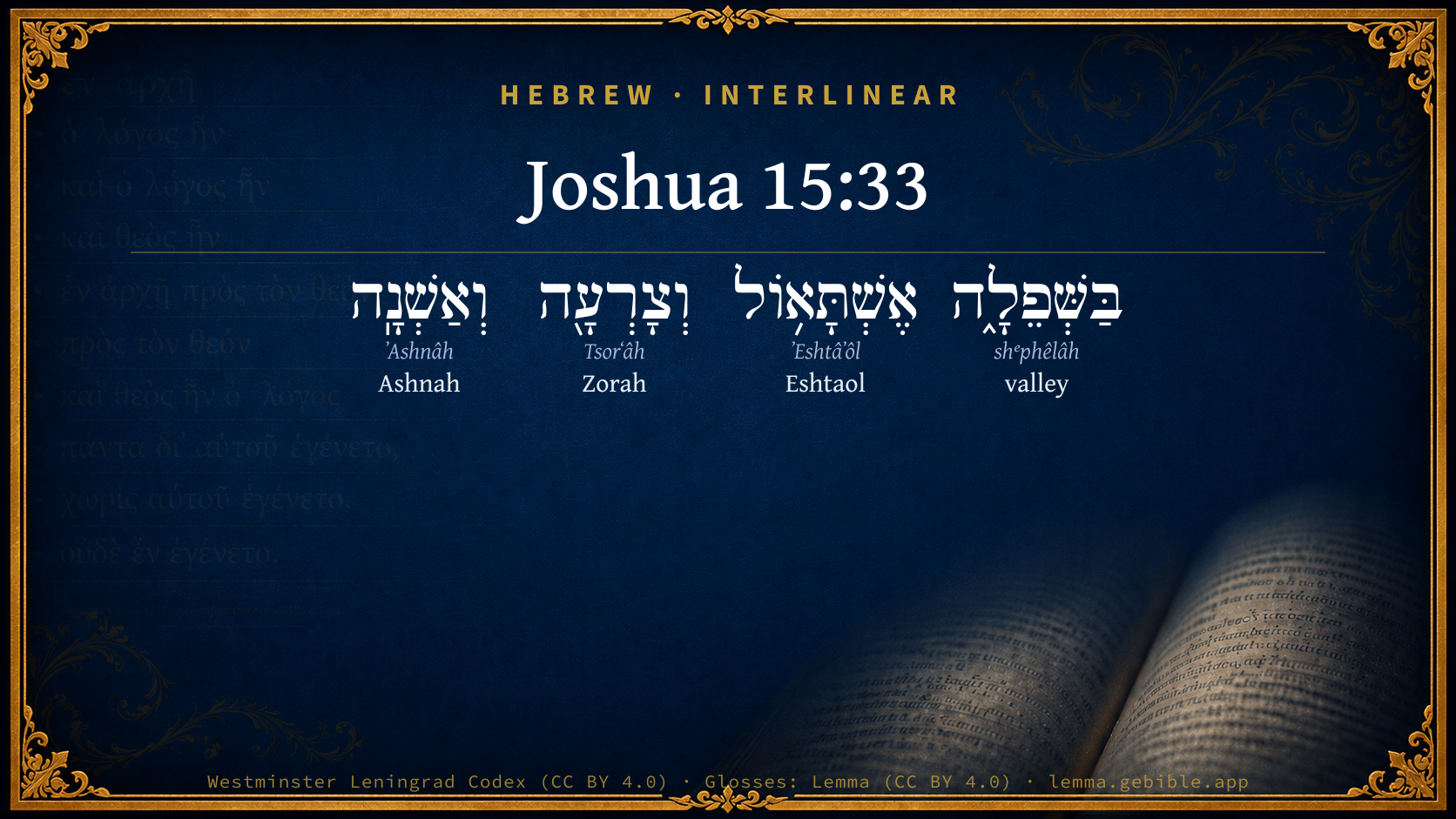
Joshua 15:33

Hebrew (Westminster Leningrad Codex) Joshua 15:33 appears in the Hebrew Old Testament. The text above is from the Westminster Leningrad Codex. Each word links to its Strong’s number, a concise gloss, and parsing drawn from the Open Scriptures Hebrew Bible morphology. Click any word for its full Brown-Driver-Briggs (BDB) entry.
Download image
Cite this verse

Joshua 15:33 (World English Bible). Public Domain. Lemma interlinear Bible study tool, https://lemma.gebible.app/v/joshua/15/33.

Show BibTeX & RIS
BibTeX
RIS
English Translation
In the lowland, Eshtaol, and Zorah, and Ashnah,
World English Bible · Public Domain
Highlights
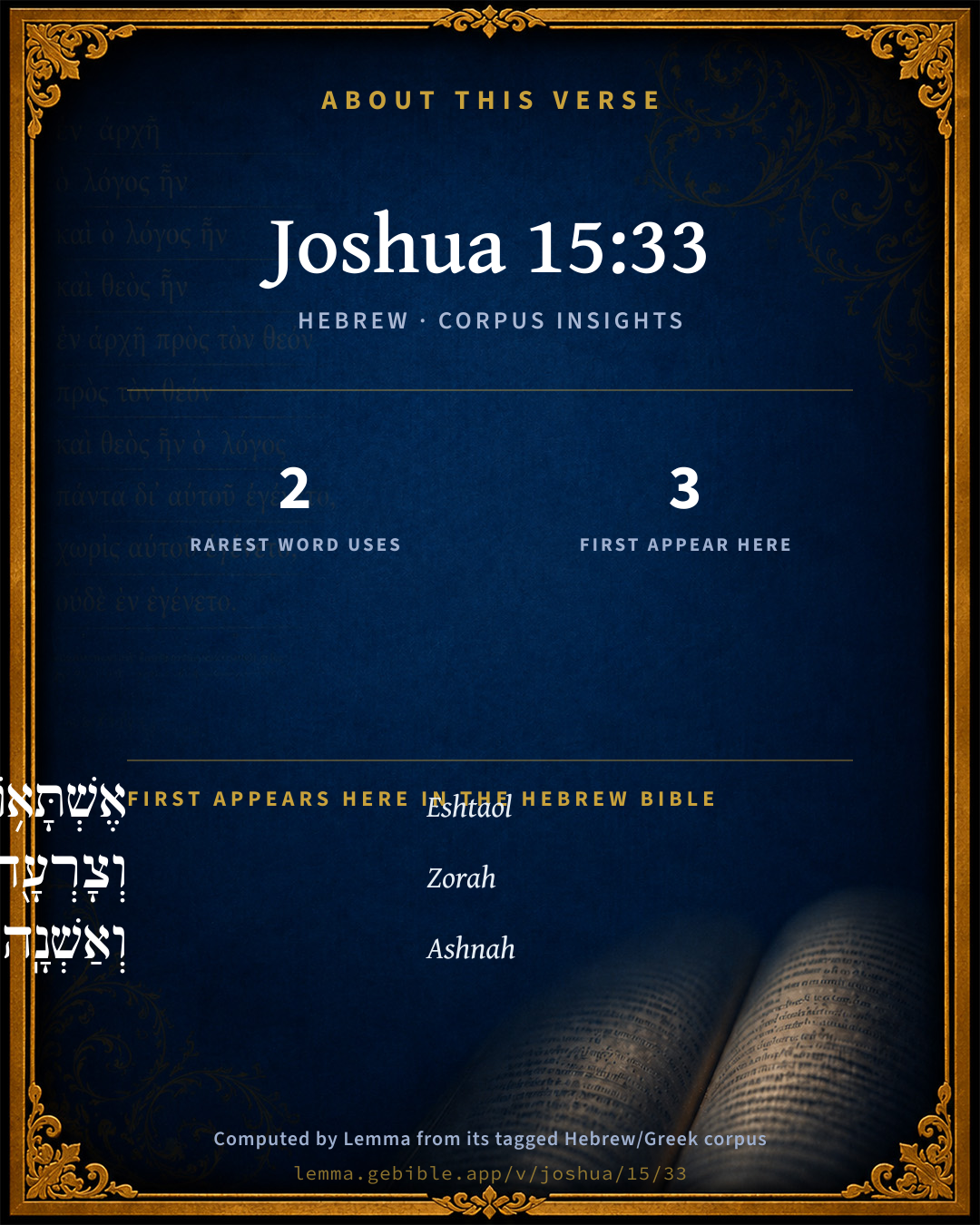
  • 3 first appearances in the Hebrew Bible
Full analysis ↓
Download a study sheet

One document with this verse’s original text, its word-by-word gloss line, the meaning frame, cross-references with their text, attributed commentary, and full source and license credits — printable, and it pastes into notes with its structure intact.

This verse Autodidact and up

Study sheet (.html) Plain text (.txt)

A passage Seminary Student

Up to 50 verses in one chapter. A passage sheet keeps up to 6 commentary sources and 12 cross-references per verse, in the order this page ranks them, and says so on the sheet whenever that leaves anything out. Ask for a single verse and you get the Autodidact verse sheet above.

Everything on this page stays free to read, with no account — the sheet is a download of what is already on screen, not access to it.

Want to remove ads? Support Godless Engineer
Compare translations 3

The same verse in 3 English versions, stacked beneath the original-language interlinear above. Click any original word for its lexicon entry.

Each is an independent rendering of the whole verse — the interlinear is not word-aligned to these translations.

Highlighted words mark where these versions differ — a whole-verse word diff, not a word-by-word alignment.

  • World English Bible Public Domain
    In the lowland, Eshtaol, and Zorah, and Ashnah,
  • King James Version Public Domain
    And in the valley, Eshtaol, and Zoreah, and Ashnah,
  • unfoldingWord Literal Text CC BY-SA 4.0
    In the lowlands: Eshtaol and Zorah and Ashnah

unfoldingWord Literal Text — © unfoldingWord, licensed CC BY-SA 4.0. Word-aligned USFM3 via Door43 (git.door43.org/unfoldingWord/en_ult).

Versions to compare (up to 4)

3 of 4 selected

Show all 18 translations

Every available English version of this verse, each an independent rendering of the whole verse.

  • World English Bible Public Domain
    In the lowland, Eshtaol, and Zorah, and Ashnah,
  • Berean Standard Bible Public Domain
    These were in the foothills: Eshtaol, Zorah, Ashnah,
  • Majority Standard Bible Public Domain
    These were in the foothills: Eshtaol, Zorah, Ashnah,
  • King James Version Public Domain
    And in the valley, Eshtaol, and Zoreah, and Ashnah,
  • American Standard Version (1901) Public Domain
    In the lowland, Eshtaol, and Zorah, and Ashnah,
  • Revised Version (1885) Public Domain
    In the lowland, Eshtaol, and Zorah, and Ashnah;
  • Geneva Bible (1599) Public Domain
    In the lowe countrey were Eshtaol, and Zoreah, and Ashnah,
  • Douay-Rheims (1899) Public Domain
    But in the plains: Estaol and Sarea and Asena,
  • Young's Literal Translation Public Domain
    In the low country: Eshtaol, and Zoreah, and Ashnah,
  • Literal Standard Version CC BY-SA 4.0
    In the low country: Eshtaol, and Zoreah, and Ashnah,
  • Unlocked Literal Bible CC BY-SA 4.0
    In the lower hill country to the west, there were Eshtaol, Zorah, Ashnah,
  • unfoldingWord Literal Text CC BY-SA 4.0
    In the lowlands: Eshtaol and Zorah and Ashnah
  • Darby Bible Public Domain
    -- In the lowland: Eshtaol, and Zoreah, and Ashnah,
  • World Messianic Bible Public Domain
    In the lowland, Eshtaol, Zorah, Ashnah,
  • Webster's Bible Public Domain
    And in the valley, Eshtaol, and Zoreah, and Ashnah,
  • Free Bible Version CC BY-SA 4.0
    The towns in the western foothills: Eshtaol, Zorah, Ashnah,
  • Bible in Basic English Public Domain
    In the lowland, Eshtaol, and Zorah, and Ashnah;
  • JPS Tanakh (1917) Public Domain
    In the Lowland: Eshtaol, and Zorah, and Ashnah;

Literal Standard Version (2020), Covenant Press — licensed CC BY-SA 4.0. Text via the HelloAO Bible API (eBible.org). Unlocked Literal Bible (unfoldingWord) — licensed CC BY-SA 4.0. Text via the HelloAO Bible API (eBible.org). unfoldingWord Literal Text — © unfoldingWord, licensed CC BY-SA 4.0. Word-aligned USFM3 via Door43 (git.door43.org/unfoldingWord/en_ult). Free Bible Version, Dr. Jonathan Gallagher — licensed CC BY-SA 4.0. Text via the HelloAO Bible API (eBible.org).

Word by word

More ways to search: Search by grammar → Find every occurrence → Compare this word →

Practice this passage: Drill this verse → Learn its vocabulary →

About this verse

These counts appear in no published source. They are computed here, from the morphology-tagged text and Lemma’s own curated glosses. What Lemma adds →

4
words
4
distinct lemmas
Historical
section

Notable vocabulary

The rarest word here is וְאַשְׁנָֽה Ashnah H823 — appearing just 2 times in the whole Hebrew Bible.

First appearance in Scripture

These words make their first canonical appearance in the Hebrew Bible here:

  • אֶשְׁתָּא֥וֹל Eshtaol H847
  • וְצָרְעָ֖ה Zorah H6881
  • וְאַשְׁנָֽה Ashnah H823

Shared distinctive vocabulary

וְאַשְׁנָֽה Ashnah H823 occurs in 2 verses of the Hebrew Bible. Also found in:

Grammatical profile

  • 4 nouns

Hebrew & Septuagint length

In English translation the verse runs 8 words from the Hebrew and 9 from the Septuagint (LXX English) — closely comparable.

A rough comparison of the two English renderings, which tokenize alike — not a word-level alignment.

Word counts can differ between the Hebrew and the Greek without any difference in meaning — e.g. the Hebrew direct-object marker אֵת has no separate Greek word, and Greek often adds the article ὁ.

Cross-references

4

Topical passages linked to Joshua 15:33 in the Treasury of Scripture Knowledge — connected by theme and wording, ordered by reader-vote popularity; previews shown in the World English Bible.

  • Judges 13:25 The Spirit of Yahweh began to move him in Mahaneh-dan, between Zorah and Eshtaol.
  • Judges 16:31 Then his brothers and all the house of his father came down, and took him, and brought him up, and buried him between Zorah and Eshtaol in the burying-place of Manoah his father. He judged Israel twenty years.
  • Numbers 13:23 They came to the valley of Eshcol, and cut down from there a branch with one cluster of grapes, and they bore it on a staff between two; [they brought] also of the pomegranates, and of the figs.
  • Joshua 19:41 The border of their inheritance was Zorah, and Eshtaol, and Irshemesh,

Cross-references courtesy of OpenBible.info (CC BY 4.0).

Hebrew and Greek witnesses Masoretic Hebrew ↔ Greek Septuagint

The same verse in the two great witnesses to the Old Testament, shown verse-for-verse.

These are two independent witnesses, not word-aligned to each other, and the Septuagint is shown in lemma (dictionary) form.

Hebrew Joshua 15:33 Masoretic · Westminster Leningrad Codex

בַּשְּׁפֵלָ֑ה אֶשְׁתָּא֥וֹל וְצָרְעָ֖ה וְאַשְׁנָֽה

In the lowland, Eshtaol, and Zorah, and Ashnah,

World English Bible · Public Domain

Greek LXX Joshua 15:33 Septuagint · lemma form

ἐν ὁ πεδεινός ασταωλ καί ραα καί ασσα

In the plain country Astaol, and Raa, and Assa,

LXX2012 (modern English Septuagint) · Public Domain

Hebrew: Westminster Leningrad Codex (CC BY 4.0). Greek: Septuagint (public domain); English from LXX2012 (modern English Septuagint) (Public Domain). How the Septuagint differs from the Hebrew →

Targum (Aramaic paraphrase)

1

The Targum is the ancient Jewish Aramaic paraphrase of the Hebrew Scriptures — an interpretive translation, not the Hebrew text itself. Onkelos (literal) and Pseudo-Jonathan (expansive) render the Torah, and Jonathan the Prophets. Coverage is partial: where no permissively-licensed English translation exists for a verse, only the Aramaic is shown. This is verse-level text, not a word-by-word alignment to the Hebrew.

  1. Targum Jonathan Prophets (Joshua–Malachi)
    בִּשְׁפֶלְתָּא אֶשְׁתָּאוֹל וְצָרְעָה וְאַשְׁנָה:

    (no public-domain English translation for this verse)

    Targum Jonathan — Aramaic: “Mikraot Gedolot” (public domain). English: “Sefaria Community Translation” (CC0 1.0 (public-domain dedication)); “London "Chaldee Paraphrase," 1871” (public domain). Text via Sefaria.

Commentary

Notes on Joshua 15:33 from classic Christian and Jewish commentators (each source and its license shown beneath its notes). The classic Christian expositions comment on the surrounding passage and are grouped to its opening verse, so a note may address several verses; the Jewish commentaries on the Tanakh (Rashi and others) are per-verse, so they appear only where the commentator wrote on this verse.

Lemma curates 59 commentaries, every one of them public domain or Creative Commons licensed, each selected and text-cleaned for this edition rather than reprinted as found. About our sources →

Ellicott's Commentary for English Readers

(33) In the valley—i.e., the Shephêlah, or plain of the coast. Of the fourteen that follow in Jos_15:33-36, Conder identifies ten.

Eshtaol, and Zoreah, were afterwards assigned to Dan (Jos_19:41).

A Bible Commentary for English Readers, edited by Charles John Ellicott (1878–1897) — public domain. Text from a community e-Sword module.

Tyndale Open Study Notes

Tyndale Open Resources

15:33 From the perspective of the highlanders of the Judean hill country, the lower hills between them and the coastal plain were the western foothills. These hills were separated geologically from the hill country by a series of north–south valleys. In this list, the western foothills are divided into four districts.

Tyndale Open Study Notes — © Tyndale Open Resources, licensed CC BY-SA 4.0. Text via the HelloAO Bible API.

Adam Clarke's Commentary

Verse 33. Eshtaol, and Zoreah] Here Samson was buried, it being the burial-place of his fathers; see Jdg 16:31. These places though first given to Judah, afterwards fell to the lot of Dan, Jos 19:41.

Adam Clarke's Commentary on the Bible (1810–1826) — public domain. Text from a community e-Sword/MySword module.

The Cambridge Bible for Schools and Colleges

gen. ed. J. J. S. Perowne

33–47. Cities in the Lowland

33. in the valley] i.e. the Lowland. See above, Jos_15:20, and also Jos_10:40; Jos_11:16. The places mentioned are arranged in four groups. The first of these lies in the north-eastern portion of the Shephêlah:—

Group I. 1. Eshtaol = Yeshû’a; 2. Zoreah = Sûrah, the residence of Manoah (Jdg_13:2; Jdg_13:25) and the native place of Samson. It lay close to Eshtaol. Here Samson spent his boyhood, and to a spot between the two places his dead body was brought after his last great exploit (Jdg_13:25; Jdg_16:31); 3. Ashnah, unknown; 4. Zanoah now Zântû’a; 5. En-gannim, and 6. Tappuah are unknown; 7. Enam is mentioned Gen_38:14; Gen_38:21; Genesis 8. Jarmuth (Yarmuk), a Canaanitish capital, see above Jos_15:35; Joshua 9. Adullam, see above Jos_15:35; Joshua 10. Socoh, now Shuweikeh; 11. Azekah (see above, Jos_10:10), the beautiful vale, “the valley of Elah,” between it and Socoh, was celebrated for the combat between David and Goliath; 12. Sharaim, see 1Sa_17:52; 1 Samuel 13. Adithaim, site unknown; 14. Gederah, with the article, properly = “the wall,” undiscovered; 15. Gederothaim, unknown.

The Cambridge Bible for Schools and Colleges (gen. ed. J. J. S. Perowne; Cambridge University Press, 1878–1918) — public domain. Text from a community e-Sword module.

John Gill's Exposition

And Zanoah,.... The first of these, Jerom says (i), is in the borders of Eleutheropolis, as you go to Aelia (or Jerusalem); there is at this day a village called Zanua:

and Engannim, which signifies a fountain of gardens, is now (according to the same writer (k)) a village near Bethel:

and Tappuah was a royal city, of which see Jos 12:17. Enaim, in the tribe of Judah, Jerom says (l) in his day was the village Bethenim, about the turpentine tree, or oak of Mamre; but that seems to be the same with Ain, Jos 15:32; of which he says the same under that word, and makes it to be two miles from the oak, and four from Hebron. Masius thinks it is the same with Enam, near to Timnath, of which See Gill on Gen 38:14; it following Tappuah one would be tempted to think with Jarchi it was the same with Entappuah, but that that was on the borders of Manasseh, Jos 17:7,

and Enam; it has an prefixed to it, and may be read "that Enam", as pointing out some known and remarkable place, though now unknown.

(i) De loc. Heb. fol. 95. G. (k) Ibid. fol. 91. E. (l) Ibid. fol. 91. E.

John Gill's Exposition of the Whole Bible (1746–1763) — public domain (CC PDM 1.0). Text via the HelloAO Bible API.

Haydock's Catholic Bible Commentary

Plains. Hebrew Schephela, near Eleutheropolis, chap. x. 40. --- Estaol was afterwards given to Dan. Samson was buried near it and Sarea, Judges xvi.

George Leo Haydock (1774–1849), Haydock's Catholic Family Bible and Commentary, 1859 edition — public domain. Excludes Psalms (Douay-Rheims chapter numbering differs from Protestant) and Deuterocanonical books (Catholic canon only).

Whedon's Commentary on the Bible

Daniel D. Whedon

33. In the valley — Hebrews, Shephelah, the lowland. See on Jos_10:40. These cities are enumerated in four groups. A portion of these in the north was afterwards conceded to Dan. Eshtaol and Zoreah afterwards became famous in the tribe of Dan as the scene of Samson’s childhood and first daring exploits, (Jdg_13:25,) and also the place of his burial. Jdg_16:31. The exact site of Eshtaol is unknown; but Zoreah, or Zorah, still exists in the modern Surah, just below the summit of a sharp-pointed hill on the north side of the Wady Ghurab. The prospect from the top of this hill is extensive and fine.

Daniel D. Whedon (gen. ed.), Commentary on the Old and New Testaments (1874–1909) — public domain. Text from a community e-Sword module.

The Pulpit Commentary

The valley. hlpe (see note on Jos_9:1 Jos_10:40) This was the fertile part of Judah, and formed a part of the rich plain which has been described as extending northward as far as Carmel. It was "renowned for the beauty of its flowers" (Delitzsch). With the exception of Zorah and Eshtaol, border towns to the tribe of Dan, (Jos_19:41 Jud_1:13:25) famous in the history of Samson (see Judges 13-16.), and mentioned in 2Ch_11:10 Neh_11:29, the cities remarkable in history have been noticed already. It is worthy of remark that the cities of the Philistines were included in this list. But the Philistines, save during the reigns of David and Solomon, retained their independence, and in earlier and later times alike even encroached upon the Jewish territory. (see 1Sa_13:5 2Ch_28:18; and note on ver. 11)

The Pulpit Commentary (1880–1919), ed. H.D.M. Spence-Jones & Joseph S. Exell — public domain. Text from a community e-Sword module.

unfoldingWord translationNotes

Door43 World Missions Community

General Information:

The writer lists the northern cities of which Judah took possession. (See: How to Translate Names)

unfoldingWord translationNotes — © Distant Shores Media and the Door43 World Missions Community, licensed CC BY-SA 4.0. Source: git.door43.org/Door43/en_tn.

Lesson kit

Teaching starters — assembled from the data on this page, not authored interpretation. Every prompt links to the verse data it draws on. Edit before teaching.

Joshua, in the Historical, opens this verse with 4 words (4 distinct Hebrew lemmas). Its most distinctive word is ʼAshnâh (“Ashnah”). A historical commentator’s framing appears above. Read the whole chapter for the surrounding context.

Discussion questions

  1. What does “Ashnah” (ʼAshnâh) contribute to the verse as a whole?
  2. 3 words here appear for the first time in Scripture. What is being introduced at this debut?
  3. Joshua 15:43 shares the word «Ashnah» with this verse. How do the two illuminate each other?
  4. These translations render this verse differently; the difference is in the English rendering, not the original. What questions does that raise?
  5. Reading how Ellicott's Commentary for English Readers and Tyndale Open Study Notes read this verse, where do the two commentators agree and where do they part?

Things to notice

  • 3 words make their first canonical appearance in Scripture here.
  • These translations choose different wording for 5 words in this verse.
  • 4 distinct Hebrew lemmas span 4 words in this verse.

Reading settings

Reading text

Shown beneath each verse's original-language words.

Old Testament
Old Testament edition

Read the OT as the Masoretic Hebrew (MT) or the Greek Septuagint (LXX).

English shown for the Greek Septuagint (in the Hebrew ↔ Greek comparison).

Comparing translations? Open the Compare panel on any verse page to stack up to four side by side.