
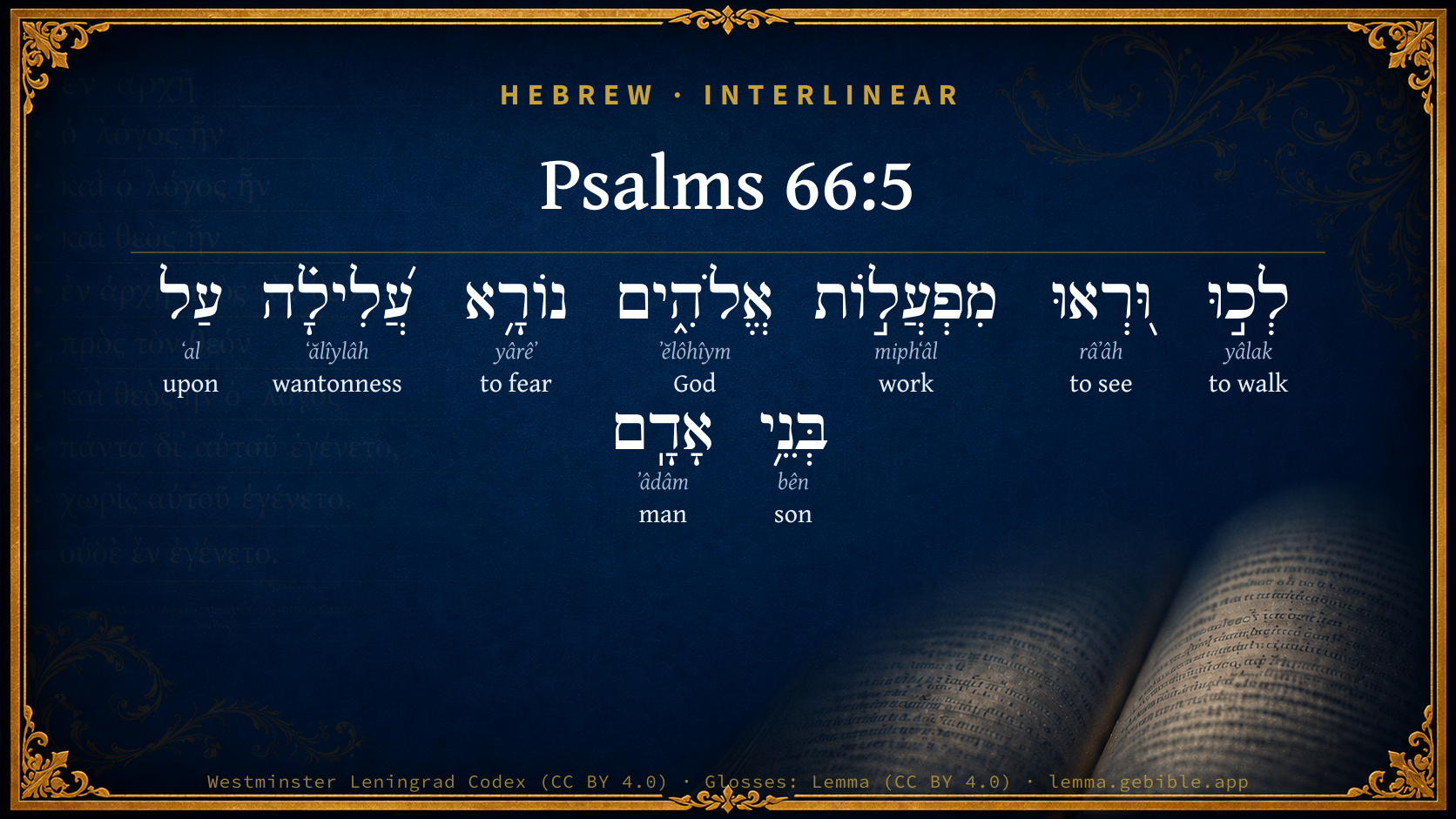
Psalms 66:5

Hebrew (Westminster Leningrad Codex) Psalms 66:5 appears in the Hebrew Old Testament. The text above is from the Westminster Leningrad Codex. Each word links to its Strong’s number, a concise gloss, and parsing drawn from the Open Scriptures Hebrew Bible morphology. Click any word for its full Brown-Driver-Briggs (BDB) entry.
Download image
Cite this verse

Psalms 66:5 (World English Bible). Public Domain. Lemma interlinear Bible study tool, https://lemma.gebible.app/v/psalms/66/5.

Show BibTeX & RIS
BibTeX
RIS
English Translation
Come, and see God's deeds-- Awesome work on behalf of the children of men.
World English Bible · Public Domain
Download a study sheet

One document with this verse’s original text, its word-by-word gloss line, the meaning frame, cross-references with their text, attributed commentary, and full source and license credits — printable, and it pastes into notes with its structure intact.

This verse Autodidact and up

Study sheet (.html) Plain text (.txt)

A passage Seminary Student

Up to 50 verses in one chapter. A passage sheet keeps up to 6 commentary sources and 12 cross-references per verse, in the order this page ranks them, and says so on the sheet whenever that leaves anything out. Ask for a single verse and you get the Autodidact verse sheet above.

Everything on this page stays free to read, with no account — the sheet is a download of what is already on screen, not access to it.

Want to remove ads? Support Godless Engineer
Compare translations 3

The same verse in 3 English versions, stacked beneath the original-language interlinear above. Click any original word for its lexicon entry.

Each is an independent rendering of the whole verse — the interlinear is not word-aligned to these translations.

Highlighted words mark where these versions differ — a whole-verse word diff, not a word-by-word alignment.

  • World English Bible Public Domain
    Come, and see God's deeds-- Awesome work on behalf of the children of men.
  • King James Version Public Domain
    Come and see the works of God: he is terrible in his doing toward the children of men.
  • unfoldingWord Literal Text CC BY-SA 4.0
    Come and see the works of God, fearsome in doing toward the sons of man.

unfoldingWord Literal Text — © unfoldingWord, licensed CC BY-SA 4.0. Word-aligned USFM3 via Door43 (git.door43.org/unfoldingWord/en_ult).

Versions to compare (up to 4)

3 of 4 selected

Show all 18 translations

Every available English version of this verse, each an independent rendering of the whole verse.

  • World English Bible Public Domain
    Come, and see God's deeds-- Awesome work on behalf of the children of men.
  • Berean Standard Bible Public Domain
    Come and see the works of God; how awesome are His deeds toward mankind.
  • Majority Standard Bible Public Domain
    Come and see the works of God; how awesome are His deeds toward mankind.
  • King James Version Public Domain
    Come and see the works of God: he is terrible in his doing toward the children of men.
  • American Standard Version (1901) Public Domain
    Come, and see the works of God; `He is' terrible in his doing toward the children of men.
  • Revised Version (1885) Public Domain
    Come, and see the works of God; he is terrible in his doing toward the children of men.
  • Geneva Bible (1599) Public Domain
    Come and beholde the workes of God: he is terrible in his doing towarde the sonnes of men.
  • Douay-Rheims (1899) Public Domain
    Come and see the works of God; who is terrible in his counsels over the sons of men.
  • Young's Literal Translation Public Domain
    Come ye, and see the works of God, Fearful acts toward the sons of men.
  • Literal Standard Version CC BY-SA 4.0
    Come, and see the works of God, || Fearful acts toward the sons of men.
  • Unlocked Literal Bible CC BY-SA 4.0
    Come and see the works of God; he is fearsome in his deeds toward the sons of mankind.
  • unfoldingWord Literal Text CC BY-SA 4.0
    Come and see the works of God, fearsome in doing toward the sons of man.
  • Darby Bible Public Domain
    Come and see the works of God: he is terrible in [his] doings toward the children of men.
  • World Messianic Bible Public Domain
    Come, and see God’s deeds— awesome work on behalf of the children of men.
  • Webster's Bible Public Domain
    Come and see the works of God: he is terrible in his doing towards the children of men.
  • Free Bible Version CC BY-SA 4.0
    Come and see what God has done! What he does for people is truly awesome!
  • Bible in Basic English Public Domain
    Come and see the works of God: he is to be feared in all he does to the children of men.
  • JPS Tanakh (1917) Public Domain
    Come, and see the works of God; He is terrible in His doing toward the children of men.

Literal Standard Version (2020), Covenant Press — licensed CC BY-SA 4.0. Text via the HelloAO Bible API (eBible.org). Unlocked Literal Bible (unfoldingWord) — licensed CC BY-SA 4.0. Text via the HelloAO Bible API (eBible.org). unfoldingWord Literal Text — © unfoldingWord, licensed CC BY-SA 4.0. Word-aligned USFM3 via Door43 (git.door43.org/unfoldingWord/en_ult). Free Bible Version, Dr. Jonathan Gallagher — licensed CC BY-SA 4.0. Text via the HelloAO Bible API (eBible.org).

Word by word

More ways to search: Search by grammar → Find every occurrence → Compare this word →

Practice this passage: Drill this verse → Learn its vocabulary →

About this verse

These counts appear in no published source. They are computed here, from the morphology-tagged text and Lemma’s own curated glosses. What Lemma adds →

9
words
9
distinct lemmas
Wisdom
section

Notable vocabulary

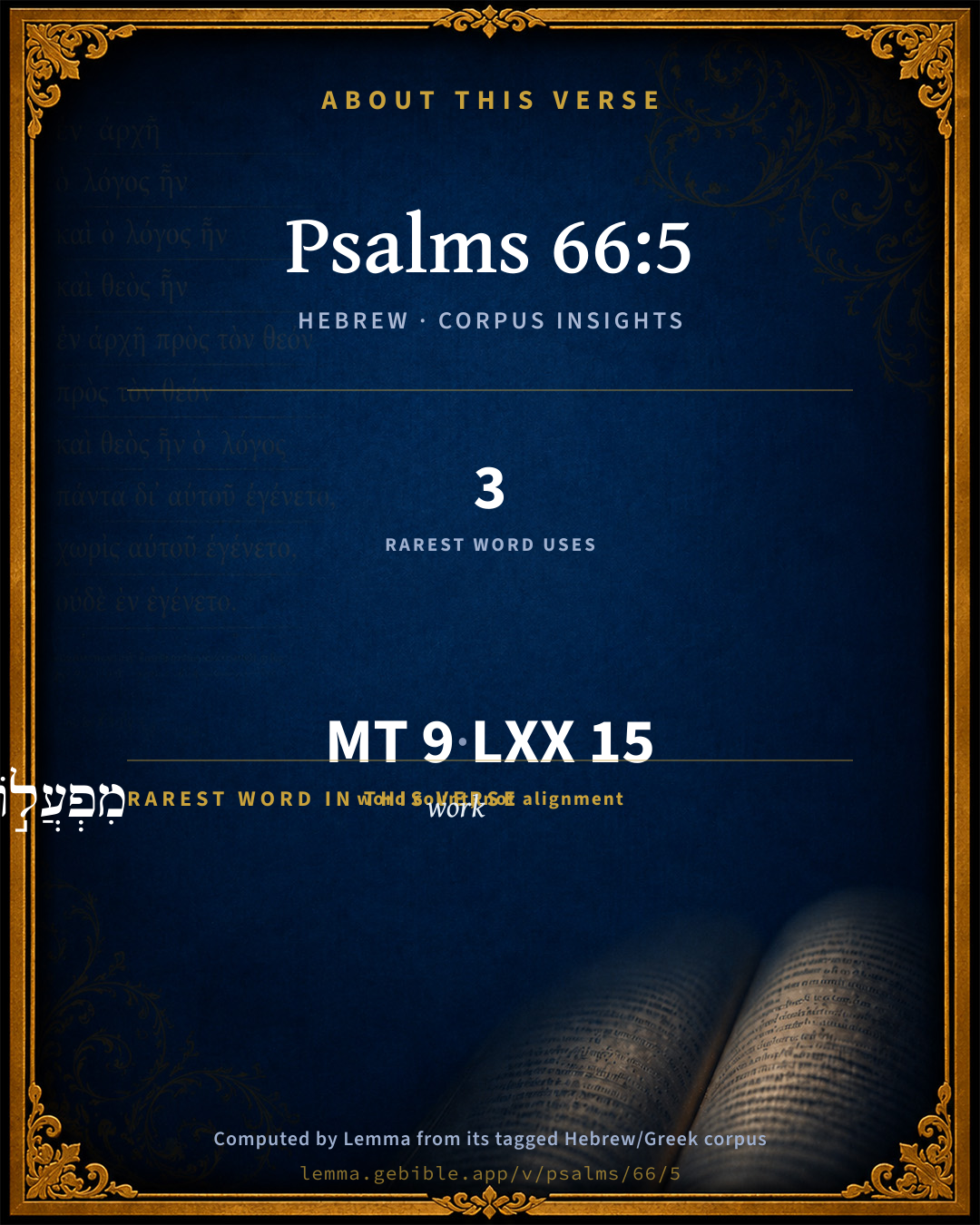
The rarest word here is מִפְעֲל֣וֹת work H4659 — appearing just 3 times in the whole Hebrew Bible.

Shared distinctive vocabulary

מִפְעֲל֣וֹת work H4659 occurs in 3 verses of the Hebrew Bible. Also found in:

Grammatical profile

  • 3 verbs
  • 5 nouns
  • 1 preposition

Verb forms

  • לְכ֣וּ Qal · Imperative
  • וּ֭רְאוּ Qal · Imperative
  • נוֹרָ֥א Niphal · Participle Active

Hebrew & Septuagint length

In English translation the verse runs 14 words from the Hebrew and 18 from the Septuagint (LXX English) — closely comparable.

A rough comparison of the two English renderings, which tokenize alike — not a word-level alignment.

Word counts can differ between the Hebrew and the Greek without any difference in meaning — e.g. the Hebrew direct-object marker אֵת has no separate Greek word, and Greek often adds the article ὁ.

In the original languages it is 9 Hebrew tokens and 15 Greek tokens — but the two are counted differently (Hebrew bundles its prefixes and suffixes into one token; the Greek is in lemma form), so that isn’t a like-for-like length.

Cross-references

9

Topical passages linked to Psalms 66:5 in the Treasury of Scripture Knowledge — connected by theme and wording, ordered by reader-vote popularity; previews shown in the World English Bible.

  • Psalms 126:1–3 When Yahweh brought back those who returned to Zion, We were like those who dream.
  • Numbers 23:23 Surely there is no enchantment with Jacob; Neither is there any divination with Israel: Now shall it be said of Jacob and of Israel, What has God done!
  • Psalms 46:8 Come, see Yahweh's works, What desolations he has made in the earth.
  • Psalms 66:3 Tell God, "How awesome are your deeds! Through the greatness of your power, your enemies submit themselves to you.
  • Psalms 66:16 Come, and hear, all you who fear God. I will declare what he has done for my soul.
  • Psalms 111:2 Yahweh's works are great, Pondered by all those who delight in them.
  • Psalms 99:3 Let them praise your great and awesome name. He is Holy!
  • Psalms 106:22 Wondrous works in the land of Ham, And awesome things by the Red Sea.
  • Ezekiel 1:18 As for their rims, they were high and dreadful; and they four had their rims full of eyes round about.

Cross-references courtesy of OpenBible.info (CC BY 4.0).

Hebrew and Greek witnesses Masoretic Hebrew ↔ Greek Septuagint

The same verse in the two great witnesses to the Old Testament, shown verse-for-verse.

You’re reading Greek Psalm 65 (Hebrew Psalm 66). The Septuagint counts the superscription, so verse numbers can differ from the Hebrew — chapter-level alignment, not verse-by-verse. Numbering follows Rahlfs.

These are two independent witnesses, not word-aligned to each other, and the Septuagint is shown in lemma (dictionary) form.

Hebrew Psalms 66:5 Masoretic · Westminster Leningrad Codex

לְכ֣וּ וּ֭רְאוּ מִפְעֲל֣וֹת אֱלֹהִ֑ים נוֹרָ֥א עֲ֝לִילָ֗ה עַל בְּנֵ֥י אָדָֽם

Come, and see God's deeds-- Awesome work on behalf of the children of men.

World English Bible · Public Domain

Greek LXX Greek Psalm 65:5 Septuagint · lemma form

δεῦτε καί ὁράω ὁ ἔργον ὁ θεός φοβερός ἐν βουλή ὑπέρ ὁ υἱός ὁ ἄνθρωπος

Come and behold the works of God; he is terrible in his counsels beyond the children of men.

LXX2012 (modern English Septuagint) · Public Domain

Hebrew: Westminster Leningrad Codex (CC BY 4.0). Greek: Septuagint (public domain); English from LXX2012 (modern English Septuagint) (Public Domain). How the Septuagint differs from the Hebrew →

Commentary

Notes on Psalms 66:5 from classic Christian and Jewish commentators (each source and its license shown beneath its notes). The classic Christian expositions comment on the surrounding passage and are grouped to its opening verse, so a note may address several verses; the Jewish commentaries on the Tanakh (Rashi and others) are per-verse, so they appear only where the commentator wrote on this verse.

Lemma curates 59 commentaries, every one of them public domain or Creative Commons licensed, each selected and text-cleaned for this edition rather than reprinted as found. About our sources →

Trapp's Complete Commentary

John Trapp

Psa 66:5 Come and see the works of God: [he is] terrible [in his] doing toward the children of men.

Ver. 5. Come and see] Venite, videte; he taketh good people by the hand, as it were, leading them to the sight of God’s stupendous proceedings, which may not be slighted, Isa 5:12.

Toward the children of men] For they are his chief care, and about them is his providence principally exercised.

John Trapp, A Commentary or Exposition upon All the Books of the Old and New Testament (1647–1656) — public domain. Text from a community e-Sword module.

The Biblical Illustrator

Joseph S. Exell

Psa_66:5-12

Come and see the works of God.

The Eternal Ruler of the universe

I. As an object for human study. Come and see the works of God.

1. The highest study of man is God. All other studies, unless they lead up to Him, are worse than useless.

(1) The study of God is the most quickening. It stirs the profoundest fountains of sympathy, and sets all the wheels of the mental machine to work.

(2) It is the most humbling study. As the mind directs its attention to God, all egotism vanishes--the particular is lost in the universal, the temporary in the eternal.

(3) It is the most elevating study. That on which a man centres his mind has a mystic power to draw him to it, either up or down, according to its nature. The study of God alone has the power to draw man up into the higher grades of being.

2. The writer here directs attention to two things in relation to God.

(1) His special interpositions (Psa_66:5).

(2) His transcendent rulership (Psa_66:7).

II. As an object for human praise (Psa_66:8-12). He suggests three reasons for praising God.

1. Preservation (Psa_66:9).

2. Chastisement (Psa_66:10-12). Afflictions, says Lord Bacon, plough the heart and make it fit for Wisdom to sow her seed in, and for Grace to bring forth her increase. Could we see things as they really are, we should often see greater reason for praising God in our afflictions rather than for our health and prosperity.

3. Success. Thou broughtest us out into a wealthy place. A place of refreshment. This was compensation for all the trials. What if our scorching and exhausting journey lead us to a delicious resting-place? What if our frail bark is beaten by the tempest to a golden shore? What if the loathsome medicine work off the disease, and establish health? In all such cases there should be praise for all the trials. (Homilist.)

The Biblical Illustrator, edited by Joseph S. Exell (c. 1880s–1900s) — public domain. Text from a community e-Sword module.

Joseph Benson's Commentary

Psa 66:5-6. Come and see the works of God, &c. — Inquire after and consider seriously what works of stupendous power God has shown in the earth, in regard to the human race, and on their account. He turned the sea, &c. — He opened a passage for our fathers through the sea, so that they walked as on dry land, Exo 14:16; and also led them dry-shod through the river Jordan, when it was so full of water that it overflowed its banks. There did we rejoice in him — That is, our nation, or our ancestors, in whose loins we then were, and the benefit of which ancient deliverance we at this day enjoy. The whole people of Israel are here, and in many other parts of Scripture, considered as one body, continued through all succeeding generations, united in the bonds of the same covenant and worship, and in the possession of the same promises, privileges, and blessings, and influenced by one and the same spirit. Hence several and contrary things may reasonably be ascribed to them, in regard of their several ages; and what was done in one age may be imputed to another, by virtue of their close conjunction with the same body.

Joseph Benson's Commentary on the Old and New Testaments (1811–1818) — public domain. Text from a community e-Sword module.

J. A. Alexander on Psalms

Joseph Addison Alexander

5. (Psa 66:5) Go, see the works of God, fearful (in) action on the sons of man. The verb go is often used in Hebrew, as a formula of invitation or of challenge, where in English we say come. See below, Psa 66:16, and compare Isa 2:3; Isa 2:5. In this case, however, go may be intended to express something more than would have been expressed by come. The meaning may be, if you do not believe these general declarations of God's power and dominion, go and see for yourselves the proofs already given in the history of mankind, and more especially in that of Israel: go to Egypt, to the Red Sea, to the Wilderness, to Jordan, and in the wonders there performed and still repeated in the experience of the church, see the evidence that God is indeed possessed of a tremendous power to control and influence mankind. With the first clause compare Psa 46:8, the only other place where the word tvlfpm occurs.

Joseph Addison Alexander, The Psalms Translated and Explained (1850) — public domain. Text from a community e-Sword module.

Tyndale Open Study Notes

Tyndale Open Resources

66:5-7 The story of the Exodus and God’s victory over the sea evokes responses of astonishment (66:5) and worship (66:6). God works miracles . . . for people in order to redeem them for himself.

Tyndale Open Study Notes — © Tyndale Open Resources, licensed CC BY-SA 4.0. Text via the HelloAO Bible API.

Geneva Bible (1599)

Geneva Bible translators

He toucheth the slothful dullness of man, who is cold in the consideration of God’s works.

His providence is wonderful in maintaining their estate.

Geneva Bible (1599) marginal notes — public domain. Text via Bolls.life.

Jamieson, Fausset & Brown

Robert Jamieson, A. R. Fausset & David Brown

The terrible works illustrated in Israel's history (Exo 14:21). By this example let rebels be admonished.

Jamieson, Fausset & Brown — Commentary Critical and Explanatory on the Whole Bible (1871) — public domain (CC PDM 1.0). Text via the HelloAO Bible API.

Adam Clarke's Commentary

Verse 5. Come and see the works of God] Let every man lay God's wonderful dealings with us to heart; and compare our deliverance from Babylon to that of our fathers from Egypt.

Adam Clarke's Commentary on the Bible (1810–1826) — public domain. Text from a community e-Sword/MySword module.

John Calvin's Commentaries

5. Come and see the works of God An indirect censure is here passed upon that almost universal thoughtlessness which leads men to neglect the praises of God. Why is it that they so blindly overlook the operations of his hand, but just because they never direct their attention seriously to them? We need to be aroused upon this subject. The words before us may receive some explanation by referring to a parallel passage, Psalm 46:8. But the great scope of them is this, that the Psalmist would withdraw men from the vain or positively sinful and pernicious pursuits in which they are engaged, and direct their thoughts to the works of God. To this he exhorts them, chiding their backwardness and negligence. The expression, Come and see, intimates that what they blindly overlooked was open to observation; for were it otherwise with the works of God, this language would be inappropriate. He next points out what those works of God are to which he would have our attention directed; in general he would have us look to the method in which God governs the human family. This experimental or practical kind of knowledge, if I might so call it, is that which makes the deepest impression. We find, accordingly, that Paul, (Acts 17:27) after speaking of the power of God in general, brings his subject to bear upon this one particular point, and calls upon us to descend into ourselves if we would discover the proofs of a present God. The last clause of the fifth verse I would not interpret with some as meaning that God was terrible above the children of men — superior to them in majesty — but rather that he is terrible towards them, evincing an extraordinary providence in their defense and preservation, as we have seen noticed, Psalm 40:5. Men need look no further, therefore, than themselves, in order to discover the best grounds for reverencing and fearing God. The Psalmist passes next from the more general point of his providence towards mankind at large, to his special care over his own Church, adverting to what he had done for the redemption of his chosen people. What he states here must be considered as only one illustration of many which he might have touched upon, and as intended to remind God’s people of the infinite variety of benefits with which their first and great deliverance had been followed up and confirmed. This appears obvious from what he adds, there we rejoiced in him It is impossible that the joy of that deliverance could have extended to him or any of the descendants of the ancient Israelites, unless it had partaken the nature of a pledge and illustration of the love of God to the Church generally. Upon that event he showed himself to be the everlasting Savior of his people; so that it proved a common source of joy to all the righteous.

John Calvin's Commentaries (1540-1563) — public domain. Text from the Calvin Translation Society English edition (1840s-50s) via the Christian Classics Ethereal Library (ccel.org). Calvin's coverage is partial (roughly two-thirds of the Bible); uncommented books and verses are honest gaps, never fabricated. The 19th-century editor's footnotes and remarks are omitted so the notes are faithfully Calvin's own voice.

The Cambridge Bible for Schools and Colleges

gen. ed. J. J. S. Perowne

5. Come and see the works of God] Cp. Psa_46:8, the only other place where the word for works is found.

he is terrible in his doing toward the children of men] The preposition toward implies supremacy over mankind. All men must fear Him (Psa_64:9); but it depends on themselves whether they will reverence Him as their God, or must dread Him as an enemy.

5–7. The nations are invited to contemplate God’s mighty works for His people in the past, and to learn that the sovereignty to which they bear witness is eternal and universal.

The Cambridge Bible for Schools and Colleges (gen. ed. J. J. S. Perowne; Cambridge University Press, 1878–1918) — public domain. Text from a community e-Sword module.

John Gill's Exposition

Come and see the works of God,.... Of the Messiah, God manifest in the flesh; those divine works which he did when here on earth; his miraculous works, which were proofs of his deity and Messiahship; his preaching the Gospel, in so divine a manner as never man did; his works of obedience to the law, which were pure and perfect; the everlasting righteousness he wrought out for the justification of his people; and the great work of redemption and salvation finished by him, which none but God could ever have effected. This is an invitation to the inhabitants of all lands, where the Gospel should come with power, to take notice of and consider these works of Christ, and the glory of his might, wisdom, and grace in them, in order to engage them to sing his praise;

he is terrible in his doing toward the children of men; in his vengeance on the Jews, for disbelieving and rejecting him; in destroying antichrist, and pouring out the vials of his wrath on the antichristian states; and in the everlasting damnation of the wicked. So that as his other works in the former clause design these of grace, this doing of his respects his work, his strange work of judgment on his enemies; on account of which he is terrible to them, and reverenced by his people.

John Gill's Exposition of the Whole Bible (1746–1763) — public domain (CC PDM 1.0). Text via the HelloAO Bible API.

Albert Barnes' Notes on the Bible

Come and see the works of God - See the notes at Psa 46:8, where substantially the same expression occurs. The idea is, “Come and see what God has done and is doing; come and learn from this what he is; and let your hearts in view of all this, be excited to gratitude and praise.” The particular reference here is to what God had done in delivering his people from their former bondage in Egypt Psa 66:6; but there is, connected with this, the idea that he actually rules among the nations, and that in his providence he has shown his power to govern and sbdue them.

He is terrible in his doing - That is, His acts are suited to inspire awe and veneration. See the notes at Psa 66:3.

Albert Barnes' Notes on the Bible (1834–1885) — public domain. Text from a community e-Sword/MySword module.

Matthew Poole's English Annotations

See the works of God; consider them wisely and seriously, for God’s glory, and for your own good.

Toward the children of men; to all his enemies; whom he calls the children of men, partly in way of contempt, to show how unable they are either to avoid or resist the great God; and partly in opposition to his own people, who are frequently called the children of God.

Matthew Poole's English Annotations on the Holy Bible (1683–1685) — public domain. Text from a community e-Sword/MySword module.

The Treasury of David

Charles H. Spurgeon

Ver. 5. Come and see the works of God. Such glorious events, as the cleaving of the Red Sea and the overthrow of Pharaoh, are standing wonders, and throughout all time a voice sounds forth concerning them --"Come and see." Even till the close of all things, the marvellous works of God at the Red Sea will be the subject of meditation and praise; for, standing on the sea of glass mingled with fire, the triumphal armies of heaven sing the song of Moses, the servant of God, and the song of the Lamb. It has always been the favourite subject of the inspired bards, and their choice was most natural.

He is terrible in his doing toward the children of men. For the defence of his church and the overthrow of her foes he deals terrific blows, and strikes the mighty with fear. O thou enemy, wherefore dost thou vaunt thyself? Speak no more so exceeding proudly, but remember the plagues which bowed the will of Pharaoh, the drowning of Egypt's chariots in the Red Sea, the overthrow of Og and Sihon, the scattering of the Canaanites before the tribes. This same God still liveth, and is to be worshipped with trembling reverence.

Ver. 5. Come and see the works of God. An indirect censure is here passed upon that almost universal thoughtlessness which leads men to neglect the praises of God. John Calvin.

Ver. 5. Come and see. The church at all times appeals to the world, Come and see, as Jesus said to the two disciples of John the Baptist, and Philip to Nathanael. Joh 1:39, 46. God's marvels are to be seen by all, and seeing them is the first step towards believing in their divine author. A. R. Faussett.

Ver. 5. Here is--

I. A subject for general study: the Works of God.

II. For particular study: his doings towards, etc.

1. These are the most wonderful.

2. In these we are most concerned.

Psalms 66:6*

Charles H. Spurgeon's The Treasury of David (1869–1885) — public domain. Psalms only. Text from a community e-Sword/MySword module.

Whedon's Commentary on the Bible

Daniel D. Whedon

5. Come and see the works of God—The address is still, as in Psa_66:1-3, to the nations of the earth. The “works of God” here referred to particularly relate to the great political revolutions of the kingdoms attending the downfall of the Babylonian monarchy, and the uprising of that of the Medo-Persian, eventuating in the fulfilment of the divine purpose and promise toward his Church in its liberation and re-establishment. Compare Dan_5:30-31; Dan_6:28 with chap. 9 and Ezra 1.

Terrible in his doing—See Psa_66:3.

Children of men—Poetically for men, mankind, especially the world as opposed to Israel.

Daniel D. Whedon (gen. ed.), Commentary on the Old and New Testaments (1874–1909) — public domain. Text from a community e-Sword module.

The Pulpit Commentary

Come and see the works of God. Contemplate, i.e., the terrible "works of God," spoken of in ver. 3. See how, to save his people, he has to smite their enemies. Truly, on such occasions, he is terrible in his doing toward the children of men (compare the next verse for an example).

Holy fear a reasonable element of true spiritual worship.

"Come and see," etc. Joy and terror seem so diverse and contrary, that one might seem to shut out the other. Yet this psalm, which opens with a note of exultant joy, follows it with a note of terror (vers. 1-3). So in Psa_2:11, "Rejoice with trembling.

I AS INSPIRED BY GOD"S CHARACTER AND GLORY. "Perfect love casteth out fear." "Ye have not received," etc. (1Jn_4:18 Rom_8:15 2Ti_1:7) But there is a fear which love does not cast out, which is not tormenting or slavish, but salutary and akin to "a sound mind." To contemplate the infinite greatness, majesty, power, wisdom, and eternal unchangeableness of God, and the fact that we and all creatures live, move, and have our being in him, with no emotion of profound awe and sacred fear, argues rather clodlike insensibility than childlike confidence. Hence in so many passages, "the fear of the Lord" stands for the whole of true piety. The word here (vers. 3, 5) translated "terrible," and in very many other passages, is elsewhere rendered "reverend," or "to be had in reverence". (Psa_111:9 Psa_89:7)

II GOD"S DEALINGS. "Terrible things in righteousness". (Psa_65:5) These especially referred to here (vers. 3-5). As the cloud which gave light to Israel in their flight was darkness to their pursuers, so the redemption of Israel involved the destruction of their tyrants. They trembled as they rejoiced. (Exo_14:30, Exo_14:31) God"s holiness must needs have a severe side of justice, as well as a gracious side of redeeming mercy. The cross reveals both. Christ would not have "died for our sins," but that "the wages of sin is death." As the psalmist says of the Egyptian plagues, the Red Sea and Sinai, so we, of the cross, and of the place where the Lord lay, "Come and see!

III THE SENSE OF OUR OWN UNWORTHINESS AND SIN. (See Job_42:5, 6 Isa_6:5 Luk_5:8) To this is sometimes added personal experience of troubles in which faith and joy find it hard to stand ground against terror and despair. (vers. 10-12 2Co_1:8, 2Co_1:9) Yet the outcome is to be joy in God. "There did we rejoice" (ver. 6); or, as margin of Revised Version, "let us rejoice." This is the strict translation, but has been set aside because of supposed difficulty as to meaning. But "Faith makes the past as well as the future her own" (Perowne). What the greatest heathen historian wished his work to be (Thuc., 1:22), is incomparably truer of the record of God"s mighty works for his Church it is "a possession forever.

PRACTICAL.

1. Holy fear must not lose its place in our religion.

2. But must not eclipse joy in God.

3. Faith must call memory to her aid, and joy and gratitude.

Vers. 5-12. An invitation to study God"s marvellous works towards men.

I WE SHOULD STUDY THE PHYSICAL WONDERS OF THE WORLD. (Ver. 6) He turns the sea into dry land still, and the dry land into sea.

II WE SHOULD STUDY HIS PROVIDENTIAL RULE IN THE HISTORY OF NATIONS. How he humbles and overthrows those who rebel against his will, and exalts and establishes the people who obey his laws.

III WE SHOULD STUDY GOD"S WORK OF SALVATION IN THE WORLD. (Vers. 8, 9) "Who putteth not "holdeth our soul in life, and suffereth not our feet to be moved.

IV WE SHOULD STUDY GOD"S METHODS OF TRIAL AND DISCIPLINE FOR MAKING US SPIRITUALLY RICH. (Vers. 10-12) "We went through fire and through water; but thou broughtest us out to abundance. S.

The Pulpit Commentary (1880–1919), ed. H.D.M. Spence-Jones & Joseph S. Exell — public domain. Text from a community e-Sword module.

Keil & Delitzsch

C. F. Keil & F. Delitzsch

Although the summons: Come and see... (borrowed apparently from Psa 46:9), is called forth by contemporary manifestations of God's power, the consequences of which now lie open to view, the rendering of Psa 66:6, "then will we rejoice in Him," is nevertheless unnatural, and, rightly looked at, neither grammar nor the matter requires it. For since שׁם in this passage is equivalent to אז, and the future after אז takes the signification of an aorist; and since the cohortative form of the future can also (e.g., after עד, Psa 73:7, and in clauses having a hypothetical sense) be referred to the past, and does sometimes at least occur where the writer throws himself back into the past (Sa2 22:38), the rendering: Then did we rejoice in Him, cannot be assailed on syntactical grounds. On the "we," cf. Jos 5:1, Chethb, Hos 12:1-14 :54. The church of all ages is a unity, the separate parts being jointly involved in the whole. The church here directs the attention of all the world to the mighty deeds of God at the time of the deliverance from Egypt, viz., the laying of the Red Sea and of Jordan dry, inasmuch as it can say in Psa 66:7, by reason of that which it has experienced ibn the present, that the sovereign power of God is ever the same: its God rules in His victorious might עולם, i.e., not "over the world," because that ought to be בּעולם, but "in eternity" (accusative of duration, as in Psa 89:2., Psa 45:7), and therefore, as in the former days, so also in all time to come. His eyes keep searching watch among the peoples; the rebellious, who struggle agaisnt His yoke and persecute His people, had better not rise, it may go ill with them. The Chethb runs ירימוּ, for which the Ker is ירוּמוּ. The meaning remains the same; הרים can (even without יד, ראשׁ, קרן, Psa 65:5) mean "to practise exaltation," superbire. By means of למו this proud bearing is designated as being egotistical, and as unrestrainedly boastful. Only let them not imagine themselves secure in their arrogance! There is One more exalted, whose eye nothing escapes, and to whose irresistible might whatever is not conformed to His gracious will succumbs.

Keil & Delitzsch — Biblical Commentary on the Old Testament (1861–1891) — public domain (CC PDM 1.0). Text via the HelloAO Bible API. (Old Testament only.)

unfoldingWord translationNotes

Door43 World Missions Community

he ... his ... him

Here all these words refer to God.

he is fearsome in his deeds toward the sons of mankind

"he causes people to feel fear and wonder when they see his deeds"

the sons of mankind

"humanity"

He turned the sea into dry land; they went through the river on foot

This refers to the crossing of the Red Sea. (See: Assumed Knowledge and Implicit Information)

they went

The word "they" refers to God's people, the Israelites.

we rejoiced

The word "we" refers to the Israelites, their ancestors, David, and the people he is speaking to. (See: Inclusive "We")

his eyes observe

The phrase "his eyes" refers to God himself. AT: "he sees" (See: Synecdoche)

let not the rebellious exalt themselves

"let not the rebellious people exalt themselves" or "let not the rebellious people be proud"

translationWords

works

joy

eternity

might

nation

rebel

exalt

selah

unfoldingWord translationNotes — © Distant Shores Media and the Door43 World Missions Community, licensed CC BY-SA 4.0. Source: git.door43.org/Door43/en_tn.

Rashi

Rabbi Shlomo Yitzchaki (Rashi)

awesome in His deeds Feared by mankind, lest He find a transgression in them, for all their deeds are revealed to You.

Rashi on the Tanakh — English translations: “The Judaica Press complete Tanach with Rashi, translated by A. J. Rosenberg” (CC BY 4.0); “Pentateuch with Rashi's commentary by M. Rosenbaum and A.M. Silbermann, 1929-1934” (public domain); “The Metsudah Tanach series, Lakewood, N.J” (CC BY 4.0); and “The Book of Joshua, Metsudah Publications, 1997” (CC BY 4.0). Text via Sefaria.

Lesson kit

Teaching starters — assembled from the data on this page, not authored interpretation. Every prompt links to the verse data it draws on. Edit before teaching.

Psalms, in the Wisdom, opens this verse with 9 words (9 distinct Hebrew lemmas). Its most distinctive word is miphʻâl (“work”). A historical commentator’s framing appears above. Read the whole chapter for the surrounding context.

Discussion questions

  1. What does “work” (miphʻâl) contribute to the verse as a whole?
  2. How does Psalms 46:8, which shares the word «work», read alongside this verse?
  3. The translations on this page render this verse differently — a whole-verse word diff, not a word-by-word alignment. What might account for the different wordings?
  4. «לְכ֣וּ» is a Qal Imperative verb. How does that grammatical form shape the action described?
  5. Compare how Trapp's Complete Commentary and The Biblical Illustrator read this verse. Where do they agree or differ?

Things to notice

Reading settings

Reading text

Shown beneath each verse's original-language words.

Old Testament
Old Testament edition

Read the OT as the Masoretic Hebrew (MT) or the Greek Septuagint (LXX).

English shown for the Greek Septuagint (in the Hebrew ↔ Greek comparison).

Comparing translations? Open the Compare panel on any verse page to stack up to four side by side.