
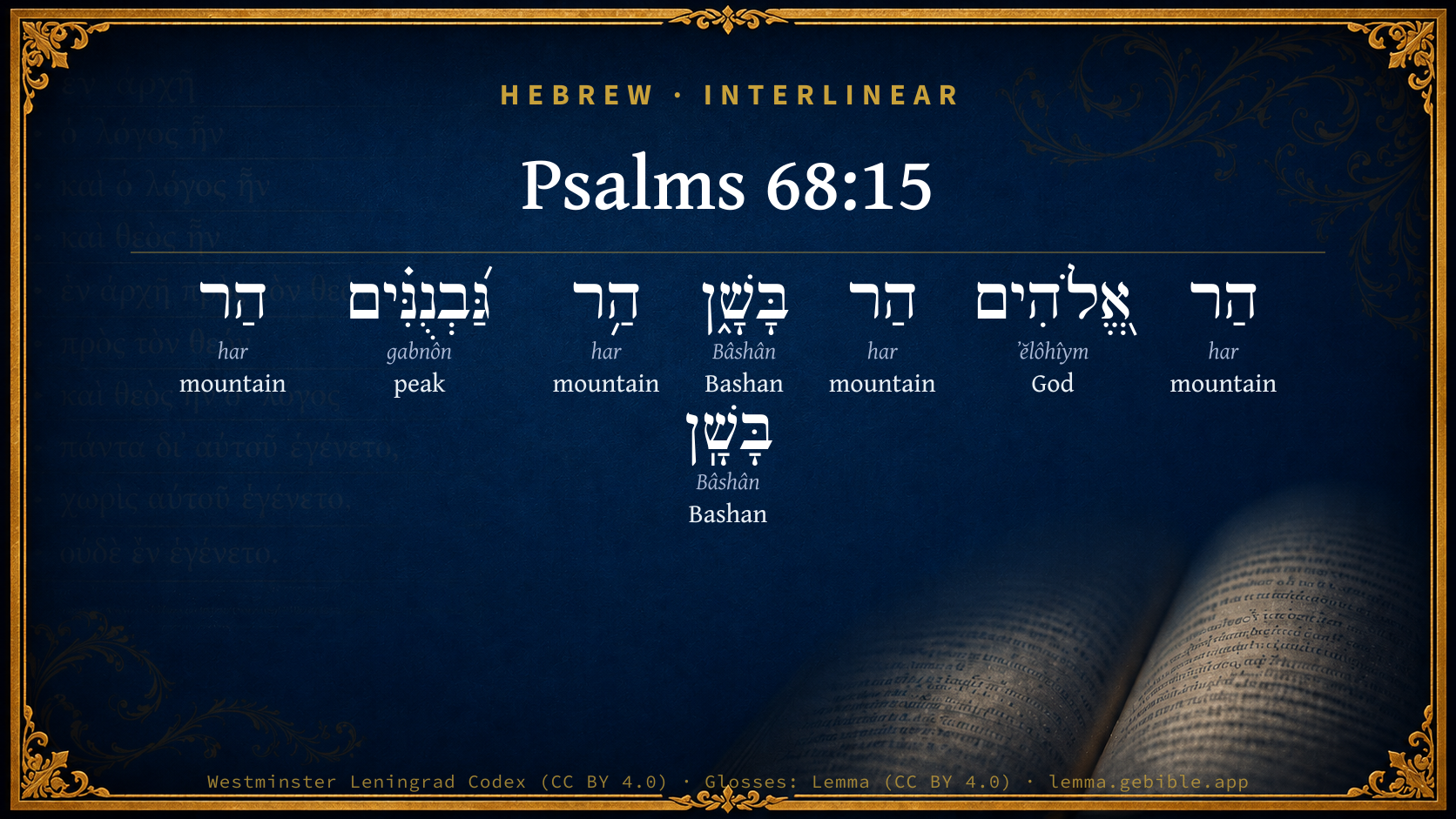
Psalms 68:15

Hebrew (Westminster Leningrad Codex) Psalms 68:15 appears in the Hebrew Old Testament. The text above is from the Westminster Leningrad Codex. Each word links to its Strong’s number, a concise gloss, and parsing drawn from the Open Scriptures Hebrew Bible morphology. Click any word for its full Brown-Driver-Briggs (BDB) entry.
Download image
Cite this verse

Psalms 68:15 (World English Bible). Public Domain. Lemma interlinear Bible study tool, https://lemma.gebible.app/v/psalms/68/15.

Show BibTeX & RIS
BibTeX
RIS
English Translation
The mountains of Bashan are majestic mountains. The mountains of Bashan are rugged.
World English Bible · Public Domain
Highlights
  • 1 first appearance in the Hebrew Bible
Full analysis ↓
Download a study sheet

One document with this verse’s original text, its word-by-word gloss line, the meaning frame, cross-references with their text, attributed commentary, and full source and license credits — printable, and it pastes into notes with its structure intact.

This verse Autodidact and up

Study sheet (.html) Plain text (.txt)

A passage Seminary Student

Up to 50 verses in one chapter. A passage sheet keeps up to 6 commentary sources and 12 cross-references per verse, in the order this page ranks them, and says so on the sheet whenever that leaves anything out. Ask for a single verse and you get the Autodidact verse sheet above.

Everything on this page stays free to read, with no account — the sheet is a download of what is already on screen, not access to it.

Want to remove ads? Support Godless Engineer
Compare translations 3

The same verse in 3 English versions, stacked beneath the original-language interlinear above. Click any original word for its lexicon entry.

Each is an independent rendering of the whole verse — the interlinear is not word-aligned to these translations.

Highlighted words mark where these versions differ — a whole-verse word diff, not a word-by-word alignment.

  • World English Bible Public Domain
    The mountains of Bashan are majestic mountains. The mountains of Bashan are rugged.
  • King James Version Public Domain
    The hill of God is as the hill of Bashan; an high hill as the hill of Bashan.
  • unfoldingWord Literal Text CC BY-SA 4.0
    Mount Bashan a mountain of God; Mount Bashan a mountain of peaks.

unfoldingWord Literal Text — © unfoldingWord, licensed CC BY-SA 4.0. Word-aligned USFM3 via Door43 (git.door43.org/unfoldingWord/en_ult).

Versions to compare (up to 4)

3 of 4 selected

Show all 18 translations

Every available English version of this verse, each an independent rendering of the whole verse.

  • World English Bible Public Domain
    The mountains of Bashan are majestic mountains. The mountains of Bashan are rugged.
  • Berean Standard Bible Public Domain
    A mountain of God is Mount Bashan; a mountain of many peaks is Mount Bashan.
  • Majority Standard Bible Public Domain
    A mountain of God is Mount Bashan; a mountain of many peaks is Mount Bashan.
  • King James Version Public Domain
    The hill of God is as the hill of Bashan; an high hill as the hill of Bashan.
  • American Standard Version (1901) Public Domain
    A mountain of God is the mountain of Bashan; A high mountain is the mountain of Bashan.
  • Revised Version (1885) Public Domain
    A mountain of God is the mountain of Bashan; an high mountain is the mountain of Bashan.
  • Geneva Bible (1599) Public Domain
    The mountaine of God is like the mountaine of Bashan: it is an high Mountaine, as mount Bashan.
  • Douay-Rheims (1899) Public Domain
    When he that is in heaven appointeth kings over her, they shall be whited with snow in Selmon.
  • Young's Literal Translation Public Domain
    A hill of God `is' the hill of Bashan, A hill of heights `is' the hill of Bashan.
  • Literal Standard Version CC BY-SA 4.0
    A hill of God [is] the hill of Bashan, || A hill of heights [is] the hill of Bashan.
  • Unlocked Literal Bible CC BY-SA 4.0
    A mighty mountain is the hill country of Bashan; a high mountain is the hill country of Bashan.
  • unfoldingWord Literal Text CC BY-SA 4.0
    Mount Bashan a mountain of God; Mount Bashan a mountain of peaks.
  • Darby Bible Public Domain
    [As] mount Bashan is the mount of God, a many-peaked mountain, [as] mount Bashan.
  • World Messianic Bible Public Domain
    The mountains of Bashan are majestic mountains. The mountains of Bashan are rugged.
  • Webster's Bible Public Domain
    \\68:14\\When the Almighty scattered kings in it, it was white as snow in Salmon.
  • Free Bible Version CC BY-SA 4.0
    “Mountain of God,” Mount Bashan, with your many high peaks, Mount Bashan,
  • Bible in Basic English Public Domain
    A hill of God is the hill of Bashan; a hill with high tops is the hill of Bashan.
  • JPS Tanakh (1917) Public Domain
    (68-16) A mountain of God is the mountain of Bashan; a mountain of peaks is the mountain of Bashan.

Literal Standard Version (2020), Covenant Press — licensed CC BY-SA 4.0. Text via the HelloAO Bible API (eBible.org). Unlocked Literal Bible (unfoldingWord) — licensed CC BY-SA 4.0. Text via the HelloAO Bible API (eBible.org). unfoldingWord Literal Text — © unfoldingWord, licensed CC BY-SA 4.0. Word-aligned USFM3 via Door43 (git.door43.org/unfoldingWord/en_ult). Free Bible Version, Dr. Jonathan Gallagher — licensed CC BY-SA 4.0. Text via the HelloAO Bible API (eBible.org).

Word by word

More ways to search: Search by grammar → Find every occurrence → Compare this word →

Practice this passage: Drill this verse → Learn its vocabulary →

About this verse

These counts appear in no published source. They are computed here, from the morphology-tagged text and Lemma’s own curated glosses. What Lemma adds →

8
words
4
distinct lemmas
Wisdom
section

Notable vocabulary

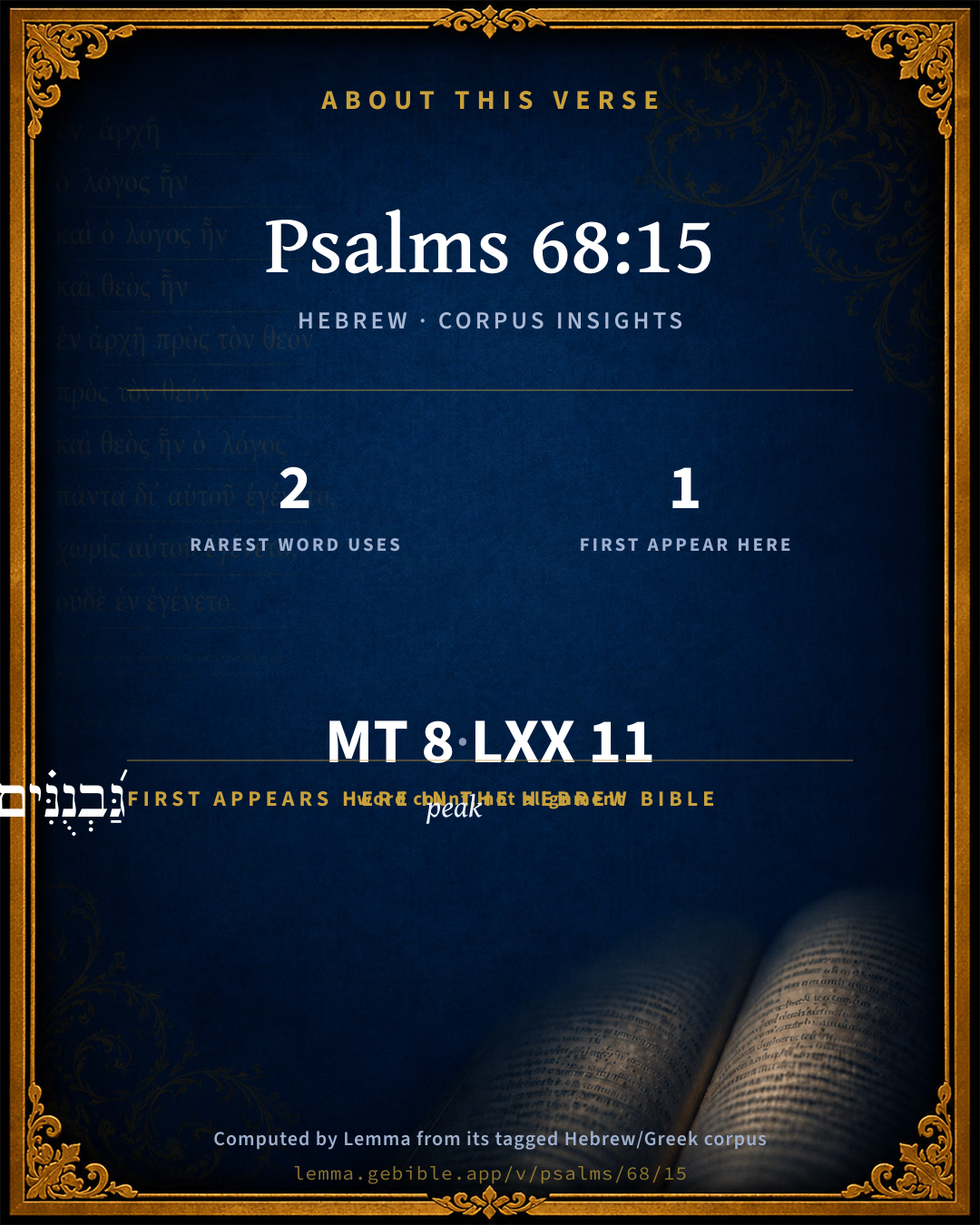
The rarest word here is גַּ֝בְנֻנִּ֗ים peak H1386 — appearing just 2 times in the whole Hebrew Bible.

First appearance in Scripture

This word makes its first canonical appearance in the Hebrew Bible here:

  • גַּ֝בְנֻנִּ֗ים peak H1386

Shared distinctive vocabulary

גַּ֝בְנֻנִּ֗ים peak H1386 occurs in 2 verses of the Hebrew Bible. Also found in:

Grammatical profile

  • 8 nouns

Repetition

Words recur within this verse — often emphatic in Hebrew:

  • הַר mountain H2022 ×4
  • בָּשָׁ֑ן Bashan H1316 ×2

Hebrew & Septuagint length

In English translation the verse runs 13 words from the Hebrew and 14 from the Septuagint (LXX English) — closely comparable.

A rough comparison of the two English renderings, which tokenize alike — not a word-level alignment.

Word counts can differ between the Hebrew and the Greek without any difference in meaning — e.g. the Hebrew direct-object marker אֵת has no separate Greek word, and Greek often adds the article ὁ.

In the original languages it is 8 Hebrew tokens and 11 Greek tokens — but the two are counted differently (Hebrew bundles its prefixes and suffixes into one token; the Greek is in lemma form), so that isn’t a like-for-like length.

Cross-references

6

Topical passages linked to Psalms 68:15 in the Treasury of Scripture Knowledge — connected by theme and wording, ordered by reader-vote popularity; previews shown in the World English Bible.

  • Deuteronomy 3:10 all the cities of the plain, and all Gilead, and all Bashan, to Salecah and Edrei, cities of the kingdom of Og in Bashan.
  • Psalms 78:68–69 But chose the tribe of Judah, Mount Zion which he loved.
  • Psalms 87:1–2 His foundation is in the holy mountains.
  • Micah 7:14 Shepherd your people with your staff, The flock of your heritage, Who dwell by themselves in a forest, In the midst of fertile pasture land, let them feed; In Bashan and Gilead, as in the days of old.
  • Psalms 2:6 "Yet I have set my king on my holy hill of Zion."
  • Isaiah 2:2–3 It shall happen in the latter days, that the mountain of Yahweh's house shall be established on the top of the mountains, And shall be raised above the hills; And all nations shall flow to it.

Cross-references courtesy of OpenBible.info (CC BY 4.0).

Hebrew and Greek witnesses Masoretic Hebrew ↔ Greek Septuagint

The same verse in the two great witnesses to the Old Testament, shown verse-for-verse.

You’re reading Greek Psalm 67 (Hebrew Psalm 68). The Septuagint counts the superscription, so verse numbers can differ from the Hebrew — chapter-level alignment, not verse-by-verse. Numbering follows Rahlfs.

These are two independent witnesses, not word-aligned to each other, and the Septuagint is shown in lemma (dictionary) form.

Hebrew Psalms 68:15 Masoretic · Westminster Leningrad Codex

הַר אֱ֭לֹהִים הַר בָּשָׁ֑ן הַ֥ר גַּ֝בְנֻנִּ֗ים הַר בָּשָֽׁן

The mountains of Bashan are majestic mountains. The mountains of Bashan are rugged.

World English Bible · Public Domain

Greek LXX Greek Psalm 67:15 Septuagint · lemma form

ἐν ὁ διαστέλλω ὁ ἐπουράνιος βασιλεύς ἐπί αὐτός χιονόομαι ἐν σελμων

The mountain of God is a rich mountain; a swelling mountain, a rich mountain.

LXX2012 (modern English Septuagint) · Public Domain

On this verse, Joseph Benson's Commentary discusses the Septuagint’s reading. Read the note in Commentary ↓

Hebrew: Westminster Leningrad Codex (CC BY 4.0). Greek: Septuagint (public domain); English from LXX2012 (modern English Septuagint) (Public Domain). How the Septuagint differs from the Hebrew →

Commentary

Notes on Psalms 68:15 from classic Christian and Jewish commentators (each source and its license shown beneath its notes). The classic Christian expositions comment on the surrounding passage and are grouped to its opening verse, so a note may address several verses; the Jewish commentaries on the Tanakh (Rashi and others) are per-verse, so they appear only where the commentator wrote on this verse.

Lemma curates 59 commentaries, every one of them public domain or Creative Commons licensed, each selected and text-cleaned for this edition rather than reprinted as found. About our sources →

Matthew Henry's Commentary

David, having given God praise for what he had done for Israel in general, as the God of Israel (Psa 68:8), here comes to give him praise as Zion's God in a special manner; compare Psa 9:11. Sing praises to the Lord who dwelleth in Zion, for which reason Zion is called the hill of God.

I. He compares it with the hill of Bashan and other high and fruitful hills, and prefers it before them, Psa 68:15, Psa 68:16. It is true, Zion was but little and low in comparison with them, and was not covered over with flocks and herds as they were, yet, upon this account, it has the pre-eminence above them all, that it is the hill of God, the hill which he desires to dwell in, and where he chooses to manifest the tokens of his peculiar presence, Psa 132:13, Psa 132:14. Note, It is much more honourable to be holy to God than to be high and great in the world. "Why leap you, you high hills? Why do you insult over poor Zion, and boast of your own height? This is the hill which God has chosen, and therefore though you exceed it in bulk, and be first-rates, yet, because on this the royal flag is hoisted, you must all strike sail to it." Zion was especially honourable because it was a type of the gospel church, which is therefore called Mount Zion (Heb 12:22), and this is intimated here, when he said, The Lord will dwell in it for ever, which must have its accomplishment in the gospel Zion. There is no kingdom in the world comparable to the kingdom of the Redeemer, no city comparable to that which is incorporated by the gospel charter, for there God dwells and will dwell for ever.

II. He compares it with Mount Sinai, of which he had spoken (Psa 68:8), and shows that it has the Shechinah or divine presence in it as really, though not as sensibly, as Sinai itself had, Psa 68:17. Angels are the chariots of God, his chariots of war, which he make use of against his enemies, his chariots of conveyance, which he sends for his friends, as he did for Elijah (and Lazarus is said to be carried by the angels), his chariots of state, in the midst of which he shows his glory and power. They are vastly numerous: Twenty thousands, even thousands multiplied. There is an innumerable company of angels in the heavenly Jerusalem, Heb 12:22. The enemies David fought with had chariots (Sa2 8:4), but what were they, for number or strength, to the chariots of God? While David had these on his side he needed not to fear those that trusted in chariots and horses, Psa 20:7. God appeared on Mount Sinai, attended with myriads of angels, by whose dispensation the law was given, Act 7:53. He comes with ten thousands of saints, Deu 33:2. And still in Zion God manifests his glory, and is really present, with a numerous retinue of his heavenly hosts, signified by the cherubim between which God is said to dwell. So that, as some read the last words of the verse, Sinai is in the sanctuary; that is, the sanctuary was to Israel instead of Mount Sinai, whence they received divine oracles. Our Lord Jesus has these chariots at command. When the first-begotten was brought into the world it was with this charge, Let all the angels of God worship him (Heb 1:6); they attended him upon all occasions, and he is now among them, angels, principalities, and powers, being made subject to him, Pe1 3:22. And it is intimated in the New Testament that the angels are present in the solemn religious assemblies of Christians, Co1 11:10. Let the woman have a veil on her head because of the angels; and see Eph 3:10.

III. The glory of Mount Zion was the King whom God set on that holy hill (Psa 2:6), who came to the daughter of Zion, Mat 21:5. Of his ascension the psalmist here speaks, and to it his language is expressly applied (Eph 4:8): Thou hast ascended on high (Psa 68:18); compare Psa 47:5, Psa 47:6. Christ's ascending on high is here spoken of as a thing past, so sure was it; and spoken of to his honour, so great was it. It may include his whole exalted state, but points especially at his ascension into heaven to the right hand of the Father, which was as much our advantage as his advancement. For, 1. He then triumphed over the gates of hell. He led captivity captive; that is, he led his captives in triumph, as great conquerors used to do, making a show of them openly, Col 2:15. He led those captive who had led us captive, and who, if he had not interposed, would have held us captive for ever. Nay, he led captivity itself captive, having quite broken the power of sin and Satan. As he was the death of death, so he was the captivity of captivity, Hos 13:14. This intimates the complete victory which Jesus Christ obtained over our spiritual enemies; it was such that through him we also are more than conquerors, that is, triumphers, Rom 8:37. 2. He then opened the gates of heaven to all believers: Thou hast received gifts for men. He gave gifts to men, so the apostle reads it, Eph 4:8. For he received that he might give; on his head the anointing of the Spirit was poured, that from him it might descend to the skirts of his garments. And he gave what he had received; having received power to give eternal life, he bestows it upon as many as were given him, Joh 17:2. Thou hast received gifts for men, not for angels; fallen angels were not to be made saints, nor standing angels made gospel ministers, Heb 2:5. Not for Jews only, but for all men; whoever will may reap the benefit of these gifts. The apostle tells us what these gifts were (Eph 4:11), prophets, apostles, evangelists, pastors and teachers, the institution of a gospel ministry and the qualification of men for it, both which are to be valued as the gifts of heaven and the fruits of Christ's ascension. Thou hast received gifts in man (so the margin), that is, in the human nature which Christ was pleased to clothe himself with, that he might be a merciful and faithful high priest in things pertaining to God. In him, as Mediator, all fulness dwells, that from his fulness we might receive. To magnify the kindness and love of Christ to us in receiving these gifts for us, the psalmist observes, (1.) The forfeiture we had made of them. He received them for the rebellious also, for those that had been rebellious; so all the children of men had been in their fallen state. Perhaps it is especially meant of the Gentiles, that had been enemies in their minds by wicked works, Col 1:21. For them these gifts are received, to them they are given, that they might lay down their arms, that their enmity might be slain, and that they might return to their allegiance. This magnifies the grace of Christ exceedingly that through him rebels are, upon their submission, not only pardoned, but preferred. They have commissions given them under Christ, which some say, in our law, amounts to the reversing of an attainder. Christ came to a rebellious world, not to condemn it, but that through him it might be saved. (2.) The favour designed us in them: He received gifts for the rebellious, that the Lord God might dwell among them, that he might set up a church in a rebellious world, in which he would dwell by his word and ordinances, as of old in the sanctuary, that he might set up his throne, and Christ might dwell in the hearts of particular persons that had been rebellious. The gracious intention of Christ's undertaking was to rear up the tabernacle of God among men, that he might dwell with them and they might themselves be living temples to his praise, Eze 37:27.

IV. The glory of Zion's King is that he is a Saviour and benefactor to all his willing people and a consuming fire to all those that persist in rebellion against him, Psa 68:19-21. We have here good and evil, life and death, the blessing and the curse, set before us, like that (Mar 16:16), He that believes shall be saved; he that believes not shall be damned.

1. Those that take God for their God, and so give up themselves to him to be his people, shall be loaded with his benefits, and to them he will be a God of salvation. If in sincerity we avouch God to be our God, and seek to him as such, (1.) He will continually do us good and furnish us with occasion for praise. Having mentioned the gifts Christ received for us (Psa 68:18), fitly does he subjoin, in the next words, Blessed be the Lord; for it is owing to the mediation of Christ that we live, and live comfortably, and are daily loaded with benefits. So many, so weighty, are the gifts of God's bounty to us that he may be truly said to load us with them; he pours out blessings till there is no room to receive them, Mal 3:10. So constant are they, and so unwearied is he in doing us good, that he daily loads us with them, according as the necessity of every day requires. (2.) He will at length be unto us the God of salvation, of everlasting salvation, the salvation of God, which he will show to those that order their conversation aright (Psa 50:23), the salvation of the soul. He that daily loads us with benefits will not put us off with present things for a portion, but will be the God of our salvation; and what he gives us now he gives as the God of salvation, pursuant to the great design of our salvation. He is our God, and therefore he will be the God of eternal salvation to us; for that only will answer the vast extent of his covenant-relation to us as our God. But has he power to complete this salvation? Yes, certainly; for unto God the Lord belong the issues from death. The keys of hell and death are put into the hand of the Lord Jesus, Rev 1:18. He, having made an escape from death himself in his resurrection, has both authority and power to rescue those that are his from the dominion of death, by altering the property of it to them when they die and giving them a complete victory over it when they shall rise again; for the last enemy that shall be destroyed is death. And to those that shall thus for ever escape death, and shall find such an outlet from it as not to be hurt of the second death, to them surely deliverances from temporal death are mercies indeed and come from God as the God of their salvation. Co2 1:10.

2. Those that persist in their enmity to him will certainly be ruined (Psa 68:21): God shall wound the head of his enemies, - of Satan the old serpent (of whom it was by the first promise foretold that the seed of the woman should break his head, Gen 3:15), - of all the powers of the nations, whether Jews or Gentiles, that oppose him and his kingdom among men (Psa 110:6, He shall wound the heads over many countries), - of all those, whoever they are, that will not have him to reign over them, for those he accounts his enemies, and they shall be brought forth and slain before him, Luk 19:27. He will wound the hairy scalp of such a one as goeth on still in his trespasses. Note, Those who go on still in their trespasses, and hate to be reformed, God looks upon as his enemies and will treat them accordingly. In calling the head the hairy scalp perhaps there is an allusion to Absalom, whose bushy hair was his halter. Or it denotes either the most fierce and barbarous of his enemies, who let their hair grow, to make themselves look the more frightful, or the most fine and delicate of his enemies, who are nice about their hair: neither the one nor the other can secure themselves from the fatal wounds which divine justice will give to the heads of those that go on in their sins.

Matthew Henry's Commentary on the Whole Bible (1708–1710) — public domain (CC PDM 1.0). Text via the HelloAO Bible API.

Trapp's Complete Commentary

John Trapp

Psa 68:15 The hill of God [is as] the hill of Bashan; an high hill [as] the hill of Bashan.

Ver. 15. The hill of God is as the hill of Bashan] Bashan was fat and fertile, but Sion was better; because the place where God’s honour dwelled, any relation to whom doth greatly ennoble any place or person: so Gen 17:21-22, Ishmael have I blessed, twelve princes shall he beget; but my covenant will I establish with Isaac. Since thou hast been precious in my sight, thou hast been honourable, Isa 43:4.

John Trapp, A Commentary or Exposition upon All the Books of the Old and New Testament (1647–1656) — public domain. Text from a community e-Sword module.

The Treasury of David

Charles H. Spurgeon

Ver. 15. Here the priests on the summit of the chosen hill begin to extol the Lord for his choice of Zion as his dwelling place.

The hill of God is as the hill of Bashan, or more accurately, "a hill of God is Bashan, "that is to say, Bashan is an eminent mountain, far exceeding Zion in height. According to the Hebrew custom, every great or remarkable thing is thus designated. Where we talk of the Devil's Dyke, the Devil's Ditch, the Devil's Punch Bowl, etc., the more commendable idiom of the Hebrews speaks of the hill of God, the trees of the Lord, the river of God, etc.

An high hill as the hill of Bashan, or rather, "a mount of peaks is Bashan." It does not appear that Zion is compared with Bashan, but contrasted with it. Zion certainly was not a high hill comparatively; and it is here conceded that Bashan is a greater mount, but not so glorious, for the Lord in choosing Zion had exalted it above the loftier hills. The loftiness of nature is made as nothing before the Lord. He chooses as pleases him, and, according to the counsel of his own will, he selects Zion, and passes by the proud, uplifted peaks of Bashan; thus doth he make the base things of this world, and things that are despised, to become monuments of his grace and sovereignty.

Ver. 15. Hill of Bashan. The world's physical greatness must yield to the church's spiritual grandeur. The "hill of God" is here an emblem of the world kingdoms, which (Ps 65:6) are great only by the grace of God. A great hill reminds us of the creative power of God. Hence, "the hill of Elohim" (the general name of God as the Creator) stands in contrast to the hill which (Ps 68:16) "the Lord" (Jehovah) will dwell in for ever. It lay in the north, in the region east of Jordan, or the land of Hermon, the kingdom of Og, the most formidable enemy whom Israel encountered on their march to Canaan. "The hill of Bashan is the high snow summit of Anti Lebanon, or Hermon, the extreme limit of Bashan. There was a peculiar propriety, from its position on the boundary between Judaea and the heathen world, in employing it as a symbol of the world's might (Ps 68:22 42:6 89:12)" (Hengstenberg). The original name of Hermon as Sion; i.e., lofty (De 4:48); allied in sound to Zion, which suggested the contrast here between the world hills and the Lord's hill. A. R. Fausset.

Ver. 15-16: --

"A mountain of God Mount Bashan is.

A mountain of peaks Mount Bashan is,

Why are ye piqued, ye peaked mountains?

At the mountain which God desires to dwell in?

Yea, Jehovah will dwell therein forever." Frederic Fysh's Version.

Ver. 15-16.

I. The superiority of the hill of Zion.

1. In fertility, to the hill of Bashan; to earthly pleasures.

2. In glory, to other hills; to human heights of learning and power. II. The reason of that superiority.

1. The place of God's choice.

2. Of his delight

3. Of his abode.

4. Of his continuance for ever. G. R.

Psalms 68:16*

Ver. 15-16. See Psalms on "Ps 68:15" for further information.

Charles H. Spurgeon's The Treasury of David (1869–1885) — public domain. Psalms only. Text from a community e-Sword/MySword module.

Joseph Benson's Commentary

Psa 68:15. The hill of God — That is, Zion, the seat of God’s ark; is as the hill of Bashan — Equal, yea, superior to it. Bashan was a rich and fruitful mountain beyond Jordan, called by the LXX. πιον ορος, a fat mountain, and ορος τετυρωμενον, a mountain that yielded much butter and cheese. But Zion had greater advantages, and yielded much better fruits. A high hill as the hill of Bashan — Though it be but a low, mean hill, compared with Bashan, in outward appearance, yet it is as high as it, yea, is exalted far above it, through its spiritual privileges, being the place where God’s worship is established, where he is peculiarly present, and where he confers his choicest blessings; in which respect the mountain of the Lord’s house is said to be established on the top of the mountains, and exalted above the hills. Dr. Chandler supposes that this and the two following verses were begun to be sung when the ark came in view of mount Zion, the place of its fixed residence for the future, and probably when they began to ascend the hill. And he reads this, as well as the following verse, with an interrogation, conceiving that it makes them appear more suitable to the occasion, and worthy of the genuine spirit of poetry; thus: Is the hill of Bashan, is the craggy hill of Bashan the hill of God? As if he had said, Bashan may boast of its proud eminences, its craggy summits, but is this the hill where God will fix his residence?

Joseph Benson's Commentary on the Old and New Testaments (1811–1818) — public domain. Text from a community e-Sword module.

J. A. Alexander on Psalms

Joseph Addison Alexander

16. (Psa 68:15). A mount of God (is) mount Bashan, a mount of peaks (or ridges) is mount Bashan. The first phrase means a mountain shewing forth the creative power of God by its vastness. See above, on Psa 36:6. Mount Bashan, not a single eminence, but the lofty range of Antilibanus, also called Hermon, and by other races, Sion and Sirion. See Deu 3:9; Deu 4:48, Psa 42:6, Psa 89:12. The last two names would be apt to suggest, by a fortuitous resemblance, that of the holy hill of Zion. A mount of peaks or ridges, i.e. not a detached mountain, but a chain with many lofty summits, forming the northern boundary of Bashan. At the same time, the expression of this verse would necessarily suggest the idea of great states or kingdoms, of which mountains are the standing symbols. See above, on Psa 46:2.

Joseph Addison Alexander, The Psalms Translated and Explained (1850) — public domain. Text from a community e-Sword module.

Tyndale Open Study Notes

Tyndale Open Resources

68:15 Bashan is a plateau northeast of Jerusalem and east of the Sea of Galilee that was known for its woods and pastureland (see 22:12; Isa 2:13). The mountains might have included Mount Hermon to the north of the plateau or Mount Zalmon, which might be Jebel ed-Druze on the east.

Tyndale Open Study Notes — © Tyndale Open Resources, licensed CC BY-SA 4.0. Text via the HelloAO Bible API.

Geneva Bible (1599)

Geneva Bible translators

Zion the Church of God, doth excel all worldly things, not in pomp and outward show, but by the inward grace of God, which there remaineth, because of his dwelling there.

Geneva Bible (1599) marginal notes — public domain. Text via Bolls.life.

Jamieson, Fausset & Brown

Robert Jamieson, A. R. Fausset & David Brown

Mountains are often symbols of nations (Psa 46:2; Psa 65:6). That of Bashan, northeast of Palestine, denotes a heathen nation, which is described as a "hill of God," or a great hill. Such are represented as envious of the hill (Zion) on which God resides;

Jamieson, Fausset & Brown — Commentary Critical and Explanatory on the Whole Bible (1871) — public domain (CC PDM 1.0). Text via the HelloAO Bible API.

Adam Clarke's Commentary

Verse 15. The hill of God is as the hill of Bashan] This and the following verse should be read thus: "Is Mount Bashan the craggy mount, Mount Bashan, the mount of God? Why envy ye, ye craggy mounts? This is the mount of God in which he has desired to dwell." The Targum countenances this translation: Mount Moriah, the place where our fathers of old worshipped God, is chosen to build on it the house of the sanctuary, and Mount Sinai for the giving of the law. Mount Bashan, Mount Tabor, and Carmel are rejected; they are made as Mount Bashan."

Adam Clarke's Commentary on the Bible (1810–1826) — public domain. Text from a community e-Sword/MySword module.

John Calvin's Commentaries

15. The hill of God, the hill of Bashan Here he adverts to the spring and source of all the kindness which God had shown, this being the circumstance that he had chosen mount Zion as the place of his palace and temple, whence all blessings should go out to the nation. A Divine declaration to that effect had been made to David, and this pre-eminence and dignity conferred upon mount Zion is very properly adduced as a proof of his being king, lawfully and by Divine appointment; for there was an inseparable connection between God’s dwelling upon that mountain, and David’s sitting upon the throne to govern the people. The words of the verse admit of two senses. We may suppose that the mountain of God is compared to mount Bashan as being like it, or we may understand that it is opposed to it. The first is the sense adopted almost by all interpreters, that while Bashan was famed for its fertility, Zion excelled it. It is of little importance which we prefer; but perhaps the distinction would be brought out as well were we to construe the words the hill of God by themselves, and consider that Bashan with its boasted height is afterwards ordered to yield precedence, as if David would say, that there was but one mountain which God had consecrated to himself by an irrevocable decree, and that though Bashan was renowned for height and fertility, it must rank with other mountains, which might in vain exalt themselves to an equality with Zion, honored as the chosen residence of God. If we read the verse differently, and consider it as applying to mount Zion throughout, then the Psalmist extols it as high and illustrious, and this because there emanated from it the Divine favor, which distinguished the Jews from every other nation.

John Calvin's Commentaries (1540-1563) — public domain. Text from the Calvin Translation Society English edition (1840s-50s) via the Christian Classics Ethereal Library (ccel.org). Calvin's coverage is partial (roughly two-thirds of the Bible); uncommented books and verses are honest gaps, never fabricated. The 19th-century editor's footnotes and remarks are omitted so the notes are faithfully Calvin's own voice.

Ellicott's Commentary for English Readers

(15) The hill of God is . . .—Better,

“Mountain of God, mount Basan;

Mountain of peaks, mount Basan.”

Even if the range of Hermon were not included, the basalt (basanite, probably from the locality) ranges, always rising up before the eyes of those looking eastward from Palestine, must have been doubly impressive from their superior height, and the contrast of their bold and rugged outlines with the monotonous rounded forms of the limestone hills of Judæa. And it is quite possible that, in a poetic allusion, the term “mountains of Bashan” might include all the heights to the eastward of Jordan, stretching southward as well as northward. There would then be an additional propriety in their introduction as jealously watching the march of Israel from Sinai to take possession of the promised land. Why these trans-Jordanic ranges should be styled “mountains of God” has been much discussed. Some explain the term to denote ancient seats of religious worship; others take it simply as a general term expressing grandeur—“a ridge of god-like greatness.”

(15-18) A third retrospect follows—the third scene in the sacred drama of Israel’s early fortunes. It sets forth the glory of God’s chosen mountain. A finer passage could hardly be found. The towering ranges of Bashan—Hermon with its snowy peaks—are personified. They become, in the poet’s imagination, envious of the distinction given to the petty heights of Judæa. (Perhaps a similar envy is implied in Psa_133:3.) The contrast between the littleness of Palestine and the vast extent of the empires which hung upon its northern and southern skirts, is rarely absent from the minds of the prophets and psalmists. (See Isa_49:19-20.) Here the watchful jealousy with which these powers regarded Israel is represented by the figure of the high mountain ranges watching Zion (see Note below) like hungry beasts of prey ready to spring. And what do they see? The march of God Himself, surrounded by an army of angels, from Sinai to His new abode.

A Bible Commentary for English Readers, edited by Charles John Ellicott (1878–1897) — public domain. Text from a community e-Sword module.

The Cambridge Bible for Schools and Colleges

gen. ed. J. J. S. Perowne

15. A mountain of God is the mountain of Bashan:

An high-peaked mountain is the mountain of Bashan.

Mount Hermon is probably meant, rather than the mountains of Bashan generally. It is the grandest of the mountains of Palestine, and was the northern boundary of Bashan (Deu_3:8). It has three summits of nearly equal height. Its natural preeminence seemed to mark it as a mountain of God, a mountain worthy to be the abode of God; and the early conquest of Bashan seemed to confirm its prior claim.

15–18. After the conquest of the land, God chose for His abode not the stately mountains of Bashan, whose natural preeminence might seem to mark them out for that privilege, but the insignificant hill of Zion.

The Cambridge Bible for Schools and Colleges (gen. ed. J. J. S. Perowne; Cambridge University Press, 1878–1918) — public domain. Text from a community e-Sword module.

John Gill's Exposition

The hill of God is as the hill of Bashan,.... The church is the hill of God, an excellent and supereminent one, and in which he dwells, as is said in Psa 68:16; called an hill for its visibility, and especially as it will be in the latter day, when it will be established and exalted above the mountains and hills, the kingdoms of this world, Isa 2:2; this is compared to the hill of Bashan for fertility and fruitfulness; hence we read of the kine and bulls, the rams and lambs, and fatlings of Bashan, and of the oaks thereof, Deu 32:14, Isa 2:13; the ordinances of the church are green pastures, where his people become fat and flourishing, Psa 23:2;

an high hill, as the hill of Bashan; or "an hill of eminences" (h); it had several tops, or little hills that rose up from it; so the church of Christ, though but one hill or church in general, yet there are several little hills belong unto it, or particular congregational churches, of which it consists: for "a mountain abounding with cheese" (i); which fed much cattle, and these produced much milk, of which large quantities of cheese were made, and so is expressive of the fruitfulness of it.

(h) "mons gibborum", Montanus; "vel eminentiarum", Gejerus; "monte frequente gibbis", Junius & Tremellius; "mons fastigiorum", Cocceius. (i) "Mons qui caseis abundat", Tigurine version.

John Gill's Exposition of the Whole Bible (1746–1763) — public domain (CC PDM 1.0). Text via the HelloAO Bible API.

Albert Barnes' Notes on the Bible

The hill of God - The phrase “the hill of God,” or the mountain of God, is elsewhere applied in the Scriptures only to Mount Horeb or Sinai Exo 3:1; Exo 18:5; Exo 24:13; 1Ki 19:8, and to Mount Zion, Psa 24:3; Isa 30:29. There is no reason for supposing that there is a reference here to Mount Horeb or Sinai, as the psalm does not particularly relate to that mountain, and as there is nothing in the psalm to bring that mountain into comparison with other mountains. The allusion is, I think, clearly to Mount Zion; and the idea is, that that mountain, though it was not distinguished for its elevation or grandeur - though it had nothing in itself to claim attention, or to excite wonder - yet, from the fact that it had been selected as the place where God was to be worshipped, had an honor not less than that of the loftiest mountain, or than those which showed forth the divine perfections by their loftiness and sublimity. There is connected with this, also, the idea that, although it might be less defensible by its natural position, yet, because God resided there, it was defended by his presence more certainly than loftier mountains were by their natural strength. It should be remarked, however, that many other interpretations have been given of the passage, but this seems to me to be its natural meaning.

Is as the hill of Bashan - Luther renders this, “The mount of God is a fruit-bearing hill; a great and fruitbearing mountain.” On the word Bashan, see the notes at Isa 2:13; notes at Isa 33:9; notes at Psa 22:12. Bashan was properly the region beyond Jordan, bounded on the north by Mount Hermon or the Anti-Libanus, and extending south as far as the stream Jabbok, and the mountains of Gilead. The “hill” of Bashan, or the “mountain of Bashan,” was properly Mount Hermon - the principal mountain pertaining to Bashan. The name Bashan was properly given to the country, and not to the mountain. The mountain referred to - Hermon - is that lofty range which lies on the east of the Jordan, and in the northern part of the country - a range some twelve thousand feet in height. See the notes at Psa 42:6. It is the most lofty and distinguished mountain in Palestine, and the idea here, as above expressed, is, that Mount Zion, though not so lofty, or not having so much in itself to attract attention, was not less honored, and not less safe, as being the special dwelling-place of God.

An high hill ... - Or rather; a mount of peaks or ridges as Bashan. Mount Hermon was not a single hill, or a detached mountain, but a chain of mountains - a range of lofty peaks or summits. So of Zion. It was by the presence and protection of God what Bashan was by its natural strength and grandeur. Comparatively low and unimportant as Zion was, it had in fact more in it to show what God is, and to constitute safety, than there was in the loftiness and grandeur of Bashan. The latter, though thus lofty and grand, had no “advantage” over Zion, but Zion might in every way be compared with that lofty range of hills which, by their natural position, their strength, and their grandeur, showed forth so much the greatness and glory of God. The teaching would be, as applied to Zion, or the Church, that there is “as much” there to show the divine perfections, to illustrate the greatness and the power of God, as there is in the most sublime works of nature; or that they who look upon the works of God in nature to learn his perfections, have no advantage over those who seek to learn what he is in his church.

Albert Barnes' Notes on the Bible (1834–1885) — public domain. Text from a community e-Sword/MySword module.

Matthew Poole's English Annotations

The hill of God, i.e. of Zion, the seat of God’s ark.

As the hill of Bashan; equal to it, to wit, in height, as the next clause explains it; which yet is not to be understood of an external and visible height, for Zion was a low and little hill, and Bashan a very high hill; but of its spiritual height, or exaltation, in regard of the glorious privileges of God’s presence, and worship, and blessing conferred upon it, in which respect the mountain of the Lord’s house is said to be established on the top of the mountains, and exalted above the hills, Isa 2:2.

Matthew Poole's English Annotations on the Holy Bible (1683–1685) — public domain. Text from a community e-Sword/MySword module.

Whedon's Commentary on the Bible

Daniel D. Whedon

15. The hill of God—A Hebraistic superlative for most excellent of its kind. The psalmist turns to the central thought of the psalm, which he strikes in the next verse—the hill Zion, which God has chosen to dwell in. As a mountain, physically, it cannot be compared with many others, but in historic association it transcends all and awakens the envy of all.

Bashan— The district of Bashan, mainly identical with the ancient kingdom of Og, lay east of the Jordan, and extended from the Jabbok to Hermon. Deu_3:8; Jos_12:4-5. But the “hill of Bashan” is nowhere mentioned, and as it is here spoken of as chief of the mountains, it is probable that either Hermon or the whole range of Gilead is intended.

High hill—Hebrew, Mountain of heights. The relative height of mountains is the point of comparison, and Hermon was the loftiest of all.

Daniel D. Whedon (gen. ed.), Commentary on the Old and New Testaments (1874–1909) — public domain. Text from a community e-Sword module.

The Pulpit Commentary

The hill of God is as the hill of Bashan; rather, a mountain of God is the mountain of Bashan. A sudden transition, and perhaps a quotation from an ancient poem. The special object of the psalmist"s thought is not Bashan, but Mount Zion; and what he is about to celebrate is Jehovah"s choice of Mount Zion for his dwelling place, and his establishment on it. But he prefers to introduce the subject by a contrast with the great range of Canaan. Bashan, he says, is truly "a mountain of Godi.e. a very great mountain (see the comment on Psa_36:6) which seemed in an especial degree to show forth creative power." It is also a high hill; or rather, a mountain of peaks, containing numerous pointed summits. Yet God did not choose one of these for his habitation.

The Pulpit Commentary (1880–1919), ed. H.D.M. Spence-Jones & Joseph S. Exell — public domain. Text from a community e-Sword module.

John Wesley's Explanatory Notes

The hill - Zion, the seat of God's ark. High hill - Which is not to be understood of external height, but of its spiritual height, or exaltation, in regard of the glorious privileges of God's presence, and worship.

John Wesley, Explanatory Notes Upon the Whole Bible (1754–1765) — public domain. Text via the GEBible commentary corpus.

Keil & Delitzsch

C. F. Keil & F. Delitzsch

This victory of Israel over the kings of the Gentiles gives the poet the joyful assurance that Zion is the inaccessible dwelling-place of Elohim, the God of the heavenly hosts. The mention of Zalmon leads him to mention other mountains. He uses the mountains of Bashan as an emblem of the hostile powers east of Jordan. These stand over against the people of God, as the mighty mountains of Bashan rising in steep, only slightly flattened peaks, to little hill-like Zion. In the land on this side Jordan the limestone and chalk formation with intermingled strata of sandstone predominates; the mountains of Bashan, however, are throughout volcanic, consisting of slag, lava, and more particularly basalt (basanites), which has apparently taken its name from Bashan (Basan).

(Note: This is all the more probable as Semitism has no proper word for basalt; in Syria it is called hag'ar aswad, "black stone.")

As a basalt range the mountains of Bashan are conspicuous among other creations of God, and are therefore called "the mountain of Elohim:" the basalt rises in the form of a cone with the top lopped off, or even towers aloft like so many columns precipitous and rugged to sharp points; hence the mountains of Bashan are called הר גּבננּים, i.e., a mountain range (for הר, as is well known, signifies both the single eminence and the range of summits) of many peaks = a many-peaked mountain; גּבנן is an adjective like רענן, אמלל. With this boldly formed mass of rock so gloomily majestic, giving the impression of antiquity and of invincibleness, when compared with the ranges on the other side of unstable porous limestone and softer formations, more particularly with Zion, it is an emblem of the world and its powers standing over against the people of God as a threatening and seemingly invincible colossus. The poet asks these mountains of Bashan "why," etc.? רצד is explained from the Arabic rṣd, which, in accordance with its root Arab. rṣ, signifies to cleave firmly to a place (firmiter inhaesit loco), properly used of a beast of prey couching down and lying in wait for prey, of a hunter on the catch, and of an enemy in ambush; hence then: to lie in wait for, lurk, ἐνεδρεύειν, craftily, insidiose (whence râṣid, a lier-in-wait, tarraṣṣud, an ambush), here: to regard enviously, invidiose. In Arabic, just as in this instance, it is construed as a direct transitive with an accusative of the object, whereas the original signification would lead one to look for a dative of the object (רצד ל), which does also really occur in the common Arabic. Olewejored is placed by גבננים, but what follows is not, after all, the answer: "the mountain - Elohim has chosen it as the seat of His throne," but ההר is the object of the interrogative clause: Quare indiviose observatis, montes cacuminosi, hunc montem (δεικτικῶς: that Zion yonder), quem, etc. (an attributive clause after the determinate substantive, as in Psa 52:9; Psa 89:50, and many other instances, contrary to the Arabic rule of style). Now for the first time, in Psa 68:17, follows that which is boastfully and defiantly contrasted with the proud mountains: "Jahve will also dwell for ever;" not only that Elohim has chosen Zion as the seat of His throne, it will also continue to be the seat of His throne, Jahve will continue to dwell [there] for ever. Grace is superior to nature, and the church superior to the world, powerful and majestic as this may seem to be. Zion maintains its honour over against the mountains of Bashan.

Psa 68:18

Psa 68:18 now describes the kind of God, so to speak, who sits enthroned on Zion. The war-chariots of the heavenly hosts are here collectively called רכב, as in Kg2 6:17. רבּתים (with Dech, not Olewejored) is a dual from רבּות; and this is either an abstract noun equivalent to רבּוּת (from which comes the apocopated רבּו = רבּוּ), a myriad, consequently רבּתים, two myriads, or a contracted plural out of רבּאחת, Ezr 2:69, therefore the dual of a plural (like הומותים, לוּהותים): an indefinite plurality of myriads, and this again doubled (Hofmann). With this sense, in comparison with which the other is poor and meagre, also harmonies the expression אלפי שׂנאן, thousands of repetition (ἅπαξ λεγομ = שׂנין), i.e., thousands and again thousands, numberless, incalculable thousands; cf. the other and synonymous expression in Dan 7:10.

(Note: Tradition (Targum, Saadia, and Abulwald) takes שׂנאן forthwith as a synonym of מלאך, an angel. So also the lxx (Jerome): χιλιάδες εὐθηνούντων (שׁנאן = שׁאנן), and Symmachus, χιλιάδες ὴχούντων (from שׁאה?). The stem-word is, however, שׁנה, just as שׁנים, Arabic thinân, ithnân, is also formed from a singular that is to be assumed, viz., שׁן, Arab. ṯinun (iṯnun), and this from שׁנה, Arab. ṯnâ (cf. בּן from בּנה, Arab. banâ).)

It is intended to give a conception of the "hosts" which Elohim is to set in array against the "kings of hosts," i.e., the martial power of the kingdom of the world, for the protection and for the triumph of His own people. Chariots of fire and horses of fire appear in Kg2 2:11; Kg2 6:17 as God's retinue; in Dan 7:10 it is angelic forces that thus make themselves visible. They surround Him on both sides in many myriads, in countless thousands. אדני בם (with Beth raphatum),

(Note: This is one of the three passages (the others being Isa 34:11; Eze 23:42; cf. Ew. 93, b) in which the dageshing of the opening mute of the following word is given up after a soft final consonant, when the words are connected by a conjunctive accent or Makkeph.))

the Lord is among them (cf. Isa 45:14), i.e., they are round about Him, He has them with Him (Jer 41:15), and is present with them. It now becomes clear why Sinai is mentioned, viz., because at the giving of the Law Jahve revealed Himself on Sinai surrounded by "ten thousands of saints" (Deu 33:2.). But in what sense is it mentioned? Zion, the poet means, presents to the spiritual eye now a spectacle such as Sinai presented in the earlier times, although even Sinai does not belong to the giants among the mountains:

(Note: Cf. the epigram in Sadi's Garden of Roses, "Of all mountains Sinai is the smallest, and yet the greatest in rank and worth in the estimation of God," etc. On the words סיני בקדשׁ which follow we may to a certain extent compare the name of honour given to it in Arabic, ṭûr m‛ana, "Sinai of Pensiveness" (Pertsch, Die persischen Handschriften der Gothaer Bibliothek, 1859, S. 24).)

God halts there with His angel host as a protection and pledge of victory to His people. The conjectures בא מסיני and בם מסיני (Hitzig) are of no use to us. We must either render it: Sinai is in the sanctuary, i.e., as it were transferred into the sanctuary of Zion; or: a Sinai is it in holiness, i.e., it presents a spectacle such as Sinai presented when God by His appearing surrounded it with holiness. The use of the expression בּקּדשׂ in Psa 68:25, Psa 77:14; Exo 15:11, decides in favour of the latter rendering.

With Psa 68:19 the Psalm changes to prayer. According to Psa 7:8; Psa 47:6, למּרום appears to be the height of heaven; but since in Psa 68:16-18 Zion is spoken of as Jahve's inaccessible dwelling-place, the connection points to מרום ציּון, Jer 31:12, cf. Eze 17:23; Eze 20:40. Moreover the preterites, which under other circumstances we should be obliged to take as prophetic, thus find their most natural explanation as a retrospective glance at David's storming of "the stronghold of Zion" (Sa2 5:6-10) as the deed of Jahve Himself. But we should exceed the bounds of legitimate historical interpretation by referring לקחתּ מתּנות בּאדם to the Nethı̂nim, Ezr 8:20 (cf. Num 17:6), those bondmen of the sanctuary after the manner of the Gibeonites, Jos 9:23. The Beth of באדם is not Beth substantiae: gifts consisting of men, so that these themselves are the thing given (J. D. Michaelis, Ewald), but the expression signifies inter homines, as in Psa 78:60; Sa2 23:3; Jer 32:20. עלית למּרום mentions the ascending of the triumphant One; שׁבית שּׁבי (cf. Jdg 5:12), the subjugation of the enemy; לקחתּ וגו, the receiving of the gifts betokening homage and allegiance (Deu 28:38, and frequently), which have been presented to Him since He has taken possession of Zion - there He sits enthroned henceforth over men, and receives gifts like to the tribute which the vanquished bring to the victor. These He has received among men, and even (ואף, atque etiam, as in Lev 26:29-32) among the rebellious ones. Or does a new independent clause perhaps begin with ואף סוררים? This point will be decided by the interpretation of the words that follow. Side by side with an infinitive with ל expressing a purpose, the one following noun (here a twofold name) has the assumption against it of being the subject. Is יה אלהים then consequently the object, or is it an apostrophe? If it be taken as the language of address, then the definition of the purpose, לשׁכן, ought, as not being suited to what immediately precedes, to refer back to עלית; but this word is too far off. Thus, therefore, the construction of יה אלהים with לשכן, as its object, is apparently intended (Ewald, Hupfeld): and even the rebellious are to dwell (Ges. 132, rem. 1) with Jāh Elohim descend and dwell; the Syriac version: and even the rebellious will ("not" is probably to be crossed out) dwell before God (יעמדון קדם אלהא); and Jerome: insuper et non credentes inhabitare Dominum Deum. Thus Theodoret also understands the versions of the lxx and of Aquila: "Thou hast not regarded their former disobedience, but notwithstanding their rebellion hast Thou continually been gracious to them ἕως αὐτοὺς oikeetee'rion oikei'on ape'feenas." The expression, however, sounds too grand to have "the rebellious ones" as its subject, and more particularly in view of Psa 68:7. Hence we take ואף סוררים with בּאדם: and even among rebellious ones (hast Thou received gifts), or: and even rebellious ones (give Thee); and לשׁכן as a clause denoting the purpose, followed by the subject (as e.g., in Sa2 19:20): in order that Jāh Elohim may dwell, i.e., continue to dwell (as in Psa 68:17, cf. Isa 57:15).

The first half of the Psalm ends here. With the words Jāh Elohim the Psalm has reached a summit upon which it takes its rest. God has broken forth on behalf of His people against their enemies, and He now triumphs over and on behalf of men. The circumstance of Elohim arising is the raise of the final glory, and His becoming manifest as Jāh Elohim is its zenith. Paul (Eph 4:8) gathers up the meaning of Psa 68:19, without following the lxx, in the following manner: ἀναβὰς εἰς ὕψος ᾐχμαλώτευσεν αιχμαλωσίαν καὶ ἔδωκε δόματα τοῖς ἀνθρώποις. Might he perhaps have had the Targum, with which the Syriac version agrees, in his mind at the time: יחבתּא להון מתנן לבני נשׂא? He interprets in the light and in the sense of the history that realizes it. For the ascension of Elohim in its historical fulfilment is none other than the ascension of Christ. This latter was, however, as the Psalm describes it, a triumphal procession (Col 2:15); and what the Victor has gained over the powers of darkness and of death, He has gained not for His own aggrandisement, but for the interests of men. It is מתּנות בּאדם, gifts which He now distributes among men, and which benefit even the erring ones. So the apostle takes the words, inasmuch as he changes ἔλαβες into ἔδωκε. The gifts are the charismata which come down from the Exalted One upon His church.

(Note: In this respect Ps 68 is the most appropriate Psalm for the Dominica Pentecostes, just as it is also, in the Jewish ritual, the Psalm of the second Shabuoth day.)

It is a distribution of gifts, a dispensing of blessing, which stands related to His victory as its primary cause; for as Victor He is also the possessor of blessing, His gifts are as it were the spoils of the victory He has gained over sin, death, and Satan.

(Note: Just so Hlemann in the second division of his Bibelstudien (1861); whereas to Hormann (Schriftbeweis, ii. 482ff.) the New Testament application of the citation from the Psalm is differently brought about, because he refers neither ᾐχμαλώτευσεν αἰχμαλωσίαν nor κατέβη εἰς τὰ κατώτερα μέρη τῆς γῆς to the descent of the Lord into Hades.)

The apostle is the more warranted in this interpretation, since Elohim in what follows is celebrated as the Lord who also brings out of death. This praise in the historical fulfilment applies to Him, who, as Theodoret observes on Psa 68:21, has opened up the prison-house of death, which for us had no exit, and burst the brazen doors, and broken asunder the iron bolts,

(Note: Just so that portion of the Gospel of Nicodemus that treats of Christ's descent into Hades; vis. Tischendorf, Evangelia Apocryph. (1853), p. 307.)

viz., to Jesus Christ, who now has the keys of Death and of Hades.

Keil & Delitzsch — Biblical Commentary on the Old Testament (1861–1891) — public domain (CC PDM 1.0). Text via the HelloAO Bible API. (Old Testament only.)

Rashi

Rabbi Shlomo Yitzchaki (Rashi)

When... spreads out Heb. בפרש, an expression of (Deut. 22:17): “and they will spread out (ופרשו) the garment”; they clarify the matter as a new garment.

kings These are the Torah scholars, as it is said (Prov. 8:15): “Kings reign with me.”

Rashi on the Tanakh — English translations: “The Judaica Press complete Tanach with Rashi, translated by A. J. Rosenberg” (CC BY 4.0); “Pentateuch with Rashi's commentary by M. Rosenbaum and A.M. Silbermann, 1929-1934” (public domain); “The Metsudah Tanach series, Lakewood, N.J” (CC BY 4.0); and “The Book of Joshua, Metsudah Publications, 1997” (CC BY 4.0). Text via Sefaria.

Lesson kit

Teaching starters — assembled from the data on this page, not authored interpretation. Every prompt links to the verse data it draws on. Edit before teaching.

Psalms, in the Wisdom, opens this verse with 8 words (4 distinct Hebrew lemmas). Its most distinctive word is gabnôn (“peak”). A historical commentator’s framing appears above. Read the whole chapter for the surrounding context.

Discussion questions

  1. What does “peak” (gabnôn) contribute to the verse as a whole?
  2. The word “peak” first appears here in Scripture. What is being introduced at this debut?
  3. Psalms 68:16 shares the word «peak» with this verse. How do the two illuminate each other?
  4. “mountain” occurs 4× in this one verse. What is the effect of the repetition?
  5. The translations on this page render this verse differently — a whole-verse word diff, not a word-by-word alignment. What might account for the different wordings?
  6. Reading how Matthew Henry's Commentary and Trapp's Complete Commentary read this verse, where do the two commentators agree and where do they part?

Things to notice

Reading settings

Reading text

Shown beneath each verse's original-language words.

Old Testament
Old Testament edition

Read the OT as the Masoretic Hebrew (MT) or the Greek Septuagint (LXX).

English shown for the Greek Septuagint (in the Hebrew ↔ Greek comparison).

Comparing translations? Open the Compare panel on any verse page to stack up to four side by side.