
Psalms 34:5

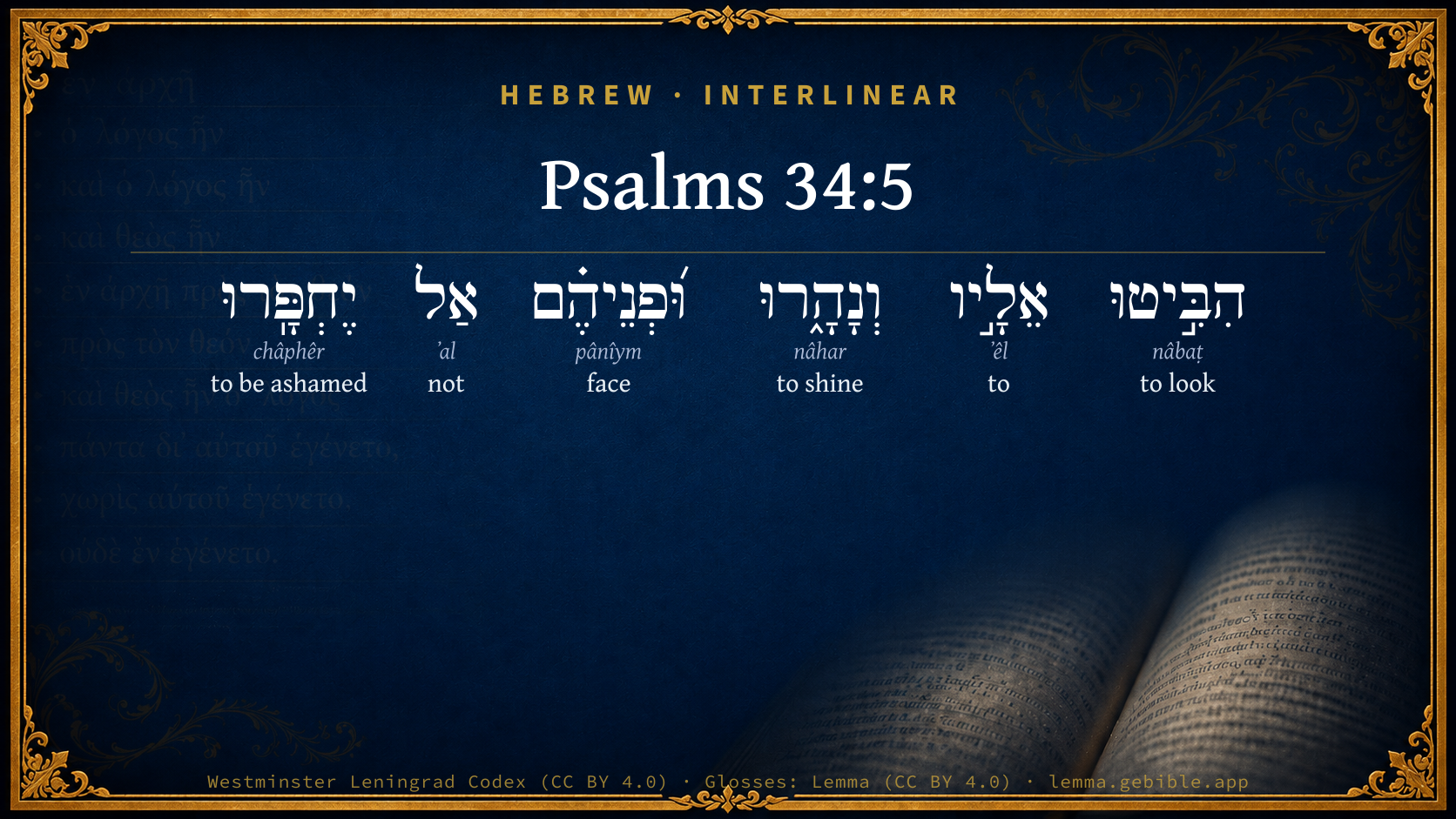
Hebrew (Westminster Leningrad Codex) Psalms 34:5 appears in the Hebrew Old Testament. The text above is from the Westminster Leningrad Codex. Each word links to its Strong’s number, a concise gloss, and parsing drawn from the Open Scriptures Hebrew Bible morphology. Click any word for its full Brown-Driver-Briggs (BDB) entry.
Download image
Cite this verse

Psalms 34:5 (World English Bible). Public Domain. Lemma interlinear Bible study tool, https://lemma.gebible.app/v/psalms/34/5.

Show BibTeX & RIS
BibTeX
RIS
English Translation
They looked to him, and were radiant. Their faces shall never be covered with shame.
World English Bible · Public Domain
Highlights
  • 1 first appearance in the Hebrew Bible
Full analysis ↓
Download a study sheet

One document with this verse’s original text, its word-by-word gloss line, the meaning frame, cross-references with their text, attributed commentary, and full source and license credits — printable, and it pastes into notes with its structure intact.

This verse Autodidact and up

Study sheet (.html) Plain text (.txt)

A passage Seminary Student

Up to 50 verses in one chapter. A passage sheet keeps up to 6 commentary sources and 12 cross-references per verse, in the order this page ranks them, and says so on the sheet whenever that leaves anything out. Ask for a single verse and you get the Autodidact verse sheet above.

Everything on this page stays free to read, with no account — the sheet is a download of what is already on screen, not access to it.

Want to remove ads? Support Godless Engineer
Compare translations 3

The same verse in 3 English versions, stacked beneath the original-language interlinear above. Click any original word for its lexicon entry.

Each is an independent rendering of the whole verse — the interlinear is not word-aligned to these translations.

Highlighted words mark where these versions differ — a whole-verse word diff, not a word-by-word alignment.

  • World English Bible Public Domain
    They looked to him, and were radiant. Their faces shall never be covered with shame.
  • King James Version Public Domain
    They looked unto him, and were lightened: and their faces were not ashamed.
  • unfoldingWord Literal Text CC BY-SA 4.0
    They look to him and are radiant; let their faces not have shame.

unfoldingWord Literal Text — © unfoldingWord, licensed CC BY-SA 4.0. Word-aligned USFM3 via Door43 (git.door43.org/unfoldingWord/en_ult).

Versions to compare (up to 4)

3 of 4 selected

Show all 18 translations

Every available English version of this verse, each an independent rendering of the whole verse.

  • World English Bible Public Domain
    They looked to him, and were radiant. Their faces shall never be covered with shame.
  • Berean Standard Bible Public Domain
    Those who look to Him are radiant with joy; their faces shall never be ashamed.
  • Majority Standard Bible Public Domain
    Those who look to Him are radiant with joy; their faces shall never be ashamed.
  • King James Version Public Domain
    They looked unto him, and were lightened: and their faces were not ashamed.
  • American Standard Version (1901) Public Domain
    They looked unto him, and were radiant; And their faces shall never be confounded.
  • Revised Version (1885) Public Domain
    They looked unto him, and were lightened: and their faces shall never be confounded.
  • Geneva Bible (1599) Public Domain
    They shall looke vnto him, and runne to him: and their faces shall not be ashamed, saying,
  • Douay-Rheims (1899) Public Domain
    I sought the Lord, and he heard me; and he delivered me from all my troubles.
  • Young's Literal Translation Public Domain
    They looked expectingly unto Him, And they became bright, And their faces are not ashamed.
  • Literal Standard Version CC BY-SA 4.0
    They looked expectingly to Him, || And they became bright, || And their faces are not ashamed.
  • Unlocked Literal Bible CC BY-SA 4.0
    Those who look to him are radiant, and their faces are not ashamed.
  • unfoldingWord Literal Text CC BY-SA 4.0
    They look to him and are radiant; let their faces not have shame.
  • Darby Bible Public Domain
    They looked unto him, and were enlightened, and their faces were not confounded.
  • World Messianic Bible Public Domain
    They looked to him, and were radiant. Their faces shall never be covered with shame.
  • Webster's Bible Public Domain
    \\34:4\\I sought the LORD, and he heard me, and delivered me from all my fears.
  • Free Bible Version CC BY-SA 4.0
    The faces of those who look to him will shine with joy; they will never be downcast with shame.
  • Bible in Basic English Public Domain
    Let your eyes be turned to him and you will have light, and your faces will not be shamed.
  • JPS Tanakh (1917) Public Domain
    (34-6) They looked unto Him, and were radiant; and their faces shall never be abashed.

Literal Standard Version (2020), Covenant Press — licensed CC BY-SA 4.0. Text via the HelloAO Bible API (eBible.org). Unlocked Literal Bible (unfoldingWord) — licensed CC BY-SA 4.0. Text via the HelloAO Bible API (eBible.org). unfoldingWord Literal Text — © unfoldingWord, licensed CC BY-SA 4.0. Word-aligned USFM3 via Door43 (git.door43.org/unfoldingWord/en_ult). Free Bible Version, Dr. Jonathan Gallagher — licensed CC BY-SA 4.0. Text via the HelloAO Bible API (eBible.org).

Word by word

More ways to search: Search by grammar → Find every occurrence → Compare this word →

Practice this passage: Drill this verse → Learn its vocabulary →

About this verse

These counts appear in no published source. They are computed here, from the morphology-tagged text and Lemma’s own curated glosses. What Lemma adds →

6
words
6
distinct lemmas
Wisdom
section

Notable vocabulary

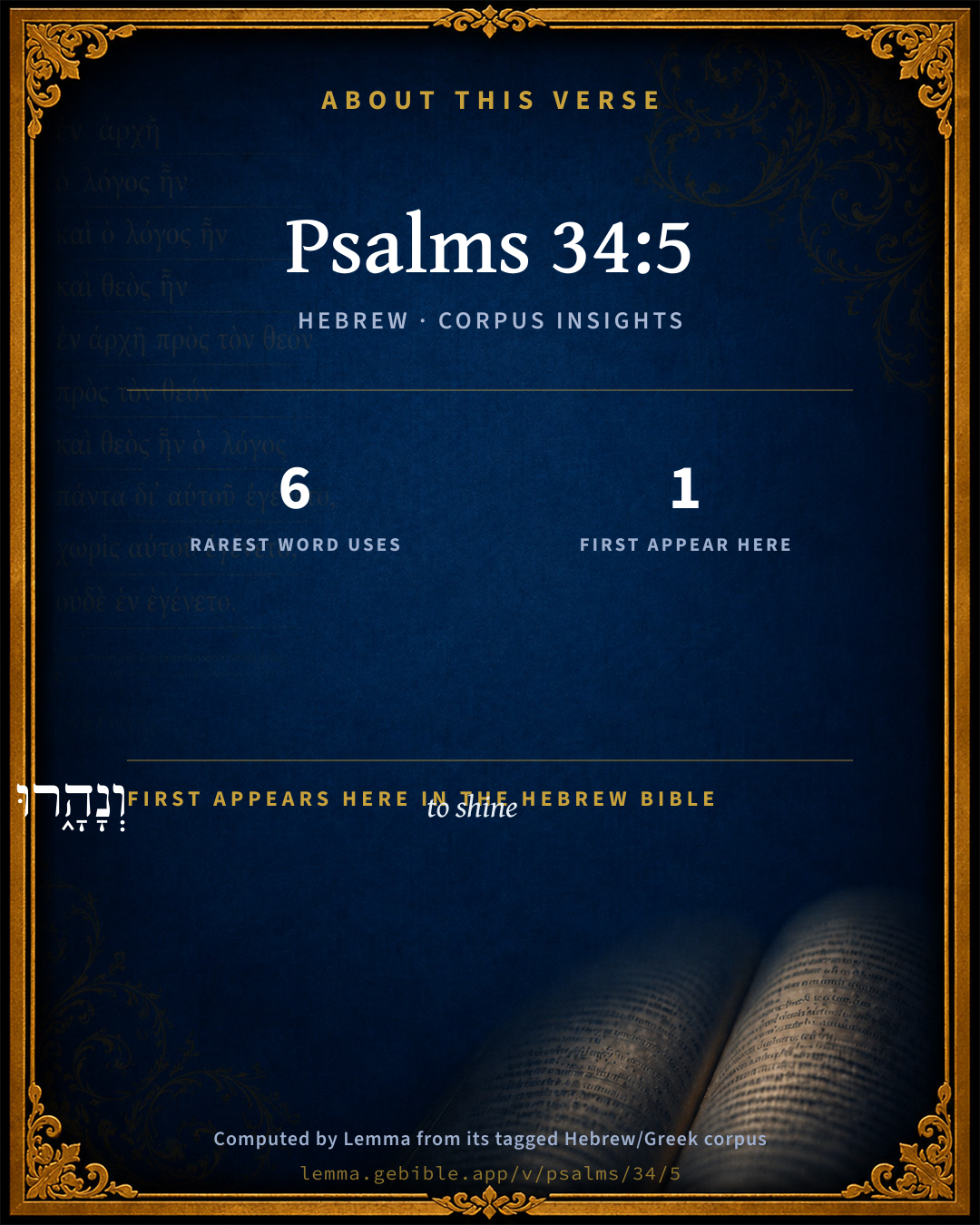
The rarest word here is וְנָהָ֑רוּ to shine H5102 — appearing just 6 times in the whole Hebrew Bible.

First appearance in Scripture

This word makes its first canonical appearance in the Hebrew Bible here:

  • וְנָהָ֑רוּ to shine H5102

Shared distinctive vocabulary

וְנָהָ֑רוּ to shine H5102 occurs in 6 verses of the Hebrew Bible. Also found in:

Grammatical profile

  • 3 verbs
  • 1 noun
  • 1 preposition
  • 1 particle

Verb forms

  • הִבִּ֣יטוּ Hiphil · Perfect
  • וְנָהָ֑רוּ Qal · Perfect
  • יֶחְפָּֽרוּ Qal · Jussive

Hebrew & Septuagint length

In English translation the verse runs 15 words from the Hebrew and 17 from the Septuagint (LXX English) — closely comparable.

A rough comparison of the two English renderings, which tokenize alike — not a word-level alignment.

Word counts can differ between the Hebrew and the Greek without any difference in meaning — e.g. the Hebrew direct-object marker אֵת has no separate Greek word, and Greek often adds the article ὁ.

Cross-references

12

Topical passages linked to Psalms 34:5 in the Treasury of Scripture Knowledge — connected by theme and wording, ordered by reader-vote popularity; previews shown in the World English Bible.

  • Hebrews 12:2 looking to Jesus, the author and perfecter of faith, who for the joy that was set before him endured the cross, despising shame, and has sat down at the right hand of the throne of God.
  • Psalms 123:1–2 To you I do lift up my eyes, You who sit in the heavens.
  • Psalms 18:28 For you will light my lamp, Yahweh. My God will light up my darkness.
  • Psalms 25:3 Yes, no one who waits for you shall be shamed. They shall be shamed who deal treacherously without cause.
  • Psalms 36:9 For with you is the spring of life. In your light shall we see light.
  • Isaiah 60:5 Then you shall see and be radiant, and your heart shall thrill and be enlarged; because the abundance of the sea shall be turned to you, the wealth of the nations shall come to you.
  • Psalms 97:11 Light is sown for the righteous, And gladness for the upright in heart.
  • Psalms 13:3 Behold, and answer me, Yahweh, my God. Give light to my eyes, lest I sleep in death;
  • Isaiah 45:22 Look to me, and be you saved, all the ends of the earth; for I am God, and there is none else.
  • Esther 8:16 The Jews had light and gladness, and joy and honor.
  • Psalms 83:16 Fill their faces with confusion, That they may seek your name, Yahweh.
  • 2 Samuel 19:5 Joab came into the house to the king, and said, You have shamed this day the faces of all your servants, who this day have saved your life, and the lives of your sons and of your daughters, and the lives of your wives, and the lives of your concubines;

Cross-references courtesy of OpenBible.info (CC BY 4.0).

Hebrew and Greek witnesses Masoretic Hebrew ↔ Greek Septuagint

The same verse in the two great witnesses to the Old Testament, shown verse-for-verse.

You’re reading Greek Psalm 33 (Hebrew Psalm 34). The Septuagint counts the superscription, so verse numbers can differ from the Hebrew — chapter-level alignment, not verse-by-verse. Numbering follows Rahlfs.

These are two independent witnesses, not word-aligned to each other, and the Septuagint is shown in lemma (dictionary) form.

Hebrew Psalms 34:5 Masoretic · Westminster Leningrad Codex

הִבִּ֣יטוּ אֵלָ֣יו וְנָהָ֑רוּ וּ֝פְנֵיהֶ֗ם אַל יֶחְפָּֽרוּ

They looked to him, and were radiant. Their faces shall never be covered with shame.

World English Bible · Public Domain

Greek LXX Greek Psalm 33:5 Septuagint · lemma form

ἐκζητέω ὁ κύριος καί ἐπιἀκούω ἐγώ καί ἐκ πᾶς ὁ παροικία ἐγώ ῥύομαι ἐγώ

Draw near to him, and be enlightened: and your faces shall not by any means be ashamed.

LXX2012 (modern English Septuagint) · Public Domain

On this verse, John Calvin's Commentaries discusses the Septuagint’s reading. Read the note in Commentary ↓

Hebrew: Westminster Leningrad Codex (CC BY 4.0). Greek: Septuagint (public domain); English from LXX2012 (modern English Septuagint) (Public Domain). How the Septuagint differs from the Hebrew →

Commentary

Notes on Psalms 34:5 from classic Christian and Jewish commentators (each source and its license shown beneath its notes). The classic Christian expositions comment on the surrounding passage and are grouped to its opening verse, so a note may address several verses; the Jewish commentaries on the Tanakh (Rashi and others) are per-verse, so they appear only where the commentator wrote on this verse.

Lemma curates 59 commentaries, every one of them public domain or Creative Commons licensed, each selected and text-cleaned for this edition rather than reprinted as found. About our sources →

The Cambridge Bible for Schools and Colleges

gen. ed. J. J. S. Perowne

5. They looked &c.] The subject is to be supplied from the verb. They that looked unto him looked, and were brightened. The earnest gaze of faith and confidence was not in vain. For the phrase cp. Isa_31:1; and for illustration see Num_21:9; Zec_12:10. The Heb. word for brightened is a rare word, found in Isa_60:5 (R.V.); but this, not flowed unto him (A.V. marg.) is the right sense. In most editions They flowed is wrongly marked as the alternative to They looked. For the thought cp. Psa_36:9.

were not ashamed] R.V. shall never be confounded, lit. put to the blush with disappointment: a word which has not met us before in the Psalter, but recurs twice in Psalms 35. (Psa_35:4; Psa_35:26), and elsewhere.

The reading of the Massoretic text gives a fair sense, but the ancient Versions (except the Targum) read an imperative in the first clause, and your faces in the second. We should then render, Look unto him and be brightened, that your faces may not be confounded. This reading is in itself probable, and is supported by grammatical considerations. The connexion of thought in Psa_34:5-6 will then be exactly the same as in Psa_34:3-4; an invitation, followed by the statement of a fact which supports it.

5, 6. Such experience of Jehovah’s help is not limited to the Psalmist.

The Cambridge Bible for Schools and Colleges (gen. ed. J. J. S. Perowne; Cambridge University Press, 1878–1918) — public domain. Text from a community e-Sword module.

Trapp's Complete Commentary

John Trapp

Psa 34:5 They looked unto him, and were lightened: and their faces were not ashamed.

Ver. 5. They looked unto him, and were lightened] They, that is, my servants and fellow soldiers who accompanied me first to Nob, 1Sa 21:2; 1Sa 21:4 Mat 12:3-4, and afterwards to Gath (as it is probable); these being in the same danger, looked likewise unto God by faith, hope, and prayer; and were lightened; that is, comforted, cheered, directed, yea, delivered together with David. Or, they flowed together, viz. to God, as rivers roll to the sea, or malefactors run to the sanctuary, Isa 2:2; Isa 60:5.

And their faces were not ashamed] i.e. They were not repulsed, disappointed, made to hide their heads, as Rev 6:15-16.

John Trapp, A Commentary or Exposition upon All the Books of the Old and New Testament (1647–1656) — public domain. Text from a community e-Sword module.

The Biblical Illustrator

Joseph S. Exell

Psa_34:5

They looked unto Him and were lightened; and their faces were not ashamed.

Good authority for a good hope

How low, oftentimes, has been the condition of the people of God! See the lamentations of Jeremiah. But he and all Gods saints have looked unto God and were lightened. Consider--

I. their expectation. They looked unto Him. They did so under--

1. The deluge of sin. This universal; none ever escaped it. We are all under sin.

2. The deluge of death.

3. Jehovahs eternal wrath. None, by and of themselves, can escape either. But Jesus said, Lo, I come, and He hath rolled back the waters of each, for all them that look to Him.

4. Bondage. Israel was in bondage, and so are Gods people now. But the Lord has promised to deliver them. The sighing of the prisoners comes before Him, and He preserves those that are appointed to die. The sins of our nature are hard task-masters.

II. confirmation. They were lightened in mind and in soul. Let us then rejoice in our religion, and we shall never be ashamed. (James Wells.)

Looking unto Jesus

From the connection we are to understand the pronoun Him as referring to the word Lord in the preceding verse. They looked unto the Lord Jehovah, and were lightened. But no man ever yet looked to Jehovah God, as He is in Himself, and found any comfort in Him, for our God is a consuming fire. The only way in which we can see God is through the Mediator Jesus Christ.

I. First, look to the Lord Jesus Christ in his life. Here the troubled saint will find the most to enlighten him. In the example, in the patience, in the sufferings of Jesus Christ, there are stars of glory to cheer the midnight darkness of the sky of your tribulation. One glimpse at Him may well suffice for all our toils while on the road. Cheered by His voice, nerved by His strength, we are prepared to do and suffer, even as He did, to the death. We trust that those of you who are weary Christians will not forget to look unto Him, and be lightened.

II. Come, then, poor, doubting, trembling sinners and saints--come ye now to Calvarys cross. Certain I am, that if we lived more with Jesus, were more like Jesus, and trusted more to Jesus, doubts and fears would be very scarce. They looked unto Him, and were lightened.

III. And now I invite you to a glorious scene--Christs resurrection. You have lost, some of you, the dearest of your earthly relatives. There are others under the constant fear of death. Come, come, behold Jesus Christ risen! For remember, this is a great truth--Now is Christ risen from the dead, and become the first-fruits of them that slept.

IV. look at Jesus Christ ascending into heaven. You are wrestling with spiritual enemies; you are at war to-day, and mayhap the enemy has thrust sore at you, and you have been ready to fall; it is a marvel to you that you have not turned like a coward from the field. But tremble not, your Master was more than conqueror, and so shall you be.

V. look unto him, and be lightened. See there He sits in heaven, He has led captivity captive, and now sits at the right hand of God for ever making intercession for us. Like a great high priest of old, He stands with outstretched arms: there is majesty in His mien, for He is no mean, cringing suppliant. If thou dost not succeed, He will; if thy intercession be unnoticed, His cannot be passed away. Oh! be of good cheer, continue still thy supplication. Look unto Him, and be lightened. (C. H. Spurgeon.)

The Biblical Illustrator, edited by Joseph S. Exell (c. 1880s–1900s) — public domain. Text from a community e-Sword module.

J. A. Alexander on Psalms

Joseph Addison Alexander

6. (Psa 34:5). They looked unto him and brightened, and let not their faces blush. The plural they refers to the whole class of which the Psalmist was the representative.—Brightened, or as we say in English, brightened up, is a natural expression of relief and renewed cheerfulness. In the last clause the optative form is substituted for that of simple affirmation, so as to increase the emphasis. The wish, let not their faces blush, implies that there is danger of their doing so, and need of divine grace to prevent it.

Joseph Addison Alexander, The Psalms Translated and Explained (1850) — public domain. Text from a community e-Sword module.

Tyndale Open Study Notes

Tyndale Open Resources

34:5-6 The psalmist narrates his experiences of answered prayer.

Tyndale Open Study Notes — © Tyndale Open Resources, licensed CC BY-SA 4.0. Text via the HelloAO Bible API.

Geneva Bible (1599)

Geneva Bible translators

They shall be bold to flee to thee for succor, when they shall see thy mercies toward me.

Geneva Bible (1599) marginal notes — public domain. Text via Bolls.life.

Jamieson, Fausset & Brown

Robert Jamieson, A. R. Fausset & David Brown

God's favor to the pious generally, and to himself specially, is celebrated.

looked--with desire for help.

lightened--or, "brightened," expressing joy, opposed to the downcast features of those who are ashamed or disappointed (Psa 25:2-3).

Jamieson, Fausset & Brown — Commentary Critical and Explanatory on the Whole Bible (1871) — public domain (CC PDM 1.0). Text via the HelloAO Bible API.

Adam Clarke's Commentary

Verse 5. They looked unto him] Instead of הביטו hibbitu, they looked, several of Dr. Kennicott's and De Rossi's MSS. have הביטו habbitu, with the point pathach, "Look ye."

And their faces were not ashamed.] Some MSS., and the Complutensian Polyglot, make this clause the beginning of a new verse and as it begins with a vau, ופניהם upheneyhem, "and their faces," they make it supply the place of the verse which appears to be lost; but see what is said in the introduction before the first verse.

Adam Clarke's Commentary on the Bible (1810–1826) — public domain. Text from a community e-Sword/MySword module.

John Calvin's Commentaries

5. They shall look to him, and shall flow to him. I have already intimated, that this verse and the following should be read in connection with the preceding verse. In relating his own experience David has furnished an example to others, that they should freely and without fear approach God in order to present their prayers before him. Now, he says that they shall come, and this too with a happy issue. The first two verbs are expressed in the past time in the Hebrew; but I have, notwithstanding, no doubt that the sentence ought to be explained thus: When they shall have looked to him, and flowed to him, their faces shall not be ashamed. I have therefore translated them in the future tense. David is not relating things which had happened, but is commending the fruit of the favor which had been manifested to himself. Some interpreters, I know, refer the words to him to David, Those who take this view explain the words as meaning that the humble or afflicted, upon looking to David, saw how graciously God had dealt with him, and were enlightened, revived, and encouraged. They also consider, as Calvin himself does, the humble or afflicted as the persons who speak in the sixth verse, where, pointing as it were with the finger to David, they say, “This poor man cried,” etc.

This is the rendering adopted by Horsley, who understands by the expression the illumination of the soul by the light of Divine truth. He reads the verb in the imperative mood, and his translation of the entire verse is as follows:

“Look towards him, and thou shalt be enlightened; And your faces shall never be ashamed.”

This reading is sanctioned by the Septuagint. It supposes two alterations on the text. First, that instead of הביטו, they looked, we should read הביטו, habitu, look ye; and this last reading is supported by several of Dr Kennicott’s and De Rossi’s MSS. The other alteration is, that instead of ופניהש, upeneyhem, their faces, we should read ופניכש, upeneykem, your faces. Poole, in defense of reading your instead of their, observes, “that the change of persons is very frequent in this book.”

John Calvin's Commentaries (1540-1563) — public domain. Text from the Calvin Translation Society English edition (1840s-50s) via the Christian Classics Ethereal Library (ccel.org). Calvin's coverage is partial (roughly two-thirds of the Bible); uncommented books and verses are honest gaps, never fabricated. The 19th-century editor's footnotes and remarks are omitted so the notes are faithfully Calvin's own voice.

Ellicott's Commentary for English Readers

(5) Were lightened.—The Hebrew verb means properly “to flow,” but by a natural process, as in the common phrases “streams of light,” “floods of light,” acquired in Aramaic the sense of “shining.” Such must be its meaning in Isa_60:5, almost the echo of the thought in the psalm, the thought of a reflex of the Divine glory lighting up the face of those who in trouble seek God. (Theodoret has “He who approaches God, receives the rays of intellectual light.”) We naturally think of the dying Stephen.

As to the construction, the subject must either be supplied from Psa_34:2, or it must be general. The LXX. and Vulg. avoid the difficulty by changing to the second person.

A Bible Commentary for English Readers, edited by Charles John Ellicott (1878–1897) — public domain. Text from a community e-Sword module.

John Gill's Exposition

They looked to him, and were lightened,.... That is, "the humble" ones, Psa 34:2; and so this is a reason why they should join in praising and magnifying the Lord; these "looked" up to God in prayer and by faith, when in distressed and uncomfortable circumstances, for help and deliverance, and a supply of every needful good thing; and they were "enlightened"; so the Targum renders it, "their faces were enlightened"; as Jarchi and Aben Ezra interpret it, in opposition to what follows: they must have been enlightened before they could look, but by looking to the Lord more light was gained: this chiefly designs the light of joy, peace, and comfort, which is had in a way of believing: some render the word "and flowed" (l), as a river does, that is, to the Lord, as in Jer 31:12. So Kimchi and Ben Melech explain the word; and it denotes both the numbers of them that looked up to the Lord in their distress, and the swiftness of their motion to him, and their earnestness and fervour of mind; so faith is not only a looking to Christ, but a going forth unto him;

and their faces were not ashamed; having what they prayed and looked for, and what they hoped and believed they should have; namely, deliverance and salvation, and so peace and pleasure.

(l) "et confluunt", Junius & Tremellius, Michaelis; "et instar fluvii irruerint", Piscator, Amama; "et confluxerunt", Gejerus.

John Gill's Exposition of the Whole Bible (1746–1763) — public domain (CC PDM 1.0). Text via the HelloAO Bible API.

Albert Barnes' Notes on the Bible

They looked unto him - That is, they who were with the psalmist. He was not alone when he fled to Abimelech; and the meaning here is, that each one of those who were with him looked to God, and found light and comfort in Him. The psalmist seems to have had his thoughts here suddenly turned from himself to those who were with him, and to have called to his remembrance how they “all” looked to God in their troubles, and how they all found relief.

And were lightened - Or, “enlightened.” They found light. Their faces, as we should say, “brightened up,” or they became cheerful. Their minds were made calm, for they felt assured that God would protect them. Nothing could better express what often occurs in the time of trouble, when the heart is sad, and when the countenance is sorrowful - a dark cloud apparently having come over all things - if one thus looks to God. The burden is removed from the heart, and the countenance becomes radiant with hope and joy. The margin here, however, is, “They flowed unto him.” The Hebrew word, נהר nâhar, means sometimes “to flow, to flow together,” Isa 2:2; Jer 31:12; Jer 51:44; but it also means “to shine, to be bright;” and thence, “to be cheered, to rejoice,” Isa 60:5. This is probably the idea here, for this interpretation is better suited to the connection in which the word occurs.

And their faces were not ashamed - That is, they were not ashamed of having put their trust in God, or they were not disappointed. They had not occasion to confess that it was a vain reliance, or that they had been foolish in thus trusting him. Compare Job 6:20, note; Psa 22:5, note; Rom 9:33, note; 1Jo 2:28, note. The idea here is, that they found God to be all that they expected or hoped that he would be. They had no cause to repent of what they had done. What was true of them will be true of all who put their trust in God.

Albert Barnes' Notes on the Bible (1834–1885) — public domain. Text from a community e-Sword/MySword module.

Matthew Poole's English Annotations

They looked; the humble, Psa 34:2; or they that fear him, Psa 34:7, when they were in distress. Or it is an indefinite expression.

Unto him; either,

1. Unto the Lord, expressed Psa 34:4, i.e. they sought and expected help from him. Or rather,

2. Unto this poor man, as it follows, Psa 34:6, or unto David. So he speaks of himself in the third person, which is usual. So the sense is, when I was delivered, Psa 34:4, men looked upon me with wonder and astonishment, as one saved in a prodigious manner.

Lightened, i.e. comforted and encouraged by my example. But these and the foregoing words are by the ancient interpreters read imperatively, as an exhortation to others, to whom he oft addresseth his speech, as Psa 34:3,8,9,11.

Look unto him, ( with an eye of faith and prayer,) and be ye enlightened, i.e. take comfort in the expectation of mercy from him. And then the last words they render thus, and your, Heb. their, (but the change of persons is very frequent in this book,) fear shall not be ashamed. Their faces were not ashamed; they were not disappointed of their hope, but found relief, as I did.

Matthew Poole's English Annotations on the Holy Bible (1683–1685) — public domain. Text from a community e-Sword/MySword module.

The Treasury of David

Charles H. Spurgeon

Ver. 5. They looked unto him, and were lightened. The psalmist avows that his case was not at all peculiar, it was matched in the lives of all the faithful; they too, each one of them on looking to their Lord were brightened up, their faces began to shine, their spirits were uplifted. What a means of blessing one look at the Lord may be! There is life, light, liberty, love, everything in fact, in a look at the crucified One. Never did a sore heart look in vain to the good Physician; never a dying soul turned its darkening eye to the brazen serpent to find its virtue gone. And their faces were not ashamed. Their faces were covered with joy but not with blushes. He who trusts in God has no need to be ashamed of his confidence, time and eternity will both justify his reliance.

Ver. 5. They looked unto him. The more we can think upon our Lord, and the less upon ourselves, the better. Looking to him, as he is seated upon the right hand of the throne of God, will keep our heads, and especially our hearts, steady when going through the deep waters of affliction. Often have I thought of this when crossing the water opposite the old place of Langholm. I found, when I looked down on the water, I got dizzy; I therefore fixed my eyes upon a steady object on the other side, and got comfortably through. David Smith, 1792-1867.

Ver. 5. The power of a faith look.

Psalms 34:6*

Charles H. Spurgeon's The Treasury of David (1869–1885) — public domain. Psalms only. Text from a community e-Sword/MySword module.

Whedon's Commentary on the Bible

Daniel D. Whedon

5. They looked— “Looked,” here, imports intense longing, as Num_21:9. But who “looked?” The subject of the verb is not apparent, the humble, (Psa_34:2,) being too far removed. It is better taken as a universal truth, as if David had suddenly generalized his local experience. “They looked,”—equal to, whosoever looketh, etc.

Were lightened— Brightened up. The shining of God’s face radiated theirs. Exo_34:29-35. The word nahar commonly means to flow, (the noun is the ordinary word for river,) and might here be rendered flowed together; but as it stands contrasted with ashamed, in the next line, it is better to take the more radical sense, as in Isa_60:5, where instead of “flow together,” as in the English Bible, read “shalt shine.”

Daniel D. Whedon (gen. ed.), Commentary on the Old and New Testaments (1874–1909) — public domain. Text from a community e-Sword module.

The Pulpit Commentary

They looked unto him, and were lightened; or, were brightened (Hengstenberg); i.e. had their countenances lighted up and cheered. And their faces were not ashamed. As they would have been if God had made no response to their appeal. (comp. Psa_25:2, 3 74:21)

The Pulpit Commentary (1880–1919), ed. H.D.M. Spence-Jones & Joseph S. Exell — public domain. Text from a community e-Sword module.

John Wesley's Explanatory Notes

Lightened - Comforted and encouraged. Ashamed - They were not disappointed of their hope.

John Wesley, Explanatory Notes Upon the Whole Bible (1754–1765) — public domain. Text via the GEBible commentary corpus.

Rashi

Rabbi Shlomo Yitzchaki (Rashi)

my terrors Heb. מגורותי, an expression of fear, as (in Num. 22:3): “and Moab became terrified (ויגר).”

Rashi on the Tanakh — English translations: “The Judaica Press complete Tanach with Rashi, translated by A. J. Rosenberg” (CC BY 4.0); “Pentateuch with Rashi's commentary by M. Rosenbaum and A.M. Silbermann, 1929-1934” (public domain); “The Metsudah Tanach series, Lakewood, N.J” (CC BY 4.0); and “The Book of Joshua, Metsudah Publications, 1997” (CC BY 4.0). Text via Sefaria.

Lesson kit

Teaching starters — assembled from the data on this page, not authored interpretation. Every prompt links to the verse data it draws on. Edit before teaching.

Psalms, in the Wisdom, opens this verse with 6 words (6 distinct Hebrew lemmas). Its most distinctive word is nâhar (“to shine”). A historical commentator’s framing appears above. Read the whole chapter for the surrounding context.

Discussion questions

  1. The word nâhar carries the sense “to shine.” How does it shape the verse?
  2. The word “to shine” first appears here in Scripture. What is being introduced at this debut?
  3. Isaiah 2:2 shares the word «to shine» with this verse. How do the two illuminate each other?
  4. These translations render this verse differently. What is at stake in choosing one wording over another?
  5. The verb «הִבִּ֣יטוּ» is Hiphil Perfect. How does its form color the action?
  6. Reading how The Cambridge Bible for Schools and Colleges and Trapp's Complete Commentary read this verse, where do the two commentators agree and where do they part?

Things to notice

Reading settings

Reading text

Shown beneath each verse's original-language words.

Old Testament
Old Testament edition

Read the OT as the Masoretic Hebrew (MT) or the Greek Septuagint (LXX).

English shown for the Greek Septuagint (in the Hebrew ↔ Greek comparison).

Comparing translations? Open the Compare panel on any verse page to stack up to four side by side.