
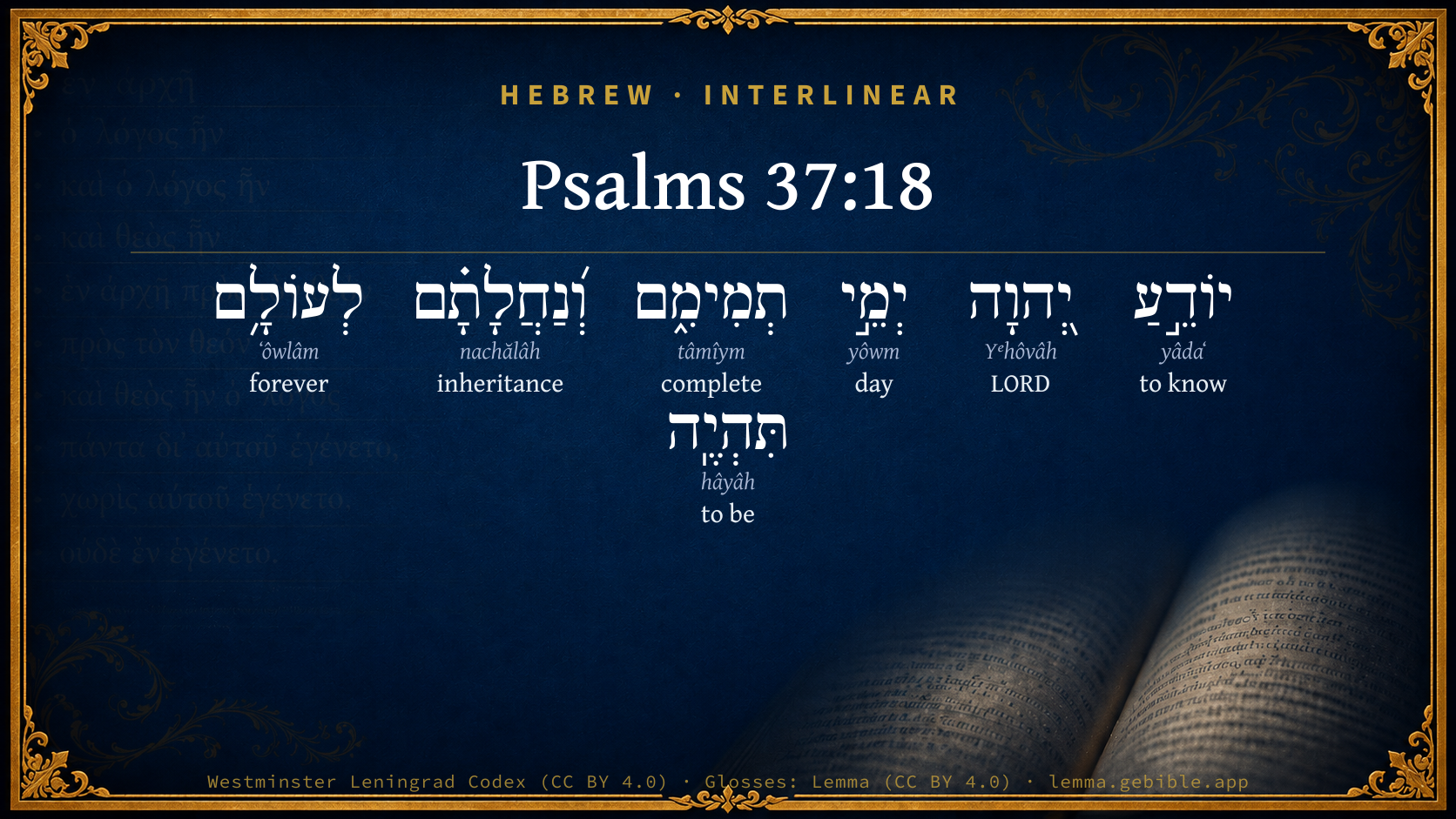
Psalms 37:18

Hebrew (Westminster Leningrad Codex) Psalms 37:18 appears in the Hebrew Old Testament. The text above is from the Westminster Leningrad Codex. Each word links to its Strong’s number, a concise gloss, and parsing drawn from the Open Scriptures Hebrew Bible morphology. Click any word for its full Brown-Driver-Briggs (BDB) entry.
Download image
Cite this verse

Psalms 37:18 (World English Bible). Public Domain. Lemma interlinear Bible study tool, https://lemma.gebible.app/v/psalms/37/18.

Show BibTeX & RIS
BibTeX
RIS
English Translation
Yahweh knows the days of the perfect. Their inheritance shall be forever.
World English Bible · Public Domain
Download a study sheet

One document with this verse’s original text, its word-by-word gloss line, the meaning frame, cross-references with their text, attributed commentary, and full source and license credits — printable, and it pastes into notes with its structure intact.

This verse Autodidact and up

Study sheet (.html) Plain text (.txt)

A passage Seminary Student

Up to 50 verses in one chapter. A passage sheet keeps up to 6 commentary sources and 12 cross-references per verse, in the order this page ranks them, and says so on the sheet whenever that leaves anything out. Ask for a single verse and you get the Autodidact verse sheet above.

Everything on this page stays free to read, with no account — the sheet is a download of what is already on screen, not access to it.

Want to remove ads? Support Godless Engineer
Compare translations 3

The same verse in 3 English versions, stacked beneath the original-language interlinear above. Click any original word for its lexicon entry.

Each is an independent rendering of the whole verse — the interlinear is not word-aligned to these translations.

Highlighted words mark where these versions differ — a whole-verse word diff, not a word-by-word alignment.

  • World English Bible Public Domain
    Yahweh knows the days of the perfect. Their inheritance shall be forever.
  • King James Version Public Domain
    The LORD knoweth the days of the upright: and their inheritance shall be for ever.
  • unfoldingWord Literal Text CC BY-SA 4.0
    Yahweh is knowing the days of the blameless, and their inheritance will be forever.

unfoldingWord Literal Text — © unfoldingWord, licensed CC BY-SA 4.0. Word-aligned USFM3 via Door43 (git.door43.org/unfoldingWord/en_ult).

Versions to compare (up to 4)

3 of 4 selected

Show all 18 translations

Every available English version of this verse, each an independent rendering of the whole verse.

  • World English Bible Public Domain
    Yahweh knows the days of the perfect. Their inheritance shall be forever.
  • Berean Standard Bible Public Domain
    The LORD knows the days of the blameless, and their inheritance will last forever.
  • Majority Standard Bible Public Domain
    The LORD knows the days of the blameless, and their inheritance will last forever.
  • King James Version Public Domain
    The LORD knoweth the days of the upright: and their inheritance shall be for ever.
  • American Standard Version (1901) Public Domain
    Jehovah knoweth the days of the perfect; And their inheritance shall be for ever.
  • Revised Version (1885) Public Domain
    The LORD knoweth the days of the perfect: and their inheritance shall be for ever.
  • Geneva Bible (1599) Public Domain
    The Lord knoweth the dayes of vpright men, and their inheritance shall bee perpetuall.
  • Douay-Rheims (1899) Public Domain
    The Lord knoweth the days of undefiled; and their inheritance shall be for ever.
  • Young's Literal Translation Public Domain
    Jehovah knoweth the days of the perfect, And their inheritance is -- to the age.
  • Literal Standard Version CC BY-SA 4.0
    YHWH knows the days of the perfect, || And their inheritance is for all time.
  • Unlocked Literal Bible CC BY-SA 4.0
    Yahweh watches over the blameless day by day, and their heritage will be forever.
  • unfoldingWord Literal Text CC BY-SA 4.0
    Yahweh is knowing the days of the blameless, and their inheritance will be forever.
  • Darby Bible Public Domain
    Jehovah knoweth the days of the perfect; and their inheritance shall be for ever:
  • World Messianic Bible Public Domain
    The LORD knows the days of the perfect. Their inheritance shall be forever.
  • Webster's Bible Public Domain
    The LORD knoweth the days of the upright: and their inheritance shall be for ever.
  • Free Bible Version CC BY-SA 4.0
    The Lord knows what is happening to the innocent and grants them an eternal inheritance.
  • Bible in Basic English Public Domain
    The days of the upright are numbered by the Lord, and their heritage will be for ever.
  • JPS Tanakh (1917) Public Domain
    The LORD knoweth the days of them that are wholehearted; and their inheritance shall be for ever.

Literal Standard Version (2020), Covenant Press — licensed CC BY-SA 4.0. Text via the HelloAO Bible API (eBible.org). Unlocked Literal Bible (unfoldingWord) — licensed CC BY-SA 4.0. Text via the HelloAO Bible API (eBible.org). unfoldingWord Literal Text — © unfoldingWord, licensed CC BY-SA 4.0. Word-aligned USFM3 via Door43 (git.door43.org/unfoldingWord/en_ult). Free Bible Version, Dr. Jonathan Gallagher — licensed CC BY-SA 4.0. Text via the HelloAO Bible API (eBible.org).

Word by word

More ways to search: Search by grammar → Find every occurrence → Compare this word →

Practice this passage: Drill this verse → Learn its vocabulary →

About this verse

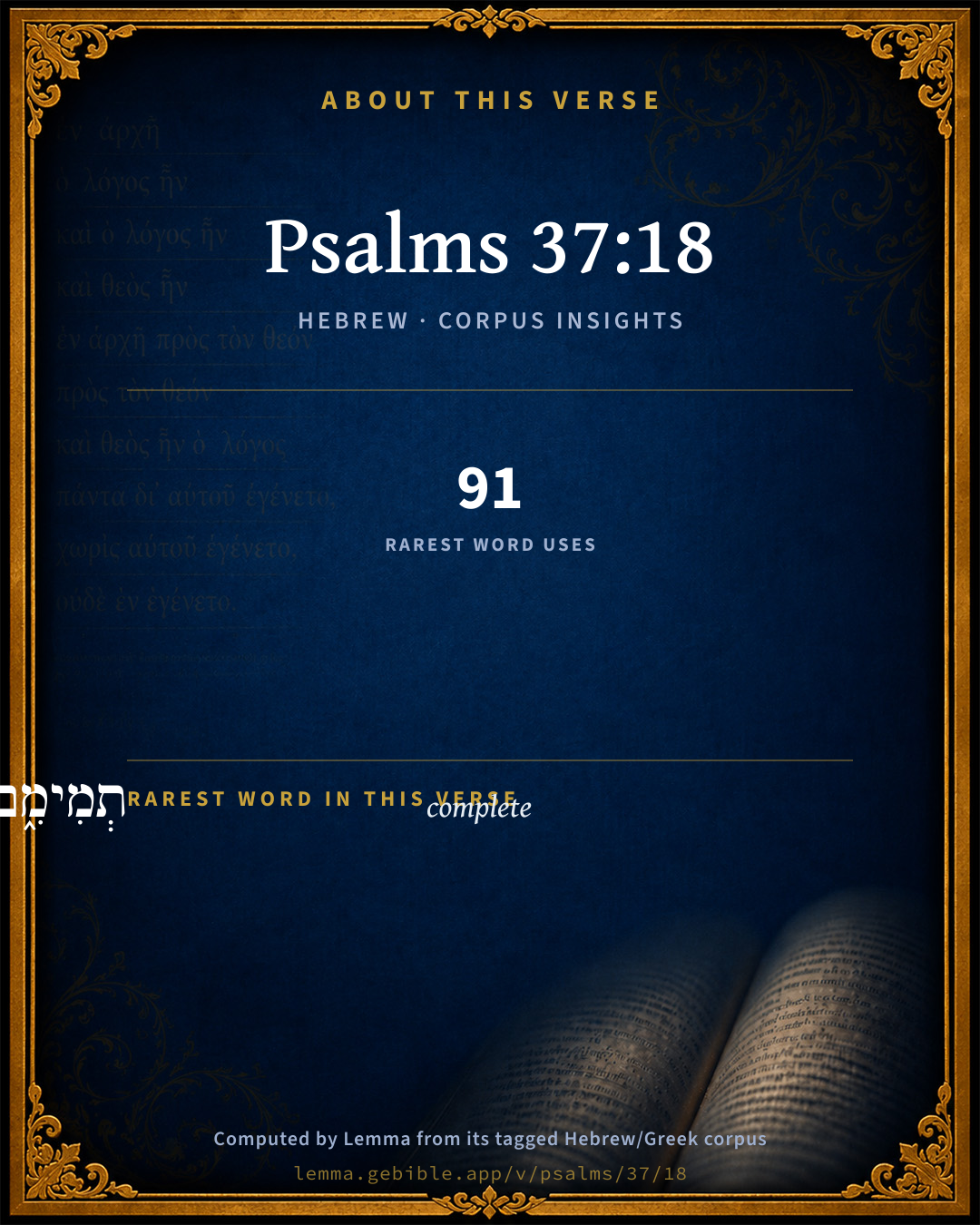
These counts appear in no published source. They are computed here, from the morphology-tagged text and Lemma’s own curated glosses. What Lemma adds →

7
words
7
distinct lemmas
Wisdom
section

Grammatical profile

  • 2 verbs
  • 4 nouns
  • 1 adjective

Verb forms

  • יוֹדֵ֣עַ Qal · Participle Active
  • תִּהְיֶֽה Qal · Imperfect

Hebrew & Septuagint length

In English translation the verse runs 12 words from the Hebrew and 15 from the Septuagint (LXX English) — closely comparable.

A rough comparison of the two English renderings, which tokenize alike — not a word-level alignment.

Word counts can differ between the Hebrew and the Greek without any difference in meaning — e.g. the Hebrew direct-object marker אֵת has no separate Greek word, and Greek often adds the article ὁ.

Cross-references

21

Topical passages linked to Psalms 37:18 in the Treasury of Scripture Knowledge — connected by theme and wording, ordered by reader-vote popularity; previews shown in the World English Bible.

  • Psalms 1:6 For Yahweh knows the way of the righteous, But the way of the wicked shall perish.
  • Psalms 103:17 But Yahweh's loving kindness is from everlasting to everlasting with those who fear him, His righteousness to children's children;
  • Romans 6:23 For the wages of sin is death, but the free gift of God is eternal life in Christ Jesus our Lord.
  • 2 Timothy 2:19 However God's firm foundation stands, having this seal, "The Lord knows those who are his," and, "Let every one who names the name of the Lord depart from unrighteousness."
  • Psalms 31:7 I will be glad and rejoice in your loving kindness, For you have seen my affliction. You have known my soul in adversities.
  • Psalms 49:5 Why should I fear in the days of evil, When iniquity at my heels surrounds me?
  • Psalms 73:24 You will guide me with your counsel, And afterward receive me to glory.
  • 1 Peter 1:4–5 to an incorruptible and undefiled inheritance that doesn't fade away, reserved in heaven for you,
  • Revelation 11:3–5 I will give power to my two witnesses, and they will prophesy one thousand two hundred sixty days, clothed in sackcloth."
  • Deuteronomy 33:25 Your bars shall be iron and brass; As your days, so shall your strength be.
  • Psalms 21:4 He asked life of you, you gave it to him, Even length of days forever and ever.
  • Isaiah 60:21 Your people also shall be all righteous; they shall inherit the land forever, the branch of my planting, the work of my hands, that I may be glorified.
  • 1 John 2:25 This is the promise which he promised us, the eternal life.
  • Psalms 16:11 You will show me the path of life. In your presence is fullness of joy. In your right hand there are pleasures forevermore.
  • Psalms 31:15 My times are in your hand. Deliver me from the hand of my enemies, and from those who persecute me.
  • Psalms 37:13 The Lord will laugh at him, For he sees that his day is coming.
  • Matthew 6:32 For the Gentiles seek after all these things, for your heavenly Father knows that you need all these things.
  • Matthew 24:21–24 for then there will be great oppression, such as has not been from the beginning of the world until now, no, nor ever will be.
  • Romans 5:21 that as sin reigned in death, even so might grace reign through righteousness to eternal life through Jesus Christ our Lord.
  • 2 Timothy 3:1–5 But know this, that in the last days, grievous times will come.
  • 2 Timothy 4:2–4 preach the word; be urgent in season and out of season; reprove, rebuke, and exhort, with all patience and teaching.

Cross-references courtesy of OpenBible.info (CC BY 4.0).

Hebrew and Greek witnesses Masoretic Hebrew ↔ Greek Septuagint

The same verse in the two great witnesses to the Old Testament, shown verse-for-verse.

You’re reading Greek Psalm 36 (Hebrew Psalm 37). The Septuagint counts the superscription, so verse numbers can differ from the Hebrew — chapter-level alignment, not verse-by-verse. Numbering follows Rahlfs.

These are two independent witnesses, not word-aligned to each other, and the Septuagint is shown in lemma (dictionary) form.

Hebrew Psalms 37:18 Masoretic · Westminster Leningrad Codex

יוֹדֵ֣עַ יְ֭הוָה יְמֵ֣י תְמִימִ֑ם וְ֝נַחֲלָתָ֗ם לְעוֹלָ֥ם תִּהְיֶֽה

Yahweh knows the days of the perfect. Their inheritance shall be forever.

World English Bible · Public Domain

Greek LXX Greek Psalm 36:18 Septuagint · lemma form

γιγνώσκω κύριος ὁ ὁδός ὁ ἄμωμος καί ὁ κληρονομία αὐτός εἰς ὁ αἰών εἰμί

The Lord knows the ways of the perfect; and their inheritance shall be for ever.

LXX2012 (modern English Septuagint) · Public Domain

Hebrew: Westminster Leningrad Codex (CC BY 4.0). Greek: Septuagint (public domain); English from LXX2012 (modern English Septuagint) (Public Domain). How the Septuagint differs from the Hebrew →

Commentary

Notes on Psalms 37:18 from classic Christian and Jewish commentators (each source and its license shown beneath its notes). The classic Christian expositions comment on the surrounding passage and are grouped to its opening verse, so a note may address several verses; the Jewish commentaries on the Tanakh (Rashi and others) are per-verse, so they appear only where the commentator wrote on this verse.

Lemma curates 59 commentaries, every one of them public domain or Creative Commons licensed, each selected and text-cleaned for this edition rather than reprinted as found. About our sources →

Trapp's Complete Commentary

John Trapp

Psa 37:18 The LORD knoweth the days of the upright: and their inheritance shall be for ever.

Ver. 18. The Lord knoweth the days of the upright] In bonum novit, Psa 1:6 id est prolongat, saith Kimchi; he knoweth, that is, he acknowledgeth, approveth, hath a gracious regard unto, their days and the events thereof; he hath decreed to a minute how long they shall suffer, and what happiness shall succeed their sufferings.

And their inheritance shall be for ever] Here long; and hereafter eternal. What they want here, shall be there made up abundantly.

John Trapp, A Commentary or Exposition upon All the Books of the Old and New Testament (1647–1656) — public domain. Text from a community e-Sword module.

The Biblical Illustrator

Joseph S. Exell

Psa_37:18

The Lord knoweth the days of the upright: and their inheritance shall be for ever.

The portion of the upright

I. The persons spoken of--the upright, a character equally rare and excellent.

II. The period--their days. These are known of God. He knows them kindly and graciously, and will make them all work together for good. How varied are their days: days of affliction, of danger, etc. But He knows them all.

III. The portion--their inheritance shall be for ever. So was not the inheritance of many of the angels in heaven; nor of Adam in Paradise; nor of the Jews in Canaan; nor of the man of this world. But the Christian inheritance is for ever. In the world we may have many losses, but they cannot affect our state. (W. Jay.)

The Biblical Illustrator, edited by Joseph S. Exell (c. 1880s–1900s) — public domain. Text from a community e-Sword module.

Joseph Benson's Commentary

Psa 37:18-20. The Lord knoweth — Observeth with singular care and affection; the days of the upright — Their condition, and all things which do or may befall them; their dangers, and fears, and sufferings from ungodly men; and therefore will watch over them, and preserve them from all the designs and attempts of their enemies. Days, or years, or times, are often put for things done, or events happening in them. And their inheritance shall be for ever — To them and their seed for ever: see Psa 37:29. When they die the inheritance is not lost, but exchanged for one infinitely better. They shall not be ashamed — For the disappointment of their hopes, but their hopes and desires shall be satisfied; as it follows. But the wicked shall be as the fat of lambs — Which in an instant melteth before the fire. They shall consume into smoke — Utterly and irrecoverably.

Joseph Benson's Commentary on the Old and New Testaments (1811–1818) — public domain. Text from a community e-Sword module.

J. A. Alexander on Psalms

Joseph Addison Alexander

18. (Psa 37:18) Knowing, habitually, always knowing, (is) Jehovah, i.e. Jehovah knows.—The days, the life, including both duration and events. Compare Psa 31:16 (15).—Of perfect (men), those free from essential defect or obliquity of character. See above, on Psa 18:24 (23). The epithet is evidently used as an equivalent to the righteous in ver. 17. God knows their days, how long they are to live, and what is to befall them, with an implication that he knows they will be numerous and good days. See above, on Psa 1:3. The same idea is then stated more distinctly in the last clause. And their heritage, their portion, their condition, as God's heirs, to eternity shall be, or shall continue. While this expression would perhaps suggest to a contemporary reader nothing more than an undisturbed possession, on the part of the righteous, as contrasted with the short-lived prosperity of sinners, it necessarily conveys to our minds the idea of a literally everlasting, indefeasible inheritance. See 1Pe 1:4.

Joseph Addison Alexander, The Psalms Translated and Explained (1850) — public domain. Text from a community e-Sword module.

Tyndale Open Study Notes

Tyndale Open Resources

37:18-20 The Lord cares for the blameless in this life and for eternity, but the wicked will perish.

Tyndale Open Study Notes — © Tyndale Open Resources, licensed CC BY-SA 4.0. Text via the HelloAO Bible API.

Geneva Bible (1599)

Geneva Bible translators

God knoweth what dangers hang over his, and by what means to deliver them.

Geneva Bible (1599) marginal notes — public domain. Text via Bolls.life.

Jamieson, Fausset & Brown

Robert Jamieson, A. R. Fausset & David Brown

God, who knows His people's changes, provides against evil and supplies all their need.

Jamieson, Fausset & Brown — Commentary Critical and Explanatory on the Whole Bible (1871) — public domain (CC PDM 1.0). Text via the HelloAO Bible API.

Adam Clarke's Commentary

Verse 18. The Lord knoweth the days of the upright] He is acquainted with all his circumstances, severings, and ability to bear them; and he will either shorten his trials or increase his power. The Lord also approves of the man and his concerns; and his inheritance shall be for ever. He shall have God for his portion, here and hereafter. This is probably another indirect promise to the captives that they shall be restored to their own land. See Ps 37:11.

Adam Clarke's Commentary on the Bible (1810–1826) — public domain. Text from a community e-Sword/MySword module.

John Calvin's Commentaries

18 Jehovah knoweth the days of the upright It is not without good reason that David so frequently inculcates this doctrine, that the righteous are blessed because God provides for their necessities. We see how prone the minds of men are to distrust, and how much they are vexed by an excess of cares and anxieties from which they are unable to extricate themselves, while, on the other hand, they fall into another error in being more anxious regarding the future than there is any reason for; and yet, however active and industrious in the formation of their plans, they are often disappointed in their expectations, and not unfrequently fail altogether of success. Nothing, therefore, is more profitable for us than to have our eyes continually set upon the providence of God, which alone can best provide for us every thing we need. On this account, David now says, that God knoweth the days of the righteous; that is to say, he is not ignorant of the dangers to which they are exposed, and the help which they need. This doctrine we ought to improve as a source of consolation under every vicissitude which may seem to threaten us with destruction. We may be harassed in various ways, and distracted by many dangers, which every moment threaten us with death, but this consideration ought to prove to us a sufficient ground of comfort, that not only are our days numbered by God, but that he also knows all the vicissitudes of our lot on earth. Since God then so carefully watches over us for the maintenance of our welfare, we ought to enjoy, in this our pilgrimage on earth, as much peace and satisfaction as if we were put in full possession of our paternal inheritance and home. Because we are regarded by God, David from this concludes, that our inheritance is everlasting. Moreover, in declaring that those who are upright are thus carefully protected by God, he exhorts us to the sincere pursuit of truth and uprightness; and if we desire to be placed in safety under the protection of God, let us cultivate meekness, and reject with detestation this hellish proverb, “We must howl among wolves.”

John Calvin's Commentaries (1540-1563) — public domain. Text from the Calvin Translation Society English edition (1840s-50s) via the Christian Classics Ethereal Library (ccel.org). Calvin's coverage is partial (roughly two-thirds of the Bible); uncommented books and verses are honest gaps, never fabricated. The 19th-century editor's footnotes and remarks are omitted so the notes are faithfully Calvin's own voice.

Ellicott's Commentary for English Readers

(18) Knoweth.—See Psa_1:6, Note.

A Bible Commentary for English Readers, edited by Charles John Ellicott (1878–1897) — public domain. Text from a community e-Sword module.

The Cambridge Bible for Schools and Colleges

gen. ed. J. J. S. Perowne

18. Jehovah knoweth, and the Omniscient is also the All-Sovereign (see on Psa_1:6), the days of the perfect: each fraction of the lives of those who are devoted to Him (see on Psa_15:2), with all that it brings. Cp. my times (Psa_31:15); Mat_6:8.

and their inheritance shall be for ever] The righteous man lives in his posterity, who continue in possession of the ancestral inheritance, while the posterity of the wicked perish (Psa_37:28; Psa_37:38; Psa_34:16). The Psalmist’s view is still limited to earth (cp. Psa_37:19). The eternal inheritance reserved in heaven is beyond his horizon.

18, 19. Stanza of Yôd. Jehovah’s care for the godly.

The Cambridge Bible for Schools and Colleges (gen. ed. J. J. S. Perowne; Cambridge University Press, 1878–1918) — public domain. Text from a community e-Sword module.

John Gill's Exposition

They shall not be ashamed in the evil time,.... Of affliction and persecution, or of old age, or in the day of judgment, when it will go ill with others; see Jo1 2:28;

and in the days of famine they shall be satisfied: whether it is understood figuratively of a famine of hearing the word, or literally of a proper famine of bread and water: these God will provide for them, as he did for Elijah, and they shall be sure unto them, and therefore let them not fret nor envy.

John Gill's Exposition of the Whole Bible (1746–1763) — public domain (CC PDM 1.0). Text via the HelloAO Bible API.

Albert Barnes' Notes on the Bible

The Lord knoweth the days of the upright - See the notes at Psa 1:6. He knows how long they will live, and all that will happen to them. He sees their whole course of life; he sees the end. It is implied here that his eyes are on all the allotted days of their life; on all that has been ordained for them in the whole course of their life; and that nothing can shorten the days appointed to them. The wicked expect to live, hope to live, make their arrangements to live; but their eyes cannot rest on the future, and they cannot see the end - cannot tell precisely when they will be cut off. Some unexpected calamity - something which they cannot foresee - may come upon them, and cut short their days long before the expected thee; but this cannot happen in respect to Him whose eyes are on the righteous. Nothing can prevent their reaching the thee which he has fixed as the termination of their lives.

And their inheritance shall be forever - Shall be permanent, enduring. Perhaps all that was implied in tiffs language, as it was used by the psalmist, was that they would “continue,” or would not be cut off as the wicked are; that is, that righteousness would contribute to length of days upon the earth (compare Psa 37:9); yet the “language” suggests a higher idea, and is applicable to the righteous in respect to the promise that they will be put in “everlasting” possession of that which they “inherit” from God; that is, that they will be literally blessed forever. They will have a sure inheritance on earth, and it will endure to all eternity in another world.

Albert Barnes' Notes on the Bible (1834–1885) — public domain. Text from a community e-Sword/MySword module.

Matthew Poole's English Annotations

Knoweth; observeth with singular care and affection

The days of the upright, i.e. their condition, and all things which do or may befall them, their dangers and fears, and suffering from ungodly men; and therefore will watch over them, and preserve them from all the designs and attempts of their enemies.

Days, or years, or times are oft put for things done or events happening in them, as Deu 32:7; Psa 31:15; 77:5; 143:5; Isa 63:11.

Their inheritance shall be for ever; to them and their seed for ever: compare Psa 37:29. And when they die, their inheritance is not lost, but exchanged for one infinitely better.

Matthew Poole's English Annotations on the Holy Bible (1683–1685) — public domain. Text from a community e-Sword/MySword module.

The Treasury of David

Charles H. Spurgeon

Ver. 18. The Lord knoweth the days of the upright. His foreknowledge made him laugh at the proud, but in the case of the upright he sees a brighter future, and treats them as heirs of salvation. Ever is this our comfort, that all events are known to our God, and that nothing in our future can take him at unawares. No arrow can pierce us by accident, no danger smite us by stealth; neither in time nor eternity can any unforeseen ill occur to us. Futurity shall be but a continual development of the good things which the Lord has laid up in store for us. And their inheritance shall be for ever. Their inheritance fades not away. It is entailed, so that none cam deprive them of it, and preserved, so that none shall destroy it. Eternity is the peculiar attribute of the believer's portion: what they have on earth is safe enough, but what they shall have in heaven is theirs without end.

Ver. 18. The Lord knoweth the days of the upright. Deposits their days, lays them up in safety for them: for such is the original idea of (edy). John Fry.

Ver. 18. The Lord knoweth the days of the upright, and they cannot be cut short by the malice of man. W. Wilson.

Ver. 18. The comforts derivable from a consideration of the divine knowledge. The eternity of the righteous man's possessions.

Ver. 18.

1. The persons, "the upright."

2. The period, "their days." These are known to God. (1) He knows them kindly and graciously; (2) He knows their number; (3) He knows the nature of them.

3. The portion, "their inheritance shall be for ever."

William Jay.

Ver. 18 (last clause). What it is. How they come by it. How long they hold it.

Psalms 37:19*

Charles H. Spurgeon's The Treasury of David (1869–1885) — public domain. Psalms only. Text from a community e-Sword/MySword module.

Whedon's Commentary on the Bible

Daniel D. Whedon

18. Knoweth—See on Psa_1:6.

Their inheritance shall be for ever—A clear pointing to the life to come. The nature of the subject demands this sense of the words, and the argument wholly falls to the ground without it. See on Psa_37:27-29; Psa_37:37

Daniel D. Whedon (gen. ed.), Commentary on the Old and New Testaments (1874–1909) — public domain. Text from a community e-Sword module.

The Pulpit Commentary

The Lord knoweth the days of the upright; literally, of the perfect those who yield him a complete obedience. God takes loving note of their days, knows their number, and the events which each day will bring. He will cause all things to "work together for their good." And their inheritance shall be for ever (comp. vers. 27, 29, and 37; which all, like this verse, point, albeit vaguely, to a future life). The mere continuance of a man"s posterity in a prosperous condition cannot exhaust the meaning of such phrases as, "Their inheritance shall be for ever;" "Dwell for evermore;" "The righteous shall inherit the land, and dwell therein for ever." If David himself meant no more than this, yet the Holy Spirit which inspired him may have meant more. At any rate, to the Christian the words will always bring up the thought of that "inheritance incorruptible, and undefiled, and that fadeth not away, which is reserved for us in heaven". (1Pe_1:4)

The Pulpit Commentary (1880–1919), ed. H.D.M. Spence-Jones & Joseph S. Exell — public domain. Text from a community e-Sword module.

John Wesley's Explanatory Notes

Knoweth - Observes with care and affection. The days - All things which befall them, their dangers and fears, and suffering. For ever - To them and their seed forever: and when they die their inheritance is not lost, but exchanged for one infinitely better.

John Wesley, Explanatory Notes Upon the Whole Bible (1754–1765) — public domain. Text via the GEBible commentary corpus.

Keil & Delitzsch

C. F. Keil & F. Delitzsch

The life of those who love Jahve with the whole heart is, with all its vicissitudes, an object of His loving regard and of His observant providential care, Psa 1:6; Psa 31:8, cf. Psa 16:1-11. He neither suffers His own to lose their heritage nor to be themselves lost to it. The αἰώνιος κληρονομία is not as yet thought of as extending into the future world, as in the New Testament. In Psa 37:19 the surviving refers only to this present life.

Keil & Delitzsch — Biblical Commentary on the Old Testament (1861–1891) — public domain (CC PDM 1.0). Text via the HelloAO Bible API. (Old Testament only.)

unfoldingWord translationNotes

Door43 World Missions Community

watches over the blameless

To "watch over" means to protect someone. Here "the blameless" refers to the blameless people. AT: "protects the blameless people" (See: Idiom and Nominal Adjectives)

day by day

This is an idiom that means "continually." AT: "every day" (See: Idiom)

when times are bad

This phrase refers to disasters, such as famine. AT: "when calamities occur" (See: Idiom)

translationWords

watch

blameless

inherit

eternity

shame

famine

unfoldingWord translationNotes — © Distant Shores Media and the Door43 World Missions Community, licensed CC BY-SA 4.0. Source: git.door43.org/Door43/en_tn.

Rashi

Rabbi Shlomo Yitzchaki (Rashi)

The Lord knows the days of the innocent He recognizes the deeds of their days,

and their inheritance and the reception of their reward from Him shall be forever.

Rashi on the Tanakh — English translations: “The Judaica Press complete Tanach with Rashi, translated by A. J. Rosenberg” (CC BY 4.0); “Pentateuch with Rashi's commentary by M. Rosenbaum and A.M. Silbermann, 1929-1934” (public domain); “The Metsudah Tanach series, Lakewood, N.J” (CC BY 4.0); and “The Book of Joshua, Metsudah Publications, 1997” (CC BY 4.0). Text via Sefaria.

Lesson kit

Teaching starters — assembled from the data on this page, not authored interpretation. Every prompt links to the verse data it draws on. Edit before teaching.

Psalms, in the Wisdom, opens this verse with 7 words (7 distinct Hebrew lemmas). Its most distinctive word is tâmîym (“complete”). A historical commentator’s framing appears above. Read the whole chapter for the surrounding context.

Discussion questions

  1. The word tâmîym carries the sense “complete.” How does it shape the verse?
  2. How does Psalms 1:6, which shares this passage’s theme, read alongside this verse?
  3. The translations on this page render this verse differently — a whole-verse word diff, not a word-by-word alignment. What might account for the different wordings?
  4. «יוֹדֵ֣עַ» is a Qal Participle Active verb. How does that grammatical form shape the action described?
  5. Compare how Trapp's Complete Commentary and The Biblical Illustrator read this verse. Where do they agree or differ?

Things to notice

Reading settings

Reading text

Shown beneath each verse's original-language words.

Old Testament
Old Testament edition

Read the OT as the Masoretic Hebrew (MT) or the Greek Septuagint (LXX).

English shown for the Greek Septuagint (in the Hebrew ↔ Greek comparison).

Comparing translations? Open the Compare panel on any verse page to stack up to four side by side.