Jeremiah 42:9

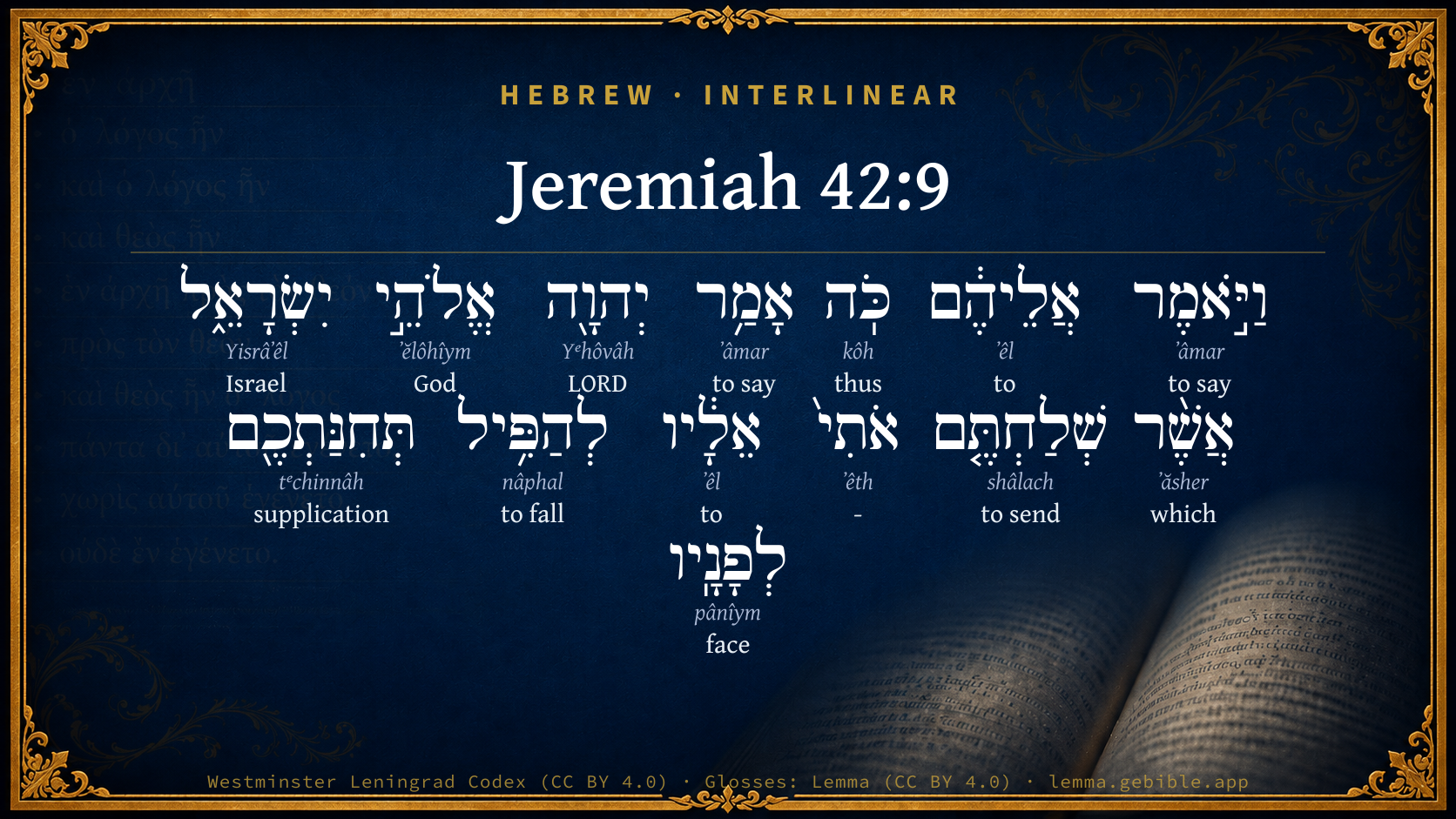
Hebrew (Westminster Leningrad Codex) Jeremiah 42:9 appears in the Hebrew Old Testament. The text above is from the Westminster Leningrad Codex. Each word links to its Strong’s number, a concise gloss, and parsing drawn from the Open Scriptures Hebrew Bible morphology. Click any word for its full Brown-Driver-Briggs (BDB) entry.
Download image
Cite this verse

Jeremiah 42:9 (World English Bible). Public Domain. Lemma interlinear Bible study tool, https://lemma.gebible.app/v/jeremiah/42/9.

Show BibTeX & RIS
BibTeX
RIS
English Translation
and said to them, Thus says Yahweh, the God of Israel, to whom you sent me to present your supplication before him:
World English Bible · Public Domain
Download a study sheet

One document with this verse’s original text, its word-by-word gloss line, the meaning frame, cross-references with their text, attributed commentary, and full source and license credits — printable, and it pastes into notes with its structure intact.

This verse Autodidact and up

Study sheet (.html) Plain text (.txt)

A passage Seminary Student

Up to 50 verses in one chapter. A passage sheet keeps up to 6 commentary sources and 12 cross-references per verse, in the order this page ranks them, and says so on the sheet whenever that leaves anything out. Ask for a single verse and you get the Autodidact verse sheet above.

Everything on this page stays free to read, with no account — the sheet is a download of what is already on screen, not access to it.

Want to remove ads? Support Godless Engineer
Compare translations 3

The same verse in 3 English versions, stacked beneath the original-language interlinear above. Click any original word for its lexicon entry.

Each is an independent rendering of the whole verse — the interlinear is not word-aligned to these translations.

Highlighted words mark where these versions differ — a whole-verse word diff, not a word-by-word alignment.

  • World English Bible Public Domain
    and said to them, Thus says Yahweh, the God of Israel, to whom you sent me to present your supplication before him:
  • King James Version Public Domain
    And said unto them, Thus saith the LORD, the God of Israel, unto whom ye sent me to present your supplication before him;
  • unfoldingWord Literal Text CC BY-SA 4.0
    Then he said to them, “This is what Yahweh, the God of Israel—to whom you sent me so I might lay your pleas before him—says,

unfoldingWord Literal Text — © unfoldingWord, licensed CC BY-SA 4.0. Word-aligned USFM3 via Door43 (git.door43.org/unfoldingWord/en_ult).

Versions to compare (up to 4)

3 of 4 selected

Show all 18 translations

Every available English version of this verse, each an independent rendering of the whole verse.

  • World English Bible Public Domain
    and said to them, Thus says Yahweh, the God of Israel, to whom you sent me to present your supplication before him:
  • Berean Standard Bible Public Domain
    Jeremiah told them, “Thus says the LORD, the God of Israel, to whom you sent me to present your petition:
  • Majority Standard Bible Public Domain
    Jeremiah told them, “Thus says the LORD, the God of Israel, to whom you sent me to present your petition:
  • King James Version Public Domain
    And said unto them, Thus saith the LORD, the God of Israel, unto whom ye sent me to present your supplication before him;
  • American Standard Version (1901) Public Domain
    and said unto them, Thus saith Jehovah, the God of Israel, unto whom ye sent me to present your supplication before him:
  • Revised Version (1885) Public Domain
    and said unto them, Thus saith the LORD, the God of Israel, unto whom ye sent me to present your supplication before him:
  • Geneva Bible (1599) Public Domain
    And saide vnto them, Thus saith the Lord God of Israel, vnto whom ye sent me to present your prayers before him,
  • Douay-Rheims (1899) Public Domain
    And he said to them: Thus saith the Lord the God of Israel, to whom you sent me, to present your supplications before him:
  • Young's Literal Translation Public Domain
    and he saith unto them, `Thus said Jehovah, God of Israel, unto whom ye sent me, to cause your supplication to fall before Him:
  • Literal Standard Version CC BY-SA 4.0
    and he says to them, “Thus said YHWH, God of Israel, to whom you sent me, to cause your supplication to fall before Him:
  • Unlocked Literal Bible CC BY-SA 4.0
    Then he said to them, “This is what Yahweh, the God of Israel—to whom you sent me so I might lay your pleas before him—says,
  • unfoldingWord Literal Text CC BY-SA 4.0
    Then he said to them, “This is what Yahweh, the God of Israel—to whom you sent me so I might lay your pleas before him—says,
  • Darby Bible Public Domain
    and said unto them, Thus saith Jehovah the God of Israel, to whom ye sent me to present your supplication before him:
  • World Messianic Bible Public Domain
    and said to them, “The LORD, the God of Israel, to whom you sent me to present your supplication before him, says:
  • Webster's Bible Public Domain
    And said to them, Thus saith the LORD, the God of Israel, to whom ye sent me to present your supplication before him;
  • Free Bible Version CC BY-SA 4.0
    Jeremiah told them, This what the Lord, the God of Israel, says to those of who you sent to me to present your request:
  • Bible in Basic English Public Domain
    And said to them, These are the words of the Lord, the God of Israel, to whom you sent me to put your request before him:
  • JPS Tanakh (1917) Public Domain
    and said unto them: 'Thus saith the LORD, the God of Israel, unto whom ye sent me to present your supplication before Him:

Literal Standard Version (2020), Covenant Press — licensed CC BY-SA 4.0. Text via the HelloAO Bible API (eBible.org). Unlocked Literal Bible (unfoldingWord) — licensed CC BY-SA 4.0. Text via the HelloAO Bible API (eBible.org). unfoldingWord Literal Text — © unfoldingWord, licensed CC BY-SA 4.0. Word-aligned USFM3 via Door43 (git.door43.org/unfoldingWord/en_ult). Free Bible Version, Dr. Jonathan Gallagher — licensed CC BY-SA 4.0. Text via the HelloAO Bible API (eBible.org).

Word by word

More ways to search: Search by grammar → Find every occurrence → Compare this word →

Practice this passage: Drill this verse → Learn its vocabulary →

תְּחִנַּתְכֶ֖ם
tᵉchinnâh
H8467
“supplication · your”
Noun, Common, Feminine, Singular, Construct + Suffix, Personal, 2nd Person, Masculine, Plural
Part of Speech
Noun
Type
Common
Gender
Feminine
Number
Singular
State
Construct
Full BDB Definition

Origin: from H2603

TWOT: 694f

favour, supplication, supplication for favour - favour - supplication for favour
  1. וַיֹּ֣אמֶר ʼâmar H559 “and · to say” Conjunction + Verb, Qal, Sequential Imperfect, 3rd Person, Masculine, Singular
  2. אֲלֵיהֶ֔ם ʼêl H413 “to · them” Preposition + Suffix, Personal, 3rd Person, Masculine, Plural
  3. כֹּֽה kôh H3541 “thus” Adverb
  4. אָמַ֥ר ʼâmar H559 “to say” Verb, Qal, Perfect, 3rd Person, Masculine, Singular
  5. יְהוָ֖ה Yᵉhôvâh H3068 “LORD” Noun, Proper
  6. אֱלֹהֵ֣י ʼĕlôhîym H430 “God(s) of” Noun, Common, Masculine, Plural, Construct
  7. יִשְׂרָאֵ֑ל Yisrâʼêl H3478 “Israel” Noun, Proper
  8. אֲשֶׁ֨ר ʼăsher H834 “which” Particle, Relative
  9. שְׁלַחְתֶּ֤ם shâlach H7971 “to send” Verb, Qal, Perfect, 2nd Person, Masculine, Plural
  10. אֹתִי֙ ʼêth H853 “- · me” Particle, Direct Object + Suffix, Personal, 1st Person, Common, Singular
  11. אֵלָ֔יו ʼêl H413 “to · him” Preposition + Suffix, Personal, 3rd Person, Masculine, Singular
  12. לְהַפִּ֥יל nâphal H5307 “to fall” Preposition + Verb, Hiphil, Infinitive Construct
  13. לְפָנָֽיו pânîym H6440 “to/for · face(s) · his” Preposition + Noun, Common, Both, Plural, Construct + Suffix, Personal, 3rd Person, Masculine, Singular

About this verse

These counts appear in no published source. They are computed here, from the morphology-tagged text and Lemma’s own curated glosses. What Lemma adds →

14
words
12
distinct lemmas
Prophets
section

Notable vocabulary

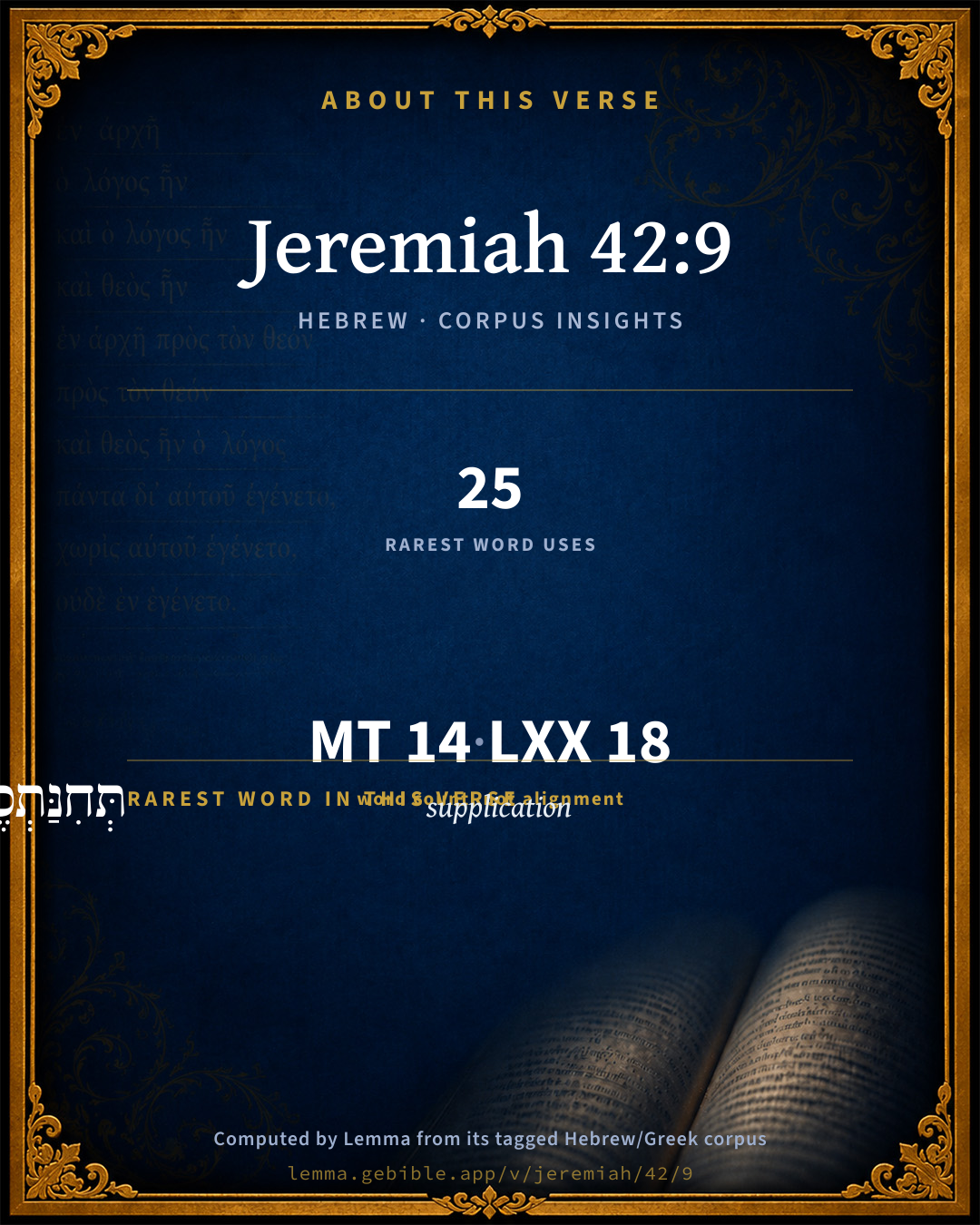
The rarest word here is תְּחִנַּתְכֶ֖ם supplication H8467 — appearing just 25 times in the whole Hebrew Bible.

Shared distinctive vocabulary

תְּחִנַּתְכֶ֖ם supplication H8467 occurs in 24 verses of the Hebrew Bible. Also found in:

Grammatical profile

  • 4 verbs
  • 5 nouns
  • 2 prepositions
  • 1 adverb
  • 2 particles

Verb forms

  • וַיֹּ֣אמֶר Qal · Sequential Imperfect
  • אָמַ֥ר Qal · Perfect
  • שְׁלַחְתֶּ֤ם Qal · Perfect
  • לְהַפִּ֥יל Hiphil · Infinitive Construct

Repetition

Words recur within this verse — often emphatic in Hebrew:

  • וַיֹּ֣אמֶר to say H559 ×2
  • אֲלֵיהֶ֔ם to H413 ×2

Hebrew & Septuagint length

In the original languages it is 14 Hebrew tokens and 18 Greek tokens — but the two are counted differently (Hebrew bundles its prefixes and suffixes into one token; the Greek is in lemma form), so that isn’t a like-for-like length.

Cross-references

5

Topical passages linked to Jeremiah 42:9 in the Treasury of Scripture Knowledge — connected by theme and wording, ordered by reader-vote popularity; previews shown in the World English Bible.

  • 2 Kings 19:4 It may be Yahweh your God will hear all the words of Rabshakeh, whom the king of Assyria his master has sent to defy the living God, and will rebuke the words which Yahweh your God has heard. Therefore lift up your prayer for the remnant that is left.
  • 2 Kings 19:6 Isaiah said to them, Thus shall you tell your master, Thus says Yahweh, Don't be afraid of the words that you have heard, with which the servants of the king of Assyria have blasphemed me.
  • Jeremiah 42:2 and said to Jeremiah the prophet, Let, we pray you, our supplication be presented before you, and pray for us to Yahweh your God, even for all this remnant; for we are left but a few of many, as your eyes do see us:
  • 2 Kings 19:20–37 Then Isaiah the son of Amoz sent to Hezekiah, saying, Thus says Yahweh, the God of Israel, Whereas you have prayed to me against Sennacherib king of Assyria, I have heard [you].
  • 2 Kings 22:15–20 She said to them, Thus says Yahweh, the God of Israel: Tell you the man who sent you to me,

Cross-references courtesy of OpenBible.info (CC BY 4.0).

Hebrew and Greek witnesses Masoretic Hebrew ↔ Greek Septuagint

The same verse in the two great witnesses to the Old Testament, shown verse-for-verse.

These are two independent witnesses, not word-aligned to each other, and the Septuagint is shown in lemma (dictionary) form.

Hebrew Jeremiah 42:9 Masoretic · Westminster Leningrad Codex

וַיֹּ֣אמֶר אֲלֵיהֶ֔ם כֹּֽה אָמַ֥ר יְהוָ֖ה אֱלֹהֵ֣י יִשְׂרָאֵ֑ל אֲשֶׁ֨ר שְׁלַחְתֶּ֤ם אֹתִי֙ אֵלָ֔יו לְהַפִּ֥יל תְּחִנַּתְכֶ֖ם לְפָנָֽיו

and said to them, Thus says Yahweh, the God of Israel, to whom you sent me to present your supplication before him:

World English Bible · Public Domain

Greek LXX Structure differs

In the Septuagint, Jeremiah is about an eighth shorter than the Hebrew and arranges its material differently — the Oracles Against the Nations (Hebrew chapters 46–51) appear in the middle of the Greek book, after 25:13. Because the chapter and verse boundaries do not line up, a verse-for-verse comparison with the Hebrew is not shown.

A verse-for-verse comparison isn’t shown here because the chapters and verses don’t line up. Switch to the LXX edition with the MT / LXX toggle above to read the Greek directly.

Hebrew: Westminster Leningrad Codex (CC BY 4.0). Greek: Septuagint (public domain); English from a public-domain English Septuagint. How the Septuagint differs from the Hebrew →

Targum (Aramaic paraphrase)

1

The Targum is the ancient Jewish Aramaic paraphrase of the Hebrew Scriptures — an interpretive translation, not the Hebrew text itself. Onkelos (literal) and Pseudo-Jonathan (expansive) render the Torah, and Jonathan the Prophets. Coverage is partial: where no permissively-licensed English translation exists for a verse, only the Aramaic is shown. This is verse-level text, not a word-by-word alignment to the Hebrew.

  1. Targum Jonathan Prophets (Joshua–Malachi)
    וַאֲמַר לְהוֹן כִּדְנַן אֲמַר יְיָ אֱלָהָנָא דְיִשְׂרָאֵל דִשְׁלַחְתּוּן יָתִי לָקֳדָמוֹהִי לְמִבְעֵי בָּעוּתְכוֹן קֳדָמוֹהִי:

    (no public-domain English translation for this verse)

    Targum Jonathan — Aramaic: “Mikraot Gedolot” (public domain). English: “Sefaria Community Translation” (CC0 1.0 (public-domain dedication)); “London "Chaldee Paraphrase," 1871” (public domain). Text via Sefaria.

Commentary

Notes on Jeremiah 42:9 from classic Christian and Jewish commentators (each source and its license shown beneath its notes). The classic Christian expositions comment on the surrounding passage and are grouped to its opening verse, so a note may address several verses; the Jewish commentaries on the Tanakh (Rashi and others) are per-verse, so they appear only where the commentator wrote on this verse.

Lemma curates 59 commentaries, every one of them public domain or Creative Commons licensed, each selected and text-cleaned for this edition rather than reprinted as found. About our sources →

The Cambridge Bible for Schools and Colleges

gen. ed. J. J. S. Perowne

9–22. Du. (see introd. note to section) considers Jer_42:15-18 as wholly an addition, and Jer_42:9-14 as containing much editorial matter.

The Cambridge Bible for Schools and Colleges (gen. ed. J. J. S. Perowne; Cambridge University Press, 1878–1918) — public domain. Text from a community e-Sword module.

Trapp's Complete Commentary

John Trapp

Jer 42:9 And said unto them, Thus saith the LORD, the God of Israel, unto whom ye sent me to present your supplication before him;

Ver. 9. Unto whom ye sent me to present your supplication.] Heb., To make your supplication fall in his presence. This I have not ceased to do ever since, but had no answer till now; and it may be that now you may the better regard it. Cito data eito vilescunt. Soon given, soon worthless.

John Trapp, A Commentary or Exposition upon All the Books of the Old and New Testament (1647–1656) — public domain. Text from a community e-Sword module.

John Calvin's Commentaries

He then says that he faithfully related to them what God had commanded, Thus saith Jehovah, the God of Israel, to whom you sent me By this circumstance he shews that they were more bound to obey; for if God had sent his Prophet to them,’ they ought to have obeyed his voice; but when they of their own accord came to him and prayed for a favor, and wished God’s will to be made known to them, they became doubly culpable when they refused the answer given them in God’s name. And he adds, That I might prostrate, or make to fall, your prayer before God We have stated what is meant by this mode of speaking; but there is a difference to be noticed, for he had been requested sup-pliantly to ask God; and he says here that he had not only prayed, but had presented the prayer of the whole people, because he acted for the public; and then he was a middle person between God and the people. On this account he says, that he had been seat to present the prayer of the people to God, for he asked nothing for himself, but acted for them all, and asked God to answer the people.

John Calvin's Commentaries (1540-1563) — public domain. Text from the Calvin Translation Society English edition (1840s-50s) via the Christian Classics Ethereal Library (ccel.org). Calvin's coverage is partial (roughly two-thirds of the Bible); uncommented books and verses are honest gaps, never fabricated. The 19th-century editor's footnotes and remarks are omitted so the notes are faithfully Calvin's own voice.

John Gill's Exposition

If ye will still abide in this land,.... In the land of Judea, their native country, where they had always lived, and where they continued when their brethren were carried captive; and yet they thought of going out of it, which the Lord knew; and therefore to encourage them to abide in it, and not think of departing into Egypt; that if they would take up their residence in it, and determine to continue there, he thus promises them:

then will I build you, and not pull you down: and I will plant you,

and not pluck you up; that is, they should be firm and stable, happy and prosperous; and abound with all kind of blessings, and increase in numbers, wealth, and riches. The metaphors are taken from building houses, and planting fields and vineyards:

for I repent me of the evil that I have done unto you; not that he had done any unjust thing to them; or that he changed his mind concerning them; but that he had compassion on them, and would change his way and course of providence towards them, according to his unchangeable will.

John Gill's Exposition of the Whole Bible (1746–1763) — public domain (CC PDM 1.0). Text via the HelloAO Bible API.

Matthew Poole's English Annotations

The prophet after ten days, all which time some (but upon what ground I know not) think he spent in prayer, receiveth an answer from God, which he presently communicates to the princes and people, with a preface that containeth in it many arguments to have induced this compliance with it:

1. Because it came from the Lord.

2. From that God who, as he was in covenant with Israel, so in all the course of his providence had so carried himself to them, as they had no just reason to suspect either his kindness or his power.

3. From their employing of him to seek God upon their behalf.

Matthew Poole's English Annotations on the Holy Bible (1683–1685) — public domain. Text from a community e-Sword/MySword module.

Whedon's Commentary on the Bible

Daniel D. Whedon

9. Thus saith the Lord — How definite and vivid, apparently, was the consciousness of Jeremiah that he was the organ of God! And how clearly does such a belief as this on the part of individuals and the people generally lie at the foundation of every thing characteristic in the Old Testament.

Daniel D. Whedon (gen. ed.), Commentary on the Old and New Testaments (1874–1909) — public domain. Text from a community e-Sword module.

The Pulpit Commentary

Vers. 9-12. The blessedness of patient endurance.

In answer to the appeal of the people for guidance, Jeremiah has to tell them that good will attend them so long as they stay in their land, but curses if they flee to Egypt. Hardships crowd upon them at present, and dangers threaten for the future. But if they will but endure these patiently, God will save and prosper them.

I WHY THE PEOPLE WERE REQUIRED TO REMAIN IN THEIR LAND.

1. It was the will of God. When we know his will, if we know nothing more, that alone should be a final answer to all questions. Because he is our King we are bound to obey, and because he is our Father his will must be for our good.

2. It was the course of faith. Flight to Egypt was always regarded as a sign of distrust in God and reliance upon the arm of flesh. Repeatedly had the people been warned not to trust "upon the staff of this bruised reed, even upon Egypt, on which if a man lean, it will go into his hand, and pierce it: so is Pharaoh King of Egypt unto all that trust on him". (2Ki_18:21) When Pharaoh takes the place of Jehovah, when any earthly judge is trusted rather than God, it will surely betray us.

3. It was a safeguard for purity. Egypt was a heathen power. An asylum in Egypt would bring temptations to immorality and unfaithfulness to the God of Israel. It is always unwise and wrong to run into temptation in order to escape from trouble.

4. It was a sign of contentment. It is happiest for a man to do his duty in that state of life into which it has pleased God to call him, though if God calls him out of one state to a more prosperous one, he may enjoy the greater comfort thus gained.

II WHAT PROMISES WERE GIVEN TO THOSE WHO REMAINED IN THEIR LAND.

1. Prosperity would be restored. The troubles of God"s people are transitory. Patient endurance will see the end of all of them. Then God will bring, not bare deliverance, but happiness and prosperity. The Jew looked for this in temporal concerns; the Christian expects it in eternal things.

2. The people would be delivered from danger. God would save them from the King of Babylon. And if this salvation was possible, shall we not believe that all other deliverances are possible, and rest calmly assured that to those who patiently and obediently submit to God no real harm can come? Nebuchadnezzar may triumph insolently; but God can cast him down to the level of the brutes. The lions may roar, but they are chained, or God wilt send an angel to shut their mouths.

III WHAT ASSURANCES THE PEOPLE HAD THAT IT WOULD BE THUS WELL WITH THEM IF THEY REMAINED IN THEIR LAND.

1. They were assured of the presence of God. "I am with you" (ver. 11). If God is with us, we can dispense with the patronage of a Pharaoh, even though a Nebuchadnezzar is thundering at our gates.

2. They were assured of the active help of God. "I am with you to save you." The very object of God"s presence is his people"s good. When present he does not only observe; he acts, saves, delivers.

3. They were assured of the continued mercy of God. "I will procure you mercy" (ver. 12).

4. They were assured that God would overrule their enemy and convert him into their friend. Nebuchadnezzar should be made to have mercy upon the people. Thus what we most fear is led by God to work our good when we are obedient and submissive.

The Pulpit Commentary (1880–1919), ed. H.D.M. Spence-Jones & Joseph S. Exell — public domain. Text from a community e-Sword module.

Lesson kit

Teaching starters — assembled from the data on this page, not authored interpretation. Every prompt links to the verse data it draws on. Edit before teaching.

Jeremiah, in the Prophets, opens this verse with 14 words (12 distinct Hebrew lemmas). Its most distinctive word is tᵉchinnâh (“supplication”). A historical commentator’s framing appears above. Read the whole chapter for the surrounding context.

Discussion questions

  1. The word tᵉchinnâh carries the sense “supplication.” How does it shape the verse?
  2. Joshua 11:20 shares the word «supplication» with this verse. How do the two illuminate each other?
  3. “to say” occurs 2× in this one verse. What is the effect of the repetition?
  4. These translations render this verse differently; the difference is in the English rendering, not the original. What questions does that raise?
  5. The verb «וַיֹּ֣אמֶר» is Qal Sequential Imperfect. How does its form color the action?
  6. Reading how The Cambridge Bible for Schools and Colleges and Trapp's Complete Commentary read this verse, where do the two commentators agree and where do they part?

Things to notice

Reading settings

Reading text

Shown beneath each verse's original-language words.

Old Testament
Old Testament edition

Read the OT as the Masoretic Hebrew (MT) or the Greek Septuagint (LXX).

English shown for the Greek Septuagint (in the Hebrew ↔ Greek comparison).

Comparing translations? Open the Compare panel on any verse page to stack up to four side by side.