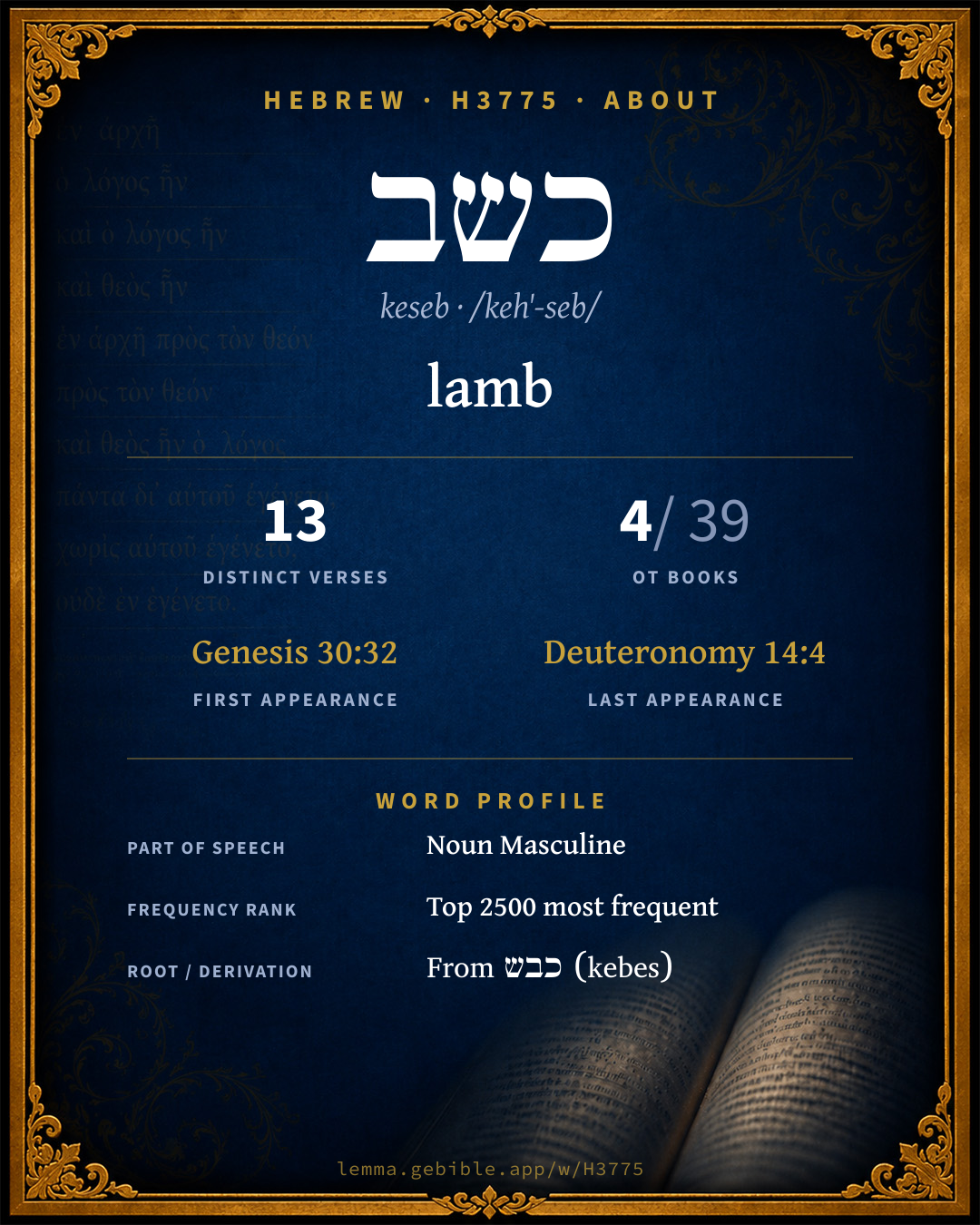
כֶּ֫שֶׂב
lamb
Full lexicon entry — Brown-Driver-Briggs (BDB)
From Brown-Driver-Briggs (BDB)
Where this word appears
Grammar key — what these labels mean
Part of speech
- Noun
- A naming word — a person, place, thing, or idea.
Noun type
- Common
- A common noun — a general class of person, place, or thing (“king,” “city,” “water”), not a specific name.
State
- Absolute
- The independent form of a noun, not bound to a following word.
Gender
- Masculine
- Grammatically masculine.
Number
- Singular
- One.
- Plural
- More than one (in Hebrew, generally three or more).
Grammatical forms
- Noun, Common, Masculine, Plural, Absolute 7 times (54%)
- Noun, Common, Masculine, Singular, Absolute 6 times (46%)
Parsed forms decoded from the imported morphology (morphhb / Westminster Leningrad Codex — WLC text public domain, morphhb tagging CC BY 4.0), counted across 13 parsed occurrences — not distinct verses.
Every verse where H3775 appears — 13 distinct verses across 4 books. Click any verse to open its interlinear word-by-word view. Verse text shown in the World English Bible for context — . Each verse’s Hebrew form is shown with its reference; the English is not keyword-highlighted, since the data carries no word-level English alignment. Use “Compare translations” on any verse to read it across multiple English versions. This concordance covers the Hebrew Bible; Septuagint (Greek Old Testament) occurrences are not indexed here.
Genesis 4 verses
- Genesis 30:32 בַּ/כְּשָׂבִ֔ים prep det + n c mp I will pass through all your flock today, removing from there every speckled and spotted one, and every black one among the sheep, and the spotted and speckled among the goats. This will be my hire.
- Genesis 30:33 בַּ/כְּשָׂבִ֔ים prep det + n c mp So my righteousness will answer for me hereafter, when you come concerning my hire that is before you. Everyone that is not speckled and spotted among the goats, and black among the sheep, that might be with me, will be counted stolen."
- Genesis 30:35 בַּ/כְּשָׂבִ֑ים prep det + n c mp That day, he removed the male goats that were streaked and spotted, and all the female goats that were speckled and spotted, every one that had white in it, and all the black ones among the sheep, and gave them into the hand of his sons.
- Genesis 30:40 וְ/הַ/כְּשָׂבִים֮ conj + ptcl def.art + n c mp Jacob separated the lambs, and set the faces of the flocks toward the streaked and all the black in the flock of Laban: and he put his own droves apart, and didn't put them into Laban's flock.
Leviticus 7 verses
- Leviticus 1:10 הַ/כְּשָׂבִ֛ים ptcl def.art + n c mp "'If his offering is from the flock, from the sheep, or from the goats, for a burnt offering, he shall offer a male without blemish.
- Leviticus 3:7 כֶּ֥שֶׂב n c ms If he offers a lamb for his offering, then he shall offer it before Yahweh;
- Leviticus 4:35 הַ/כֶּשֶׂב֮ ptcl def.art + n c ms All its fat he shall take away, like the fat of the lamb is taken away from the sacrifice of peace offerings; and the priest shall burn them on the altar, on the offerings of Yahweh made by fire; and the priest shall make atonement for him concerning his sin that he has sinned, and he will be forgiven.
- Leviticus 7:23 וְ/כֶ֛שֶׂב conj + n c ms "Speak to the children of Israel, saying, 'You shall eat no fat, of ox, or sheep, or goat.
- Leviticus 17:3 כֶ֛שֶׂב n c ms Whatever man there is of the house of Israel, who kills an ox, or lamb, or goat, in the camp, or who kills it outside the camp,
- Leviticus 22:19 בַּ/כְּשָׂבִ֖ים prep det + n c mp that you may be accepted, you shall offer a male without blemish, of the bulls, of the sheep, or of the goats.
- Leviticus 22:27 כֶ֤שֶׂב n c ms "When a bull, or a sheep, or a goat, is born, then it shall remain seven days with its mother; and from the eighth day and thenceforth it shall be accepted for the offering of an offering made by fire to Yahweh.
Numbers 1 verse
Deuteronomy 1 verse
About this entry
At a glance — auto-summarized from this page’s data, not written by a person. Every figure links to its source below. This summary describes the numbers; it doesn’t interpret them.
כשב — transliterated keseb — is a Hebrew noun carrying the sense “lamb.” More than half of its appearances fall in Leviticus. It appears 13 verses across 4 books of the Hebrew Bible, among its uncommon vocabulary. Its earliest occurrence is Genesis 30:32. It shares a root with כבש, כבשה and כשבה. See the sense tree, 13-verse concordance, and the renderings breakdown below.
Gloss history
Strong's 1890 vs modern scholarship
About this word
Strong's H3775 catalogs a Hebrew word from the Hebrew Old Testament.
These counts are not copied from any lexicon or concordance. They are computed here, from the morphology-tagged Hebrew Old Testament. What Lemma adds →
- 13
- distinct verses
- The word appears in 13 distinct verses.
- 4 / 39
- OT books
- The word appears in 4 of 39 Old Testament books.
- #2,001
- by frequency
- Top 2500 most frequent Hebrew words (rank 2,001 of 8,640 Hebrew words by occurrence).
View all 13 occurrences in the concordance →
By section of the Old Testament
By traditional corpus
Conventional, traditional groupings — biblical authorship is debated, so this is a traditional corpus grouping, not an authorship claim. Each share is this word’s portion of its verses in that division of the Hebrew canon. Each figure is a share of the word’s 13 distinct verses.
- Torah (Pentateuch) 13 verses · 100%
How translations render this word
Counts come from each version’s own published word-to-Strong’s tagging or interlinear alignment — an approximate guide to how each version renders this word, not a word-level alignment the data otherwise carries. Because each total is that version’s own tagged count, the per-version totals vary from one another and need not match the appearance or distinct-verse counts above. These counts may also differ from a printed concordance because Lemma counts each distinctly tagged rendering and does not collapse phrase taggings into a single head-word total. This is a fixed set of word-tagged versions (KJV, ASV, BSB, ULT) and does not change with the reading translation you choose elsewhere. Each version’s license is shown beside its name below (and on Sources).
BDB lists this Strong’s number as 2 distinct words (homographs). Each count above pools all of them and is not split by sense — see the Senses section below. A low-frequency rendering may belong to a different one of those words, not the primary meaning.
- King James Version†: Among the sheep 3×, Lamb 2×, Sheep 2×
- American Standard Version†: Sheep 3×, Among the sheep 2×, Lamb 2×
- Berean Standard Bible†: Sheep 6×, Lamb 5×
- unfoldingWord Literal Text†: Lamb 4×, Among the sheep 3×, Sheep 2×
King James Version Public Domain
Renders H3775 across 12† tagged occurrences — most commonly:
Plus 5 renderings that appear only once — usually multi-word phrases or single function words the recovered tagging swept in, not distinct renderings. Not rendered by a distinct English word in 1 further occurrence.
American Standard Version Public Domain
Renders H3775 across 12† tagged occurrences — most commonly:
Plus 5 renderings that appear only once — usually multi-word phrases or single function words the recovered tagging swept in, not distinct renderings.
Berean Standard Bible Public Domain
Renders H3775 across 13† tagged occurrences — most commonly:
Plus 2 renderings that appear only once — usually multi-word phrases or single function words the recovered tagging swept in, not distinct renderings.
unfoldingWord Literal Text CC BY-SA 4.0
Renders H3775 across 14† tagged occurrences — most commonly:
Plus 5 renderings that appear only once — usually multi-word phrases or single function words the recovered tagging swept in, not distinct renderings.
Senses in BDB
The 1 sense BDB distinguishes for this word, in lexicon order (not ranked by frequency or importance). The full entry — with sub-senses — is in the Lexicon Entry tab.
- lamb, young ram, sheep
Word origin
n.[m.] lamb (transp. from preceding)—כ׳ abs. Lv 3:7 + 5 times; pl. כְּשָׂבִים Gn 30:32 + 6 times;—lamb, as property Gn 30:32, 33, 35, 40 (J); for sacrif. Lv 1:10; 3:7; 4:35; 22:19 Nu 18:17, cf. Lv 22:27; for food Lv 7:23, cf. 17:3 (all P); Dt 14:4.
— Brown-Driver-Briggs (Oxford 1906, public domain), digitized via Sefaria, supplemented by the OpenScriptures HebrewLexicon (CC BY 4.0). See Sources.
Derived from כבש (kebes) (H3532) — lamb.
Jastrow Dictionary
A second Hebrew/Aramaic lexicon for comparison, covering Aramaic and post-biblical (Talmudic, Targumic, Midrashic) usage that the biblical-Hebrew BDB does not. Matched by lemma rather than by Strong’s number, so a lemma may carry more than one Jastrow headword (shown separately below), and the entries cover usage well beyond the Bible.
כֶּשֶׂב
- , v. כֶּבֶשׂ
שֵׁב
- , imper. of יָשַׁב.
שַׁב
- v. = h. שֶׁבַע, seven. Targ. Y. Gen. XXIX, 18; 20; 27; a. e.—Snh. 29ᵃ. Pes. 116ᵃ שב בנתיך thy seven daughters. Ḥull. 42ᵇ; a. fr.—שֵׁבְסְרֵי, שֵׁבְסַר, שִׁ׳, שֶׁ׳ (= שב עסר) seventeen. Targ. Y. Gen. VII, 11. Ib. XXXVII, 2; a. e.—B. Bath. 10ᵃ שֵׁיבְסַר דינרי seventeen Denars. Taan. 28ᵇ בש׳ בתמוז on the seventeenth day of Tammuz; a. fr.—שְׁבִיסְרָאָה the seventeenth. Targ. I Chr. XXIV, 15.
שַׁב ²
- (preced.)
- 1. = h. שָׁבוּעַ. week. Targ. II Esth. III, 7; a. fr.—Sabb. 156ᵃ האי מאן דבחד בש׳ a person born on the first day of the week; בתרי בש׳ on Monday &c. Bets. 16ᵃ מחד שֵׁבָּיךְ לשבתך from thy first day of the week begin to set aside good things for thy Sabbath; a. fr.
- 2. the seventh day, the Sabbath; day of rest. Targ. Y. Deut. V, 14 שב ונייח a day of rest and repose; Targ. Y. Ex. XX, 10 שבא ונ׳. Targ. Y. Lev. XXIII, 32 שבא ונייחא; Targ. O. ש׳ שבתא (h. text שבת שבתון); a. fr.—Y. Taan. I, 64ᵃ בשׁוּבָּה וכ׳, v. נְיָיח. Y. Sot. I, 16ᵈ bot. כל לילי ש׳ every Sabbath night. Y. Ab. Zar. V, 44ᵈ bot. ערובת ש׳ Sabbath eve; בפוקי ש׳ at the exit of the Sabbath; a. fr.—Y. Taan. IV, 69ᵃ bot. כל ארובת שובאי (corr. acc.).—Pl. שַׁבִּין, שַׁבַּיָּא, שַׁבֵּי. Targ. Is. I, 13 (ed. Wil. שַׁבְּאִין). Targ. I Chr. XXIII, 31; a. fr.—Sabb. 119ᵃ יוסף מוקיר שבי Joseph, the honorer of the Sabbaths; a. e.
A Dictionary of the Targumim, the Talmud Babli and Yerushalmi, and the Midrashic Literature (Marcus Jastrow; London, Luzac, 1903) — Public Domain. Digitized via Sefaria. Digitized via Sefaria. Full attribution on Sources.
Forms in the corpus
The 12 distinct written forms H3775 takes in the Hebrew Bible, most frequent first — each parse links to that state’s occurrences in the concordance. Hebrew forms include their vowel points and cantillation, so a single lemma takes many written forms.
| Form | Parsing | Example | Uses |
|---|---|---|---|
| בַּ/כְּשָׂבִ֔ים | Noun, Common, Masculine, Plural, Absolute | Genesis 30:32 | 2 |
| בַּ/כְּשָׂבִ֑ים | Noun, Common, Masculine, Plural, Absolute | Genesis 30:35 | 1 |
| בַּ/כְּשָׂבִ֖ים | Noun, Common, Masculine, Plural, Absolute | Leviticus 22:19 | 1 |
| הַ/כְּשָׂבִ֛ים | Noun, Common, Masculine, Plural, Absolute | Leviticus 1:10 | 1 |
| הַ/כֶּשֶׂב֮ | Noun, Common, Masculine, Singular, Absolute | Leviticus 4:35 | 1 |
| וְ/הַ/כְּשָׂבִים֮ | Noun, Common, Masculine, Plural, Absolute | Genesis 30:40 | 1 |
| וְ/כֶ֛שֶׂב | Noun, Common, Masculine, Singular, Absolute | Leviticus 7:23 | 1 |
| כְשָׂבִ֖ים | Noun, Common, Masculine, Plural, Absolute | Deuteronomy 14:4 | 1 |
| כֶ֛שֶׂב | Noun, Common, Masculine, Singular, Absolute | Leviticus 17:3 | 1 |
| כֶ֤שֶׂב | Noun, Common, Masculine, Singular, Absolute | Leviticus 22:27 | 1 |
| כֶּ֜שֶׂב | Noun, Common, Masculine, Singular, Absolute | Numbers 18:17 | 1 |
| כֶּ֥שֶׂב | Noun, Common, Masculine, Singular, Absolute | Leviticus 3:7 | 1 |
Same root — word family
Other BDB entries built from the same root as H3775, grouped by Strong’s listed origin. These share a root / origin per the lexicon — not necessarily a shared meaning. Each links to that word’s own entry.
Derives from
Shares the same root
Derived from this word
Compare all same-root words → They share a root, not necessarily a meaning.
Septuagint verse parallels
This word appears in 13 verses that also exist in the Greek Old Testament (Septuagint), out of the 13 Hebrew verses it occurs in. You can read those verses in Greek by switching the Old Testament edition to the Septuagint.
Read these verses in the Septuagint
This is a verse-level parallel only — the same verses exist in both the Hebrew and Greek Old Testaments. No word-level Hebrew↔Greek correspondence is claimed: the data carries no such alignment, so no Greek word is shown as this Hebrew word’s translation. Coverage is not total — the Septuagint omits the deuterocanon and renumbers the Psalms, so some Hebrew verses have no direct Greek parallel.