1 John 5:7

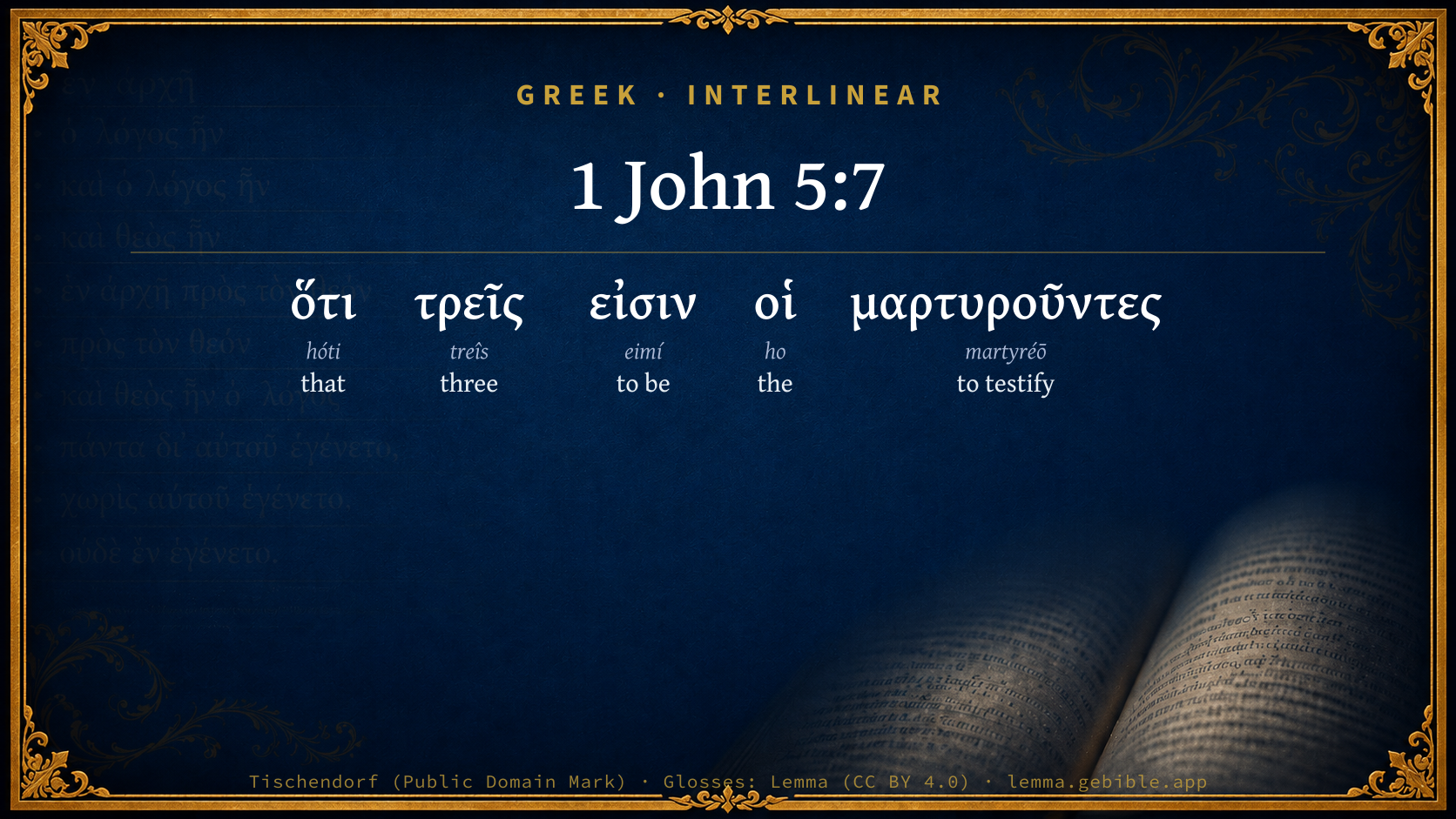
Greek (Tischendorf 8th ed.) 1 John 5:7 appears in the Greek New Testament. The text above is from the Tischendorf 8th edition. Each word links to its Strong’s number and a concise gloss. Click any word for its full Thayer’s Greek Lexicon entry.
Download image
Cite this verse

1 John 5:7 (World English Bible). Public Domain. Lemma interlinear Bible study tool, https://lemma.gebible.app/v/1-john/5/7.

Show BibTeX & RIS
BibTeX
RIS
English Translation
For there are three who testify:
World English Bible · Public Domain
Download a study sheet

One document with this verse’s original text, its word-by-word gloss line, the meaning frame, cross-references with their text, attributed commentary, and full source and license credits — printable, and it pastes into notes with its structure intact.

This verse Autodidact and up

Study sheet (.html) Plain text (.txt)

A passage Seminary Student

Up to 50 verses in one chapter. A passage sheet keeps up to 6 commentary sources and 12 cross-references per verse, in the order this page ranks them, and says so on the sheet whenever that leaves anything out. Ask for a single verse and you get the Autodidact verse sheet above.

Everything on this page stays free to read, with no account — the sheet is a download of what is already on screen, not access to it.

Want to remove ads? Support Godless Engineer
Compare translations 3

The same verse in 3 English versions, stacked beneath the original-language interlinear above. Click any original word for its lexicon entry.

Each is an independent rendering of the whole verse — the interlinear is not word-aligned to these translations.

Highlighted words mark where these versions differ — a whole-verse word diff, not a word-by-word alignment.

  • World English Bible Public Domain
    For there are three who testify:
  • King James Version Public Domain
    For there are three that bear record in heaven, the Father, the Word, and the Holy Ghost: and these three are one.
  • unfoldingWord Literal Text CC BY-SA 4.0
    For there are three who are testifying:

unfoldingWord Literal Text — © unfoldingWord, licensed CC BY-SA 4.0. Word-aligned USFM3 via Door43 (git.door43.org/unfoldingWord/en_ult).

Versions to compare (up to 4)

3 of 4 selected

Show all 19 translations

Every available English version of this verse, each an independent rendering of the whole verse.

  • World English Bible Public Domain
    For there are three who testify:
  • Berean Standard Bible Public Domain
    For there are three that testify:
  • Majority Standard Bible Public Domain
    For there are three that testify:
  • King James Version Public Domain
    For there are three that bear record in heaven, the Father, the Word, and the Holy Ghost: and these three are one.
  • American Standard Version (1901) Public Domain
    And it is the Spirit that beareth witness, because the Spirit is the truth.
  • Revised Version (1885) Public Domain
    And it is the Spirit that beareth witness, because the Spirit is the truth.
  • Geneva Bible (1599) Public Domain
    For there are three, which beare recorde in heauen, the Father, the Worde, and the holy Ghost: and these three are one.
  • Douay-Rheims (1899) Public Domain
    And there are three who give testimony in heaven, the Father, the Word, and the Holy Ghost. And these three are one.
  • Young's Literal Translation Public Domain
    because three are who are testifying `in the heaven, the Father, the Word, and the Holy Spirit, and these -- the three -- are one;
  • Literal Standard Version CC BY-SA 4.0
    because [there] are three who are testifying [[in Heaven: the Father, the Word, and the Holy Spirit, and these three are one;
  • Unlocked Literal Bible CC BY-SA 4.0
    For there are three who bear witness:
  • unfoldingWord Literal Text CC BY-SA 4.0
    For there are three who are testifying:
  • Darby Bible Public Domain
    For they that bear witness are three:
  • World Messianic Bible Public Domain
    For there are three who testify:
  • Webster's Bible Public Domain
    For there are three that bear testimony in heaven, the Father, the Word, and the Holy Spirit, and these three are one.
  • Free Bible Version CC BY-SA 4.0
    So there are three that give evidence:
  • Bible in Basic English Public Domain
    And the Spirit is the witness, because the Spirit is true.
  • Text-Critical English NT CC BY 4.0
    For there are three that testify:
  • Tyndale New Testament (1534) Public Domain
    (For ther are thre which beare recorde in heuen the father the worde and the wholy goost. And these thre are one)

Literal Standard Version (2020), Covenant Press — licensed CC BY-SA 4.0. Text via the HelloAO Bible API (eBible.org). Unlocked Literal Bible (unfoldingWord) — licensed CC BY-SA 4.0. Text via the HelloAO Bible API (eBible.org). unfoldingWord Literal Text — © unfoldingWord, licensed CC BY-SA 4.0. Word-aligned USFM3 via Door43 (git.door43.org/unfoldingWord/en_ult). Free Bible Version, Dr. Jonathan Gallagher — licensed CC BY-SA 4.0. Text via the HelloAO Bible API (eBible.org).

Cross-references

28

Topical passages linked to 1 John 5:7 in the Treasury of Scripture Knowledge — connected by theme and wording, ordered by reader-vote popularity; previews shown in the World English Bible.

  • Matthew 28:19 Therefore go, and make disciples of all nations, baptizing them in the name of the Father and of the Son and of the Holy Spirit,
  • 2 Corinthians 13:14 The grace of the Lord Jesus Christ, the love of God, and the communion of the Holy Spirit, be with you all. Amen.
  • Acts 5:32 We are His witnesses of these things; and so also is the Holy Spirit, whom God has given to those who obey him."
  • Matthew 3:16–17 Jesus, when he was baptized, went up directly from the water: and behold, the heavens were opened to him. He saw the Spirit of God descending as a dove, and coming on him.
  • John 1:1 In the beginning was the Word, and the Word was with God, and the Word was God.
  • Acts 2:33 Being therefore exalted by the right hand of God, and having received from the Father the promise of the Holy Spirit, he has poured out this, which you now see and hear.
  • 1 John 5:6 This is he who came by water and blood, Jesus Christ; not with the water only, but with the water and the blood. It is the Spirit who testifies, because the Spirit is the truth.
  • John 8:54 Jesus answered, "If I glorify myself, my glory is nothing. It is my Father who glorifies me, of whom you say that he is our God.
  • Isaiah 61:1 The Spirit of the Lord Yahweh is on me; because Yahweh has anointed me to preach good news to the humble; he has sent me to bind up the broken-hearted, to proclaim liberty to the captives, and the opening [of the prison] to those who are bound;
  • Matthew 17:5 While he was still speaking, behold, a bright cloud overshadowed them. Behold, a voice came out of the cloud, saying, "This is my beloved Son, in whom I am well pleased. Listen to him."
  • John 1:32–34 John testified, saying, "I have seen the Spirit descending like a dove out of heaven, and it remained on him.
  • John 10:30 I and the Father are one."
  • Psalms 33:6 By Yahweh's word the heavens were made; All their host by the breath of his mouth.
  • Isaiah 48:16–17 Come you near to me, hear you this; from the beginning I have not spoken in secret; from the time that it was, there am I: and now the Lord Yahweh has sent me, and his Spirit.
  • John 10:37–38 If I don't do the works of my Father, don't believe me.
  • 1 Corinthians 12:4–6 Now there are various kinds of gifts, but the same Spirit.
  • Hebrews 2:3–4 how will we escape if we neglect so great a salvation-- which at the first having been spoken through the Lord, was confirmed to us by those who heard;
  • Deuteronomy 6:4 Hear, Israel: Yahweh is our God; Yahweh is one:
  • John 8:13–14 The Pharisees therefore said to him, "You testify about yourself. Your testimony is not valid."
  • Hebrews 4:12–13 For the word of God is living, and active, and sharper than any two-edged sword, and piercing even to the dividing of soul and spirit, of both joints and marrow, and is able to discern the thoughts and intentions of the heart.
  • 1 John 5:10–11 He who believes in the Son of God has the testimony in himself. He who doesn't believe God has made him a liar, because he has not believed in the testimony that God has given concerning his Son.
  • John 5:26 For as the Father has life in himself, even so he gave to the Son also to have life in himself.
  • John 8:18 I am one who testifies about myself, and the Father who sent me testifies about me."
  • John 12:28 Father, glorify your name!" Then there came a voice out of the sky, saying, "I have both glorified it, and will glorify it again."
  • Revelation 1:4–5 John, to the seven assemblies that are in Asia: Grace to you and peace, from God, who is and who was and who is to come; and from the seven Spirits who are before his throne;
  • Revelation 19:13 He is clothed in a garment sprinkled with blood. His name is called "The Word of God."
  • Matthew 18:16 But if he doesn't listen, take one or two more with you, that at the mouth of two or three witnesses every word may be established.
  • 1 John 1:1 That which was from the beginning, that which we have heard, that which we have seen with our eyes, that which we saw, and our hands touched, concerning the Word of life

Cross-references courtesy of OpenBible.info (CC BY 4.0).

Where the printed editions differ

1 variant

Places in this verse where the major printed Greek editions disagree on the wording in a way that affects the translation — a comparison of editions, not a manuscript-by-manuscript collation. The editions are the modern critical texts (Nestlé-Aland 28/27, SBL, Westcott-Hort, Tregelles, Tyndale House) and the traditional texts behind the KJV (the Textus Receptus and the Byzantine/Majority text). It is not a claim about which reading is original.

  1. Extra text
    ἕν τῷ οὐρανῷ ὁ πατήρ ὁ λόγος καὶ τὸ ἅγιον πνεῦμα καὶ οὗτοι οἱ τρεῖς ἕν εἰσιν

    “in the heaven the Father the Word and the Holy Spirit and these <the> three one are”

    In TR Not in NA28NA27TynSBLWHTregByz

    ἕν τῷ οὐρανῷ ὁ πατήρ ὁ λόγος καὶ τὸ ἅγιον πνεῦμα καὶ οὗτοι οἱ τρεῖς ἕν εἰσιν (hen tō ouranō ho patēr ho logos kai to hagion pneuma kai houtoi hoi treis hen eisin) 'in the heaven the Father the Word and the Holy Spirit and these three one are' is only in traditional manuscripts (TR)

Textual data: Translators Amalgamated Greek New Testament (STEPBible TAGNT) · CC BY 4.0.

Commentary

Notes on 1 John 5:7 from classic Christian and Jewish commentators (each source and its license shown beneath its notes). The classic Christian expositions comment on the surrounding passage and are grouped to its opening verse, so a note may address several verses; the Jewish commentaries on the Tanakh (Rashi and others) are per-verse, so they appear only where the commentator wrote on this verse.

Lemma curates 59 commentaries, every one of them public domain or Creative Commons licensed, each selected and text-cleaned for this edition rather than reprinted as found. About our sources →

Adam Clarke's Commentary

Verse 7. There are three that bear record] The FATHER, who bears testimony to his Son; the WORD or λογος, Logos, who bears testimony to the Father; and the HOLY GHOST, which bears testimony to the Father and the Son. And these three are one in essence, and agree in the one testimony, that Jesus came to die for, and give life to, the world.

But it is likely this verse is not genuine. It is wanting in every MS. of this epistle written before the invention of printing, one excepted, the Codex Montfortii, in Trinity College, Dublin: the others which omit this verse amount to one hundred and twelve.

It is wanting in both the Syriac, all the Arabic, AEthiopic, the Coptic, Sahidic, Armenian, Slavonian, c., in a word, in all the ancient versions but the Vulgate and even of this version many of the most ancient and correct MSS. have it not. It is wanting also in all the ancient Greek fathers; and in most even of the Latin.

The words, as they exist in all the Greek MSS. with the exception of the Codex Montfortii, are the following:-

"1Jo 5:6. This is he that came by water and blood, Jesus Christ; not by water only, but by water and blood. And it is the Spirit that beareth witness because the Spirit is truth.

1Jo 5:7. For there are three that bear witness, the Spirit, the water, and the blood; and these three agree in one.

1Jo 5:9. If we receive the witness of man, the witness of God is greater, c."

The words that are omitted by all the MSS., the above excepted, and all the versions, the Vulgate excepted, are these:-

[ln heaven, the Father, the Word, and the Holy Spirit, and these three are one, and there are three which bear witness in earth.]

To make the whole more clear, that every reader may see what has been added, I shall set down these verses, with the inserted words in brackets.

"1Jo 5:6. And it is the Spirit that beareth witness, because the Spirit is truth.

1Jo 5:7. For there are three that bear record [in heaven, the Father, the Word, and the Holy Ghost, and these three are one. 1Jo 5:8. And there are three that bear witness in earth,] the Spirit, and the water, and the blood, and these three agree in one.

1Jo 5:9. If we receive the witness of men, the witness of God is greater, c."

Any man may see, on examining the words, that if those included in brackets, which are wanting in the MSS. and versions, be omitted, there is no want of connection and as to the sense, it is complete and perfect without them and, indeed much more so than with them. I shall conclude this part of the note by observing, with Dr. Dodd, "that there are some internal and accidental marks which may render the passage suspected; for the sense is complete, and indeed more clear and better preserved, without it. Besides, the Spirit is mentioned, both as a witness in heaven and on earth; so that the six witnesses are thereby reduced to five, and the equality of number, or antithesis between the witnesses in heaven and on earth, is quite taken away. Besides, what need of witnesses in heaven? No one there doubts that Jesus is the Messiah; and if it be said that Father, Son, and Spirit are witnesses on earth, then there are five witnesses on earth, and none in heaven; not to say that there is a little difficulty in interpreting how the Word or the Son can be a witness to himself."

It may be necessary to inquire how this verse stood in our earliest English Bibles. In COVERDALE'S Bible, printed about 1535, for it bears no date, the seventh verse is put in brackets thus:-

And it is the Sprete that beareth wytnes; for the Sprete is the truth. (For there are thre which beare recorde in heaven: the Father, the Woorde, and the Holy Ghost, and these thre are one.) And there are thre which beare record in earth: the Sprete, water, and bloude and these thre are one. If we receyve, c.

TINDAL was as critical as he was conscientious and though he admitted the words into the text of the first edition of his New Testament printed in 1526, yet he distinguished them by a different letter, and put them in brackets, as Coverdale has done; and also the words in earth, which stand in 1Jo 5:8, without proper authority, and which being excluded make the text the same as in the MSS., c.

Two editions of this version are now before me one printed in English and Latin, quarto, with the following title:-

The New Testament, both in Englyshe and Laten, of Master Erasmus translation-and imprinted by William Powell-the yere of out Lorde M.CCCCC.XLVII. And the fyrste yere of the kynges (Edw. VI.) moste gratious reygne.

In this edition the text stands thus:-

And it is the Spirite that beareth wytnes, because the Spirite is truth (for there are thre whiche beare recorde in heaven, the Father, the Worde, and the Holy Ghost, and these thre are one.) For there are thre which beare recorde, (in earth,) the Spirite, water, and blode, and these thre are one. If we receyve, c.

The other printed in London "by William Tylle, 4to without the Latin of Erasmus in M.CCCCC.XLIX. the thyrde yere of the reigne of our moost dreade Soverayne Lorde Kynge Edwarde the Syxte," has, with a small variety of spelling, the text in the same order, and the same words included in brackets as above.

The English Bible, with the book of Common Prayer, printed by Richard Cardmarden, at Rouen in Normandy, fol. 1566, exhibits the text faithfully, but in the following singular manner:-

And it is the Spyryte that beareth witnesse, because the Spyryte is truthe. (for there are three which beare recorde in heaven, the Father, the Woorde, and the Holy Ghost; and these Three are One) And three which beare recorde* (in earth) the Spirite, and water, and bloode; and these three are one.

The first English Bible which I have seen, where these distinctions were omitted, is that called The Bishops' Bible, printed by Jugge, fol. 1568. Since that time, all such distinctions have been generally disregarded.

Though a conscientious believer in the doctrine of the ever blessed, holy, and undivided Trinity, and in the proper and essential Divinity of our Lord Jesus Christ, which doctrines I have defended by many, and even new, arguments in the course of this work, I cannot help doubting the authenticity of the text in question; and, for farther particulars, refer to the observations at the end of this chapter.

Adam Clarke's Commentary on the Bible (1810–1826) — public domain. Text from a community e-Sword/MySword module.

Albert Barnes' Notes on the Bible

For there are three that bear record in heaven ... - There are three that “witness,” or that “bear witness” - the same Greek word which, in 1Jo 5:8, is rendered “bear witness” - μαρτυροῦντες marturountes. There is no passage of the New Testament which has given rise to so much discussion in regard to its genuineness as this. The supposed importance of the verse in its bearing on the doctrine of the Trinity has contributed to this, and has given to the discussion a degree of consequence which has pertained to the examination of the genuineness of no other passage of the New Testament. On the one hand, the clear testimony which it seems to bear to the doctrine of the Trinity, has made that portion of the Christian church which holds the doctrine reluctant in the highest degree to abandon it; and on the other hand, the same clearness of the testimony to that doctrine, has made those who deny it not less reluctant to admit the genuineness of the passage.

It is not consistent with the design of these notes to go into a full investigation of a question of this sort. And all that can be done is to state, in a brief way, the “results” which have been reached, in an examination of the question. Those who are disposed to pursue the investigation further, can find all that is to be said in the works referred to at the bottom of the page. The portion of the passage, in 1Jo 5:7-8, whose genuineness is disputed, is included in brackets in the following quotation, as it stands in the common editions of the New Testament: “For there are three that bear record (in heaven, the Father, the Word, and the Holy Spirit: and these three are one. And there are three that bear witness on earth,) the Spirit, and the water, and the blood; and these three agree in one.” If the disputed passage, therefore, be omitted as spurious, the whole passage will read, “For there are three that bear record, the Spirit, and the water, and the blood; and these three agree in one.” The reasons which seem to me to prove that the passage included in brackets is spurious, and should not be regarded as a part of the inspired writings, are briefly the following:

I. It is missing in all the earlier Greek manuscripts, for it is found in no Greek manuscript written before the 16th century. Indeed, it is found in only two Greek manuscripts of any age - one the Codex Montfortianus, or Britannicus, written in the beginning of the sixteenth century, and the other the Codex Ravianus, which is a mere transcript of the text, taken partly from the third edition of Stephen’s New Testament, and partly from the Complutensian Polyglott. But it is incredible that a genuine passage of the New Testament should be missing in all the early Greek manuscripts.

II. It is missing in the earliest versions, and, indeed, in a large part of the versions of the New Testament which have been made in all former times. It is wanting in both the Syriac versions - one of which was made probably in the first century; in the Coptic, Armenian, Slavonic, Ethiopic, and Arabic.

III. It is never quoted by the Greek fathers in their controversies on the doctrine of the Trinity - a passage which would be so much in point, and which could not have failed to be quoted if it were genuine; and it is not referred to by the Latin fathers until the time of Vigilius, at the end of the 5th century. If the passage were believed to be genuine - nay, if it were known at all to be in existence, and to have any probability in its favor - it is incredible that in all the controversies which occurred in regard to the divine nature, and in all the efforts to define the doctrine of the Trinity, this passage should never have been referred to. But it never was; for it must be plain to anyone who examines the subject with an unbiassed mind, that the passages which are relied on to prove that it was quoted by Athanasius, Cyprian, Augustin, etc., (Wetstein, II., p. 725) are not taken from this place, and are not such as they would have made if they had been acquainted with this passage, and had designed to quote it. IV. The argument against the passage from the external proof is confirmed by internal evidence, which makes it morally certain that it cannot be genuine.

(a) The connection does not demand it. It does not contribute to advance what the apostle is saying, but breaks the thread of his argument entirely. He is speaking of certain things which bear “witness” to the fact that Jesus is the Messiah; certain things which were well known to those to whom he was writing - the Spirit, and the water, and the blood. How does it contribute to strengthen the force of this to say that in heaven there are “three that bear witness” - three not before referred to, and having no connection with the matter under consideration?

(b) The “language” is not such as John would use. He does, indeed, elsewhere use the term “Logos,” or “Word” - ὁ Λόγος ho Logos, Joh 1:1, Joh 1:14; 1Jo 1:1, but it is never in this form, “The Father, and the Word;” that is, the terms “Father” and “Word” are never used by him, or by any of the other sacred writers, as correlative. The word “Son” - ὁ Υἱός ho Huios - is the term which is correlative to the “Father” in every other place as used by John, as well as by the other sacred writers. See 1Jo 1:3; 1Jo 2:22-24; 1Jo 4:14; 2Jo 1:3, 2Jo 1:9; and the Gospel of John, “passim.” Besides, the correlative of the term “Logos,” or “Word,” with John, is not “Father,” but “God.” See Joh 1:1. Compare Rev 19:13.

(c) Without this passage, the sense of the argument is clear and appropriate. There are three, says John, which bear witness that Jesus is the Messiah. These are referred to in 1Jo 5:6; and in immediate connection with this, in the argument, 1Jo 5:8, it is affirmed that their testimony goes to one point, and is harmonious. To say that there are other witnesses elsewhere, to say that they are one, contributes nothing to illustrate the nature of the testimony of these three - the water, and the blood, and the Spirit; and the internal sense of the passage, therefore, furnishes as little evidence of its genuineness as the external proof. V. It is easy to imagine how the passage found a place in the New Testament. It was at first written, perhaps, in the margin of some Latin manuscript, as expressing the belief of the writer of what was true in heaven, as well as on earth, and with no more intention to deceive than we have when we make a marginal note in a book. Some transcriber copied it into the body of the text, perhaps with a sincere belief that it was a genuine passage, omitted by accident; and then it became too important a passage in the argument for the Trinity, ever to be displaced but by the most clear critical evidence. It was rendered into Greek, and inserted in one Greek manuscript of the 16th century, while it was missing in all the earlier manuscripts.

VI. The passage is now omitted in the best editions of the Greek Testament, and regarded as spurious by the ablest critics. See Griesbach and Hahn. On the whole, therefore, the evidence seems to me to be clear that this passage is not a genuine portion of the inspired writings, and should not be appealed to in proof of the doctrine of the Trinity. One or two remarks may be made, in addition, in regard to its use.

(1) Even on the supposition that it is genuine, as Bengel believed it was, and as he believed that some Greek manuscript would still be found which would contain it , yet it is not wise to adduce it as a proof-text. It would be much easier to prove the doctrine of the Trinity from other texts, than to demonstrate the genuineness of this.

(2) It is not necessary as a proof-text. The doctrine which it contains can be abundantly established from other parts of the New Testament, by passages about which there can be no doubt.

(3) The removal of this text does nothing to weaken the evidence for the doctrine of the Trinity, or to modify that doctrine. As it was never used to shape the early belief of the Christian world on the subject, so its rejection, and its removal from the New Testament, will do nothing to modify that doctrine. The doctrine was embraced, and held, and successfully defended without it, and it can and will be so still.

Albert Barnes' Notes on the Bible (1834–1885) — public domain. Text from a community e-Sword/MySword module.

The Biblical Illustrator

Joseph S. Exell

1Jn_5:7-8

For there are three that bear record in heaven, the Father, the Word, and the Holy Ghost

The Scriptural doctrine of the Trinity not repugnant to sound reason

I.

I shall attempt to show what conceptions the Scripture leads us to form of the peculiar mode of the divine existence.

1. The Scripture leads us to conceive of God, the first and supreme Being, as existing in three distinct persons. The one living and true God exists in such a manner that there is a proper foundation in His nature to speak of Himself in the first, second, and third person, and say I, Thou, and He, meaning only Himself. There is a certain something in the Divine nature which lays a proper foundation for such a personal distinction. But what that something is can neither be described nor conceived. Here lies the whole mystery of the Trinity.

2. The Scripture represents the three persons in the sacred Trinity as absolutely equal in every Divine perfection. We find the same names, the same attributes, and the same works ascribed to each person.

3. The Scripture represents the three equally Divine persons in the Trinity as acting in a certain order in the work of redemption. Though they are absolutely equal in nature, yet in office the first person is superior to the second, and the second is superior to the third. The Son acts in subordination to the Father, and the Spirit acts in subordination to the Son and Father both.

4. The Scripture teaches us that each of the Divine persons takes His peculiar name from the peculiar office which He sustains in the economy of redemption. The first person assumes the name of Father, because He is by office the Creator or Author of all things, and especially of the human nature of Christ. The second person assumes the name of Son and Word, by virtue of His incarnation, and mediatorial conduct. The third person is called the Holy Ghost, on account of His peculiar office as Sanctifier.

5. The Scripture represents these three Divine persons as one God. This is the plain language of the text. The Father, Son, and Holy Ghost are three in respect to their personality, and but one in respect to their nature and essence.

II. This Scriptural account of the mysterious doctrine of the sacred Trinity is not repugnant to the dictates of sound reason.

1. The doctrine of the Trinity, as represented in Scripture, implies no contradiction. There may be, for aught we know, an incomprehensible something in the one self-existent Being which lays a proper foundation for his existing a Trinity in Unity.

2. If it implies no contradiction that the one living and true God should .exist in three persons, then this mysterious mode of the Divine existence is agreeable to the dictates of sound reason. We cannot suppose that the uncreated Being should exist in the same manner in which we and other created beings exist. And if He exists in a different manner from created beings, then His mode of existence must necessarily be mysterious. And whoever now objects against the Scripture account of the sacred Trinity would have equally objected against any other account which God could have given of His peculiar mode of existence.

3. The doctrine of the Trinity, as represented in Scripture, is no more repugnant to the dictates of sound reason than many other doctrines which all Christians believe concerning God. It is generally believed that God is a self-existent Being, or that there is no cause or ground of His existence out of Himself. But who can explain this mode of existence, or even form any clear conception of it? It is generally believed that God is constantly present in all places, or that His presence perpetually fills the whole created universe. But can we frame any clear ideas of this universal presence of the Deity? It is generally believed that God is the Creator, who has made all things out of nothing. But of that power which is able to create, or produce something out of nothing, we can form no manner of conception. This attribute of the Deity, therefore, is as really mysterious and incomprehensible in its operation as the doctrine of the Trinity. (N. Emmons, D. D.)

And there are three that bear witness in earth, the Spirit, and the water, and the blood--

The three-fold witnesses on earth

I. The Spirit bears witness. The Holy Ghost is meant. What is the permanent testimony which He bears to Christ and His gospel? The Scriptures are His witness to Christ. It would be impossible to overrate the value of this testimony. It is a written Word, and therefore not liable to change. We can study it in a way altogether different from the attention which we can give to a spoken discourse. We can carry it with us, whither we go. We can refresh our memory with it as often as we need it. Not only, however, did the Scriptures proceed from the Spirit at the first, but they have been preserved by Him in a most remarkable manner. He has used the most scrupulous care to maintain their purity. Nor does the testimony of the Spirit cease in the publication and preservation of the Scriptures. He continues to enlighten men in the knowledge of them, to impress their hearts by the belief of them, and to bring them under their power. But how are we to speak of the testimony itself which is thus borne by the Spirit to Christ? Then truly the words are verified, He shall glorify Me, for He shall receive of Mine, and show it unto you. He gives the soul views of Christ such as it never entertained before, the most honourable to Him and assuring to it. He produces affections towards Him such as never existed before, the most ardent and self-denying. He causes unreserved submission to His will, so that it is either borne with patience or done with diligence.

II. The water bears witness to Christ.

1. What are we to understand by this water? There is only one use of water in the Christian economy. This is in the administration of baptism. But the fact that an ordinance is made to be a witness to Christ is not to be passed unnoticed. It resembles the Scriptures in being permanent, but it possesses a feature peculiar to itself. It is a testimony to the eye, and by it to the understanding and heart.

2. What is the amount of the testimony borne by the water of baptism? It is very simple, yet very expressive. In this ordinance we behold reflected, as in a mirror, the gospel of Christ. It is a standing testimony to the depravity of the sinner. If we come to it at all, it is because we are defiled. At the same time the efficacy of cleansing is no less clearly signified. It says, here is a fountain, and everyone that washes in it is made clean. Nor is it the pardon of sin only that is figured in baptism. We are at the same time reminded of the destruction of its power. A great moral change is made to pass upon the soul that is pardoned. Pardon is received by faith, but this grace is ever accompanied by regeneration.

III. The blood is a witness unto Christ. How is it to be understood? The reference appears to be to the Lords Supper, as a lively representation of the death of Christ.

1. His person is presented to our faith in the bread and wine. They are emblems of His body, of its reality, that He was truly a partaker of flesh and blood. But this fact cannot be separated from His original and higher nature.

2. Equally clear is the representation of His work. It is testified in the broken bread. That calls up the fact of His crucifixion.

3. We are also taught how we are saved by it. Eating and drinking are essential to the preservation of life.

4. But these exercises are not observed by us singly and alone. We are associated with others. The Lords table is thus the emblem of the Church of Christ. There is at it the interchange of a holy and heavenly communion. (James Morgan, D. D.)

The Spirit, and the water, and the blood

We dismiss, without any misgiving, the clause respecting the heavenly Trinity from 1Jn_5:7. The sentence is irrelevant to this context, and foreign to the apostles mode of conception. It is the Churchs victorious faith in the Son of God, vindicated against the world (1Jn_5:1-5), that the writer here asserts, and to invoke witnesses for this in heaven is nothing to the purpose. The contrast present to his thought is not that between heaven and earth as spheres of testimony, but only between the various elements of the testimony itself (1Jn_5:6-10). (For this manner of combining witnesses, comp. Joh_5:31-47; Joh_8:13-18; Joh_10:25-38; Joh_14:8-13; Joh_15:26-27) The passage of the three heavenly witnesses is now admitted to be a theological gloss, which crept first into the Latin manuscripts of the fifth century, making its way probably from the margin into the text: no Greek codex exhibits it earlier than the fifteenth century. This, the apostle writes in 1Jn_5:6 --this Jesus of whom we believe that He is the Son of God (1Jn_5:5)--is He that came through water and blood--Jesus Christ. By this time Jesus Christ and Jesus the Son of God had become terms synonymous in true Christian speech. The great controversy of the age turned upon their identification. The Gnostics distinguished Jesus and Christ as human and Divine persons, united at the baptism and severed on the Cross, when Jesus cried, My God, why hast Thou forsaken Me? St. John asserts, therefore, at every turn the oneness of Jesus Christ; the belief that Jesus is the Christ he makes the test of a genuine Christianity (1Jn_5:1;comp. 1Jn_2:22; 1Jn_3:23; 1Jn_4:9; 1Jn_4:3; 1Jn_4:15). The name thus appended to verse 6 is no idle repetition; it is a solemn reassertion and reassumption of the Christian creed in two words--Jesus Christ. And He is Jesus Christ, inasmuch as He came through water and blood--not in the water only. The heretics allowed and maintained in their own way that Jesus Christ came by water when He received His Messianic anointing at Johns baptism, and the man Jesus thus became the Christ; but the coming through blood they abhorred. They regarded the death of the Cross, befalling the human Jesus, as a punishment of shame inflicted on the flesh, in which the Divine or Deiform Christ could have no part. Upon this Corinthian view, the Christ who came through water went away rather than came through blood; they saw in the death upon the Cross nothing that witnessed of the Godhead in Jesus Christ, nothing that spoke of Divine forgiveness and cleansing (1Jn_1:7; 1Jn_1:9), but an eclipse and abandonment by God, a surrender of the earthly Jesus to the powers of darkness. The simple words, that came, are of marked significance in this context; for the coming One (ὁ ἐρχόμενος, Mat_11:3; Joh_1:15; Joh_1:27; Joh_11:27; Heb_10:37; Rev_1:4; Rev_1:8, etc.) was a standing name for the Messiah, now recognised as the Son of God. He that came, therefore, signifies He who has assumed this character, who appeared on earth as the Divine Messiah; and St. John declares that He thus appeared disclosing Himself through these two signs--of blood as well as water. So the beginning and the end, the inauguration and consummation of Christs ministry, were marked by the two supreme manifestations of His Messiah-ship; and of both events this apostle was a near and deeply interested witness. When he speaks of the Lord as coming through water and blood, these are viewed historically as steps in His glorious march, signal epochs in the continuous disclosure of Himself to men, and crises in His past relations to the world; when he says, in the water and in the blood, they are apprehended as abiding facts, each making its distinct and living appeal to our faith. This verse stands in much the same relation to the two sacraments as does the related teaching of chs. 3 and 6 in St. Johns Gospel. The two sacraments embody the same truths that are symbolised here. Observing them in the obedience of faith, we associate ourselves visibly with the water and the blood, with Christ baptized and crucified, living and dying for us. But to see in these observances the equivalents of the water and blood of this passage, to make the apostle say that the water of baptism and the cup of the Lords Supper are the chief witnesses to Him and the essential instruments of our salvation, and that the former sacrament is unavailing without the addition of the latter, is to narrow and belittle his declaration and to empty out its historical content. Nearer to St. Johns thought lies the inference that Christ is our anointed Priest as well as Prophet, making sacrifice for our sin while He is our guide and light of life. To the virtue of His life and teaching must be added the virtue of His passion and death. Had He come in the water only, had Jesus Christ stopped short of Calvary and drawn back from the blood baptism, there had been no cleansing from sin for us, no witness to that chief function of His Christhood. This third manifestation of the Son of God--the baptism of the Spirit following on that of water and of blood, a baptism in which Jesus Christ was agent and no longer subject--verified and made good the other two. And the Spirit, he says, is that which beareth witness (μαρτυροῦν, the witnessing power): the water and the blood, though they have so much to say, must have spoken in vain, becoming mere voices of past history, but for this abiding and ever active Witness (Joh_15:26; Joh_16:7-15). The Spirit, whose witness comes last in the order of distinct manifestation, is first in principle; His breath animates the whole testimony; hence He takes the lead in the final enumeration of verse 8. The witness of the water had His silent attestation; the Baptist testified, saying, I have seen the Spirit descending as a dove out of heaven, and it abode upon Him, etc. (Joh_1:32-33). It is the Spirit, therefore, that bears witness; in all true witness He is operative, and there is no testifying without Him. For the Spirit is truth, is the truth--Jesus called Him repeatedly the Spirit of truth (Joh_14:17; Joh_15:26; 1Jn_4:6; comp. Joh_4:23-24)--truth in its substance and vital power is lodged with Him; in this element He works; this effluence He ever breathes forth. Practically, the Spirit is the truth; whatever is stated in Christian matters without His attestation, is something less or other than the truth. Such, then, are the three witnesses which were gathered into one in the Apostle Johns experience, in the history of Jesus Christ and His disciples: the three he says. agree in one, or more strictly, amount to the one thing (καὶ οἱ τρεῖς εἰς τὸ ἔν εἰσου, verse 8); they converge upon this single aim. The Jordan banks, Calvary, the upper chamber in Jerusalem; the beginning, the end of Jesus Christs earthly course, and the new beginning which knows no end; His Divine life and words and works, His propitiatory death, the promised and perpetual gift of the Spirit to His Church--these three cohere into one solid and imperishable witness, which is the demonstration alike of history and personal experience and the Spirit of God. They have one outcome, as they have one purpose; and it is this--viz. that God gave us eternal life, and this life is in His Son (verse 11). The apostle has indicated in verses 6-8 what are, to his mind, the proofs of the testimony of Jesus--evidences that must in the end convict and overcome the world (verse 5). So far as the general cause of Christianity is concerned this is enough. But it concerns each man to whom this evidence comes to realise for himself the weight and seriousness of the testimony which confronts him. So St. John points with emphasis in verses 9 and 10 to the Author of the three-fold manifestation. If we receive the witness of men--if credible human testimony wins our ready assent the witness of God is greater. The declaration of the gospel brings every soul that hears it face to face with God (comp. 1Th_2:13). And of all subjects on which God might speak to men, of all revelations that He has made, or might conceivably make, to mankind, this, St. John feels, is the supreme and critical matter--the testimony of God, viz., the fact that He has testified concerning His Son. The gospel is, in St. Pauls words, Gods good news about His Son. God insists upon our believing this witness; it is that in which He is supremely concerned, and which He asserts and commends to men above all else. Let the man, therefore, who with this evidence before him remains unbelieving, understand what he is about; let him know whom he is rejecting and whom he is contradicting. He has made God a liar--he has given the lie to the All-holy and Almighty One, the Lord God of truth. This apostle said the same terrible thing about the impenitent denier of his own sin (1Jn_1:10); these two denials are kindred to each other, and run up into the same condition of defiance toward God. On the other hand, he who believes on the Son of God, hearing from the Father and coming to Christ accordingly (Joh_6:45), he finds within himself the confirmation of the witness he received (verse 10a). The testimony of the Spirit and the water and the blood is no mere historical and objective proof; it enters the mans own nature, and becomes the regnant, creative factor in the shaping of his soul. The apostle might have added this subjective confirmation as a fourth, experimental witness to the other three; but, to his conception, the sense of inward life and power attained by Christian faith is the very witness of the Spirit, translated into terms of experience, realised and operative in personal consciousness. The water that I will give, said Jesus, will be within him a fountain of water, springing up unto life eternal (Joh_4:14). It is thus that the believer on the Son of God sets to his seal that God is true. His testimony is not to the general fact that there is life and troth in Christ; but this is the witness, that God gave to us life eternal, and this life is in His Son? (verse 11). This witness of God concerning His Son is not only a truth to be believed or denied, it is a life to be chosen or refused; and on this choice turns the eternal life or death of all to whom Christ offers Himself: He that hath the Son, hath life; he that hath not the Son of God, hath not life (verse 12). Life appears everywhere in St. John as a gift, not an acquisition; and faith is a grace rather than a virtue; it is yielding to Gods power rather than the exerting of our own. It is not so much that we apprehend Christ; rather He apprehends us, our souls are laid hold of and possessed by the truth concerning Him. Our part is but to receive Gods bounty pressed upon us in Christ; it is merely to consent to the strong purpose of His love, and allow Him, as St. Paul puts it, to work in us to will and to work on behalf of His good pleasure (Php_2:13). As this operation proceeds and the truth concerning Christ takes practical possession of our nature, the assurance of faith, the conviction that we have eternal life in Him, becomes increasingly settled and firm. Rothe finely says, Faith is not a mere witness on the mans part to the object of his faith; it is a witness which the man receives from that object … In its first beginnings faith is, no doubt, mainly the acceptance of testimony from without; but the element of trust involved in this acceptance, includes the beginning of an inner experience of that which is believed. This trust arises from the attraction which the object of our faith has exercised upon us; it rests on the consciousness of a vital connection between ourselves and that object. In the measure in which we accept the Divine witness, our inner susceptibility to its working increases, and thus there is formed in us a certainty of faith which rises unassailably above all scepticism. The language of St. John in this last chapter of his Epistle breathes the force of a spiritual conviction raised to its highest potency. For him perfect love has now cast out fear, and perfect faith has banished every shadow of doubt. Believing on the name of the Son of God, he knows that he has eternal life (verse 13). With him the transcendental has become the experimental, and no breach is left any more between them. (G. G. Findlay, B. A.)

The gospel record

I. The view here given of the gospel testimony.

1. Unspeakably important.

2. Exceedingly comprehensive.

3. Preeminently gracious.

4. Remarkably distinct and definite.

II. The evidence adduced in confirmation of its truths.

1. The voice from heaven.

2. From earth.

3. Scripture testimony.

4. Personal experience.

III. The claims which it has, as thus established, upon our regards. It claims our earnest attention and most serious study; but, above all, it claims our unwavering faith. This is the main point which is here set forth.

1. The nature of faith. It is nothing more nor less than receiving the Divine testimony, especially concerning Jesus Christ.

2. Its reasonableness.

3. Its importance. Through it we have eternal life.

4. The opposite of faith is unbelief--a sin most heinous in its nature, and most awful in its results. (Expository Outlines.)

The three witnesses

Christianity puts forth very lofty claims. She claims to be the true faith, and the only true one. She avows her teachings to be Divine, and therefore infallible; while for her great Teacher, the Son of God, she demands Divine worship, and the unreserved confidence and obedience of men. Now, to justify such high claims, the gospel ought to produce strong evidence, and it does so. The armoury of external evidences is well stored with weapons of proof. The gospel also bears within itself its own evidence, it has a self-proving power. It is so pure, so holy, so altogether above the inventive capacity of fallen man, that it must be of God. But neither with these external or internal evidences have we to do now, but I call your attention to the three witnesses which are spoken of in the text, three great witnesses still among us, whose evidence proves the truth of our religion, the Divinity of our Lord, and the future supremacy of the faith.

I. Our Lord himself was attested by these three witnesses. If you will carefully read in the twenty ninth chapter of the Book of Exodus, or in the eighth chapter of the Book of Leviticus, you will see that every priest came by the anointing Spirit, by water, and by blood, as a matter of type, and if Jesus Christ be indeed the priest that was for to come, He will be known by these three signs. Godly men in the olden times also well understood that there was no putting away of sin except with these three things; in proof of which we will quote Davids prayer, Purge me with hyssop--that is, the hyssop dipped in blood--and I shall be clean; wash me--there is the water--and I shall be whiter than snow; and then, Restore unto me the joy of Thy salvation, and uphold me with Thy free Spirit. Thus the blood, the water, and the Spirit were recognised of old as necessary to cleanse from guilt, and if Jesus of Nazareth be indeed able to save His people from their sins, He must come with the triple gift--the Spirit, the water, and the blood. Now it was evidently so. Our Lord was attested by the Spirit. The Spirit of God bore witness to Christ in the types and prophecies, Holy men of old spake as they were moved by the Holy Ghost; and Jesus Christ answers to those prophecies. The Spirit abode with our Lord all His life long, and to crown all, after He had died and risen again, the Holy Ghost gave the fullest witness by descending in full power upon the disciples at Pentecost. It is also manifest that our Lord came with water too. He came not by the water merely as a symbol, but by that which the water meant, by unsullied purity of life. With Jesus also was the blood. This distinguished Him from John the Baptist, who came by water, but Jesus came not by water only, but by water and blood. We must not prefer any one of the three witnesses to another, but what a wonderful testimony to Christ was the blood! From the very first He came with blood, for John the Baptist cried, Behold the Lamb of God, which taketh away the sin of the world! In His ministry there was often a clear testimony to His future sufferings and shedding of blood, for to the assembled crowd He said, Except a man eat My flesh and drink My blood, there is no life in him; while to His disciples He spake of the decease which He should shortly accomplish at Jerusalem. However pure the life He led, had He never died He could not have been the Saviour appointed to bear the iniquity of us all. The blood was needed to complete the witness. The blood must flow with the water, the suffering with the serving.

II. These three remain as standing witnesses to him to all time. And first, the Holy Spirit is witness at this hour that the religion of Jesus is the truth, and that Jesus is the Son of God. By His Divine energy He convinces men of the truth of the gospel; and these so convinced are not only persons who, through their education, are likely to believe it, but men like Saul of Tarsus, who abhor the whole thing. He pours His influences upon men, and infidelity melts away like the iceberg in the Gulf Stream; He touches the indifferent and careless, and they repent, believe, and obey the Saviour. Then, too, the Spirit goes forth among believers, and by them He bears witness to our Lord and His gospel. How mightily does He comfort the saints! And He does the same when He gives them guidance, enlightenment, and elevation of soul. The next abiding witness in the Church is the water--not the water of baptism, but the new life implanted in Christians, for that is the sense in which Johns Master had used the word water: The water that I shall give him shall be in him a well of water springing up into everlasting life. The worlds conscience knows that the religion of Jesus is the religion of purity, and if professed Christians fall into uncleanness the world knows that such a course of action does not arise out of the religion of Christ, but is diametrically opposite to it. The gospel is perfect, and did we wholly yield to its sway sin would be abhorred by us, and slain in us, and we should live on earth the life of the perfect ones above. The third abiding witness is the blood. The blood of Christ is still on the earth, for when Jesus bled it fell upon the ground and was never gathered up. O earth, thou still art bespattered with the blood of the murdered Son of God, and if thou dost reject Him this will curse thee. But, O humanity, thou art blessed with the drops of that precious blood, and believing in Him it doth save thee. The blood of Jesus, after speaking peace to the conscience, inflames the heart with fervent love, and full often leads men to high deeds of consecration, self-denial, and self-sacrifice, such as can scarce be understood till they are traced back to that amazing love which bled upon the tree.

III. This triple yet united witness is peculiarly forcible within believing hearts. John tells us, He that believeth on the Son of God hath the witness in himself. Now, these three witnesses bear testimony in our souls abidingly. I speak not of years ago, but of last night, when you prayed, and were heard. Did not the Spirit when He helped you to pray, bear witness that the gospel was no lie? Was not the answer to your prayer good evidence? The next witness in us is the water, or the new and pure life. Do you feel the inner life? You are conscious that you are not what you used to be, you are conscious of a new life within your soul which you never knew till the date of your conversion, and that new life within you is the living and incorruptible seed which liveth and abideth forever. Witnessing within us is also the blood. This is a witness which never fails, speaking in us better things than the blood of Abel. It gives us such peace that we can sweetly live and calmly die. It gives us such access to God that sometimes when we have felt its power we have drawn as near to our Father as if we had seen Him face to face. And oh, what safety the blood causes us to enjoy! We feel that we cannot perish while the crimson canopy of atonement by blood hangs over our head. Thus I have tried to show that these three witnesses testify in our souls; I beg you now to notice their order. The Spirit of God first enters the heart, perhaps long before the man knows that such is the case; the Spirit creates the new life, which repents and seeks the Saviour, that is the water; and that new life flies to the blood of Jesus and obtains peace. Having observed their order, now note their combination. These three agree in one, therefore every true believer should have the witness of each one, and if each one does not witness in due time, there is cause for grave suspicion,

IV. These witnesses certify to us the ultimate triumph of our religion. Is the Spirit working through the gospel? then the gospel will win the day, because the Spirit of God is almighty, and complete master over the realm of mind. He has the power to illuminate the intellect, to win the affections, to curb the will, and change the entire nature of man, for He worketh all things after His own pleasure, and, like the wind, He bloweth where He listeth. Next, the gospel must conquer, because of the water, which I have explained to be the new life of purity. What says John? Whatsoever is born of God overcometh the world. It is impossible for the gospel to be vanquished so long as there remains in the world one soul that is born of God. Living and incorruptible seed abideth forever! Lastly, the gospel must spread and conquer because of the blood. God, the everlasting Father, has promised to Jesus by covenant, of which the blood is the seal, that He shall see His seed, He shall prolong His days, and the pleasure of the Lord shall prosper in His hand. As surely as Christ died on the Cross, He must sit on a universal throne. (C. H. Spurgeon.)

The Biblical Illustrator, edited by Joseph S. Exell (c. 1880s–1900s) — public domain. Text from a community e-Sword module.

Joseph Benson's Commentary

1Jn 5:7. For there are three, &c. — It is well known that the authenticity of this verse has been a subject of much controversy. “The arguments, on both sides of the question, taken from ancient Greek MSS. and versions, and from quotations made by the fathers, and from printed editions, have been stated with the greatest fidelity and accuracy by Mill in his long note at the end of John’s first epistle, where he observes that this verse is wanting in all the ancient Greek MSS. of the New Testament which have come down to us, except a few, which shall be mentioned immediately. It is wanting likewise in the first Syriac, and other ancient versions, particularly the Coptic, Arabic, and Ethiopic, and in many of the present Latin MSS. With respect to quotations from the fathers, Mill acknowledges that few of the Greek writers, who lived before the council of Nice, have cited this verse. The same he observes concerning those who, after that council, wrote in defence of the Trinity against the Arians, and other heretics; which, he thinks, shows that this verse was not in their copies.” But, on the other hand, the proofs of the authenticity of this verse are,” 1st, Some of the most ancient and most correct Vatican Greek copies, from which the Spanish divines formed the Complutensian edition of the Greek Testament, and with which they were furnished by Pope Leo X.,” one of which Mill speaks of as peculiarly eminent, of great antiquity, and approved fidelity. “2d, A Greek copy, called by Erasmus, Codex Britannicus, on the authority of which he inserted this verse in his edition anno, 1522, but which he had omitted in his two former editions. This is supposed to be a MS. at present in the Trinity College library, Dublin, in which this, verse is found with the omission of the word αγισν, holy, before πνευμα, Spirit. It likewise wants the last clause of 1Jn 5:8, namely, and these three are one. All Stephens’s MSS., being seven in number, which contain the catholic epistles, have this verse: only they want the words εν ουρανω, in heaven. 4th, The Vulgate version, in most of the MS. copies and printed editions of which it is found, with some variations. 5th, The testimony of Tertullian, who alludes to this verse, Praxeam, c. 25, and who lived in an age in which he saith, Præscript, c. 30, the authenticæ literæ (the authentic writings) of the apostles were read in the churches. By authenticæ literæ Mill understands, either the autographs of the apostles, which the churches, to whom they were written, had carefully preserved, or correct transcripts taken from these autographs. Also the testimony of Cyprian, who flourished about the middle of the third century, and who, in his epistle to Jubajanus, expressly cites the latter clause of this verse. The objections which have been raised against the testimonies of Tertullian and Cyprian, Mill hath mentioned and answered in his long note at the end of 1 John 5., which see in page 582 of Kuster’s edition. 6th, The testimony of many Greek and Latin fathers in subsequent ages, who have cited the last clause of this verse; and some who have appealed to the Arians themselves as acknowledging its authenticity. Lastly, the Complutensian edition, anno 1515, had this seventh verse exactly as it is in the present printed copies, with this difference only, that instead of these three are one, it hath substituted the last clause of 1Jn 5:8, And these three agree in one, and hath omitted it in that verse. These arguments appear to Mill of such weight, that, after balancing them against the opposite arguments, he gave it as his decided opinion that, in whatever manner this verse disappeared, it was undoubtedly in St. John’s autograph, and in some of the copies which were transcribed from it.”

“Instead of passing any judgment in a matter so much contested,” says Macknight, “I shall only observe, 1st, That this verse, instead of disturbing the sense of the verses with which it is joined, rather renders it more connected and complete. 2d, That in 1Jn 5:9, the witness of God is supposed to have been before appealed to: If we receive the witness of men, the witness of God is greater. And yet, if 1Jn 5:7 is excluded, the witness of God is nowhere mentioned by the apostle. 3d, That in the opinion of Beza, Calvin, and other orthodox commentators, the last clause of 1Jn 5:7 hath no relation to the unity of the divine essence. If so, the Trinitarians, on the one hand, need not contend for the authenticity of this verse, in the view of supporting their doctrine, nor the Arians, on the other, strive to have it excluded from the text as opposing their tenets. 4th, That the doctrine which the Trinitarians affirm to be asserted in this verse is contained in other places of Scripture. So Wall saith. Dr. Benson likewise, in his Dissertation, written to prove this verse not genuine, saith, ‘If it were genuine, there could nothing be proved thereby but what may be proved from other texts of Scripture.’” The reader who wishes for more satisfactory information respecting the authenticity of the text, may find it in Dr. Calamy’s Vindication of it, annexed to his Sermons on the Trinity, preached at the lecture at Salter’s Hall, and published in 1722.

There are three that bear witness, &c. — When there is a cause depending in any court, and proof is to be given in order to the decision of it, witnesses are produced, and if they are credible, and liable to no just objection, the cause is determined according to the evidence they give, unless they, to whom it belongs to determine the matter, are partial or biased. Now St. John, aiming at the establishment of those in the truth to whom he wrote this his first epistle, represents the cause depending before them as very weighty; a cause of such consequence, that it highly concerned them to weigh all matters well before they came to a determination. It was really no less a matter than whether Christianity was true or a forgery: and he intimates to them that they had very good evidence to assist them in determining. There were two sets of witnesses, the one above, the other below; and both of them unexceptionable. The one was of persons, and the other of things, which, by a figure, are represented as witnesses. The persons witnessing were, of all others in the universe, the most worthy of credit and regard, being all truly and properly divine persons, even the Father, the Word, and the Holy Ghost — Persons with whom none that had the least knowledge of Christianity could be unacquainted. For these are the very persons in whose name they had been baptized, and to whom they had been most solemnly dedicated. There is only this difference to be observed, that the second witness mentioned has another name given him. In the form of baptism he is called the Son, but here the Word; a name or title which St. John seems to have taken a peculiar pleasure in giving to the Lord Jesus, for he begins his gospel with it, Joh 1:1, repeats it again in 1Jn 5:14 of the same chapter, and in entering upon this epistle, represents it as the great subject about which he was going to write; and mentions it again in the Apocalypse, Rev 19:13. And as for the third witness, the Holy Ghost, he would not have been mentioned separate from the other two if he were not distinct from both. For the apostle does not speak of three names as bearing record, but three distinct persons, acting different ways and in different capacities. It is also hereby intimated that the evidence given is very full and convincing, no one of the witnesses being liable to any just objection: so that Christianity, the truth of which is so well attested, must necessarily have a firm foundation. Observe, reader, the witnesses brought forth and appealed to on this occasion, are the same that our Lord himself had mentioned as attesting his divine mission and Messiahship in the days of his flesh, as Joh 5:37, where he speaks of the Father that sent him as bearing witness of him; and Joh 8:18, where he says that he bore witness of himself; and Joh 15:26, where he mentions the Comforter, the Spirit of truth, as testifying of him. Accordingly we learn from the gospel history, 1st, That the Father bore witness to Jesus with an audible voice three sundry times; first, when he was baptized, Mat 3:16-17; a second time when he was transfigured, Mat 17:5; and a third time after he had raised Lazarus from the dead, when many flocked out of Jerusalem to meet and applaud him, Joh 12:28; and the two former of those times, the testimony borne is the same with that here mentioned by St. John, 1Jn 5:1; 1Jn 5:5, namely, that Jesus is God’s beloved Son, and therefore the true Messiah and Saviour of the world. 2d, The Word made flesh, the Lord Jesus himself, several times bore the same testimony; as, for instance, to the woman of Samaria, Joh 4:26; to the Jews, Joh 8:24; Joh 8:58; Joh 10:30; Joh 10:36; and especially when adjured by the high-priest, in the name of the living God, to tell them whether he was the Christ, the Son of God, Mat 26:63; Mar 14:61. And he, in effect, bore the same testimony when he showed himself to dying Stephen, as standing at the right hand of God in all the splendour of the divine glory, — when he appeared to Paul on his way to Damascus, surrounded with a light above the brightness of the sun, — and when he manifested himself to John in the isle of Patmos, to give him the wonderful visions contained in the Apocalypse. And, 3d, The Holy Ghost in many ways bore the same testimony, as by his descending on Jesus immediately after his baptism, and in a glorious manner remaining on him, Joh 1:32-33, and working miracles by the disciples sent out during his life: by coming down on the apostles in fiery tongues ten days after our Lord’s ascension, thereby publicly declaring to all present, and to all to whom a well-attested account of that fact should come, that he really was the Son of God, exalted to the right hand of the Majesty on high; a truth which these same apostles boldly testified from that day forward in Judea, and all the world over. Thus we see what the apostle means when he says, the Father, the Word, and the Holy Ghost witnessed in heaven. Or, as the words may be rendered, there are three in heaven that bear, or that bore witness, (for μαρτυρουντες is a participle of the imperfect as well as of the present tense,) distinguished from the other three witnesses mentioned in the next verse, that are on earth. The meaning is, not that they bear, or bore, witness to the angels and blessed spirits that are in heaven, but only that they speak from heaven, while the others speak on earth. They witness while they are in heaven, notwithstanding that they are so much above us, and so far distant from us: and therefore the testimony they bear is to be the more regarded, and we shall be the more inexcusable if we do not acquiesce in it, and improve by it.

And these three are one — The word is not εις, one person, but εν, one thing, expressing evidently the unity of the three, and that not only as to their testimony, but also and especially with respect to their nature; it being evident, from a variety of other texts, that each of the three is truly and properly God, as has been abundantly proved in the course of these notes. If unity of testimony had only been intended, it is probable the expression would have been as in the close of the next verse, where the three witnesses on earth are spoken of, these three εις το εν εισιν, agree in one.

Joseph Benson's Commentary on the Old and New Testaments (1811–1818) — public domain. Text from a community e-Sword module.

Scofield Reference Notes

C. I. Scofield

It is generally agreed that 1Jn 5:7 has no real authority, and has been inserted. 1Jn 5:7.

The Scofield Reference Bible (1917 edition), notes by C. I. Scofield — public domain. Text from a community e-Sword module.

Tyndale Open Study Notes

Tyndale Open Resources

5:7-8 three witnesses: The Spirit descended on Christ at his baptism (see John 1:32-34). The water is the water in which Christ was baptized (see Matt 3:13-15; Mark 1:9-11). The blood is the blood that Christ shed at his crucifixion (see Mark 15:37-39). All three proclaim Jesus as God’s Son (1 Jn 5:6). • After the phrase three witnesses, a few very late manuscripts add in heaven—the Father, the Word, and the Holy Spirit, and these three are one. And we have three witnesses on earth. The longer version was written in Latin several centuries after John to explain the three elements (water, blood, and Spirit) as symbols of the Trinity. This explanation found its way into some Latin editions of 1 John, including later copies of the Latin Vulgate. Eventually, Erasmus translated it into Greek and included it in what became the Textus Receptus, the “received text,” which is why it was included in the King James Version. The longer version cannot be found in any Greek manuscript prior to the 1700s and was never cited by any of the early fathers of the church. For these reasons, few modern English translations recognize the longer version as part of the authentic text.

Tyndale Open Study Notes — © Tyndale Open Resources, licensed CC BY-SA 4.0. Text via the HelloAO Bible API.

Bengel's Gnomon

Johann Albrecht Bengel

1Jn 5:7. Ὅτι τρεῖς εἰσιν οἱ μαρτυροῦντες ἐπὶ τῆς γῆς—ἐν τῷ οὐρανῷ, ὁ Πατὴρ και ὁ λόγος (ὁ Υἱὸς) καὶ τὸ Πνεῦμα· καὶ οἱ τρεῖς ἓν εἰσιν, Because there are three who bear witness on earth—in heaven, the Father, and the Word (the Son), and the Spirit: and these three are one) I have long ago explained the form employed in the margin of my edition, and blamed by some one, although the whole dissertation in the Apparatus itself was prepared for a true vindication of the passage. Now, since this most brilliant passage has again and again come under my consideration, I will first enter into a gleaning of criticisms, and will bring forward some chief points[15] from my Apparatus, according to the order of the subjects there discussed; by which critics may, if they please, be invited to a more full discussion of the matters of which we have there spoken, as the truth shall require: but the last of those subjects will lead us to a much more pleasing contemplation, that of interpretation.

[15] These, indeed (although regularly inserted in the second Edition of the Appar. Crit. by Burk), I did not think fit to omit in this remarkable passage, as I did in the case of the other critical annotations. My doing so will, I am confident, he pardoned, or even welcomed, by those readers who are not possessed of the App. Crit.—E. B.

The only Greek MSS., in any form, which support the words from ἐν τῷ οὐρανῷ, ὁ Πατὴρ, to μαρτυροῦντες ἐν τῇ γῇ, are—1. The Cod. Montfortianus at Dublin, palpably copied from the modern Latin Vulgate [as the fact, that the articles before πατὴρ, λόγος, and πνεῦμα are clumsily omitted, shows], and brought forward as an authority to compel Erasmus to insert the words: Erasmus terms it Codex Britannicus. 2. Cod. Ravianus of Berlin, a transcript from the Complutensian Polyglot, imitating even its misprints. 3. A MS. at Naples, with the words added in the margin by a recent hand. 4. Cod. Ottobonianus 298, in the Vatican, a Greek and Latin MS. of the 15th century, in which the Greek is a mere accompaniment of the Latin, and is quite peculiar (ex. gr. ἀπὸ τοῦ οὐρανοῦ). The words were first edited in Greek by the Complut. Editors, 1514, A.D.; and then by Erasmus, not until his third Ed., 1522, A.D. And so, through Stephens and the Elzevirs, the Rec. Text has adopted them. All the old Versions, as well as Greek MSS., reject them. The oldest copy of the Latin Vulg. containing them is Wizanburgensis, 99, of the 8th century: also the codex in the monastery of H. Trinity of Cava, near Naples, of the 8th century: also Cod, Toletanus: also Cod. Demidovianus of the 12th century. But Cod. Amiatinfus and the oldest MSS. of the Vulg. omit them. All the Greek Fathers omit them.

A Schorium, quoted in Matthæi, seems to me to account for the origin of the words, which probably did not arise from fraud: οἱ τρεῖς δὲ εἶπεν ἀρσενικῶς, ὅτι σύμβολα ταῦτα τῆς τριάδος, “He uses τρεῖς in the Masculine, because these things (the Spirit, the water, and the blood) are symbols of the Trinity.” This also is plainly the reference of Cyprian, 196, “De Patre et Filio et Spiritu Sancto Scriptum est, Et hi tres unum sunt.” There is plainly in the genuine words, which use τρεῖς in the masc., though the antecedents to which it refers are neuter, some mystery or symbol; and that the Trinity was the truth meant, seems not an unnatural inference. The more recent Latin Vulg. embodied in the text what was probably a marginal comment, made not without reason.—E.

I. Many persons confine their critical investigations within the limits of this one passage; or at any rate wish to commence them with this passage. They act as though any one should begin the study of Geometry with squaring the circle. Such persons scarcely find ground on which to stand; but he who has penetrated through other intricacies, will be able to find a way here also, and to set at rest the minds of others, as far as they are teachable. Here it is only by changing the course that the harbour is gained: the present passage requires a peculiar method of treatment.

II. Not a few of those, who rightly and religiously defend this very expression, are too eager in seeking out and employing supports even of such a kind as have no strength. That has occurred to a distinguished man, Leonard Twells, whose miscellaneous production Wolf has translated from English into Latin, and with a few corrections, has put forth on this passage, pp. 300–313. I read and attentively considered Twells before the publication of my Apparatus: Wherefore, when I proceeded with more of self-distrust than he did, I did not do so without good reason, and I would have the reader imagine that there is matter for deliberation. I am not aware that anything new needs particularly to be supplied: I will mention a few points, which bear upon the subject.

III. As the Complutensian editors, on the authority of Latin manuscripts, omitted in ch. 2 the former part of 1Jn 5:14, and in ch. 5 the last clause of 1Jn 5:8, although they found them in Greek manuscripts, so they restored this very seventh verse, although not contained in the Greek manuscripts; thus they allowed themselves singular liberty in this Epistle. The undisguised confession of Stunica, respecting the Latin manuscripts here employed, is of more weight than all suspicion respecting two Greek Vatican manuscripts, one of which did not contain the passage, while the other suggested it to Stunica himself, or his colleagues. That the Spanish editors here followed the Vatican copy, Erasmus does not plainly assert, as Twells understands him; he only says, if I am not mistaken. If Amelotus afterwards read the sentence in the Vatican Manuscript, we must see that it does not in this instance Latinize.[16]

[16] That is, Bengel suspects that the Greek of the Vatican MS., if indeed it contains, as Amelotus says, this passage as to the three heavenly witnesses, must be interpolated from the Latin MSS., and not from original Greek MSS.

IV. Erasmus obtained from Britain, by the instrumentality of some one or other, a leaf. He himself distrusted it: he related the causes of his distrust, which were not unreasonable. Nothing but mere spontaneous credulity can make from this source an adequate (reliable) British manuscript. The Complutensian editors gave one Greek version of the sentence from Latin writers; the British writer brought forward by Erasmus gave another; the Greek translator of the Council of Lateran another; the interpolator of the Montfortian Manuscript another.

V. That the sentence was read by the Stephens in no Greek manuscript, the margin of the Latin Bible of Robert (Stephens) of itself proves.

It is altogether unnecessary to quote the editions of the Stephens and the others. All the rest followed Erasmus and the Complutensian edition in omitting or expressing the sentence.

VI. There is no great number of Greek manuscripts in which the epistles, for instance those of John, are contained: and of those which are now extant in considerable numbers, with very few exceptions none exceed the age of a thousand years; the rest are considerably, or even much more, recent. Therefore it is the less remarkable, that the sentence in Greek is scarcely found at present in the Greek manuscripts; and I have ascertained that we must add to these the royal Hafniensian Manuscript, the Ebnerian, and all those of Paris (Journal des Savans, June 1720), and many, which the celebrated La Croze (in his History of Christianity in India, p. 316, 2d Edit. Germ.) says that he has seen. In the Florentine manuscripts, which that illustrious man, John Lamius, mentions in his book respecting the learning of the Apostles, ch. 13, there are found twelve which contain the General Epistles, and yet are without this clause; but all of them were written after the ninth century, We ought, on the other hand, to value the more highly the supplementary authority of that most ancient Version, the Latin Vulgate,[17] from which this sentence was read and quoted by many fathers in a continued series, and afterwards was introduced into the copies of other languages, and at the present time is extant in the Latin manuscripts of the New Testament.

[17] In the absence of the oldest Greek MSS. we have a valuable substitute for them in the Vulgate.

It is conjectured, but without any reason, from his silence, that Valla had read the clause in his Greek manuscripts. Valla also passed over (without notice) a remarkable difference in 1Jn 5:6, where in the Greek copies the reading is τὸ Πνεῦμα (the Spirit), in the Latin, Christus (Christ). And in ch. 2, Valla had without doubt read in the Greek copies the former part of 1Jn 5:14, which is wanting in the Latin copies;[18] and yet he passes it over in silence [et tamen in pausâ est]. He has been very sparing in his notes on this Epistle.

[18] Some MSS. of Vulg. omit ἔγραψα ὑμ. πατ. to ἀρχῆς. In Beza’s Latin, the last clause of the 13th ver., “scribo vobis, pueruli,” etc., is the first clause of ver. 14.—E.

The Council of Lateran, in that sentence, as it is found in SOME copies, does not refer to the whole of 1Jn 5:7, but to the clause of 1Jn 5:8, and these three are one: which clause, being met with in ALL the Greek copies, even of itself demonstrates that the Council is not speaking of Greek, but of Latin manuscripts, of which SOME only have the clause in question.

The Montfortian, or Dublin, or Hibernian copy, to which so much weight is attached in certain quarters on account of this clause, is new, and Latinizes; being written in the West, as is proved by the Latin division into chapters. That the Berlin Manuscript is of no weight apart from the Complutensian editors, the candour of the people of Berlin admits.

VIII. To the Greek Fathers, who did not read the clause, is to be added Germanus of Constantinople, as his View of Ecclesiastical Affairs shows. The negative argument, in such an inquiry, cannot be rejected. It is of no weight in the case of one or two ecclesiastical writers only; it is of weight in the case of a great number, when they omit a clause so remarkable, and so singularly adapted to decide controversies. If the Africans in such numbers quote it, how is it that the Asiatics in as many instances refrain from quoting it? The latter did not read it; the former did.

XIX. John Lamius, in the treatise already quoted, pp. 260, 266, 284, mentions the Latin copies of the Florentines which do or do not contain the sentence. Moreover, so great is the antiquity, and so great the authority of the Latin Version, wherever Tertullian, Cypria[19], and a portion only, but these forming a continuous series, of the Fathers follow it, that we are fully justified in depending upon it, and are not compelled to remain in suspense, although it is not yet clearly ascertained, what the following ages read in different parts of the East. They who have at hand those more abstruse versions are easily led to disparage too much the Latin Version, which is too much extolled by the Romanists.

[19] yprian (in the beginning and middle of the third century: a Latin father). Ed. Steph. Baluzii, Paris. 1726.

XXI. The Florentine Manuscript, and that Laurentian one [= Amiatinus] which we have quoted from Burnet, is the same, if I mistake not, with that which John Lamius describes in the book quoted, p. 265. Other Latin manuscripts of the Florentines are added, which have that order of the verses, pp. 258, 268, 285. A writer also of the eighth century, Etherius, Bishop of Axima in Spain, has it, who in his first book against Elipandus, reviewing a great part of this Epistle, thus sets forth the two verses: Because there are three, who bear witness on earth, the water and the blood and the flesh; and these three are one: and there are three, who bear witness in heaven, the Father, the Word, and the Spirit; and these three are one in Christ Jesus. Cornelius Jansenius, in his Commentary on the Harmony of the Gospels, chapter 144, has imitated those who follow this reading, whether manuscripts or Latin Fathers. The seventh verse, in the judgment of Cameron, is to be enclosed in a parenthesis, and the sixth to be joined with the eighth. There is no need of a parenthesis: the sixth verse is of itself connected with the eighth.

XXII. That Manuel Calecas, a DOMINICAN, and the Lectionary of the Greeks, in this place undoubtedly interpolated, edited by VENETIANS, follow the authority of the Vulgate translation, is by no means surprising. The Armenians formerly did the same thing.

XXIII. That Basil the Great made use of rare (that is, having a few copies much resembling one another, which were peculiar in their class) manuscripts of the Epistles, is plain from the Apparatus, p. 690; and he lays open to us a trace of this dictum of John, when, in his fifth book against Eunomius, he says: God and the Word and the Spirit, one Deity, and alone to be adored. It is scarcely possible for more weight to be assigned to the Dialogue, which is attributed to Maximus, than is assigned to it in my Apparatus. That author undoubtedly owes his knowledge of the clause to the Latin copies of the Africans: whether he found it afterwards in Greek copies, is for the consideration of the learned.

Now I wish the reader attentively to compare together the great number of manuscripts, which Gerard of Mastricht brings together in his Notes on this passage, and the fourteen Greek witnesses which Twells enumerates in the 302d page of Wolf, and, on the other side, the things which I have supplied instead, in the 3d and subsequent paragraphs. You will say that an essential service will be rendered by him who shall prove, by any means whatever, that there are in existence even but one or two witnesses of Greek authority. He who shall bring forward credible witnesses from Greek antiquity, will deserve the gratitude of the Church.

XXV. They who defend the clause are not therefore necessarily bound to know, or to bring forward, the cause why it is wanting in so many copies. Let the cause of the omission be less certain: still the omission, and moreover the genuineness of the clause also, is certain. He who has lost and found a choice treasure, even though he knows not how it was lost, yet recognises and recovers it. The suspicion of an hiatus in this passage, arising from a similarity of ending, will, as I think, be slow in coming to an end. I frequently, throughout this work, notice what influence similarity of ending is accustomed to have in the production of hiatus; but that this cause cannot possibly avail in the present instance, I have, unless I am mistaken, proved in the Apparatus, p. 765 [Ed. ii. p. 474]. But another, and not unreasonable conjecture, as to the manner in which the clause came to be expunged, is subjoined in the same place. On the other hand, it can by no means be regarded as a patch stitched on by the Latin Fathers, who are, some wanting the clause itself, others rejoicing in it; some known, others unknown or lost; some of great antiquity, others more recent. Indulge suspicions in every way; but you will effect nothing. At so early a period, so seriously, so universally, through such a perpetual series of ages, do they bring it forward.

XXVIII. This last thesis leads us to the exigesis of this most precious passage, in which the 7th verse, when compared (1st) with the context of the whole Epistle, and especially (2d) with the 8th verse, is vindicated, upon the strongest grounds of internal probability.

(1.) There are some who think that it is not easy to ascertain the design and arrangement of this Epistle: but if we examine it with simplicity, this will be laid open to us without any violence. In this letter, or rather treatise (for a letter is sent to the absent; but here the writer seems to have been among those to whom he was writing), St John designs to confirm the happy and holy communion of the faithful with God and Jesus Christ, by showing the marks [gnorismata, by which they may be known] of their most blessed state.

There are three parts:—

THE EXORDIUM, ch. 1Jn 1:1-4.

THE DISCUSSION, ch. 1Jn 1:5 to 1Jn 5:12.

THE CONCLUSION, ch. 1Jn 5:13-21.

Let the text itself be consulted.

In the Exordium the apostle establishes authority for his own preaching and writing from the appearance of the Word of Life; and clearly points out his design (ἵνα, that, 1Jn 5:3-4). The Conclusion (that we may at once clear out of the way this point) corresponds with the Exordium, more fully explaining the same design, a recapitulation of those Marks being made by the thrice-repeated we know, ch. 1Jn 5:18-20.

The Discussion itself contains two parts, treating—

I. Separately,

a. Of communion with God, in the light, 1Jn 1:5-10:

b. Of communion with the Son, in the light, 1Jn 2:1-2; 1Jn 2:7-8.

A special application being subjoined to fathers, young men, and little children, ch. 1Jn 2:13-27.

Here is interwoven an exhortation to abide in Him, 1Jn 2:28 to 1Jn 3:24;

That the fruit arising from His manifestation in the flesh may extend to His manifestation in glory.

c. Of the confirmation and fruit of this abiding by the Spirit, 1 John 4 throughout:

To which subject 1Jn 3:24 prepares the way, to be compared with 1Jn 4:13.

II. By a Summing up, or comprehensive statement (Congeries) of the testimony of the Father and Son and Spirit: on which depends faith on Jesus Christ, the being born of God, love towards God and His children, the keeping of His commandments, and victory over the world, ch. 1Jn 5:1-12.

The parts often begin and end in a similar manner; just as the Conclusion answers to the Exordium. See above on Ch. 1Jn 2:12. Sometimes there is a previous allusion in some preceding part, and a recapitulation in a subsequent part. Every part treats of the Divine benefit, and the duty of the faithful: and the duty is derived from the benefit by the most befitting inferences, of love towards God, of the imitation of Jesus Christ, of the love of the brethren: and although many things may appear to be repeated without order, yet these same inferences are formed in the most methodical manner, by regarding the subject in a different point of view from different causes.

The seventh verse therefore contains a recapitulation, which not only treats of the Father and the Son, but also of the Spirit. What the sun is in the universe, the needle in the mariner’s compass, or the heart in the body, that is the 7th verse of chapter 5 in this discussion. First take an edition without this verse, and then an edition which contains it; and you will easily perceive what is required by the whole tenor of John’s discourse.

(2.) The connection of the verses is indissoluble, in this text: 1Jn 5:6. This is He who came by water and blood, Jesus Christ, not in water only, but in water and blood: and it is the Spirit which beareth witness; because the Spirit is truth. 7. Because there are three that bear witness on earth, the spirit and the water and the blood; and these three agree in one. 8. And there are three that bear witness in heaven, the Father and the Word and the Spirit; and these three are one. 9. If we receive the witness of men, the witness of God is greater.

Lest any confusion should arise, we remind the reader, that that which is spoken of by us in the further consideration of this passage, as the 7th verse, is that which treats of those who bear witness on earth; and that the 8th verse is that which treats of those who bear witness in heaven. And we take for granted this 8th verse, partly as already confirmed by critical arguments in the Apparatus, and partly as about to be further confirmed by exegetical arguments.

1Jn 5:7. Ὅτι τρεῖς εἰσιν οἱ μαρτυροῦντες, because there are three bearing witness) The participle, bearing witness, used instead of the noun, witnesses, implies that the act of bearing witness, and the effect of the testimony, are always present. Before also he had spoken of the spirit, in the neuter gender, τὸ πνεῦμά ἐστι ΤΟ ΜΑΡΤΥΡΟΥΝ: now he speaks in the masculine gender, there are three who bear witness, of the spirit also; at the same saying, that the water and the blood bear witness, also in the masculine gender. Those feminines, faith, hope, charity, are said to be three (tria), in the neuter gender, 1Co 13:13; but here πνεῦμα, ὕδωρ, αἷμα, all of the neuter gender in Greek, that is, the spirit, the water, and the blood, are τρεῖς μαρτυροῦντες, in the masculine gender. To be bearing witness is properly applied to persons only: and the fact that three are described, by personification, as bearing witness on earth, just as though they were persons, is admirably adapted (subservient) to the personality of the three who bear witness in heaven; but yet neither the spirit (that is the truth of the Gospel), nor the water, nor the blood, are persons. Therefore the apostle, advancing from the preceding verse to the one now present, employs a trope, adapted to the brevity of the discourse, so as to say this: There are three classes of men (1Jn 5:9, compared with Joh 5:34), who discharge the office of bearing witness on earth; (1st) that class of witnesses in general which is employed in preaching the Gospel; and, in particular, (2d) that class of witnesses, which administers baptism, as John the Baptist and the others; and also (3d) that class of witnesses, which beheld and puts on record the passion and death of the Lord. There is therefore a METALEPSIS,[20] and that of a most weighty kind: viz. one wherein (a) by a Synecdoche of number, instead of the whole class of witnesses, there is put one who witnesses; as though it were said, a prophet, baptist, apostle: for although these three functions might often meet in one man, yet of themselves they were divided: comp. Eph 4:11: and on that account the Metonymy is the more suitable, on which presently. The degrees of these three functions are found, Mat 11:9; Mat 11:11, where however the word prophet is used in a more restricted sense. (b) By Metonymy of the abstract term, instead of those who bear witness, as αὐτόπται καὶ ὑπηρέται (eye-witnesses and ministers), the spirit itself, the water, and the blood, are mentioned.—ἐν τῇ γῇ, on earth) See below.—τὸ πνεῦμα, καὶ τὸ ὕδωρ, καὶ τὸ αἷμα, the spirit, and the water, and the blood) The apostle changes the order: for whereas before he had put the spirit in the third place, he now puts it in the first place, according to the natural order. The spirit, as was before said, bore witness before the water and the blood; and the spirit bears witness even without the testimony of the water and the blood, but the water and the blood never bear witness without the spirit.—καὶ οἱ τρεῖς εἰς τὸ ἓν εἰσιν, and these three agree in one [concur towards one end]) The Prophet, the Baptist, and the Apostle are equally of the same earthly nature of themselves (comp. are one, 1Co 3:8), and are ordained altogether to one end, to testify of Jesus Christ, as of Him who is come into the world. Comp. εἶναι εἰς τὶ, Luk 5:17. Τὸ ἓν, with the article, denotes not so much one, as the same thing.

[20] A twofold or manifold trope. See Append. on the figure.—E.

Does this interpretation of the 7th verse seem somewhat weak? This complaint will presently be of service to our argument.

1Jn 5:7-8. Ἐν τῇ γῇ· ἐν τῷ οὐρανῷ, on earth: in heaven) The testimony is not given in heaven, but on earth: but they who bear witness, are some on earth and some in heaven; that is, the former are of an earthly and human nature, the latter of a divine and glorious nature. Moreover, because they who are witnessing on earth, and they who are witnessing in heaven, bear witness concerning Jesus Christ, and a true witness is present and not absent, not so much with reference to those to whom He witnesses, as with reference to the things which He witnesses: therefore they who are witnessing on earth, are said to witness concerning Jesus Christ in such a manner that their testimony chiefly has to do with the dwelling of Jesus on the earth, so that it may be testified that He is the Christ: whence He Himself is said to have come by water and blood, that is, to have come into the world; though the state of His exaltation is not excluded from this testimony, especially during the life of the apostles. But they who are bearing witness in heaven, bear witness of the same Jesus Christ, so that their testimony is chiefly concerned with the heavenly glory of Jesus, the Son of God, exalted to the right hand of the Father, without excluding His state of humiliation. Undoubtedly the testimony of water (for instance), or of baptism, was chiefly administered by John before the death, or rather before the manifestation, of Jesus Christ, as He walked on the earth; whereas the testimony of the Paraclete was reserved until the glorification of Jesus Christ. Whence the Lord had said respecting the apostles, μαρτυρεῖτε, ye bear witness, in the present; but respecting the Paraclete, μαρτυρήσει, He shall bear witness: Joh 15:27 [reading with the best authorities μαρτυρεῖτε, not as Engl. Vers., Ye shall bear witness], 26.

The seventh verse therefore, together with the sixth, contains a recapitulation of the whole economy of Jesus Christ, from His baptism until the day of Pentecost, Acts 2. The eighth verse contains a summary of the Divine economy from His exaltation and thenceforth: see Joh 8:28; Joh 14:20; Mat 26:64. Wherefore Christ, on His ascension, commanded to baptize in the name of the Father, and of the Son, and of the Holy Ghost: Mat 28:19; and the Apocalypse commences with announcing grace and peace from the Sacred Trinity.

Since these things are so, a new argument arises, that the arrangement of the verses, which first makes mention of the witnesses on earth and then of the witnesses in heaven [not vice versâ, as Engl. Vers.], is to be preferred, as containing a gradation most suitable to the subjects themselves.

Bengel's Gnomon of the New Testament — English translation (T&T Clark, Edinburgh, 1860) — public domain. Text from a community e-Sword module.

Meyer's Critical & Exegetical Commentary

Heinrich August Wilhelm Meyer

1Jn_5:7. By means of the witness of the Spirit, water and blood also attain to the position of witnesses. As such John now adduces them in connection with the Spirit, in order by the weight of this threefold witness to confirm the truth that the Son of God, who is identical with Jesus, is the Messiah.

The ὅτι which begins the verse means neither: jam vero (Grotius, Calov), nor: hence (Meyer), nor: consequently (Baumgarten-Crusius), but: for. This connection with the foregoing is explained by the fact that the truth of the testimony of the Holy Ghost (who is the truth itself) is strengthened by the circumstance that it is not He alone that bears witness, but that with Him the water and the blood bear witness also, as the two elements by means of which the atonement took place (similarly Lücke);[312] de Wette unnecessarily supplies: and, humanly considered, the witness is also true, for. Paulus connects 1Jn_5:9, as consequent, with this verse as antecedent: because there are three, etc., then, if, etc., the witness of God is much greater. This construction, which is contrary to the style of John, is the more to he rejected as an erroneous idea arises from it.

τρεῖς εἰσιν οἱ μαρτυροῦντες] The masculine is used because the three that are mentioned are regarded as concrete witnesses (Lücke, etc.), but not because they are types of men representing these three (Bengel),[313] or symbols of the Trinity (as they are interpreted in the Scholion of Matthaei, p. 138, mentioned in the critical notes). It is uncertain whether John brings out this triplicity of witnesses with reference to the well-known legal rule, Deu_17:6; Deu_19:15, Mat_18:16, etc., as several commentators suppose. It is not to be deduced from the present that ὕδωρ and αἷμα are things still at present existing, and hence the sacraments, for by means of the witness of the Spirit the whole redemptive life of Christ is permanently present, so that the baptism and death of Jesusalthough belonging to the pastprove Him constantly to be the Messiah who makes atonement for the world (so also Braune). The participle οἱ μαρτυροῦντες, instead of the substantive οἱ μάρτυρες, emphasizes more strongly the activity of the witnessing.

τὸ πνεῦμα καὶ τὸ ὕδωρ καὶ τὸ αἷμα] All these three expressions have here, of course, the same meaning as previously.[314]

καὶ οἱ τρεῖς εἰς τὸ ἕν ΕἸΣΙΝ] Luther inaccurately: and these three are one; ΤῸ ἝΝ is the one specific object of the witness; the three are directed to this one, namely, in their thus unanimous witness. Storr inaccurately: they serve one cause, they promote one and the same object, namely, the object previously mentioned (v. 1, 5).

[312] In ver. 6 it was said that the witnessing Spirit is the truth, and hence it is implied that, to prove that Jesus is the Christ, the Spirit unites with the water and blood, as the testimony of the truth. As John now assumes this conclusion from ver. 6, he adds, passing on to another subordinate confirmatory proof: for, etc.

[313] Tropum … Ap. Adhibet … ut hoc dicat: tria sunt genera hominum, qui ministerio testandi in terra funguntur: (1) illud … genus testinni, quod praeconio evangelii vacat; (2) illud gen. test., quod baptismum administrat, ut Johannes baptista et caeteri; (3) illud gen. test., quod passionem et mortem Domini spectavit et celebrat.

[314] Weiss erroneously refers the witness of the baptism here to that which was given at the baptism of Christ, and the witness of the death to that which was given at the outflowing of His blood.It is not by what happened in connection with them, but in themselves, that ὕδωρ and αἷμα are the μαρτυροῦντες.According to Ebrard, ὕδωρ here is the baptism of water instituted by Christ, as an external institution … as the representation of every means of grace to be administered by men, above all in its connection with the preaching of the word; and αἷμα is the blood of Christ, i.e. His atoning death, … not, however, the blood of Christ alone, but also the power of the blood of the testimony, which is shed from time to time by His disciples for the sake of confessing Jesus. To this Ebrard further adds: we may say that in the water of baptism is embodied the confession which by its firmness overcomes the lie, and in the blood of testimony that love which by patience overcomes the power of the flesh. This interpretation needs no refutation.

REMARK.

According to the Rec., after οἱ μαρτυροῦντες appear the words: ἐν τῷ οὐρανῷ … οἱ μαρτυροῦντες ἐν τῇ γῇ (see the critical notes). Luther says in reference to them: It appears as if this verse was inserted by the orthodox against the Arians, which, however, cannot suitably be done, because both here and there he speaks not of witnesses in heaven, but of witnesses on earth. With this most modern commentators agree, with the exception of Besser and Sander. It is true that, if we consider the contents of the whole Epistle, the idea of the three witnesses in heaven may be brought into connection with something or other that appears in the Epistle; but it does not follow from this that that idea has here a suitable or even a necessary place. This plainly is not the case, so much the more, as neither in what follows nor in what immediately precedes, with which 1Jn_5:7 is closely connected by ὅτι, is there the slightest reference to such a witness of the Trinity. There are clear and intelligible grounds in the foregoing for adducing the three witnesses: πνεῦμα, ὓδωρ, αἷμα, but not for adducing the three witnesses: ὁ πατήρ, ὁ λόγος, τὸ πνεῦμα ἅγιον; this trinity appears quite unprepared for; but the sequel is also opposed to it, for it makes it unintelligible what witness is meant by the μαρτυρία τοῦ Θεοῦ, 1Jn_5:9, whether that of the three in heaven, or that of the three on earth.

To this it may be added that these two different classes of witnesses appear together quite unconnected; it is said, indeed, that these three witnesses agree in one, but not in what relationship the two threes stand to one another.

Besides, however, the idea in itself is utterly obscure; for what are we to understand by a witness in heaven? Bengel, it is true (with whom Sander agrees), says: non fertur testimonium in coelo, sed in terra: qui autem testantur, sunt in terra, sunt in coelo; i.e. illi sunt naturae terrestris et humanae, hi autem naturae divinae et gloriosae. How untenable, however, this is, is shown, on the one hand, in the fact that ἐν τῷ οὐρανῷ does not belong to εἰσιν, but rather to μαρτυροῦντες, and the text therefore does not speak of being, but of bearing witness, in heaven; and, on the other hand, in the fact that according to it the πνεῦμα which is connected with ὓδωρ and αἷμα must be regarded as something earthly and human.

There is further the un-Johannean character of the diction, as by John ὁ Θεός and ὁ λόγος, and similarly ὁ πατήρ and ὁ υἱός, are certainly conjoined, but never ὁ πατήρ and ὁ λόγος; Sander avails himself of the assumption, which is certainly very easy, of a ἅπαξ λεγόμενον; but this is here unwarrantable, for those ideas are so frequently occurring in Johnand that mode of conjunction is not accidental, but is grounded on the nature of the case. We see that the interpolator wrote λόγος, because this suggested itself to him as a genuine Johannean expression, without reflecting that its connection with πατήρ is un-Johannean. Finally, the καὶ οὗτοι οἱ τρεῖς ἕν εἰσι is also strange. Bengel interprets: unum sunt essentia, notitia, voluntate, atque adeo consensu testimonii. Bengel with justice puts the essentiality first, for it is just this that is denoted by the expressionbut just this is unsuitable here, where the subject rather is the unity of the witness.

Meyer — Critical and Exegetical Commentary on the New Testament — English translation by Peter Christie, edited by Frederick Crombie (T&T Clark, 1880) — public domain. Text from a community e-Sword module.

Expositor's Greek Testament

ed. W. Robertson Nicoll

1Jn 5:7-8 . The Water (the Lord’s consecrated Life) and the Blood (His sacrificial Death) are testimonies to the Incarnation, but they are insufficient. A third testimony, that of the Spirit, is needed to reveal their significance to us and bring it home to our hearts. Without His enlightenment the wonder and glory of that amazing manifestation will be hidden from us. It will be as unintelligible to us as “mathematics to a Scythian boor, and music to a camel”. τρεῖς οἱ μαρτυροῦντες , masculine though Πνεῦμα , ὕδωρ , and αἷμα are all neuter, because agreeing κατὰ σύνεσιν with τὸ Πνεῦμα a testimony, the more striking because involuntary, to the personality of the Spirit. εἰς τὸ ἕν , “for the one end,” i.e. to bring us to faith in the Incarnation ( ὅτι Ἰησοῦς ἐστιν ὁ Υἱὸς τοῦ θεοῦ ). This was the end for which St. John wrote his Gospel (Joh 20:31 ). There is no reference in the Water and the Blood either to the effusion of blood and water from the Lord’s pierced side (Joh 19:34 ) or to the two Sacraments.

The Expositor's Greek Testament, edited by W. Robertson Nicoll (1897–1910) — public domain. Text from a community e-Sword module.

Vincent's Word Studies in the New Testament

Marvin R. Vincent

There are three that bear record [τρεις εισιν οι μαρτυρουντες] . Lit., three are the witnessing ones.

The Father, the Word, and the Holy Ghost, and these three are one. These words are rejected by the general verdict of critical authorities. For the details of the memorable controversy on the passage, the student may consult Frederick Henry Scrivener, "Introduction to the Criticism of the New Testament;" Samuel P. Tregelles, "An Account of the Printed Text of the Greek New Testament;" John Selby Watson, "The Life of Richard Porson, M. A.;" Professor Ezra Abbot, "Orme's Memoir of the Controversy on 1Jo 5:7;" Charles Foster, "A New Plea for the Authenticity of the Text of the Three Heavenly Witnesses," or "Porson's Letters to Travis Eclectically Examined," Cambridge, 1867. On the last - named work, Scrivener remarks, "I would fain call it a success if I could with truth. To rebut much of Porson's insolent sophistry was easy, to maintain the genuineness of this passage is simply impossible." Tregelles gives a list of more than fifty volumes, pamphlets, or critical notices on this question. Porson, in the conclusion of his letters to Travis, says : "In short, if this verse be really genuine, notwithstanding its absence from all the visible Greek manuscripts except two (that of Dublin and the forged one found at Berlin), one of which awkwardly translates the verse from the Latin, and the other transcribes it from a printed book; notwithstanding its absence from all the versions except the Vulgate, even from many of the best and oldest manuscripts of the Vulgate; notwithstanding the deep and dead silence of all the Greek writers down to the thirteenth, and of most of the Latins down to the middle of the eighth century; if, in spite of all these objections, it be still genuine, no part of Scripture whatsoever can be proved either spurious or genuine; and Satan has been permitted for many centuries miraculously to banish the 'finest passage in the New Testament, ' as Martin calls it, from the eyes and memories of almost all the Christian authors, translators, and transcribers."

Marvin R. Vincent, Word Studies in the New Testament (1887–1900) — public domain. Text from a community e-Sword/MySword module.

Geneva Bible (1599)

Geneva Bible translators

See John 8:13, 14.

Agree in one.

Geneva Bible (1599) marginal notes — public domain. Text via Bolls.life.

Jamieson, Fausset & Brown

Robert Jamieson, A. R. Fausset & David Brown

three--Two or three witnesses were required by law to constitute adequate testimony. The only Greek manuscripts in any form which support the words, "in heaven, the Father, the Word, and the Holy Ghost, and these three are one; and there are three that bear witness in earth," are the Montfortianus of Dublin, copied evidently from the modern Latin Vulgate; the Ravianus, copied from the Complutensian Polyglot; a manuscript at Naples, with the words added in the Margin by a recent hand; Ottobonianus, 298, of the fifteenth century, the Greek of which is a mere translation of the accompanying Latin. All the old versions omit the words. The oldest manuscripts of the Vulgate omit them: the earliest Vulgate manuscript which has them being Wizanburgensis, 99, of the eighth century. A scholium quoted in Matthæi, shows that the words did not arise from fraud; for in the words, in all Greek manuscripts "there are three that bear record," as the Scholiast notices, the word "three" is masculine, because the three things (the Spirit, the water, and the blood) are SYMBOLS OF THE TRINITY. To this CYPRIAN, 196, also refers, "Of the Father, Son and Holy Spirit, it is written, 'And these three are one' (a unity)." There must be some mystical truth implied in using "three" (Greek) in the masculine, though the antecedents, "Spirit, water, and blood," are neuter. That THE TRINITY was the truth meant is a natural inference: the triad specified pointing to a still Higher Trinity; as is plain also from Jo1 5:9, "the witness of GOD," referring to the Trinity alluded to in the Spirit, water, and blood. It was therefore first written as a marginal comment to complete the sense of the text, and then, as early at least as the eighth century, was introduced into the text of the Latin Vulgate. The testimony, however, could only be borne on earth to men, not in heaven. The marginal comment, therefore, that inserted "in heaven," was inappropriate. It is on earth that the context evidently requires the witness of the three, the Spirit, the water, and the blood, to be borne: mystically setting forth the divine triune witnesses, the Father, the Spirit, and the Son. LUECKE notices as internal evidence against the words, John never uses "the Father" and "the Word" as correlates, but, like other New Testament writers, associates "the Son" with "the Father," and always refers "the Word" to "God" as its correlate, not "the Father." Vigilius, at the end of the fifth century, is the first who quotes the disputed words as in the text; but no Greek manuscript earlier than the fifteenth is extant with them. The term "Trinity" occurs first in the third century in TERTULLIAN [Against Praxeas, 3].

Jamieson, Fausset & Brown — Commentary Critical and Explanatory on the Whole Bible (1871) — public domain (CC PDM 1.0). Text via the HelloAO Bible API.

John Calvin's Commentaries

7. There are three than bear record in heaven The whole of this verse has been by some omitted. Jerome thinks that this has happened through design rather than through mistake, and that indeed only on the part of the Latins. But as even the Greek copies do not agree, I dare not assert any thing on the subject. Since, however, the passage flows better when this clause is added, and as I see that it is found in the best and most approved copies, I am inclined to receive it as the true reading. And the meaning would be, that God, in order to confirm most abundantly our faith in Christ, testifies in three ways that we ought to acquiesce in him. For as our faith acknowledges three persons in the one divine essence, so it is called in so really ways to Christ that it may rest on him.

When he says, These three are one, he refers not to essence, but on the contrary to consent; as though he had said that the Father and his eternal Word and Spirit harmoniously testify the same thing respecting Christ. Hence some copies have εἰς ἓν, “for one.” But though you read ἓν εἰσιν, as in other copies, yet there is no doubt but that the Father, the Word and the Spirit are said to be one, in the same sense in which afterwards the blood and the water and the Spirit are said to agree in one.

But as the Spirit, who is one witness, is mentioned twice, it seems to be an unnecessary repetition. To this I reply, that since he testifies of Christ in various ways, a twofold testimony is fitly ascribed to him. For the Father, together with his eternal Wisdom and Spirit, declares Jesus to be the Christ as it were authoritatively, then, in this ease, the sole majesty of the deity is to be considered by us. But as the Spirit, dwelling in our hearts, is an earnest, a pledge, and a seal, to confirm that decree, so he thus again speaks on earth by his grace.

But inasmuch as all do not receive this reading, I will therefore so expound what follows, as though the Apostle referred to the witnesses only on the earth.

John Calvin's Commentaries (1540-1563) — public domain. Text from the Calvin Translation Society English edition (1840s-50s) via the Christian Classics Ethereal Library (ccel.org). Calvin's coverage is partial (roughly two-thirds of the Bible); uncommented books and verses are honest gaps, never fabricated. The 19th-century editor's footnotes and remarks are omitted so the notes are faithfully Calvin's own voice.

The Cambridge Bible for Schools and Colleges

gen. ed. J. J. S. Perowne

7. For there are three that bear record in heaven] If there is one thing that is certain in textual criticism, it is that this famous passage is not genuine. The Revisers have only performed an imperative duty in excluding it from both text and margin. External and internal evidence are alike overwhelmingly against the passage. A summary of both will be found in Appendix D. But there are three facts, which every one should know, and which alone are enough to shew that the words are an interpolation. (1) They are not found in a single Greek MS. earlier than the fourteenth century. (2) Not one of the Greek or Latin Fathers who conducted the controversies about the doctrine of the Trinity in the third, fourth, and first half of the fifth centuries ever quotes the words. (3) The words occur first towards the end of the fifth century in Latin, and are found in no other language until the fourteenth century. The only words which are genuine in this verse are, For there are three that bear record, or more accurately, For those who bear witness are three: ‘three’ is the predicate; for ‘witness’ see on 1Jn_1:2.

The Cambridge Bible for Schools and Colleges (gen. ed. J. J. S. Perowne; Cambridge University Press, 1878–1918) — public domain. Text from a community e-Sword module.

John Gill's Exposition

For there are three that bear record in heaven,.... That is, that Jesus is the Son of God. The genuineness of this text has been called in question by some, because it is wanting in the Syriac version, as it also is in the Arabic and Ethiopic versions; and because the old Latin interpreter has it not; and it is not to be found in many Greek manuscripts; nor cited by many of the ancient fathers, even by such who wrote against the Arians, when it might have been of great service to them: to all which it may be replied, that as to the Syriac version, which is the most ancient, and of the greatest consequence, it is but a version, and a defective one. The history of the adulterous woman in the eighth of John, the second epistle of Peter, the second and third epistles of John, the epistle of Jude, and the book of the Revelations, were formerly wanting in it, till restored from Bishop Usher's copy by De Dieu and Dr. Pocock, and who also, from an eastern copy, has supplied this version with this text. As to the old Latin interpreter, it is certain it is to be seen in many Latin manuscripts of an early date, and stands in the Vulgate Latin edition of the London Polyglot Bible: and the Latin translation, which bears the name of Jerom, has it, and who, in an epistle of his to Eustochium, prefixed to his translation of these canonical epistles, complains of the omission of it by unfaithful interpreters. And as to its being wanting in some Greek manuscripts, as the Alexandrian, and others, it need only be said, that it is to be found in many others; it is in an old British copy, and in the Complutensian edition, the compilers of which made use of various copies; and out of sixteen ancient copies of Robert Stephens's, nine of them had it: and as to its not being cited by some of the ancient fathers, this can be no sufficient proof of the spuriousness of it, since it might be in the original copy, though not in the copies used by them, through the carelessness or unfaithfulness of transcribers; or it might be in their copies, and yet not cited by them, they having Scriptures enough without it, to defend the doctrine of the Trinity, and the divinity of Christ: and yet, after all, certain it is, that it is cited by many of them; by Fulgentius (z), in the beginning of the "sixth" century, against the Arians, without any scruple or hesitation; and Jerom, as before observed, has it in his translation made in the latter end of the "fourth" century; and it is cited by Athanasius (a) about the year 350; and before him by Cyprian (b), in the middle, of the "third" century, about the year 250; and is referred to by Tertullian (c) about, the year 200; and which was within a "hundred" years, or little more, of the writing of the epistle; which may be enough to satisfy anyone of the genuineness of this passage; and besides, there never was any dispute about it till Erasmus left it out in the, first edition of his translation of the New Testament; and yet he himself, upon the credit of the old British copy before mentioned, put it into another edition of his translation. The heavenly witnesses of Christ's sonship are,

the Father, the Word, and the Holy Ghost. The "Father" is the first Person, so called, not in, reference to the creatures, angels, or men, he is the Creator, and so the Father of; for this is common to the other two Persons; but in reference to his Son Jesus Christ, of whose sonship he bore witness at his baptism and transfiguration upon the mount. The "Word" is the second Person, who said and it was done; who spoke all things out of nothing in the first creation; who was in the beginning with God the Father, and was God, and by whom all things were created; he declared himself to be the Son of God, and proved himself to be so by his works and miracles; see Mar 14:61, &c. and his witness of himself was good and valid; see Joh 8:13; and because it is his sonship that is, here testified of, therefore the phrase, "the Word", and not "the Son", is here used. "The Holy Ghost" is the third Person, who proceeds from the Father, and is also called the Spirit of the Son, who testified of, Christ's sonship also at his baptism, by descending on him as a dove, which was the signal given to John the Baptist, by which he knew him, and bare record of him, that he was the Son of God. Now the number of these witnesses was three, there being so many persons in the Godhead; and such a number being sufficient, according to law, for the establishing of any point: to which may be added, that they were witnesses in heaven, not to the heavenly inhabitants, but to men on earth; they were so called, because they were in heaven, and from thence gave out their testimony; and which shows the firmness and excellency of it, it being not from earth, but from heaven, and not human, but divine; to which may be applied the words of Job, in Job 16:19; it follows,

and these three are one; which is to be understood, not only of their unity and agreement in their testimony, they testifying of the same thing, the sonship of Christ; but of their unity in essence or nature, they being the one God. So that, this passage holds forth and asserts the unity of God, a trinity of persons in the Godhead, the proper deity of each person, and their distinct personality, the unity of essence in that they are one; a trinity of persons in that they are three, the Father, the Word, and the Holy Ghost, and are neither more nor fewer; the deity of each person, for otherwise their testimony would not be the testimony of God, as in Jo1 5:9; and their distinct personality; for were they not three distinct persons, they could not be three testifiers, or three that bare record. This being a proper place, I shall insert the faith of the ancient Jews concerning the doctrine of the Trinity; and the rather, as it agrees with the apostle's doctrine in words and language, as well as in matter. They call the three Persons in the Godhead three degrees: they say (d),

"Jehovah, Elohenu (our God), Jehovah, Deu 6:4; these are the three degrees with respect to this sublime mystery, in the beginning Elohim, or God, created, Gen 1:1, &c.''

And these three, they say, though they are distinct, yet are one, as appears by what follows (e):

"come see the mystery of the word; there are three degrees, and every degree is by itself, yet they are all one, and are bound together in one, and one is not separated from the other.''

Again, it is said (f),

"this is the unity of Jehovah the first, Elohenu, Jehovah, lo, all of them are one, and therefore: called one; lo, the three names are as if they were one, and therefore are called one, and they are one; but by the revelation of the Holy Spirit it is made known, and they by the sight of the eye may be known, , "that these three are one": and this is the mystery of the voice which is heard; the voice is one, and there are three things, fire, and Spirit, and water, and all of them are one in the mystery of the voice, and they are but one: so here, Jehovah, Elohenu, Jehovah, they are one, the three, forms, modes, or things, which are one.''

Once more (g),

"there are two, and one is joined unto them, and they are three; and when the three are one, he says to them, these are the two names which Israel heard, Jehovah, Jehovah, and Elohenu is joined unto them, and it is the seal of the ring of truth; and when they are joined as one, they are one in one unity.''

And this they illustrate by the three names of the soul of man (h);

"the three powers are all of them one, the soul, spirit, and breath, they are joined as one, and they are one; and all is according to the mode of the sublime mystery,''

meaning the Trinity.

"Says R. Isaac (i) worthy are the righteous in this world, and in the world to come, for lo, the whole of them is holy, their body is holy, their soul is holy, their Spirit is holy, their breath is holy, holy are these three degrees "according to the form above".--Come see these three degrees cleave together as one, the soul, Spirit, and breath.''

The three first Sephirot, or numbers, in the Cabalistic tree, intend the three divine Persons; the first is called the chief crown, and first glory, which essence no creature can comprehend (k), and designs the Father, Joh 1:18; the second is called wisdom, and the intelligence illuminating, the crown of the creation, the brightness of equal unity, who is exalted above every head; and he is called, by the Cabalists, the second glory (l); see Co1 1:24 Heb 1:3. This is the Son of God: the third is called understanding sanctifying, and is the foundation of ancient wisdom, which is called the worker of faith; and he is the parent of faith, and from his power faith flows (m); and this is the Holy Spirit; see Pe1 1:2. Now they say (n) that these three first numbers are intellectual, and are not "properties", or "attributes", as the other seven are. R. Simeon ben Jochai says (o),

"of the three superior numbers it is said, Psa 62:11, "God hath spoken once, twice have I heard this"; one and two, lo the superior numbers of whom it is said, one, one, one, three ones, and this is the mystery of Psa 62:11.''

Says R. Judah Levi (p),

"behold the mystery of the numberer, the number, and the numbered; in the bosom of God it is one thing, in the bosom of man three; because he weighs with his understanding, and speaks with his mouth, and writes with his hand.''

It was usual with the ancient Jews to introduce Jehovah speaking, or doing anything, in this form, I and my house of judgment; and it is a rule with them, that wherever it is said, "and Jehovah", he and his house or judgment are intended (q); and Jarchi frequently makes use of this phrase to explain texts where a plurality in the Godhead is intended, as Gen 1:26; and it is to be observed, that a house of judgment, or a sanhedrim, among the Jews, never consisted of less than three. They also had used to write the word "Jehovah" with three "Jods", in the form of a triangle,

as representing the three divine Persons: one of their more modern (r) writers has this observation on the blessing of the priest in Num 6:24,

"these three verses begin with a "Jod", in reference to the three "Jods" which we write in the room of the name, (i.e. Jehovah,) for they have respect to the three superior things.''

(z) Respons. contr. Arian. obj. 10. & de Trinitate, c. 4. (a) Contr. Arium, p. 109. (b) De Unitate Eccles. p. 255. & in Ep. 73. ad Jubajan, p. 184. (c) Contr. Praxeam, c. 25. (d) Zohar in Gen. fol. 1. 3. (e) Ib. in Lev. fol. 27. 2. (f) Ib. in Exod. fol. 18. 3, 4. (g) lb. in Numb. fol. 67. 3. (h) lb. in Exod. fol. 73. 4. (i) lb. in Lev. fol. 29. 2. (k) Sepher Jetzira, Semit. 1. (l) Sepher Jetzira, Semit. 2. (m) Ib. Semit. 3. (n) R. Menachem apud Rittangel. in Jetzira, p. 193. (o) Tikkune Zohar apud ib. p. 64. (p) Apud ib. p. 38. (q) Zohar in Gen. fol. 48. 4. Jarchi in Gen. xix. 24. Vid. T. Bab. Beracot, fol. 6. 1. & Gloss. in ib. & Sanhedrin, fol. 3. 2. (r) R. Abraham Seba in Tzeror Hammor, fol. 113. 2.

John Gill's Exposition of the Whole Bible (1746–1763) — public domain (CC PDM 1.0). Text via the HelloAO Bible API.

Trapp's Complete Commentary

John Trapp

7 For there are three that bear record in heaven, the Father, the Word, and the Holy Ghost: and these three are one.

Ver. 7. Three that bear record] viz. That Jesus Christ is the Son of God. These three heavenly witnesses have given testimony hereof in earth. {See Trapp on "Joh 5:32"} {See Trapp on "Joh 8:18"}

These three are one] In essence and will. As if three lamps were lighted in one chamber, albeit the lamps be different, yet the lights cannot be severed; so in the Godhead, as there is a distinction of persons, so a simplicity of nature.

John Trapp, A Commentary or Exposition upon All the Books of the Old and New Testament (1647–1656) — public domain. Text from a community e-Sword module.

Haydock's Catholic Bible Commentary

There are three that give testimony in heaven: the Father, the Word, and the Holy Ghost; and these three are one: i.e. one in nature, in substance, and in all perfections, in the same sense as when Christ himself said, (John x. 30.) I and the Father are one, or one thing. The Socinians object that this verse is wanting in many Greek manuscripts; and even Erasmus in one edition, and Mr. Simon in his Critics, have questioned it, or rejected it, as a false reading, but without any sufficient proofs and grounds, as hath been shewn by many learned Catholics, and also by Protestant writers, who receive in their translations this verse as canonical. It is easy to account for the omission of this verse; for as both the seventh and eighth verse begin and end with the same words, this gave occasion to the oversight and omission of the transcribers, whereas it is not credible that such a whole verse could be added. And that it was only by the mistake and oversight of transcribers may further appear, because we find part of the seventh verse, to wit, and these three are one, cited by Tertullian, lib. cont. Praxeam. chap. xxiii. p. 515. Ed. Rig. and twice by St. Cyprian, Epist. 73. ad Jubaianum. p. 125. Ed. Rig. in the Oxford Edition, p. 310. and in his Treatise de Unit. Ecclesiæ, p. 181. Ed. Rigal. and in the Oxford Ed. p. 79, where also Dr. Fell defends this verse of St. John to be genuine. Tertullian and St. Cyprian wrote long before the dispute with the Arians. The Socinians also object that this passage is not brought by St. Athanasius and some other fathers against the Arians, which they could scarce have omitted had they read this verse, but this only proves that this omission had happened in some manuscripts in their time, or, as some conjecture, that the Arians had corrupted some copies. St. Fulgentius made use of it against the Arians, and also others about that time. See the Benedictines of St. Maur against Mr. Simon, in the first tome of St. Jerome, p. 1670. Both Catholics and Protestants, after diligent examination, have received this verse, which is found in the best manuscripts. See Greek Testament at Amsterdam, in the year 1711. The three divine Persons, who are present everywhere, though said to be in heaven, gave testimony concerning Christ. The Father by a voice from heaven, both at his baptism (Matthew iii. 17.) and at his transfiguration, (Matthew xvii. 5.) saying: "This is my beloved Son, in whom I am well pleased, hear ye him:" and also by all the miracles wrought by the same power of all the three divine Persons. 2. The Son testified to the Jews on many occasions, that he was sent from God, that he was the only Son of God, that he and his Father were one, &c. as in the annotations on John iii. The Holy Ghost confirmed the same, particularly by coming down upon the disciples on the day of Pentecost, and inspiring them to teach the same doctrine concerning Jesus Christ. (Witham) --- An express proof of the three distinct persons and unity of nature and essence in the blessed Trinity.

George Leo Haydock (1774–1849), Haydock's Catholic Family Bible and Commentary, 1859 edition — public domain. Excludes Psalms (Douay-Rheims chapter numbering differs from Protestant) and Deuterocanonical books (Catholic canon only).

Matthew Poole's English Annotations

Having mentioned the Spirit’s testifying in the close of 1Jo 5:6, he returns to give us in order, in these two verses, the whole testimony of the truth of Christianity, which he reduces to two ternaries of witnesses. The matter of their testimony is the same with that of their faith who are born of God, that Jesus is the Son of God, and the Messiah, as may be collected from what was said before, 1Jo 5:1,5, and what is said afterwards, 1Jo 5:9. What they believe, is no other thing than what these testify. For the first three,

in heaven, that is not said to signify heaven to be the place of their testifying; for though the same thing concerning Jesus be also no doubt testified to the glorious inhabitants of that world, yet that is not the apostle’s present scope, but to show what reason we have, who inhabit this world, to believe Jesus to be Christ, and the Son of God.

In heaven therefore is to be referred to

three, not to bear record, or witness; as if the text were read, which it may as well: There are three in heaven who bear witness; the design being to represent their immediate testifying from thence unto us, or the glorious, heavenly, majestic manner of their testifying. So the Father testified of the man Jesus by immediate voice from heaven, at his baptism and transfiguration: This is my Son, & c. The eternal Word owned its union with him, in that glory with which it so eminently clothed his humanity, and which visibly shone through it in the holy mount, whereof this apostle was a spectator, and whereto he seems to refer in his Gospel, Joh 1:14; We beheld his glory, the glory as of the only begotten of the Father, i.e. such as sufficiently testified him to be so, even the very Son of God. And the Holy Ghost testified, descending as a dove in a visible glorious appearance upon him, at his baptism also.

And these three are one, viz. not only agreeing in their testimony, as 1Jo 5:8, but in unity of nature: an express testimony of the triune Deity, by whatsoever carelessness or ill design left out of some copies, but sufficiently demonstrated by many most ancient ones, to belong to the sacred text: of which L. Brug. Not. in loc., with the other critics, and at large, Dr. Hammond.

Matthew Poole's English Annotations on the Holy Bible (1683–1685) — public domain. Text from a community e-Sword/MySword module.

Whedon's Commentary on the Bible

Daniel D. Whedon

7. For—Scholars are agreed, at the present day, that this entire verse and the words in earth in the following verse are not genuine; being a late interpolation and not the words of St. John. They are omitted in all Greek manuscripts previous to the sixteenth century; by all the Greek fathers, and by many of the Latin fathers. They are omitted in the early editions of the Latin Vulgate. The text was never used by the Orthodox fathers of the early Church in defending the doctrine of the Trinity against Arius. That doctrine was established in the Church without any aid from this text. It is not needed for that purpose now, and it cannot be justifiably quoted as proof in that discussion.

Daniel D. Whedon (gen. ed.), Commentary on the Old and New Testaments (1874–1909) — public domain. Text from a community e-Sword module.

The Pulpit Commentary

For those who bear witness are three, and thus constitute full legal testimony (Deu_17:6 Deu_19:15; Mat_18:16; 2Co_13:1) It will be assumed here, without discussion, that the remainder of this verse and the first clause of verse 8 are spurious. Words which are not contained in a single Greek uncial manuscript, nor in a single Greek cursive earlier than the fourteenth century (the two which contain the passage being evidently translated from the Vulgate), nor are quoted by a single Greek Father during the whole of the Trinitarian controversy, nor are found in any authority until late in the fifth century, cannot be genuine.

The Pulpit Commentary (1880–1919), ed. H.D.M. Spence-Jones & Joseph S. Exell — public domain. Text from a community e-Sword module.

John Wesley's Explanatory Notes

What Bengelius has advanced, both concerning the transposition of these two verses, and the authority of the controverted verse, partly in his "Gnomon," and partly in his "Apparatus Criticus," will abundantly satisfy any impartial person. For there are three that testify - Literally, testifying, or bearing witness. The participle is put for the noun witnesses, to intimate that the act of testifying, and the effect of it, are continually present. Properly, persons only can testify; and that three are described testifying on earth, as if they were persons, is elegantly subservient to the three persons testifying in heaven. The Spirit - In the word, confirmed by miracles. The water - Of baptism, wherein we are dedicated to the Son, (with the Father and Spirit,) typifying his spotless purity, and the inward purifying of our nature. And the blood - Represented in the Lord's supper, and applied to the consciences of believer. And these three harmoniously agree in one - In bearing the same testimony, - that Jesus Christ is the divine, the complete, the only saviour of the world.

John Wesley, Explanatory Notes Upon the Whole Bible (1754–1765) — public domain. Text via the GEBible commentary corpus.

Burkitt's Expository Notes on the New Testament

William Burkitt

That is, "There are three in heaven which do bear record to this truth here upon earth, namely, that Jesus is the Christ; that is to say, the three persons in the Holy Trinity, The Father, the Word, and the Holy Ghost; the Father bore witness both at Christ’s baptism and transfiguration also, when with an audible voice he declared, This is my beloved Son, in whom I am well pleased.

The Word bore record of himself, affirming frequently, plainly, and directly, that he was the Son of God, and making it manifest, by his doctrine and miracles, that he came from the Father; the Spirit bore witness to this, partly by descending on Christ at his baptism in the shape of a dove, and partly by descending on his apostles in the feast of Pentecost in the figure of fiery tongues, Act 2:1"

Learn hence, 1. That it was no easy matter to believe the truth of our Saviour’s mission and miracles, and that Jesus Christ was the essential and natural Son of God. Though by the mouth of two or three witnesses every truth is established, yet in this and the next verse we have no less than six witnesses produced to prove our Jesus to be the Son of God, three heavenly, and three earthly witnesses. -- It is added, these three are one, one in testimony, say the adversaries of the Trinity, but not one in essence. One in both, say we, as one in testimony, so one in essence.

But suppose that we should grant that the oneness spoken of in the text is to be expounded of consent in testimony, agreement, and will, principally, yet will it prove the Godhead of Christ, and of the Holy Ghost; for in free agents, where there is the same will, there is the same nature: With men it is the same specifical nature; but with God, because there in but one only God, therefore it must be the same numerical nature.

Learn, 2. That there are three persons, yet but one God, that do bear witness to the divinity of Christ, and of the plenteous redemption wrought by him.

William Burkitt's Expository Notes on the New Testament (1700–1703) — public domain. Text from a community e-Sword module.

The People's New Testament

B. W. Johnson

7. There are three that bear record in heaven. This verse is not found in the Revision or in any ancient MS. It is no doubt an interpolation.

B. W. Johnson's The People's New Testament with Notes (1889–1891) — public domain. Electronic text from the Christian Classics Ethereal Library (CCEL) ThML edition.

Cambridge Greek Testament for Schools and Colleges

7. For the notorious interpolation here see Appendix D. The disputed words (ἐν τῷ οὐρανῷ ὁ πατὴρ ὁ λόγος καὶ τὸ ἅγιον πνεῦμα· καὶ οὖτοι οἱ τρεῖς ἕν εἰσι. καὶ τρεῖς εἰσιν οἱ μαρτυροῦντες ἐν τῇ γῇ) are absent from every Greek MS. earlier than the fourteenth century, from every Greek Father in discussing the doctrine of the Trinity, and from every ancient Version. The insertion is of Latin origin and even in Latin is not older than the fifth century. Another Western interpolation.

7. For a discussion of the famous interpolation respecting the Three Heavenly Witnesses, see Appendix D. The Revisers have only performed an imperative duty in excluding it from both text and margin. Three facts ought never to be forgotten: and one of them singly would be decisive; combined they are irresistible. 1. Not a single Greek Codex earlier than the fourteenth century contains the passage. 2. Not one of the Greek or Latin Fathers ever quotes the passage in conducting the controversies about the Trinity in the first four and a half centuries. 3. No Version earlier than the fifth century contains the passage, and, excepting the Latin, none earlier than the fourteenth.

τρεῖς εἰσὶν οἱ μαρτ. These who bear witness are three. For μαρτυρεῖν see on 1Jn 1:2. S. John does not say merely οἱ μάρτυρες but οἱ μαρτυροῦντες. They are not merely witnesses who might be called: they are perpetually delivering their testimony. The masculine points to the personality of the Spirit. The Apostle is answering the misgivings of those who fancied that when he, the last of the Apostles, was taken from them, the Church would possess only second-hand evidence, and a tradition ever growing fainter, as to the Person and Mission of the Christ. ‘Nay’, says he, ‘evidence at first-hand is ever present, and each believer has it in himself’ (1Jn 5:10). Comp. Joh 15:26.

It is very doubtful whether the Trinity is even remotely symbolized. Perhaps S. John wishes to give the full complement of evidence recognised by law (Mat 18:16; 2Co 13:1; Deu 19:15; comp. Joh 8:17).

Cambridge Greek Testament for Schools and Colleges (Cambridge University Press, 1896; 21 vols, various authors incl. Carr, Maclear, Plummer, Farrar, Lumby, Moule, M. R. James, Simcox) — public domain. Text from a community e-Sword module.

Alford’s Greek Testament

Henry Alford

7.] “Johannes hic causam reddit, cur locutus fuerit non de Spiritu tantum, cujus præcipua in hoc negotio est auctoritas, verum etiam de aqua et sanguine, quia in illis etiam non exigua est testimonii fides, et ternarius numerus in testibus est perfectissimus.” Grot. For (from what has been just cited from Grot. it will be seen that “because” would be here, as so often, too strong a causal rendering for ὅτι, and that even at the risk of identifying it with γάρ, logical accuracy requires the slighter causal conjunction) those who bear witness are three (τρεῖς εἰσιν is copula and predicate. The three are considered as living and speaking witnesses; hence the masculine form. By being three, they fulfil the requirements of the Law as to full testimony: cf. Deu 17:6, Deu 19:15: Mat 18:16, 2Co 13:1), the Spirit, and the water, and the blood (now, the Spirit is put first: and not without reason. The Spirit is, of the three, the only living and active witness, properly speaking: besides, the water and the blood are no witnesses without Him; whereas He is independent of them, testifying both in them and out of them), and the three concur in one (contribute to one and the same result: viz. the truth that Jesus is the Christ and that we have life in Him. Corn.-a-lap.’s mistake, “in unum, ad unum, scil. Christum,” cannot have come (as Düsterd.) from a misunderstanding of the vulgate, seeing that it has “hi tres unum sunt:” but is merely an exegesis, and in the main a right one. But the words simply signify in themselves, “are in accord.” And this their one testimony is given by the purification in the water of baptism into His name, Joh 3:5: by the continual cleansing from all sin which we enjoy in and by His atoning blood: by the inward witness of His Spirit, which He hath given us).

The question of the genuineness of the words read in the rec. at the end of ver. 7, has been discussed, as far as external grounds are concerned, in the digest; and it has been seen, that unless pure caprice is to be followed in the criticism of the sacred text, there is not the shadow of a reason for supposing them genuine. Even the supposed citations of them in early Latin Fathers have now, on closer examination, disappeared (see Digest) Something remains to be said on internal grounds, on which we have full right to enter, now that the other is secured. And on these grounds it must appear, on any fair and unprejudiced consideration, that the words are 1) alien from the context: 2) in themselves incoherent, and betraying another hand than the Apostle’s. For 1) the context, as above explained, is employed in setting forth the reality of the substance of the faith which overcomes the world, even of our eternal life in Jesus the Son of God. And this is shewn by a threefold testimony, subsisting in the revelation of the Lord Himself, and subsisting in us His people. And this testimony is the water of baptism, the blood of atonement, the Spirit of truth, concurrent in their witness to the one fact that He is the Son of God, and that we have eternal life in Him. Now between two steps of this argument,—not as a mere analogy referred to at its conclusion,—insert the words “For there are three that bear witness in heaven, the Father, the Word, and the Holy Spirit: and these three are one,” and who can fail to see, unless prejudice have blinded his eyes, that the context is disturbed by the introduction of an irrelevant matter? Consequently, Bengel, one of the most strenuous upholders of the words, is obliged tamely to take refuge in the transposition of vv. 7 and 8 (which was perhaps the original form of its insertion in the vulgate; see Digest I. II. and the quotation by Vigilius), so as to bring into treatment the matter in hand, before the illustration of it is introduced. But even suppose this could be done; what kind of illustration is it? What is it to which our attention is directed? Apparently the mere fact of the triplicity of testimony: for there is not the remotest analogy between the terms in the one case and those in the other; the very order of them, differing as it does in the two cases, shews this. Is this triplicity a fact worthy of such a comparison? And then, what is the testimony in heaven? Is it borne to men? Certainly not: for God hath no man seen, as He is there: His only-begotten Son hath declared Him to us on earth, where all testimony affecting us must be borne. Is it a testimony to angels? Possibly: but quid ad rem? And then, again, what but an unworthy play on words can it be called, to adduce the ἕν εἰσιν on the one side, the essential unity of the ever blessed Godhead, and on the other the εἰς τὸ ἕν εἰσιν, the concurrence in testifying to one fact,—as correspondent to one another? Does not this betray itself as the fancy of a patristic gloss, in the days when such analogies and comparisons were the sport of every theological writer? And 2) the very words betray themselves. ὁ πατήρ and ὁ λόγος are never combined by St. John, but always ὁ πατήρ and ὁ υἱός. The very apology of Bengel, “Verbi appellatio egregie convenit cum testimonio,” may serve to shew how utterly weak he must have felt the cause to be.

The best conclusion to the whole subject is found in the remark of Bengel himself on another occasion (cited by Lücke here), of the practice reprobated, of which he himself furnishes here so striking an instance: “male strenuos ii se præbent in bellis Domini, qui ita animum inducunt, ‘Dogmati elenchoque meo opportunus est hic textus: ergo me ipse cogam ad eum protinus pro vero habendum: eumque ipsum, et omnia quæ pro eo corradi possunt, obnixe defendam.’ Atqui veritas non eget fulcris falsis, sed se sola multo melius nititur.”

A sketch of the principal particulars of the dispute and of the books relating to it is given in Horne’s Introduction, vol. iv. pp. 355-388.

Henry Alford, The Greek Testament (1849–1861) — public domain. Text from a community e-Sword module.

International Critical Commentary

7. ὅτι τρεῖς κ.τ.λ.] The witness to the fact that Jesus is the Christ, the Son of God, is trustworthy. It fulfils the conditions of legally valid witness, as laid down in Deu 19:15, οὐκ ἐμμενεῖ μάρτυς εἷς μαρτυρῆσαι κατὰ ἀνθρώπου κατὰ πᾶσαν ἀδικίαν καὶ κατὰ πᾶν ἁμάρτημα καὶ κατὰ πᾶσαν ἁμαρτίαν ἣν ἂν ἁμάρτῃ· ἐπὶ στόματος δυὸ μαρτύρων καὶ ἐπὶ στόματος τριῶν μαρτύρων στήσεται πᾶν ῥῆμα. Cf. Deu 17:6; Mat 18:16; 2Co 13:1; Joh 8:17. It is obvious that the same interpretation must be given to πνεῦμα, ὕδωρ, and αἷμα here as in the preceding verse. The Christ “came” by water and by blood, and the Spirit bore witness to Him and to His Mission. The witness of the Spirit is supported by the witness of the water and the blood. The means by which He accomplished His Mission are subsidiary witnesses to its character. And the witnesses agree. The Spirit, and the opening and closing scenes of the Ministry as interpreted by the Spirit, bear similar witness to the Christ.

εἰς τὸ ἕν εἰσιν] Are for the one thing, tend in the same direction, exist for the same object. They all work towards the same result, the establishing of the truth that Jesus is the Christ, the Son of God.

εισιν] om. Ib 157 (29).

μαρτυρουντες] μαρτυρουσιν Hδ6 (Ψ) Ic 114f (335).

και 1o] om. Ib δ602ffff (522).

και 3o] om. Hδ6 (Ψ).

και το υδωρ post αιμα arm-codd.

το 4o] om. Ia 70 (505).

International Critical Commentary — older volumes (1896–1929), various authors — public domain. Text from a community e-Sword module.

Westcott on Hebrews & the Epistles of John

Brooke Foss Westcott

7, 8. ὅτι τρεῖς εἰσίν...] Because three are they... This clause appears to give the reason for the main proposition in Ὁ. 5, that ‘Jesus is the Son of God,’ a truth briefly expressed and affirmed by His full Name, ‘Jesus Christ.’ What has been said in o. 6 —this is He that came—prepares the way for the assertion of this complete personal testimony, adequate according to the human standard: Deut. xix. 15; comp. John viii. 17 f—£ The stress laid by the order upon ‘three’ emphasises this thought of the fulness of the number of the witnesses, and the consequent certainty of that which they affirm. The faith in Jesus as ‘the Christ, the Son

7, 8 See Additional Note.

of God’ is reasonable according to the ordinary laws of belief.

It seems to be less natural to regard the clause as a confirmation of the words which immediately precede. The ground of the Spirit’s witness is given perfectly in the declaration of His Nature and Office as ‘the Truth. Yet it is possible that the ὅτι may simply explain the addition of the Spirit: “besides ‘the Water’ and ‘the Blood,’ there is yet another witness; because three are they that bear witness.”

τρεῖς...οἱ μαρτυροῦντες] The passage from the neuter τὸ μαρτυροῦν to the masculine of μαρτυροῦντες marks the different aspect under which the witness is now regarded, as a per-

‘sonal witness. The transition is made

through the Spirit, who is regarded both as a power and as a person: comp. John xiv. 26; xv. 26, τὸ πνεῦμα...ὅ... ἐκεῖνος. Just as the Spirit is found to be personal in His work with men, 80 also ‘the water’ and ‘the blood’ speak personally through those in whom their efficacy is realised.

οἱ papr.|] The participle, as distinguished from the noun of paprupes (Acts i. 8; ii. 32, &.), expresses the actual delivery of the witness, and this is a present, continuous, action. The witness here is considered mainly as the living witness of the Church and not as the historical witness of the Gospels. Through believers these three, ‘the Spirit and the Water and the Blood,’ perform a work not for believers only but for the world (John xvii. 20 ff.).

Brooke Foss Westcott (1825–1901), The Epistle to the Hebrews (1889) and The Epistles of St John (1883) — public domain (pre-1929). Text recovered from Internet Archive / Google Books OCR scans. Westcott’s Gospel of John commentary is not included (its OCR lost the chapter running-heads required for reliable verse-keying). Some Greek quoted in the Hebrews volume is imperfectly rendered by the OCR.

Lesson kit

Teaching starters — assembled from the data on this page, not authored interpretation. Every prompt links to the verse data it draws on. Edit before teaching.

1 John, in the General Epistles, opens this verse with 5 words (5 distinct Greek lemmas). Its most distinctive word is treîs (“three”). A historical commentator’s framing appears above. Read the whole chapter for the surrounding context.

Discussion questions

  1. What does “three” (treîs) contribute to the verse as a whole?
  2. Matthew 28:19 shares this passage’s theme. How do the two illuminate each other?
  3. The translations on this page render this verse differently — a whole-verse word diff, not a word-by-word alignment. What might account for the different wordings?
  4. Reading how Adam Clarke's Commentary and Albert Barnes' Notes on the Bible read this verse, where do the two commentators agree and where do they part?

Things to notice

Reading settings

Reading text

Shown beneath each verse's original-language words.

Old Testament
Old Testament edition

Read the OT as the Masoretic Hebrew (MT) or the Greek Septuagint (LXX).

English shown for the Greek Septuagint (in the Hebrew ↔ Greek comparison).

Comparing translations? Open the Compare panel on any verse page to stack up to four side by side.