
Jeremiah 4:27

Hebrew (Westminster Leningrad Codex) Jeremiah 4:27 appears in the Hebrew Old Testament. The text above is from the Westminster Leningrad Codex. Each word links to its Strong’s number, a concise gloss, and parsing drawn from the Open Scriptures Hebrew Bible morphology. Click any word for its full Brown-Driver-Briggs (BDB) entry.
Download image
Cite this verse

Jeremiah 4:27 (World English Bible). Public Domain. Lemma interlinear Bible study tool, https://lemma.gebible.app/v/jeremiah/4/27.

Show BibTeX & RIS
BibTeX
RIS
English Translation
For thus says Yahweh, The whole land shall be a desolation; yet will I not make a full end.
World English Bible · Public Domain
Download a study sheet

One document with this verse’s original text, its word-by-word gloss line, the meaning frame, cross-references with their text, attributed commentary, and full source and license credits — printable, and it pastes into notes with its structure intact.

This verse Autodidact and up

Study sheet (.html) Plain text (.txt)

A passage Seminary Student

Up to 50 verses in one chapter. A passage sheet keeps up to 6 commentary sources and 12 cross-references per verse, in the order this page ranks them, and says so on the sheet whenever that leaves anything out. Ask for a single verse and you get the Autodidact verse sheet above.

Everything on this page stays free to read, with no account — the sheet is a download of what is already on screen, not access to it.

Want to remove ads? Support Godless Engineer
Compare translations 3

The same verse in 3 English versions, stacked beneath the original-language interlinear above. Click any original word for its lexicon entry.

Each is an independent rendering of the whole verse — the interlinear is not word-aligned to these translations.

Highlighted words mark where these versions differ — a whole-verse word diff, not a word-by-word alignment.

  • World English Bible Public Domain
    For thus says Yahweh, The whole land shall be a desolation; yet will I not make a full end.
  • King James Version Public Domain
    For thus hath the LORD said, The whole land shall be desolate; yet will I not make a full end.
  • unfoldingWord Literal Text CC BY-SA 4.0
    For thus says Yahweh, “All the land will become a devastation, but complete destruction I shall not make.

unfoldingWord Literal Text — © unfoldingWord, licensed CC BY-SA 4.0. Word-aligned USFM3 via Door43 (git.door43.org/unfoldingWord/en_ult).

Versions to compare (up to 4)

3 of 4 selected

Show all 18 translations

Every available English version of this verse, each an independent rendering of the whole verse.

  • World English Bible Public Domain
    For thus says Yahweh, The whole land shall be a desolation; yet will I not make a full end.
  • Berean Standard Bible Public Domain
    For this is what the LORD says: “The whole land will be desolate, but I will not finish its destruction.
  • Majority Standard Bible Public Domain
    For this is what the LORD says: “The whole land will be desolate, but I will not finish its destruction.
  • King James Version Public Domain
    For thus hath the LORD said, The whole land shall be desolate; yet will I not make a full end.
  • American Standard Version (1901) Public Domain
    For thus saith Jehovah, The whole land shall be a desolation; yet will I not make a full end.
  • Revised Version (1885) Public Domain
    For thus saith the LORD, The whole land shall be a desolation; yet will I not make a full end.
  • Geneva Bible (1599) Public Domain
    For thus hath the Lord saide, The whole lande shall be desolate: yet will I not make a full ende.
  • Douay-Rheims (1899) Public Domain
    For thus saith the Lord: All the land shall be desolate, but yet I will not utterly destroy.
  • Young's Literal Translation Public Domain
    For thus said Jehovah: All the land is a desolation, but a completion I make not.
  • Literal Standard Version CC BY-SA 4.0
    For thus said YHWH: “All the land is a desolation, but I do not make a completion.
  • Unlocked Literal Bible CC BY-SA 4.0
    This is what Yahweh says, “All the land will become a devastation, but I will not completely destroy it.
  • unfoldingWord Literal Text CC BY-SA 4.0
    For thus says Yahweh, “All the land will become a devastation, but complete destruction I shall not make.
  • Darby Bible Public Domain
    For thus saith Jehovah: The whole land shall be a desolation; but I will not make a full end.
  • World Messianic Bible Public Domain
    For the LORD says, “The whole land will be a desolation; yet I will not make a full end.
  • Webster's Bible Public Domain
    For thus hath the LORD said, The whole land shall be desolate; yet will I not make a full end.
  • Free Bible Version CC BY-SA 4.0
    This is what the Lord says: “The whole country will be devastated, but I won't do so completely.
  • Bible in Basic English Public Domain
    For this is what the Lord has said: All the land will become a waste; I will make destruction complete.
  • JPS Tanakh (1917) Public Domain
    For thus saith the LORD: The whole land shall be desolate; yet will I not make a full end.

Literal Standard Version (2020), Covenant Press — licensed CC BY-SA 4.0. Text via the HelloAO Bible API (eBible.org). Unlocked Literal Bible (unfoldingWord) — licensed CC BY-SA 4.0. Text via the HelloAO Bible API (eBible.org). unfoldingWord Literal Text — © unfoldingWord, licensed CC BY-SA 4.0. Word-aligned USFM3 via Door43 (git.door43.org/unfoldingWord/en_ult). Free Bible Version, Dr. Jonathan Gallagher — licensed CC BY-SA 4.0. Text via the HelloAO Bible API (eBible.org).

Word by word

More ways to search: Search by grammar → Find every occurrence → Compare this word →

Practice this passage: Drill this verse → Learn its vocabulary →

וְכָלָ֖ה
kâlâh
H3617
“and · completion”
Conjunction + Noun, Common, Feminine, Singular, Absolute
Part of Speech
Conjunction + Noun
Type
Common
Gender
Feminine
Number
Singular
State
Absolute
Full BDB Definition

Origin: from H3615

TWOT: 982a

completion, termination, full end, complete destruction, consumption, annihilation - completion - completely, altogether (adverb) - complete destruction, consumption, annihilation
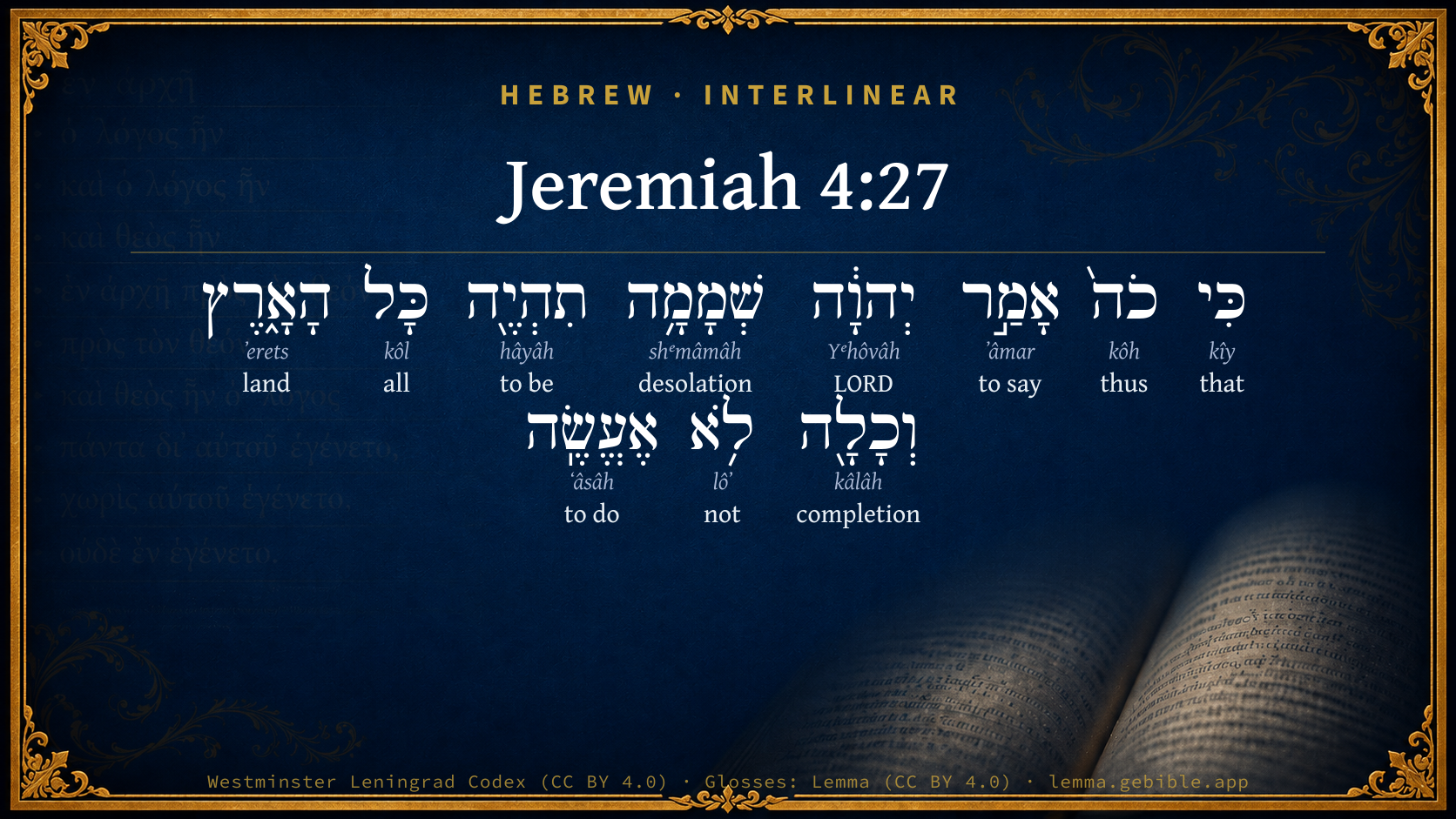
  1. כִּי kîy H3588 “that” Conjunction
  2. כֹה֙ kôh H3541 “thus” Adverb
  3. אָמַ֣ר ʼâmar H559 “to say” Verb, Qal, Perfect, 3rd Person, Masculine, Singular
  4. יְהוָ֔ה Yᵉhôvâh H3068 “LORD” Noun, Proper
  5. שְׁמָמָ֥ה shᵉmâmâh H8077 “desolation” Noun, Common, Feminine, Singular, Absolute
  6. תִהְיֶ֖ה hâyâh H1961 “to be” Verb, Qal, Imperfect, 3rd Person, Feminine, Singular
  7. כָּל kôl H3605 “all of” Noun, Common, Masculine, Singular, Construct
  8. הָאָ֑רֶץ ʼerets H776 “the · land” Particle, Definite Article + Noun, Common, Both, Singular, Absolute
  9. לֹ֥א lôʼ H3808 “not” Particle, Negative
  10. אֶעֱשֶֽׂה ʻâsâh H6213 “to do” Verb, Qal, Imperfect, 1st Person, Common, Singular

About this verse

These counts appear in no published source. They are computed here, from the morphology-tagged text and Lemma’s own curated glosses. What Lemma adds →

11
words
11
distinct lemmas
Prophets
section

Notable vocabulary

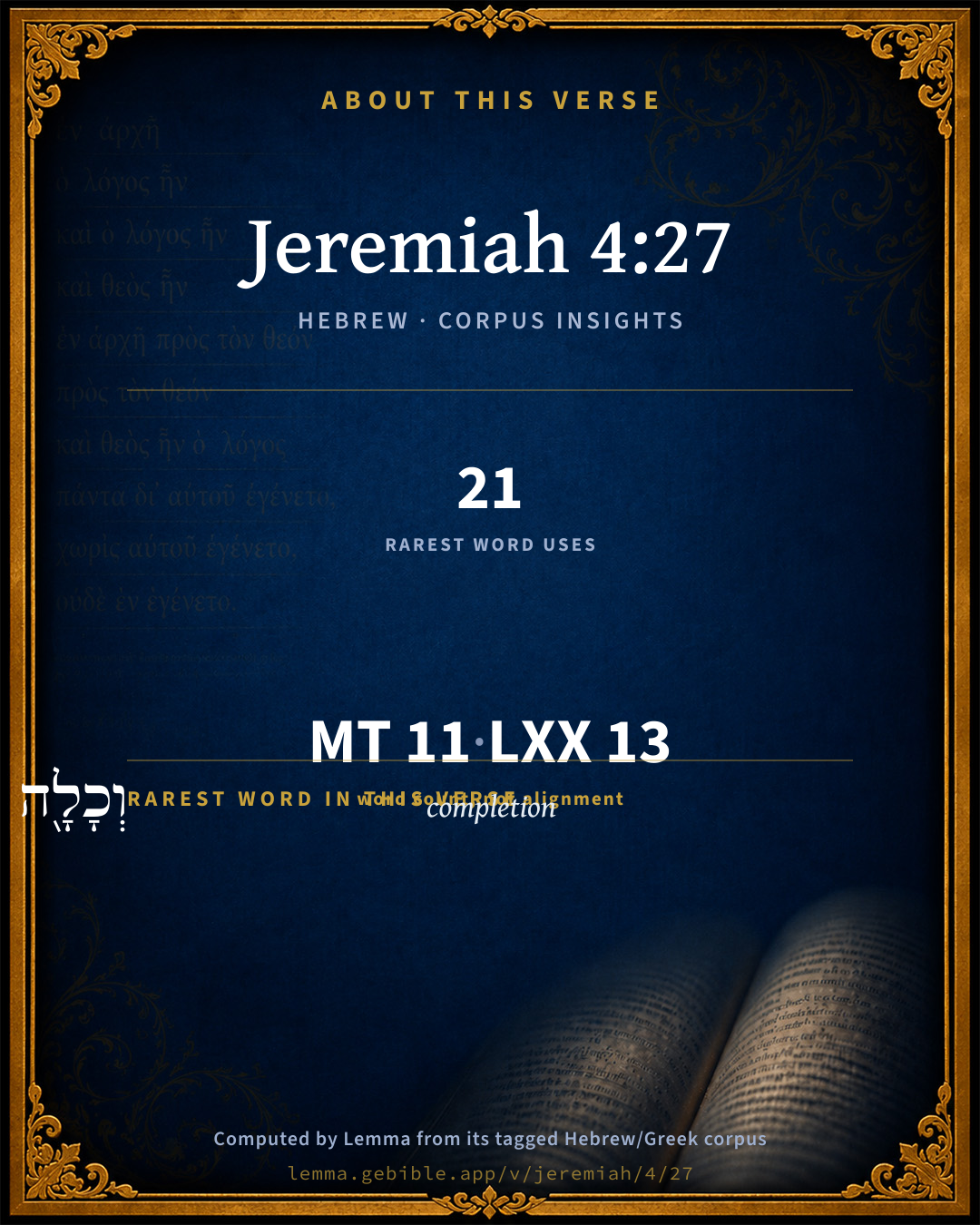
The rarest word here is וְכָלָ֖ה completion H3617 — appearing just 21 times in the whole Hebrew Bible.

Shared distinctive vocabulary

וְכָלָ֖ה completion H3617 occurs in 19 verses of the Hebrew Bible. Also found in:

Grammatical profile

  • 3 verbs
  • 5 nouns
  • 1 conjunction
  • 1 adverb
  • 1 particle

Verb forms

  • אָמַ֣ר Qal · Perfect
  • תִהְיֶ֖ה Qal · Imperfect
  • אֶעֱשֶֽׂה Qal · Imperfect

Hebrew & Septuagint length

In the original languages it is 11 Hebrew tokens and 13 Greek tokens — but the two are counted differently (Hebrew bundles its prefixes and suffixes into one token; the Greek is in lemma form), so that isn’t a like-for-like length.

Cross-references

19

Topical passages linked to Jeremiah 4:27 in the Treasury of Scripture Knowledge — connected by theme and wording, ordered by reader-vote popularity; previews shown in the World English Bible.

  • Jeremiah 5:10 Go up on her walls, and destroy; but don't make a full end: take away her branches; for they are not Yahweh's.
  • Jeremiah 5:18 But even in those days, says Yahweh, I will not make a full end with you.
  • Jeremiah 46:28 Don't be afraid you, O Jacob my servant, says Yahweh; for I am with you: for I will make a full end of all the nations where I have driven you; but I will not make a full end of you, but I will correct you in measure, and will in no way leave you unpunished.
  • Jeremiah 30:11 For I am with you, says Yahweh, to save you: for I will make a full end of all the nations where I have scattered you, but I will not make a full end of you; but I will correct you in measure, and will in no way leave you unpunished.
  • Leviticus 26:44 Yet for all that, when they are in the land of their enemies, I will not reject them, neither will I abhor them, to destroy them utterly, and to break my covenant with them; for I am Yahweh their God;
  • Ezekiel 11:13 It happened, when I prophesied, that Pelatiah the son of Benaiah died. Then fell I down on my face, and cried with a loud voice, and said, Ah Lord Yahweh! will you make a full end of the remnant of Israel?
  • Romans 9:27–29 Isaiah cries concerning Israel, "If the number of the children of Israel are as the sand of the sea, It is the remnant who will be saved;
  • Romans 11:1–7 I ask then, Did God reject his people? May it never be! For I also am an Israelite, a descendant of Abraham, of the tribe of Benjamin.
  • 2 Chronicles 36:21 to fulfill the word of Yahweh by the mouth of Jeremiah, until the land had enjoyed its Sabbaths: [for] as long as it lay desolate it kept Sabbath, to fulfill seventy years.
  • Isaiah 6:11–12 Then I said, "Lord, how long?" He answered, "Until cities are waste without inhabitant, And houses without man, And the land becomes utterly waste,
  • Isaiah 24:1 Behold, Yahweh makes the earth empty, and makes it waste, and turns it upside down, and scatters abroad the inhabitants of it.
  • Isaiah 24:3–13 The earth shall be utterly emptied, and utterly laid waste; for Yahweh has spoken this word.
  • Jeremiah 4:7 A lion is gone up from his thicket, and a destroyer of nations; he is on his way, he is gone forth from his place, to make your land desolate, that your cities be laid waste, without inhabitant.
  • Jeremiah 7:34 Then will I cause to cease from the cities of Judah, and from the streets of Jerusalem, the voice of mirth and the voice of gladness, the voice of the bridegroom and the voice of the bride; for the land shall become a waste.
  • Jeremiah 12:11–12 They have made it a desolation; it mourns to me, being desolate; the whole land is made desolate, because no man lays it to heart.
  • Jeremiah 18:16 to make their land an astonishment, and a perpetual hissing; everyone who passes thereby shall be astonished, and shake his head.
  • Ezekiel 6:14 I will stretch out my hand on them, and make the land desolate and waste, from the wilderness toward Diblah, throughout all their habitations: and they shall know that I am Yahweh.
  • Ezekiel 33:28 I will make the land a desolation and an astonishment; and the pride of her power shall cease; and the mountains of Israel shall be desolate, so that none shall pass through.
  • Amos 9:8–9 Behold, the eyes of the Lord Yahweh are on the sinful kingdom, and I will destroy it from off the surface of the earth; except that I will not utterly destroy the house of Jacob," says Yahweh.

Cross-references courtesy of OpenBible.info (CC BY 4.0).

Hebrew and Greek witnesses Masoretic Hebrew ↔ Greek Septuagint

The same verse in the two great witnesses to the Old Testament, shown verse-for-verse.

These are two independent witnesses, not word-aligned to each other, and the Septuagint is shown in lemma (dictionary) form.

Hebrew Jeremiah 4:27 Masoretic · Westminster Leningrad Codex

כִּי כֹה֙ אָמַ֣ר יְהוָ֔ה שְׁמָמָ֥ה תִהְיֶ֖ה כָּל הָאָ֑רֶץ וְכָלָ֖ה לֹ֥א אֶעֱשֶֽׂה

For thus says Yahweh, The whole land shall be a desolation; yet will I not make a full end.

World English Bible · Public Domain

Greek LXX Structure differs

In the Septuagint, Jeremiah is about an eighth shorter than the Hebrew and arranges its material differently — the Oracles Against the Nations (Hebrew chapters 46–51) appear in the middle of the Greek book, after 25:13. Because the chapter and verse boundaries do not line up, a verse-for-verse comparison with the Hebrew is not shown.

A verse-for-verse comparison isn’t shown here because the chapters and verses don’t line up. Switch to the LXX edition with the MT / LXX toggle above to read the Greek directly.

On this verse, Keil & Delitzsch discusses the Septuagint’s reading. Read the note in Commentary ↓

Hebrew: Westminster Leningrad Codex (CC BY 4.0). Greek: Septuagint (public domain); English from a public-domain English Septuagint. How the Septuagint differs from the Hebrew →

Targum (Aramaic paraphrase)

1

The Targum is the ancient Jewish Aramaic paraphrase of the Hebrew Scriptures — an interpretive translation, not the Hebrew text itself. Onkelos (literal) and Pseudo-Jonathan (expansive) render the Torah, and Jonathan the Prophets. Coverage is partial: where no permissively-licensed English translation exists for a verse, only the Aramaic is shown. This is verse-level text, not a word-by-word alignment to the Hebrew.

  1. Targum Jonathan Prophets (Joshua–Malachi)
    אֲרֵי כִּדְנַן אֲמַר יְיָ צָדוּ תְּהֵי כָּל אַרְעָא וּגְמִירָא לָא אַעְבֵּיד:

    (no public-domain English translation for this verse)

    Targum Jonathan — Aramaic: “Mikraot Gedolot” (public domain). English: “Sefaria Community Translation” (CC0 1.0 (public-domain dedication)); “London "Chaldee Paraphrase," 1871” (public domain). Text via Sefaria.

Commentary

Notes on Jeremiah 4:27 from classic Christian and Jewish commentators (each source and its license shown beneath its notes). The classic Christian expositions comment on the surrounding passage and are grouped to its opening verse, so a note may address several verses; the Jewish commentaries on the Tanakh (Rashi and others) are per-verse, so they appear only where the commentator wrote on this verse.

Lemma curates 59 commentaries, every one of them public domain or Creative Commons licensed, each selected and text-cleaned for this edition rather than reprinted as found. About our sources →

The Cambridge Bible for Schools and Colleges

gen. ed. J. J. S. Perowne

27. yet will I not make a full end] This clause is probably added by a later hand (so perhaps in Jer_5:10), for not only does it interrupt the metre in the original, but it also breaks the connexion between the pronouncements of Jer_4:27-28.

The Cambridge Bible for Schools and Colleges (gen. ed. J. J. S. Perowne; Cambridge University Press, 1878–1918) — public domain. Text from a community e-Sword module.

Trapp's Complete Commentary

John Trapp

Jer 4:27 For thus hath the LORD said, The whole land shall be desolate; yet will I not make a full end.

Ver. 27. Yet I will not make a full end.] God kept the room empty all those seventy years, till the return of the natives.

John Trapp, A Commentary or Exposition upon All the Books of the Old and New Testament (1647–1656) — public domain. Text from a community e-Sword module.

Joseph Benson's Commentary

Jer 4:27. Yet will I not make a full end — That is, say some commentators, neither shall the punishment suffice, nor my anger stop here: but it rather seems to be a word of comfort, signifying that they should not be utterly destroyed, but that, in the midst of judgment, God would remember mercy, and preserve a remnant; accordingly, in fact, after seventy years’ captivity, he brought a remnant back again into their own land.

Joseph Benson's Commentary on the Old and New Testaments (1811–1818) — public domain. Text from a community e-Sword module.

Keil & Delitzsch

C. F. Keil & F. Delitzsch

The devastation of Judah, though not its utter annihilation, is irrevocably decreed, and cannot be turned away by any meretricious expedients. - Jer 4:27. "For thus saith Jahveh, A waste shall the whole land be, yet will I not make an utter end. Jer 4:28. For this shall the earth mourn, and the heaven above darken, because I have said it, purposed it, and repent it not, neither will I turn back from it. Jer 4:29. For the noise of the horseman and bowman every city flees; they come into thickets, and into clefts of the rock they go up; every city is forsaken, and no man dwells therein. Jer 4:30. And thou, spoiled one, what wilt thou do? Though thou clothest thyself in purple, though thou deckest thee with ornaments of gold, though thou tearest open thine eyes with paint, in vain thou makest thyself fair; the lovers despise thee, they seek thy life. Jer 4:31. For I hear a voice as of a woman in travail, anguish as of one who bringeth forth her first-born, the voice of the daughter of Zion; she sigheth, she spreadeth out her hands: Woe is me! for my soul sinketh powerless beneath murderers."

Jer 4:27-29

Jer 4:27 and Jer 4:28 confirm and explain what the prophet has seen in spirit in Jer 4:23-26. A waste shall the land become; but the wasting shall not be a thorough annihilation, not such a destruction as befell Sodom and Gomorrah. עשׂה , as in Nah 1:8., Isa 10:23, and freq. This limitation is yet again in v. Jer 5:10, Jer 5:18 made to apply to Jerusalem, as it has done already to the people at large. It is founded on the promise in Lev 26:44, that the Lord will punish Israel with the greatest severity for its stubborn apostasy from Him, but will not utterly destroy it, so as to break His covenant with it. Accordingly, all prophets declare that after the judgments of punishment, a remnant shall be left, from which a new holy race shall spring; cf. Amo 9:8; Isa 6:13; Isa 11:11, Isa 11:16; Isa 10:20., Mic 2:12; Mic 5:6; Zep 3:13, etc. "For this" refers to the first half of Jer 4:27, and is again resumed in the על כּי following: for this, because Jahveh hath purposed the desolation of the whole land. The earth mourns, as in Hos 4:3, because her productive power is impaired by the ravaging of the land. The heaven blackens itself, i.e., shrouds itself in dark clouds (Kg1 18:45), so as to mourn over the desolated earth. The vividness of the style permits "have decreed it" to be appended as asyndeton to "I have said it," for the sake of greater emphasis. God has not only pronounced the desolation of the land, but God's utterance in this is based upon a decree which God does not repent, and from which He will not turn back. The lxx have placed the זמּתי after נחמתּי, and have thus obtained a neater arrangement of the clauses; but by this the force of expression in "I have said it, decreed it," is weakened. In Jer 4:29 the desolation of the land is further portrayed, set forth in Jer 4:30 as inevitable, and exhibited in its sad consequences in Jer 4:31. On the approach of the hostile army, all the inhabitants flee into inaccessible places from the clatter or noise of the horsemen and archers. He that casts the bow, the bowman; cf. Psa 78:9. כּל־העיר means, in spite of the article, not the whole city, but every city, all cities, as may be gathered from the בּהן, which points back to this. So frequently before the definite noun, especially when it is further defined by a relative clause, as e.g., Exo 1:22; Deu 4:3; Sa1 3:17; cf. Ew. 290, c. For the first כּל־העירthe lxx have πᾶσα ἡ χώρα, and accordingly J. D. Mich., Hitz., and Graf propose to amend to כּל־הארץ, so as to avoid "the clumsy repetition." But we cannot be ruled here by aesthetic principles of taste. Clearly the first "every city" means the populace of the cities, and so בּאוּ is: they (i.e., the men) come, pouring forth. עבים is not here clouds, but, according to its etymology, to be dark, means the dark thickets or woods; cf. the Syr. ̀āb, wood. כּפים, rocks, here clefts in the rocks, as is demanded by the בּ. For this state of things, cf. Isa 2:19, Isa 2:21, and the accounts of Jdg 6:2; Sa1 13:6, where the Israelites hide themselves from the invading Midianites in caves, ravines, thorn-thickets, rocks, and natural fastnesses.

Keil & Delitzsch — Biblical Commentary on the Old Testament (1861–1891) — public domain (CC PDM 1.0). Text via the HelloAO Bible API. (Old Testament only.)

Geneva Bible (1599)

Geneva Bible translators

But for his mercy’s sake, he will reserve himself a residue to be his Church, and to praise him in earth, Isa. 1:9.

Geneva Bible (1599) marginal notes — public domain. Text via Bolls.life.

Jamieson, Fausset & Brown

Robert Jamieson, A. R. Fausset & David Brown

full end--utter destruction: I will leave some hope of restoration (Jer 5:10, Jer 5:18; Jer 30:11; Jer 46:28; compare Lev 26:44).

Jamieson, Fausset & Brown — Commentary Critical and Explanatory on the Whole Bible (1871) — public domain (CC PDM 1.0). Text via the HelloAO Bible API.

John Calvin's Commentaries

The Prophet briefly explains here what he understood by the four things which he had seen and of which he had spoken. He then declares, as it were in the person of God, that there would be a dreadful desolation throughout Judea; Wasted, he says, shall be the whole land, or, in the whole land there shall be desolation. Some explain what afterwards follows, as though he mitigated the severity of his language. Hence, as they think, a mitigation is added, which was to relieve the faithful with some hope of mercy, lest they should wholly despond. And indeed were he to threaten only he might fill a hundred worlds with terror. Lest then despair should so overwhelm the faithful as to restrain them from fleeing to God for mercy, it is often added by way of mitigation, that God would not consume the whole land.

The word כלה, cale, sometimes means perfection, but in most places, consummation; for the verb signifies to perfect and to consume, and for the same reason. Though these two things seem inconsistent, yet what is consumed is said to be perfected, for it comes to an end. If this explanation is approved, we now see the reason why he declares that he would not make a consummation, with whatever severity he might punish the sins of his people; it was, that some hope might remain for the faithful, so that they might not be wholly discouraged; which would have been the case had not God promised to be propitious and mindful of his covenant.

Some perhaps may approve of reading the sentence as a question, and think that the object is to beat down the pride of the ungodly, and to dissipate the boasting of those who relied on the hope of impunity; as though he had said, “Do ye still deny that I shall make a consummation?”

Now, though the former exposition contains a richer truth, yet I prefer to take כלה, cale, as signifying an end, as though he had declared that he would observe no moderation in executing his vengeance: and a similar language occurs in the next chapter. The real meaning then is, — that God would to the end carry on his work of desolation. The prophets indeed do not always speak alike when they announce God’s judgments. Sometimes they denounce ruin where none seems to be safe; yet God ever preserves some hidden seed, as it is said in Isaiah 1:9; where also it appears evident what the prophets understood by making a consummation. For God there threatens and says,

“Behold I will make a consummation;” yet he afterwards adds, “The consummation shall bring forth fruit,”

that is, what remained of the consummation. The prophets elsewhere compare the Church of God to olive — trees when shaken, or to vines after vintage, (Isaiah 17:6; Isaiah 24:13;) for some grapes ever remain which escape the eyes of the gatherers; so also, when the olive — trees are shaken, some fruit remain on the highest branches. Thus God says, that the consummation he makes in his Church is like the vintage or the shaking of olive — trees, when some fruit remain and escape the eyes of the gatherers. We now perceive what the Prophet means, — that there would be the ruin of the whole people, so that they would have neither a name nor existence as a body; which thing also happened, when they were driven as exiles into Babylon; for the people, as a civil community, then ceased to exist, so that there was an end made of them.

I indeed allow that God’s threatenings cannot avail for our salvation, unless connected with the promise of pardon, so that being raised up by the hope of salvation we may flee to him: for as long as we deem God inexorable, we shun every access to him; and thus despair drives us into a rage like that of fiends. Hence it is that the reprobate rage so much against God, and make a great clamor: and they would willingly thrust him from his throne. It is therefore necessary that a hope of salvation should be set before us, so that we may be touched with repentance: and as this promise is perpetual, whatever may happen, even if earth and heaven were mixed together, and ruin on every side were filling us with dread, we must still remember that there will be ever some remnant according to the passages we have referred to in the first and tenth chapters of Isaiah. But as the people were not prepared to receive consolation, the design of the Prophet here is different, for he only mentions punishment. He afterwards adds —

John Calvin's Commentaries (1540-1563) — public domain. Text from the Calvin Translation Society English edition (1840s-50s) via the Christian Classics Ethereal Library (ccel.org). Calvin's coverage is partial (roughly two-thirds of the Bible); uncommented books and verses are honest gaps, never fabricated. The 19th-century editor's footnotes and remarks are omitted so the notes are faithfully Calvin's own voice.

Ellicott's Commentary for English Readers

(27) Yet will I not make a full end.—The thought is echoed from Amo_9:8; Isa_6:13; Isa_10:21, and repeated in Jer_5:18. There was then hope in the distance. The destruction, terrible as it seemed, was not final. The penalty was a discipline. (Comp. Lev_26:44.)

A Bible Commentary for English Readers, edited by Charles John Ellicott (1878–1897) — public domain. Text from a community e-Sword module.

John Gill's Exposition

For thus hath the Lord said,.... What follows is an explanation and confirmation of the above vision the prophet had:

the whole land shall be desolate; as he had seen; it should not be manured, ploughed, and sown, or bring forth fruit; and should be without inhabitants, at least have very few:

yet I will not make a full end; there should be some inhabitants, who, with those that should hereafter return from captivity, would repeople it, rebuild the temple, and restore it to its pristine form and order, both as to things natural, civil, and ecclesiastical; but though a full end of them, as a church and people, was not to be made now by the Chaldeans, yet it would be; as it has been done by the Romans, in the times of Vespasian and Hadrian.

John Gill's Exposition of the Whole Bible (1746–1763) — public domain (CC PDM 1.0). Text via the HelloAO Bible API.

Albert Barnes' Notes on the Bible

Desolate - a waste.

One of the most striking points of prophecy is, that however severe. may be the judgment pronounced against Judah, there is always the reservation, that the ruin shall not be complete Jer 3:14.

Albert Barnes' Notes on the Bible (1834–1885) — public domain. Text from a community e-Sword/MySword module.

Haydock's Catholic Bible Commentary

Destroy, when Jechonias was led captive. God allowed the people still eleven years to repent; and he afterwards restored the Jews. (Calmet) --- He will never suffer his church to perish. (Worthington)

George Leo Haydock (1774–1849), Haydock's Catholic Family Bible and Commentary, 1859 edition — public domain. Excludes Psalms (Douay-Rheims chapter numbering differs from Protestant) and Deuterocanonical books (Catholic canon only).

Matthew Poole's English Annotations

Some expound it, Neither shall this punishment suffice, nor my fury stop here; I will not thus have done with them; and so look to what they were further to endure in their long captivity. See Lev 26:36,39. But it seems rather to be a word of comfort, that they shall not be utterly extinct, he will preserve a remnant, Jer 5:10; Isa 1:9; 24:13; q.d. Though I am greatly moved with anger, yet I will not be inexorable, I will remember my covenant, Jer 30:11; in the midst of judgment he will remember mercy; after seventy years’ captivity he brought them back again.

Matthew Poole's English Annotations on the Holy Bible (1683–1685) — public domain. Text from a community e-Sword/MySword module.

Whedon's Commentary on the Bible

Daniel D. Whedon

27. Not… a full end — Again does the light shine through the gloom. God has not forsaken his people utterly. Appalling as is this picture, yet God’s faithfulness is beneath, behind, and over all.

Daniel D. Whedon (gen. ed.), Commentary on the Old and New Testaments (1874–1909) — public domain. Text from a community e-Sword module.

The Pulpit Commentary

The vision breaks off, and the prophet emphasizes its truthfulness by the announcement of the Divine decree. "Desolation, and yet not a full end," is its burden. This is the same doctrine of the" remnant" which formed so important a part of the prophetic message of Isaiah and his contemporaries. However severe the punishment of Judah may be, there will be a "remnant" which shall escape, and become the seed of a holier nation. (Amo_9:8 Isa_4:2 Isa_6:13 Isa_10:20 Isa_11:11 Hos_6:1, Hos_6:2)

"Yet will I not make a full end" God"s reserve of mercy.

This Divine resolve regarding the reserved remnant of the people of Judah and Jerusalem, who should be excepted from the desolation that was coming, is declared several times. Here in the text, then again in Jer_5:10 Jer_30:11, and once again in Jer_46:28. And these are but the echo of what God said to Israel long ages before in the desert of Sinai, as we read in Lev_26:44. And in other parts of Jeremiah"s prophecies, and in the writings of all the prophets, this Divine resolve to mercifully reserve from destruction a portion of Israel is more or less plainly declared. Thus, then, God does not conceal that the end he makes will not be a full end. And there were many reasons why this fact should be declared.

1. It would show that God was mindful of his covenant with their fathers; that their "unfaithfulness could not make the faithfulness of God of none effect." The scoff of the unbeliever, the dismay of the true-hearted, would be alike prevented, for, by God"s not making a full end, the way was yet plain for the accomplishment of all that he had spoken.

2. Moreover, such declaration would sustain the faith of the faithful. They would see how they were not forgotten, that God"s watchful care was over them, and that amid the coming desolations he would find means to deliver those who put their trust in him.

3. And the keeping open of this door of hope was calculated to persuade some to enter through that door and so be saved. This is why, even when a man has sinned away well-nigh all his life, when he has made an end of nearly every opportunity of return to God, we go and stand by his bedside, dying sinner as he is, and tell him that "a full end" is not yet made; even now Christ waits to be gracious, and will in no wise cast out. We toll of this hope in the trust that now, even at the last, the guilty one may turn to Christ and live. But we know that an "end" was indeed made to the national life of Israel. The terrific judgments which came upon them, and which the prophet in this chapter so vividly describes and so bitterly bewails, did make an end to all their national glory. Their land became desolate, their cities were destroyed, the holy and beautiful house of God was burnt with fire, their kings were slain, the throne overturned, the whole people carried into captivity; their cup of national sorrow was full to overflowing. But God did not suffer the agents of his righteous judgment to make a full end. Accordingly, in the days of Cyrus and his successors there came a restoration, although partial, poor, and incomplete, and under Ezra and Nehemiah Jerusalem and the house of the Lord were raised from their ruins and rebuilt. A remnant of the people was saved, the full end was not allowed to come, has never been allowed to come, though Israel"s national glory, yea, their very existence as a nation, has long since passed away. But whilst the oft-repeated words of the text refer mainly to Judah and Jerusalem, they really declare a principle of the Divine procedure , a continual law of his government and rule. God"s way is, when making an end, not to make a full end. He has ever a reserve of mercy. Now, concerning this principle, we observe

I IT IS IN PERPETUAL OPERATION.

1. It finds illustration, yea, may be said to be ever ruthlessly at work, in the kingdom of nature. Look at the story of oration. Whatever may have been the material condition of our globe prior to the period told of in the sacred record, we cannot conceive of it as having been eternally "without form and void." The researches of science seem to give a very different account from that. But whatever may have been its condition, and we can hardly doubt that it had an order and beauty of its own, an end was made to all that ere the last creation era dawned. But yet not a full end. The material for the new creation was there and it took new form and order according to the creative word. All had become desolate, but out of that God brought forth a new condition of things, which he himself declared to be "very good." And what is this doctrine of evolution, concerning which in these days we hear so much what is it but a further illustration in the kingdom of nature of the law of the text? "The survival of the fittest what does that imply but that there has been an end made of all the unfit and the less fit. But the whole order has not perished; there has been an end, but not a full end, and the fittest have been reserved.

2. And how frequent in the pages of history are the illustrations and examples of this principle of the Divine procedure! The destruction of the world by the Flood, that was an end, but not a full end, for Noah and his house were saved Earlier still, when God drove out from Eden the parents of our race, what an end was then made of all that was bright and blessed in their lives! but still not a full end. For, as St. Paul tells us, "the creature was made subject to vanity, in hope." Hope, the hope, of redemption and restoration through the promised Seed of the woman, was God"s illustration of this law then. The destruction of the generation of Israel that came up out of Egypt with Moses, and whose carcasses fell in the wilderness; but their children were God"s reserve of mercy in their case. And outside the pages of the Bible, thoughtful students of history, who love to trace the hand of God therein, are able to point to many an illustration of this law. Take the story of one man Alfred the Great: he and the little Saxon band that clave to him were God"s reserve of mercy for our land in those dark days, and saved us from coming to a full end, though we had come so near to it. And there are many, many more to which we cannot now allude. And in the history of the Church also how often has this been seen! Take the call of Abraham, for example. The religion of the ancient patriarchs had all but died out, an end had nearly come. But by the Divine call of Abraham it was prevented from being a full end; a new era was introduced when he became "the father of the faithful and the friend of God." And to pass over all intermediate illustrations of this same law, though they be many, and some of them most notable, we may refer to the revival of evangelical religion in the last century. An end had come to well nigh all earnest religion; the land was desolate with more than a material desolation. There was "a famine, not of bread, but of the hearing of the Word of the Lord." But God suffered it not to be a full end. Wesley and his trusty band, Whitefield and those who labored with him, became, under God, the means of a new departure, the introducers of a better order of things, which has continued to this day. And it has been the same in families. Take the prophetic family in the days of Samuel. But for him it would have come to a full end. Take the most illustrious instance of all, the house and lineage of David. To what nearness to extinction it had come when the Savior, the predicted Stem who should grow out of the root of Jesse, was born at Bethlehem, and that course of events began which have made the name of David, great before, yet infinitely and eternally great now by means of him of whom it was foretold by the angel to his mother, that he should" sit upon the throne of his father David," and of whose kingdom David himself sang that it "should have no end.

3. And what are many of God"s providential dealings with men, his afflictive dispensations especially, but further illustrations of this same law? "Ye have heard of the patience of Job." The lives of Joseph, of David, of Elijah, of Daniel, of Paul, and, above all, of our Lord, what are they but instances in which "it pleased the Lord to bruise them, and to put them to grief?" He saw fit to make an end to much of that which naturally they loved, and for a weary while to cloud over and conceal well-nigh all the brightness of their lives. But in no ease was there a full end made, nor ever will there be. To many of us the Lord God comes and makes an end of what we would so much like to guard and keep health, wealth, friends, prosperity, our inward joys, our outward gladness; God sends his angel of discipline and bids him make an end though not a full end of these things. Yes, it is oftentimes God"s way.

4. And what are his spiritual disciplines but the carrying out of the same principle? Do we not read, "Then Manasseh knew that the Lord he was God?" of the prodigal, that "he came to himself," and said, "I will arise and go to my father, and say unto him, Father, I have sinned?" of Peter, "he went out and wept bitterly?" Yes, often does he bring down our hearts so that we cry out, "Why art thou cast down, O my soul?" But he never makes a full end. False hope and trust have to go, but trust that is, real, hope that is of God, come under the law of his reserve of mercy they are the pared remnant, and whilst an end is made of all the rest, these survive.

5. And what will death itself be but our last experience of this law? Heart and flesh shall fail, the outward man shall perish, there shall be an end made of all that belongs to this world so far as we are concerned, and the place that has known us here shall know us no more forever. But whilst it will be an end, so much so that our bodies shall return, "earth to earth, dust to dust, ashes to ashes," still it will not be "a full end." We the true self shall still remain; though the body go back to its earth, "the spirit shall return unto God who gave it." Yes, the law of the text is seen everywhere. It is a principle of the Divine procedure that is in perpetual operation; it was brought to bear upon Judah and Jerusalem in the days of Jeremiah, and it bears upon nations, Churches, families, individuals, men, whenever God sees that the time has come for its application. But

II IT IS A PRINCIPLE THAT PROMPTS INQUIRY AS TO ITS REASON AND INTENT. This making an end, even though it be not a full end, has much about it that may well, if not perplex, yet give rise to earnest, thoughtful inquiry on the part of him who observes it. Without question, it is often a severe law, a principle prolific in pain. It was so in the case of those to whom Jeremiah wrote. The righteous scarcely were saved," but the ungodly and the sinners," who formed the vast majority, were not saved at all. Yes, though God made not a full end, the end he did make was terrible indeed. Now, we know it is not possible for us so to understand all the ways of God that we may fully rise toThe height of this high argument, And justify the ways of God to me.

But this much we may say: the surgeon"s knife that cuts away the poisoned flesh in order to save life is a severe operation, yet one that even he who writhes beneath it will consent to and be thankful for. The burning houses that cannot be saved are allowed to burn on, and men"s efforts are all turned towards the saving of those that are yet untouched. If Israel was to be preserved faithful as the keeper of the oracles of God and, humanly speaking, the welfare of the whole world depended upon her fidelity in this matter then the cankered portion of her people must be cut off, that the rest, yet in health, might continue so. "Our God is a consuming fire." His judgments will, must, burn on until all that is rotten and unsound has perished from the way. The dread doom of the world to come is described by a word that tells of the action of the surgeon"s knife, or of the vine-dresser"s pruning implements, which are used to cut away that which is evil or worthless, that that which is healthful may be preserved, strengthened, and developed according to the will of God. Yes, it is dreadful when God comes forth to make an end of wickedness and the wicked; but it would be more dreadful still the whole history of mankind attests it if he did not. But it is a work from which he shrinks. "As I live, saith the Lord and can we dare, or would we wish, to disbelieve him?I have no pleasure in the death of the wicked; but rather that he should turn from his wickedness and live." "Why will ye die, O ye house of Israel?" And we may say more than this. In the repetition of our text, which we have in the tenth verse of the next chapter, we see another purpose designed by these terrible dealings of God with his people. They were getting behind "battlements," trusting in defenses and safeguards which were of no avail; withdrawing their confidence from God, who had never failed them, to place it in those professed protectors who would always fail them, even as they had ever done. Hence one purpose of the stern process through which Judah and Jerusalem bad to pass was the taking away of those "battlements" which were "not the Lord"s." Their looking to the rulers of other nations, the gods of other nations, or to such poor material resources as they could themselves supply, was fatal to that reliance on the Lord God, which had been their distinguishing feature in their happiest and most glorious days. But it was essential to the fulfillment of God"s purposes in regard to them that this reliance upon God should by any means be restored. Therefore it was necessary that God should make an end of and destroy these "battlements," taking them utterly away. And in pursuance of this same main design, God would set the faithful amongst them free to live a new, a happier, holier, and every way better life. For they were hampered, entangled, ensnared, thwarted, and hindered at every turn by the hideous mass of moral wreckage by which they were surrounded. They could hardly move for it. There must, therefore, be a clearance made if God"s people were to enter upon, as he was determined that they should, that new that better life, to which he recommended them, and after which they yearned. "Now all these things happened unto them for an ensample," and we may see in them, we will, the motive and intent of the like dealings of God with men in our day. Thou troubled child of God, afflicted very much, of whose earthly comforts, enjoyments, and possessions God has been pleased to make so large an end, thou seest the reason why. And thou whose soul he has brought very low, taking from thee all thy trust and confidence, so that now he has made "thy very spirit poor," canst thou not understand wherefore he hath so dealt with thee? And our death, which makes an end of all that in this world we have called our own, it too finds its explanation in what was the evident purpose of God"s dealing with his ancient people. It was and it is, either for the putting away if even by a terrible process of the evil and wrong that are yet in men; or for the destruction of every false confidence, or for the setting the soul free as his disciplines do, and as at last his messenger, Death, will do to serve him in newness of life to his honor and glory, and to our own eternal joy. But in what has now been advanced we have only spoken of the reason wherefore God makes an end of so much, why he comes in these often terrible ways. We have yet to ask," Why are we spared? Why is there this reserve of mercy. Why is not a full end made?" And looking at the history of God"s ancient people, answers to these questions also may readily be found. To have made a full end would have given occasion to the enemies of God to blaspheme. We remember how Moses pleaded this argument when sore wrath had gone out against Israel, and it seemed as if a full end was to be made. And the promise of God to Abraham would have been set aside, the covenant which he made with their fathers in the days of old. And the language which we find in the Scriptures, the language of intense tenderness and love towards his people, proves that to have made a full end would have broken the heart of God. "How shall I give thee up?" "I have written thee on the palms of my hands." "Can a mother forget her sucking child, that she should not have compassion on the son of her womb? Yea, she may forget; yet will not I forget thee." In view of such love, how could there be a full end? And the Lord Jesus Christ has rendered such condemnation needless. For they who are spared when God judges the world, are spared not for any inherent intrinsic excellency in themselves, but they are they who have believed on the Name of God"s dear Son. Hence they have the righteousness of faith, the germ, the guarantee, the generator of all righteousness; and they have the indwelling of the Holy Ghost by whom they shall be strengthened to live in newness of life. All the possibilities to secure which God makes an end of so much in those who have not come to faith, they already have, and hence God is able, even as he is willing, to except them from the destruction that comes on all beside. And to mention but one other reason for this reserve of mercy for God not making a full end; he sees in these spared ones those by whom his "way shall be made known upon earth, and his saving health among all nations." They are to be the instruments of his grace, his channel of untold blessing to all mankind. Therefore doth God care for and guard them, and amid all destruction no evil is suffered to befall them, nor any plague to come nigh their dwelling.

III And now, lastly, we note that this principle of the Divine procedure which we have been considering. Is ONE WHICH WE MUST ALL OF US BE PREPARED TO HAVE APPLIED TO OURSELVES. Yes, God will look down upon us all, as Churches, families, individuals, and will mark What in us and who of us will be found worthy to stand in the great day when he separates the chaff from the wheat. Ah! this is the great question which concerns us. Where, then, shall I myself be? Shall it be amongst those whom God must put away, or amongst those whom he shall delightedly spare?" What question can compare with this? But the material for its answer may be found by askingWhere are we now? The destroying powers of the world, the flesh, and the devil are abroad; they are slaying their thousands and their tens of thousands. But are they destroying us? Or are we as God grant it may be amongst his "reserve of mercy?" Are we living unto God? Can we look up to our Lord and Savior and appeal to him who knoweth all things, to attest the love and trust towards him that abide in our heart? Oh, if it be so, and the life of prayer, of obedience, of self-surrender, be ours now, then we can, with humble but strong confidence, predict that when the last destroyer comes, even Death, whilst he will be permitted to make an end of much that here we rejoice in, yet he shall by no means make "a full end" of us. No, his coming, which is so terrible to the unbeliever, shall for us be but a setting us free, a delivering us from the bondage of corruption" into the glorious liberty of the children of God," so that our soul shall escape as a bird from out the snare of the fowler, and we henceforth shall "live unto God." Then shall the day, dear Lord, appear That we shall mount and dwell above, And stand and how amongst them there, And see thy face and sing thy love.

An end, a full end, will have been made of all that is corruptible, all that distresses, all that defiles, all that death can in any way touch; but it shall not be a full end of us, rather shall it be the beginning of a life so holy, so blessed, that all the past shall seem to have been no life at all. Look, then, at the two companies which have been brought before us. There are those whom God"s judgments are making an end of, and there are those whom those judgments cannot touch God"s reserve of mercy. Look at these latter again; they are clothed in white robes, and they have palms in their hands. For they have come "out of great tribulation, and have washed their robes, and made them white in the blood of the Lamb. Therefore are they before the throne of God, and serve him day and night in his temple They hunger no more, neither thirst any more; neither doth the sun light on them, nor any heat. For the Lamb which is in the midst of the throne shall feed them, and shall lead them unto living fountains of waters: and, God shall wipe away all tears from their eyes." Therefore, O Lord, make us to be numbered with thy saints now and in glory everlasting. C.

The Pulpit Commentary (1880–1919), ed. H.D.M. Spence-Jones & Joseph S. Exell — public domain. Text from a community e-Sword module.

John Wesley's Explanatory Notes

Yet - In the midst of judgment he will remember mercy.

John Wesley, Explanatory Notes Upon the Whole Bible (1754–1765) — public domain. Text via the GEBible commentary corpus.

unfoldingWord translationNotes

Door43 World Missions Community

All the land will become a devastation

"All the land of Judah will be devastated" or "all the land of Judah will be ruined"

the land will mourn, and the heavens above will darken

Jeremiah emphasizes Yahweh's judgment by saying that the earth itself expresses great sorrow. (See: Personification)

I will not hold back

"I will not change my mind"

I will not turn from carrying them out

Here "turn" represents deciding not to do what he said he would do. AT: "I will not change my mind about doing what I said I would do" or "I will not refuse to do what I planned to do" (See: Metaphor)

Every city

Here "city" represents the people living in the city. AT: "The people of every city" (See: Metonymy)

cavalry

a group of soldiers riding horses

they will run into the forests

They will run away to the forests for safety.

The cities will be abandoned, for there will be no one to inhabit them

These two clauses have similar meanings. The second one strengthens the thought in the first. AT: "The cities will be empty. There will be no one left to live in them" (See: Parallelism)

translationWords

mourn

declare

bow and arrow

unfoldingWord translationNotes — © Distant Shores Media and the Door43 World Missions Community, licensed CC BY-SA 4.0. Source: git.door43.org/Door43/en_tn.

Rashi

Rabbi Shlomo Yitzchaki (Rashi)

but I will not make an end of its inhabitants, for I will leave over refugees who will go into exile.

Rashi on the Tanakh — English translations: “The Judaica Press complete Tanach with Rashi, translated by A. J. Rosenberg” (CC BY 4.0); “Pentateuch with Rashi's commentary by M. Rosenbaum and A.M. Silbermann, 1929-1934” (public domain); “The Metsudah Tanach series, Lakewood, N.J” (CC BY 4.0); and “The Book of Joshua, Metsudah Publications, 1997” (CC BY 4.0). Text via Sefaria.

Lesson kit

Teaching starters — assembled from the data on this page, not authored interpretation. Every prompt links to the verse data it draws on. Edit before teaching.

Jeremiah, in the Prophets, opens this verse with 11 words (11 distinct Hebrew lemmas). Its most distinctive word is kâlâh (“completion”). A historical commentator’s framing appears above. Read the whole chapter for the surrounding context.

Discussion questions

  1. The word kâlâh carries the sense “completion.” How does it shape the verse?
  2. Genesis 18:21 shares the word «completion» with this verse. How do the two illuminate each other?
  3. These translations render this verse differently; the difference is in the English rendering, not the original. What questions does that raise?
  4. The verb «אָמַ֣ר» is Qal Perfect. How does its form color the action?
  5. Reading how The Cambridge Bible for Schools and Colleges and Trapp's Complete Commentary read this verse, where do the two commentators agree and where do they part?

Things to notice

Reading settings

Reading text

Shown beneath each verse's original-language words.

Old Testament
Old Testament edition

Read the OT as the Masoretic Hebrew (MT) or the Greek Septuagint (LXX).

English shown for the Greek Septuagint (in the Hebrew ↔ Greek comparison).

Comparing translations? Open the Compare panel on any verse page to stack up to four side by side.