Jeremiah 11:9

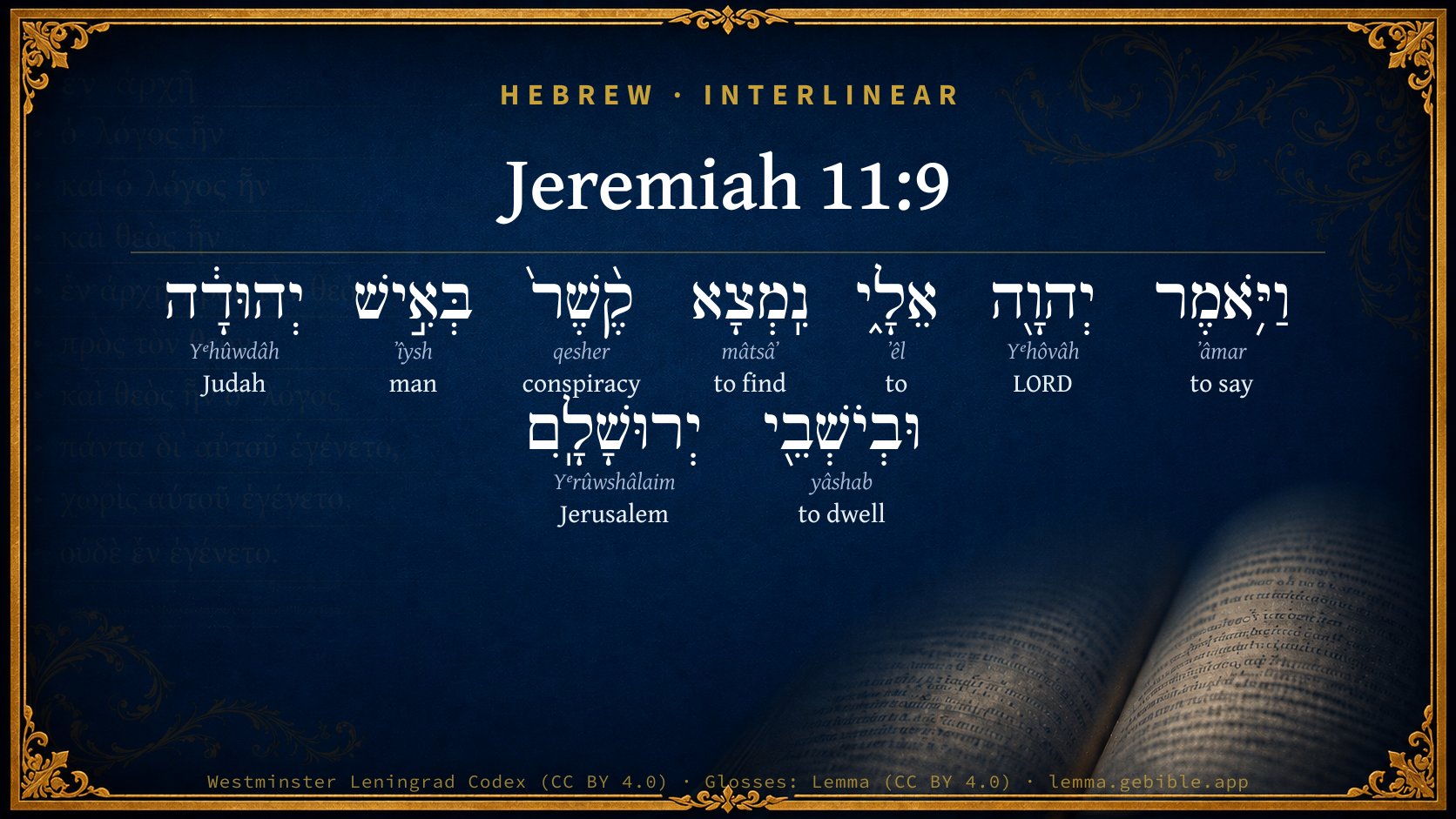
Hebrew (Westminster Leningrad Codex) Jeremiah 11:9 appears in the Hebrew Old Testament. The text above is from the Westminster Leningrad Codex. Each word links to its Strong’s number, a concise gloss, and parsing drawn from the Open Scriptures Hebrew Bible morphology. Click any word for its full Brown-Driver-Briggs (BDB) entry.
Download image
Cite this verse

Jeremiah 11:9 (World English Bible). Public Domain. Lemma interlinear Bible study tool, https://lemma.gebible.app/v/jeremiah/11/9.

Show BibTeX & RIS
BibTeX
RIS
English Translation
Yahweh said to me, A conspiracy is found among the men of Judah, and among the inhabitants of Jerusalem.
World English Bible · Public Domain
Download a study sheet

One document with this verse’s original text, its word-by-word gloss line, the meaning frame, cross-references with their text, attributed commentary, and full source and license credits — printable, and it pastes into notes with its structure intact.

This verse Autodidact and up

Study sheet (.html) Plain text (.txt)

A passage Seminary Student

Up to 50 verses in one chapter. A passage sheet keeps up to 6 commentary sources and 12 cross-references per verse, in the order this page ranks them, and says so on the sheet whenever that leaves anything out. Ask for a single verse and you get the Autodidact verse sheet above.

Everything on this page stays free to read, with no account — the sheet is a download of what is already on screen, not access to it.

Want to remove ads? Support Godless Engineer
Compare translations 3

The same verse in 3 English versions, stacked beneath the original-language interlinear above. Click any original word for its lexicon entry.

Each is an independent rendering of the whole verse — the interlinear is not word-aligned to these translations.

Highlighted words mark where these versions differ — a whole-verse word diff, not a word-by-word alignment.

  • World English Bible Public Domain
    Yahweh said to me, A conspiracy is found among the men of Judah, and among the inhabitants of Jerusalem.
  • King James Version Public Domain
    And the LORD said unto me, A conspiracy is found among the men of Judah, and among the inhabitants of Jerusalem.
  • unfoldingWord Literal Text CC BY-SA 4.0
    And Yahweh said to me, “A conspiracy has been found among the men of Judah and in the inhabitants of Jerusalem.

unfoldingWord Literal Text — © unfoldingWord, licensed CC BY-SA 4.0. Word-aligned USFM3 via Door43 (git.door43.org/unfoldingWord/en_ult).

Versions to compare (up to 4)

3 of 4 selected

Show all 18 translations

Every available English version of this verse, each an independent rendering of the whole verse.

  • World English Bible Public Domain
    Yahweh said to me, A conspiracy is found among the men of Judah, and among the inhabitants of Jerusalem.
  • Berean Standard Bible Public Domain
    And the LORD told me, “There is a conspiracy among the men of Judah and the residents of Jerusalem.
  • Majority Standard Bible Public Domain
    And the LORD told me, “There is a conspiracy among the men of Judah and the residents of Jerusalem.
  • King James Version Public Domain
    And the LORD said unto me, A conspiracy is found among the men of Judah, and among the inhabitants of Jerusalem.
  • American Standard Version (1901) Public Domain
    And Jehovah said unto me, A conspiracy is found among the men of Judah, and among the inhabitants of Jerusalem.
  • Revised Version (1885) Public Domain
    And the LORD said unto me, A conspiracy is found among the men of Judah, and among the inhabitants of Jerusalem.
  • Geneva Bible (1599) Public Domain
    And the Lord sayd vnto me, A conspiracie is found among the men of Iudah, and among the inhabitants of Ierusalem.
  • Douay-Rheims (1899) Public Domain
    And the Lord said to me: A conspiracy is found among the men of Juda, and among the inhabitants of Jerusalem.
  • Young's Literal Translation Public Domain
    And Jehovah saith unto me: `A conspiracy is found in the men of Judah, And in the inhabitants of Jerusalem.
  • Literal Standard Version CC BY-SA 4.0
    And YHWH says to me: “A conspiracy is found in the men of Judah, || And in the inhabitants of Jerusalem.
  • Unlocked Literal Bible CC BY-SA 4.0
    Next Yahweh said to me, “A conspiracy has been discovered among the men of Judah and the inhabitants of Jerusalem.
  • unfoldingWord Literal Text CC BY-SA 4.0
    And Yahweh said to me, “A conspiracy has been found among the men of Judah and in the inhabitants of Jerusalem.
  • Darby Bible Public Domain
    And Jehovah said unto me, A conspiracy is found among the men of Judah, and among the inhabitants of Jerusalem.
  • World Messianic Bible Public Domain
    The LORD said to me, “A conspiracy is found among the men of Judah, and among the inhabitants of Jerusalem.
  • Webster's Bible Public Domain
    And the LORD said to me, A conspiracy is found among the men of Judah, and among the inhabitants of Jerusalem.
  • Free Bible Version CC BY-SA 4.0
    The Lord told me, There is a rebellion happening among the people of Judah and those living in Jerusalem.
  • Bible in Basic English Public Domain
    And the Lord said to me, There is an evil design at work among the men of Judah and the people of Jerusalem.
  • JPS Tanakh (1917) Public Domain
    And the LORD said unto me: 'A conspiracy is found among the men of Judah, and among the inhabitants of Jerusalem.

Literal Standard Version (2020), Covenant Press — licensed CC BY-SA 4.0. Text via the HelloAO Bible API (eBible.org). Unlocked Literal Bible (unfoldingWord) — licensed CC BY-SA 4.0. Text via the HelloAO Bible API (eBible.org). unfoldingWord Literal Text — © unfoldingWord, licensed CC BY-SA 4.0. Word-aligned USFM3 via Door43 (git.door43.org/unfoldingWord/en_ult). Free Bible Version, Dr. Jonathan Gallagher — licensed CC BY-SA 4.0. Text via the HelloAO Bible API (eBible.org).

Word by word

More ways to search: Search by grammar → Find every occurrence → Compare this word →

Practice this passage: Drill this verse → Learn its vocabulary →

About this verse

These counts appear in no published source. They are computed here, from the morphology-tagged text and Lemma’s own curated glosses. What Lemma adds →

9
words
9
distinct lemmas
Prophets
section

Notable vocabulary

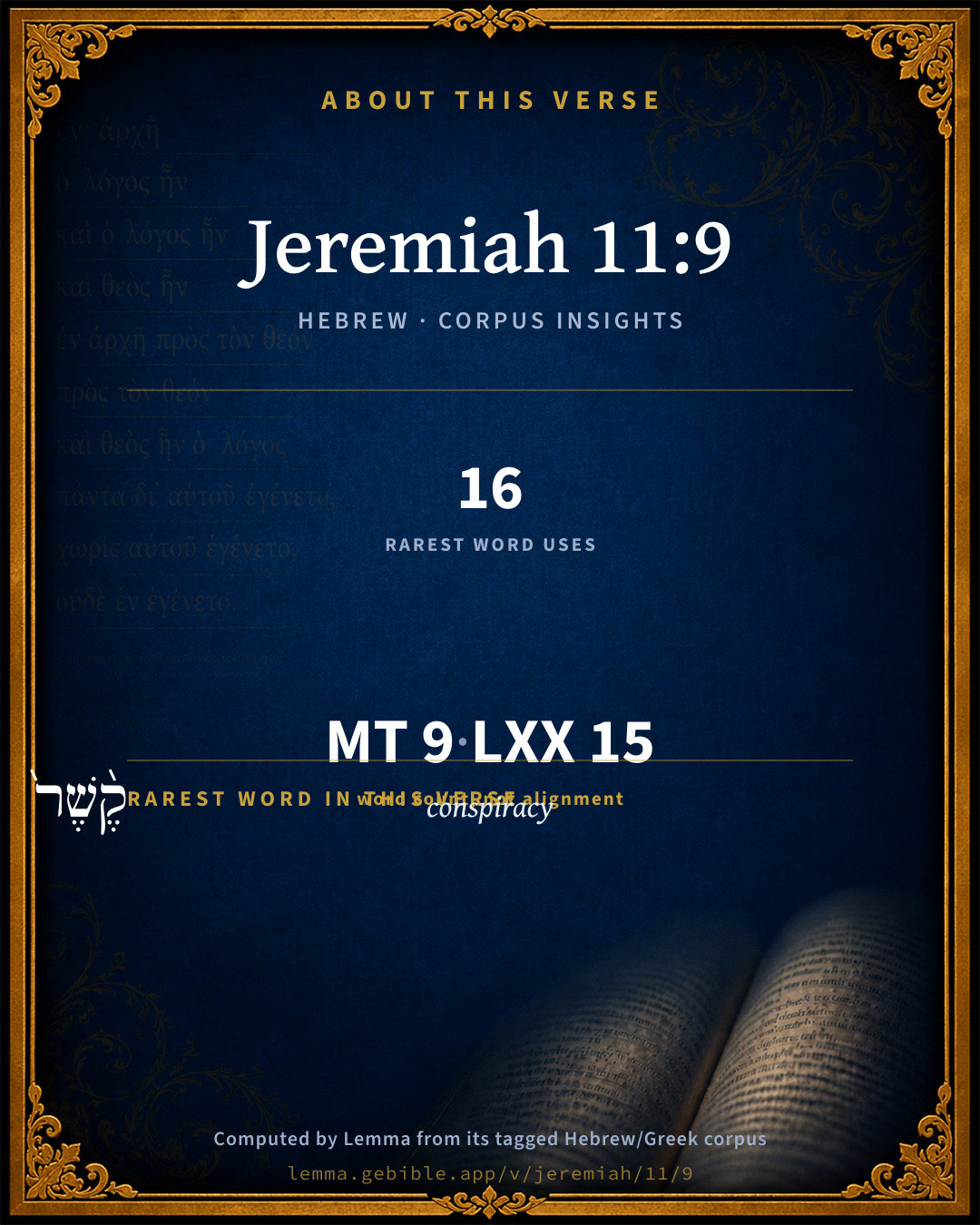
The rarest word here is קֶ֨שֶׁר֙ conspiracy H7195 — appearing just 16 times in the whole Hebrew Bible.

Shared distinctive vocabulary

קֶ֨שֶׁר֙ conspiracy H7195 occurs in 13 verses of the Hebrew Bible. Also found in:

Grammatical profile

  • 3 verbs
  • 5 nouns
  • 1 preposition

Verb forms

  • וַיֹּ֥אמֶר Qal · Sequential Imperfect
  • נִֽמְצָא Niphal · Perfect
  • וּבְיֹשְׁבֵ֖י Qal · Participle Active

Hebrew & Septuagint length

In the original languages it is 9 Hebrew tokens and 15 Greek tokens — but the two are counted differently (Hebrew bundles its prefixes and suffixes into one token; the Greek is in lemma form), so that isn’t a like-for-like length.

Cross-references

13

Topical passages linked to Jeremiah 11:9 in the Treasury of Scripture Knowledge — connected by theme and wording, ordered by reader-vote popularity; previews shown in the World English Bible.

  • Hosea 6:9 As gangs of robbers wait to ambush a man, So the company of priests murder in the way toward Shechem, Committing shameful crimes.
  • Jeremiah 5:31 the prophets prophesy falsely, and the priests bear rule by their means; and my people love to have it so: and what will you do in the end of it?
  • Jeremiah 6:13 For from the least of them even to the greatest of them everyone is given to covetousness; and from the prophet even to the priest everyone deals falsely.
  • Jeremiah 8:10 Therefore will I give their wives to others, and their fields to those who shall possess them: for everyone from the least even to the greatest is given to covetousness; from the prophet even to the priest every one deals falsely.
  • Ezekiel 22:25–31 There is a conspiracy of her prophets in the midst of it, like a roaring lion ravening the prey: they have devoured souls; they take treasure and precious things; they have made her widows many in the midst of it.
  • Micah 3:11 Her leaders judge for bribes, And her priests teach for a price, And her prophets of it tell forturnes for money: Yet they lean on Yahweh, and say, Isn't Yahweh in the midst of us? No disaster will come on us.
  • Micah 7:2–3 The godly man has perished out of the earth, And there is no one upright among men. They all lie in wait for blood; Every man hunts his brother with a net.
  • Zephaniah 3:1–4 Woe to her who is rebellious and polluted, the oppressing city!
  • Matthew 21:38–39 But the farmers, when they saw the son, said among themselves, 'This is the heir. Come, let's kill him, and seize his inheritance.'
  • Matthew 26:3–4 Then the chief priests, the scribes, and the elders of the people were gathered together in the court of the high priest, who was called Caiaphas.
  • Matthew 26:15 and said, "What are you willing to give me, that I should deliver him to you?" They weighed out for him thirty pieces of silver.
  • John 11:53 So from that day forward they took counsel that they might put him to death.
  • Acts 23:12–15 When it was day, some of the Jews banded together, and bound themselves under a curse, saying that they would neither eat nor drink until they had killed Paul.

Cross-references courtesy of OpenBible.info (CC BY 4.0).

Hebrew and Greek witnesses Masoretic Hebrew ↔ Greek Septuagint

The same verse in the two great witnesses to the Old Testament, shown verse-for-verse.

These are two independent witnesses, not word-aligned to each other, and the Septuagint is shown in lemma (dictionary) form.

Hebrew Jeremiah 11:9 Masoretic · Westminster Leningrad Codex

וַיֹּ֥אמֶר יְהוָ֖ה אֵלָ֑י נִֽמְצָא קֶ֨שֶׁר֙ בְּאִ֣ישׁ יְהוּדָ֔ה וּבְיֹשְׁבֵ֖י יְרוּשָׁלִָֽם

Yahweh said to me, A conspiracy is found among the men of Judah, and among the inhabitants of Jerusalem.

World English Bible · Public Domain

Greek LXX Structure differs

In the Septuagint, Jeremiah is about an eighth shorter than the Hebrew and arranges its material differently — the Oracles Against the Nations (Hebrew chapters 46–51) appear in the middle of the Greek book, after 25:13. Because the chapter and verse boundaries do not line up, a verse-for-verse comparison with the Hebrew is not shown.

A verse-for-verse comparison isn’t shown here because the chapters and verses don’t line up. Switch to the LXX edition with the MT / LXX toggle above to read the Greek directly.

Hebrew: Westminster Leningrad Codex (CC BY 4.0). Greek: Septuagint (public domain); English from a public-domain English Septuagint. How the Septuagint differs from the Hebrew →

Targum (Aramaic paraphrase)

1

The Targum is the ancient Jewish Aramaic paraphrase of the Hebrew Scriptures — an interpretive translation, not the Hebrew text itself. Onkelos (literal) and Pseudo-Jonathan (expansive) render the Torah, and Jonathan the Prophets. Coverage is partial: where no permissively-licensed English translation exists for a verse, only the Aramaic is shown. This is verse-level text, not a word-by-word alignment to the Hebrew.

  1. Targum Jonathan Prophets (Joshua–Malachi)
    וַאֲמַר יְיָ לִי אִשְׁתְּכַּח דִמְרָדוּ בְּמֵימְרִי אֱנַשׁ יְהוּדָה וְיַתְבֵי יְרוּשְׁלֵם:

    (no public-domain English translation for this verse)

    Targum Jonathan — Aramaic: “Mikraot Gedolot” (public domain). English: “Sefaria Community Translation” (CC0 1.0 (public-domain dedication)); “London "Chaldee Paraphrase," 1871” (public domain). Text via Sefaria.

Commentary

Notes on Jeremiah 11:9 from classic Christian and Jewish commentators (each source and its license shown beneath its notes). The classic Christian expositions comment on the surrounding passage and are grouped to its opening verse, so a note may address several verses; the Jewish commentaries on the Tanakh (Rashi and others) are per-verse, so they appear only where the commentator wrote on this verse.

Lemma curates 59 commentaries, every one of them public domain or Creative Commons licensed, each selected and text-cleaned for this edition rather than reprinted as found. About our sources →

Trapp's Complete Commentary

John Trapp

Jer 11:9 And the LORD said unto me, A conspiracy is found among the men of Judah, and among the inhabitants of Jerusalem.

Ver. 9. A conspiracy is found among the men of Judah.] A combination in sinful courses, this is not unity but conspiracy. See Eze 22:25 Hos 6:9. Such is the unity of the Antichristian crew. {Rev 17:13} The Turks have as little dissension in their religion as any, yet are a rabble of rebels conspiring against Heaven.

John Trapp, A Commentary or Exposition upon All the Books of the Old and New Testament (1647–1656) — public domain. Text from a community e-Sword module.

The Biblical Illustrator

Joseph S. Exell

Jer_11:9

And the Lord said unto me, A conspiracy is found

A sad relapse

1.

The prophet calls the peoples relapse a plot or conspiracy; thereby suggesting, perhaps, the secrecy with which the prohibited worships were at first revived, and the intrigues of the unfaithful nobles and priests and prophets, in order to bring about a reversal of the policy of reform.

2. The word further means a bond, which is the exact antithesis of the covenant with Jehovah, and it implies that this bond has about it a fatal strength and permanence, involving as its necessary consequence the ruin of the nation. Breaking covenant with Jehovah meant making a covenant with other gods. If you have broken faith with God in Christ, it is because you have entered into an agreement with another; it is because you have surrendered to the proposals of the tempter, and preferred his promises to the promises of God. (C. J. Ball, M. A.)

The Biblical Illustrator, edited by Joseph S. Exell (c. 1880s–1900s) — public domain. Text from a community e-Sword module.

Joseph Benson's Commentary

Jer 11:9-11. And the Lord said, A conspiracy is found, &c. — Namely, by him whose eye is upon the hidden works of darkness. There is a combination formed among them against God and religion, a dangerous design to overthrow the government of Jehovah, and to bring in counterfeit deities. In other words, All sorts of people have been alike disobedient, as if they had conspired together to break my law. They are turned back to the iniquities of their forefathers — They made some steps toward a reformation in the former part of the reign of Josiah, but now they have agreed to turn back to their former idolatries. Therefore behold, I will bring evil upon them, &c. — The evil of punishment for the evil of sin, which they shall not be able to escape by any evasion whatsoever. Let us remember, those who will not submit to God’s government, shall not be able to escape his wrath. Evil pursues sinners, and entangles them in snares, out of which they cannot extricate themselves. And though they shall cry unto me, I will not hearken — God will not hear them crying to him in their adversity, who refuse to hear him speaking to them in their prosperity.

Joseph Benson's Commentary on the Old and New Testaments (1811–1818) — public domain. Text from a community e-Sword module.

Whedon's Commentary on the Bible

Daniel D. Whedon

THE BREAKING OF THE COVENANT BY JUDAH, Jer_11:9-13.

9. Conspiracy — Such unanimity as would be brought about by formal preconcertment.

Daniel D. Whedon (gen. ed.), Commentary on the Old and New Testaments (1874–1909) — public domain. Text from a community e-Sword module.

Tyndale Open Study Notes

Tyndale Open Resources

11:9-10 conspiracy: The word connotes “betrayal” or “treason” (cp. 2 Kgs 11:14). • Judah and Jerusalem would no longer worship the Redeemer God, but would give themselves to worshiping other gods. Both Israel (probably referring here to the ten northern tribes) and Judah had broken the covenant.

Tyndale Open Study Notes — © Tyndale Open Resources, licensed CC BY-SA 4.0. Text via the HelloAO Bible API.

Geneva Bible (1599)

Geneva Bible translators

That is, a general consent to rebel against me.

Geneva Bible (1599) marginal notes — public domain. Text via Bolls.life.

Jamieson, Fausset & Brown

Robert Jamieson, A. R. Fausset & David Brown

conspiracy--a deliberate combination against God and against Josiah's reformation. Their idolatry is not the result of a hasty impulse (Psa 83:5; Eze 22:25).

Jamieson, Fausset & Brown — Commentary Critical and Explanatory on the Whole Bible (1871) — public domain (CC PDM 1.0). Text via the HelloAO Bible API.

Adam Clarke's Commentary

Verse 9. A conspiracy is found] They were all fratres conjurati, sworn brothers, determined to cast off the Divine yoke, and no longer to have God to reign over them.

Adam Clarke's Commentary on the Bible (1810–1826) — public domain. Text from a community e-Sword/MySword module.

John Calvin's Commentaries

Here the Prophet joins closer battle with the men of his age, and says, that they were worse than their fathers; for this is the meaning of the word, banding or joining together. For when the Israelites concurred in a body in ungodly superstitions, it was more excusable at the beginning, for they had not yet struck deep roots in true religion; but when God by his prophets had endeavored many times, and in various ways, to restore them to the right way, and when his diligence and assiduous efforts had proved fruitless, it was an evidence of confirmed and hopeless obstinacy. He then says, that this had been discovered; for this is what he means by saying, that it had been found out This verb is often used in Scripture in another sense, but it means here the same, as though he had said, that the conspiracy of the people had been discovered or proved, as it is said of thieves when found out, that they are caught in the very act. So God says here, that it was no matter of dispute whether the people had designedly and from sheer wickedness perverted his true and lawful worship; the conspiracy, he says, is sufficiently notorious

We then understand the meaning of the Prophet to be, — that not a part of the people was implicated in impiety, but that all, from the least to the greatest, were together defiled, and that this was done, not by some foolish impulse of the moment, but designedly, for they banded together; and further, that this was sufficiently evident, so that they could no longer contend as to the fact, for their wickedness was sufficiently manifest.

And he says between Judah and Israel There is here implied a sharp reproof; for we know that these two kingdoms had not only entertained a hidden grudge, but fiercely contended with one another, Since then the discord had been such between the ten tribes and the tribe of Judah, that it was as it were an insane hatred, so that they wished wholly to destroy one another, for the Jews sent for the Egyptians when the Israelites had called to arms the Syrians and the Assyrians for the destruction of Judah. Since then they so inimically treated one another for so many ages, what did this now mean? What a monstrous thing it was, that they conspired together to subvert the worship of God, to overturn everything true in religion, and to set up their own idols! We now then perceive the meaning of the Prophet; he intimates, that they had in all other things been enemies, and that they only united in this one thing, that is, in carrying on war against God, in subverting his worship, and rendering void his law. We hence see what the Spirit of God had in view in saying, that a conspiracy was found out; which was, that the Prophet might not use many words, as though the matter was doubtful! God then bids him positively to declare this fact, like at scribe who records the sentence of a judge; and thus God shews that he dealt with the Jews, as men deal with those who are condemned.

John Calvin's Commentaries (1540-1563) — public domain. Text from the Calvin Translation Society English edition (1840s-50s) via the Christian Classics Ethereal Library (ccel.org). Calvin's coverage is partial (roughly two-thirds of the Bible); uncommented books and verses are honest gaps, never fabricated. The 19th-century editor's footnotes and remarks are omitted so the notes are faithfully Calvin's own voice.

Ellicott's Commentary for English Readers

(9) A conspiracy.—The words explain the rapid apostasy that followed on the death of Josiah. There had been all along, even while he was urging his reforms, an organised though secret resistance to the policy of which he was the representative.

A Bible Commentary for English Readers, edited by Charles John Ellicott (1878–1897) — public domain. Text from a community e-Sword module.

The Cambridge Bible for Schools and Colleges

gen. ed. J. J. S. Perowne

9. They have silently agreed to apostatize.

9–14. See summary at commencement of section.

9–17. Judah has fallen back into apostasy. It is now clear that Josiah’s reforms have had no lasting results. The passage may therefore be placed in Jehoiakim’s reign.

The Cambridge Bible for Schools and Colleges (gen. ed. J. J. S. Perowne; Cambridge University Press, 1878–1918) — public domain. Text from a community e-Sword module.

John Gill's Exposition

They are turned back to the iniquities of their forefathers,.... According to Kimchi, this prophecy was delivered out in the times of Jehoiakim. There had been a reformation in the reign of Josiah, but now they had rebelled against the Lord, and had returned to their former idolatries that had been practised in the times of Amon, Manasseh, and Ahaz:

which refused to hear my words; sent unto them by the prophets, Isaiah, and others:

and they went after other gods to serve them; not their forefathers, though it was true of them; but the then present generation, that were in the conspiracy and rebellion against God; they put their schemes into execution, and worshipped and served the gods of the nations:

the house of Israel and the house of Judah have broken my covenant which I made with their fathers; by their many transgressions, and especially by their idolatry; the house of Israel, or the ten tribes, had done so, many years ago, and were carried captive; and the house of Judah, or the two tribes of Benjamin and Judah, committing the same iniquities, might justly expect the like treatment.

John Gill's Exposition of the Whole Bible (1746–1763) — public domain (CC PDM 1.0). Text via the HelloAO Bible API.

Albert Barnes' Notes on the Bible

A conspiracy - The defection from the covenant was as general as if it had been the result of preconcerted arrangement. The decided course taken by Josiah may, however, have led the opposite party to secret combinations against him.

Albert Barnes' Notes on the Bible (1834–1885) — public domain. Text from a community e-Sword/MySword module.

Haydock's Catholic Bible Commentary

Conspiracy. They are leagued together to do evil, with all earnestness. (St. Jerome)

George Leo Haydock (1774–1849), Haydock's Catholic Family Bible and Commentary, 1859 edition — public domain. Excludes Psalms (Douay-Rheims chapter numbering differs from Protestant) and Deuterocanonical books (Catholic canon only).

Matthew Poole's English Annotations

All sorts of people, whether of the city or country, have done alike, as if they had conspired together to break my law, and to provoke me to wrath, they are all alike and act alike. The thing is manifest, it is not done secretly, nor is it done rashly, but upon a conspiracy, upon counsel and deliberation.

Matthew Poole's English Annotations on the Holy Bible (1683–1685) — public domain. Text from a community e-Sword/MySword module.

The Pulpit Commentary

A conspiracy. The language is figurative. Jehovah is the King of Israel; to commit sin is "to rebel against" him (Authorized Version sometimes weakens this into "transgress"); and to encourage one another in wickedness is "to conspire against" God. We need not suppose any open combination against spiritual religion; it is enough if" the spirit of the time" was directly contrary to it.

The Pulpit Commentary (1880–1919), ed. H.D.M. Spence-Jones & Joseph S. Exell — public domain. Text from a community e-Sword module.

John Wesley's Explanatory Notes

A conspiracy - All sorts of people have done alike, as if they had conspired together to break my law.

John Wesley, Explanatory Notes Upon the Whole Bible (1754–1765) — public domain. Text via the GEBible commentary corpus.

Kretzmann's Popular Commentary

Paul E. Kretzmann

Israel’s Conspiracy Against the Lord and its Punishment

v. 9. And the Lord said unto me, A conspiracy is found among the men of Judah and among the inhabitants of Jerusalem, a plot in opposition to Jehovah and to the demands of right and duty, the entire nation being involved in this wickedness.

v. 10. They are turned back to the iniquities of their forefathers, by which Israelites of the former generations heaped guilt upon themselves, which refused to hear My words, deliberately combining to deny Him obedience in His just demands; and they went after other gods to serve them, this sin of idolatry being the Lord’s chief charge against them; the house of Israel, the ten tribes of the northern kingdom, and the house of Judah, the southern kingdom, have broken My covenant which I made with their fathers, Judah thus being destined to a similar punishment as that which befell Israel.

v. 11. Therefore, thus saith the Lord, Jehovah, the same God of the covenant who was still seeking His children with the same loving-kindness as of old, Behold, I will bring evil upon them which they shall not be able to escape, from which also no deliverance is possible; and though they shall cry unto Me, I will not hearken unto them, refusing them assistance and redemption, since their time of grace had now expired.

v. 12. Then shall the cities of Judah, that is, their people, and inhabitants of Jerusalem go and cry unto the gods unto whom they offer incense, the idols whom they have worshiped; but they, the false gods in whom they professed to trust, shall not save them at all in the time of their trouble, since, of course, they were utterly unable to do so, being but dead images, who could not deliver in any calamity.

v. 13. For according to the number of thy cities were thy gods, O Judah, practically a different idol for every city; and according to the number of the streets of Jerusalem have ye set up altars, a different one for every open place, to that shameful thing, to the idol which is the essence of all that is shameful and will bring confusion upon all who persist in worshiping it, even altars to burn incense unto Baal, this idol being the chief abomination of the Canaanite nations since remote times. The Lord, having thus set forth the obstinate wickedness of the people of Judah, turns to His prophet with the command that he should not interfere with His just punishment upon the apostate nation.

v. 14. Therefore pray not thou for this people, neither lift up a cry or prayer for them, any supplication asking deliverance for them; for I will not hear them, He would pay no attention to the prophet’s intercession, in the time that they cry unto Me for their trouble, on account of the calamity which has befallen them. Moreover, the Lord also resents the hypocritical worship of the people.

v. 15. What hath My beloved to do in Mine house, the congregation making a pretense at seeking Him in true worship, seeing she hath wrought lewdness with many, having become guilty of spiritual adultery in its most revolting form, and the holy flesh is passed from thee? The Lord calls their worship an enormity, because it was, in truth, a hollow mockery, with which they deceived none but themselves. When thou doest evil, then thou rejoicest. The entire second part of the verse may be rendered: "Will vows and holy flesh take thy calamity from thee? Then mayest thou exult!" All the religious customs upon which they relied could not protect them. If they were sincere in their worship, then there would be reason for congratulating themselves.

v. 16. The Lord called thy name "A green olive-tree," fair and of goodly fruit, thus He had regarded Israel in the days when He chose it for His own; with the noise of a great tumult, amid the rattling of thunder or the noise of battle. He hath kindled fire upon it, to destroy the very plant which He formerly cherished so dearly, and the branches of it are broken, ten tribes of the original nation having already been taken away into captivity and the tree thus badly crippled.

v. 17. For the Lord of hosts, that planted thee, hath pronounced evil against thee, being firmly determined upon punishing the apostate nation, for the evil of the house of Israel and of the house of Judah which they have done against themselves, to their own hurt, to provoke Me to anger in offering incense unto Baal. Jeremiah now notes a proof of the incorrigible nature of the people of his own nation.

v. 18. And the Lord hath given me knowledge of it, and I know it, their wickedness was revealed to him; then Thou showedst me their doings. Even this, however, had not disturbed Jeremiah’s trustfulness.

v. 19. But I was like a lamb or an ox that is brought to the slaughter, with never an inkling of the evil intention of his own familiar friends; and I knew not that they had devised devices against me, saying, Let us destroy the tree with the fruit thereof and let us cut him off from the land of the living that his name may be no more remembered. They wanted to bring ruin, if possible, death, to Jeremiah and cause his teaching to be forgotten. Therefore the prophet calls upon the Lord for vengeance in his just cause.

v. 20. But, O Lord of hosts, that judgest righteously, that triest the reins and the heart, testing the inmost thoughts of man; let me see Thy vengeance on them, for it is He whose honor is principally at stake; for unto Thee have I revealed my cause, laying the whole matter before Him for adjustment.

v. 21. Therefore, thus saith the Lord of the men of Anathoth, Jeremiah’s own townsmen, that seek thy life, saying, Prophesy not in the name of the Lord, that thou die not by our hand, this being the demand which they placed before him;

v. 22. therefore, thus saith the Lord of hosts, Behold, I will punish them, for daring to threaten the life of His servant; the young men shall die by the sword, being cut down by the enemy in battle, their sons and their daughters shall die by famine, the result of the unmerciful siege begun by the enemies.

v. 23. And there shall be no remnant of them, the Lord being determined to carry out His sentence of extermination upon them; for I will bring evil upon the men of Anathoth, even the year of their visitation. Thus the punishment of the Lord descends upon the evil-doers in due time, often with terrible effect.

Paul E. Kretzmann, Popular Commentary of the Bible (1921–1924) — public domain. Text from a community e-Sword module.

unfoldingWord translationNotes

Door43 World Missions Community

A conspiracy has been discovered

This can be stated in active form. AT: "There is a conspiracy" (See: Active or Passive)

conspiracy

a secret plan to do something that is harmful or illegal

the inhabitants of Jerusalem

"the people who live in Jerusalem"

They have turned to the iniquities of their earliest ancestors

The phrase "turned to" is an idiom that means to start doing something. AT: "They have returned to committing the same iniquities as their earliest ancestors committed" (See: Active or Passive)

walked after

"followed after"

The house of Israel

The word "house" is a metonym for the family that lives in the house. In this case it refers to the kingdom of Israel. See how you translated this in Jeremiah 3:18. AT: "Israel" or "The kingdom of Israel" (See: Metonymy)

the house of Judah

The word "house" is a metonym for the family that lives in the house. In this case it refers to the kingdom of Judah, which included the descendants of Judah and Benjamin. See how you translated this in Jeremiah 3:18. AT: "Judah" or "the kingdom of Judah" (See: Metonymy)

translationWords

turn

iniquity

word of God

false god

worship

house

kingdom of Israel

kingdom of Judah

unfoldingWord translationNotes — © Distant Shores Media and the Door43 World Missions Community, licensed CC BY-SA 4.0. Source: git.door43.org/Door43/en_tn.

Lesson kit

Teaching starters — assembled from the data on this page, not authored interpretation. Every prompt links to the verse data it draws on. Edit before teaching.

Jeremiah, in the Prophets, opens this verse with 9 words (9 distinct Hebrew lemmas). Its most distinctive word is qesher (“conspiracy”). A historical commentator’s framing appears above. Read the whole chapter for the surrounding context.

Discussion questions

  1. How does “conspiracy” (qesher) shape what this verse is saying?
  2. 2 Samuel 15:12 shares the word «conspiracy» with this verse. How do the two illuminate each other?
  3. These translations render this verse differently; the difference is in the English rendering, not the original. What questions does that raise?
  4. The verb «וַיֹּ֥אמֶר» is Qal Sequential Imperfect. How does its form color the action?
  5. Reading how Trapp's Complete Commentary and The Biblical Illustrator read this verse, where do the two commentators agree and where do they part?

Things to notice

Reading settings

Reading text

Shown beneath each verse's original-language words.

Old Testament
Old Testament edition

Read the OT as the Masoretic Hebrew (MT) or the Greek Septuagint (LXX).

English shown for the Greek Septuagint (in the Hebrew ↔ Greek comparison).

Comparing translations? Open the Compare panel on any verse page to stack up to four side by side.