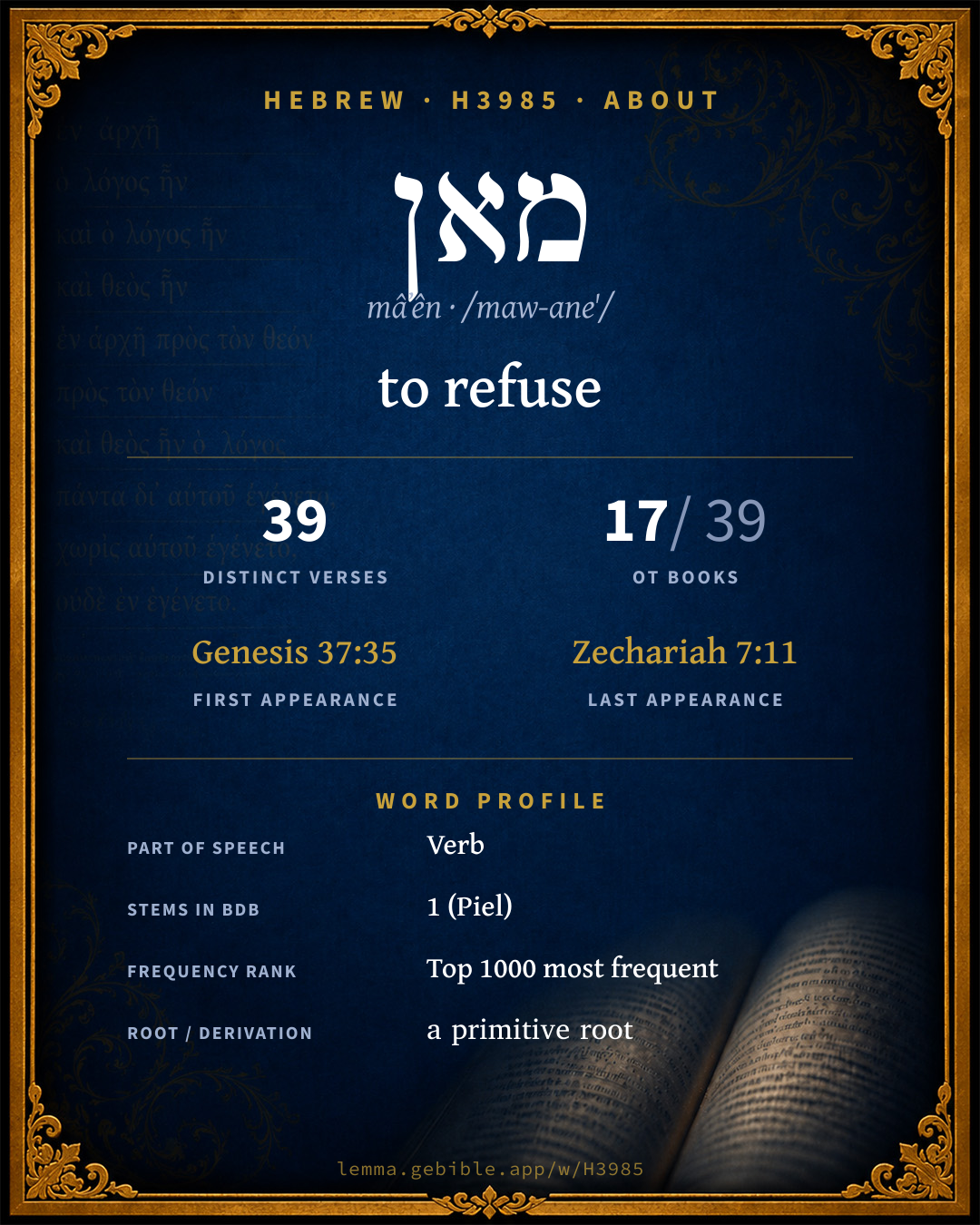
מָאֵן
to refuse
Full lexicon entry — Brown-Driver-Briggs (BDB)
From Brown-Driver-Briggs (BDB)
Where this word appears
Grammar key — what these labels mean
Part of speech
- Verb
- An action or state-of-being word.
Stem
- Piel
- An intensive or resultative active stem.
Form
- Perfect
- A completed action or state — Hebrew marks aspect (completeness) more than strict tense (“he wrote”).
- Sequential Imperfect
- An imperfect with prefixed waw — the standard past-narrative form (waw-consecutive imperfect).
- Infinitive Absolute
- An unbound verbal noun, often intensifying or standing in for a finite verb.
- Imperfect
- An incomplete, ongoing, or future action (“he will / would write”).
Person
- 3rd Person
- The one spoken about (“he / she / it / they”).
- 2nd Person
- The one addressed (“you”).
Gender
- Common
- Either gender — not distinguished for this form.
- Masculine
- Grammatically masculine.
- Feminine
- Grammatically feminine.
Number
- Plural
- More than one (in Hebrew, generally three or more).
- Singular
- One.
Grammatical forms 15 distinct
- Verb, Piel, Perfect, 3rd Person, Common, Plural 10 times (24%)
- Verb, Piel, Sequential Imperfect, 3rd Person, Masculine, Singular 9 times (22%)
- Verb, Piel, Perfect, 3rd Person, Masculine, Singular 5 times (12%)
- Verb, Piel, Perfect, 3rd Person, Feminine, Singular 4 times (10%)
- Verb, Piel, Sequential Imperfect, 3rd Person, Masculine, Plural 3 times (7%)
- Verb, Piel, Sequential Imperfect, 2nd Person, Masculine, Plural 1 time (2%)
- Verb, Piel, Sequential Imperfect, 2nd Person, Masculine, Singular 1 time (2%)
- Verb, Piel, Sequential Imperfect, 3rd Person, Feminine, Singular 1 time (2%)
+7 more forms (7 occurrences)
Parsed forms decoded from the imported morphology (morphhb / Westminster Leningrad Codex — WLC text public domain, morphhb tagging CC BY 4.0), counted across 41 parsed occurrences — not distinct verses.
Every verse where H3985 appears — 39 distinct verses across 17 books. Click any verse to open its interlinear word-by-word view. Verse text shown in the World English Bible for context — . Each verse’s Hebrew form is shown with its reference; the English is not keyword-highlighted, since the data carries no word-level English alignment. Use “Compare translations” on any verse to read it across multiple English versions. This concordance covers the Hebrew Bible; Septuagint (Greek Old Testament) occurrences are not indexed here.
Genesis 3 verses
- Genesis 37:35 וַ/יְמָאֵן֙ conj + Piel wimpf 3ms All his sons and all his daughters rose up to comfort him; but he refused to be comforted. He said, "For I will go down to Sheol to my son mourning." His father wept for him.
- Genesis 39:8 וַ/יְמָאֵ֓ן conj + Piel wimpf 3ms But he refused, and said to his master's wife, "Behold, my master doesn't know what is with me in the house, and he has put all that he has into my hand.
- Genesis 48:19 וַ/יְמָאֵ֣ן conj + Piel wimpf 3ms His father refused, and said, "I know, my son, I know. He also will become a people, and he also will be great. However, his younger brother will be greater than he, and his seed will become a multitude of nations."
Exodus 5 verses
- Exodus 4:23 וַ/תְּמָאֵ֖ן conj + Piel wimpf 2ms and I have said to you, "Let my son go, that he may serve me;" and you have refused to let him go. Behold, I will kill your son, your firstborn.'"
- Exodus 7:14 מֵאֵ֖ן Piel pf 3ms Yahweh said to Moses, "Pharaoh's heart is stubborn. He refuses to let the people go.
- Exodus 10:3 מֵאַ֔נְתָּ Piel pf 2ms Moses and Aaron went in to Pharaoh, and said to him, "This is what Yahweh, the God of the Hebrews, says: 'How long will you refuse to humble yourself before me? Let my people go, that they may serve me.
- Exodus 16:28 מֵֽאַנְתֶּ֔ם Piel pf 2mp Yahweh said to Moses, "How long do you refuse to keep my commandments and my laws?
- Exodus 22:17 מָאֵ֧ן יְמָאֵ֛ן Piel inf.abs Piel impf 3ms If her father utterly refuses to give her to him, he shall pay money according to the dowry of virgins.
Numbers 3 verses
- Numbers 20:21 וַ/יְמָאֵ֣ן conj + Piel wimpf 3ms Thus Edom refused to give Israel passage through his border: why Israel turned away from him.
- Numbers 22:13 מֵאֵ֣ן Piel pf 3ms Balaam rose up in the morning, and said to the princes of Balak, Get you into your land; for Yahweh refuses to give me leave to go with you.
- Numbers 22:14 מֵאֵ֥ן Piel pf 3ms The princes of Moab rose up, and they went to Balak, and said, Balaam refuses to come with us.
Deuteronomy 1 verse
1 Samuel 2 verses
- 1 Samuel 8:19 וַ/יְמָאֲנ֣וּ conj + Piel wimpf 3mp But the people refused to listen to the voice of Samuel; and they said, No: but we will have a king over us,
- 1 Samuel 28:23 וַ/יְמָאֵ֗ן conj + Piel wimpf 3ms But he refused, and said, I will not eat. But his servants, together with the woman, constrained him; and he listened to their voice. So he arose from the earth, and sat on the bed.
2 Samuel 2 verses
- 2 Samuel 2:23 וַ/יְמָאֵ֣ן conj + Piel wimpf 3ms However he refused to turn aside: therefore Abner with the hinder end of the spear struck him in the body, so that the spear came out behind him; and he fell down there, and died in the same place: and it happened, that as many as came to the place where Asahel fell down and died stood still.
- 2 Samuel 13:9 וַ/יְמָאֵ֖ן conj + Piel wimpf 3ms She took the pan, and poured them out before him; but he refused to eat. Amnon said, Have out all men from me. They went out every man from him.
1 Kings 2 verses
- 1 Kings 20:35 וַ/יְמָאֵ֥ן conj + Piel wimpf 3ms A certain man of the sons of the prophets said to his fellow by the word of Yahweh, Please strike me. The man refused to strike him.
- 1 Kings 21:15 מֵאֵן֙ Piel pf 3ms It happened, when Jezebel heard that Naboth was stoned, and was dead, that Jezebel said to Ahab, Arise, take possession of the vineyard of Naboth the Jezreelite, which he refused to give you for money; for Naboth is not alive, but dead.
2 Kings 1 verse
Nehemiah 1 verse
Esther 1 verse
Job 1 verse
Psalms 2 verses
Proverbs 3 verses
- Proverbs 1:24 וַ/תְּמָאֵ֑נוּ conj + Piel wimpf 2mp Because I have called, and you have refused; I have stretched out my hand, and no one has paid attention;
- Proverbs 21:7 מֵ֝אֲנ֗וּ Piel pf 3cp The violence of the wicked will drive them away, Because they refuse to do what is right.
- Proverbs 21:25 מֵאֲנ֖וּ Piel pf 3cp The desire of the sluggard kills him, For his hands refuse to labor.
Isaiah 1 verse
Jeremiah 9 verses
- Jeremiah 3:3 מֵאַ֖נְתְּ Piel pf 2fs Therefore the showers have been withheld, and there has been no latter rain; yet you have a prostitute's forehead, you refused to be ashamed.
- Jeremiah 5:3 מֵאֲנ֖וּ מֵאֲנ֖וּ Piel pf 3cp Piel pf 3cp O Yahweh, don't your eyes look on truth? you have stricken them, but they were not grieved; you have consumed them, but they have refused to receive correction: they have made their faces harder than a rock; they have refused to return.
- Jeremiah 8:5 מֵאֲנ֖וּ Piel pf 3cp Why then is this people of Jerusalem slidden back by a perpetual backsliding? they hold fast deceit, they refuse to return.
- Jeremiah 9:6 מֵאֲנ֥וּ Piel pf 3cp Your habitation is in the midst of deceit; through deceit they refuse to know me, says Yahweh.
- Jeremiah 11:10 מֵֽאֲנוּ֙ Piel pf 3cp They are turned back to the iniquities of their forefathers, who refused to hear my words; and they are gone after other gods to serve them: the house of Israel and the house of Judah have broken my covenant which I made with their fathers.
- Jeremiah 15:18 מֵֽאֲנָה֙ Piel pf 3fs Why is my pain perpetual, and my wound incurable, which refuses to be healed? will you indeed be to me as a deceitful [brook], as waters that fail?
- Jeremiah 25:28 יְמָאֲנ֛וּ Piel impf 3mp It shall be, if they refuse to take the cup at your hand to drink, then shall you tell them, Thus says Yahweh of Hosts: You shall surely drink.
- Jeremiah 31:15 מֵאֲנָ֛ה Piel pf 3fs Thus says Yahweh: A voice is heard in Ramah, lamentation, and bitter weeping, Rachel weeping for her children; she refuses to be comforted for her children, because they are no more.
- Jeremiah 50:33 מֵאֲנ֖וּ Piel pf 3cp Thus says Yahweh of hosts: The children of Israel and the children of Judah are oppressed together; and all who took them captive hold them fast; they refuse to let them go.
Hosea 1 verse
Zechariah 1 verse
About this entry
At a glance — auto-summarized from this page’s data, not written by a person. Every figure links to its source below. This summary describes the numbers; it doesn’t interpret them.
“to refuse” is the headline sense of the Hebrew verb מאן (mâʼên). First canonically at Genesis 37:35, it enters the text early. The Hebrew Bible uses it across 39 verses — moderately common. It shares a root with מאן and מאן. The sections below give every sense, occurrence, and version rendering.
Gloss history
Strong's 1890 vs modern scholarship
About this word
Strong's H3985 catalogs a Hebrew word from the Hebrew Old Testament.
These counts are not copied from any lexicon or concordance. They are computed here, from the morphology-tagged Hebrew Old Testament. What Lemma adds →
- 39
- distinct verses
- The word appears in 39 distinct verses.
- 17 / 39
- OT books
- The word appears in 17 of 39 Old Testament books.
- #891
- by frequency
- Top 1000 most frequent Hebrew words (rank 891 of 8,640 Hebrew words by occurrence).
View all 39 occurrences in the concordance →
By section of the Old Testament
By traditional corpus
Conventional, traditional groupings — biblical authorship is debated, so this is a traditional corpus grouping, not an authorship claim. Each share is this word’s portion of its verses in that division of the Hebrew canon. Each figure is a share of the word’s 39 distinct verses.
- Prophets (Nevi'im) 19 verses · 49%
- Torah (Pentateuch) 12 verses · 31%
- Writings (Ketuvim) 8 verses · 21%
How translations render this word
Counts come from each version’s own published word-to-Strong’s tagging or interlinear alignment — an approximate guide to how each version renders this word, not a word-level alignment the data otherwise carries. Because each total is that version’s own tagged count, the per-version totals vary from one another and need not match the appearance or distinct-verse counts above. These counts may also differ from a printed concordance because Lemma counts each distinctly tagged rendering and does not collapse phrase taggings into a single head-word total. This is a fixed set of word-tagged versions (KJV, ASV, BSB, ULT) and does not change with the reading translation you choose elsewhere. Each version’s license is shown beside its name below (and on Sources).
BDB lists this Strong’s number as 2 distinct words (homographs). Each count above pools all of them and is not split by sense — see the Senses section below. A low-frequency rendering may belong to a different one of those words, not the primary meaning.
- King James Version†: Refused 11×, He refused 6×, Refuseth 4×
- American Standard Version†: Refused 7×, Refuseth 4×, He refused 3×
- Berean Standard Bible†: Refused 11×, He refused 4×, They refuse 4×
- unfoldingWord Literal Text†: Refused 8×, He refused 7×, They refuse 5×
King James Version Public Domain
Renders H3985 across 41† tagged occurrences — most commonly:
Plus 10 renderings that appear only once — usually multi-word phrases or single function words the recovered tagging swept in, not distinct renderings.
American Standard Version Public Domain
Renders H3985 across 41† tagged occurrences — most commonly:
Plus 20 renderings that appear only once — usually multi-word phrases or single function words the recovered tagging swept in, not distinct renderings.
Berean Standard Bible Public Domain
Renders H3985 across 40† tagged occurrences — most commonly:
Plus 10 renderings that appear only once — usually multi-word phrases or single function words the recovered tagging swept in, not distinct renderings. Not rendered by a distinct English word in 1 further occurrence.
unfoldingWord Literal Text CC BY-SA 4.0
Renders H3985 across 44† tagged occurrences — most commonly:
Plus 4 renderings that appear only once — usually multi-word phrases or single function words the recovered tagging swept in, not distinct renderings.
Senses in the full BDB
What do BDB’s symbols mean?
BDB uses these scholarly abbreviations:
| Symbol | Meaning |
|---|---|
| 𝔊 | the Septuagint (the ancient Greek translation, LXX) |
| 𝔙 | the Vulgate (the Latin translation) |
| 𝔖 | the Syriac version (the Peshitta) |
| 𝔗 | the Targum (the Aramaic translation) |
| ψ | the Psalms |
| √ | root (the underlying root or stem) |
| ‖ | parallel passage (a synonymous or contrasted parallel) |
| † | the dagger: every passage where the word occurs is cited |
The 1 sense the full Brown-Driver-Briggs lexicon distinguishes for this word, in lexicon order (not ranked by frequency), with BDB’s own verbatim wording and sub-sense lettering. Shown in Hebrew script with BDB’s own scholarly abbreviations. The condensed entry is in the Lexicon Entry tab. See also the Forms in the corpus table below.
מאן I Pi. refuse (Qal perhaps be distasteful, cf. Syriac ܡܶܐܢ taeduit, piguit, Aph. be slothful
Piel
- Pf. מֵאֵן Ex 7:14 + 4 times; fs. מֵאֲנָה Je 15:18 + 3 times; מֵאַנְתָּ Ex 10:3, etc.; Impf. יְמָאֵן Ex 22:16; וַיְמָאֵן Gn 37:35 + 8 times etc.; Inf. abs. מָאֵן Ex 22:16;—refuse, (sq. ל with inf. except 6 times) human subj. Gn 37:35 (J), Je 31:15; Ex 22:16(×2) Nu 20:21; 22:14 (all E), Dt 25:7; 1 S 8:19; 2 S 2:23; 13:9; 1 K 20:35; 21:15 Est 1:12; Je 50:33 cf. Jb 6:7 ψ 77:3 Pr 21:25 Je 15:18; without Inf. וַיְמָאֵן וַיֹּאמֶר Gn 39:8; 48:19 (both J), 1 S 28:23; also 2 K 5:16; especially of refusing to obey י׳’s commands Ex 4:23; 7:14; 10:3; 16:28 (all J), Ne 9:17; also ψ 78:10 Pr 21:7; Ho 11:5, v. especially Je 3:3; 5:3(×2); 8:5; 9:5; 11:10 cf. 25:28, Zc 7:11; without Inf. = be recusant Pr 1:24; Is 1:20; once subj. י׳ Nu 22:13 (E). e.g. Exodus 7:14
מאן II verb. refusing, sq. Inf., and always of disobeying י׳
Senses from the full Brown-Driver-Briggs lexicon (Brown, Driver, Briggs; Oxford 1906 — public domain), digitized via Sefaria, supplemented by the OpenScriptures HebrewLexicon (CC BY 4.0). Full attribution on Sources.
Word origin
I. vb. Pi. refuse (Qal perhaps be distasteful, cf. Syriac ܡܶܐܢ taeduit, piguit, Aph. be slothful; NH Pi., as term. techn. of girl, refuse to acknowledge marriage contract; poss. akin to Ethiopic መነነ reject; Arabic مَأَنَ is sustain, maintain);—
II. adj.verb. refusing, sq. Inf., and always of disobeying י׳; Ex 7:27; 9:2; 10:4 (all J), Je 38:21.
— Brown-Driver-Briggs (Oxford 1906, public domain), digitized via Sefaria, supplemented by the OpenScriptures HebrewLexicon (CC BY 4.0). See Sources.
Origin: a primitive root
Jastrow Dictionary
A second Hebrew/Aramaic lexicon for comparison, covering Aramaic and post-biblical (Talmudic, Targumic, Midrashic) usage that the biblical-Hebrew BDB does not. Matched by lemma rather than by Strong’s number, so a lemma may carry more than one Jastrow headword (shown separately below), and the entries cover usage well beyond the Bible.
מַאן
- (cmp. מָא) who?, what?, which?; (relat.) who, which. [Targ. מַן.] Sabb. 57ᵃ, a. fr. מ׳ דכר וכ׳, v. דְּכַר I. Yeb. 107ᵇ מ׳ לא הודו לו who is meant by ‘they did not agree with him’? Ib., a. fr. מ׳ תנא who is the authority for the law just quoted?, i.e. whose opinion is here represented?—Ḥull. 50ᵃ אמר מ׳ דהו somebody said; Bets. 27ᵃ; M. Kat. 22ᵃ; (Nidd. 48ᵃ ר׳ זירא). Y. Kil. IX, 32ᵇ פוק חזי מ׳ בעי וכ׳ go out and see who it is that wants thee outside (an intimation of a teacher’s displeasure); Gen. R. s. 33 (some ed. מַן). Ber. 30ᵇ; Ḥull. 7ᵃ חזי מ׳ גברא וכ׳ see how great a man gives testimony about him. Y. Maas. Sh. II, 53ᵇ bot. מ׳ דאמר וכ׳ according to him who says &c.; a. v. fr.—V. מַן.
מָאַן
- , Pi. מֵיאֵן, מֵאֵן (b. h.; v. אֵין) to deny, refuse, esp.
- 1. (of a woman betrothed in childhood, on arriving at majority) to protest against, to annul one’s marriage. Yeb. XIII, 1 אין מְמָאֲנִין אלא ארוסות only betrothed (not married) women may have their obligation cancelled. Ib. מְמָאֶנֶת והיא קטנה וכ׳ she may protest (have her marriage cancelled) even while yet a minor, and even four or five times in succession. Ib. 2 איזו … שצריכה למָאֵן what minor is bound to make declaration (before leaving her husband)?—Ib. 4 הממאנת באיש וכ׳ if a woman refuses her husband by declaration, he is permitted to marry her kindred (who otherwise would be forbidden to him); a. v. fr.
- 2. to advise a protest. Eduy. VI, 1 שמְמָאֲנִים וכ׳ that the court eventually advises women married as minors to protest; Nidd. 8ᵃ; Ber. 27ᵃ.—V. מִיאוּן.
מָאן
- (v. preced.) [thing,]
- 1. vessel, utensil. Targ. Ps. II, 9. Targ. Lev. XI, 33; a. fr. (interch. with מָן, מַן).—B. Kam. 17ᵇ מ׳ תבירא תבר it was a broken vessel he broke. Ib. בתר תבר מ׳ אזלינן we judge by the final cause by which the vessel was broken; a. v. fr.—Pl. מָאנִין, מָאנַיָּא, מָאנֵי, מָנ׳. Targ. Ex. XI, 2; a. fr.—Sabb. 105ᵇ תבר מ׳ תבירי broke broken vessels (pretending to be angry); a. fr.
- 2. (cmp. כֶּלִי) garment, dress. Ib. 113ᵇ; Snh. 94ᵃ קרי למָאנֵיה וכ׳ called his dress (garments) &c., v. כָּבֵד I; B. Kam. 91ᵇ למאני (corr. acc.; v. Rabb. D. S. a. l.).—B. Mets. 47ᵃ במ׳ דכשר למקני ביה (symbolical possession has been given) by means of a garment fit for the purpose; a. fr.—Pl. as ab. Ber. 6ᵃ. Y. Kil. IX, 32ᵇ top; Y. Keth. XII, 35ᵃ top מָאנוֹי, v. בְּזַע; a. fr.
- 3. (= h. קַנְקַן) [handle,] coulter of the plough. B. Mets. 80ᵃ
A Dictionary of the Targumim, the Talmud Babli and Yerushalmi, and the Midrashic Literature (Marcus Jastrow; London, Luzac, 1903) — Public Domain. Digitized via Sefaria. Digitized via Sefaria. Full attribution on Sources.
Forms in the corpus
The 31 distinct written forms H3985 takes in the Hebrew Bible, most frequent first — each parse links to that stem’s occurrences in the concordance. Hebrew forms include their vowel points and cantillation, so a single lemma takes many written forms.
| Form | Parsing | Example | Uses |
|---|---|---|---|
| מֵאֲנ֖וּ | Verb, Piel, Perfect, 3rd Person, Common, Plural | Hosea 11:5 | 6 |
| וַ/יְמָאֲנ֣וּ | Verb, Piel, Sequential Imperfect, 3rd Person, Masculine, Plural | 1 Samuel 8:19 | 3 |
| וַ/יְמָאֵ֣ן | Verb, Piel, Sequential Imperfect, 3rd Person, Masculine, Singular | Genesis 48:19 | 3 |
| מֵאֲנ֥וּ | Verb, Piel, Perfect, 3rd Person, Common, Plural | Jeremiah 9:6 | 2 |
| וַ/יְמָאֵ֓ן | Verb, Piel, Sequential Imperfect, 3rd Person, Masculine, Singular | Genesis 39:8 | 1 |
| וַ/יְמָאֵ֖ן | Verb, Piel, Sequential Imperfect, 3rd Person, Masculine, Singular | 2 Samuel 13:9 | 1 |
| וַ/יְמָאֵ֗ן | Verb, Piel, Sequential Imperfect, 3rd Person, Masculine, Singular | 1 Samuel 28:23 | 1 |
| וַ/יְמָאֵ֥ן | Verb, Piel, Sequential Imperfect, 3rd Person, Masculine, Singular | 1 Kings 20:35 | 1 |
| וַ/יְמָאֵֽן | Verb, Piel, Sequential Imperfect, 3rd Person, Masculine, Singular | 2 Kings 5:16 | 1 |
| וַ/יְמָאֵן֙ | Verb, Piel, Sequential Imperfect, 3rd Person, Masculine, Singular | Genesis 37:35 | 1 |
| וַ/תְּמָאֵ֑נוּ | Verb, Piel, Sequential Imperfect, 2nd Person, Masculine, Plural | Proverbs 1:24 | 1 |
| וַ/תְּמָאֵ֖ן | Verb, Piel, Sequential Imperfect, 2nd Person, Masculine, Singular | Exodus 4:23 | 1 |
| וַ/תְּמָאֵ֞ן | Verb, Piel, Sequential Imperfect, 3rd Person, Feminine, Singular | Esther 1:12 | 1 |
| יְמָאֲנ֛וּ | Verb, Piel, Imperfect, 3rd Person, Masculine, Plural | Jeremiah 25:28 | 1 |
| יְמָאֵ֛ן | Verb, Piel, Imperfect, 3rd Person, Masculine, Singular | Exodus 22:17 | 1 |
| מֵ֝אֲנ֗וּ | Verb, Piel, Perfect, 3rd Person, Common, Plural | Proverbs 21:7 | 1 |
| מֵֽאֲנָה֙ | Verb, Piel, Perfect, 3rd Person, Feminine, Singular | Jeremiah 15:18 | 1 |
| מֵֽאֲנוּ֙ | Verb, Piel, Perfect, 3rd Person, Common, Plural | Jeremiah 11:10 | 1 |
| מֵֽאַנְתֶּ֔ם | Verb, Piel, Perfect, 2nd Person, Masculine, Plural | Exodus 16:28 | 1 |
| מֵאֲנָ֖ה | Verb, Piel, Perfect, 3rd Person, Feminine, Singular | Psalms 77:2 | 1 |
| מֵאֲנָ֛ה | Verb, Piel, Perfect, 3rd Person, Feminine, Singular | Jeremiah 31:15 | 1 |
| מֵאֲנָ֣ה | Verb, Piel, Perfect, 3rd Person, Feminine, Singular | Job 6:7 | 1 |
| מֵאֵ֖ן | Verb, Piel, Perfect, 3rd Person, Masculine, Singular | Exodus 7:14 | 1 |
| מֵאֵ֣ן | Verb, Piel, Perfect, 3rd Person, Masculine, Singular | Numbers 22:13 | 1 |
| מֵאֵ֥ן | Verb, Piel, Perfect, 3rd Person, Masculine, Singular | Numbers 22:14 | 1 |
| מֵאֵ֨ין | Verb, Piel, Perfect, 3rd Person, Masculine, Singular | Deuteronomy 25:7 | 1 |
| מֵאֵן֙ | Verb, Piel, Perfect, 3rd Person, Masculine, Singular | 1 Kings 21:15 | 1 |
| מֵאַ֔נְתָּ | Verb, Piel, Perfect, 2nd Person, Masculine, Singular | Exodus 10:3 | 1 |
| מֵאַ֖נְתְּ | Verb, Piel, Perfect, 2nd Person, Feminine, Singular | Jeremiah 3:3 | 1 |
| מָאֵ֧ן | Verb, Piel, Infinitive Absolute | Exodus 22:17 | 1 |
| תְּמָאֲנ֖וּ | Verb, Piel, Imperfect, 2nd Person, Masculine, Plural | Isaiah 1:20 | 1 |
Same root — word family
Other BDB entries built from the same root as H3985, grouped by Strong’s listed origin. These share a root / origin per the lexicon — not necessarily a shared meaning. Each links to that word’s own entry.
Derived from this word
Compare all same-root words → They share a root, not necessarily a meaning.
Septuagint verse parallels
This word appears in 35 verses that also exist in the Greek Old Testament (Septuagint), out of the 39 Hebrew verses it occurs in. You can read those verses in Greek by switching the Old Testament edition to the Septuagint.
Read these verses in the Septuagint
- Genesis 37:35
- Exodus 4:23
- Numbers 20:21
- Deuteronomy 25:7
- 1 Samuel 8:19
- 2 Samuel 2:23
- 1 Kings 21:15
- 2 Kings 5:16
- Esther 1:12
- Job 6:7
- Psalms 77:2
- Proverbs 1:24
This is a verse-level parallel only — the same verses exist in both the Hebrew and Greek Old Testaments. No word-level Hebrew↔Greek correspondence is claimed: the data carries no such alignment, so no Greek word is shown as this Hebrew word’s translation. Coverage is not total — the Septuagint omits the deuterocanon and renumbers the Psalms, so some Hebrew verses have no direct Greek parallel.