
Isaiah 24:14

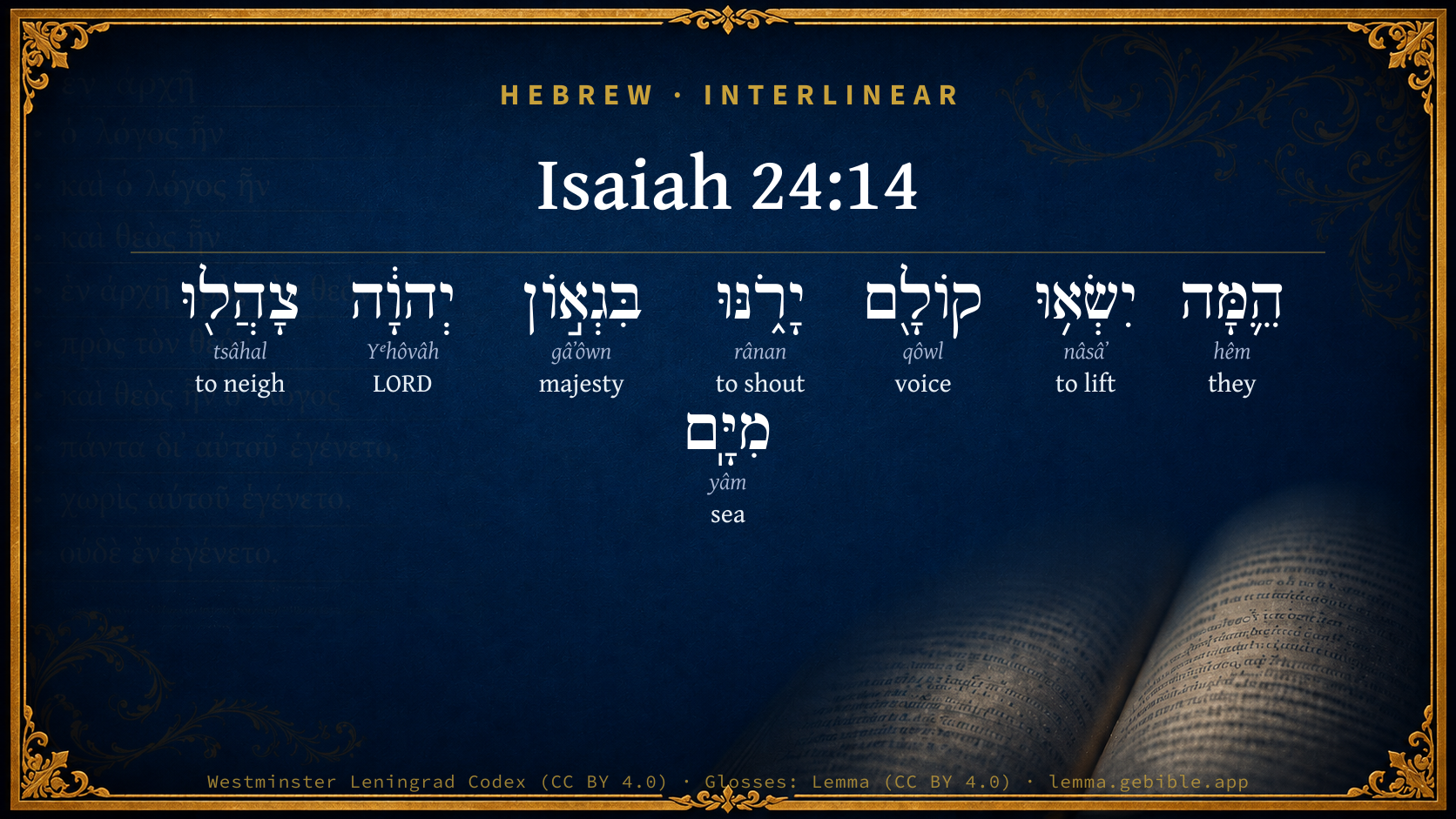
Hebrew (Westminster Leningrad Codex) Isaiah 24:14 appears in the Hebrew Old Testament. The text above is from the Westminster Leningrad Codex. Each word links to its Strong’s number, a concise gloss, and parsing drawn from the Open Scriptures Hebrew Bible morphology. Click any word for its full Brown-Driver-Briggs (BDB) entry.
Download image
Cite this verse

Isaiah 24:14 (World English Bible). Public Domain. Lemma interlinear Bible study tool, https://lemma.gebible.app/v/isaiah/24/14.

Show BibTeX & RIS
BibTeX
RIS
English Translation
These shall lift up their voice, they shall shout; for the majesty of Yahweh they cry aloud from the sea.
World English Bible · Public Domain
Download a study sheet

One document with this verse’s original text, its word-by-word gloss line, the meaning frame, cross-references with their text, attributed commentary, and full source and license credits — printable, and it pastes into notes with its structure intact.

This verse Autodidact and up

Study sheet (.html) Plain text (.txt)

A passage Seminary Student

Up to 50 verses in one chapter. A passage sheet keeps up to 6 commentary sources and 12 cross-references per verse, in the order this page ranks them, and says so on the sheet whenever that leaves anything out. Ask for a single verse and you get the Autodidact verse sheet above.

Everything on this page stays free to read, with no account — the sheet is a download of what is already on screen, not access to it.

Want to remove ads? Support Godless Engineer
Compare translations 3

The same verse in 3 English versions, stacked beneath the original-language interlinear above. Click any original word for its lexicon entry.

Each is an independent rendering of the whole verse — the interlinear is not word-aligned to these translations.

Highlighted words mark where these versions differ — a whole-verse word diff, not a word-by-word alignment.

  • World English Bible Public Domain
    These shall lift up their voice, they shall shout; for the majesty of Yahweh they cry aloud from the sea.
  • King James Version Public Domain
    They shall lift up their voice, they shall sing for the majesty of the LORD, they shall cry aloud from the sea.
  • unfoldingWord Literal Text CC BY-SA 4.0
    They, they will lift up their voice; they will sing joyfully. They will shout from the sea about the majesty of Yahweh.

unfoldingWord Literal Text — © unfoldingWord, licensed CC BY-SA 4.0. Word-aligned USFM3 via Door43 (git.door43.org/unfoldingWord/en_ult).

Versions to compare (up to 4)

3 of 4 selected

Show all 18 translations

Every available English version of this verse, each an independent rendering of the whole verse.

  • World English Bible Public Domain
    These shall lift up their voice, they shall shout; for the majesty of Yahweh they cry aloud from the sea.
  • Berean Standard Bible Public Domain
    They raise their voices, they shout for joy; from the west they proclaim the majesty of the LORD.
  • Majority Standard Bible Public Domain
    They raise their voices, they shout for joy; from the west they proclaim the majesty of the LORD.
  • King James Version Public Domain
    They shall lift up their voice, they shall sing for the majesty of the LORD, they shall cry aloud from the sea.
  • American Standard Version (1901) Public Domain
    These shall lift up their voice, they shall shout; for the majesty of Jehovah they cry aloud from the sea.
  • Revised Version (1885) Public Domain
    These shall lift up their voice, they shall shout; for the majesty of the LORD they cry aloud from the sea.
  • Geneva Bible (1599) Public Domain
    They shall lift vp their voyce: they shall shout for the magnificence of the Lord: they shall reioyce from the sea.
  • Douay-Rheims (1899) Public Domain
    These shall lift up their voice, and shall give praise: when the Lord shall be glorified, they shall make a joyful noise from the sea.
  • Young's Literal Translation Public Domain
    They -- they lift up their voice, They sing of the excellency of Jehovah, They have cried aloud from the sea.
  • Literal Standard Version CC BY-SA 4.0
    They lift up their voice, || They sing of the excellence of YHWH, || They have cried aloud from the sea.
  • Unlocked Literal Bible CC BY-SA 4.0
    They will lift up their voices and shout the majesty of Yahweh, and will joyfully shout from the sea.
  • unfoldingWord Literal Text CC BY-SA 4.0
    They, they will lift up their voice; they will sing joyfully. They will shout from the sea about the majesty of Yahweh.
  • Darby Bible Public Domain
    These shall lift up their voice, they shall shout for the majesty of Jehovah, they shall cry aloud from the sea.
  • World Messianic Bible Public Domain
    These shall lift up their voice. They will shout for the majesty of the LORD. They cry aloud from the sea.
  • Webster's Bible Public Domain
    They shall lift up their voice, they shall sing for the majesty of the LORD, they shall cry aloud from the sea.
  • Free Bible Version CC BY-SA 4.0
    These survivors shout aloud and sing for joy. From the west they praise the Lord's majesty.
  • Bible in Basic English Public Domain
    But those will be making sounds of joy; they will be crying loudly from the sea for the glory of the Lord.
  • JPS Tanakh (1917) Public Domain
    Those yonder lift up their voice, they sing for joy; for the majesty of the LORD they shout from the sea:

Literal Standard Version (2020), Covenant Press — licensed CC BY-SA 4.0. Text via the HelloAO Bible API (eBible.org). Unlocked Literal Bible (unfoldingWord) — licensed CC BY-SA 4.0. Text via the HelloAO Bible API (eBible.org). unfoldingWord Literal Text — © unfoldingWord, licensed CC BY-SA 4.0. Word-aligned USFM3 via Door43 (git.door43.org/unfoldingWord/en_ult). Free Bible Version, Dr. Jonathan Gallagher — licensed CC BY-SA 4.0. Text via the HelloAO Bible API (eBible.org).

Word by word

More ways to search: Search by grammar → Find every occurrence → Compare this word →

Practice this passage: Drill this verse → Learn its vocabulary →

About this verse

These counts appear in no published source. They are computed here, from the morphology-tagged text and Lemma’s own curated glosses. What Lemma adds →

8
words
8
distinct lemmas
Prophets
section

Notable vocabulary

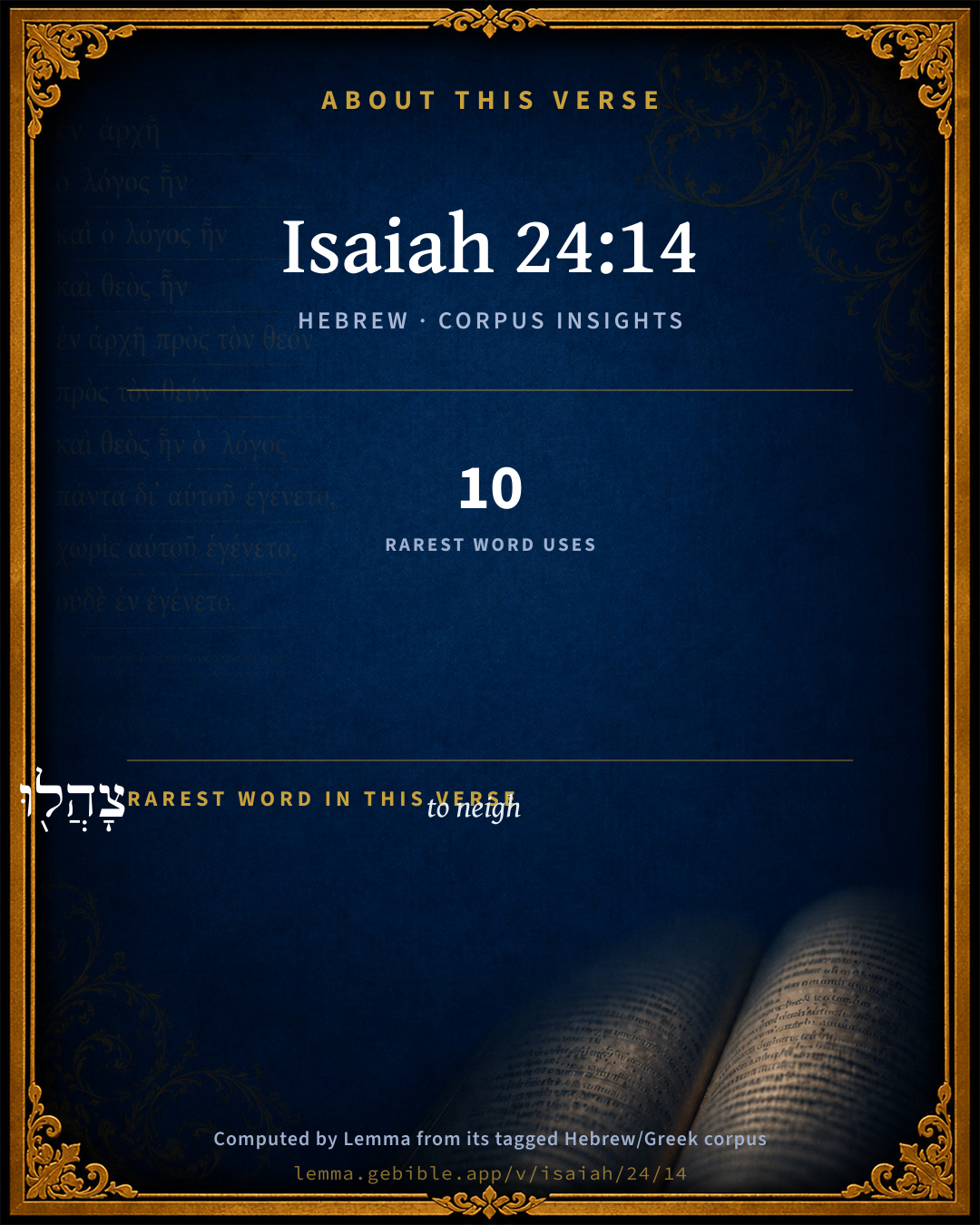
The rarest word here is צָהֲל֖וּ to neigh H6670 — appearing just 10 times in the whole Hebrew Bible.

Shared distinctive vocabulary

צָהֲל֖וּ to neigh H6670 occurs in 9 verses of the Hebrew Bible. Also found in:

Grammatical profile

  • 3 verbs
  • 4 nouns
  • 1 pronoun

Verb forms

  • יִשְׂא֥וּ Qal · Imperfect
  • יָרֹ֑נּוּ Qal · Imperfect
  • צָהֲל֖וּ Qal · Perfect

Hebrew & Septuagint length

In English translation the verse runs 20 words from the Hebrew and 29 from the Septuagint (LXX English) — the Septuagint runs noticeably longer here. See the side-by-side →

A rough comparison of the two English renderings, which tokenize alike — not a word-level alignment.

Word counts can differ between the Hebrew and the Greek without any difference in meaning — e.g. the Hebrew direct-object marker אֵת has no separate Greek word, and Greek often adds the article ὁ.

Cross-references

17

Topical passages linked to Isaiah 24:14 in the Treasury of Scripture Knowledge — connected by theme and wording, ordered by reader-vote popularity; previews shown in the World English Bible.

  • Isaiah 12:1–6 In that day you will say, "I will give thanks to you, Yahweh; for though you were angry with me, your anger has turned away and you comfort me.
  • Isaiah 25:1 Yahweh, you are my God; I will exalt you, I will praise your name; for you have done wonderful things, [even] counsels of old, in faithfulness [and] truth.
  • Isaiah 26:1 In that day shall this song be sung in the land of Judah: we have a strong city; salvation will he appoint for walls and bulwarks.
  • Isaiah 27:2 In that day: A vineyard of wine, sing you to it.
  • Isaiah 35:2 It shall blossom abundantly, and rejoice even with joy and singing; the glory of Lebanon shall be given to it, the excellency of Carmel and Sharon: they shall see the glory of Yahweh, the excellency of our God.
  • Isaiah 35:10 and the ransomed of Yahweh shall return, and come with singing to Zion; and everlasting joy shall be on their heads: they shall obtain gladness and joy, and sorrow and sighing shall flee away.
  • Isaiah 40:9 You who tell good news to Zion, go up on a high mountain; you who tell good news to Jerusalem, lift up your voice with strength; lift it up, don't be afraid; say to the cities of Judah, Behold, your God!
  • Isaiah 44:23 Sing, you heavens, for Yahweh has done it; shout, you lower parts of the earth; break forth into singing, you mountains, O forest, and every tree therein: for Yahweh has redeemed Jacob, and will glorify himself in Israel.
  • Isaiah 51:11 The ransomed of Yahweh shall return, and come with singing to Zion; and everlasting joy shall be on their heads: they shall obtain gladness and joy; [and] sorrow and sighing shall flee away.
  • Isaiah 52:7–9 How beautiful on the mountains are the feet of him who brings good news, who publishes peace, who brings good news of good, who publishes salvation, who says to Zion, Your God reigns!
  • Isaiah 54:1 Sing, barren, you who didn't bear; break forth into singing, and cry aloud, you who did not travail with child: for more are the children of the desolate than the children of the married wife, says Yahweh.
  • Jeremiah 30:19 Out of them shall proceed thanksgiving and the voice of those who make merry: and I will multiply them, and they shall not be few; I will also glorify them, and they shall not be small.
  • Jeremiah 31:12 They shall come and sing in the height of Zion, and shall flow to the goodness of Yahweh, to the grain, and to the new wine, and to the oil, and to the young of the flock and of the herd: and their soul shall be as a watered garden; and they shall not sorrow any more at all.
  • Jeremiah 33:11 the voice of joy and the voice of gladness, the voice of the bridegroom and the voice of the bride, the voice of those who say, Give thanks to Yahweh of Hosts, for Yahweh is good, for his loving kindness endures forever; [and of them] who bring [sacrifices of] thanksgiving into the house of Yahweh. For I will cause the captivity of the land to return as at the first, says Yahweh.
  • Zephaniah 3:14–20 Sing, daughter of Zion! Shout, Israel! Be glad and rejoice with all your heart, daughter of Jerusalem.
  • Zechariah 2:10 Sing and rejoice, daughter of Zion; for, behold, I come, and I will dwell in the midst of you,' says Yahweh.
  • Isaiah 42:10–12 Sing to Yahweh a new song, and his praise from the end of the earth; you who go down to the sea, and all that is therein, the isles, and the inhabitants of it.

Cross-references courtesy of OpenBible.info (CC BY 4.0).

Hebrew and Greek witnesses Masoretic Hebrew ↔ Greek Septuagint

The same verse in the two great witnesses to the Old Testament, shown verse-for-verse.

Here the Septuagint runs noticeably longer than the Hebrew — LXX2012 (modern English Septuagint) 29 words vs World English Bible 20. A rough length comparison of the two English translations, not a word-level alignment — read both below.

These are two independent witnesses, not word-aligned to each other, and the Septuagint is shown in lemma (dictionary) form.

Hebrew Isaiah 24:14 Masoretic · Westminster Leningrad Codex

הֵ֛מָּה יִשְׂא֥וּ קוֹלָ֖ם יָרֹ֑נּוּ בִּגְא֣וֹן יְהוָ֔ה צָהֲל֖וּ מִיָּֽם

These shall lift up their voice, they shall shout; for the majesty of Yahweh they cry aloud from the sea.

World English Bible · Public Domain

Greek LXX Isaiah 24:14 Septuagint · lemma form

οὗτος φωνή βοάω ὁ δέ καταλείπω ἐπί ὁ γῆ εὐφραίνω ἅμα ὁ δόξα κύριος ταράσσω ὁ ὕδωρ ὁ θάλασσα

these shall cry aloud; and they that are left on the land shall rejoice together in the glory of the Lord: the water of the sea shall be troubled.

LXX2012 (modern English Septuagint) · Public Domain

On this verse, John Gill's Exposition discusses the Septuagint’s reading. Read the note in Commentary ↓

Hebrew: Westminster Leningrad Codex (CC BY 4.0). Greek: Septuagint (public domain); English from LXX2012 (modern English Septuagint) (Public Domain). How the Septuagint differs from the Hebrew →

Targum (Aramaic paraphrase)

1

The Targum is the ancient Jewish Aramaic paraphrase of the Hebrew Scriptures — an interpretive translation, not the Hebrew text itself. Onkelos (literal) and Pseudo-Jonathan (expansive) render the Torah, and Jonathan the Prophets. Coverage is partial: where no permissively-licensed English translation exists for a verse, only the Aramaic is shown. This is verse-level text, not a word-by-word alignment to the Hebrew.

  1. Targum Jonathan Prophets (Joshua–Malachi)
    אִנוּן יִרְמוֹן קָלֵיהוֹן יְשַׁבְּחוּן בְּמֵימְרָא דַייָ יִבְעוֹן כְּמָא דִבְעוֹ עַל גְבוּרָן דְאִתְעֲבִידָא לְהוֹן עַל יַמָא:

    They shall lift up their voice, they shall praise on account of the WORD of the Lord: they shall rejoice as they rejoiced on account of the mighty works which were done for them by the sea.

    Targum Jonathan — Aramaic: “Mikraot Gedolot” (public domain). English: “Sefaria Community Translation” (CC0 1.0 (public-domain dedication)); “London "Chaldee Paraphrase," 1871” (public domain). Text via Sefaria.

Commentary

Notes on Isaiah 24:14 from classic Christian and Jewish commentators (each source and its license shown beneath its notes). The classic Christian expositions comment on the surrounding passage and are grouped to its opening verse, so a note may address several verses; the Jewish commentaries on the Tanakh (Rashi and others) are per-verse, so they appear only where the commentator wrote on this verse.

Lemma curates 59 commentaries, every one of them public domain or Creative Commons licensed, each selected and text-cleaned for this edition rather than reprinted as found. About our sources →

Trapp's Complete Commentary

John Trapp

Isa 24:14 They shall lift up their voice, they shall sing for the majesty of the LORD, they shall cry aloud from the sea.

Ver. 14. They shall lift up their voice, &c.] Laudabunt Deum et laetabuntur: this elect remnant in all countries shall be filled with spiritual joy and peace through the belief of the truth, which shall vent itself by singing praises to God. And here we have the very mark of the true Church, which is to celebrate and profess the great and glorious name of the God and Father of our Lord Jesus Christ.

For the majesty of the Lord.] Or, For the magnificence; that great work of his especially of divulging his gospel all the world over, and thereby gathering his Church out of all nations.

They shall cry aloud from the sea,] i.e., From the islands and transmarine parts, as we do now from Great Britain - "thanks be unto God for his unspeakable gift" - calling to our neighbour nations, and saying,

John Trapp, A Commentary or Exposition upon All the Books of the Old and New Testament (1647–1656) — public domain. Text from a community e-Sword module.

Tyndale Open Study Notes

Tyndale Open Resources

24:14-16 In spite of wailing and ruin, the sound of praise is heard from all directions. Even while still experiencing the pain of the devastation of the old world, the godly will respond with joyous expectation for the new world.

Tyndale Open Study Notes — © Tyndale Open Resources, licensed CC BY-SA 4.0. Text via the HelloAO Bible API.

Geneva Bible (1599)

Geneva Bible translators

From the utmost coasts of the world, where the Gospel shall be preached, as verse 16.

Geneva Bible (1599) marginal notes — public domain. Text via Bolls.life.

Jamieson, Fausset & Brown

Robert Jamieson, A. R. Fausset & David Brown

They--those who are left: the remnant.

sing for the majesty of the Lord--sing a thanksgiving for the goodness of the Lord, who has so mercifully preserved them.

from the sea--from the distant lands beyond the sea, whither they have escaped.

Jamieson, Fausset & Brown — Commentary Critical and Explanatory on the Whole Bible (1871) — public domain (CC PDM 1.0). Text via the HelloAO Bible API.

Adam Clarke's Commentary

Verse 14. They shall lift up their voice - "But these shall lift up their voice"] That is, they that escaped out of these calamities. The great distresses brought upon Israel and Judah drove the people away, and dispersed them all over the neighbouring countries: they fled to Egypt, to Asia Minor, to the islands and the coasts of Greece. They were to be found in great numbers in most of the principal cities of these countries. Alexandria was in a great measure peopled by them. They had synagogues for their worship in many places, and were greatly instrumental in propagating the knowledge of the true God among these heathen nations, and preparing them for the reception of Christianity. This is what the prophet seems to mean by the celebration of the name of JEHOVAH in the waters, in the distant coasts, and in the uttermost parts of the land. מים mayim, the waters; υδωρ, Sept.; υδατα, Theod.; not מים miyam from the sea.

Adam Clarke's Commentary on the Bible (1810–1826) — public domain. Text from a community e-Sword/MySword module.

Ellicott's Commentary for English Readers

(14) They shall cry aloud from the sea . . .—The utterers of the praise are obviously the remnant of the saved, whether of the “Jews of the dispersion,” or of the Gentiles. To them there appears in the midst of the desolation, the vision of the glory of the Lord, and far off, from the sea (the Mediterranean, as the great sea of the ancient world) they raise their song of praise.

A Bible Commentary for English Readers, edited by Charles John Ellicott (1878–1897) — public domain. Text from a community e-Sword module.

The Cambridge Bible for Schools and Colleges

gen. ed. J. J. S. Perowne

14. They shall lift up their voice] Rather: These lift up their voice. The pronoun at the beginning is emphatic and stands in contrast to the “I” of Isa_24:16.

they shall sing, for the majesty …] Better (following the accents) they shout: for the majesty of Jehovah they cry aloud, &c. The last words from the sea (i.e. the Mediterranean) point to the West as the quarter whence the songs of triumph proceed. Cf. “in the coasts,” Isa_24:15.

14–16. Already, indeed, the prophet can hear songs of praise ascending from distant parts of the earth, hailing the dawn of a better day; but he himself cannot share these enthusiastic hopes. It is not likely that this representation is purely ideal. Events must have occurred which excited the premature expectation of an immediate deliverance. It is difficult to conceive the historical situation which is presupposed. The most natural supposition will be that the singers referred to are Israelites of the Dispersion, who follow with sympathetic interest the development of some great crisis in the fortunes of the people of God, but whose vision is unable to perceive the darker signs of the times which are manifest to the prophet. A more exact determination of the circumstances must depend on the date which is found best to harmonise all the indications of the prophecy.

The Cambridge Bible for Schools and Colleges (gen. ed. J. J. S. Perowne; Cambridge University Press, 1878–1918) — public domain. Text from a community e-Sword module.

John Gill's Exposition

They shall lift up their voice, they shall sing,.... That is, as the Septuagint version adds,

"they that are left upon the earth;''

these shall lift up their voice, in singing the praises of God, for his judgments on Babylon, and avenging the blood of his saints; and for their deliverance and salvation, and the inestimable blessings they are now put into the possession of; these are they, who, having gotten the victory over the beast and his image, sing the song of Moses and the Lamb, Rev 15:2,

for the majesty of the Lord, they shall cry aloud from the sea: so the Hebrew accents distinguish these clauses; and the sense is, that from the west, as Kimchi and Ben Melech interpret it, from the western nations, where Protestantism chiefly prevails; or from the Mediterranean Sea, which lay west of Judea; from the maritime countries, the countries bordering upon it, where at this time will appear many that will embrace the Gospel of Christ; or from the isles of the sea, as the phrase is explained in the next verse Isa 24:15, such as our isles of Great Britain and Ireland; great acclamations will be made unto the Lord, on account of his glorious majesty, seen in the destruction of antichrist, and in setting up his own kingdom and glory: these are the four and twenty elders, who will fall down, and give thanks to Christ, for taking to himself his great power, and reigning; and these triumphant and victorious persons are represented as standing on a sea, while they make their shouts and hallelujahs; see Rev 11:16 this, with what follows in the two next verses Isa 24:15, belong to the Philadelphian church state, or spiritual reign of Christ, and express the light and joy that will attend that.

John Gill's Exposition of the Whole Bible (1746–1763) — public domain (CC PDM 1.0). Text via the HelloAO Bible API.

Albert Barnes' Notes on the Bible

They shall lift up their voice - They who are left in the land; or who are not carried away to Babylon. ‘To lift up the voice’ in the Scriptures may denote either grief or joy; compare Gen 21:6; 1Sa 24:16; Jdg 2:4; Rth 1:9, ..., where to lift up the voice is conected with weeping; and Eze 21:22; Psa 93:3; Isa 40:29; Isa 42:11, etc., where it is connected with exultation and joy. The latter is evidently the idea here, that the few who would escape from captivity by fleeing to neighboring countries, would lift up their voice with exultation that they had escaped.

They shall sing for the majesty of the Lord - They shall sing on account of the glory, or goodness of Yahweh, wire had so mercifully kept and preserved them.

They shall cry aloud from the sea - From the isles and coasts of the Mediterranean where they would have escaped, and where they would find a refuge. No doubt many of the inhabitants adjacent to the sea, when they found the land invaded, would betake themselves to the neighboring islands, and find safety there until the danger should be overpast. Lowth renders this,

‘The waters shall resound with the exaltation of Jehovah,’

Where he supposes מים should be rendered as if pointed מים mayâm ‘waters,’ not as it is in the present Hebrew text, מים miyâm ‘from the sea.’ The sense is not materially different; but there seems to be no good reason for departing from the usual interpretation.

Albert Barnes' Notes on the Bible (1834–1885) — public domain. Text from a community e-Sword/MySword module.

Haydock's Catholic Bible Commentary

Sea. The few elect (ver. 13.) being rescued from the misery of the world, shall praise God. (Haydock) --- They are exhorted to lift up their heads, Luke xxi. 28. (Menochius)

George Leo Haydock (1774–1849), Haydock's Catholic Family Bible and Commentary, 1859 edition — public domain. Excludes Psalms (Douay-Rheims chapter numbering differs from Protestant) and Deuterocanonical books (Catholic canon only).

Matthew Poole's English Annotations

They; the remnant preserved.

For the majesty of the Lord; for his glorious power and goodness manifested in their deliverance.

They shall cry aloud, in way of exultation and thanksgiving to God.

From the sea; from the isles of the sea, as this is explained in the next verse; from those parts beyond the sea, into which they were carried captive, and in which they were miraculously preserved.

Matthew Poole's English Annotations on the Holy Bible (1683–1685) — public domain. Text from a community e-Sword/MySword module.

Whedon's Commentary on the Bible

Daniel D. Whedon

14. They shall lift up their voice — Here is another of Isaiah’s lightning-like transitions. The humble gleaned ones — the remnant — the returned escaped ones, of Isa_24:13 — the representatives of all the delivered faithful ones of Israel — the sifted and purified Church of Jehovah.

They — In the original the pronoun is locatively emphatic, designating the righteous few as a special class.

They shall sing — Shall celebrate by loud acclamation.

The majesty of the Lord — In overpowering oppressors, and in bringing deliverance to the meek and true children of God — “the remnant.”

They shall cry aloud — This verb is what in Hebrew is called the preterite present. The people have shouted aloud, and do still, as a habit. The verbs preceding this are in the future present: They, from this time on, shall cry, as a habit also.

Cry aloud from the sea — Which may mean for deliverances from the sea, or, more than the sea; that is, than at the sea, namely, the Red Sea, under Miriam:

see Exodus chap. 15; or, from the direction of the sea, that is, from the west. This last is to be preferred, as will be seen from the next verse.

Daniel D. Whedon (gen. ed.), Commentary on the Old and New Testaments (1874–1909) — public domain. Text from a community e-Sword module.

The Pulpit Commentary

They shall lift up their voice. Even in this time of depression and ruin there shall he a "remnant," which will be faithful to God, and which, from the midst of the sufferings and calamities of the period, will "lift up its voice," in songs of adoration and praise, to Jehovah, and sing, or "send forth a cry." This chorus of praise will go forth to a large extentfrom the sea; i.e. from the Mediterranean.

The Pulpit Commentary (1880–1919), ed. H.D.M. Spence-Jones & Joseph S. Exell — public domain. Text from a community e-Sword module.

Keil & Delitzsch

C. F. Keil & F. Delitzsch

There is now a church there refined by the judgment, and rejoicing in its apostolic calling to the whole world. "They will lift up their voice, and exult; for the majesty of Jehovah they shout from the sea: therefore praise ye Jehovah in the lands of the sun, in the islands of the sea the name of Jehovah the God of Israel." The ground and subject of the rejoicing is "the majesty of Jehovah," i.e., the fact that Jehovah had shown Himself so majestic in judgment and mercy (Isa 12:5-6), and was now so manifest in His glory (Isa 2:11, Isa 2:17). Therefore rejoicing was heard "from the sea" (the Mediterranean), by which the abode of the congregation of Jehovah was washed. Turning in that direction, it had the islands and coast lands of the European West in front (iyyi hayyâm; the only other passage in which this occurs is Isa 11:11, cf., Eze 26:18), and at its back the lands of the Asiatic East, which are called 'urim, the lands of light, i.e., of the sun-rising. This is the true meaning of 'urim, as J. Schelling and Drechsler agree; for Dderlein's comparison of the rare Arabic word awr, septentrio is as far removed from the Hebrew usage as that of the Talmud אור אורתּא, vespera. Hitzig's proposed reading באיים (according to the lxx) diminishes the substance and destroys the beauty of the appeal, which goes forth both to the east and west, and summons to the praise of the name of Jehovah the God of Israel, על־כּן, i.e., because of His manifested glory. His "name" (cf., Isa 30:27) is His nature as revealed and made "nameable" in judgment and mercy.

Keil & Delitzsch — Biblical Commentary on the Old Testament (1861–1891) — public domain (CC PDM 1.0). Text via the HelloAO Bible API. (Old Testament only.)

J. A. Alexander on Isaiah

Joseph Addison Alexander

“They shall raise their voice, they shall sing (or shout), for the majesty of Jehovah they cry aloud from the sea.” The pronoun at the beginning is emphatic. ‘They’, the few dispersed survivors of these judgments.

Joseph Addison Alexander, The Prophecies of Isaiah (1846–1847; New York: Scribner, 1870–1878) — public domain. Text from a community e-Sword module.

unfoldingWord translationNotes

Door43 World Missions Community

They will lift up their voices and shout the majesty of Yahweh

The phrase "lift up their voices" is an idiom that means to speak loudly. AT: "They will sing and shout about the majesty of Yahweh" (See: Idiom)

They will

Here "They" refers to those who are still alive after Yahweh devastates the earth.

and will joyfully shout from the sea

Here "the sea" refers to the Mediterranean Sea which is west of Israel. AT: "and those in the west towards the sea will shout with joy" (See: Assumed Knowledge and Implicit Information)

Therefore in the east glorify Yahweh

The phrase "in the east" represents the people living east of Israel. Isaiah is commanding these people as if they were there with him. But, he is talking to the people in the future after God devastates the earth. AT: "Therefore everyone from distant lands in the east will glorify Yahweh" (See: Metonymy and Apostrophe and Predictive Past)

in the isles of the sea give glory

Isaiah is commanding the people who live on the islands in the Mediterranean sea as if they were there with him. But, he is talking to the people in the future after God devastates the earth. AT: "everyone in the islands will give glory" (See: Metonymy and Apostrophe and Predictive Past)

to the name of Yahweh

Here "name" represents Yahweh. AT: "to Yahweh" (See: Metonymy)

translationWords

voice

majesty

Yahweh

glory

glory

name

God

Israel

unfoldingWord translationNotes — © Distant Shores Media and the Door43 World Missions Community, licensed CC BY-SA 4.0. Source: git.door43.org/Door43/en_tn.

Rashi

Rabbi Shlomo Yitzchaki (Rashi)

They shall raise their voice For those few survivors shall come the good that I prophesied above.

they shall shout for joy more than [by the] sea (Lit., they shall shout for joy from the sea.) More than they shouted for joy by the sea during the redemption from Egypt.

Rashi on the Tanakh — English translations: “The Judaica Press complete Tanach with Rashi, translated by A. J. Rosenberg” (CC BY 4.0); “Pentateuch with Rashi's commentary by M. Rosenbaum and A.M. Silbermann, 1929-1934” (public domain); “The Metsudah Tanach series, Lakewood, N.J” (CC BY 4.0); and “The Book of Joshua, Metsudah Publications, 1997” (CC BY 4.0). Text via Sefaria.

Ibn Ezra

Rabbi Abraham ibn Ezra

They shall lift up, etc. All commentators agree that from the words, Behold, the Lord maketh, etc. (ver. 1), the prophet refers to the remote future, to the war of Gog and Magog; only R. Moses Hakkohen refers this prophecy to the king of Assyria, and finds in a feast of fat things (25:6) the indication of the destruction of the hosts of Sennacherib, which remains the subject of the prophecy until the words, Woe to the crown of pride, etc. (28:1). —

They shall lift up, etc., they that escaped, etc.

ירנו They shall shout. Comp. הרנה the proclamation (1 Kgs. 22:36). They shall cry aloud from the sea. They that go on the sea, shall cry, etc. צהלו They shall cry aloud. Comp. צהלת הסום the neighing of the horse.

Ibn Ezra on the Tanakh — English translations: “Sefaria Community Translation” (CC0 1.0 (public-domain dedication)); “Yalkut, Sifsei Chachomim Chumash, Metsudah Publications, 2009” (CC BY 4.0); and “Commentary of Ibn Ezra on Isaiah - trans. by M. Friedlander, 1873” (public domain). Text via Sefaria.

Lesson kit

Teaching starters — assembled from the data on this page, not authored interpretation. Every prompt links to the verse data it draws on. Edit before teaching.

Isaiah, in the Prophets, opens this verse with 8 words (8 distinct Hebrew lemmas). Its most distinctive word is tsâhal (“to neigh”). The Greek Septuagint runs longer here. A historical commentator’s framing appears above. Read the whole chapter for the surrounding context.

Discussion questions

  1. What does “to neigh” (tsâhal) contribute to the verse as a whole?
  2. Esther 8:15 shares the word «to neigh» with this verse. How do the two illuminate each other?
  3. Compared with the Hebrew, the Septuagint runs longer here. What questions does that raise?
  4. These translations render this verse differently. What is at stake in choosing one wording over another?
  5. The verb «יִשְׂא֥וּ» is Qal Imperfect. How does its form color the action?
  6. Reading how Trapp's Complete Commentary and Tyndale Open Study Notes read this verse, where do the two commentators agree and where do they part?

Things to notice

Reading settings

Reading text

Shown beneath each verse's original-language words.

Old Testament
Old Testament edition

Read the OT as the Masoretic Hebrew (MT) or the Greek Septuagint (LXX).

English shown for the Greek Septuagint (in the Hebrew ↔ Greek comparison).

Comparing translations? Open the Compare panel on any verse page to stack up to four side by side.