Ezekiel 3:17

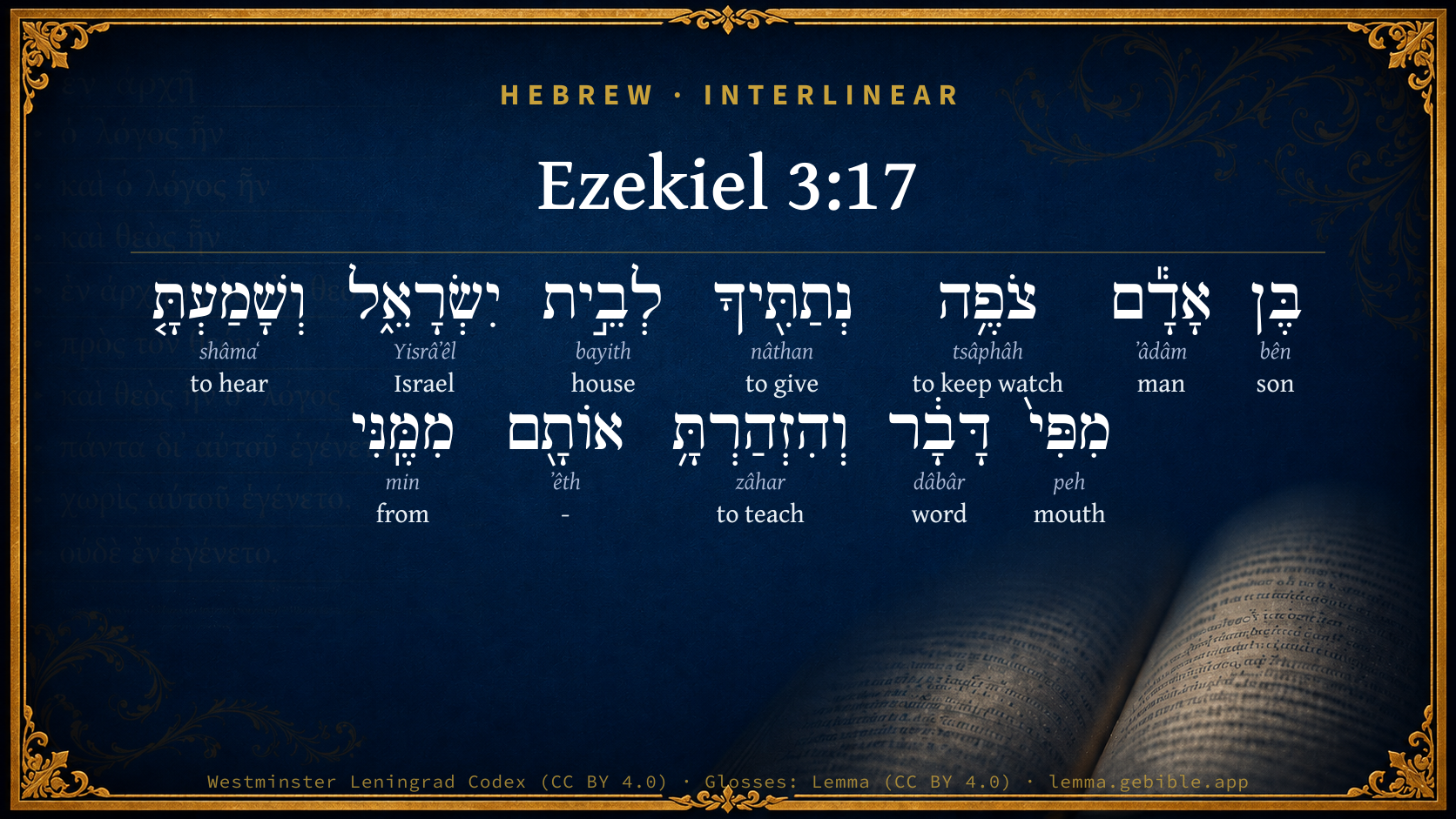
Hebrew (Westminster Leningrad Codex) Ezekiel 3:17 appears in the Hebrew Old Testament. The text above is from the Westminster Leningrad Codex. Each word links to its Strong’s number, a concise gloss, and parsing drawn from the Open Scriptures Hebrew Bible morphology. Click any word for its full Brown-Driver-Briggs (BDB) entry.
Download image
Cite this verse

Ezekiel 3:17 (World English Bible). Public Domain. Lemma interlinear Bible study tool, https://lemma.gebible.app/v/ezekiel/3/17.

Show BibTeX & RIS
BibTeX
RIS
English Translation
Son of man, I have made you a watchman to the house of Israel: therefore hear the word at my mouth, and give them warning from me.
World English Bible · Public Domain
Download a study sheet

One document with this verse’s original text, its word-by-word gloss line, the meaning frame, cross-references with their text, attributed commentary, and full source and license credits — printable, and it pastes into notes with its structure intact.

This verse Autodidact and up

Study sheet (.html) Plain text (.txt)

A passage Seminary Student

Up to 50 verses in one chapter. A passage sheet keeps up to 6 commentary sources and 12 cross-references per verse, in the order this page ranks them, and says so on the sheet whenever that leaves anything out. Ask for a single verse and you get the Autodidact verse sheet above.

Everything on this page stays free to read, with no account — the sheet is a download of what is already on screen, not access to it.

Want to remove ads? Support Godless Engineer
Compare translations 3

The same verse in 3 English versions, stacked beneath the original-language interlinear above. Click any original word for its lexicon entry.

Each is an independent rendering of the whole verse — the interlinear is not word-aligned to these translations.

Highlighted words mark where these versions differ — a whole-verse word diff, not a word-by-word alignment.

  • World English Bible Public Domain
    Son of man, I have made you a watchman to the house of Israel: therefore hear the word at my mouth, and give them warning from me.
  • King James Version Public Domain
    Son of man, I have made thee a watchman unto the house of Israel: therefore hear the word at my mouth, and give them warning from me.
  • unfoldingWord Literal Text CC BY-SA 4.0
    “Son of man, I have made you a watchman for the house of Israel, so listen to the word from my mouth, and give them my warning.

unfoldingWord Literal Text — © unfoldingWord, licensed CC BY-SA 4.0. Word-aligned USFM3 via Door43 (git.door43.org/unfoldingWord/en_ult).

Versions to compare (up to 4)

3 of 4 selected

Show all 18 translations

Every available English version of this verse, each an independent rendering of the whole verse.

  • World English Bible Public Domain
    Son of man, I have made you a watchman to the house of Israel: therefore hear the word at my mouth, and give them warning from me.
  • Berean Standard Bible Public Domain
    “Son of man, I have made you a watchman for the house of Israel. Whenever you hear a word from My mouth, give them a warning from Me.
  • Majority Standard Bible Public Domain
    “Son of man, I have made you a watchman for the house of Israel. Whenever you hear a word from My mouth, give them a warning from Me.
  • King James Version Public Domain
    Son of man, I have made thee a watchman unto the house of Israel: therefore hear the word at my mouth, and give them warning from me.
  • American Standard Version (1901) Public Domain
    Son of man, I have made thee a watchman unto the house of Israel: therefore hear the word at my mouth, and give them warning from me.
  • Revised Version (1885) Public Domain
    Son of man, I have made thee a watchman unto the house of Israel: therefore hear the word at my mouth, and give them warning from me.
  • Geneva Bible (1599) Public Domain
    Sonne of man, I haue made thee a watchman vnto the house of Israel: therefore heare the worde at my mouth, and giue them warning from me.
  • Douay-Rheims (1899) Public Domain
    Son of man, I have made thee a watchman to the house of Israel: and thou shalt hear the word out of my mouth, and shalt tell it them from me.
  • Young's Literal Translation Public Domain
    that there is a word of Jehovah unto me, saying, `Son of man, a watchman I have given thee to the house of Israel, and thou hast heard from My mouth a word, and hast warned them from Me.
  • Literal Standard Version CC BY-SA 4.0
    that there is a word of YHWH to me, saying, “Son of man, I have given you [as] a watchman to the house of Israel, and you have heard a word from My mouth, and have warned them from Me.
  • Unlocked Literal Bible CC BY-SA 4.0
    “Son of man, I have made you a watchman for the house of Israel, so listen to the word from my mouth, and give them my warning.
  • unfoldingWord Literal Text CC BY-SA 4.0
    “Son of man, I have made you a watchman for the house of Israel, so listen to the word from my mouth, and give them my warning.
  • Darby Bible Public Domain
    Son of man, I have appointed thee a watchman unto the house of Israel, and thou shalt hear the word from my mouth, and give them warning from me.
  • World Messianic Bible Public Domain
    “Son of man, I have made you a watchman to the house of Israel. Therefore hear the word from my mouth, and warn them from me.
  • Webster's Bible Public Domain
    Son of man, I have made thee a watchman to the house of Israel: therefore hear the word at my mouth, and give them warning from me.
  • Free Bible Version CC BY-SA 4.0
    “Son of man, I have chosen you as a watchman for the people of Israel. Whenever I give you a message, then you must warn them for me.
  • Bible in Basic English Public Domain
    Son of man, I have made you a watchman for the children of Israel: so give ear to the word of my mouth, and give them word from me of their danger.
  • JPS Tanakh (1917) Public Domain
    'Son of man, I have appointed thee a watchman unto the house of Israel; and when thou shalt hear a word at My mouth, thou shalt give them warning from Me.

Literal Standard Version (2020), Covenant Press — licensed CC BY-SA 4.0. Text via the HelloAO Bible API (eBible.org). Unlocked Literal Bible (unfoldingWord) — licensed CC BY-SA 4.0. Text via the HelloAO Bible API (eBible.org). unfoldingWord Literal Text — © unfoldingWord, licensed CC BY-SA 4.0. Word-aligned USFM3 via Door43 (git.door43.org/unfoldingWord/en_ult). Free Bible Version, Dr. Jonathan Gallagher — licensed CC BY-SA 4.0. Text via the HelloAO Bible API (eBible.org).

Word by word

More ways to search: Search by grammar → Find every occurrence → Compare this word →

Practice this passage: Drill this verse → Learn its vocabulary →

וְהִזְהַרְתָּ֥
zâhar
H2094
“and · to teach”
Conjunction + Verb, Hiphil, Sequential Perfect, 2nd Person, Masculine, Singular
Part of Speech
Conjunction + Verb
Stem
Hiphil
Form
Sequential Perfect
Person
2nd Person
Gender
Masculine
Number
Singular
Full BDB Definition

Origin: a primitive root

TWOT: 531 , 532

to admonish, warn, teach, shine, send out light, be light, be shining - (Niphal) to be taught, be admonished - (Hiphil) - to teach, warn - to shine, send out light (figuratively)
  1. בֶּן bên H1121 “son of” Noun, Common, Masculine, Singular, Construct
  2. אָדָ֕ם ʼâdâm H120 “man” Noun, Common, Masculine, Singular, Absolute
  3. צֹפֶ֥ה tsâphâh H6822 “keeping watch” Verb, Qal, Participle Active, Masculine, Singular, Absolute
  4. נְתַתִּ֖יךָ nâthan H5414 “to give · you” Verb, Qal, Perfect, 1st Person, Common, Singular + Suffix, Personal, 2nd Person, Masculine, Singular
  5. לְבֵ֣ית bayith H1004 “to/for · house of” Preposition + Noun, Common, Masculine, Singular, Construct
  6. יִשְׂרָאֵ֑ל Yisrâʼêl H3478 “Israel” Noun, Proper
  7. וְשָׁמַעְתָּ֤ shâmaʻ H8085 “and · to hear” Conjunction + Verb, Qal, Sequential Perfect, 2nd Person, Masculine, Singular
  8. מִפִּי֙ peh H6310 “from · mouth · my” Preposition + Noun, Common, Masculine, Singular, Construct + Suffix, Personal, 1st Person, Common, Singular
  9. דָּבָ֔ר dâbâr H1697 “word” Noun, Common, Masculine, Singular, Absolute
  10. אוֹתָ֖ם ʼêth H853 “- · them” Particle, Direct Object + Suffix, Personal, 3rd Person, Masculine, Plural
  11. מִמֶּֽנִּי min H4480 “from · me” Preposition + Suffix, Personal, 1st Person, Common, Singular

About this verse

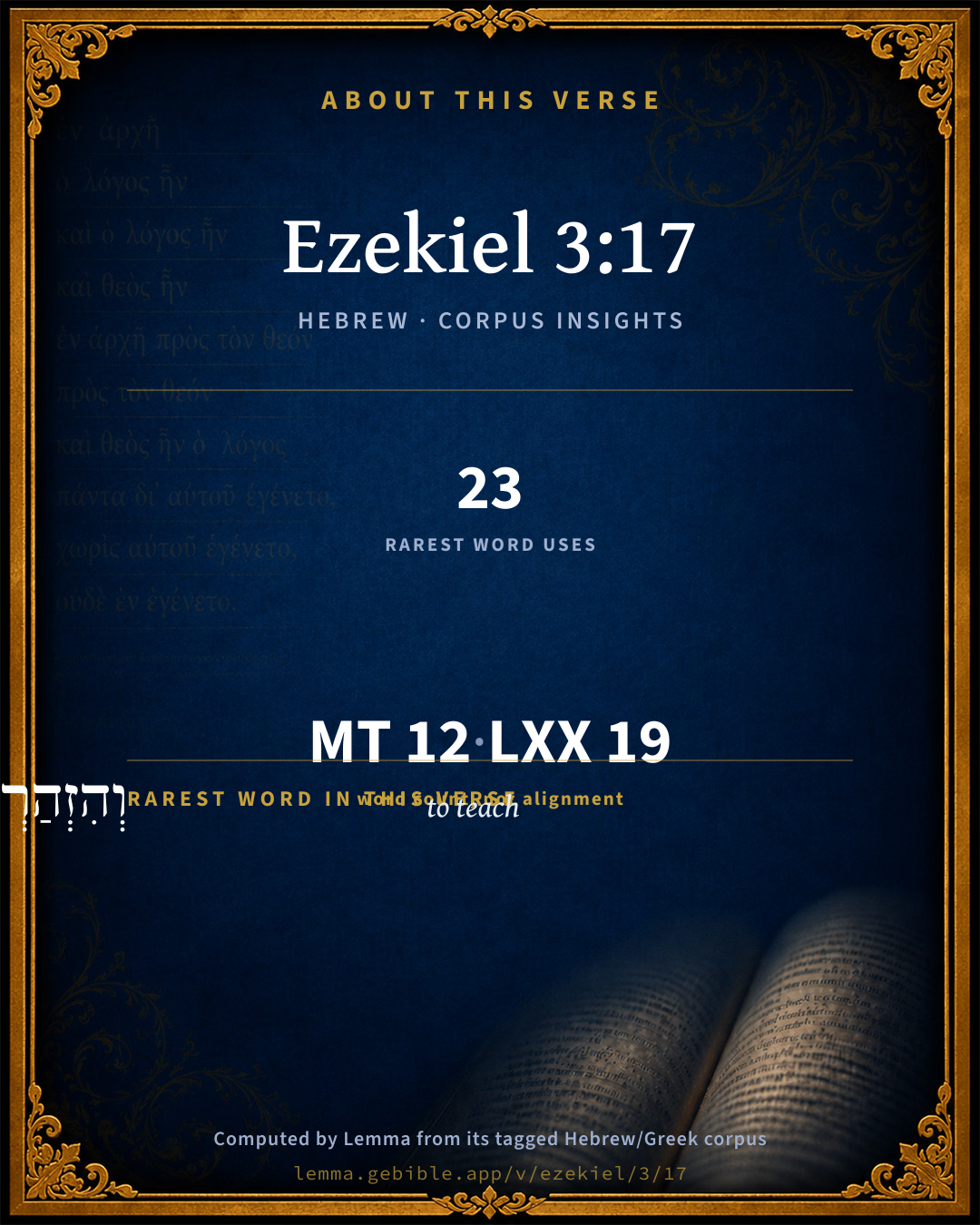
These counts appear in no published source. They are computed here, from the morphology-tagged text and Lemma’s own curated glosses. What Lemma adds →

12
words
12
distinct lemmas
Prophets
section

Notable vocabulary

The rarest word here is וְהִזְהַרְתָּ֥ to teach H2094 — appearing just 23 times in the whole Hebrew Bible.

Shared distinctive vocabulary

וְהִזְהַרְתָּ֥ to teach H2094 occurs in 19 verses of the Hebrew Bible. Also found in:

Grammatical profile

  • 4 verbs
  • 6 nouns
  • 1 preposition
  • 1 particle

Verb forms

  • צֹפֶ֥ה Qal · Participle Active
  • נְתַתִּ֖יךָ Qal · Perfect
  • וְשָׁמַעְתָּ֤ Qal · Sequential Perfect
  • וְהִזְהַרְתָּ֥ Hiphil · Sequential Perfect

Hebrew & Septuagint length

In English translation the verse runs 27 words from the Hebrew and 26 from the Septuagint (LXX English) — closely comparable.

A rough comparison of the two English renderings, which tokenize alike — not a word-level alignment.

Word counts can differ between the Hebrew and the Greek without any difference in meaning — e.g. the Hebrew direct-object marker אֵת has no separate Greek word, and Greek often adds the article ὁ.

In the original languages it is 12 Hebrew tokens and 19 Greek tokens — but the two are counted differently (Hebrew bundles its prefixes and suffixes into one token; the Greek is in lemma form), so that isn’t a like-for-like length.

Cross-references

24

Topical passages linked to Ezekiel 3:17 in the Treasury of Scripture Knowledge — connected by theme and wording, ordered by reader-vote popularity; previews shown in the World English Bible.

  • 2 Chronicles 19:10 Whenever any controversy shall come to you from your brothers who dwell in their cities, between blood and blood, between law and commandment, statutes and ordinances, you shall warn them, that they not be guilty towards Yahweh, and so wrath come on you and on your brothers: this do, and you shall not be guilty.
  • Isaiah 52:8 The voice of your watchmen! they lift up the voice, together do they sing; for they shall see eye to eye, when Yahweh returns to Zion.
  • Hebrews 13:17 Obey your leaders and submit to them, for they watch on behalf of your souls, as those who will give account, that they may do this with joy, and not with groaning, for that would be unprofitable for you.
  • Isaiah 62:6 I have set watchmen on your walls, Jerusalem; they shall never hold their peace day nor night: you who call on Yahweh, take no rest,
  • Jeremiah 6:17 I set watchmen over you, [saying], Listen to the sound of the trumpet; but they said, We will not listen.
  • Colossians 1:28 whom we proclaim, admonishing every man and teaching every man in all wisdom, that we may present every man perfect in Christ Jesus;
  • Isaiah 21:11–12 The burden of Dumah. One calls to me out of Seir, Watchman, what of the night? Watchman, what of the night?
  • Isaiah 56:10 His watchmen are blind, they are all without knowledge; they are all mute dogs, they can't bark; dreaming, lying down, loving to slumber.
  • Isaiah 58:1 Cry aloud, don't spare, lift up your voice like a trumpet, and declare to my people their disobedience, and to the house of Jacob their sins.
  • Ezekiel 33:2–9 Son of man, speak to the children of your people, and tell them, When I bring the sword on a land, and the people of the land take a man from among them, and set him for their watchman;
  • Habakkuk 2:1 I will stand at my watch, and set myself on the ramparts, and will look out to see what he will say to me, and what I will answer concerning my complaint.
  • 1 Corinthians 4:14 I don't write these things to shame you, but to admonish you as my beloved children.
  • 2 Corinthians 5:11 Knowing therefore the fear of the Lord, we persuade men, but we are revealed to God; and I hope that we are revealed also in your consciences.
  • 2 Corinthians 5:20 We are therefore ambassadors on behalf of Christ, as though God were entreating by us. We beg you on behalf of Christ, be reconciled to God.
  • 1 Thessalonians 5:14 We exhort you, brothers, admonish the disorderly, encourage the fainthearted, support the weak, be patient toward all.
  • Song of Solomon 3:3 The watchmen who go about the city found me; "Have you seen him whom my soul loves?"
  • Isaiah 21:6 For thus has the Lord said to me, Go, set a watchman: let him declare what he sees:
  • Jeremiah 6:10 To whom shall I speak and testify, that they may hear? behold, their ear is uncircumcised, and they can't listen: behold, the word of Yahweh is become to them a reproach; they have no delight in it.
  • Acts 20:28–31 Take heed, therefore, to yourselves, and to all the flock, in which the Holy Spirit has made you overseers, to shepherd the assembly of the Lord and God which he purchased with his own blood.
  • 1 Corinthians 12:28 God has set some in the assembly: first apostles, second prophets, third teachers, then miracle workers, then gifts of healings, helps, governments, and various kinds of languages.
  • Song of Solomon 5:7 The watchmen who go about the city found me. They beat me. They bruised me. The keepers of the walls took my cloak away from me.
  • Isaiah 21:8 He cried as a lion: Lord, I stand continually on the watch-tower in the day-time, and am set in my ward whole nights;
  • Jeremiah 31:6 For there shall be a day, that the watchmen on the hills of Ephraim shall cry, Arise you, and let us go up to Zion to Yahweh our God.
  • Matthew 3:7 But when he saw many of the Pharisees and Sadducees coming for his baptism, he said to them, "You offspring of vipers, who warned you to flee from the wrath to come?

Cross-references courtesy of OpenBible.info (CC BY 4.0).

Hebrew and Greek witnesses Masoretic Hebrew ↔ Greek Septuagint

The same verse in the two great witnesses to the Old Testament, shown verse-for-verse.

These are two independent witnesses, not word-aligned to each other, and the Septuagint is shown in lemma (dictionary) form.

Hebrew Ezekiel 3:17 Masoretic · Westminster Leningrad Codex

בֶּן אָדָ֕ם צֹפֶ֥ה נְתַתִּ֖יךָ לְבֵ֣ית יִשְׂרָאֵ֑ל וְשָׁמַעְתָּ֤ מִפִּי֙ דָּבָ֔ר וְהִזְהַרְתָּ֥ אוֹתָ֖ם מִמֶּֽנִּי

Son of man, I have made you a watchman to the house of Israel: therefore hear the word at my mouth, and give them warning from me.

World English Bible · Public Domain

Greek LXX Ezekiel 3:17 Septuagint · lemma form

υἱός ἄνθρωπος σκοπός δίδωμι σύ ὁ οἶκος ἰσραήλ καί ἀκούω ἐκ στόμα ἐγώ λόγος καί διαπειλέω αὐτός παρά ἐγώ

I have made you a watchman to the house of Israel; and you shall hear a word of my mouth, and shall threaten them from me.

LXX2012 (modern English Septuagint) · Public Domain

Hebrew: Westminster Leningrad Codex (CC BY 4.0). Greek: Septuagint (public domain); English from LXX2012 (modern English Septuagint) (Public Domain). How the Septuagint differs from the Hebrew →

Targum (Aramaic paraphrase)

1

The Targum is the ancient Jewish Aramaic paraphrase of the Hebrew Scriptures — an interpretive translation, not the Hebrew text itself. Onkelos (literal) and Pseudo-Jonathan (expansive) render the Torah, and Jonathan the Prophets. Coverage is partial: where no permissively-licensed English translation exists for a verse, only the Aramaic is shown. This is verse-level text, not a word-by-word alignment to the Hebrew.

  1. Targum Jonathan Prophets (Joshua–Malachi)
    בַּר אָדָם מַלֵיף מַנִיתָךְ לְבֵית יִשְׂרָאֵל וּתְקַבֵּיל מִמֵימְרִי פִּתְגַם וְתַזְהֵיר יַתְהוֹן מִלְמֶחֱטֵי קָדָמָי:

    (no public-domain English translation for this verse)

    Targum Jonathan — Aramaic: “Mikraot Gedolot” (public domain). English: “Sefaria Community Translation” (CC0 1.0 (public-domain dedication)); “London "Chaldee Paraphrase," 1871” (public domain). Text via Sefaria.

Commentary

Notes on Ezekiel 3:17 from classic Christian and Jewish commentators (each source and its license shown beneath its notes). The classic Christian expositions comment on the surrounding passage and are grouped to its opening verse, so a note may address several verses; the Jewish commentaries on the Tanakh (Rashi and others) are per-verse, so they appear only where the commentator wrote on this verse.

Lemma curates 59 commentaries, every one of them public domain or Creative Commons licensed, each selected and text-cleaned for this edition rather than reprinted as found. About our sources →

Trapp's Complete Commentary

John Trapp

Eze 3:17 Son of man, I have made thee a watchman unto the house of Israel: therefore hear the word at my mouth, and give them warning from me.

Ver. 17. Son of man.] So Christ constantly calleth this prophet, to keep him humble. See Eze 2:1.

I have made thee a watchman.] I, who am the chief Bishop and Shepherd of souls, {1Pe 2:25} have set thee in thy watch tower, with charge to look well to my flock with golden fleeces, precious souls, that none be lost for want of warning. See therefore that thou be Episcopus, not Aposcopus; an overseer, not a byseer; a watcher, not a sleeper: Somnoleatia Pastorum est gaudium luporum. {a} Shall the shepherds sleep whenas the wolves watch and worry the flock? {Act 20:29-30} Herodotus {b} telleth of one Euenius, a city shepherd, who for sleeping and allowed the wolf to enter the fold and kill sixty sheep, had his eyes pulled out. God threateneth the like punishment upon sleepy watchmen, idol shepherds. {Zec 11:17}

Therefore, hear the word at my mouth.] Who am the arch-prophet, the only doctor of my Church; {Mat 23:8; Mat 17:4} admonish them therefore in my words, foresee and foretell them their danger in my name and stead. See Hab 2:1 2Co 5:20.

{a} Ephrem., Tract. de Tim. Dei.

{b} Lib. ix.

John Trapp, A Commentary or Exposition upon All the Books of the Old and New Testament (1647–1656) — public domain. Text from a community e-Sword module.

Geneva Bible (1599)

Geneva Bible translators

Of this read Ezek. 33:2.

Geneva Bible (1599) marginal notes — public domain. Text via Bolls.life.

Jamieson, Fausset & Brown

Robert Jamieson, A. R. Fausset & David Brown

watchman--Ezekiel alone, among the prophets, is called a "watchman," not merely to sympathize, but to give timely warning of danger to his people where none was suspected. Habakkuk (Hab 2:1) speaks of standing upon his "watch," but it was only in order to be on the lookout for the manifestation of God's power (so Isa 52:8; Isa 62:6); not as Ezekiel, to act as a watchman to others.

Jamieson, Fausset & Brown — Commentary Critical and Explanatory on the Whole Bible (1871) — public domain (CC PDM 1.0). Text via the HelloAO Bible API.

Adam Clarke's Commentary

Verse 17. I have made thee a watchman] The care and welfare of all this people I have laid on thee. Thou must watch for their safety, preach for their edification, and pray for their eternal welfare. And that thou mayest be successful, receive the word at my mouth, and warn them from me.

God is particularly jealous lest any words but his own be taught for Divine doctrines. He will not have human creeds, no more than TRADITIONS, taught instead of his own word. No word can be successful in the salvation of sinners but that which comes from God. Every minister of the Gospel should be familiar with his Maker by faith and prayer; God will then hold communion with his spirit; otherwise, what he preaches will be destitute of spirit and life, and his hackneyed texts and sermons, instead of being the bread from heaven, will be like the dry mouldy Gibeonitish crusts.

Adam Clarke's Commentary on the Bible (1810–1826) — public domain. Text from a community e-Sword/MySword module.

John Calvin's Commentaries

What Ezekiel heard belongs to all teachers of the Church, namely, that they are Divinely appointed and placed as on watch-towers, that they may keep watch for the common safety of all. It was the duty of those who have been appointed from the beginning ministers of the heavenly doctrine to be watchmen. And would that in the Papacy, as this name has been imposed on idols, dumb and blind and deaf, those who with swelling cheeks call themselves Bishops, had been admonished of their vocation. For we know that the word Bishop means the same as watchman. But when they were boasting themselves to be bishops, they were drowned in the darkness of gross ignorance: then also they were buried in their pleasure, as well as in sloth, for there is no more intelligence in these animals than in oxen or asses. Asses and oxen do spend their labor for the advantage of man, but these are not only destitute of all judgment and reason, but are altogether useless. But what I have said is to be remembered, when God chooses Prophets, that they are placed, as it were, on watch-towers, that they may keep watch for the safety of the whole Church. This ought now to have its force, that pastors may acknowledge themselves placed in stations whence they may be watchful: and this, indeed, is one point. Now this cannot be done unless they are endued with superior gifts and prevail in the grace of the Spirit above the commonalty. Nor is it sufficient that pastors should live as private men, but they ought to wait longer, as if they were placed on a lofty watchtower, which demands both diligence and a power of observation: this is a second point.

It is now added, thou shalt hear words from my mouth, and shalt announce them to the people from me. Here a general rule is prescribed to all Prophets and pastors of the Church, namely, that they should hear the word from the mouth of God: by which particle God wishes to exclude whatever men fabricate or invent for themselves. For it is evident, when God claimed to himself the right of speaking that he orders all men to be silent and not to offer anything of their own, and then, when he orders them to hear the word from his mouth, that he puts a bridle upon them that they should neither invent anything, nor hanker after their own devices, nor dare to conceive either more or less than the word: and, lastly, we see that whatever men offer of their ownselves, is here abolished, when God alone wishes to be heard, for he does not mingle himself here with others as in a crowd, as if he wished to be heard only in part. He assumes to himself, therefore, what we ought to attribute to his supreme command over all things, namely, that we should hang upon his lips. But if this was said to Ezekiel, how is it that men of no authority now dare to spread abroad their own fictions, as we see done in the Papacy? for what. is such a religion but a confused jumble of the numberless fictions of men? dray have heaped together, from many brains, an immense chaos of errors; ‘for they wish us to adore as the oracles of God whatever foolish men have imagined. But who among them will boast himself superior to Ezekiel? nay, if they were all put together will they dare to assert that they can be compared with him alone? And if they dare, who will admit their arrogance? We see then, that Ezekiel with the other Prophets is reined in, that he should not say anything but what he has heard from God’s mouth.

Now it follows, thou shalt admonish them from me The word which the Prophet uses, signifies as well to admonish as to caution. There is no doubt that he means those admonitions by which men are roused to caution, lest they should perish through any error or thoughtlessness. Hence after God had subjected the Prophet to himself, and commanded him to be a disciple, he appointed him a teacher, because hearing was not sufficient, unless he who had been called to rule the Church should deliver out of his hand what he had received from God. God therefore commands his Prophet to speak, after he had ordered him to hear. But he adds, from me, that the people may understand that God alone is the author of instruction. False teachers, indeed, proudly assume the name of God, as we see in the Papacy that this axiom sounds through it, that the Church is ruled by the Holy Spirit immediately, and therefore that it cannot err: but these two things are to be read conjointly, namely, that he who is appointed a teacher should hear God speaking, and afterwards should admonish in the name of God himself, that is, should profess that he is the minister and witness of God, so that his teaching should not be thought his own. For those who affect the praise of ability, or learning, or eloquence, often obscure the name of God, and therefore although they professed that they had their teaching from God, yet afterwards they speak from themselves: that is, they puff themselves up with vain ostentation, so that the majesty of God does not appear, nor the efficacy of the Spirit in that profane method of teaching. Hence God afterwards imposed a law upon his Prophet, that he should utter nothing but what he had heard: now he adds another clause: that he should admonish the people; but he must admonish them not from himself, but must always have in his mouth that sacred name of God, and show that he is in reality sent from him. For after this manner spake Moses, What am I and my brother Aaron? (Numbers 16:11.) Here we see that Moses spake from God; that is, professed himself to be God’s minister, when he bore witness that he was nothing, that he assumed nothing to himself, and acted in nothing by his own peculiar counsel or motion.

John Calvin's Commentaries (1540-1563) — public domain. Text from the Calvin Translation Society English edition (1840s-50s) via the Christian Classics Ethereal Library (ccel.org). Calvin's coverage is partial (roughly two-thirds of the Bible); uncommented books and verses are honest gaps, never fabricated. The 19th-century editor's footnotes and remarks are omitted so the notes are faithfully Calvin's own voice.

John Gill's Exposition

Son of man, I have made thee a watchman unto the house of Israel,.... Not in a civil sense, a watchman of a town or city, or of the whole country, but in an ecclesiastical sense. So the Targum renders it by "a teacher"; whose business it was to instruct the people in divine things, to warn them of their evil ways, and of the danger they exposed them to; such were the prophets of old, and such are the ministers of the New Testament: the office is the same with that of bishops or overseers; and lies in watching over the souls of men, as shepherds over their flocks, that they go into right pastures, and not astray, and so preserves them from beasts of prey; and as watchmen of cities, to give the time of night, and, notice of approaching danger; to the discharge of which office are necessary quick sight, diligence in looking out, sobriety and vigilance, courage, constancy, and faithfulness: and they are "sons of men" that are put into this office, and not angels; sons of fallen Adam, sinful men; men subject to infirmity, weak, frail, mortal men, and oftentimes of a mean and low extraction, and greatly unworthy of so high an honour; but Christ counts them faithful, and puts them into this office; they are not made and constituted watchmen or ministers by themselves or by others, but by him; and they are given by him as such to the church of God: "son of man, I have given thee a watchman" (t), &c. they become watchmen through gifts bestowed upon them, qualifying them for this office; and they themselves are gifts to the churches over whom they are placed, signified by "the house of Israel"; for a church is a house of Christ's building, and where he dwells, and a family named of him, which he takes care of, and consists of Israelites indeed;

therefore hear the word at my mouth; for, as the prophets of old, so the ministers of the Gospel are first to hear what Christ says; and then deliver out his doctrine, called the doctrine of Christ, and the wholesome words of our Lord Jesus. So the Targum,

"and thou shalt receive the word from my Word;''

the word of prophecy, or the word of the Gospel, from Christ the essential Word;

and give them warning from me; in his name and stead, and as from his mouth, to take care of sinning against him, dishonouring his name, and wounding their own souls; that they live soberly, righteously, and godly, and adorn the doctrine of God their Saviour; that they avoid all appearances of evil, and shun the company of wicked men; the house of Israel, or church of God, are to be warned to be careful who they take into their communion, and to exclude such that are bad in principle and practice; to beware of innovations in worship, and of false teachers and false doctrines; and that they do not forsake the word, worship, and ordinances of God's house, but fill up their places, and perform all duties incumbent on them. The Targum is,

"and thou shalt warn them from sinning before me.''

(t) "speculatorem dedi", V. L. Polanus, Cocceius, Starckius. So Junius & Tremellius, Piscator.

John Gill's Exposition of the Whole Bible (1746–1763) — public domain (CC PDM 1.0). Text via the HelloAO Bible API.

Albert Barnes' Notes on the Bible

Watchman - The priests and ministers of the Lord were often so called. Ezekiel is especially distinguished by this title Eze 33:7. The duties of a watchman are twofold,

(1) to wait and watch what God will order,

(2) to watch over and superintend the people.

Isaiah describes and censures unfaithful watchmen Isa 56:10.

Albert Barnes' Notes on the Bible (1834–1885) — public domain. Text from a community e-Sword/MySword module.

Haydock's Catholic Bible Commentary

Watchman: the usual title of those placed over others, chap. xxxiii. 2., and Isaias xxi. 6. Let none perish through thy neglect. (Calmet) --- "He (the pastor) kills the man whom he delivers up to death by silence." (St. Gregory, hom. xi. 9.)

George Leo Haydock (1774–1849), Haydock's Catholic Family Bible and Commentary, 1859 edition — public domain. Excludes Psalms (Douay-Rheims chapter numbering differs from Protestant) and Deuterocanonical books (Catholic canon only).

Matthew Poole's English Annotations

See Eze 2:1.

I; the person that appeared to him, Eze 1:26. It is the great and glorious One.

Made thee; appointed by commission; I have qualified by gifts, I have actually sent thee forth, &c.

Watchman; night and day to observe whether the enemy approach, and to give notice on pain of death.

Hear the word at my mouth: see Eze 2:8.

Give them warning; I will give thee notice, thou art then to give warning unto them, and let them know it comes from me, and in mercy, to prevent their final ruin. Be not as a prognosticator, as one that consults the stars, and foretells from the conjunction of them, but own the things thou art to warn them of as from my mouth.

Matthew Poole's English Annotations on the Holy Bible (1683–1685) — public domain. Text from a community e-Sword/MySword module.

Whedon's Commentary on the Bible

Daniel D. Whedon

17-21. Jehovah uses a figure to describe the prophet’s duty with which doubtless Ezekiel was well acquainted (Jer_6:17). A silent prophet is like the watchman who, sleeping at his post, fails to warn the city of danger. Such a sentinel is guilty of death. If he gives the warning, some may save themselves; but even if no one is saved, the sentinel is guiltless. Just so with the prophet. If he does not reprove the people for their sins, he is guilty of a capital crime. If he utters the word of warning, they may repent and escape punishment; but whether they repent or not, the watchman has delivered his soul. The principles of judgment are here emphasized with special reference to the prophet. In chaps. xviii and xxxiii they are more fully explained with reference to the disobedient people to whom he speaks.

Daniel D. Whedon (gen. ed.), Commentary on the Old and New Testaments (1874–1909) — public domain. Text from a community e-Sword module.

The Pulpit Commentary

A watchman unto the house of Israel. The seven days" session of amazement came to an end, but even then there was at first no utterance of a message. The word of the Lord came to his own soul, and told him what his special vocation as a prophet was to be. He was to be a "watchman unto the house of Israel." He was, like the watchman of a city on his tower, to be on the look out to warn men against coming dangers, not to slumber on his post in 2Sa_18:24-27 and 2Ki_9:17-20 we have vivid pictures of such a work. It had already been used figuratively of the prophet"s work by Jeremiah. (Jer_6:17) The cognate verb, with the image fully developed, meets us in Hab_2:1. Its use in Hos_9:8 is doubtful as to meaning, and in Isa_52:8 and Isa_56:10 it may be, if we accept the theory of a Deutero-Isaiah, an echo from Ezekiel. It is reproduced with special emphasis in Eze_33:2-7. More than any word it describes the special characteristic of Ezekiel"s work. He is to watch personally over individual souls. So in a like sense, a corresponding word is used of the Christian ministry in Heb_13:17 (compare also for the thought, though the word is not the same, Isa_21:11, 12 62:6; Psa_127:1) A vivid picture of the work of such a watchman is found, it may be noted, in the opening speech of the "Agamemnon" of Aeschylus. Give them warning, etc. It is, I think, a legitimate inference that the prophet acted on the command while he was with the exiles and before the departure of ver. 22, not by harangues or sermons addressed to the whole body of the exiles, but by direct warning to individuals.

The watchman.

See on Eze_33:1-9

Vers. 17-21. Varieties of judgment.

The duties and responsibilities of the prophet as a watchman, which are here first described, receive more elaborate attention later in the book, where therefore they can be best studied. The other side of the subject that which concerns the guilt and dangers of the people, which is also set forth in the passage before us is worthy of grave consideration on its own account. Let us take that alone now.

I JUDGMENT IS DETERMINED BY PERSONAL GUILT. God is discriminating and fair. He does not deal out judgment in the gross; each case is token in detail. There is to be no wholesale deluge of future retribution; every man will bear his own share of guilt. There will be differences between the treatment of one sinner and that of another. Differences in conduct and circumstances are noted. Temptation is weighed on the one side; light and opportunity on the other. The child of the thieves" den cannot be judged as the son of a Christian home. The ignorance of the heathen puts them in quite another category in the day of judgment from that in which the favoured inhabitants of Christendom will stand. There is thus not only a difference between the guilt of different deeds as of minor morals or great crimes; there is also a difference in the guilt of similar deeds committed by people differently situated.

II JUDGMENT IS AFFECTED BY AFTER CONDUCT. The whole passage treats of this after conduct. It presupposes that sin has been committed. Yet it shows a variety of possibilities according to subsequent behaviour. We cannot return on the past. History is not to be wiped out. What is done remains as a fact accomplished. Yet its evil fruit may be crushed, or it may be eaten to the last bitter morsel. Later conduct may aggravate the guilt, deepen the black dye, and add to the weight of the impending conduct. Or it may be such as to lift the load of doom and open a door of escape. We have to do with a personal God, not with a blind Nemesis. God rules by law, but this law is not a mechanical system. Therefore:

1. There is hope for the worst of men. None need despair.

2. It is wrong and foolish for the sinner to be reckless. Nobody"s fate is sobad that it cannot be made worse. Even the vilest sinner may be warned of the danger of intensifying his already heinous guilt and multiplying the many stripes which he has already earned. The possibilities of evil are infinite; so also are the possibilities of heightened penalties. As there are third heavens and seventh heavens, so are there deeper and darker and yet more horrible inner circles of future punishment.

III GUILT VARIES ACCORDING TO THE SINNER"S WARNING AND HIS TREATMENT OF IT. Here are four possible cases.

1. The unwarned sinner suffers. He cannot be excused because no prophet was sent him. On the face of it this looks unjust; but it is not so, since no man could have been a sinner at all unless he had known he was doing wrong. Therefore by the light of his own conscience he must be judged and condemned. Moreover, the moral degradation of sin in the heathen and in ignorant people nearer home is a fact that must bring its natural consequences. If only the pure in heart can see God, the impure must miss the beatific vision by lack of faculty to receive it. Sin kills the soul by natural necessity.

2. The warned sinner who persists suffers a worse penalty. He not only dies. His blood is on his own head. This must imply an aggravation of guilt and a consequent increase of punishment.

3. The fallen righteous man is punished, though he is not warned. His previous goodness gives him no immunity in present sin. He of all men can plead no excuse in the lack of warning, for certainly he should have known his danger. His eyes were once open. He may have been careless and surprised into sin. But this would not destroy guilt, for should he not have watched and prayed against entering into temptation?

4. The fallen righteous man who repents on receiving warning is forgiven. He is judged by his returning course of conduct. Too often despair follows the fall of good men, or reckless indifference. But the grace of Christ is for his own repentant people, as well as for those who had never known him.

He who bade his disciples forgive seventy times seven offences is as long suffering and patient in his own treatment of genuine penitents among his brethren.

Vers. 17-19. The watchman"s office.

Every servant of God conceives his service in his own manner, under the special light of his own experience and character. Ezekiel evidently felt the peculiar solemnity of his position among the children of the Captivity, and evidently was consumed by a desire to discharge his difficult and painful duty with fidelity and efficiency. Hence his habit of regarding himself, as indeed the Divine Spirit prompted him to do, as a watchman set to admonish and protect the Hebrew exiles in the East. In many respects this figure sets forth the vocation of every true minister of Christ called upon to watch fur souls as one who must give account unto God.

I THE WATCHMAN"S COMMISSION. The spiritual guardian and keeper does not undertake this duty at the suggestion of his own thoughts and inclinations; he is called to it by the voice of God himself. The word of the Lord comes unto him. He is stationed where he stands by Divine authority. He has to listen for the Divine voice, to give heed to every direction, to be ready to utter such messages as he may receive from Heaven.

II THE WATCHMAN"S DUTY. This is, generally, to testify to man according to the instructions he receives. He has to hear in order that he may speak, to take in the truth in order that he may give it forth. It is, therefore, not enough that he be attentive and intelligent; he must impart the tidings, the message, which he receives. He has a ministry, a trust, to fulfil for the benefit of his fellow men he has to seek to bring them into conscious relations with the Father of spirits.

III THE WATCHMAN"S SPECIAL OFFICE FOR THE REBELLIOUS. Watching for men, the spiritual guardian is bound to remember the special character of those over whom he is placed. He is not simply an instructor entrusted with the duty of declaring truth, of inculcating lessons and precepts. He has to deal with "a rebellious house." Hence one great function of the watchman is to warn. Throughout this book the greatest stress is laid upon this duty. "Warn them from me!" is the admonition of God to the faithful watchman. The people are in danger from manifold temptations; and they have to be put upon their guard against the spiritual perils by which they are threatened. The wicked are to be warned, that they may repent; the righteous have to be warned, lest they fall from their righteousness.

IV THE WATCHMAN"S RESPONSIBILITY. The office thus described is indeed an honourable one; but it is difficult and responsible. Much depends upon the way in which the duty is discharged; the safety of the people and the acceptance of the guardian are both alike at stake.

1. The watchman"s fidelity will be rewarded. If he fulfil his duty, he willdeliver his soul, he will be approved and recompensed, promoted and honored.

2. The watchman"s unfaithfulness will be punished. If he do not his duty,others will suffer, hut he himself will not escape just retribution. The blood of the lost will be required at his hand.

APPLICATION.

1. Here is a lesson for those who are appointed to watch for souls. Theirears must be open to receive the Word of the Lord; their lips must be open to speak that Word.

2. Here is a lesson for those who enjoy the benefit of spiritualministrations. It is not only an awful and responsible duty to watch; it is an awful and responsible privilege to listen to the watchman"s warning. If the preacher is accountable for his utterances, the hearer is accountable for the spirit in which he receives those utterances. Take heed what, and how, you hear! T.

The Pulpit Commentary (1880–1919), ed. H.D.M. Spence-Jones & Joseph S. Exell — public domain. Text from a community e-Sword module.

Rashi

Rabbi Shlomo Yitzchaki (Rashi)

I have made you a lookout Why are you silent? Is it not as a lookoutone who is appointed over the towers to see to it that if armies come to the city, the shofar shall be sounded to warn the people to gather and strengthen themselves—that I have appointed you; to warn them to beware of retribution, so that I need not bring it upon them.

Rashi on the Tanakh — English translations: “The Judaica Press complete Tanach with Rashi, translated by A. J. Rosenberg” (CC BY 4.0); “Pentateuch with Rashi's commentary by M. Rosenbaum and A.M. Silbermann, 1929-1934” (public domain); “The Metsudah Tanach series, Lakewood, N.J” (CC BY 4.0); and “The Book of Joshua, Metsudah Publications, 1997” (CC BY 4.0). Text via Sefaria.

Lesson kit

Teaching starters — assembled from the data on this page, not authored interpretation. Every prompt links to the verse data it draws on. Edit before teaching.

Ezekiel, in the Prophets, opens this verse with 12 words (12 distinct Hebrew lemmas). Its most distinctive word is zâhar (“to teach”). A historical commentator’s framing appears above. Read the whole chapter for the surrounding context.

Discussion questions

  1. What does “to teach” (zâhar) contribute to the verse as a whole?
  2. Exodus 18:20 shares the word «to teach» with this verse. How do the two illuminate each other?
  3. These translations render this verse differently; the difference is in the English rendering, not the original. What questions does that raise?
  4. The verb «צֹפֶ֥ה» is Qal Participle Active. How does its form color the action?
  5. Reading how Trapp's Complete Commentary and Geneva Bible (1599) read this verse, where do the two commentators agree and where do they part?

Things to notice

Reading settings

Reading text

Shown beneath each verse's original-language words.

Old Testament
Old Testament edition

Read the OT as the Masoretic Hebrew (MT) or the Greek Septuagint (LXX).

English shown for the Greek Septuagint (in the Hebrew ↔ Greek comparison).

Comparing translations? Open the Compare panel on any verse page to stack up to four side by side.