Isaiah 28:5

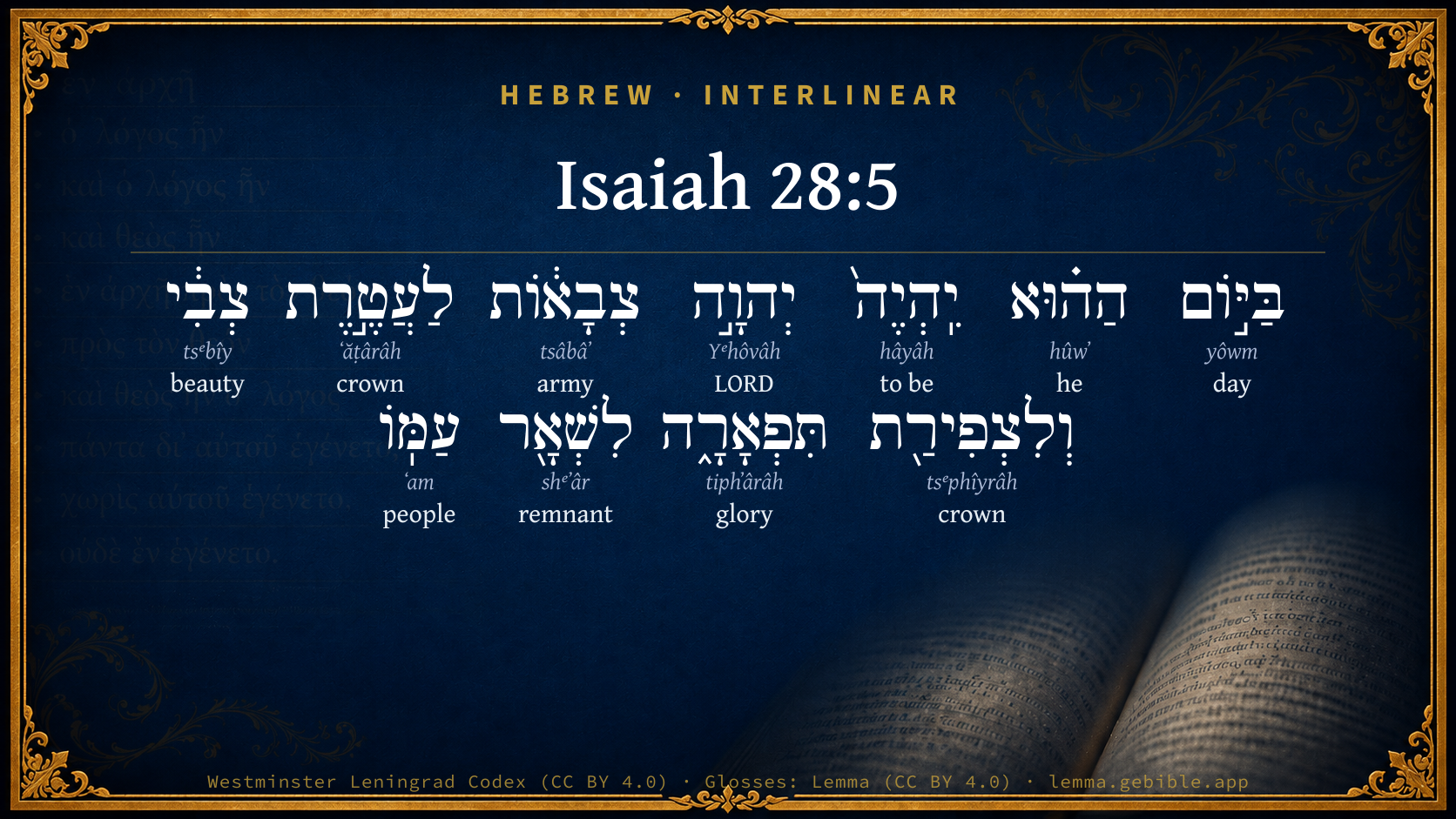
Hebrew (Westminster Leningrad Codex) Isaiah 28:5 appears in the Hebrew Old Testament. The text above is from the Westminster Leningrad Codex. Each word links to its Strong’s number, a concise gloss, and parsing drawn from the Open Scriptures Hebrew Bible morphology. Click any word for its full Brown-Driver-Briggs (BDB) entry.
Download image
Cite this verse

Isaiah 28:5 (World English Bible). Public Domain. Lemma interlinear Bible study tool, https://lemma.gebible.app/v/isaiah/28/5.

Show BibTeX & RIS
BibTeX
RIS
English Translation
In that day will Yahweh of Hosts become a crown of glory, and a diadem of beauty, to the residue of his people;
World English Bible · Public Domain
Highlights
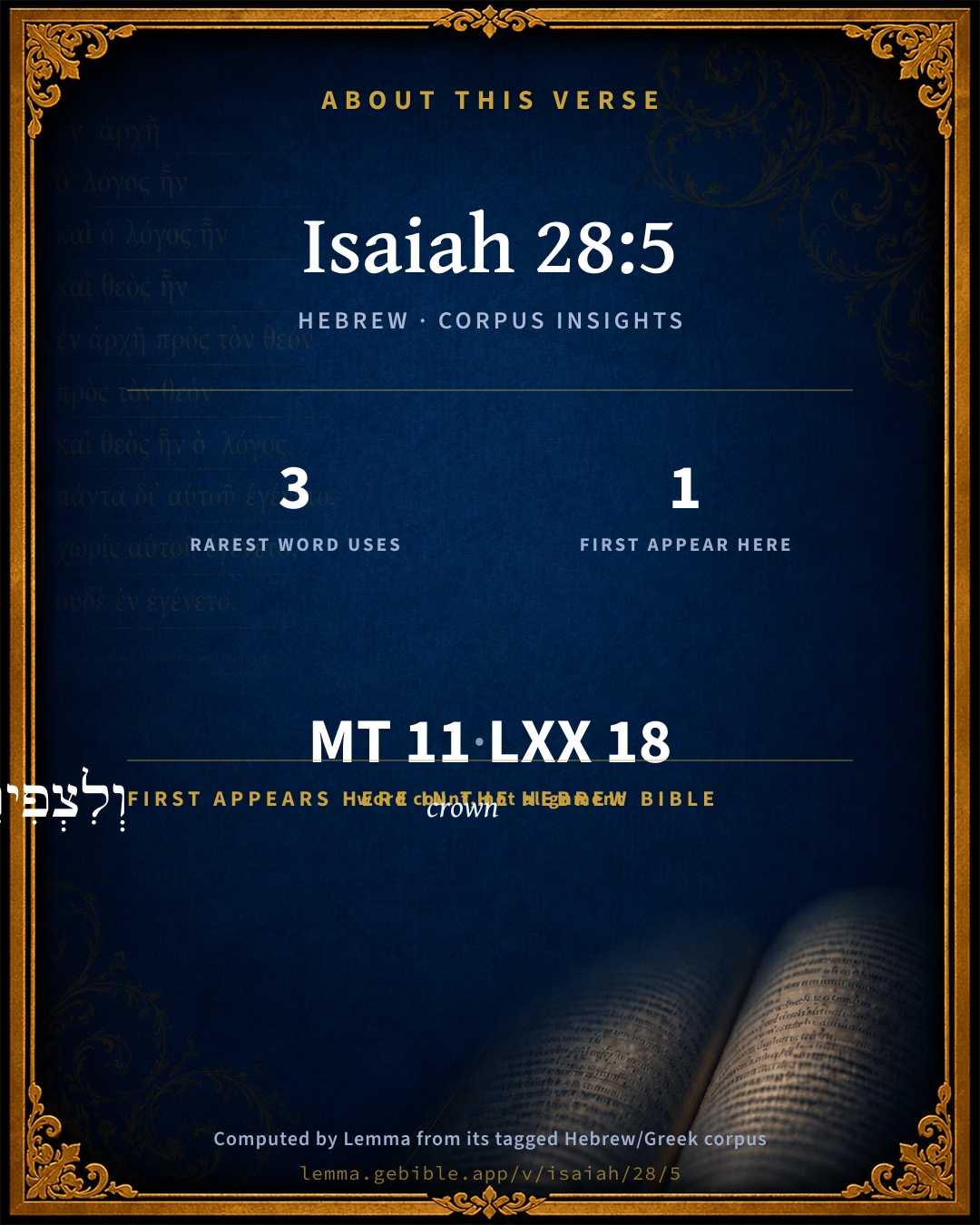
  • 1 first appearance in the Hebrew Bible
Full analysis ↓
Download a study sheet

One document with this verse’s original text, its word-by-word gloss line, the meaning frame, cross-references with their text, attributed commentary, and full source and license credits — printable, and it pastes into notes with its structure intact.

This verse Autodidact and up

Study sheet (.html) Plain text (.txt)

A passage Seminary Student

Up to 50 verses in one chapter. A passage sheet keeps up to 6 commentary sources and 12 cross-references per verse, in the order this page ranks them, and says so on the sheet whenever that leaves anything out. Ask for a single verse and you get the Autodidact verse sheet above.

Everything on this page stays free to read, with no account — the sheet is a download of what is already on screen, not access to it.

Want to remove ads? Support Godless Engineer
Compare translations 3

The same verse in 3 English versions, stacked beneath the original-language interlinear above. Click any original word for its lexicon entry.

Each is an independent rendering of the whole verse — the interlinear is not word-aligned to these translations.

Highlighted words mark where these versions differ — a whole-verse word diff, not a word-by-word alignment.

  • World English Bible Public Domain
    In that day will Yahweh of Hosts become a crown of glory, and a diadem of beauty, to the residue of his people;
  • King James Version Public Domain
    In that day shall the LORD of hosts be for a crown of glory, and for a diadem of beauty, unto the residue of his people,
  • unfoldingWord Literal Text CC BY-SA 4.0
    In that day, Yahweh of Armies will become a crown of splendor and a diadem of beauty for the remnant of his people,

unfoldingWord Literal Text — © unfoldingWord, licensed CC BY-SA 4.0. Word-aligned USFM3 via Door43 (git.door43.org/unfoldingWord/en_ult).

Versions to compare (up to 4)

3 of 4 selected

Show all 18 translations

Every available English version of this verse, each an independent rendering of the whole verse.

  • World English Bible Public Domain
    In that day will Yahweh of Hosts become a crown of glory, and a diadem of beauty, to the residue of his people;
  • Berean Standard Bible Public Domain
    On that day the LORD of Hosts will be a crown of glory, a diadem of splendor to the remnant of His people,
  • Majority Standard Bible Public Domain
    On that day the LORD of Hosts will be a crown of glory, a diadem of splendor to the remnant of His people,
  • King James Version Public Domain
    In that day shall the LORD of hosts be for a crown of glory, and for a diadem of beauty, unto the residue of his people,
  • American Standard Version (1901) Public Domain
    In that day will Jehovah of hosts become a crown of glory, and a diadem of beauty, unto the residue of his people;
  • Revised Version (1885) Public Domain
    In that day shall the LORD of hosts be for a crown of glory, and for a diadem of beauty, unto the residue of his people:
  • Geneva Bible (1599) Public Domain
    In that day shall the Lord of hostes be for a crowne of glory, and for a diademe of beautie vnto the residue of his people:
  • Douay-Rheims (1899) Public Domain
    In that day the Lord of hosts shall be a crown of glory, and a garland of joy to the residue of his people:
  • Young's Literal Translation Public Domain
    In that day is Jehovah of Hosts For a crown of beauty, and for a diadem of glory, To the remnant of His people.
  • Literal Standard Version CC BY-SA 4.0
    In that day YHWH of Hosts is || For a crown of beauty, and for a circlet of glory, || To the remnant of His people.
  • Unlocked Literal Bible CC BY-SA 4.0
    In that day Yahweh of hosts will become a beautiful crown and a diadem of beauty for the remainder of his people,
  • unfoldingWord Literal Text CC BY-SA 4.0
    In that day, Yahweh of Armies will become a crown of splendor and a diadem of beauty for the remnant of his people,
  • Darby Bible Public Domain
    In that day will Jehovah of hosts be for a crown of glory, and for a diadem of beauty, unto the remnant of his people;
  • World Messianic Bible Public Domain
    In that day, the LORD of Hosts will become a crown of glory and a diadem of beauty to the residue of his people,
  • Webster's Bible Public Domain
    In that day will the LORD of hosts be for a crown of glory, and for a diadem of beauty, to the residue of his people,
  • Free Bible Version CC BY-SA 4.0
    At that time the Lord Almighty will be a beautiful, glorious crown that brings pride to those of his people who are left.
  • Bible in Basic English Public Domain
    In that day will the Lord of armies be a crown of glory, and a fair ornament, to the rest of his people;
  • JPS Tanakh (1917) Public Domain
    In that day shall the LORD of hosts be for a crown of glory, and for a diadem of beauty, unto the residue of His people;

Literal Standard Version (2020), Covenant Press — licensed CC BY-SA 4.0. Text via the HelloAO Bible API (eBible.org). Unlocked Literal Bible (unfoldingWord) — licensed CC BY-SA 4.0. Text via the HelloAO Bible API (eBible.org). unfoldingWord Literal Text — © unfoldingWord, licensed CC BY-SA 4.0. Word-aligned USFM3 via Door43 (git.door43.org/unfoldingWord/en_ult). Free Bible Version, Dr. Jonathan Gallagher — licensed CC BY-SA 4.0. Text via the HelloAO Bible API (eBible.org).

Word by word

More ways to search: Search by grammar → Find every occurrence → Compare this word →

Practice this passage: Drill this verse → Learn its vocabulary →

וְלִצְפִירַ֖ת
tsᵉphîyrâh
H6843
“and · to/for · crown of”
Conjunction + Preposition + Noun, Common, Feminine, Singular, Construct
Part of Speech
Conjunction + Preposition + Noun
Type
Common
Gender
Feminine
Number
Singular
State
Construct
Full BDB Definition

Origin: formed like H6842

TWOT: 1960a

plait, chaplet, wreath, crown - plait, coronet, diadem
  1. בַּיּ֣וֹם yôwm H3117 “in/at the · day” Preposition, Determined + Noun, Common, Masculine, Singular, Absolute
  2. הַה֗וּא hûwʼ H1931 “the · he” Particle, Definite Article + Pronoun, Personal, 3rd Person, Masculine, Singular
  3. יִֽהְיֶה֙ hâyâh H1961 “to be” Verb, Qal, Imperfect, 3rd Person, Masculine, Singular
  4. יְהוָ֣ה Yᵉhôvâh H3068 “LORD” Noun, Proper
  5. צְבָא֔וֹת tsâbâʼ H6635 “armies” Noun, Common, Both, Plural, Absolute
  6. לַעֲטֶ֣רֶת ʻăṭârâh H5850 “to/for · crown of” Preposition + Noun, Common, Feminine, Singular, Construct
  7. צְבִ֔י tsᵉbîy H6643 “beauty” Noun, Common, Masculine, Singular, Absolute
  8. תִּפְאָרָ֑ה tiphʼârâh H8597 “glory” Noun, Common, Feminine, Singular, Absolute
  9. לִשְׁאָ֖ר shᵉʼâr H7605 “to/for · remnant of” Preposition + Noun, Common, Masculine, Singular, Construct
  10. עַמּֽוֹ ʻam H5971 “people · his” Noun, Common, Masculine, Singular, Construct + Suffix, Personal, 3rd Person, Masculine, Singular

About this verse

These counts appear in no published source. They are computed here, from the morphology-tagged text and Lemma’s own curated glosses. What Lemma adds →

11
words
11
distinct lemmas
Prophets
section

Notable vocabulary

The rarest word here is וְלִצְפִירַ֖ת crown H6843 — appearing just 3 times in the whole Hebrew Bible.

First appearance in Scripture

This word makes its first canonical appearance in the Hebrew Bible here:

  • וְלִצְפִירַ֖ת crown H6843

Shared distinctive vocabulary

וְלִצְפִירַ֖ת crown H6843 occurs in 3 verses of the Hebrew Bible. Also found in:

Grammatical profile

  • 1 verb
  • 9 nouns
  • 1 pronoun

Verb forms

  • יִֽהְיֶה֙ Qal · Imperfect

Hebrew & Septuagint length

In English translation the verse runs 23 words from the Hebrew and 24 from the Septuagint (LXX English) — closely comparable.

A rough comparison of the two English renderings, which tokenize alike — not a word-level alignment.

Word counts can differ between the Hebrew and the Greek without any difference in meaning — e.g. the Hebrew direct-object marker אֵת has no separate Greek word, and Greek often adds the article ὁ.

In the original languages it is 11 Hebrew tokens and 18 Greek tokens — but the two are counted differently (Hebrew bundles its prefixes and suffixes into one token; the Greek is in lemma form), so that isn’t a like-for-like length.

Cross-references

17

Topical passages linked to Isaiah 28:5 in the Treasury of Scripture Knowledge — connected by theme and wording, ordered by reader-vote popularity; previews shown in the World English Bible.

  • 1 Peter 5:4 When the chief Shepherd is revealed, you will receive the crown of glory that doesn't fade away.
  • Isaiah 60:19 The sun shall be no more your light by day; neither for brightness shall the moon give light to you: but Yahweh will be to you an everlasting light, and your God your glory.
  • Isaiah 62:3 You shall also be a crown of beauty in the hand of Yahweh, and a royal diadem in the hand of your God.
  • Romans 11:5–6 Even so then at this present time also there is a remnant according to the election of grace.
  • Job 29:14 I put on righteousness, and it clothed me. My justice was as a robe and a diadem.
  • Psalms 90:16–17 Let your work appear to your servants; Your glory to their children.
  • Isaiah 41:16 You shall winnow them, and the wind shall carry them away, and the whirlwind shall scatter them; and you shall rejoice in Yahweh, you shall glory in the Holy One of Israel.
  • Isaiah 45:25 In Yahweh shall all the seed of Israel be justified, and shall glory.
  • Jeremiah 9:23–24 Thus says Yahweh, Don't let the wise man glory in his wisdom, neither let the mighty man glory in his might, don't let the rich man glory in his riches;
  • 1 Corinthians 1:30–31 But of him, you are in Christ Jesus, who was made to us wisdom from God, and righteousness and sanctification, and redemption:
  • Isaiah 10:20–21 It shall come to pass in that day, that the remnant of Israel, and those who are escaped of the house of Jacob, shall no more again lean on him who struck them, but shall lean on Yahweh, the Holy One of Israel, in truth.
  • Isaiah 11:16 There shall be a highway for the remnant of his people, who shall remain, from Assyria; like as there was for Israel in the day that he came up out of the land of Egypt.
  • Isaiah 37:31–32 The remnant that is escaped of the house of Judah shall again take root downward, and bear fruit upward.
  • Isaiah 60:1–3 Arise, shine; for your light is come, and the glory of Yahweh is risen on you.
  • Zechariah 6:13–15 even he shall build the temple of Yahweh; and he shall bear the glory, and shall sit and rule on his throne; and he shall be a priest on his throne; and the counsel of peace shall be between them both.
  • 2 Corinthians 4:17 For our light affliction, which is for the moment, works for us more and more exceedingly an eternal weight of glory;
  • Luke 2:32 A light for revelation to the Gentiles, And the glory of your people Israel."

Cross-references courtesy of OpenBible.info (CC BY 4.0).

Hebrew and Greek witnesses Masoretic Hebrew ↔ Greek Septuagint

The same verse in the two great witnesses to the Old Testament, shown verse-for-verse.

These are two independent witnesses, not word-aligned to each other, and the Septuagint is shown in lemma (dictionary) form.

Hebrew Isaiah 28:5 Masoretic · Westminster Leningrad Codex

בַּיּ֣וֹם הַה֗וּא יִֽהְיֶה֙ יְהוָ֣ה צְבָא֔וֹת לַעֲטֶ֣רֶת צְבִ֔י וְלִצְפִירַ֖ת תִּפְאָרָ֑ה לִשְׁאָ֖ר עַמּֽוֹ

In that day will Yahweh of Hosts become a crown of glory, and a diadem of beauty, to the residue of his people;

World English Bible · Public Domain

Greek LXX Isaiah 28:5 Septuagint · lemma form

ὁ ἡμέρα ἐκεῖνος εἰμί κύριος σαβαωθ ὁ στέφανος ὁ ἐλπίς ὁ πλέκω ὁ δόξα ὁ καταλείπω ἐγώ λαός

In that day the Lord of hosts shall be the crown of hope, the woven crown of glory, to the remnant of the people.

LXX2012 (modern English Septuagint) · Public Domain

Hebrew: Westminster Leningrad Codex (CC BY 4.0). Greek: Septuagint (public domain); English from LXX2012 (modern English Septuagint) (Public Domain). How the Septuagint differs from the Hebrew →

Targum (Aramaic paraphrase)

1

The Targum is the ancient Jewish Aramaic paraphrase of the Hebrew Scriptures — an interpretive translation, not the Hebrew text itself. Onkelos (literal) and Pseudo-Jonathan (expansive) render the Torah, and Jonathan the Prophets. Coverage is partial: where no permissively-licensed English translation exists for a verse, only the Aramaic is shown. This is verse-level text, not a word-by-word alignment to the Hebrew.

  1. Targum Jonathan Prophets (Joshua–Malachi)
    בְּעִדָנָא הַהִיא יְהֵי מְשִׁיחָא דַייָ צְבָאוֹת לִכְלִילָא דְחֶדְוָא וּלְכֶתֶר דְתוּשְׁבָּחָא לִשְׁאָרָא דְעַמֵהּ:

    At that time, the Messiah of the Lord of hosts shall be for a crown of rejoicing, and for a crown of praise to the remnant of His people:

    Targum Jonathan — Aramaic: “Mikraot Gedolot” (public domain). English: “Sefaria Community Translation” (CC0 1.0 (public-domain dedication)); “London "Chaldee Paraphrase," 1871” (public domain). Text via Sefaria.

Commentary

Notes on Isaiah 28:5 from classic Christian and Jewish commentators (each source and its license shown beneath its notes). The classic Christian expositions comment on the surrounding passage and are grouped to its opening verse, so a note may address several verses; the Jewish commentaries on the Tanakh (Rashi and others) are per-verse, so they appear only where the commentator wrote on this verse.

Lemma curates 59 commentaries, every one of them public domain or Creative Commons licensed, each selected and text-cleaned for this edition rather than reprinted as found. About our sources →

Trapp's Complete Commentary

John Trapp

Isa 28:5 In that day shall the LORD of hosts be for a crown of glory, and for a diadem of beauty, unto the residue of his people,

Ver. 5. For a crown of glory, and for a diadem of beauty.] So he was to Judah - called here the "residue of his people" - during Hezekiah’s days; a crown unfading, or a garland made of amaranth, {as 1Pe 1:4} which is, saith Clement, a certain flower that being hung up in the house, yet is still fresh and green. And as God is thus to his people, so, interchangeably, are they to him "a crown of glory," {Isa 62:3} and "a royal diadem," (ib.); his "throne of glory"; {Jer 4:21} "The beauty of his ornament." {Eze 7:20}

John Trapp, A Commentary or Exposition upon All the Books of the Old and New Testament (1647–1656) — public domain. Text from a community e-Sword module.

Joseph Benson's Commentary

Isa 28:5-6. “Thus far,” says Bishop Lowth, “the prophecy relates to the Israelites, and manifestly denounces their approaching destruction by Shalmaneser. Here it turns to the two tribes of Judah and Benjamin, the remnant of God’s people, who were to continue a kingdom after the final captivity of the Israelites. It begins with a favourable prognostication of their affairs under Hezekiah: but soon changes to reproofs and threatenings, for their intemperance, disobedience, and profaneness.” In that day — When the kingdom of Israel shall be utterly destroyed; the Lord of hosts shall be for a crown of glory, &c. — Shall give eminent glory and beauty unto the residue of his people — Unto the kingdom of Judah, who shall continue in their own country, when Israel is carried into captivity. And for a spirit of judgment, &c. — He explains how, or wherein, God would glorify and beautify them, even by giving wisdom to their rulers, and courage to their soldiers; which two things contribute much to the strength, safety, and glory of a nation. To them that turn the battle to the gate — Who not only drive their enemies from their land, but pursue them into their own lands, and besiege them in their own cities.

Joseph Benson's Commentary on the Old and New Testaments (1811–1818) — public domain. Text from a community e-Sword module.

The Preacher's Complete Homiletical Commentary

Joseph S. Exell (gen. ed.)

THE BELIEVER’S DIGNITY AND POWER

Isa_28:5-6. In that day shall the LORD of Hosts be for a crown, &c.

This sustaining assurance stands in striking antithesis to the solemn threatenings and humbling charges which precede and follow it. It rises like some stately palace amid the ruins of man’s humbled pride and broken hopes. This voice comes from heaven in the very hour of earth’s desolation and decay. The prominent figure on the prophet’s canvas is very unlike the objects grouped around it. On the one side you look into a lovely valley, in the centre of which, on a commanding height, stands Samaria, the capital of the “Ten Tribes,” “the crown of pride,” “the glorious beauty.” But that proud crown is soon to be cast to the ground; that “glorious beauty” is but as a garland of fading flowers; that luxuriant valley, whose very “fatness” was made the minister of sensual indulgence, will soon be over-swept by the desolating march of the Assyrian invader; that gaudy splendour, the boast of Ephraim’s drunkards, is as short-lived as the wreaths which the revellers bind around their brows. The worm of intemperance is gnawing at the root of “the fading flower,” and overhead the storm is gathering that will blight its beauty. Turn now to the other side of the central figure, where the kingdom of Judah is introduced (Isa_28:7). Jerusalem as well as Samaria has her troops of reckless inebriates and her scenes of disgusting intoxication; though her punishment is not so near as that of the northern kingdom, here, too, are seen the marks of sure decline. On both sides, then, the prophet’s picture is gloomy and portentous—the earth a scene of drunken revelry, and the black sky streaked with the lightnings of divine wrath. But out of this sombre background of sottish intemperance and overhanging judgment, of falling crowns and fading wreaths, rises the luminous figure of our text. “In that day” of vanishing glory “shall the Lord of Hosts,” &c. In the fulness of its wealth this promise belongs to us; the Lord of Hosts has become to us “a crown of glory.”

I. THE BELIEVER’S DIGNITY. Let us not tone down the grandeur of the promise. Christ is the crown with which the believer is invested. He is an heir of God, a partaker of the divine nature. Let us see what is implied in this representation, bearing in mind the crown to which it stands in contrast.

1. It is a crown of honour without insecurity. Man is like a discrowned and exiled king (Lam_5:16). But God has taken means to restore him to his lost dignity (1Co_1:30). The crown of original righteousness which sin had torn from our brows and trampled in the dust has been replaced by the righteousness of Christ. How complete and glorious is His work in our behalf, to what dignity does He raise us! This crown cannot be placed on our head without inspiring us with a sense of honour, a feeling of recovered power, of joy and hope and security. There may be a crowned head without a kingly heart. A young prince may mount the throne incapable of discharging its duties, or, perhaps, trembling lest his new dignity should make him a mark for the bullet of the assassin; but the Christian’s honour cometh from God, and, along with the restored kingship, kingly qualities are imparted, so that no man can take his crown.

2. This is a crown in which we may boast without pride. Samaria was a crown of pride to the Ephraimites, and because they gloried in it, it was soon to be overturned. But while this crown of carnal confidence was thus to be swept away, God becomes to His people a more glorious crown in which they might boast without pride. When anything short of God is made our confidence it fosters vainglory, but with God as our crown all self-sufficiency is excluded.

3. It is a crown of joy without degradation. As it does not foster pride, so neither does it allow its wearer to descend to low indulgence. Reference is probably made to the wreath of flowers worn by drunken revellers on festive occasions. Under the plea of festive mirth they wallowed in the mire of sensuality. How soon their garlands would fall in disorder from their heads, or fall with their heads as they lay in senseless intoxication. The believer’s “diadem of beauty” points to purity and self-control (Psa_4:7).

4. It is an unfading crown. This point in the contrast is equally obvious. And is not “the fading flower” an emblem of all our earthly joys?

“All that sweet was made, but to be lost when sweetest.”

This world’s fairest chaplets will soon wither on our brows; its honours, possessions, and hopes are evanescent; but the Lord will be our everlasting crown, our God will be our eternal glory (H. E. I., 4975–4989).

II. THE BELIEVER’S POWER.

In Isa_28:6 we have all the elements of personal power, social well-being, and national greatness (Act_1:8; Eph_5:18). The indwelling Spirit confers three benefits. I. A clear head. “A spirit of judgment.” Solomon asked this blessing. It does not fall to many of us to sit on the bench, but what is good for the judge is a precious gift for all. When the Spirit pours His light upon the mind, the eyes of our understanding are enlightened. A clear intellect, a sound mind, an unwarped, unprejudiced judgment, is needed in all walks of life. How appropriate is this part of the promise! How could justice be rightly administered in such a state of society as that described by the prophet? If there is one thing that saps the morals, and muddles the understanding, it is intemperance. Men in positions of responsibility need all their wits about them.

2. A brave heart is promised “to them who turn the tide of battle to the gate.” The soldier as well as the judge is to participate in the gifts of God’s Spirit. We have a spiritual warfare to wage (Eph_6:12), and we are pledged to conquer the world for Christ. Beware lest we render ourselves unfit for military service by luxurious habits, and sinful indulgence. The drunkards of Ephraim could do nothing to oppose the invaders of their country. We need the Spirit to fire our hearts with courage and enterprise. Without His influence we shall prove poltroons.

3. A strong arm. Self-denial is a source of moral courage and of spiritual strength. Far from us be the dissoluteness which enfeebles our powers, both of mind and body.

Such, then, are the contents of this precious promise. Oh, that we were all invested with this crown of holiness, dignity, and beauty. How many are content with the gilded coronets and fading chaplets of the world. You remember the scene in the “Pilgrim’s Progress,” part ii., which has been made the subject of a painting by Sir Noel Paton—the man raking straw while one held a glittering crown over his head. Make Christ your boast. The crown of pride shall be hurled to the ground, the garlanded revellers shall sink in their own corruption, the honours which men so eagerly seek are as a fading flower, but this crown shall sparkle for ever on the believer’s head (Dan_12:3; Psa_90:17).—William Guthrie, M.A.

God had said He would discrown Ephraim, remove his beauty, and stain his pride. This was done when Samaria was overthrown by the Assyrians. “In that day” He would do to the “residue of His people”—apparently the kingdom of Judah—what is said in our present text. It was done in the reign of Hezekiah, when the true worship was re-established, reformation effected, and the nation defended against its enemies.

The text may be regarded, however, as a description of the splendour of the regenerated world.

I. THE PERSONS INTERESTED.

“The residue of His people: him that sitteth in judgment: and them that turn the battle to the gate.” All classes. Brave defenders; governors and administrators of justice, and the great mass of the people. Hence we observe that the blessing of the Gospel is needed by and suited to every class and every man. If there be a man anywhere who does not need it, it is either because—

(1), he has no soul to save; or

(2), he has not sinned; or

(3), he is sufficient in himself to remove sin and its consequences from himself. But none of these can be said of any man.

II. THE BLESSING PROMISED.

It consists in that which the Lord will be to the regenerated world.

1. Honour. Men mistake the things that constitute the true honour and dignity of human nature. Sounding titles; enormous wealth; personal beauty; commanding intellect; undisputed power. They are all insufficient and insecure, like fading flowers. God is the true crown of glory to man. When the soul returns from its wanderings to God and is re-united to Him through Christ, the crown is placed upon his head (Jer_9:23-24).

2. Wisdom. Both in barbarous and civilised countries, man without the Gospel is ignorant of the character of God, and of the way to approach Him (1Co_1:21). He gropes about in the darkness, if he desire to find Him at all. But Christ is made of God to us “wisdom,” as well as “righteousness, sanctification, and redemption.” In Him the divine character is clearly seen in the fulness, harmony, and glory of its attributes. In Him also we learn how man can be reconciled to God, and the way to eternal life.

3. Strength. Not physical, nor intellectual power, however valuable in the regions proper to them. But moral power; the power of the human will; the most important power of all. This alone possesses the terrible capacity of resisting the Almighty. The most powerful animals act as they have been created to act. All mechanical forces act according to their laws. But man, possessed of will, is possessed of a power that can either defy or obey the authority of Omnipotence. When the Gospel comes to the human heart, it constrains the will into a mighty force for good. God and man combine to overthrow the empire of evil in the heart and in the world. “The Lord of hosts is for strength to them that turn the battle to the gate.”

III. THE TIME INDICATED.

“In that day.” Christ came “in the fulness of time.” There are reasons and circumstances specially favourable to the advancement of the kingdom of Christ. There is a time in the purpose of Jehovah when all nations shall walk in the light. We may mark the circumstances which are usually indicative of the further spread of the Gospel.

1. When there is a time of special revival, reformation, and earnestness in the Church. As in time of Hezekiah.

2. When God stirs up His people to exert themselves for the world’s salvation, it is a sign that the world’s salvation is coming on apace. “When God enters the chamber, and awakes His children, and bids them rise, it is a sign that the morning has come.”

3. When the church longs, waits, prays for the success of the work, the time is likely to have come. “As soon as Zion travailed she brought forth her children.” Let the Church of Christ really desire, believe in, pray for the world’s conversion, and God will open the windows of heaven and pour down the blessing. Have you been sufficiently interested in the world’s salvation? As individuals? Are we sufficiently interested in our own?—J. Rawlinson.

The Preacher's Complete Homiletical Commentary (gen. ed. Joseph S. Exell; Funk & Wagnalls, c. 1892) — public domain (pre-1929). A full-Bible homiletical/sermon-outline anthology covering 65 of 66 books (2 John is absent from the source module). Text from a community e-Sword module.

MacLaren's Expositions of Holy Scripture

Alexander MacLaren

Isaiah

THE JUDGMENT OF DRUNKARDS AND MOCKERS

MAN’S CROWN AND GOD’S

Isa 28:5. - Isa 62:3.

Connection of first prophecy-destruction of Samaria. Its situation, crowning the hill with its walls and towers, its fertile ‘fat valley,’ the flagrant immorality and drunkenness of its inhabitants, and its final ruin, are all presented in the highly imaginative picture of its fall as being like the trampling under foot of a garland on a reveller’s head, the roses of which fade and droop amid the fumes of the banqueting hall, and are then flung out on the highway. The contrast presented is very striking and beautiful. When all that gross and tumultuous beauty has faded and died, then God Himself will be a crown of beauty to His people.

The second text comes into remarkable line with this. The verbal resemblance is not quite so strong in the original. The words for diadem and crown are not the same; the word rendered glory in the second text is rendered beauty in the first, but the two texts are entirely one in meaning. The same metaphor, then, is used with reference to what God is to the Church and what the Church is to God. He is its crown, it is His.

I. The Possession of God is the Coronation of Man.

{a} Crowns were worn by guests at feasts. They who possess God sit at a table perpetually spread with all which the soul can wish or want. Contrast the perishable delights of sense and godless life with the calm and immortal joys of communion with God; ‘a crown that fadeth not away’ beside withered garlands.

{b} Crowns were worn by kings. They who serve God are thereby invested with rule over selves, over circumstances, over all externals. He alone gives completeness to self-control.

{c} Crowns were worn by priests. The highest honour and dignity of man’s nature is thereby reached. To have God is like a beam of sunshine on a garden, which brings out the colours of all the flowers; contrast with the same garden in the grey monotony of a cloudy twilight.

II. The Coronation of Man in God is the Coronation of God in Man.

That includes the following thoughts.

The true glory of God is in the communication of Himself. What a wonderful light that throws on divine character! It is equivalent to ‘God is Love.’

He who is glorified by God glorifies God, as showing the most wonderful working of His power in making such a man out of such material, by an alchemy that can convert base metal into fine gold; as showing the most wonderful condescension of His love in taking to His heart man, into whose flesh the rotting leprosy of sin has eaten.

Such a man will glorify God by becoming a conscious herald of His praise. He who has God in his heart will magnify Him by lip and life. Redeemed men are ‘secretaries of His praise’ to men, and ‘to principalities and powers in heavenly places is made known by the Church the manifold wisdom of God.’

He who thus glorifies God is held in God’s hand.

‘None shall pluck them out of My Father’s hand.’

All this will be perfected in heaven. Redeemed men lead the universal chorus that thunders forth ‘glory to Him that sitteth on the throne.’

‘He shall come to be glorified in His saints.’

‘Glorify Thy Son, that Thy Son also may glorify Thee.’

Alexander MacLaren, Expositions of Holy Scripture (1904–1910) — public domain. Text from a community e-Sword module.

Tyndale Open Study Notes

Tyndale Open Resources

28:5-6 In the future, after God’s judgment has purged his people, he will restore a righteous remnant, transforming the desires and character of his people. Samaria will no longer be the source of Israel’s pride; instead, they will glory in the Lord, their true crown.

Tyndale Open Study Notes — © Tyndale Open Resources, licensed CC BY-SA 4.0. Text via the HelloAO Bible API.

Geneva Bible (1599)

Geneva Bible translators

Signifying, that the faithful, which put not their trust in any worldly prosperity, but made God their glory, shall be preserved.

Geneva Bible (1599) marginal notes — public domain. Text via Bolls.life.

Jamieson, Fausset & Brown

Robert Jamieson, A. R. Fausset & David Brown

The prophet now turns to Judah; a gracious promise to the remnant ("residue"); a warning lest through like sins Judah should share the fate of Samaria.

crown--in antithesis to the "fading crown" of Ephraim (Isa 28:1, Isa 28:3).

the residue--primarily, Judah, in the prosperous reign of Hezekiah (Kg2 18:7), antitypically, the elect of God; as He here is called their "crown and diadem," so are they called His (Isa 62:3); a beautiful reciprocity.

Jamieson, Fausset & Brown — Commentary Critical and Explanatory on the Whole Bible (1871) — public domain (CC PDM 1.0). Text via the HelloAO Bible API.

Adam Clarke's Commentary

Verse 5. In that day] Thus far the prophecy relates to the Israelites, and manifestly denounces their approaching destruction by Shalmaneser. Here it turns to the two tribes of Judah and Benjamin, the remnant of God's people who were to continue a kingdom after the final captivity of the Israelites. It begins with a favourable prognostication of their affairs under Hezekiah; but soon changes to reproofs and threatenings for their intemperance, disobedience, and profaneness.

Jonathan's Targum on this verse is worthy of notice: "In that time Messiah, the Lord of hosts משיחא דיי צבאות meshicha dayai tsebaoth, shall be a crown of joy and a diadem of praise to the residue of his people." Kimchi says the rabbins in general are of this opinion. Here then the rabbins, and their most celebrated Targum, give the incommunicable name, יהוה צבאות Yehovah tsebaoth, the Lord of hosts, to our ever blessed Redeemer, Jesus Christ.

Adam Clarke's Commentary on the Bible (1810–1826) — public domain. Text from a community e-Sword/MySword module.

Ellicott's Commentary for English Readers

(5) In that day shall the Lord of hosts be for a crown of glory.—The words are obviously used in direct contrast with the “crown of pride “in Isa_28:1-3. The true glory of the people for “the remnant that should be left” of Israel, as well as Judah, should be found in the presence of Jehovah, whom they would then acknowledge. In the gathering of some of the Ten Tribes at Hezekiah’ s passover (2Ch_30:11) there had already been an earnest of such a restored union.

A Bible Commentary for English Readers, edited by Charles John Ellicott (1878–1897) — public domain. Text from a community e-Sword module.

The Cambridge Bible for Schools and Colleges

gen. ed. J. J. S. Perowne

5. a crown of glory] no longer a “crown of pride,” as Isa_28:1; Isa_28:3.

diadem of beauty] The word çìphîrâh (diadem) occurs again only in Eze_7:7; Eze_7:10 (where, however, the sense is disputed). It probably denotes a “ring or circlet.

the residue (remnant) of his people] The exact phrase is not found elsewhere.

5, 6. Jehovah Himself the true glory of His people; a Messianic pendant to the foregoing picture of Samaria’s fall. The phrase in that day points as usual to the indefinite future of the Messianic age, not to the day of the judgment on North Israel. Whether the “remnant of His people” denotes the survivors of the Northern tribes, or those of Judah, or of the whole nation, it means a converted remnant; and there is no reason to suppose that Isaiah at any time expected the conversion of Judah to follow immediately the destruction of Ephraim. He is here looking beyond the whole series of national judgments, and the insertion of the promise is evidently suggested by the contrast between the false glory that has vanished and the true glory which shall endure.

The Cambridge Bible for Schools and Colleges (gen. ed. J. J. S. Perowne; Cambridge University Press, 1878–1918) — public domain. Text from a community e-Sword module.

John Gill's Exposition

And for a spirit of judgment to him that sitteth in judgment,.... That is, as the Lord would give honour and glory to the people in general, so wisdom and prudence, a spirit of judgment and discerning, to the king in particular, who sat on the throne of judgment to do justice, and execute judgment among his subjects: though this need not be restrained to the king, but be applied to all the judges and magistrates in the land, who sat and heard causes and complaints brought before them, for which they should be qualified by the Lord; so Aben Ezra interprets it of the sanhedrim:

and for strength to them that turn the battle to the gate; as wisdom is promised to the king and judges of the land, so strength of body and mind, valour and courage, to the prince and his army; so that they should turn the battle, and cause their enemies to fly before them, and pursue them to the very gates of their cities, as Hezekiah did, Kg2 18:8. The Syriac version is, "who turn the battle from the gate"; who, when besieged, sally out upon the besiegers, and drive them from their gates, oblige them to break up the siege, and fly before them. The Vulgate Latin version renders it, "and strength to them that return from war to the gate": that come home victorious to their own houses; and so the Targum,

"that he may give victory to them that go out in war, to return them in peace to their own houses.''

Wisdom in the cabinet and courts of judicature, and courage in the camp, are two great blessings to a nation, and serve much to explain the glory and beauty before promised.

John Gill's Exposition of the Whole Bible (1746–1763) — public domain (CC PDM 1.0). Text via the HelloAO Bible API.

Albert Barnes' Notes on the Bible

In that day - This verse commences a new subject, and affirms that while the kingdom of Israel should be destroyed, the kingdom of Judah would be preserved, and restored (compare Isa. 7–9)

Be for a crown of glory - He shall reign there as its king, and he shall guard and defend the remnant of his people there. This reign of Yahweh shall be to them better than palaces, towers, walls, and fruitful fields, and shall be a more glorious ornament than the proud city of Samaria was to the kingdom of Israel.

And for a diadem of beauty - A beautiful garland. The phrase stands opposed to the wreath of flowers or the diadem which was represented Isa 28:1, Isa 28:3 as adorning the kingdom and capital of Israel. Yahweh and his government would be to them their chief glory and ornament.

Unto the residue of his people - To the kingdom of Judah, comprising the two tribes of Judah and Benjamin. This doubtless refers to the comparatively prosperous and happy times of the reign of Hezekiah.

Albert Barnes' Notes on the Bible (1834–1885) — public domain. Text from a community e-Sword/MySword module.

Haydock's Catholic Bible Commentary

People, who returned to the service of God; or it refer to the kingdom of Juda.

George Leo Haydock (1774–1849), Haydock's Catholic Family Bible and Commentary, 1859 edition — public domain. Excludes Psalms (Douay-Rheims chapter numbering differs from Protestant) and Deuterocanonical books (Catholic canon only).

Matthew Poole's English Annotations

In that day; when the kingdom of Israel shall be utterly destroyed.

For a crown of glory, and for a diadem of beauty; God shall give them eminent glory and beauty. Unto the residue of his people; unto the kingdom of Judah, who shall continue in their own country, when Israel is carried into captivity.

Matthew Poole's English Annotations on the Holy Bible (1683–1685) — public domain. Text from a community e-Sword/MySword module.

Whedon's Commentary on the Bible

Daniel D. Whedon

5, 6. The subject partially changes here.

In that day — Referring to the time when events above predicted should occur.

Crown of glory, and… diadem of beauty — The events at Samaria are to present two lessons: 1. The Lord Jehovah is himself concerned in permitting Assyria to conquer Israel. He sees it best to do so, for Israel’s and the world’s good. 2. He shows that the fear of Jehovah, not the natural loveliness of Samaria with her gross vices, is the true “crown of glory” of a nation. And the remnant left in Israel and all of Judah shall learn these lessons. He also shows that himself only can inspire truth and justice in one sitting in the magistrate’s seat, and himself only can impart true courage, and render a people when invaded or assailed able to repel attacks and drive the enemy back to his own city gates.

Daniel D. Whedon (gen. ed.), Commentary on the Old and New Testaments (1874–1909) — public domain. Text from a community e-Sword module.

The Pulpit Commentary

Vers. 5, 6. THE FALL OF SAMARIA COINCIDENT WITH AN OFFER OF FAVOR TO JUDAH. Her sister"s fate was the most powerful of all possible warnings to Judah against treading in her steps. Samaria had perished through want of faith in Jehovah. She had turned to other gods; she had trusted in her own "glory" and "beauty;" and she had trusted in Egypt. If Judah would do the exact opposite, she might be saved. If she would take Jehovah for her "Crown of glory" and "Diadem of beauty," he was willing to be so taken. He was willing to impart a "spirit of judgment" to her rulers, and "strength" to her armed force.

In that day shall the Lord of hosts be, etc. This is an offer, and something more than an offer. It is implied that, to some extent, the offer would be accepted. And clearly the closing of the clouds around Samaria was coincident with the dawn of a brighter day in Judah. Hezekiah came to the throne only three years before the fatal siege of Samaria began. His accession must have been nearly contemporaneous with that expedition of Shal-maneser against Hoshea, when he "shut him up, and bound him in prison". (2Ki_17:4) Yet he was not daunted by his neighbor"s peril. He began his reign with a political revolution and a religious reformation. He threw off the yoke of Assyria, to which his father had submitted, (2Ki_18:7) and he cleared the land of idols and idol-worship. It was the dawn of a day of promise, such as the prophet seems to point to in these two verses. Unhappily, the dawn was soon clouded over (vers. 7-9). The residue of his people; i.e. Judah. All admit that "they also," in ver. 7, refers to Judah, and Judah only; but the sole antecedent to "they also" is this mention of the residue of God"s people.

Vers. 5, 6. God our Glory, Beauty, etc.

"In that day," i.e. in the day when God shall reign over his people, either the day of their return to him in loyal obedience, or the day of their return to their own land under his delivering power in that day God would be everything to his chosen people; he would be the Object and the Source of their glory, their beauty, their righteousness, their strength. We may see how God in Christ is the same to us.

I OUR GLORY. "The Lord of hosts shall be for a Crown of glory." We glory in our God as the Lord of all power and might, as the One whose right hand is full of righteousness, as the faithful Creator, etc.; but we glory most in him as the God and Father of our Lord Jesus Christ, in him who so pitied a rebellious race "that be gave his only begotten Son, that whosoever believeth," etc. In Christ Jesus the glories and grandeurs of the Divine character are most brilliantly illustrated.

II OUR BEAUTY. "For a Diadem of beauty." In the gospel God has

(1) revealed the beauties of his own character to us; for in the life, in the spirit of Jesus Christ, we behold transcendent moral loveliness, all imaginable graces perfectly blended and intermingled. And in it he has

(2) called forth the utmost possible beauty in human character. There are produced in Christian lands and by Christian processes not one or two exquisite human characters here and there, but multitudes of them beneath every sky and in every age; such that it is not enough to say that they are good or that they are useful; it must be added that they are exceedingly beautiful they are diadems, attracting the eye, delighting the soul.

III OUR RIGHTEOUSNESS. "For a Spirit of judgment." The man who has "learned Christ" is a man of integrity; to him injustice, unrighteousness, dishonesty, the withholding of that which is due, of whatever kind, is not Duly distasteful, but impossible: "the spirit of judgment," the spirit of equity and truth is in him, gained from Christ, implanted by the Divine Spirit. If this spirit, which is the Spirit of Christ, be not in him, he is none of Christ"s. (Rom_8:12)

IV OUR STRENGTH. "And for Strength to them that turn the battle to the gate." They who truly know God in Christ are "strong in the Lord, and in the power of his might." God communicates to them something of the "exceeding greatness of his power." In Divine strength they are strong

(1) to discharge duty;

(2) to bear burdens;

(3) to work in the field of holy service;

(4) to resist spiritual adversaries, to "turn the battle to the gate. C.

The Pulpit Commentary (1880–1919), ed. H.D.M. Spence-Jones & Joseph S. Exell — public domain. Text from a community e-Sword module.

John Wesley's Explanatory Notes

In that day - When the kingdom of Israel shall be destroyed. A diadem - God shall give eminent glory and beauty, to the kingdom of Judah.

John Wesley, Explanatory Notes Upon the Whole Bible (1754–1765) — public domain. Text via the GEBible commentary corpus.

Keil & Delitzsch

C. F. Keil & F. Delitzsch

The threat is now followed by a promise. This is essentially the same in character as Isa 4:2-6. The place of the false glory thus overthrown is now filled by a glory that is divine and true. "In that day will Jehovah of hosts be the adorning crown and the splendid diadem to the remnant of His people; and the spirit of justice to them that sit on the judgment-seat, and heroic strength to them that drive back war at the gate." "The remnant of His people" (שׁאר with a fixed kametz, as in Isa 21:17) is not Judah, as distinguished from Ephraim that had utterly perished; but Judah and the remaining portion of Ephraim, as distinguished from the portion which had perished. After the perishable thin in which they gloried had been swept away, the eternal person of Jehovah Himself would be the ornament and pride of His people. He, the Lord of the seven spirits (Isa 11:1), would be to this remnant of His people the spirit of right and heroic strength. There would be an end to unjust judging and powerless submission. The judges are called "those who sit ‛al-hammishpât" in the sense of "on the seat of judgment" (Psa 9:5; Psa 122:5); the warriors are called "those who press back milchâmâh shâ‛râh" (war at the gate), i.e., either war that has reached their own gate (Isa 22:7), or war which they drive back as far as the gate of the enemy (Sa2 11:23; 1 Macc. 5:22). The promise in this last passage corresponds to Mic 5:4-5. The athnach in Isa 28:6 ought to stand at hammishpât; the second clause of the v. may be completed from the first, ולגבוּרה being equivalent to גבורה ולרוח, and משיבי to למישבי. We might regard 2 Chron 30 as a fulfilment of what is predicted in Isa 28:6, if the feast of passover there described really fell in the age succeeding the fall of Samaria; for this feast of passover did furnish a representation and awaken a consciousness of that national unity which had been interrupted from the time of Rehoboam. But if we read the account in the Chronicles with unprejudiced minds, it is impossible to shut our eyes to the fact that this feast of passover took place in the second month of the first year of Hezekiah's reign, and therefore not after the depopulation of the northern kingdom by Shalmanassar, but after the previous and partial depopulation by Tiglath-pileser. In fact, the fulfilment cannot be looked for at all in the space between the sixth and fourteenth years of Hezekiah, since the condition of Judah during that time does not answer at all to the promises given above. The prophet here foretells what might be hoped for, when Asshur had not only humbled Ephraim, but Judah also. The address consists of two connected halves, the promising beginnings of which point to one and the same future, and lay hold of one another.

Keil & Delitzsch — Biblical Commentary on the Old Testament (1861–1891) — public domain (CC PDM 1.0). Text via the HelloAO Bible API. (Old Testament only.)

J. A. Alexander on Isaiah

Joseph Addison Alexander

“In that day shall Jehovah of Hosts be for (or become) a crown of beauty and a diadem of glory to the remnant of his people.” The true sense appears to be that after Samaria, the pride of the apostate tribes, had fallen, they who still remained as members of the church or chosen people should glory and delight in the presence of Jehovah as their choicest privilege and highest honor. The expressions are borrowed from the first verse but presented in a new combination.

Joseph Addison Alexander, The Prophecies of Isaiah (1846–1847; New York: Scribner, 1870–1878) — public domain. Text from a community e-Sword module.

unfoldingWord translationNotes

Door43 World Missions Community

Yahweh of hosts

See how you translated this in Isaiah 1:9.

will become a beautiful crown and a diadem of beauty

Yahweh is spoken of as if he were to become a beautiful crown that the people who honor him as their true king would wear. (See: Metaphor)

a beautiful crown and a diadem of beauty

These mean the same thing. AT: "a beautiful crown" (See: Doublet)

people, a spirit of justice for him who sits in judgment, and strength for those who

This can be reworded so that the abstract nouns "justice" and "strength" are expressed as adjectives. AT: "people. Yahweh will cause the judges to be just and will cause to be strong those who" (See: Abstract Nouns)

a spirit of justice

A person who has a "spirit of justice" is someone who has the characteristic of justice and is a just person. (See: Idiom)

sits in judgment

This idiom means the person has the authority to judge. (See: Idiom)

strength for those who turn back their enemies at their gates

Here "to turn back" is an idiom that means to defeat in battle. AT: "Yahweh will cause the soldiers to be strong so that they defeat their enemies when the enemies attack their city" (See: Idiom)

translationWords

Yahweh of hosts

crown

spirit

just

judge

gate

unfoldingWord translationNotes — © Distant Shores Media and the Door43 World Missions Community, licensed CC BY-SA 4.0. Source: git.door43.org/Door43/en_tn.

Rashi

Rabbi Shlomo Yitzchaki (Rashi)

On that day When the transgressors are destroyed.

for a crown of beauty for the remaining righteous men among them.

Rashi on the Tanakh — English translations: “The Judaica Press complete Tanach with Rashi, translated by A. J. Rosenberg” (CC BY 4.0); “Pentateuch with Rashi's commentary by M. Rosenbaum and A.M. Silbermann, 1929-1934” (public domain); “The Metsudah Tanach series, Lakewood, N.J” (CC BY 4.0); and “The Book of Joshua, Metsudah Publications, 1997” (CC BY 4.0). Text via Sefaria.

Ibn Ezra

Rabbi Abraham ibn Ezra

In that day, etc. This will be just the reverse of the fate of the crown of Ephraim; for the kingdom of the Lord will appear in Zion.

Ibn Ezra on the Tanakh — English translations: “Sefaria Community Translation” (CC0 1.0 (public-domain dedication)); “Yalkut, Sifsei Chachomim Chumash, Metsudah Publications, 2009” (CC BY 4.0); and “Commentary of Ibn Ezra on Isaiah - trans. by M. Friedlander, 1873” (public domain). Text via Sefaria.

Lesson kit

Teaching starters — assembled from the data on this page, not authored interpretation. Every prompt links to the verse data it draws on. Edit before teaching.

Isaiah, in the Prophets, opens this verse with 11 words (11 distinct Hebrew lemmas). Its most distinctive word is tsᵉphîyrâh (“crown”). A historical commentator’s framing appears above. Read the whole chapter for the surrounding context.

Discussion questions

  1. How does “crown” (tsᵉphîyrâh) shape what this verse is saying?
  2. The word “crown” first appears here in Scripture. What is being introduced at this debut?
  3. Ezekiel 7:7 shares the word «crown» with this verse. How do the two illuminate each other?
  4. The translations on this page render this verse differently — a whole-verse word diff, not a word-by-word alignment. What might account for the different wordings?
  5. The verb «יִֽהְיֶה֙» is Qal Imperfect. How does its form color the action?
  6. Reading how Trapp's Complete Commentary and Joseph Benson's Commentary read this verse, where do the two commentators agree and where do they part?

Things to notice

Reading settings

Reading text

Shown beneath each verse's original-language words.

Old Testament
Old Testament edition

Read the OT as the Masoretic Hebrew (MT) or the Greek Septuagint (LXX).

English shown for the Greek Septuagint (in the Hebrew ↔ Greek comparison).

Comparing translations? Open the Compare panel on any verse page to stack up to four side by side.