
Hosea 13:11

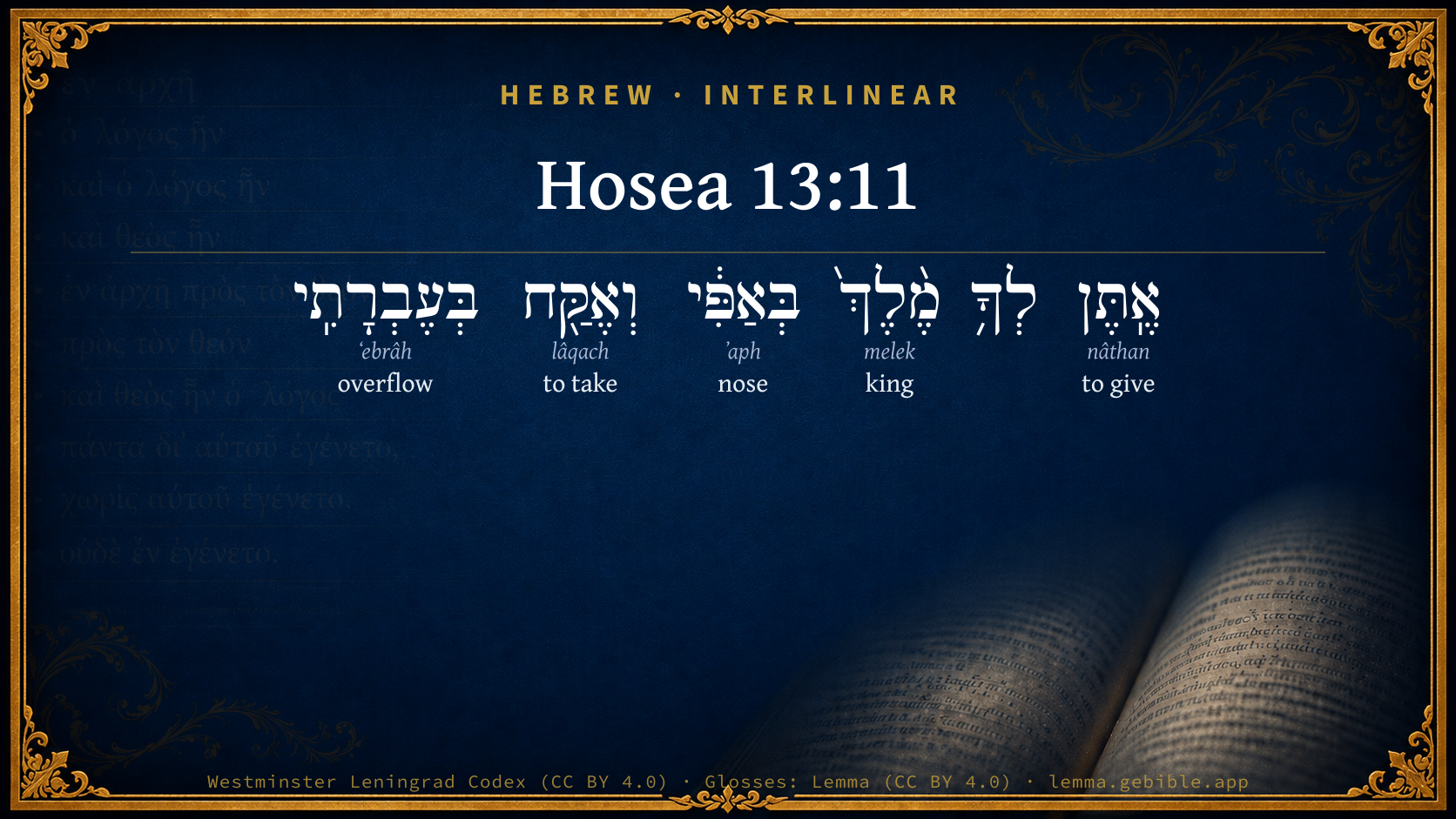
Hebrew (Westminster Leningrad Codex) Hosea 13:11 appears in the Hebrew Old Testament. The text above is from the Westminster Leningrad Codex. Each word links to its Strong’s number, a concise gloss, and parsing drawn from the Open Scriptures Hebrew Bible morphology. Click any word for its full Brown-Driver-Briggs (BDB) entry.
Download image
Cite this verse

Hosea 13:11 (World English Bible). Public Domain. Lemma interlinear Bible study tool, https://lemma.gebible.app/v/hosea/13/11.

Show BibTeX & RIS
BibTeX
RIS
English Translation
I have given you a king in my anger, And have taken him away in my wrath.
World English Bible · Public Domain
Download a study sheet

One document with this verse’s original text, its word-by-word gloss line, the meaning frame, cross-references with their text, attributed commentary, and full source and license credits — printable, and it pastes into notes with its structure intact.

This verse Autodidact and up

Study sheet (.html) Plain text (.txt)

A passage Seminary Student

Up to 50 verses in one chapter. A passage sheet keeps up to 6 commentary sources and 12 cross-references per verse, in the order this page ranks them, and says so on the sheet whenever that leaves anything out. Ask for a single verse and you get the Autodidact verse sheet above.

Everything on this page stays free to read, with no account — the sheet is a download of what is already on screen, not access to it.

Want to remove ads? Support Godless Engineer
Compare translations 3

The same verse in 3 English versions, stacked beneath the original-language interlinear above. Click any original word for its lexicon entry.

Each is an independent rendering of the whole verse — the interlinear is not word-aligned to these translations.

Highlighted words mark where these versions differ — a whole-verse word diff, not a word-by-word alignment.

  • World English Bible Public Domain
    I have given you a king in my anger, And have taken him away in my wrath.
  • King James Version Public Domain
    I gave thee a king in mine anger, and took him away in my wrath.
  • unfoldingWord Literal Text CC BY-SA 4.0
    I give to you a king in my nose, and I take away in my wrath.

unfoldingWord Literal Text — © unfoldingWord, licensed CC BY-SA 4.0. Word-aligned USFM3 via Door43 (git.door43.org/unfoldingWord/en_ult).

Versions to compare (up to 4)

3 of 4 selected

Show all 18 translations

Every available English version of this verse, each an independent rendering of the whole verse.

  • World English Bible Public Domain
    I have given you a king in my anger, And have taken him away in my wrath.
  • Berean Standard Bible Public Domain
    So in My anger I gave you a king, and in My wrath I took him away.
  • Majority Standard Bible Public Domain
    So in My anger I gave you a king, and in My wrath I took him away.
  • King James Version Public Domain
    I gave thee a king in mine anger, and took him away in my wrath.
  • American Standard Version (1901) Public Domain
    I have given thee a king in mine anger, and have taken him away in my wrath.
  • Revised Version (1885) Public Domain
    I have given thee a king in mine anger, and have taken him away in my wrath.
  • Geneva Bible (1599) Public Domain
    I gaue thee a King in mine anger, and I tooke him away in my wrath.
  • Douay-Rheims (1899) Public Domain
    I will give thee a king in my wrath, and will take him away in my indignation.
  • Young's Literal Translation Public Domain
    I give to thee a king in Mine anger, And I take away in My wrath.
  • Literal Standard Version CC BY-SA 4.0
    I give to you a king in My anger, || And I take away in My wrath.
  • Unlocked Literal Bible CC BY-SA 4.0
    I gave you a king in my anger, and I took him away in my wrath.
  • unfoldingWord Literal Text CC BY-SA 4.0
    I give to you a king in my nose, and I take away in my wrath.
  • Darby Bible Public Domain
    I gave thee a king in mine anger, and took him away in my wrath.
  • World Messianic Bible Public Domain
    I have given you a king in my anger, and have taken him away in my wrath.
  • Webster's Bible Public Domain
    I gave thee a king in my anger, and took him away in my wrath.
  • Free Bible Version CC BY-SA 4.0
    In my anger I give you a king, and in my fury I take one.
  • Bible in Basic English Public Domain
    I have given you a king, because I was angry, and have taken him away in my wrath.
  • JPS Tanakh (1917) Public Domain
    I give thee a king in Mine anger, and take him away in My wrath.

Literal Standard Version (2020), Covenant Press — licensed CC BY-SA 4.0. Text via the HelloAO Bible API (eBible.org). Unlocked Literal Bible (unfoldingWord) — licensed CC BY-SA 4.0. Text via the HelloAO Bible API (eBible.org). unfoldingWord Literal Text — © unfoldingWord, licensed CC BY-SA 4.0. Word-aligned USFM3 via Door43 (git.door43.org/unfoldingWord/en_ult). Free Bible Version, Dr. Jonathan Gallagher — licensed CC BY-SA 4.0. Text via the HelloAO Bible API (eBible.org).

Word by word

More ways to search: Search by grammar → Find every occurrence → Compare this word →

Practice this passage: Drill this verse → Learn its vocabulary →

בְּעֶבְרָתִֽי
ʻebrâh
H5678
“in/at · overflow · my”
Preposition + Noun, Common, Feminine, Singular, Construct + Suffix, Personal, 1st Person, Common, Singular
Part of Speech
Preposition + Noun
Type
Common
Gender
Feminine
Number
Singular
State
Construct
Full BDB Definition

Origin: from H5676

TWOT: 1556d

outpouring, overflow, excess, fury, wrath, arrogance - overflow, excess, outburst - arrogance - overflowing rage or fury
  1. אֶֽתֶּן nâthan H5414 “to give” Verb, Qal, Imperfect, 1st Person, Common, Singular
  2. מֶ֨לֶךְ֙ melek H4428 “king” Noun, Common, Masculine, Singular, Absolute
  3. בְּאַפִּ֔י ʼaph H639 “in/at · nose · my” Preposition + Noun, Common, Masculine, Singular, Construct + Suffix, Personal, 1st Person, Common, Singular
  4. וְאֶקַּ֖ח lâqach H3947 “and · to take” Conjunction + Verb, Qal, Imperfect, 1st Person, Common, Singular

About this verse

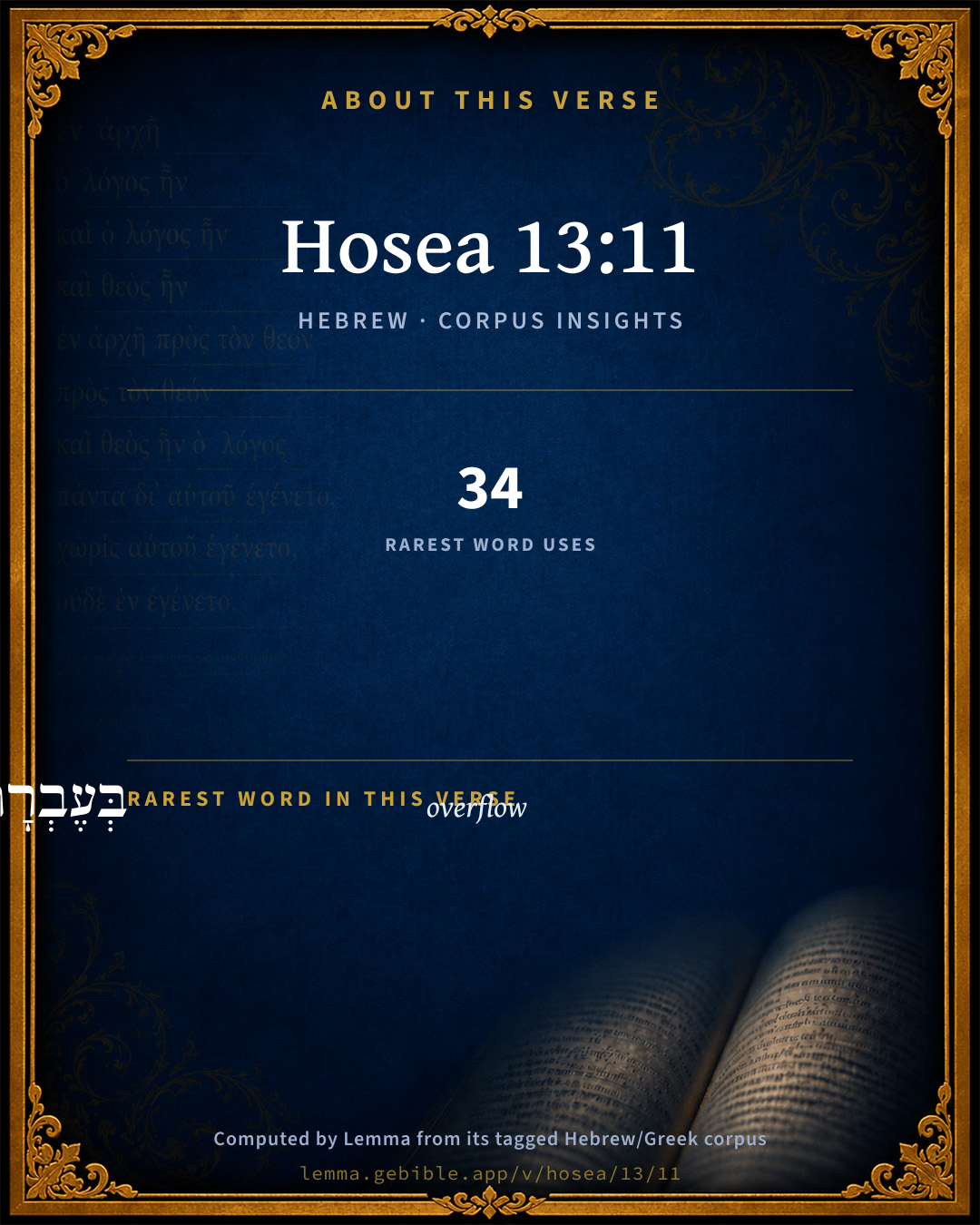
These counts appear in no published source. They are computed here, from the morphology-tagged text and Lemma’s own curated glosses. What Lemma adds →

6
words
5
distinct lemmas
Prophets
section

Shared distinctive vocabulary

בְּעֶבְרָתִֽי overflow H5678 occurs in 34 verses of the Hebrew Bible. Also found in:

Grammatical profile

  • 2 verbs
  • 3 nouns
  • 1 preposition

Verb forms

  • אֶֽתֶּן Qal · Imperfect
  • וְאֶקַּ֖ח Qal · Imperfect

Hebrew & Septuagint length

In English translation the verse runs 17 words from the Hebrew and 16 from the Septuagint (LXX English) — closely comparable.

A rough comparison of the two English renderings, which tokenize alike — not a word-level alignment.

Word counts can differ between the Hebrew and the Greek without any difference in meaning — e.g. the Hebrew direct-object marker אֵת has no separate Greek word, and Greek often adds the article ὁ.

Cross-references

13

Topical passages linked to Hosea 13:11 in the Treasury of Scripture Knowledge — connected by theme and wording, ordered by reader-vote popularity; previews shown in the World English Bible.

  • 1 Samuel 10:19 but you have this day rejected your God, who himself saves you out of all your calamities and your distresses; and you have said to him, [No], but set a king over us. Now therefore present yourselves before Yahweh by your tribes, and by your thousands.
  • 1 Samuel 16:1 Yahweh said to Samuel, How long will you mourn for Saul, seeing I have rejected him from being king over Israel? fill your horn with oil, and go: I will send you to Jesse the Bethlehemite; for I have provided me a king among his sons.
  • Proverbs 28:2 In rebellion, a land has many rulers, But order is maintained by a man of understanding and knowledge.
  • 1 Samuel 8:7–9 Yahweh said to Samuel, Listen to the voice of the people in all that they tell you; for they have not rejected you, but they have rejected me, that I should not be king over them.
  • 1 Samuel 12:13 Now therefore see the king whom you have chosen, and whom you have asked for: and, behold, Yahweh has set a king over you.
  • 1 Samuel 15:22–23 Samuel said, Has Yahweh as great delight in burnt offerings and sacrifices, as in obeying the voice of Yahweh? Behold, to obey is better than sacrifice, and to listen than the fat of rams.
  • 1 Samuel 31:1–7 Now the Philistines fought against Israel: and the men of Israel fled from before the Philistines, and fell down slain on Mount Gilboa.
  • 1 Kings 12:15–16 So the king didn't listen to the people; for it was a thing brought about of Yahweh, that he might establish his word, which Yahweh spoke by Ahijah the Shilonite to Jeroboam the son of Nebat.
  • 1 Kings 12:26–32 Jeroboam said in his heart, Now will the kingdom return to the house of David:
  • 1 Kings 14:7–16 Go, tell Jeroboam, Thus says Yahweh, the God of Israel: Because I exalted you from among the people, and made you prince over my people Israel,
  • 2 Kings 17:1–4 In the twelfth year of Ahaz king of Judah began Hoshea the son of Elah to reign in Samaria over Israel, [and reigned] nine years.
  • Hosea 10:3 Surely now they will say, "We have no king; for we don't fear Yahweh; And the king, what can he do for us?"
  • Hosea 10:7 Samaria and her king float away, Like a twig on the water.

Cross-references courtesy of OpenBible.info (CC BY 4.0).

Hebrew and Greek witnesses Masoretic Hebrew ↔ Greek Septuagint

The same verse in the two great witnesses to the Old Testament, shown verse-for-verse.

These are two independent witnesses, not word-aligned to each other, and the Septuagint is shown in lemma (dictionary) form.

Hebrew Hosea 13:11 Masoretic · Westminster Leningrad Codex

אֶֽתֶּן לְךָ֥ מֶ֨לֶךְ֙ בְּאַפִּ֔י וְאֶקַּ֖ח בְּעֶבְרָתִֽי

I have given you a king in my anger, And have taken him away in my wrath.

World English Bible · Public Domain

Greek LXX Hosea 13:11 Septuagint · lemma form

καί δίδωμι σύ βασιλεύς ἐν ὀργή ἐγώ καί ἔχω ἐν ὁ θυμός ἐγώ

And I gave you a king in my anger, and kept him back in my wrath.

LXX2012 (modern English Septuagint) · Public Domain

On this verse, Haydock's Catholic Bible Commentary discusses the Septuagint’s reading. Read the note in Commentary ↓

Hebrew: Westminster Leningrad Codex (CC BY 4.0). Greek: Septuagint (public domain); English from LXX2012 (modern English Septuagint) (Public Domain). How the Septuagint differs from the Hebrew →

Targum (Aramaic paraphrase)

1

The Targum is the ancient Jewish Aramaic paraphrase of the Hebrew Scriptures — an interpretive translation, not the Hebrew text itself. Onkelos (literal) and Pseudo-Jonathan (expansive) render the Torah, and Jonathan the Prophets. Coverage is partial: where no permissively-licensed English translation exists for a verse, only the Aramaic is shown. This is verse-level text, not a word-by-word alignment to the Hebrew.

  1. Targum Jonathan Prophets (Joshua–Malachi)
    אֲמַן עֲלָךְ מַלְכָּא בְּרוּגְזִי וְאַעְדֵיתִי בְּחֶמְתִי:

    (no public-domain English translation for this verse)

    Targum Jonathan — Aramaic: “Mikraot Gedolot” (public domain). English: “Sefaria Community Translation” (CC0 1.0 (public-domain dedication)); “London "Chaldee Paraphrase," 1871” (public domain). Text via Sefaria.

Commentary

Notes on Hosea 13:11 from classic Christian and Jewish commentators (each source and its license shown beneath its notes). The classic Christian expositions comment on the surrounding passage and are grouped to its opening verse, so a note may address several verses; the Jewish commentaries on the Tanakh (Rashi and others) are per-verse, so they appear only where the commentator wrote on this verse.

Lemma curates 59 commentaries, every one of them public domain or Creative Commons licensed, each selected and text-cleaned for this edition rather than reprinted as found. About our sources →

Trapp's Complete Commentary

John Trapp

Hos 13:11 I gave thee a king in mine anger, and took [him] away in my wrath.

Ver. 11. I gave thee a king in mine anger] As once before he gave them quails to choke them. A king, that is, all those kings they had since they fell off from the house of David. These were God’s gifts, but giftless gifts (αδωρα δωρα και ουκ ονησιμα), which he cast upon them in his anger, for a punishment both of the sins of David’s house, and likewise of the people’s rebellion. It was ab irate potius quam ab exorato Deo. Take him (saith he, since you will needs have him) with all that shall follow after. The hypocrite shall reign, that the people may be ensnared, Job 34:30. "Set thou a wicked man over him" (saith the psalmist), "and let Satan stand at his right hand," Psa 109:6; see Dan 8:23. Saul was a hypocrite, Jeroboam a wicked man; so were all his successors in that throne. Lev 26:17, it is written as a heavy curse of God, If you still trespass against me, I will set princes over you that shall hate you, mischievous, odious princes; odious to God, malignant to the people.

And took him away in my wrath] Heb. In mine immoderate wrath, that passed the bounds. This is spoken of God after the manner of men; for he cannot exceed or over do; "fury is not in him," Isa 27:4; but here he threateneth to take away king and kingdom together: as he did Hoshea, by the Assyrian that carried them all captive. Observe here, that better a bad magistrate than none, for this latter is the fruit of God’s utter indignation. Those Anabaptists that from this text inferred that no Christian can with a good conscience take upon him kingly dignity should have observed, that as an evil king is reckoned as a plague to a people, so a good king is to be held a special blessing to them.

John Trapp, A Commentary or Exposition upon All the Books of the Old and New Testament (1647–1656) — public domain. Text from a community e-Sword module.

The Biblical Illustrator

Joseph S. Exell

Hos_13:11

I gave thee a king in Mine anger, and took him away in My wrath.

Saul

The Israelites seem to have asked for a king from an unthankful caprice and waywardness. The ill conduct of Samuels sons was the occasion, an evil heart of unbelief was the cause. To punish them, God gave them a king after their own heart. There is, in true religion, a sameness, an absence of hue and brilliancy, in the eyes of the natural man. Samuel had too much of primitive simplicity about him to please the Israelites; they felt they were behind the world, and clamoured to be put on a level with the heathen. Saul had much to recommend him to minds thus greedy of the dust of the earth. He was brave, daring, resolute; gifted, too, with strength of body as well as of mind. Both his virtues and his faults were such as became an Eastern monarch, and were adapted to secure the fear and submission of his subjects. Samuels conduct in the national emergency is far above human praise. Personally qualified Saul was for a time a prosperous king. But from the beginning the prophets voice is raised both against the people and king in warnings and rebukes, which are omens of his destined destruction, according to the text. Here, then, a question may be raised--Why was Saul thus marked for vengeance from the beginning? The question leads to a deeper inspection of his character. The first duty of every man is the fear of God--a reverence for His Word, a love of Him, and a desire to obey Him. Now Saul lacked his one thing. He was never under the abiding influence of religion, however he might be at times moved and softened. What nature made him, that he remained, without improvement; with virtues which had no value, because they required no effort, and implied the influence of no principle. There was a deadness to all considerations not connected with the present world. It is his habit to treat prophet and priest with a coldness, to say the least, which seems to argue some great internal defect. We have no reason to believe, from the after history, that the Divine gift at his anointing left any religious effect on his mind. The immediate occasion of his rejection was his failing under a specific trial of his obedience, as set before him at the very time he was anointed. There was no professed or intentional irreverence in Sauls conduct. He outwardly respected the Mosaic ritual. But he was indifferent, and cared for none of these things. From the time of Sauls disobedience in the matter of Amalek, Samuel came no more to see Saul, whose season of probation was over. He finishes his bad history by an open act of apostasy from the God of Israel. He consulted the sorceress at Endor. Unbelief and wilfulness are the wretched characteristics of Sauls history--an ear deaf to the plainest commands, a heart hardened against the most gracious influences. (J. H. Newman, B. D.)

A gift of Gods anger

You were so set upon it, that you would have a king; if you will, take him, saith God, and take him with all that shall follow after. So that it was (as one speaks) rather from an angry God than from an entreated one. Saul and Jeroboam were both given in anger.

1. God may have a hand in things wherein men sin exceedingly.

2. Things that are evil may yet have present success.

3. Gods gifts are not always in love. Take heed of immoderate desires for any worldly thing.

I. How we may know that what god gives is in anger, not in love. It is a very hard thing to convince men, if they have their desires satisfied, that it is rather from anger than love. Men are so well pleased with the satisfying of their desires that they can be very hardly convinced but that God intends good to them in it

1. When you desire a gift, rather than God in it. When your desires are for the gift rather than the Giver, you can have no comfort that there is love in it.

2. When our desires are immoderate and violent.

3. When God grants men their desires before the due time. They have what they would have, but they have it not in Gods time.

4. When God grants us what we would have, but without the blessing. He grants the thing, but takes away the blessing of the thing, He takes away the comfort and satisfaction of it. They shall eat, but they shall not be satisfied.

5. When that which we desire is merely to satisfy our lusts. We do not desire such and such things that by them we may be fitted for the service of God.

6. When men are so eager that they care not whether the gift comes from a reconciled or a provoked God; it is all one to them (Num_11:1-35.).

7. When God regards not our preparation for a mercy. Carnal hearts take no great care themselves of it. Let me have it, say they, our fitness matters not. It is your sin and wickedness not to regard the preparation of your hearts for what you have, and it is Gods judgment to give it to you before you are pre pared. A gracious heart, when it would have a mercy, is as careful to get the heart prepared for the mercy as to obtain it.

8. When we rest on the means we use, and seek not God by prayer.

9. When God gives us our desires, but not a sanctified use of them. When God gives you the shell, but not the kernel, surely it is not in love. All the good things that wicked men have, are but shells without kernels.

10. When a secret curse attends what we have.

11. When we regard not what becomes of others, so we have our wants satisfied.

12. When God, in satisfying our desires, makes way for some judgment.

13. When men are greedy of things to the disregard of results; when they would have their desires satisfied in a foolish way, never minding what inconveniences may follow, but merely looking to their present comfort.

14. When men seek to have their desires satisfied, merely because they love change.

15. When our desires of further mercies make us forget former mercies.

16. When men desire new things out of mistrust of God.

17. If we seek to attain our desires by unlawful means. (Jeremiah Burroughs.)

Answers to improper prayers

The flying fish, says the fable, had originally no wings, but being of an ambitious and discontented temper she repined at being always confined to the water, and wished to soar into the air. If I could fly like the birds, said she, I should not only see more of the beauties of nature, but I should be able to escape from those fish which are continually pursuing me, and which render my life miserable. She therefore petitioned Jupiter for a pair of wings, and immediately she perceived her fins to expand. They suddenly grew to the length of her whole body, and became at the same time so strong as to do the office of a pinion. She was at first much pleased with her new powers, and looked with an air of disdain on all her former companions; but she soon perceived herself exposed to new dangers. While flying in the air she was incessantly pursued by the tropic bird and the albatross, and when for safety she dropped into the water, she was so fatigued with her flight that she was less able than ever to escape from her old enemies the fish. Finding herself more unhappy than before, she now begged of Jupiter to recall his present; but Jupiter said to her, When I gave you your wings I well knew that they would prove a curse; but your proud and restless disposition deserved this disappointment. Now, therefore, what you begged as a favour keep as a punishment. (Evenings at Home.)

The Biblical Illustrator, edited by Joseph S. Exell (c. 1880s–1900s) — public domain. Text from a community e-Sword module.

Tyndale Open Study Notes

Tyndale Open Resources

13:11 Israel had crowned her kings without consulting the Lord, so now he would take them away in fury.

Tyndale Open Study Notes — © Tyndale Open Resources, licensed CC BY-SA 4.0. Text via the HelloAO Bible API.

Jamieson, Fausset & Brown

Robert Jamieson, A. R. Fausset & David Brown

I gave . . . king in . . . anger . . . took . . . away in . . . wrath--true both of Saul (Sa1 15:22-23; Sa1 16:1) and of Jeroboam's line (Kg2 15:30). Pekah was taken away through Hoshea, as he himself took away Pekahiah; and as Hoshea was soon to be taken away by the Assyrian king.

Jamieson, Fausset & Brown — Commentary Critical and Explanatory on the Whole Bible (1871) — public domain (CC PDM 1.0). Text via the HelloAO Bible API.

Adam Clarke's Commentary

Verse 11. I gave thee a king in mine anger] Such was Saul; for they highly offended God when they clamored to have a king like the heathen nations that were around them.

Took him away in my wrath.] Permitted him and the Israelites to fall before the Philistines. Others think that Shalmaneser was the king thus given, and Hoshea the king thus taken away.

Adam Clarke's Commentary on the Bible (1810–1826) — public domain. Text from a community e-Sword/MySword module.

John Calvin's Commentaries

These are the princes, of whom thou hast said, Give me a king and princes. I gave to thee in my wrath, and took away in my fury; that is “It was a cursed beginning, and it shall be a cursed end; for the election of Jeroboam was not lawful; but through an impious wilfulness, the people then rebelled against me, when they revolted from the family of David.” Nothing successful could then proceed from so inauspicious a beginning. For it is only then an auspicious token, when we obey God, when his Spirit presides over our counsels, when we ask at his mouth, and when we begin with prayer to him. But when we despise the word of God, and give loose reins to our own humour, and fix on whatever pleases us, it cannot be but that an unhappy and disastrous issue will follow. God therefore says, that he gave them a king in his wrath; as though he said, “Ye think that you have done nobly, when Jeroboam was raised to the throne, that he might become eminent: for the kingdom of Judah was then far inferior to that of Israel, which not only excelled in power, but also in the number of its subjects. Ye think that you were then happy, because Jeroboam ruled over you: but he was given you in the anger and wrath of God,” saith the Prophet. “But God commanded Jeroboam to be anointed.” True, it was so: but this, says God, I did in my wrath; and now I will take away in my fury; that is, “I will deprive you of that kingdom which I see is the cause of your blindness. For if that kingdom remains entire, I shall be nothing, the authority of my word will be of no weight among you. It is then necessary that this kingdom should be wholly subverted; for ye began to be unhappy as soon as ye sought a new king.”

We now understand what the Prophet means. At the same time, we learn from this passage, that God so executes his judgements, that whatever evil there is, it ought to be ascribed to men. For the raising of Jeroboam to the kingdom, we certainly allow to have been rash and unjust; for thereby was violated that celestial decree made known to David,

“My Son art thou, I have this day begotten thee. Ask of me, and I will give thee the Gentiles,’ etc., (Psalm 2:7,8.)

But who appointed Jeroboam to be king? The Lord himself. How could it be, that God raised Jeroboam to the throne, and that he yet by his decree set David, not only over the children of Abraham, but also over the Gentiles, with reference to Christ who was to come? God seems here to be inconsistent with himself. By no means; for when he set David over his chosen people, it was a lawful appointment: but when he raised Jeroboam to the throne, it was a singular judgement; so that in God there is no inconsistency. The people at the same time, who by their suffrages adopted Jeroboam and made him their king, acted impiously and perversely. “Yet God seems to have directed the whole by his providence.” True; for before the people knew any thing of the new king, God had already determined to elect him and resolved also to punish in this way the defection and ingratitude of Solomon. All these things are true, that is, that God by his secret counsel had directed the whole business, and yet that he had no participation in the sin of the people.

Thus let us learn wisely to admire the secret judgements of God, and not imitate those profane cavillers, who make a great noise, because they cannot understand how God thus makes use of wicked men, and how he directs for the best end what is done by men wickedly and foolishly. As they do not perceive this, they conclude that if the Lord governs all things, he must be the author of sin. But the Scripture, as we see, when it speaks of the wrath and fury of God, does at the same time set forth to us his rectitude in all his judgements, and distinguishes between God and men, even as the difference is great; for God does not turn the perverse designs of men to answer their own ends — he is a just judge. And yet his purpose is not always apparent to us: it is, however, our duty reverently and with chastened minds to admire and adore those mysteries which surpass our comprehension. It follows —

John Calvin's Commentaries (1540-1563) — public domain. Text from the Calvin Translation Society English edition (1840s-50s) via the Christian Classics Ethereal Library (ccel.org). Calvin's coverage is partial (roughly two-thirds of the Bible); uncommented books and verses are honest gaps, never fabricated. The 19th-century editor's footnotes and remarks are omitted so the notes are faithfully Calvin's own voice.

Ellicott's Commentary for English Readers

(11) Gave . . . Took.—The past tenses should be present: “I give . . .” “take away.” The whole succession of Israelite kings, who generation after generation had been taken away, some by violent death, would close with Hoshea, who was to disappear as “a fragment on a stormy sea” (Hos_10:7).

A Bible Commentary for English Readers, edited by Charles John Ellicott (1878–1897) — public domain. Text from a community e-Sword module.

The Cambridge Bible for Schools and Colleges

gen. ed. J. J. S. Perowne

11. I gave thee, &c.] Rather, I give thee kings [lit., a king] in mine anger, and take (them) away in my wrath. The reference is to the elevation of Jeroboam I., but also to the various dynasties which from time to time forced their way to the throne (comp. on Hos_7:7). Indulged self-will brought with it its own punishment—hardening of the heart in apostasy. Thus our passage seems to mediate between the two different views of Jeroboam’s act presented to us in Hos_1:11 (see note) and 1Ki_11:29-39 respectively. In one sense Jehovah ‘gave’; in another, he ‘gave’ not.

The Cambridge Bible for Schools and Colleges (gen. ed. J. J. S. Perowne; Cambridge University Press, 1878–1918) — public domain. Text from a community e-Sword module.

John Gill's Exposition

I gave thee a king in mine anger,.... Not the king of Assyria, sent to waste and destroy them, and carry them captive, as some, for of him the next clause cannot be said; nor Jeroboam, the first king of the ten tribes, as others, who was not given in anger to Israel, but to Solomon; rather Saul, as Kimchi and Aben Ezra, the first king of all Israel; and who was given at the request of the people, though in anger and resentment, they rejecting God their King; or it may design the kingly office and power in general, in a succession of kings from him the first of them:

and took him away in my wrath; not Jeroboam, who does not appear to be taken away by death in wrath; rather Saul, who died in battle with the Philistines, and fell on the mountains of Gilboa: but it may be rendered better, "I will take him away" (o); and refers not to Zedekiah the last king of Judith, as some in Kimchi; but to Hoshea, the last king of the ten tribes; for it is of there more especially the words, both in the text and context, are spoken; and so it respects the entire removal of kingly power from them, which ceased in Hoshea; see Hos 3:4.

(o) "et auferam", Zanchius, Piscator, Cocceius, V. L. "recipiam", Drusius; "accipiam", Schmidt.

John Gill's Exposition of the Whole Bible (1746–1763) — public domain (CC PDM 1.0). Text via the HelloAO Bible API.

Albert Barnes' Notes on the Bible

I gave thee a king in Mine anger - o: “God, when He is asked for ought amiss, sheweth displeasure, when He giveth, hath mercy, when He giveth not.” “The devil was heard,” (in asking to enter into the swine) “the Apostle was not heard,” (when he prayed that the messenger of Satan might depart from him) , “God heard him whom He purposed to condemn; and He heard not him whom He willed to heal.” : “God, when propitious, denieth what we love, when we love amiss; when wroth, He giveth to the lover, what he loveth amiss. The Apostle saith plainly, “God gave them over to their own hearts’ desire.” He gave them then what they loved, but, in giving, condemned them.” God did appoint Jeroboam, although not in the way in which Israel took him. Jeroboam and Israel took, as from themselves, what God appointed; and, so taking it, marred God’s gift.

Taking it to themselves from themselves, they maintained it for themselves by human policy and sin. As was the beginning, such was the whole course of their kings. The beginning was rebellion; murder, intestine commotion, anarchy, was the oft-repeated issue. God was against them and their kings; but he let them have their way. In His displeasure with them He allowed them their choice; in displeasure with their evil kings He took them away. Some He smote in their own persons, some in their posterity. So often as He gave them, so often He removed them, until, in Hoshea, He took them away forever. This too explains, how what God “gave in anger,” could be “taken away” also “in anger.” The civil authority was not a thing wrong in itself, the ceasing whereof must be a mercy. Israel was in a worse condition through its separate monarchy; but, apart from the calf-worship, it was not sin. The changing of one king for another did not mend it.

Individual kings were taken away in anger against themselves; their removal brought fresh misery and bloodshed. Nations and Churches and individuals may put themselves in an evil position, and God may have allowed it in His anger, and yet, it may be their wisdom and humility to remain in it, until God change it, lest He should “take” it away, not in forgiveness, but in “anger.” : “David they neither asked for, nor did the Lord give him in His anger; but the Lord first chose him in mercy, gave him in grace, in His supreme good-pleasure He strengthened and preserved him.” : “Let no one who suffereth from a wicked ruler, accuse “him” from whom he suffereth, for it was from his own ill deserts, that he became subject to such a ruler. Let him accuse then his own deeds, rather than the injustice of the ruler, for it is written, “I gave thee a king in Mine anger.” Why then disdain to have as rulers, those whose rule we receive from the anger of God?” : “When a reprobate people is allowed to have a reprobate pastor, that pastor is given, neither for his own sake, nor for that of the people; inasmuch as he so governeth, and they so obey, that neither the teacher nor the taught are found meet to attain to eternal bliss. Of whom the Lord saith by Hosea, “I gave thee a king in Mine anger.” For in the anger of God is a king given, when the bad have a worse appointed as their ruler. Such a pastor is then given, when he undertakes the rule of such a people, both being condemned alike to everlasting punishment.”

Albert Barnes' Notes on the Bible (1834–1885) — public domain. Text from a community e-Sword/MySword module.

Haydock's Catholic Bible Commentary

King; Saul, Jeroboam, or the Assyrian. --- Away. Osee, (Calmet) so that you shall have no more kings of Israel. (Haydock) --- Septuagint alone have, "I took (Calmet) or had him in," &c. (St. Jerome)

George Leo Haydock (1774–1849), Haydock's Catholic Family Bible and Commentary, 1859 edition — public domain. Excludes Psalms (Douay-Rheims chapter numbering differs from Protestant) and Deuterocanonical books (Catholic canon only).

Matthew Poole's English Annotations

I gave thee a king in mine anger; such as Shallum, Menahem, Pekah, &c.; but in displeasure against you.

I took him away; the Hebrew says not what; I think, their kings mentioned.

In my wrath: God was angry when he gave such kings to Israel, and he was no better pleased when he took them away; they were punishments when given, and it was punishment to Israel when they were taken away. If you read this verse in the future tense, as you may, I will give them a king in my anger, it may refer to God’s giving the king of Assyria the rule over them, making them his vassals; and I will take away, i.e. you, O Israelites, in my wrath, I will destroy some, and send others into captivity, take all away out of your land, and send you in wrath to the grave, or captives into Assyria.

Matthew Poole's English Annotations on the Holy Bible (1683–1685) — public domain. Text from a community e-Sword/MySword module.

The Pulpit Commentary

I gave thee a king in mine anger, and took him away in my wrath. The imperfects yja and yqa here are correctly explained by Keil as denoting "an action that is repeated again and again, for which we should use the present; and refer to all the kings that the kingdom of the ten tribes had received and was receiving still, and to their removal." Hitzig calls it here the historical present. Jerome, Aben Ezra, and Kimchi refer the first clause to Saul as given in anger; and the second to Zedekiah as taken away in wrath.

The Pulpit Commentary (1880–1919), ed. H.D.M. Spence-Jones & Joseph S. Exell — public domain. Text from a community e-Sword module.

John Wesley's Explanatory Notes

A king - Such as Shallum, Menahem, Pekah.

John Wesley, Explanatory Notes Upon the Whole Bible (1754–1765) — public domain. Text via the GEBible commentary corpus.

Lesson kit

Teaching starters — assembled from the data on this page, not authored interpretation. Every prompt links to the verse data it draws on. Edit before teaching.

Hosea, in the Prophets, opens this verse with 6 words (5 distinct Hebrew lemmas). Its most distinctive word is ʻebrâh (“overflow”). A historical commentator’s framing appears above. Read the whole chapter for the surrounding context.

Discussion questions

  1. The word ʻebrâh carries the sense “overflow.” How does it shape the verse?
  2. Genesis 49:7 shares the word «overflow» with this verse. How do the two illuminate each other?
  3. The translations on this page render this verse differently — a whole-verse word diff, not a word-by-word alignment. What might account for the different wordings?
  4. The verb «אֶֽתֶּן» is Qal Imperfect. How does its form color the action?
  5. Reading how Trapp's Complete Commentary and The Biblical Illustrator read this verse, where do the two commentators agree and where do they part?

Things to notice

Reading settings

Reading text

Shown beneath each verse's original-language words.

Old Testament
Old Testament edition

Read the OT as the Masoretic Hebrew (MT) or the Greek Septuagint (LXX).

English shown for the Greek Septuagint (in the Hebrew ↔ Greek comparison).

Comparing translations? Open the Compare panel on any verse page to stack up to four side by side.