
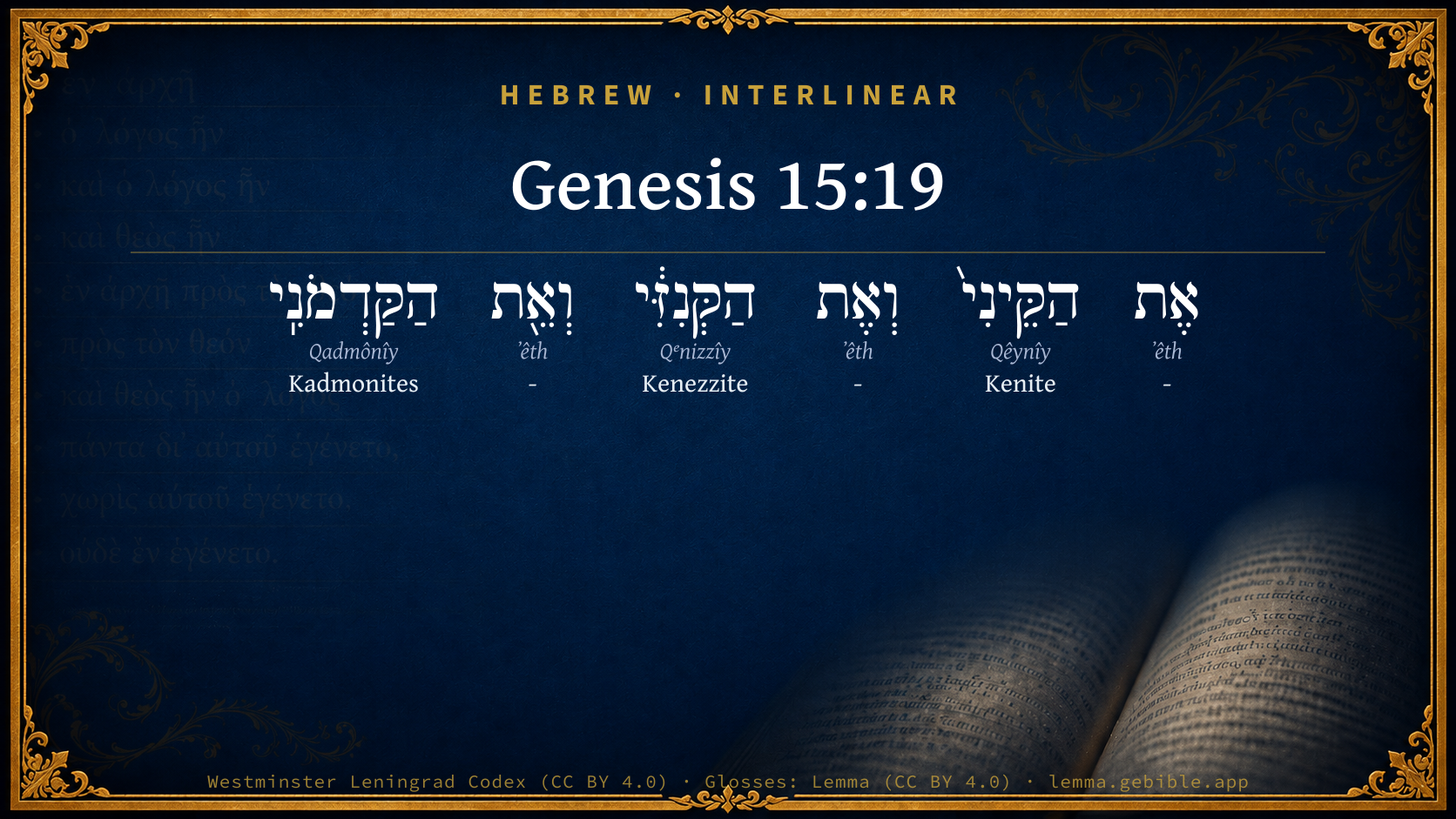
Genesis 15:19

Hebrew (Westminster Leningrad Codex) Genesis 15:19 appears in the Hebrew Old Testament. The text above is from the Westminster Leningrad Codex. Each word links to its Strong’s number, a concise gloss, and parsing drawn from the Open Scriptures Hebrew Bible morphology. Click any word for its full Brown-Driver-Briggs (BDB) entry.
Download image
Cite this verse

Genesis 15:19 (World English Bible). Public Domain. Lemma interlinear Bible study tool, https://lemma.gebible.app/v/genesis/15/19.

Show BibTeX & RIS
BibTeX
RIS
English Translation
the Kenites, the Kenizzites, the Kadmonites,
World English Bible · Public Domain
Highlights
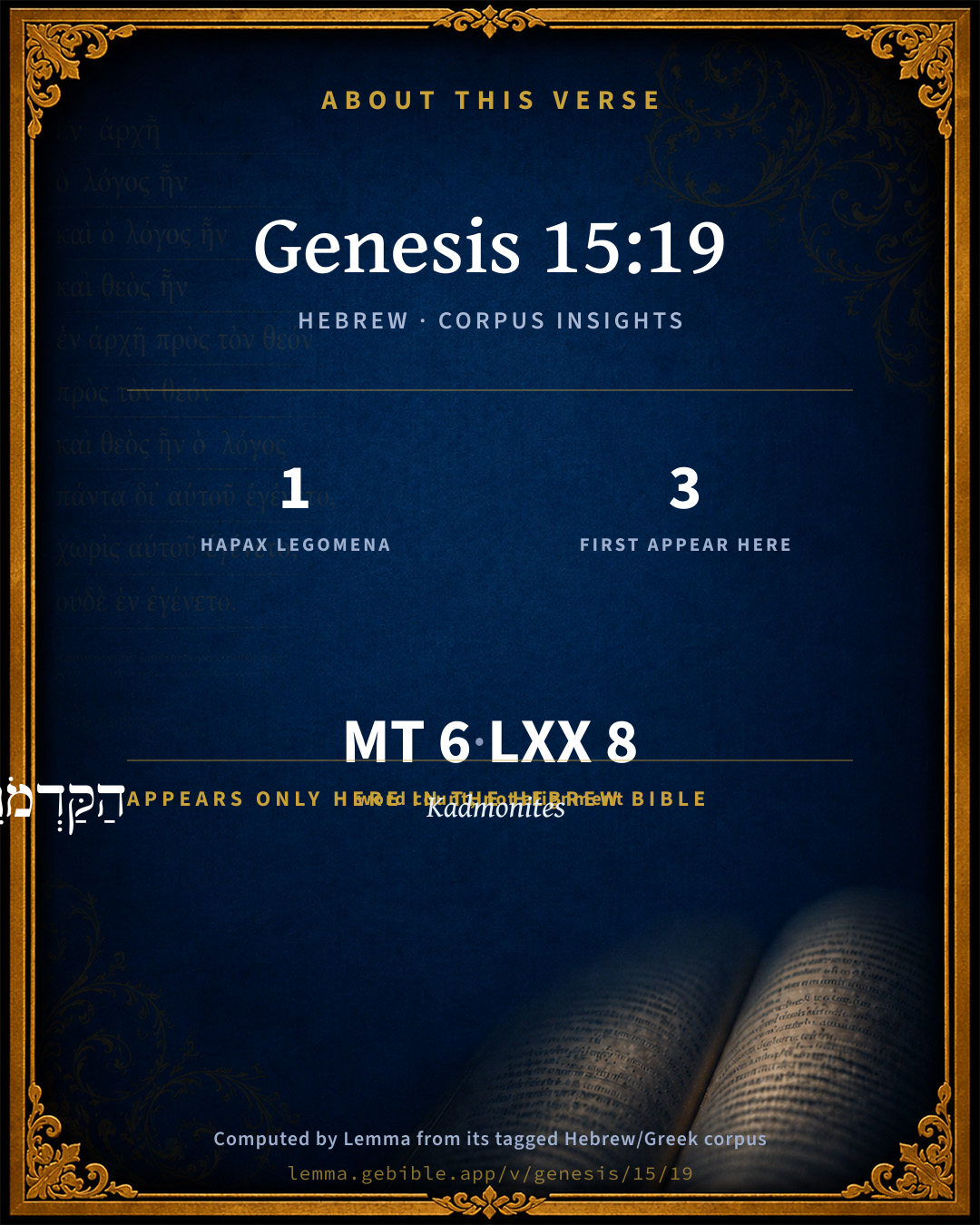
  • 1 hapax legomenon — only here in the Hebrew Bible
  • 3 first appearances in the Hebrew Bible
Full analysis ↓
Download a study sheet

One document with this verse’s original text, its word-by-word gloss line, the meaning frame, cross-references with their text, attributed commentary, and full source and license credits — printable, and it pastes into notes with its structure intact.

This verse Autodidact and up

Study sheet (.html) Plain text (.txt)

A passage Seminary Student

Up to 50 verses in one chapter. A passage sheet keeps up to 6 commentary sources and 12 cross-references per verse, in the order this page ranks them, and says so on the sheet whenever that leaves anything out. Ask for a single verse and you get the Autodidact verse sheet above.

Everything on this page stays free to read, with no account — the sheet is a download of what is already on screen, not access to it.

Want to remove ads? Support Godless Engineer
Compare translations 3

The same verse in 3 English versions, stacked beneath the original-language interlinear above. Click any original word for its lexicon entry.

Each is an independent rendering of the whole verse — the interlinear is not word-aligned to these translations.

Highlighted words mark where these versions differ — a whole-verse word diff, not a word-by-word alignment.

  • World English Bible Public Domain
    the Kenites, the Kenizzites, the Kadmonites,
  • King James Version Public Domain
    The Kenites, and the Kenizzites, and the Kadmonites,
  • unfoldingWord Literal Text CC BY-SA 4.0
    the Kenites and the Kenizzites and the Kadmonites

unfoldingWord Literal Text — © unfoldingWord, licensed CC BY-SA 4.0. Word-aligned USFM3 via Door43 (git.door43.org/unfoldingWord/en_ult).

Versions to compare (up to 4)

3 of 4 selected

Show all 18 translations

Every available English version of this verse, each an independent rendering of the whole verse.

  • World English Bible Public Domain
    the Kenites, the Kenizzites, the Kadmonites,
  • Berean Standard Bible Public Domain
    the land of the Kenites, Kenizzites, Kadmonites,
  • Majority Standard Bible Public Domain
    the land of the Kenites, Kenizzites, Kadmonites,
  • King James Version Public Domain
    The Kenites, and the Kenizzites, and the Kadmonites,
  • American Standard Version (1901) Public Domain
    the Kenite, and the Kenizzite, and the Kadmonite,
  • Revised Version (1885) Public Domain
    the Kenite, and the Kenizzite, and the Kadmonite,
  • Geneva Bible (1599) Public Domain
    The Kenites, and the Kenizites, and the Kadmonites,
  • Douay-Rheims (1899) Public Domain
    The Cineans and Cenezites, the Cedmonites,
  • Young's Literal Translation Public Domain
    with the Kenite, and the Kenizzite, and the Kadmonite,
  • Literal Standard Version CC BY-SA 4.0
    with the Kenite, and the Kenizzite, and the Kadmonite,
  • Unlocked Literal Bible CC BY-SA 4.0
    the Kenites, the Kenizzites, the Kadmonites,
  • unfoldingWord Literal Text CC BY-SA 4.0
    the Kenites and the Kenizzites and the Kadmonites
  • Darby Bible Public Domain
    the Kenites, and the Kenizzites, and the Kadmonites,
  • World Messianic Bible Public Domain
    the land of the Kenites, the Kenizzites, the Kadmonites,
  • Webster's Bible Public Domain
    The Kenites, and the Kenizzites, and the Kadmonites,
  • Free Bible Version CC BY-SA 4.0
    and includes the territory of the Kenites, Kenizzites, Kadmonites,
  • Bible in Basic English Public Domain
    The Kenite, the Kenizzite, and the Kadmonite,
  • JPS Tanakh (1917) Public Domain
    the Kenite, and the Kenizzite, and the Kadmonite,

Literal Standard Version (2020), Covenant Press — licensed CC BY-SA 4.0. Text via the HelloAO Bible API (eBible.org). Unlocked Literal Bible (unfoldingWord) — licensed CC BY-SA 4.0. Text via the HelloAO Bible API (eBible.org). unfoldingWord Literal Text — © unfoldingWord, licensed CC BY-SA 4.0. Word-aligned USFM3 via Door43 (git.door43.org/unfoldingWord/en_ult). Free Bible Version, Dr. Jonathan Gallagher — licensed CC BY-SA 4.0. Text via the HelloAO Bible API (eBible.org).

Word by word

More ways to search: Search by grammar → Find every occurrence → Compare this word →

Practice this passage: Drill this verse → Learn its vocabulary →

About this verse

These counts appear in no published source. They are computed here, from the morphology-tagged text and Lemma’s own curated glosses. What Lemma adds →

6
words
4
distinct lemmas
Pentateuch
section

Notable vocabulary

1 hapax legomenon — a word that appears only here in the entire Hebrew Bible:

  • הַקַּדְמֹנִֽי Kadmonites H6935

First appearance in Scripture

These words make their first canonical appearance in the Hebrew Bible here:

  • הַקֵּינִי֙ Kenite H7017
  • הַקְּנִזִּ֔י Kenezzite H7074
  • הַקַּדְמֹנִֽי Kadmonites H6935

Shared distinctive vocabulary

הַקְּנִזִּ֔י Kenezzite H7074 occurs in 4 verses of the Hebrew Bible. Also found in:

Grammatical profile

  • 3 nouns
  • 3 particles

Hebrew & Septuagint length

In English translation the verse runs 6 words from the Hebrew and 8 from the Septuagint (LXX English) — closely comparable.

A rough comparison of the two English renderings, which tokenize alike — not a word-level alignment.

Word counts can differ between the Hebrew and the Greek without any difference in meaning — e.g. the Hebrew direct-object marker אֵת has no separate Greek word, and Greek often adds the article ὁ.

In the original languages it is 6 Hebrew tokens and 8 Greek tokens — but the two are counted differently (Hebrew bundles its prefixes and suffixes into one token; the Greek is in lemma form), so that isn’t a like-for-like length.

Cross-references

1

Topical passages linked to Genesis 15:19 in the Treasury of Scripture Knowledge — connected by theme and wording, ordered by reader-vote popularity; previews shown in the World English Bible.

  • Numbers 24:21–22 He looked at the Kenite, and took up his parable, and said, Strong is your dwelling-place, Your nest is set in the rock.

Cross-references courtesy of OpenBible.info (CC BY 4.0).

Hebrew and Greek witnesses Masoretic Hebrew ↔ Greek Septuagint

The same verse in the two great witnesses to the Old Testament, shown verse-for-verse.

These are two independent witnesses, not word-aligned to each other, and the Septuagint is shown in lemma (dictionary) form.

Hebrew Genesis 15:19 Masoretic · Westminster Leningrad Codex

אֶת הַקֵּינִי֙ וְאֶת הַקְּנִזִּ֔י וְאֵ֖ת הַקַּדְמֹנִֽי

the Kenites, the Kenizzites, the Kadmonites,

World English Bible · Public Domain

Greek LXX Genesis 15:19 Septuagint · lemma form

ὁ καιναῖος καί ὁ κενεζαῖος καί ὁ κεδμωναῖος

The Kenites, and the Kenezites, and the Kedmoneans,

LXX2012 (modern English Septuagint) · Public Domain

Hebrew: Westminster Leningrad Codex (CC BY 4.0). Greek: Septuagint (public domain); English from LXX2012 (modern English Septuagint) (Public Domain). How the Septuagint differs from the Hebrew →

Targum (Aramaic paraphrase)

2

The Targum is the ancient Jewish Aramaic paraphrase of the Hebrew Scriptures — an interpretive translation, not the Hebrew text itself. Onkelos (literal) and Pseudo-Jonathan (expansive) render the Torah, and Jonathan the Prophets. Coverage is partial: where no permissively-licensed English translation exists for a verse, only the Aramaic is shown. This is verse-level text, not a word-by-word alignment to the Hebrew.

  1. Targum Onkelos Torah (Genesis–Deuteronomy)
    יָת שַׁלְמָאֵי וְיָת קְנִזָאֵי וְיָת קַדְמוֹנָאֵי

    (no public-domain English translation for this verse)

    Targum Onkelos — Aramaic: “Onkelos Genesis” (public domain); “Onkelos Exodus” (public domain); “Onkelos Leviticus” (public domain); “Onkelos Numbers” (public domain); “Onkelos Deuteronomy” (public domain). English: “Sefaria Community Translation” (CC0 1.0 (public-domain dedication)); “J.W. Etheridge. The Targums of Onkelos and Jonathan Ben Uzziel on the Pentateuch. London: Longmans, Green, 1862” (public domain). Text via Sefaria.

  2. Targum Pseudo-Jonathan Torah (Genesis–Deuteronomy)
    יַת שַׁלְמַיָא וְיַת קְנִיזָאָה וְיַת קַדְמוֹנָאָה

    the Shalmia, and the Kenizah, and Kadmonaah, and the

    Targum Pseudo-Jonathan — Aramaic: “Targum Jonathan on Genesis” (public domain); “Targum Jonathan on Exodus” (public domain); “Targum Jonathan on Leviticus” (public domain); “Targum Jonathan on Numbers” (public domain); “Targum Jonathan on Deuteronomy” (public domain). English: “The Targum of Jonathan ben Uzziel, trans. J. W. Etheridge, London, 1862” (public domain). Text via Sefaria.

Commentary

Notes on Genesis 15:19 from classic Christian and Jewish commentators (each source and its license shown beneath its notes). The classic Christian expositions comment on the surrounding passage and are grouped to its opening verse, so a note may address several verses; the Jewish commentaries on the Tanakh (Rashi and others) are per-verse, so they appear only where the commentator wrote on this verse.

Lemma curates 59 commentaries, every one of them public domain or Creative Commons licensed, each selected and text-cleaned for this edition rather than reprinted as found. About our sources →

Trapp's Complete Commentary

John Trapp

Gen 15:19 The Kenites, and the Kenizzites, and the Kadmonites,

Gen 15:20 And the Hittites, and the Perizzites, and the Rephaims,

Gen 15:21 And the Amorites, and the Canaanites, and the Girgashites, and the Jebusites.

Ver. 19-21. The Kenites, and the Kenezzites.] R. Salomon noteth, that whereas ten nations are here reckoned up, seven only were given to the Israelites. He addeth also, that the Kenites, Kenezzites, and Cadmonims were the same with the Edomites, Moabites, and Ammonites, all which were at length to be possessed by the Israelites.

John Trapp, A Commentary or Exposition upon All the Books of the Old and New Testament (1647–1656) — public domain. Text from a community e-Sword module.

Adam Clarke's Commentary

Verse 19. The Kenites, c.] Here are ten nations mentioned, though afterwards reckoned but seven see De 7:1; Ac 13:19. Probably some of them which existed in Abram's time had been blended with others before the time of Moses, so that seven only out of the ten then remained; see part of these noticed Ge 10:1-31.

IN this chapter there are three subjects which must be particularly interesting to the pious reader.

1. The condescension of GOD in revealing himself to mankind in a variety of ways, so as to render it absolutely evident that he had spoken, that he loved mankind, and that he had made every provision for their eternal welfare. So unequivocal were the discoveries which God made of himself, that on the minds of those to whom they were made not one doubt was left, relative either to the truth of the subject, or that it was God himself who made the discovery. The subject of the discovery also was such as sufficiently attested its truth to all future generations, for it concerned matters yet in futurity, so distinctly marked, so positively promised, and so highly interesting, as to make them objects of attention, memory, and desire, till they did come; and of gratitude, because of the permanent blessedness they communicated through all generations after the facts had taken place.

2. The way of salvation by faith in the promised Saviour, which now began to be explicitly declared. God gives the promise of salvation, and by means in which it was impossible, humanly speaking, that it should take place; teaching us, 1. That the whole work was spiritual, supernatural, and Divine; and, 2. That no human power could suffice to produce it. This Abram believed while he was yet uncircumcised, and this faith was accounted to him for righteousness or justification; God thereby teaching that he would pardon, accept, and receive into favour all who should believe on the Lord Jesus Christ. And this very case has ever since been the standard of justification by faith; and the experience of millions of men, built on this foundation, has sufficiently attested the truth and solidity of the ground on which it was built.

3. The foundation of the doctrine itself is laid in the covenant made between God and Abram in behalf of all the families of the earth, and this covenant is ratified by a sacrifice. By this covenant man is bound to God, and God graciously binds himself to man. As this covenant referred to the incarnation of Christ; and Abram, both as to himself and posterity, was to partake of the benefits of it by faith; hence faith, not works, is the only condition on which God, through Christ, forgives sins, and brings to the promised spiritual inheritance. This covenant still stands open; all the successive generations of men are parties on the one side, and Jesus is at once the sacrifice and Mediator of it. As therefore the covenant still stands open, and Jesus is still the Lamb slain before the throne, every human soul must ratify the covenant for himself; and no man does so but he who, conscious of his guilt, accepts the sacrifice which God has provided for him. Reader, hast thou done so! And with a heart unto righteousness dost thou continue to believe on the Son of God? How merciful is God, who has found out such a way of salvation by providing a Saviour every way suitable to miserable, fallen, sinful man! One who is holy, harmless, undefiled, and separate from sinners; and who, being higher than the heavens, raises up his faithful followers to the throne of his own eternal glory! Reader, give God the praise, and avail thyself of the sin-offering which lieth at the door.

Adam Clarke's Commentary on the Bible (1810–1826) — public domain. Text from a community e-Sword/MySword module.

Ellicott's Commentary for English Readers

(19) The Kenites.—An Arab race, found both among the Amalekites in the south (1Sa_15:6) and among the tribes of Naphtali and Zebulon in the north (Jdg_4:11), and even in Midian, as Jethro, the father-in-law of Moses, is called a Kenite (Jdg_1:16). Balaam speaks of them as being a powerful nation (Num_24:21), and this wide dispersion of them into feeble remnants seems to show that they were a race of early settlers in Canaan, who, like the Rephaim, had been overpowered and scattered by subsequent immigrants. They were uniformly friendly to Israel.

The Kenizzites.—The chief fact of importance connected with this race is that Caleb was a Kenezite (Num_32:12). Apparently with his clan he joined the Israelites at the Exodus, and was numbered with the tribe of Judah. Kenizzite and Kenezite are two ways of spelling the same Hebrew word, the former being right.

The Kadmonites.—This may mean either an eastern or an ancient people, of whom we know nothing.

For the Perizzites see Gen_13:7; for the Rephaims, Gen_14:5; and for the rest, Gen_10:15-18.

A Bible Commentary for English Readers, edited by Charles John Ellicott (1878–1897) — public domain. Text from a community e-Sword module.

The Cambridge Bible for Schools and Colleges

gen. ed. J. J. S. Perowne

19. the Kenite] Dwellers in the S. of Canaan, connected with the Amalekites and noted for their subsequent friendly relations with Israel. Cf. Num_24:20-21; Jdg_4:17; 1Sa_15:6.

the Kenizzite] Also a people on the Edomite border of Canaan; cf. Kenaz, Gen_36:11. Caleb, the head of the tribe of Judah, was a Kenizzite, Num_32:12, Jos_14:6. Hence the Kenizzites were probably a south Palestinian clan absorbed into the tribe of Judah.

the Kadmonite] Probably dwellers on the eastern desert frontier of Canaan. Compare “the children of the east” (b’nê ḳedem) in Gen_29:1.

19–21. The names of the ten peoples to be driven out by the Israelites. For other lists of these, cf. Exo_3:8; Exo_3:17; Exo_13:5; Exo_23:23; Exo_34:11; Deu_7:1; Deu_20:17. Here only, are ten names given; usually only five or six are mentioned. The Kenite, the Kenizzite, the Kadmonite, the Perizzite, and the Rephaim, seem here to be added to make up the full list.

These verses and Gen_15:18 are attributed by many scholars to a Deuteronomic editor.

The Cambridge Bible for Schools and Colleges (gen. ed. J. J. S. Perowne; Cambridge University Press, 1878–1918) — public domain. Text from a community e-Sword module.

John Gill's Exposition

And the Hittites,.... Who had their name from Heth, a son of Canaan, see Gen 10:15; they dwelt about Hebron, in the south of the land of Canaan:

and the Perizzites; these dwelt in the wood country of the land, Jos 17:15; and seem to have their name from dwelling in villages, and at a distance from towns and cities, and were a boorish and uncivilized people, see Gen 13:7,

and the Rephaims; or "giants", as the Targums of Onkelos, and Jonathan; they dwelt near the Perizzites, Jos 17:15; of these see Gen 14:5.

John Gill's Exposition of the Whole Bible (1746–1763) — public domain (CC PDM 1.0). Text via the HelloAO Bible API.

Haydock's Catholic Bible Commentary

Cineans, in Arabia, of which nation was Jethro. They were permitted to dwell in the tribe of Juda, and served the Hebrews. --- Cenezites, who probably inhabited the mountains of Juda. --- Cedmonites, or eastern people, as their name shews. Cadmus was of this nation, of the race of the Heveans, dwelling in the environs of mount Hermon, whence his wife was called Hermione. He was, perhaps, one of those who fled at the approach of Josue; and was said to have sowed dragons’ teeth, to people his city of Thebes in Beotia, from an allusion to the name of the Hevites, which signifies serpents. (Calmet) --- The eleven nations here mentioned were not all subdued; on account of the sins of the Hebrews. (Menochius)

George Leo Haydock (1774–1849), Haydock's Catholic Family Bible and Commentary, 1859 edition — public domain. Excludes Psalms (Douay-Rheims chapter numbering differs from Protestant) and Deuterocanonical books (Catholic canon only).

Matthew Poole's English Annotations

The Kenites are supposed the same with the Midianites, by comparing Exo 3:1, with Jdg 1:16. See also Num 24:21; 1Sa 15:6.

The Kenizzites, thought to be the Idumeans, who sprung from Kenaz of Esau's race. But this seems not to agree with Deu 2:5, where God expressly saith to the Israelites concerning the Idumeans,

I will give you none of their lands, & c.

The Kadmonites, i.e. the eastern people, as the word signifies, elsewhere called the Hivites, Jos 9:1, who lived near the Mount Hermon, Jos 11:3, which was in the east part of Canaan. See Psa 89:12.

Matthew Poole's English Annotations on the Holy Bible (1683–1685) — public domain. Text from a community e-Sword/MySword module.

Whedon's Commentary on the Bible

Daniel D. Whedon

19. Kenites… Kenizzites… Kadmonites — Ten nations are now mentioned as occupying this vast territory, seven of whom (those mentioned Gen_15:20-21) have been previously noticed. The number ten, occurring in such a prophecy as this, may well be understood to have some symbolistic significance. It seems to be the symbolic number of completed development in godless worldly empire and rule, as the toes of the image in Nebuchadnezzar’s dream, (Dan_2:42,) and the ten horns of the fourth beast. Dan_7:7; Dan_7:20; Dan_7:24. Comp. Rev_13:1; Rev_17:3; Rev_17:12. These ten heathen nations rise in prophetic vision before Abram, as representing all that long line of opposing world-forces which shall make war upon the godly seed, but in the end of the ages be overcome, so that “the kingdom and dominion, and the greatness of the kingdom under the whole heaven, shall be given to the people of the saints of the Most High.” Dan_7:27. “The Kenites inhabited rocky and mountainous tracts in the south and south-west of Palestine, near the territory of the Amalekites. Num_24:21. They may have spread, in a western direction, to the land of Egypt; so that by their expulsion the frontiers of the promised land would have nearly touched the valley of the Nile.” — Kalisch. Moses’s father-in-law was of this tribe, and some of his descendants journeyed with the children of Israel, (Jdg_1:16, see note,) and settled in the north of Palestine. Jdg_4:11; Jdg_5:24. In Saul’s time a friendly feeling was still shown toward them on account of ancient kindness, 1Sa_15:6; comp. 1Sa_27:11; 1Sa_30:29. Of the Kenizzites we have no other mention, and they were probably destroyed at an early date. The name of the Kadmonites would seem to designate them as eastern, and it is plausibly conjectured that they occupied the eastern part of the territory here given to Abram’s seed. No other mention of their name occurs.

Daniel D. Whedon (gen. ed.), Commentary on the Old and New Testaments (1874–1909) — public domain. Text from a community e-Sword module.

Radak

Rabbi David Kimhi (Radak)

את הקיני, this tribe gets its name from the city in which its members dwelled originally. The name of the city was קין, and the people known as חבר הקיני were descended from Kayin, as per Judges 4,11. Perhaps Kayin himself had built that city. We are told something to that effect in Genesis 4,17. [it is difficult to accept that this city survived the deluge, as it is difficult to accept that identifiable descendants of Kayin survived the deluge. Ed.] It is a fact that such cities as Gilead, or Chavot Yair, and Dan, received their names from their founders, naming them after themselves. (compare Joshua 19,46; Kings I 16,24; Chronicles I 2,55). According to Onkelos, it is clear that he did not accept this meaning of the name קיני, as in Numbers 24,21 he renders the Numbers 24,21 where Bileam prophesied about the Keyni's future as if it were one of the Canaanite tribes.

Radak on the Tanakh — English translations: “Sefaria Community Translation” (CC0 1.0 (public-domain dedication)); “Eliyahu Munk, HaChut Hameshulash” (CC BY 4.0); “Rabbi Mike Feuer, Jerusalem Anthology” (CC BY 4.0); and “R. David Kimhi on the first book of Psalms, Translated by R.G. Finch, London, 1919” (public domain). Text via Sefaria.

Lesson kit

Teaching starters — assembled from the data on this page, not authored interpretation. Every prompt links to the verse data it draws on. Edit before teaching.

Genesis, in the Pentateuch, opens this verse with 6 words (4 distinct Hebrew lemmas). Its most distinctive word is Qadmônîy (“Kadmonites”). A historical commentator’s framing appears above. Read the whole chapter for the surrounding context.

Discussion questions

  1. What does “Kadmonites” (Qadmônîy) contribute to the verse as a whole?
  2. This verse holds 1 word here found nowhere else in the Hebrew Bible. What might the rare word draw attention to?
  3. 3 words here appear for the first time in Scripture. What is being introduced at this debut?
  4. Numbers 32:12 shares the word «Kenezzite» with this verse. How do the two illuminate each other?
  5. Reading how Trapp's Complete Commentary and Adam Clarke's Commentary read this verse, where do the two commentators agree and where do they part?

Things to notice

Reading settings

Reading text

Shown beneath each verse's original-language words.

Old Testament
Old Testament edition

Read the OT as the Masoretic Hebrew (MT) or the Greek Septuagint (LXX).

English shown for the Greek Septuagint (in the Hebrew ↔ Greek comparison).

Comparing translations? Open the Compare panel on any verse page to stack up to four side by side.