Jeremiah 1:7

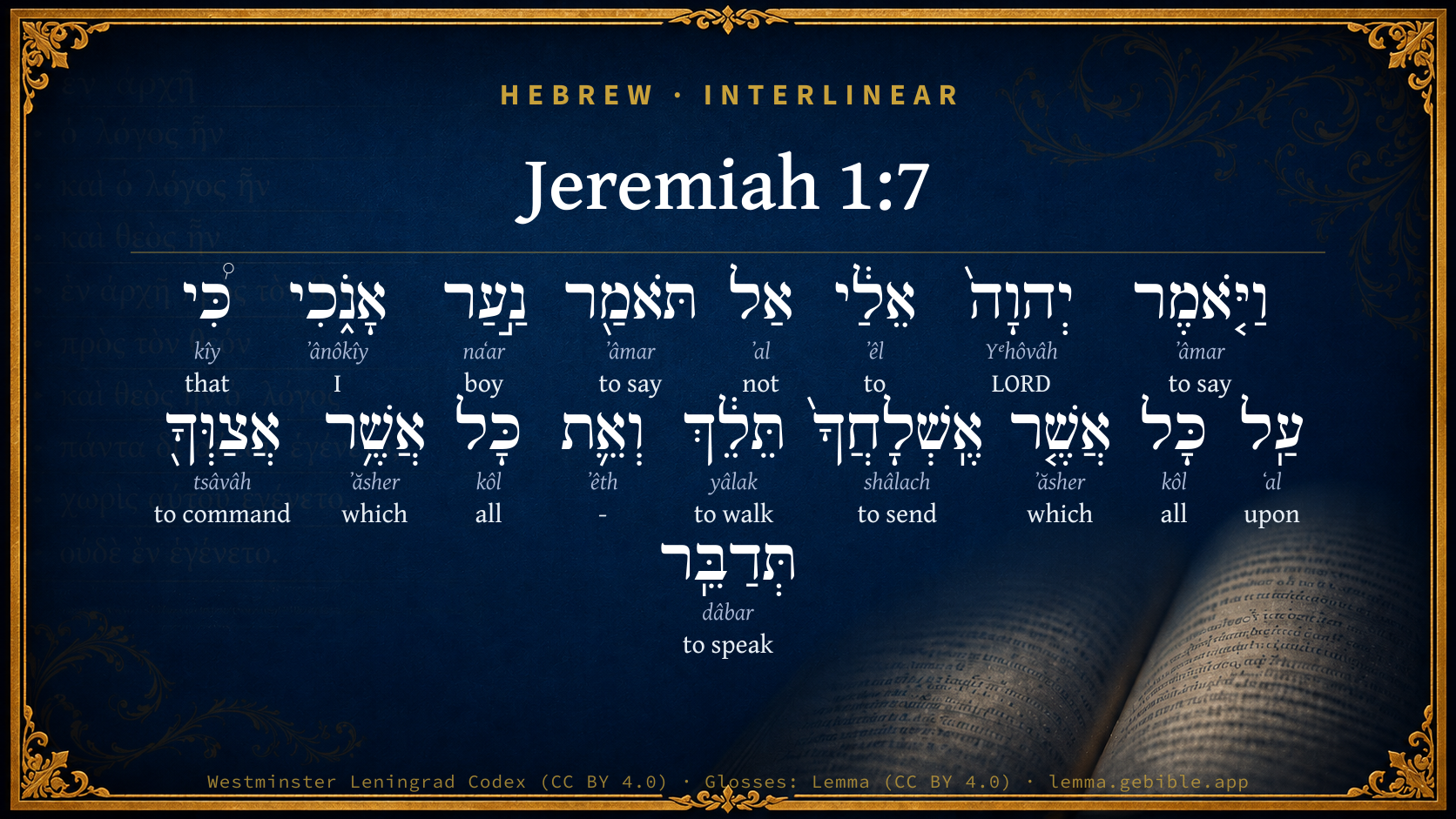
Hebrew (Westminster Leningrad Codex) Jeremiah 1:7 appears in the Hebrew Old Testament. The text above is from the Westminster Leningrad Codex. Each word links to its Strong’s number, a concise gloss, and parsing drawn from the Open Scriptures Hebrew Bible morphology. Click any word for its full Brown-Driver-Briggs (BDB) entry.
Download image
Cite this verse

Jeremiah 1:7 (World English Bible). Public Domain. Lemma interlinear Bible study tool, https://lemma.gebible.app/v/jeremiah/1/7.

Show BibTeX & RIS
BibTeX
RIS
English Translation
But Yahweh said to me, Don't say, I am a child; for to whoever I shall send you, you shall go, and whatever I shall command you, you shall speak.
World English Bible · Public Domain
Download a study sheet

One document with this verse’s original text, its word-by-word gloss line, the meaning frame, cross-references with their text, attributed commentary, and full source and license credits — printable, and it pastes into notes with its structure intact.

This verse Autodidact and up

Study sheet (.html) Plain text (.txt)

A passage Seminary Student

Up to 50 verses in one chapter. A passage sheet keeps up to 6 commentary sources and 12 cross-references per verse, in the order this page ranks them, and says so on the sheet whenever that leaves anything out. Ask for a single verse and you get the Autodidact verse sheet above.

Everything on this page stays free to read, with no account — the sheet is a download of what is already on screen, not access to it.

Want to remove ads? Support Godless Engineer
Compare translations 3

The same verse in 3 English versions, stacked beneath the original-language interlinear above. Click any original word for its lexicon entry.

Each is an independent rendering of the whole verse — the interlinear is not word-aligned to these translations.

Highlighted words mark where these versions differ — a whole-verse word diff, not a word-by-word alignment.

  • World English Bible Public Domain
    But Yahweh said to me, Don't say, I am a child; for to whoever I shall send you, you shall go, and whatever I shall command you, you shall speak.
  • King James Version Public Domain
    But the LORD said unto me, Say not, I am a child: for thou shalt go to all that I shall send thee, and whatsoever I command thee thou shalt speak.
  • unfoldingWord Literal Text CC BY-SA 4.0
    But Yahweh said to me, “Do not say, ‘I a youth,’ for to all to whom I shall send you, you shall go, and all that I command you, you shall speak.

unfoldingWord Literal Text — © unfoldingWord, licensed CC BY-SA 4.0. Word-aligned USFM3 via Door43 (git.door43.org/unfoldingWord/en_ult).

Versions to compare (up to 4)

3 of 4 selected

Show all 18 translations

Every available English version of this verse, each an independent rendering of the whole verse.

  • World English Bible Public Domain
    But Yahweh said to me, Don't say, I am a child; for to whoever I shall send you, you shall go, and whatever I shall command you, you shall speak.
  • Berean Standard Bible Public Domain
    But the LORD told me: “Do not say, ‘I am only a child.’ For to everyone I send you, you must go, and all that I command you, you must speak.
  • Majority Standard Bible Public Domain
    But the LORD told me: “Do not say, ‘I am only a child.’ For to everyone I send you, you must go, and all that I command you, you must speak.
  • King James Version Public Domain
    But the LORD said unto me, Say not, I am a child: for thou shalt go to all that I shall send thee, and whatsoever I command thee thou shalt speak.
  • American Standard Version (1901) Public Domain
    But Jehovah said unto me, Say not, I am a child; for to whomsoever I shall send thee thou shalt go, and whatsoever I shall command thee thou shalt speak.
  • Revised Version (1885) Public Domain
    But the LORD said unto me, Say not, I am a child: for to whomsoever I shall send thee thou shalt go, and whatsoever I shall command thee thou shalt speak.
  • Geneva Bible (1599) Public Domain
    But the Lord said vnto me, Say not, I am a childe: for thou shalt goe to all that I shall send thee, and whatsoeuer I command thee, shalt thou speake.
  • Douay-Rheims (1899) Public Domain
    And the Lord said to me: Say not: I am a child: for thou shalt go to all that I shall send thee: and whatsoever I shall command thee, thou shalt speak.
  • Young's Literal Translation Public Domain
    And Jehovah saith unto me, `Do not say, I `am' a youth, for to all to whom I send thee thou goest, and all that I command thee thou speakest.
  • Literal Standard Version CC BY-SA 4.0
    And YHWH says to me, “Do not say, I [am] a youth, for to all to whom I send you—go, and all that I command you—speak.
  • Unlocked Literal Bible CC BY-SA 4.0
    But Yahweh said to me, “Do not say, 'I am too young.' You must go everywhere I send you, and you must say whatever I command you!
  • unfoldingWord Literal Text CC BY-SA 4.0
    But Yahweh said to me, “Do not say, ‘I a youth,’ for to all to whom I shall send you, you shall go, and all that I command you, you shall speak.
  • Darby Bible Public Domain
    But Jehovah said unto me, Say not, I am a child; for thou shalt go to whomsoever I shall send thee, and whatsoever I command thee thou shalt speak.
  • World Messianic Bible Public Domain
    But the LORD said to me, “Don’t say, ‘I am a child;’ for you must go to whomever I send you, and you must say whatever I command you.
  • Webster's Bible Public Domain
    But the LORD said to me, Say not, I am a child: for thou shalt go to all that I shall send thee, and whatever I command thee thou shalt speak.
  • Free Bible Version CC BY-SA 4.0
    “Don't say you're too young,” the Lord told me. “Go to everyone I send you to. Tell them everything I order you to say.
  • Bible in Basic English Public Domain
    But the Lord said to me, Do not say, I am a child: for wherever I send you, you are to go, and whatever I give you orders to say, you are to say.
  • JPS Tanakh (1917) Public Domain
    But the LORD said unto me: say not: I am a child; for to whomsoever I shall send thee thou shalt go, and whatsoever I shall command thee thou shalt speak.

Literal Standard Version (2020), Covenant Press — licensed CC BY-SA 4.0. Text via the HelloAO Bible API (eBible.org). Unlocked Literal Bible (unfoldingWord) — licensed CC BY-SA 4.0. Text via the HelloAO Bible API (eBible.org). unfoldingWord Literal Text — © unfoldingWord, licensed CC BY-SA 4.0. Word-aligned USFM3 via Door43 (git.door43.org/unfoldingWord/en_ult). Free Bible Version, Dr. Jonathan Gallagher — licensed CC BY-SA 4.0. Text via the HelloAO Bible API (eBible.org).

Word by word

More ways to search: Search by grammar → Find every occurrence → Compare this word →

Practice this passage: Drill this verse → Learn its vocabulary →

נַ֣עַר
naʻar
H5288
“boy”
Noun, Common, Masculine, Singular, Absolute
Part of Speech
Noun
Type
Common
Gender
Masculine
Number
Singular
State
Absolute
Full BDB Definition

Origin: from H5287

TWOT: 1389a

a boy, lad, servant, youth, retainer - boy, lad, youth - servant, retainer
  1. וַיֹּ֤אמֶר ʼâmar H559 “and · to say” Conjunction + Verb, Qal, Sequential Imperfect, 3rd Person, Masculine, Singular
  2. יְהוָה֙ Yᵉhôvâh H3068 “LORD” Noun, Proper
  3. אֵלַ֔י ʼêl H413 “to · me” Preposition + Suffix, Personal, 1st Person, Common, Singular
  4. אַל ʼal H408 “not” Particle, Negative
  5. תֹּאמַ֖ר ʼâmar H559 “to say” Verb, Qal, Jussive, 2nd Person, Masculine, Singular
  6. אָנֹ֑כִי ʼânôkîy H595 “I” Pronoun, Personal, 1st Person, Common, Singular
  7. כִּ֠י kîy H3588 “that” Conjunction
  8. עַֽל ʻal H5921 “upon” Preposition
  9. כָּל kôl H3605 “all of” Noun, Common, Masculine, Singular, Construct
  10. אֲשֶׁ֤ר ʼăsher H834 “which” Particle, Relative
  11. אֶֽשְׁלָחֲךָ֙ shâlach H7971 “to send · you” Verb, Qal, Imperfect, 1st Person, Common, Singular + Suffix, Personal, 2nd Person, Masculine, Singular
  12. תֵּלֵ֔ךְ yâlak H3212 “to walk” Verb, Qal, Imperfect, 2nd Person, Masculine, Singular
  13. וְאֵ֛ת ʼêth H853 “and · -” Conjunction + Particle, Direct Object
  14. כָּל kôl H3605 “all of” Noun, Common, Masculine, Singular, Construct
  15. אֲשֶׁ֥ר ʼăsher H834 “which” Particle, Relative
  16. אֲצַוְּךָ֖ tsâvâh H6680 “to command · you” Verb, Piel, Imperfect, 1st Person, Common, Singular + Suffix, Personal, 2nd Person, Masculine, Singular
  17. תְּדַבֵּֽר dâbar H1696 “to speak” Verb, Piel, Imperfect, 2nd Person, Masculine, Singular

About this verse

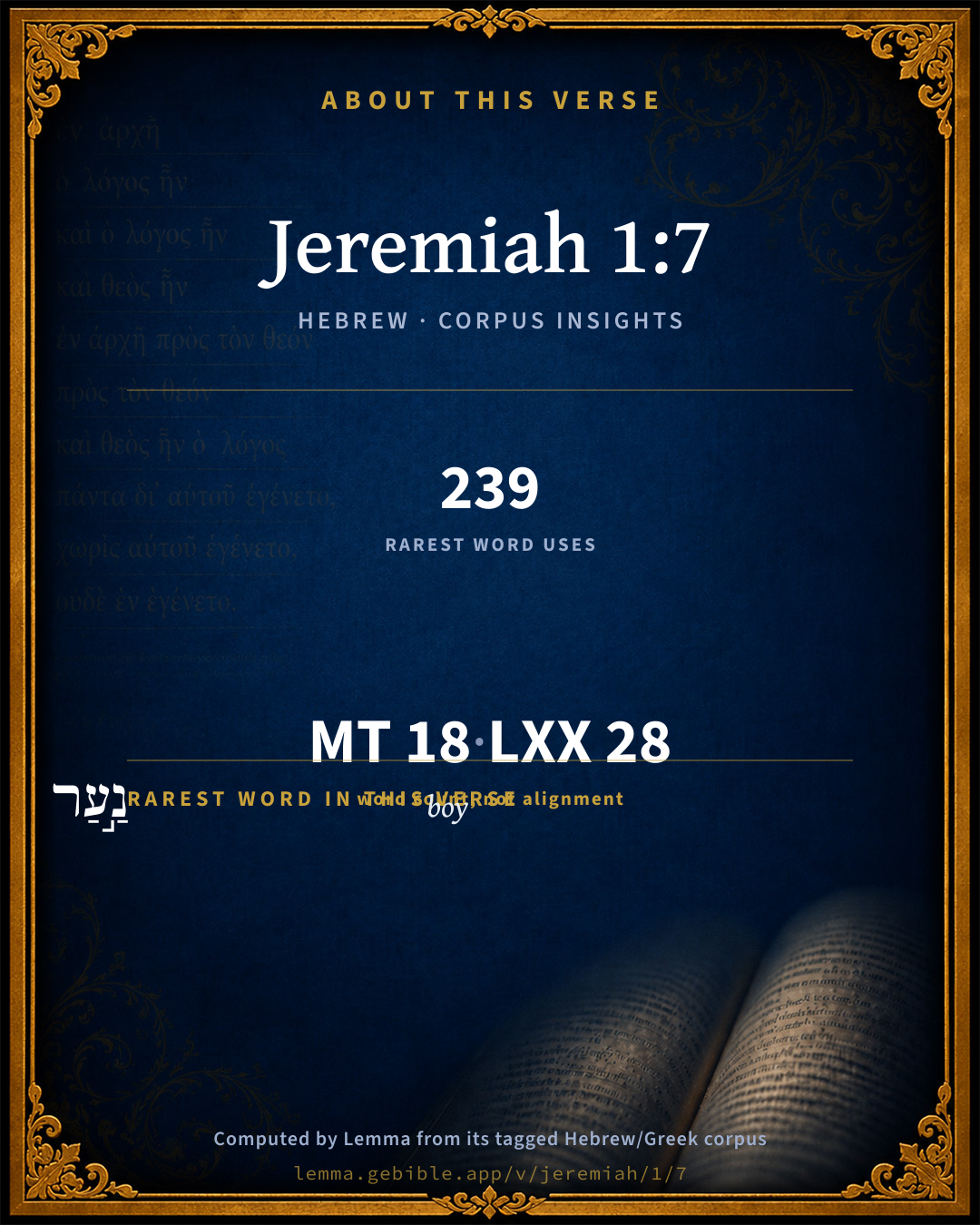
These counts appear in no published source. They are computed here, from the morphology-tagged text and Lemma’s own curated glosses. What Lemma adds →

18
words
15
distinct lemmas
Prophets
section

Grammatical profile

  • 6 verbs
  • 4 nouns
  • 1 pronoun
  • 2 prepositions
  • 1 conjunction
  • 4 particles

Verb forms

  • וַיֹּ֤אמֶר Qal · Sequential Imperfect
  • תֹּאמַ֖ר Qal · Jussive
  • אֶֽשְׁלָחֲךָ֙ Qal · Imperfect
  • תֵּלֵ֔ךְ Qal · Imperfect
  • אֲצַוְּךָ֖ Piel · Imperfect
  • תְּדַבֵּֽר Piel · Imperfect

Repetition

Words recur within this verse — often emphatic in Hebrew:

  • וַיֹּ֤אמֶר to say H559 ×2
  • כָּל all H3605 ×2
  • אֲשֶׁ֤ר which H834 ×2

Hebrew & Septuagint length

In the original languages it is 18 Hebrew tokens and 28 Greek tokens — but the two are counted differently (Hebrew bundles its prefixes and suffixes into one token; the Greek is in lemma form), so that isn’t a like-for-like length.

Cross-references

12

Topical passages linked to Jeremiah 1:7 in the Treasury of Scripture Knowledge — connected by theme and wording, ordered by reader-vote popularity; previews shown in the World English Bible.

  • Ezekiel 3:27 But when I speak with you, I will open your mouth, and you shall tell them, Thus says the Lord Yahweh: He who hears, let him hear; and he who forbears, let him forbear: for they are a rebellious house.
  • Mark 16:15–16 He said to them, "Go into all the world, and preach the Gospel to the whole creation.
  • Numbers 22:20 God came to Balaam at night, and said to him, If the men are come to call you, rise up, go with them; but only the word which I speak to you, that shall you do.
  • 2 Chronicles 18:13 Micaiah said, As Yahweh lives, what my God says, that will I speak.
  • Ezekiel 3:17–21 Son of man, I have made you a watchman to the house of Israel: therefore hear the word at my mouth, and give them warning from me.
  • Numbers 22:38 Balaam said to Balak, Behold, I have come to you: have I now any power at all to speak anything? the word that God puts in my mouth, that shall I speak.
  • Jeremiah 1:17–18 You therefore gird up your loins, and arise, and speak to them all that I command you: don't be dismayed at them, lest I dismay you before them.
  • Ezekiel 2:3–5 He said to me, Son of man, I send you to the children of Israel, to nations that are rebellious, which have rebelled against me: they and their fathers have transgressed against me even to this very day.
  • Matthew 28:20 teaching them to observe all things that I commanded you. Behold, I am with you always, even to the end of the age." Amen.
  • Exodus 7:1–2 Yahweh said to Moses, "Behold, I have made you as God to Pharaoh; and Aaron your brother shall be your prophet.
  • 1 Kings 22:14 Micaiah said, As Yahweh lives, what Yahweh says to me, that will I speak.
  • Acts 20:27 for I didn't shrink from declaring to you the whole counsel of God.

Cross-references courtesy of OpenBible.info (CC BY 4.0).

Hebrew and Greek witnesses Masoretic Hebrew ↔ Greek Septuagint

The same verse in the two great witnesses to the Old Testament, shown verse-for-verse.

These are two independent witnesses, not word-aligned to each other, and the Septuagint is shown in lemma (dictionary) form.

Hebrew Jeremiah 1:7 Masoretic · Westminster Leningrad Codex

וַיֹּ֤אמֶר יְהוָה֙ אֵלַ֔י אַל תֹּאמַ֖ר נַ֣עַר אָנֹ֑כִי כִּ֠י עַֽל כָּל אֲשֶׁ֤ר אֶֽשְׁלָחֲךָ֙ תֵּלֵ֔ךְ וְאֵ֛ת כָּל אֲשֶׁ֥ר אֲצַוְּךָ֖ תְּדַבֵּֽר

But Yahweh said to me, Don't say, I am a child; for to whoever I shall send you, you shall go, and whatever I shall command you, you shall speak.

World English Bible · Public Domain

Greek LXX Structure differs

In the Septuagint, Jeremiah is about an eighth shorter than the Hebrew and arranges its material differently — the Oracles Against the Nations (Hebrew chapters 46–51) appear in the middle of the Greek book, after 25:13. Because the chapter and verse boundaries do not line up, a verse-for-verse comparison with the Hebrew is not shown.

A verse-for-verse comparison isn’t shown here because the chapters and verses don’t line up. Switch to the LXX edition with the MT / LXX toggle above to read the Greek directly.

On this verse, John Gill's Exposition discusses the Septuagint’s reading. Read the note in Commentary ↓

Hebrew: Westminster Leningrad Codex (CC BY 4.0). Greek: Septuagint (public domain); English from a public-domain English Septuagint. How the Septuagint differs from the Hebrew →

Targum (Aramaic paraphrase)

1

The Targum is the ancient Jewish Aramaic paraphrase of the Hebrew Scriptures — an interpretive translation, not the Hebrew text itself. Onkelos (literal) and Pseudo-Jonathan (expansive) render the Torah, and Jonathan the Prophets. Coverage is partial: where no permissively-licensed English translation exists for a verse, only the Aramaic is shown. This is verse-level text, not a word-by-word alignment to the Hebrew.

  1. Targum Jonathan Prophets (Joshua–Malachi)
    וַאֲמַר יְיָ לִי לָא תֵמַר רָבֵי אֲנָא אֲרֵי לְכָל אֲתַר דְאַשְׁלְחִינָךְ תְּהַךְ וְיַת כָּל דְאַפְקְדִינָךְ תִּתְנַבֵּי:

    (no public-domain English translation for this verse)

    Targum Jonathan — Aramaic: “Mikraot Gedolot” (public domain). English: “Sefaria Community Translation” (CC0 1.0 (public-domain dedication)); “London "Chaldee Paraphrase," 1871” (public domain). Text via Sefaria.

Commentary

Notes on Jeremiah 1:7 from classic Christian and Jewish commentators (each source and its license shown beneath its notes). The classic Christian expositions comment on the surrounding passage and are grouped to its opening verse, so a note may address several verses; the Jewish commentaries on the Tanakh (Rashi and others) are per-verse, so they appear only where the commentator wrote on this verse.

Lemma curates 59 commentaries, every one of them public domain or Creative Commons licensed, each selected and text-cleaned for this edition rather than reprinted as found. About our sources →

Trapp's Complete Commentary

John Trapp

Jer 1:7 But the LORD said unto me, Say not, I [am] a child: for thou shalt go to all that I shall send thee, and whatsoever I command thee thou shalt speak.

Ver. 7. Say not, I am a child.] Plead no excuses, cast no perils; never dispute, but despatch; never reason, but run, {a} depending for direction and success upon God alone, in whom are all our fresh springs, and from whom is all our sufficiency, &c. Paul was a most unlikely piece of wood to make what he was afterwards called, a Mercury, {Act 14:12} yet God made use of him. {Act 9:13-15}

For thou shalt go to all that I shall send thee.] Whether kings or captives, lords or losels. He preached before Jehoiakim concerning the office of a king, and threatened him with the burial of an ass; {Jer 22:18-19; Jer 36:30} he dealt plainly with the princes who beat him, and with the priests who stocked him with all sorts, to his great cost; he was a heroic and unexpugnable spirit; so are not many in these times, Verbi Dei truncatores et emasculatores, men pleasing preachers.

{a} God loveth not quarists, but currists, said Luther.

John Trapp, A Commentary or Exposition upon All the Books of the Old and New Testament (1647–1656) — public domain. Text from a community e-Sword module.

Joseph Benson's Commentary

Jer 1:7-8. But the Lord said unto me, &c. — God refuses to accept of his excuse, and renews his commission to him to execute the prophetic office. Thus God refused to accept the excuse of Moses, made on a like occasion. See Exo 6:30; and Exo 7:1-2. Thou shalt go to all that I shall send thee — This is not so much a command as a promise: as much as to say, I will enable thee, notwithstanding thy youth, to go with proper boldness to those to whom I send thee, and to declare my commands with that dignity and precision wherewith they ought to be uttered. Be not afraid of their faces: for I am with thee, &c. — The style of God’s commission to his prophets and messengers commonly runs in these words, I am with thee, (see the margin,) importing that God, who sent them, would enable them to discharge the office he had committed to them, and would give them strength proportionable to the work in which they engaged. To reprove the faults of all persons, of the high as well as the low, the rich as well as the poor, with that plainness and impartiality which the prophets used, required a more than ordinary degree of courage, as well as of prudence, for which cause the promise of God’s presence with them was particularly necessary, to encourage them in the discharge of their duty.

Joseph Benson's Commentary on the Old and New Testaments (1811–1818) — public domain. Text from a community e-Sword module.

Tyndale Open Study Notes

Tyndale Open Resources

1:7-8 God urged Jeremiah to look beyond himself to the importance of the task he was called to fulfill. He had to meet God’s requirements for a royal messenger, which included willingness to travel and the faithful delivery of the Lord’s messages.

Tyndale Open Study Notes — © Tyndale Open Resources, licensed CC BY-SA 4.0. Text via the HelloAO Bible API.

Jamieson, Fausset & Brown

Robert Jamieson, A. R. Fausset & David Brown

to all that--to all "to whom" [ROSENMULLER]. Rather, "to all against whom"; in a hostile sense (compare Jer 1:8, Jer 1:17-19) [MAURER]. Such was the perversity of the rulers and people of Judea at that time, that whoever would desire to be a faithful prophet needed to arm himself with an intrepid mind; Jeremiah was naturally timid and sensitive; yet the Spirit moulded him to the necessary degree of courage without taking away his peculiar individuality.

Jamieson, Fausset & Brown — Commentary Critical and Explanatory on the Whole Bible (1871) — public domain (CC PDM 1.0). Text via the HelloAO Bible API.

Adam Clarke's Commentary

Verse 7. Whatsoever I command thee] It is my words and message, not thine own, that thou shalt deliver. I shall teach thee; therefore thy youth and inexperience can be no hinderance.

Adam Clarke's Commentary on the Bible (1810–1826) — public domain. Text from a community e-Sword/MySword module.

John Calvin's Commentaries

Now follows the answer given to him, Say not, I am a child; for thou shalt go, etc. God not only predicts here what the Prophet was to do, but declares also what he designed him to do, and what he required from him, as though he had said, “It is thy duty to obey, because I have the right to command: thou must, therefore, go wheresoever I shall send thee, and thou must also proclaim whatsoever I shall command thee.” By these words God reminds him that he was his servant, and that there was no reason why a sense of his own weakness should make him afraid; for it ought to have been enough for him simply to obey his command.

And it is especially necessary to know this doctrine: for as we ought to undertake nothing without considering what our strength is, so when God enjoins anything, we ought, immediately to obey his word as it were with closed eyes. Prudence is justly praised by writers; and it is what ought to be attended to by all generally; they ought to consider what the shoulders can bear, and cannot bear. For whence is it that many have so much audacity and boldness, except that they hurry on through extreme self — confidence? Hence, in all undertakings, this should be the first thing, that every one should weigh well his own strength, and take in hand what comports with the measure of his capacity. Then no one would foolishly obtrude himself, and arrogate to himself more than what is right. But when God calls us, we ought to obey, however deficient we may in all things be: and this is what we learn from what God says here, Say not, I am a child; that is, “though thou, indeed, thinkest thyself destitute of every qualification, though thou art conscious of thine own weakness, yet thou shalt go, thou must go wheresoever I shall send thee.” God, then, requires this honor to be simply conceded to him, that men should obey his commands, though the qualification necessary to execute them be wanting. It afterwards follows —

John Calvin's Commentaries (1540-1563) — public domain. Text from the Calvin Translation Society English edition (1840s-50s) via the Christian Classics Ethereal Library (ccel.org). Calvin's coverage is partial (roughly two-thirds of the Bible); uncommented books and verses are honest gaps, never fabricated. The 19th-century editor's footnotes and remarks are omitted so the notes are faithfully Calvin's own voice.

Ellicott's Commentary for English Readers

(7) The Lord said unto me.—The misgiving, which was not reluctance, is met by words of encouragement. God gave the work; He would also give the power.

A Bible Commentary for English Readers, edited by Charles John Ellicott (1878–1897) — public domain. Text from a community e-Sword module.

The Cambridge Bible for Schools and Colleges

gen. ed. J. J. S. Perowne

7. Here again there is brought out the contrast between Moses and Jeremiah. The former had offered one objection after another (Exo_3:11; Exo_3:13; Exo_4:1; Exo_4:10; Exo_4:13), and consequently (Jer_4:14) “the anger of the Lord was kindled against Moses.” But in Jeremiah’s case encouragement alone was needed, and it is given at once in word and then in act.

The Cambridge Bible for Schools and Colleges (gen. ed. J. J. S. Perowne; Cambridge University Press, 1878–1918) — public domain. Text from a community e-Sword module.

John Gill's Exposition

But the Lord said unto me, say not, I am a child,.... This excuse will not be admitted:

for thou shall go to all that I shall send thee; either to "every place", as the Targum paraphrases; or "to all persons to whom" he should be sent, as the Septuagint and Arabic versions render the words; or "to all things for which" he should send him, as the Syriac and Vulgate Latin versions. The sense is, that he should go everywhere, and to every person, and on every errand and message he should be sent unto and with:

and whatsoever I command thee, thou shall speak; out and openly, and keep back nothing through the fear of men; as follows:

John Gill's Exposition of the Whole Bible (1746–1763) — public domain (CC PDM 1.0). Text via the HelloAO Bible API.

Albert Barnes' Notes on the Bible

Jeremiah suggested two difficulties, the first inexperience, the second timidity. God now removes the first of these. Inexperience is no obstacle where the duty is simple obedience His timidity is removed by the promise given him in the next verse.

Albert Barnes' Notes on the Bible (1834–1885) — public domain. Text from a community e-Sword/MySword module.

Matthew Poole's English Annotations

Say not, I am a child; do not plead excuses.

Thou shalt go: this is God’s answer to Jeremiah, in respect of his sense of his own inability. This may be by way of command, and then it is a check to his timorousness; Thou shalt go, therefore draw not back. Or by way of promise, and then it is a satisfactory answer to his excuse, as both proceeded from a sense of his own insufficiency: q.d. Fear not, I will make thee eloquent and courageous.

To all: this relates either to persons or things.

To all, i.e. to all persons to whom I shall send thee; thou shalt balk none: see Rev 10:11. Or,

upon all, so is the Hebrew; and then it is, Thou shalt go upon all errands and messages that I shall send thee. See Isa 55:11; Act 26:16.

Matthew Poole's English Annotations on the Holy Bible (1683–1685) — public domain. Text from a community e-Sword/MySword module.

Whedon's Commentary on the Bible

Daniel D. Whedon

7, 8. I shall send thee… I am with thee — God sometimes seeks our weakness as well as our strength. Seeming disqualifications may even constitute special fitness: for all real sufficiency is of God. Young or old, wise or foolish, cultured or without culture, it is always enough that God says, “I send thee; I am with thee.”

Daniel D. Whedon (gen. ed.), Commentary on the Old and New Testaments (1874–1909) — public domain. Text from a community e-Sword module.

The Pulpit Commentary

Thou shalt go, etc. Thoughts of self are altogether out of place in one who has received a Divine commission. Jeremiah"s duty is simple obedience. In put-suing this path he cannot but be safe (ver. 8).

The Pulpit Commentary (1880–1919), ed. H.D.M. Spence-Jones & Joseph S. Exell — public domain. Text from a community e-Sword module.

John Wesley's Explanatory Notes

Thou shalt speak - Fear not, I will make thee eloquent and courageous.

John Wesley, Explanatory Notes Upon the Whole Bible (1754–1765) — public domain. Text via the GEBible commentary corpus.

Keil & Delitzsch

C. F. Keil & F. Delitzsch

This excuse God holds of no account. As prophet to the nations, Jeremiah was not to make known his own thoughts or human wisdom, but the will and counsel of God which were to be revealed to him. This is signified by the clauses: for to all to whom I send thee, etc. The על belonging to תלך stands for אל, and does not indicate a hostile advance against any one. כל after על is not neuter, but refers to persons, or rather peoples; since to the relative אשׁר in this connection, עליהם is quite a natural completion; cf. Isa 8:12, and Ew. 331, c. Only to those men or peoples is he to go to whom God sends him; and to them he is to declare only what God commands him. And so he needs be in no anxiety on this head, that, as a youth, he has no experience in the matter of speaking.

Keil & Delitzsch — Biblical Commentary on the Old Testament (1861–1891) — public domain (CC PDM 1.0). Text via the HelloAO Bible API. (Old Testament only.)

unfoldingWord translationNotes

Door43 World Missions Community

Do not be afraid of them

"Do not be afraid of the people I will send you to speak to"

this is Yahweh's declaration

The word "this" refers to what Yahweh just said in verses 7 and 8.

this is Yahweh's declaration

Yahweh speaks of himself by name to express the certainty of what he is declaring. AT: "this is what Yahweh has declared" or "this is what I, Yahweh, have declared" (See: First, Second, or Third Person)

translationWords

Yahweh

send

command

fear

declare

unfoldingWord translationNotes — © Distant Shores Media and the Door43 World Missions Community, licensed CC BY-SA 4.0. Source: git.door43.org/Door43/en_tn.

Rashi

Rabbi Shlomo Yitzchaki (Rashi)

wherever I send you to the heathens.

and whatever I command you to Israel, you shall speak.

Rashi on the Tanakh — English translations: “The Judaica Press complete Tanach with Rashi, translated by A. J. Rosenberg” (CC BY 4.0); “Pentateuch with Rashi's commentary by M. Rosenbaum and A.M. Silbermann, 1929-1934” (public domain); “The Metsudah Tanach series, Lakewood, N.J” (CC BY 4.0); and “The Book of Joshua, Metsudah Publications, 1997” (CC BY 4.0). Text via Sefaria.

Lesson kit

Teaching starters — assembled from the data on this page, not authored interpretation. Every prompt links to the verse data it draws on. Edit before teaching.

Jeremiah, in the Prophets, opens this verse with 18 words (15 distinct Hebrew lemmas). Its most distinctive word is naʻar (“boy”). A historical commentator’s framing appears above. Read the whole chapter for the surrounding context.

Discussion questions

  1. How does “boy” (naʻar) shape what this verse is saying?
  2. How does Ezekiel 3:27, which shares this passage’s theme, read alongside this verse?
  3. What does the repetition of “to say” (2× in this one verse) do in this verse?
  4. These translations render this verse differently. What is at stake in choosing one wording over another?
  5. «וַיֹּ֤אמֶר» is a Qal Sequential Imperfect verb. How does that grammatical form shape the action described?
  6. Compare how Trapp's Complete Commentary and Joseph Benson's Commentary read this verse. Where do they agree or differ?

Things to notice

Reading settings

Reading text

Shown beneath each verse's original-language words.

Old Testament
Old Testament edition

Read the OT as the Masoretic Hebrew (MT) or the Greek Septuagint (LXX).

English shown for the Greek Septuagint (in the Hebrew ↔ Greek comparison).

Comparing translations? Open the Compare panel on any verse page to stack up to four side by side.