

Proverbs 25:11

Hebrew (Westminster Leningrad Codex) Proverbs 25:11 appears in the Hebrew Old Testament. The text above is from the Westminster Leningrad Codex. Each word links to its Strong’s number, a concise gloss, and parsing drawn from the Open Scriptures Hebrew Bible morphology. Click any word for its full Brown-Driver-Briggs (BDB) entry.
Download image
Cite this verse

Proverbs 25:11 (World English Bible). Public Domain. Lemma interlinear Bible study tool, https://lemma.gebible.app/v/proverbs/25/11.

Show BibTeX & RIS
BibTeX
RIS
English Translation
A word fitly spoken Is like apples of gold in settings of silver.
World English Bible · Public Domain
Highlights
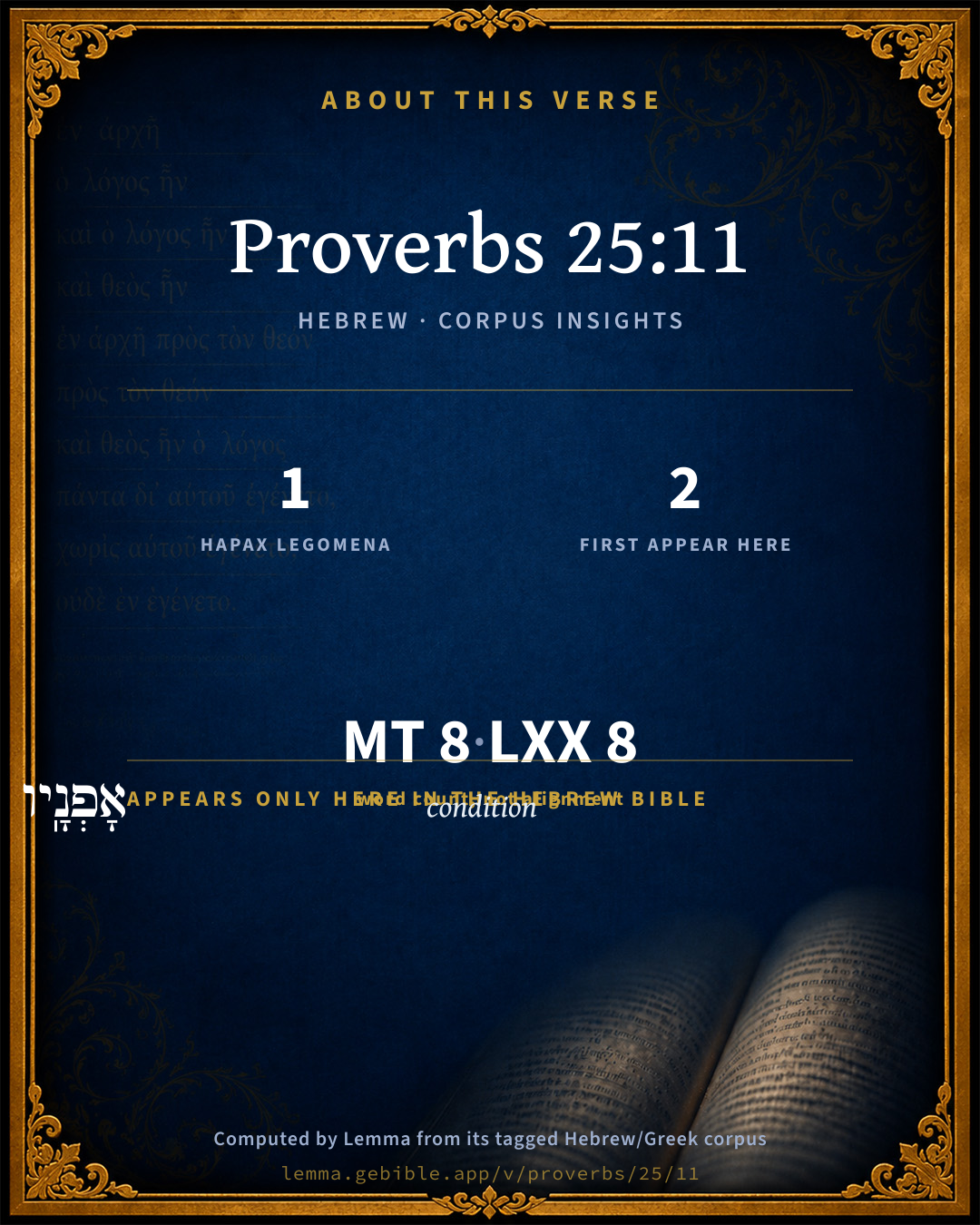
  • 1 hapax legomenon — only here in the Hebrew Bible
  • 2 first appearances in the Hebrew Bible
Full analysis ↓
Download a study sheet

One document with this verse’s original text, its word-by-word gloss line, the meaning frame, cross-references with their text, attributed commentary, and full source and license credits — printable, and it pastes into notes with its structure intact.

This verse Autodidact and up

Study sheet (.html) Plain text (.txt)

A passage Seminary Student

Up to 50 verses in one chapter. A passage sheet keeps up to 6 commentary sources and 12 cross-references per verse, in the order this page ranks them, and says so on the sheet whenever that leaves anything out. Ask for a single verse and you get the Autodidact verse sheet above.

Everything on this page stays free to read, with no account — the sheet is a download of what is already on screen, not access to it.

Want to remove ads? Support Godless Engineer
Compare translations 3

The same verse in 3 English versions, stacked beneath the original-language interlinear above. Click any original word for its lexicon entry.

Each is an independent rendering of the whole verse — the interlinear is not word-aligned to these translations.

Highlighted words mark where these versions differ — a whole-verse word diff, not a word-by-word alignment.

  • World English Bible Public Domain
    A word fitly spoken Is like apples of gold in settings of silver.
  • King James Version Public Domain
    A word fitly spoken is like apples of gold in pictures of silver.
  • unfoldingWord Literal Text CC BY-SA 4.0
    Apples of gold in sculptures of silver a word spoken according to its circumstance.

unfoldingWord Literal Text — © unfoldingWord, licensed CC BY-SA 4.0. Word-aligned USFM3 via Door43 (git.door43.org/unfoldingWord/en_ult).

Versions to compare (up to 4)

3 of 4 selected

Show all 18 translations

Every available English version of this verse, each an independent rendering of the whole verse.

  • World English Bible Public Domain
    A word fitly spoken Is like apples of gold in settings of silver.
  • Berean Standard Bible Public Domain
    A word fitly spoken is like apples of gold in settings of silver.
  • Majority Standard Bible Public Domain
    A word fitly spoken is like apples of gold in settings of silver.
  • King James Version Public Domain
    A word fitly spoken is like apples of gold in pictures of silver.
  • American Standard Version (1901) Public Domain
    A word fitly spoken Is `like' apples of gold in network of silver.
  • Revised Version (1885) Public Domain
    A word fitly spoken is like apples of gold in baskets of silver.
  • Geneva Bible (1599) Public Domain
    A word spoken in his place, is like apples of golde with pictures of siluer.
  • Douay-Rheims (1899) Public Domain
    To speak a word in due time, is like apples of gold on beds of silver.
  • Young's Literal Translation Public Domain
    Apples of gold in imagery of silver, `Is' the word spoken at its fit times.
  • Literal Standard Version CC BY-SA 4.0
    Apples of gold in imagery of silver, || [Is] the word spoken at its fit times.
  • Unlocked Literal Bible CC BY-SA 4.0
    Apples of gold in settings of silver is a word spoken in the right situation.
  • unfoldingWord Literal Text CC BY-SA 4.0
    Apples of gold in sculptures of silver a word spoken according to its circumstance.
  • Darby Bible Public Domain
    [As] apples of gold in pictures of silver, is a word spoken in season.
  • World Messianic Bible Public Domain
    A word fitly spoken is like apples of gold in settings of silver.
  • Webster's Bible Public Domain
    A word fitly spoken is like apples of gold in pictures of silver.
  • Free Bible Version CC BY-SA 4.0
    Advice given at the right time is like golden apples set in silver.
  • Bible in Basic English Public Domain
    A word at the right time is like apples of gold in a network of silver.
  • JPS Tanakh (1917) Public Domain
    A word fitly spoken is like apples of gold in settings of silver.

Literal Standard Version (2020), Covenant Press — licensed CC BY-SA 4.0. Text via the HelloAO Bible API (eBible.org). Unlocked Literal Bible (unfoldingWord) — licensed CC BY-SA 4.0. Text via the HelloAO Bible API (eBible.org). unfoldingWord Literal Text — © unfoldingWord, licensed CC BY-SA 4.0. Word-aligned USFM3 via Door43 (git.door43.org/unfoldingWord/en_ult). Free Bible Version, Dr. Jonathan Gallagher — licensed CC BY-SA 4.0. Text via the HelloAO Bible API (eBible.org).

Word by word

More ways to search: Search by grammar → Find every occurrence → Compare this word →

Practice this passage: Drill this verse → Learn its vocabulary →

About this verse

These counts appear in no published source. They are computed here, from the morphology-tagged text and Lemma’s own curated glosses. What Lemma adds →

8
words
8
distinct lemmas
Wisdom
section

Notable vocabulary

1 hapax legomenon — a word that appears only here in the entire Hebrew Bible:

  • אָפְנָֽיו condition H655

First appearance in Scripture

These words make their first canonical appearance in the Hebrew Bible here:

  • תַּפּוּחֵ֣י apple H8598
  • אָפְנָֽיו condition H655

Shared distinctive vocabulary

תַּפּוּחֵ֣י apple H8598 occurs in 6 verses of the Hebrew Bible. Also found in:

Grammatical profile

  • 1 verb
  • 6 nouns
  • 1 preposition

Verb forms

  • דָּבֻ֥ר Qal · Participle Passive

Hebrew & Septuagint length

In English translation the verse runs 13 words from the Hebrew and 17 from the Septuagint (LXX English) — closely comparable.

A rough comparison of the two English renderings, which tokenize alike — not a word-level alignment.

Word counts can differ between the Hebrew and the Greek without any difference in meaning — e.g. the Hebrew direct-object marker אֵת has no separate Greek word, and Greek often adds the article ὁ.

In the original languages it is 8 Hebrew tokens and 8 Greek tokens — but the two are counted differently (Hebrew bundles its prefixes and suffixes into one token; the Greek is in lemma form), so that isn’t a like-for-like length.

Cross-references

4

Topical passages linked to Proverbs 25:11 in the Treasury of Scripture Knowledge — connected by theme and wording, ordered by reader-vote popularity; previews shown in the World English Bible.

  • Proverbs 15:23 Joy comes to a man with the reply of his mouth. How good is a word at the right time!
  • Isaiah 50:4 The Lord Yahweh has given me the tongue of those who are taught, that I may know how to sustain with words him who is weary: he wakens morning by morning, he wakens my ear to hear as those who are taught.
  • Ecclesiastes 12:10 The Preacher sought to find out acceptable words, and that which was written blamelessly, words of truth.
  • Proverbs 24:26 An honest answer Is like a kiss on the lips.

Cross-references courtesy of OpenBible.info (CC BY 4.0).

Hebrew and Greek witnesses Masoretic Hebrew ↔ Greek Septuagint

The same verse in the two great witnesses to the Old Testament, shown verse-for-verse.

These are two independent witnesses, not word-aligned to each other, and the Septuagint is shown in lemma (dictionary) form.

Hebrew Proverbs 25:11 Masoretic · Westminster Leningrad Codex

תַּפּוּחֵ֣י זָ֭הָב בְּמַשְׂכִּיּ֥וֹת כָּ֑סֶף דָּ֝בָ֗ר דָּבֻ֥ר עַל אָפְנָֽיו

A word fitly spoken Is like apples of gold in settings of silver.

World English Bible · Public Domain

Greek LXX Proverbs 25:11 Septuagint · lemma form

μῆλον χρυσοῦς ἐν ὁρμίσκος σάρδιον οὕτως εἶπον λόγος

As a golden apple in a necklace of sardius, so is it to speak a wise word.

LXX2012 (modern English Septuagint) · Public Domain

On this verse, The Cambridge Bible for Schools and Colleges discusses the Septuagint’s reading. Read the note in Commentary ↓

Hebrew: Westminster Leningrad Codex (CC BY 4.0). Greek: Septuagint (public domain); English from LXX2012 (modern English Septuagint) (Public Domain). How the Septuagint differs from the Hebrew →

Commentary

Notes on Proverbs 25:11 from classic Christian and Jewish commentators (each source and its license shown beneath its notes). The classic Christian expositions comment on the surrounding passage and are grouped to its opening verse, so a note may address several verses; the Jewish commentaries on the Tanakh (Rashi and others) are per-verse, so they appear only where the commentator wrote on this verse.

Lemma curates 59 commentaries, every one of them public domain or Creative Commons licensed, each selected and text-cleaned for this edition rather than reprinted as found. About our sources →

Trapp's Complete Commentary

John Trapp

Pro 25:11 A word fitly spoken [is like] apples of gold in pictures of silver.

Ver. 11. A word fitly spoken.] Hebrew, Spoken upon his wheels - that is, rightly ordered and circumstantiated, spoken with a grace, and in due place. It is an excellent skill to be able to time a word, {Isa 50:4} to set it upon the wheels, as here. How "good" are such words! {Pro 15:23} how "forcible!" {Job 6:25} How pleasant! even "like apples of gold in pictures, or lattices of silver," not only precious for matter, {Ecc 12:10} but delectable for order, as gold put in a case of silver cut work.

John Trapp, A Commentary or Exposition upon All the Books of the Old and New Testament (1647–1656) — public domain. Text from a community e-Sword module.

The Biblical Illustrator

Joseph S. Exell

Pro_25:11

A word fitly spoken is like apples of gold in pictures of silver.

The lessons of the orange-tree

Apples of gold is a poetic name for the orange in more than one Eastern tongue. Pictures of silver may be a figure for the creamy-white blossoms of the orange-tree. No one who has seen orange-trees in full blossom and full bearing can have failed to notice how the beauty of the golden fruit is set off by its framework of white fragrant blossoms. Fitly spoken is in the margin a word spoken in season--a timely, opportune word. Delitzsch renders, according to circumstances, by which is meant a good word adapted to time and audience and to all the conditions of the time. Most of us can remember some word spoken in the very nick of time and so happily adapted to our conditions at the moment that it largely influenced our whole subsequent career. But perhaps the meaning is a word which was the fittest, the most perfect and beautiful expression of the thought which had to be uttered. A word spoken on its wheels. Every kind of thought has its appropriate expression in language. What the wise man bids us admire is those weighty and happy sentences which embody a noble thought in words of answering nobleness.

1. This is the first lesson of the orange-tree--that a happy, a fair and noble utterance of a wise thought gives it a new charm, a new and victorious energy. Distinction of style is almost as potent--if indeed it is not even more potent--on the life and fame of a book as depth or originality of thought.

2. All force becomes most forcible when it is smoothly and easily exerted. It is not effort, strain, violence which tell in action any more than in language, but gentleness, calmness, a gracious mastery and smiling ease. The wiser you are the less passionate, the less vehement, the less overbearing you will be. Great forces are calm and gentle because they are irresistible. Calmness, composure, gentleness are signs of strength.

3. Religion is most potent when it is clothed with grace. A genial and friendly godliness is like the ruddy fruit of the orange-tree encircled and set off by its wealth of white, odorous blooms. There was much that was admirable in the Puritan conception of religion; but though its heart was sound its face wore a frown. And in many of us religion still wears a sour and forbidding face. Some there are who still suspect beauty, culture, scholarship, mirth, and even devotion to God and man, if it take any form other than that which they approve and prefer. Such people do not render religion attractive. Let us learn the lesson of the orange-tree, and the greatest lesson of all--the lesson of charity. (Samuel Cox, D.D.)

Apples of gold in pictures of silver

The term translated fitly is a very curious one in the original Hebrew. It signifies wheels, and the marginal reading is a word spoken on his wheels, which means a word that rolled smoothly and pleasantly from the lips of the speaker to the ears of the hearer. In ancient times the carts had no wheels, and most things were carried on horseback. There were no roads, and the carts were put on long shafts, the two ends of which rested on the ground, and were dragged along by the horse with great difficulty, making deep ruts in the ground. The first wheels that were used in our country were very clumsy and rough. Modern wheels are light, and turn easily. The wise man says that each of your words should be like a vehicle on easy-going wheels, so smooth and courteous that it would produce no jar or shock to either speaker or hearer; not hurt by any harshness or roughness, or leave a painful rut behind in the memory. People in the East are remarkable for the grace and courtesy of their speech. They carry this sometimes too far, and are guilty of insincerity and exaggeration. We are apt to err in the other direction, and make our speech too rough and harsh, fancying that we cannot be true and sincere if we are polite. We are not so careful of our words as we ought to be. The text directs our thoughts to the surpassing excellence of gentle and kindly speech. Cultivated society is so pleasant to live in, because the people who move in it have learned to control their tempers, are polite and forbearing to each other, and do not say things that grate upon the feelings and leave a sting behind. But while good society gives an outward and artificial politeness, the religion of the meek and lowly Jesus gives true inward refinement and civility. It enables us to be truly considerate, bearing with the failings of some, overlooking the weaknesses of others, and having a good word to say of every one. It puts a wheel on every one of your words, so that it may glide smoothly. There are persons who grudge to say a word of praise to others, however deserving. Frankly praise what is worthy of praise, and your words will be sweet and pleasant to yourselves as well as to others. There is a temptation to be clever and say smart things, and to use words of sareasm or ridicule at the expense of those who are not so quick-witted as yourselves. Be very careful in finding fault with people, lest you should make the offender an enemy. In the text apples probably should be oranges, and this fruit gives a more suggestive figure. The flowers and fruit may be found together on the orange-tree throughout the whole year. The leaves are evergreen and of a cheerful, glossy green, and the flowers of a brilliant white, with a most delicious scent. So is the exceeding comeliness of a wise and gentle employment of your words. A word fitly spoken can administer an all-round delight in the same way. We speak about the language of flowers and of flowery language. It would be well if there was more of this attractiveness in our speech. The old Athenian laws required that a newly-married couple, when they were alone, should first eat a quince together, in token, as this fruit was the symbol of good-will, that their conversation should be mutually pleasant. And so your religion requires, in all your intercourse with one another, that you should first eat the quince of good-will, and be careful in choosing smooth words that have no sharp edges to cut and wound, that roll easily and pleasantly on wheels without making any jars or ruts. Over against all apples of discord that cause alienation and strife and misfortune set the golden apples of gentle, kind, considerate words that will win all hearts around you and sweeten the air and smooth all the rough things of the world. (Hugh Macmillan, D.D.)

The excellency of fitly-spoken words

The comparison here has undoubtedly an allusion to some old domestic ornament. The idea, says Stuart, is that of a garment of precious stuff, on which are embroidered golden apples among picture work of silver. Costly and precious was such a garment held to be: for besides the ornaments upon it, the material itself was of high value. Others think that the allusion is to a kind of table ornament, constructed of a silver basket of delicate lattice-work, containing gold in the form of apples. The basket would, of course, be so constructed as to show off with advantage its precious treasure, the apple of gold. The ancient Easterns were men of taste and men of art; they loved the beautiful, and they had their ornaments: and some of their ornaments were as exquisitely constructed as those of any scenes or times.

I. Words fitly spoken must be words fitted to exhibit the truth to the best advantage. They must be to the truth what the basket was to the apples of gold--an instrument for showing them off to the best advantage. There are words that hide the truth; they are so profuse and luxuriant that they bury the priceless flower in their wilderness. There are words that disgrace the truth; they are ill-chosen, mean, suggestive of low and degrading associations.

II. Words fitly spoken must be words adapted to the mental mood of the hearer.

1. Different men have different mental moods. Some are naturally sombre, imaginative, and practical; others are gay, poetic, and speculative. Words fitly spoken must be adapted to each particular mood: the form in which truth would suit one mood would be inapt to another.

2. The same man has different moods at different times. Circumstances modify the condition of the soul. Hence a word fitly spoken must be a word presenting truth adapted to the soul in its existing mood. It must be a word in due season.

III. Words fitly spoken should be words spoken in the right spirit.

IV. Naturally-flowing words. Spoken upon his wheels. Not forced or dragged words. Let us all endeavour to use the right words in the family, in the market, in the schools, in the debate, in the pulpit, on the platform, and in the press. (D. Thomas, D.D.)

Apples of gold

Things of rare worth and beauty are words fitly spoken, words that fit the case and match the opportunity. The human voice can do what nothing else can. Of some mens words we are sure that they are apples of gold. Such are the words of the prophets who come with messages of hope and warning. Among words of truth and beauty are--

1. Words of comfort. We have no distance to go to find a human life that needs a consoling word. On the next foot of land to yours stands a man who craves for comfort. There are times in life when the word of instruction would be an injury and the elaborated argument a great hurt, as neither would minister to the mind diseased; but simple, earnest, heartfelt words, born of sympathy, are veritable apples of gold.

2. Words of counsel. These are not always welcome. Our independent spirit will not permit us to invite or accept them. Yet many a man traces the turning-point of his career to the time when he acted on some word of good counsel. The word of experience is often the word wanted.

3. Words of encouragement. The world will never know what it owes to those people who have encouraged others. To encourage a man is to help him to turn some of the possibilities within him into actual achievements. Let us give God thanks for all those winsome servants of His who walk their appointed ways across His world, speaking as they go the encouraging word. (Albert J. Shorthouse.)

Words on wheels

A wonderful deal of good often comes from what Solomon calls a word fitly spoken. The Hebrew for fitly spoken here means set on wheels. All our words are set on wheels. If they are good words, they are wheeling on for good. If they are evil words, they go wheeling on for evil. Remember this.

A word fitly spoken

A certain Baptist merchant of Richmond became seriously embarrassed in his business. The report went out that he had failed, and caused much painful surprise. A few days after the suspension of his business Dr. Jeter, in passing down the aisle of the church one Sunday morning, met him. He grasped him by the hand with unwonted warmth, and said, How are you, brother? I have heard fine news about you. Just about that time the sad brother was feeling that all the news concerning him was of the worst sort. With mingled surprise and curiosity he asked the doctor what he had heard. Why, I heard that you had failed in business, and failed honestly. It is nothing to lose your money if you have been able to retain your integrity. The kind word went far to reconcile the brother to his misfortunes. He did fail honestly, and not long after started again, and rose to high prosperity. (From Life of Dr. Jeter.)

The Biblical Illustrator, edited by Joseph S. Exell (c. 1880s–1900s) — public domain. Text from a community e-Sword module.

Joseph Benson's Commentary

Pro 25:11. A word fitly spoken — As to the matter, and season, and other circumstances of it; is like apples of gold in pictures of silver — Which, it seems, were usual in those times, and were grateful to the eye for the beauty and variety both of the colours and figures, the golden apples appearing through the net-work of silver, or being engraven, or portrayed, upon tablets of silver. Some translate the clause, Golden apples in vessels of silver, and think that, by golden apples, citrons or oranges are meant, or some fruit of the like kind and colour, which, put into silver vessels, appear the more beautiful by the contrast of the whiteness of the silver with their golden colour. Bishop Lowth observes, that Solomon in this sentence gives us not only an apt description of the proverb or parable, but also an example of the thing described. He means, in these words, that weighty and hidden meanings are as much commended by a concise and well-turned speech, as apples, exquisite for their colour, appear more lovely and pleasing when they shine through the net-work of a silver basket exquisitely chased: see his twenty-fourth lecture.

Joseph Benson's Commentary on the Old and New Testaments (1811–1818) — public domain. Text from a community e-Sword module.

Tyndale Open Study Notes

Tyndale Open Resources

25:11-12 Timely advice and valid criticism are precious, beautiful, and rare (see also 15:23; 26:7, 9), and should be welcomed (see 10:17; 13:1, 10; 15:24, 31-32; 17:10).

Tyndale Open Study Notes — © Tyndale Open Resources, licensed CC BY-SA 4.0. Text via the HelloAO Bible API.

Matthew Henry's Commentary

Solomon here shows how much it becomes a man, 1. To speak pertinently: A word upon the wheels, that runs well, is well-circumstanced, in proper time and place - instruction, advice, or comfort, given seasonably, and in apt expressions, adapted to the case of the person spoken to and agreeing with the character of the person speaking - is like golden balls resembling apples, or like true apples of a golden colour (golden rennets), or perhaps gilded, as sometimes we have gilded laurels, and those embossed in pictures of silver, or rather brought to table in a silver network basket, or in a silver box of that which we call filigree - work, through which the golden apples might be seen. Doubtless in was some ornament of the table, then well known. As that was very pleasing to the eye, so is a word fitly spoken to the ear. 2. Especially to give a reproof with discretion, and so as to make it acceptable. If it be well given, by a wise reprover, and well taken, by an obedient ear, it is an earring of gold and an ornament of fine gold, very graceful and well becoming both the reprover and the reproved; both will have their praise, the reprover for giving it so prudently and the reproved for taking it so patiently and making a good use of it. Others will commend them both, and they will have satisfaction in each other; he who gave the reproof is pleased that it had the desired effect, and he to whom it was given has reason to be thankful for it as a kindness. That is well given, we say, that is well taken; yet it does not always prove that that is well taken which is well given. It were to be wished that a wise reprover should always meet with an obedient ear, but often it is not so.

Matthew Henry's Commentary on the Whole Bible (1708–1710) — public domain (CC PDM 1.0). Text via the HelloAO Bible API.

Jamieson, Fausset & Brown

Robert Jamieson, A. R. Fausset & David Brown

a word fitly--literally, "quickly," as wheels roll, just in time. The comparison as apples . . . silver gives a like sense.

apples, &c.--either real apples of golden color, in a silver network basket, or imitations on silver embroidery.

Jamieson, Fausset & Brown — Commentary Critical and Explanatory on the Whole Bible (1871) — public domain (CC PDM 1.0). Text via the HelloAO Bible API.

Adam Clarke's Commentary

Verse 11. A word fitly spoken] על אפניו al ophannaiv, upon its wheels. An observation, caution, reproof, or advice, that comes in naturally, runs smoothly along, is not forced nor dragged in, that appears to be without design, to rise out of the conversation, and though particularly relative to one point, will appear to the company to suit all.

Is like apples of gold in pictures of silver.] Is like the refreshing orange or beautiful citron, served up in open work or filigree baskets, made of silver. The Asiatics excel in filigree silver work. I have seen much of it, and it is exquisitely beautiful. The silver wire by which it is done they form into the appearance of numerous flowers; and though these wires are soldered everywhere at their junctions with each other, yet this is done with such delicacy and skill as to be scarcely perceptible. I have seen animals formed on this filigree work, with all their limbs, and every joint in its natural play. Fruit-baskets are made also in this way, and are exquisitely fine. The wise man seems to have this kind of work particularly in view; and the contrast of the golden yellow fruit in the exquisitely wrought silver basket, which may be all termed picture work, has a fine and pleasing effect upon the eye, as the contained fruit has upon the palate at an entertainment in a sultry climate. So the word spoken judiciously and opportunely is as much in its place, as the golden apples in the silver baskets.

Adam Clarke's Commentary on the Bible (1810–1826) — public domain. Text from a community e-Sword/MySword module.

Ellicott's Commentary for English Readers

(11) A word fitly spoken.—Or, it may be, at the proper time. (Comp. Pro_15:23.)

Apples of gold in pictures of silver.—Probably golden-coloured apples are meant, or fruit of the same tint, such as pomegranates, citrons, or oranges. “Pictures” of silver probably means “figures,” i.e., baskets or dishes of ornamental work.

A Bible Commentary for English Readers, edited by Charles John Ellicott (1878–1897) — public domain. Text from a community e-Sword module.

The Cambridge Bible for Schools and Colleges

gen. ed. J. J. S. Perowne

11. fitly] Lit. upon its wheels, i.e. smoothly and without hesitation.

Others render, at its (proper) times, i.e. seasonably, perhaps from the idea of times or seasons “revolving,” or “rolling round.” In tempore suo, Vulg. Comp. Pro_15:23.

apples of gold] Either golden-coloured fruit, such as oranges or quinces (χρυσόμηλα, Plin.; aurea mala, Virg. Ecl. iii. 71), or fruit gilded or made of gold, as part of the artistic ornament.

pictures] Rather, baskets of silver network or filigree work, through and in contrast with which the golden fruit was shown to advantage. In lectis argenteis, Vulg. The LXX. has ἐν ὁρμίσκῳ σάρδιου, in a necklace of sardius, evidently regarding the whole ornament, including its apples, or bosses, of gold as the work of the artificer.

The imagery of the proverb accords with the growth of art and luxury in the reign of Solomon, though the Hebrews were familiar from the days of Egypt (Exo_3:22), and earlier (Gen_24:22), with ornaments of gold and silver.

“The proverb may well be thought of as having had its origin in some kingly gift to the son of David, the work of Tyrian artists, like Hiram and his fellows. Others, as they gazed on the precious metals and the cunning work, far beyond the skill of their own countrymen, might highly admire, but the wise king saw in the costly rarity a parable of something higher. A word well set upon the wheels of speech excelled it. It is singular that ornamentation of this kind in the precious metals was known even as late as the middle ages, as œuvre de Salomon.” Dean Plumptre, Speaker’s Comm.

The Cambridge Bible for Schools and Colleges (gen. ed. J. J. S. Perowne; Cambridge University Press, 1878–1918) — public domain. Text from a community e-Sword module.

John Gill's Exposition

A word fitly spoken,.... Or, "a word spoken on its wheels" (d): that proceeds aright, keeps due order, is well circumstanced as to matter, method, time, place, and persons; a discourse well put together, properly pronounced, roundly, easily, and fluently delivered to proper persons, and adapted to their circumstances; and "seasonably" spoken, as the Targum and many versions render it:

is like apples of gold in pictures of silver; either like apples made of gold, and so valuable and precious; or as apples, called golden from their colour, as golden pippins, and golden rennets; or oranges, which are sometimes called golden apples: either of these in silver cases and enclosures, as Aben Ezra and Gersom interpret the word, or in a silver cup, as the Syriac version, or in silver lattices, as Maimonides, through which they may be seen, look very pleasant and delightful. The words may design, as some think, silver baskets of network (e); into which golden apples or oranges being put, and placed on a table, look very beautiful; and to such a word fitly spoken is compared. This may be applied to the word of the Gospel, as spoken by Christ, the great Prophet of the church; who has the tongue of the learned, to speak a word in season to weary souls, Isa 50:4; and by his ministers, who publish the Gospel, that faithful saying, and worthy of all acceptation: this being the word of salvation, is fitly spoken to all sensible sinners, and must be exceeding agreeable to them; since it is of salvation from all sin, and for the chief of sinners, and entirely of free grace; includes all blessings in it, and is for ever; and since it is a proclamation of pardon of all sorts of sins and sinners, and of all their sins, and according to the riches of grace; and is also the word of reconciliation, and publishes peace to rebels, who could not make their own peace with God; and yet this is done by the blood of Christ, as the Gospel declares: and, seeing it is likewise the word of righteousness, which reveals the righteousness of Christ as justifying, when a man's own righteousness will not acquit him; and invites weary souls to Christ for rest, and therefore must be grateful to all such persons, and be esteemed as valuable as balls or apples of gold; and as pleasant and delightful to see and hear of as those set in silver baskets of network; and be as refreshing and comfortable, and as grateful to the taste, as real apples of the best kind; see Sol 2:2. It may also be applied to the promises of grace, seasonably spoken, and suitably applied by the Spirit of God; who takes the promises which are in Christ, and shows and opens them to souls in distress, at the most proper and seasonable time; and which are exceeding great and precious, yield abundance of pleasure and delight, and are very comfortable. Yea, this may be applied to the words of good men, in private conversation, either by way of counsel, or comfort, or admonition; and to every word that is with grace, and ministers grace to the hearer, and is for the use of edifying, when time, place, persons, and circumstances, are observed. Maimonides (f) thinks the external sense of the word is meant by the silver, and the internal sense by the gold; which latter is seen through, and is much better than the former.

(d) "super rotis suis", Montanus, Piscator, so Kimchi and Ben Melech; "super rotationibus suis". Schultens. (e) "in thecis transparentibus", Montanus; "cancellis", Baynus; "cancellaturis, sive retiaculis", Glassius; "in speciosis calicibus", Cocceius. (f) Praefat. Moreh Nevochim.

John Gill's Exposition of the Whole Bible (1746–1763) — public domain (CC PDM 1.0). Text via the HelloAO Bible API.

Albert Barnes' Notes on the Bible

Apples of gold - Probably the golden colored fruit set in baskets (i. e., chased vessels of open worked silver); so is a word spoken upon its wheels (i. e., moving quickly and quietly on its way). The proverb may have had its origin in some kingly gift to the son of David, the work of Tyrian artists, like Hiram and his fellows. Others gazed on the cunning work and admired, but the wise king saw in the costly rarity a parable of something higher. “A word well set upon the wheels of speech” excelled it. Ornamentation of this kind in the precious metals was known, even as late as in the middle ages, as oeuvre de Salomon.

Albert Barnes' Notes on the Bible (1834–1885) — public domain. Text from a community e-Sword/MySword module.

Haydock's Catholic Bible Commentary

Time, (Symmachus) "on its wheels," (Hebrew) flowing smoothly, (Calmet) or "according to his two faces, is apples of gold in network of silver. The Scriptures have a double sense. The exterior one leads to that sense which is interior, and more excellent. (Maimonides) (Parkhurst, p. 366.) --- Gold, oranges. --- Beds. On such the kings of Parthia slept, and these metals were very common under Solomon, 3 Kings x. 27., and Esther i. 6. (Calmet) --- Montanus renders mascioth "transparent cases." Protestants, "pictures of silver."

George Leo Haydock (1774–1849), Haydock's Catholic Family Bible and Commentary, 1859 edition — public domain. Excludes Psalms (Douay-Rheims chapter numbering differs from Protestant) and Deuterocanonical books (Catholic canon only).

Matthew Poole's English Annotations

A word fitly spoken, for the matter, and season, and other circumstances of it,

is like apples of gold in pictures of silver, which it seems was usual in those times, and was grateful to the eye for the beauty and variety both of the colours and figures, the golden apples appearing through net-work of silver, or being engraven or portrayed upon tablets of silver.

Matthew Poole's English Annotations on the Holy Bible (1683–1685) — public domain. Text from a community e-Sword/MySword module.

Whedon's Commentary on the Bible

Daniel D. Whedon

11. A word fitly spoken — The margin reads, “spoken upon his wheels.” Compare Pro_15:23. That is, as Clarke explains, comes in naturally, runs smoothly, appears to be without design, rises out of the conversation, etc. With this accord many of the older interpreters. But later expositors, as also some of the ancients, do not regard the word אפניו, (ophnayv,) as derived from אופן, (ophan,) a wheel, but from, אפן, (ophen,) time, season, etc.; a word in season — at the fitting time. This is preferable.

Apples of gold in pictures of silver — Various are the renderings of this clause. “An apple of gold in a sardine (cornelian) collar.” — Septuagint. “Apples of gold in beds of silver.” — Vulgate. “Apples of gold among picturework of silver.” — Stuart. “Among figures of silver.” — Boothroyd, Noyes. “In framework of silver.” — Zockler. “In curiously wrought baskets of silver.” — Holden. “In a silver network basket.” — Patrick. “As golden fruit in baskets of silver.” — Muenscher. “Ingravings.” — Conant. Paraphrased by Dr. Adam Clarke: “Like the refreshing orange or beautiful citron served up in open-work or filigree baskets made of silver.” The principle point of difference among the critics is, whether the allusion is to real fruit in real baskets, or to pictures of fruit in baskets. The “idea,” says Stuart, “is that of a garment of precious stuff in which are introduced golden apples among picturework of silver.” This theory is favoured by the word משׂכיות, (maski-yyoth,) rendered in our version pictures, in others picturework, etc. The word and its cognates are used in the sense of pictures, resemblances, representations, engravings, sculptures, imagery, etc., in sundry places. Isaiah 20:10; Lev_26:1; Num_33:52; Eze_8:12, etc. But the note of Dr. Clarke sufficiently accounts for the use of this word here on the other theory.

“The Asiatics,” says he, “excel in filigree silverwork. I have seen much of it, and it is exquisitely beautiful. The silver wire, by which it is done, they form into the appearance of numerous flowers… I have seen animals of this filigree work, with all their limbs, and every joint in its natural play. Fruit-baskets are made in this way, and are exquisitely fine. The wise man seems to have this kind of work particularly in view, and the contrast of the golden yellow fruit in the exquisitely wrought silver baskets, which may all be termed picturework, has a fine and pleasing effect upon the eye, as the contained fruit has upon the palate, at an entertainment in a sultry climate.” The comparison teaches that an agreeable medium greatly enhances the attractiveness of truth; that appropriate words, uttered at a fitting time, are sure to be acceptable and effective. — Muenscher. It is generally agreed that the apples of the verse are not our apples, but a fruit of the lemon kind, probably the citron — some think the quince; but the golden yellow citron is excellent and greatly relished. The citron trees were also very beautiful. The goodly trees in Lev_23:40 are explained by the Targum as the citron tree. The Rabbins say, that the first “fruits of them were carried to the temple in silver baskets.”

Daniel D. Whedon (gen. ed.), Commentary on the Old and New Testaments (1874–1909) — public domain. Text from a community e-Sword module.

The Pulpit Commentary

One of the emblematical distiches in which this collection is rich. A word fitly spoken. wynpaAl may be translated "in due season," or "upon its wheels" (Venetian, epi twn trocwn authv ). In the latter case the phrase may mean a word quickly formed, or moving easily, spoken ore rotundo, or a speedy answer. But the metaphor is unusual and inappropriate; and it is best to understand a word spoken under due consideration of time and place. Vulgate, Qui loquitur verbum in tempore suo; Aquila and Theodotion, epi armozousin autw , "in circumstances that suit it;" the Septuagint has simply outwv . Is like apples of gold in pictures of silver. In these emblematical distichs the words, "is like," in the Authorized Version, are an insertion. The Hebrew places the two ideas merely in sequence; the object with which some, thing is compared usually coming before, that which is compared with it, as here, "Apples of gold a word fitly spoken" (so in vers. 14, 18, 19, 26, 28). There is a doubt about the meaning of the word rendered "pictures," maskith. (see on Pro_18:11) It seems to be used generally in the sense of "image," "sculpture," being derived from the verb hkv, "to see;" from this it comes to signify "ornament," and here most appropriately is "basket," and, as some understand, of filigree work. St. Jerome mistakes the word, rendering, in lectis argenteis . The Septuagint has, en ormiskw sardiou , "on a necklace of sardius." "Apples of gold" are apples or other fruits of a golden colour, not made of gold, which would be very costly and heavy; nor would the comparison with artificial fruits be as suitable as that with natural. The "word" is the fruit set off by its circumstances, as the latter"s beauty is enhanced by the grace of the vessel which contains it. The "apple" has been supposed to be the orange (called in late Latin pomum aurantium) or the citron. We may cite here the opinion of a competent traveller: "For my own part," says Canon Tristram ("Land of Israel," p. 605), "I have no hesitation in expressing my conviction that the apricot alone is the "apple" of Scripture Everywhere the apricot is common; perhaps it is, with the single exception of the fig, the most abundant fruit of the country. In highlands and lowlands alike, by the shores of the Mediterranean and on the banks of the Jordan, in the nooks of Judea, under the heights of Lebanon, in the recesses of Galilee, and in the glades of Gilead, the apricot flourishes, and yields a crop of prodiscus abundance.

Its characteristics meet every condition of the "tappuach" of Scripture. "I sat down under his shadow with great delight, and his fruit was sweet to my taste". (Son_2:3) Near Damascus, and on the banks of the Barada, we have pitched our tents under its shade, and spread our carpets secure from the rays of the sun. "The smell of thy nose (shall be) like tappuach". (Son_7:8) There can scarcely be a more deliciously perfumed fruit than the apricot; and what fruit can better fit the epithet of Solomon, "apples of gold in pictures of silver," than this golden fruit, as its branches bend under the weight in their setting of bright yet pale foliage?" Imagery similar to that found in this verse occurs in Pro_10:31 Pro_12:14 Pro_13:2 Pro_18:20. There is a famous article on the analogies between flowers and men"s characters in the Spectator, No. 455.

Apples of gold in a framework of silver.

This is a picture of Oriental decoration. A gorgeous chamber is richly and elaborately ornamented with the precious metals, by fruit carved in gold being set in dainty work of silver as brilliant a piece of decoration as can well be imagined. This finely turned metaphor is chosen by the writer in order to give the highest possible praise to "the word fitly spoken.

I THE NATURE AND CHARACTER OF THE WORD FITLY SPOKEN.

1. It is a word. Here we see an immense value set upon a word. Words have weight to crush, force to drive, sharpness to pierce, brightness to illumine, beauty to delight, consolation to cheer. He is a foolish man who despises words.

2. It may be but one word. We cannot value words by the length of them, nor weigh them by their bulk. Many words may be worthless, while one word is beyond all price if only it be the right word.

3. It must be a real word. It must not be a mere sound of the lips. A word is an uttered thought. The soul of it is its idea. When that has gone out of it, the empty sound is a dead thing, though it be voluminous and thunderous as the noise of many waters.

4. It needs to be an apt word; i.e.

a. true;

b. fit to be uttered by the speaker;

c. suitable for the hearer;

d. adapted to the occasion;

e. shaped with point and individual character a word that will go home and stick.

5. It should be a spoken word. There is a world of difference between living speech and written or printed sentences. The press can never supersede the human voice. We see that the newspaper has not suspended the functions of the political orator; it has only given breadth and. additional enthusiasm to his utterances. The publication of the daily paper has not prevented St. James"s Hall from being crowded nor Hyde Park from being thronged by thousands of eager listeners when some great question is agitating the public mind. It is the same with the pulpit. The vocation of the preacher can never cease while the sympathy of personal presence is a power. In private life a short word goes further than a long letter.

6. It ought to be wisely spoken. Here, too, aptness is needed, to find the right moment and speak in the best manner. Formalism, pomposity, hardness or coldness of manner, may spoil the effect of the most suitable word.

II THE SUPREME EXCELLENCE OF THE WORD FITLY SPOKEN.

1. It is rare. Such decoration as is described in the text could not have been often witnessed even amid the "barbaric splendour" of Solomon"s days. It is not often that the best words are spoken. We live in a din of speech; it rains words. But most of the words we hear are neither gold nor silver.

2. It is costly. The ornamentation of gold and silver would be very expensive, first in material, then in artistic skill. It cannot always be truly said that "kind words cost little." The best words cost time, care, consideration, self-suppression, sympathy. What costs the speaker nothing is likely to be valued by the hearer at the same price.

3. It is beautiful. The metaphor describes what would be regarded as exceedingly lovely in Oriental art. But good words are more beautiful still. Poetry is more lovely than sculpture, for it has more soul and life and thought in it. Words of wisdom and love have the beauty of the graces that inspire them.

4. It is precious. Some costly firings are of little value, for one may squander wealth for what is worthless. But words of truth and goodness are beyond price. How supremely is this true of the words of Christ! How well also does it apply to the wise proclamation of the gospel!

Vers. 11-15. Similitudes of moral beauty and goodness.

I THE APT WORD. Compared to "golden apples in silver frames." Carved work adorning the ceilings of rooms is perhaps alluded to. The beauty of the groined sets off the worth of the object. Just so the good word is set off by the seasonableness of the moment of its utterance. (1Pe_4:11) The apt word is "a word upon wheels, not lotted or dragged, but rolling smoothly along like chariot wheels." Our Lord"s discourses (e.g. on the bread and water of life) sprang naturally out of the course of passing conversation. (Joh 4 Lu 14) So with Patti"s famous discourse on Mars" Hill. (Ac 17)

II WISE CENSURE IN THE WILLING EAR IS COMPARED TO A GOLDEN EARRING. (Ver. 12) For if all wisdom is precious as pure gold, and beautiful as ornaments m that material, to receive and wear with meekness in the memory and heart such counsels is better than any other decoration. "The wisest princes need not think it any diminution to their greatness or derogation to their sufficiency to rely upon counsel. God himself is not without, but hath made it one of the great names of his blessed Son, "The Counsellor (Bacon). He who willingly gives heed to wise chastisement does a better service to his ears than if he adorned them with the finest gold and with genuine pearls.

III A FAITHFUL MESSENGER IS COMPARED TO COOLING SNOW. (Ver. 13) In the heat of harvest labour a draught of melted snow from Lebanon is like a "winter in summer" (Xen., "Mem.," 2:1, 30). A traveller says, "Snow so cold is brought down from Mount Lebanon that, mixed with wine, it renders ice itself cold." So refreshing is faithfulness in service. The true servant is not to be paid with gold.

IV IDLE PRETENSIONS COMPARED TO CLOUDS AND WIND WITHOUT RAIN. (Ver. 14) Promise without performance. Let men be what they would seem to be. "What has he done? is the Divine question which searches men and transpierces every false reputation....Pretension may sit still, but cannot act. Pretension never feigned an act of real greatness. Pretension never wrote an "Iliad," nor drove back Xerxes, nor Christianized the world, nor abolished slavery.

V THE POWER OF PATIENCE. (Ver. 15) Time and patience are persuasive; a proverb compares them to an inaudible file. Here patience is viewed as a noiseless hammer, silently crushing resistance. "He who would break through a wall with his hand," says an old commentator, "will hardly succeed!" But how do gentleness and mildness win their way! "I Paul beseech you by the meekness and gentleness of Christ". J. (2Co_10:1)

Welcome words.

But what are

I THE WORDS THAT ARE WELCOME. They are:

1. Words that travel; "words upon wheels" (literally). They are words that do not "fall to the ground like water which cannot be gathered up again;" but words which are not allowed "to fall to the ground," which pass from lip to lip, from soul to soul, from land to land, from age to age.

2. Words that are level with our human understanding; which do not require special learning, or profundity, or experience to be appreciated, but which make their appeal to the common intelligence of mankind.

3. Words that meet our spiritual necessities; that direct us in doubt, that comfort us in sorrow, that strengthen us in weakness, that nerve us in duty, that calm us in excitement, that sustain us in disappointment, that give us hope in death.

II THEIR COMMENDATION. They are like golden apples in silver caskets; i.e. they are things that excite our admiration and bring us refreshment. We do well to admire the true and wise word; the saying or the proverb, the terse, sagacious utterance which holds a little world of wisdom in its sentences, is a thing to be admired by us all. The man who first launches it is a benefactor of his people. And we do still better to appropriate and employ it; to find refreshment and even nourishment in it. Many a wise word has given needed strength to a human soul in the very crisis of its destiny.

III THEIR CULTIVATION. How shall we learn to speak these "words upon wheels these fitting, wholesome, strengthening words? They come:

1. From a true heart; a heart that is true and loyal to its God and Saviour. First of all we must be right with him; only from a pure fountain will come the healing stream.

2. From a kind heart. It is love, pity, sympathy, that will prompt the right utterance. Where the learned deliverance or the brilliant bon-mot would entirely fail, the simple utterance of affection will do the truest work, will hit the mark in the very centre. Love is the best interpreter and the ablest spokesman as we make the pilgrimage and bear the burdens of our life.

3. From a thoughtful spirit. It is not the superficial talker, that discourses upon every possible topic, but rather the man who thinks, who ponders and weighs what he knows and sees, who tries to look into things, and who takes the trouble to look back and to look onward, it is he who has something to say which it will be worth our while to listen to.

4. From practised lips. We do not acquire this sacred art of wise and helpful speech in a day or in a year; it is the happy and exquisite product of patient effort, it is a growth, it is a holy and beneficent habit, it is a thing to be cultivated; we may begin poorly enough, but by earnest eudeavour we shall succeed if we will only "continue in well doing. C.

The Pulpit Commentary (1880–1919), ed. H.D.M. Spence-Jones & Joseph S. Exell — public domain. Text from a community e-Sword module.

John Wesley's Explanatory Notes

Of silver - Which it seems was usual in those times, and was grateful to the eye for the beauty and variety both of the colours and figures, the golden apples appearing through net-work of silver. 13. Cold of snow - As drink cooled with ice or snow, as is usual in hot countries.

John Wesley, Explanatory Notes Upon the Whole Bible (1754–1765) — public domain. Text via the GEBible commentary corpus.

Keil & Delitzsch

C. F. Keil & F. Delitzsch

The first emblematical distich of this collection now follows:

11 Golden apples in silver salvers.

A word spoken according to its circumstances.

The Syr. and Jerome vocalize דּבר דּבר, and the Targ. דּבר דּבר; both are admissible, but the figure and that which is represented are not placed in so appropriate a relation as by דּבר דּבר; the wonderfully penetrating expression of the text, which is rendered by the traditional nikkud, agrees here with the often occurring דּבר (= מדבּר), also its passive דּבוּר. The defective writing is like, e.g., בּטח, Psa 112:7, and gives no authority to prefer דּבּר = מדבּר (Bttcher). That דּברי, corresponding to the plur. תּפּוּחי, is not used, arises from this, that דבר is here manifestly not a word without connection, but a sentence of motive, contents, and aim united. For על־אפניו, the meaning of בּעתּו presents itself from Pro 15:23, according to which, among the old interpreters, Symmachus, Jerome, and Luther render "at its time." Abulwald compared the Arab. âiffan (âibban, also 'iffan, whence 'aly 'iffanihi, justo tempore), which, as Orelli has shown in his Synon. der Zeitbegriffe, p. 21f., comes from the roots af ab, to drive (from within) going out, time as consisting of individual moments, the one of which drives on the other, and thus denotes time as a course of succession. One may not hesitate as to the prep. על, for אפנים would, like עתּות, denote the circumstances, the relations of the time, and על would, as e.g., in על־פּי and על־דּברתי, have the meaning of κατά. But the form אפניו, which like חפניו, Lev 16:12, sounds dualistic, appears to oppose this. Hitzig supposes that אפנים may designate the time as a circle, with reference to the two arches projecting in opposite directions, but uniting themselves together; but the circle which time describes runs out from one point, and, moreover, the Arab. names for time âfaf, âifaf, and the like, which interchange with âiffan, show that this does not proceed from the idea of circular motion. Ewald and others take for אפניו the meaning of wheels (the Venet., after Kimchi, ἐπὶ τῶν τροχῶν αὐτῆς), whereby the form is to be interpreted as dual of אפן = אופן, "a word driven on its wheels," - so Ewald explains: as the potter quickly and neatly forms a vessel on his wheels, thus a fit and quickly framed word. But דבר signifies to drive cattle and to speak = to cause words to follow one another (cf. Arab. syâḳ, pressing on = flow of words), but not to drive = to fashion in that artisan sense. Otherwise Bttcher, "a word fitly spoken, a pair of wheels perfect in their motion," to which he compares the common people "in their jesting," and adduces all kinds of heterogeneous things partly already rejected by Orelli (e.g., the Homeric ἐπιτροχάδην, which is certainly no commendation). But "jesting" is not appropriate here; for what man conceives of human speech as a carriage, one only sometimes compares that of a babbler to a sledge, or says of him that he shoves the cart into the mud.

(Note: It is something different when the weaver's beam, minwâl in Arab., is metaph. for kind and manner: they are 'aly minwâl wâḥad, is equivalent to they are of a like calibre, Arab. kalib, which is derived from καλόπους (καλοπόδιον), a shoemaker's last.)

Is it then thus decided that אפניו is a dual? It may be also like אשׂריו, the plur. especially in the adverbial expression before us, which readily carried the abbreviation with it (vid., Gesen. Lehrgebr. 134, Anm. 17). On this supposition, Orelli interprets אפן from אפן, to turn, in the sense of turning about, circumstances, and reminds of this, that in the post-bibl. Heb. this word is used as indefinitely as τρόπος, e.g., באופן מה, quodammodo (vid., Reland's Analecta Rabbinica, 1723, p. 126). This late Talm. usage of the word can, indeed, signify nothing as to the bibl. word; but that אפנים, abbreviated אפנים, can mean circumstances, is warranted by the synon. אודות. Aquila and Theodotion appear to have thus understood it, for their ἐπὶ ἁρμόζουσιν αὐτῷ, which they substitute for the colourless οὕτως of the lxx, signifies: under the circumstances, in accordance therewith. So Orelli thus rightly defines: "אפנים denote the âḥwâl, circumstances and conditions, as they form themselves in each turning of time, and those which are ascribed to דבר by the suffix are those to which it is proper, and to which it fits in. Consequently a word is commended which is spoken whenever the precise time arrives to which it is adapted, a word which is thus spoken at its time as well as at its place (van Dyk, fay mahllah), and the grace of which is thereby heightened." Aben Ezra's explanation, על פנים הראויים, in the approved way, follows the opinion of Abulwald and Parchon, that אפניו is equivalent to פניו (cf. aly wajhihi, sua ratione), which is only so far true, that both words are derived from R. פן, to turn. In the figure, it is questionable whether by תּפּוּחי זהב, apples of gold, or gold-coloured apples, are meant (Luther: as pomegranates and citrons); thus oranges are meant, as at Zac 4:12. הזּהב denotes golden oil. Since כסף, besides, signifies a metallic substance, one appears to be under the necessity of thinking of apples of gold; cf. the brazen pomegranates. But (1) apples of gold of natural size and massiveness are obviously too great to make it probable that such artistic productions are meant; (2) the material of the emblem is usually not of less value than that of which it is the emblem (Fleischer); (3) the Scriptures are fond of comparing words with flowers and fruits, Pro 10:31; Pro 12:14; Pro 13:2; Pro 18:20, and to the essence of the word which is rooted in the spirit, and buds and grows up to maturity through the mouth and the lips, the comparison with natural fruits corresponds better in any case than with artificial. Thus, then, we interpret "golden apples" as the poetic name for oranges, aurea mala, the Indian name of which with reference to or (gold) was changed into the French name orange, as our pomeranze is equivalent to pomum aurantium. משׂכּיּות is the plur. of משׂכּית, already explained, Pro 18:11; the word is connected neither with שׂכך, to twist, wreathe (Ewald, with most Jewish interpreters)

(Note: On this proceeds also the beautiful interpretation by Maimuni in the preface to More Nebuchim: Maskiyyth sont des ciselures rticulaires, etc., according to Munk's translation from the Arab. text, vid., Kohut's Pers. Pentateuch-Uebers. (1871), p. 356. Accordingly Jewish interpreters (e.g., Elia Wilna) understand under אפניו the four kinds of writing: פשׁט, רמז, דרושׁ, and סוד, which are comprehended under the memorial word פרדס.)

nor with שׂכה, to pierce, infigere (Redslob, vid., under Psa 73:7); it signifies medal or ornament, from שׂכה, to behold (cf. שׂכיּה, θέα = θέαμα, Isa 2:6), here a vessel which is a delight to the eyes. In general the Venet. rightly, ἐν μορφώμασιν ἀργύρου; Symmachus and Theodotion, more in accordance with the fundamental idea, ἐν περιβλέπτοις ἀργύρου; the Syr. and Targ. specially: in vessels of embossed work (נגוּדי, from נגד, to draw, to extend); yet more specially the lxx, ἐν ὁρμίσκῳ σαρδίου, on a chain of cornelian stone, for which, perhaps, ἐν φορμίσκῳ (Jger) ἀργυρίου, in a little silver basket, is the original phrase. Aquila, after Bereschith rabba c. 93, translates by μῆλα χρύσου ἐν δίσκοις ἀργυφίου. Jerome: in lectis argenteis, appears to have fallen into the error of taking משב for משכב, lectus. Hitzig here emends a self-made ἅπαξ λεγ. Luther's "golden apples in silver baskets" is to be preferred.

(Note: A favourite expression of Goethe's, vid., Bchmann's Geflgelte Worte, 1688.)

A piece of sculpture which represents fruit by golden little disks or points within groups of leaves is not meant - for the proverb does not speak of such pretty little apples - but golden oranges are meant. A word in accordance with the circumstances which occasion it, is like golden oranges which are handed round in silver salvers or on silver waiters. Such a word is, as adopting another figure we might say, like a well-executed picture, and the situation into which it appropriately fits is like its elegant frame. The comparison with fruit is, however, more significant; it designates the right word as a delightful gift, in a way which heightens its impression and its influences.

Keil & Delitzsch — Biblical Commentary on the Old Testament (1861–1891) — public domain (CC PDM 1.0). Text via the HelloAO Bible API. (Old Testament only.)

Bridges on Proverbs

Charles Bridges

The allusion is to the curiously wrought baskets of silver network, in which delicious fruits were served up. The beauty of the texture sets off the fruit with additional charms. So does a lovely medium enhance the attractiveness of truth.†1 "The preacher should strive to find out acceptable words"†2 — words fitly spoken — giving to each their proper meat — and that "in due season,"†3 suited to their ages and difference of temperament. "How forcible are right words!" (Job 6:25 .) Our Lord witnessed of himself, as "gifted with the tongue of the learned, that he might know how to speak the word in season" (Isa 50:4 ) — a word upon the wheels — not forced or dragged, but rolling smoothly along, like the chariot-wheels. His discourses on the living water and the bread of life†4 arose naturally out of the conversation,†5 and therefore were full of arresting application. Paul powerfully charged superstition on the Athenians by an inscription on their own altar; and strengthened his reasoning by quoting from one of their own poets. (Act 17:22-28 .) To a corrupt and profligate judge he preached "righteousness, temperance, and judgment to come." (Act 24:25 .)

In general intercourse much depends, not only upon the word spoken, but upon the occasion and spirit of speaking. We must not only lay ourselves out to do good, but to watch the fittest seasons of doing it. Under affliction, or tender impressions of conviction, a word fitly spoken might be as the descent of our gracious Lord to the soul, "like rain upon the mown grass." (Psa 72:6 .) The plough enters most effectually, when the earth is softened. Under all circumstances our "lips should know what is acceptable." (Pro 10:32 .) Unseemly language makes wholesome truth more unpalatable. As far as possible, let reproof be introduced naturally, without formality or constrained effort. Many, who feel strongly the impulse of being "instant out of season," neglect the not less Christian obligation of being "instant in season." (2Ti 4:2 .) We may think to relieve our conscience by speaking our mind. But to do it rudely and harshly, may put a stumbling-block in our brother’s way. The apples of gold in their beautiful cover, evidently imply good sense, and good taste with good things. A well-meaning absurdity rather brings contempt than conviction. (Pro 31:26 .)

All of us are bound to rebuke broad and palpable sins (Lev 19:17 ); yet on more doubtful individual cases the duty is far more restricted. Some Providence will direct into it. There must be intimate connection, full knowledge of the case, some right from age or station to warrant it. From its extreme difficulty, no duty calls for a more delicacy of feeling, and more "meekness of wisdom." Yet where reproof is well-timed and well-taken, a wise reproof to an obedient ear is an earring of gold, and an ornament of gold set out to the best advantage. Such was Eli’s word to Samuel;†6 Abigail’s and Nathan’s to David;†7 Isaiah’s to Hezekiah.†8 We see the good fruit in Jehoshaphat, whom, instead of producing revulsion, it stimulated to higher service of God.†9 The Apostle’s probing reproof to the Corinthian Church worked so efficiently, that "in all things they approved themselves clear in the matter."†10 What a triumph of grace is it, when the kindness of reproof is acknowledged,†11 and the motive of love appreciated!†12 Faithful indeed is the blessing, when the gift of an obedient ear prepares the Lord’s children for a profitable hearing of his reproof.†13

Footnotes:

†1 See Bishop Lowth’s beautiful exposition. Prælect. xxiv.

†2 Ecc 12:10. Pro 15:23 .

†3 Luk 12:42. Compare 2Ti 2:15 .

†4 Joh 4:6.

†5 Compare Luk 14:15-16 .

†6 1Sa 3:11-18 .

†7 1Sa 25:31-34 . 2Sa 12:1-13 .

†8 2Ki 20:14-19 .

†9 2Ch 19:2-4 .

†10 1Co 5:1 . 2Co 2:1-3 ; 2Co 7:11 .

†11 Psa 141:5. Compare Pro 9:8 .

†12 Pro 27:5-6.

†13 Hab 2:1-3. Pro 20:12 ; Pro 15:31 .

Charles Bridges, An Exposition of the Book of Proverbs (1846) — public domain. Text from a community e-Sword module.

unfoldingWord translationNotes

Door43 World Missions Community

Apples of gold in settings of silver is a word spoken in the right situation

The goodness of "a word spoken at the right time" is spoken of as if it were the physical beauty of "apples of gold in settings of silver." Most translations translate this metaphor as a simile and change the order of the phrases. AT: "A word spoken at the right time is beautiful like apples of gold in settings of silver" (See: Metaphor)

Apples of gold in settings of silver

The ancient Israelites did not know the apples that most people know today. Possible meanings are 1) "apples" should be translated as "design." AT: "a golden design carved into a silver bowl" or 2) "apples" refers to another type of fruit with a golden color that someone has placed on a silver plate or bowl. AT: "Golden colored fruit placed in a silver bowl"

is a word spoken

This can be stated in active form. AT: "is a message that someone speaks" (See: Active or Passive)

A gold ring or jewelry made of fine gold is a wise rebuke to a listening ear

The value and importance of "a wise rebuke" is spoken of as if it had the beauty and value of gold. Most translations translate this metaphor as a simile and change the order of the phrases. AT: "A wise rebuke to a listening ear is beautiful and valuable like a golden ring or golden jewelry" (See: Metaphor)

listening ear

The ear is a synecdoche for the whole person. AT: "person who is willing to listen" (See: Synecdoche)

translationWords

word

gold

silver

wise

rebuke

unfoldingWord translationNotes — © Distant Shores Media and the Door43 World Missions Community, licensed CC BY-SA 4.0. Source: git.door43.org/Door43/en_tn.

Rashi

Rabbi Shlomo Yitzchaki (Rashi)

golden apples Like knobs depicted on silverplated vessels. silverplated vessels Heb. משכיות כסף, vessels plated with silver, as in (Ex. 33:22): “and I will cover (ושכתי) you with My hand.”

a word spoken with proper basis Heb. אפניו, on its basis. An example of it is (Ps. 88:16): “I bear your terrors, it is settled (אפונה) [in my heart],” based and settled within me. This is not from the root of (Isa. 28: 27f): אפן and גלגל, wheel, for, were it so, it would be vowelized with a “pattach” under the “fe” as in (Ezek. 1:16) “האופנים the wheels.” The vowelization of the short kamatz is inappropriate for it.

Rashi on the Tanakh — English translations: “The Judaica Press complete Tanach with Rashi, translated by A. J. Rosenberg” (CC BY 4.0); “Pentateuch with Rashi's commentary by M. Rosenbaum and A.M. Silbermann, 1929-1934” (public domain); “The Metsudah Tanach series, Lakewood, N.J” (CC BY 4.0); and “The Book of Joshua, Metsudah Publications, 1997” (CC BY 4.0). Text via Sefaria.

Lesson kit

Teaching starters — assembled from the data on this page, not authored interpretation. Every prompt links to the verse data it draws on. Edit before teaching.

Proverbs, in the Wisdom, opens this verse with 8 words (8 distinct Hebrew lemmas). Its most distinctive word is ʼôphen (“condition”). A historical commentator’s framing appears above. Read the whole chapter for the surrounding context.

Discussion questions

  1. What does “condition” (ʼôphen) contribute to the verse as a whole?
  2. This verse holds 1 word here found nowhere else in the Hebrew Bible. What might the rare word draw attention to?
  3. 2 words here appear for the first time in Scripture. What is being introduced at this debut?
  4. Song of Solomon 2:3 shares the word «apple» with this verse. How do the two illuminate each other?
  5. These translations render this verse differently. What is at stake in choosing one wording over another?
  6. The verb «דָּבֻ֥ר» is Qal Participle Passive. How does its form color the action?
  7. Reading how Trapp's Complete Commentary and The Biblical Illustrator read this verse, where do the two commentators agree and where do they part?

Things to notice

Reading settings

Reading text

Shown beneath each verse's original-language words.

Old Testament
Old Testament edition

Read the OT as the Masoretic Hebrew (MT) or the Greek Septuagint (LXX).

English shown for the Greek Septuagint (in the Hebrew ↔ Greek comparison).

Comparing translations? Open the Compare panel on any verse page to stack up to four side by side.