
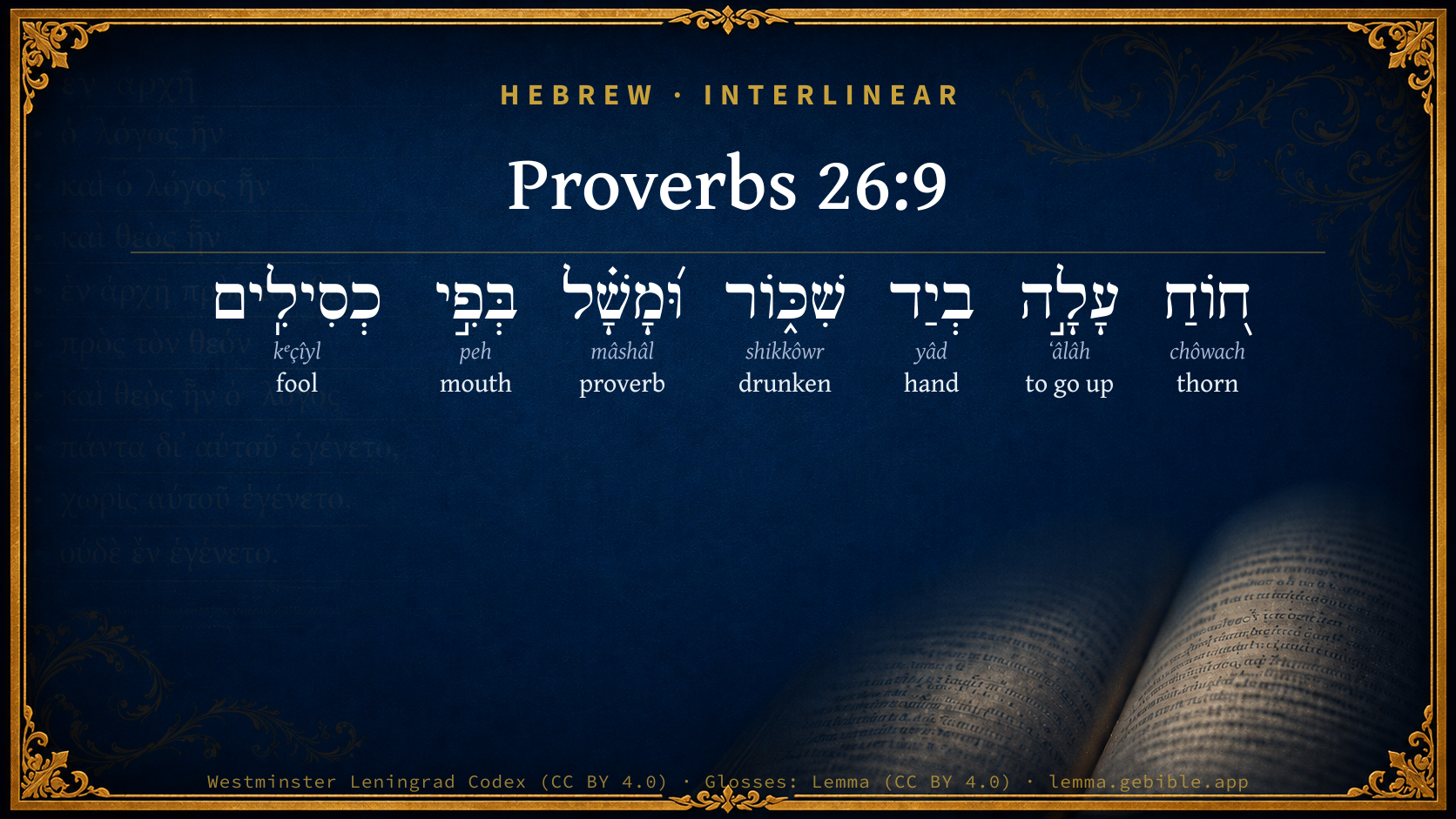
Proverbs 26:9

Hebrew (Westminster Leningrad Codex) Proverbs 26:9 appears in the Hebrew Old Testament. The text above is from the Westminster Leningrad Codex. Each word links to its Strong’s number, a concise gloss, and parsing drawn from the Open Scriptures Hebrew Bible morphology. Click any word for its full Brown-Driver-Briggs (BDB) entry.
Download image
Cite this verse

Proverbs 26:9 (World English Bible). Public Domain. Lemma interlinear Bible study tool, https://lemma.gebible.app/v/proverbs/26/9.

Show BibTeX & RIS
BibTeX
RIS
English Translation
Like a thornbush that goes into the hand of a drunkard, So is a parable in the mouth of fools.
World English Bible · Public Domain
Download a study sheet

One document with this verse’s original text, its word-by-word gloss line, the meaning frame, cross-references with their text, attributed commentary, and full source and license credits — printable, and it pastes into notes with its structure intact.

This verse Autodidact and up

Study sheet (.html) Plain text (.txt)

A passage Seminary Student

Up to 50 verses in one chapter. A passage sheet keeps up to 6 commentary sources and 12 cross-references per verse, in the order this page ranks them, and says so on the sheet whenever that leaves anything out. Ask for a single verse and you get the Autodidact verse sheet above.

Everything on this page stays free to read, with no account — the sheet is a download of what is already on screen, not access to it.

Want to remove ads? Support Godless Engineer
Compare translations 3

The same verse in 3 English versions, stacked beneath the original-language interlinear above. Click any original word for its lexicon entry.

Each is an independent rendering of the whole verse — the interlinear is not word-aligned to these translations.

Highlighted words mark where these versions differ — a whole-verse word diff, not a word-by-word alignment.

  • World English Bible Public Domain
    Like a thornbush that goes into the hand of a drunkard, So is a parable in the mouth of fools.
  • King James Version Public Domain
    As a thorn goeth up into the hand of a drunkard, so is a parable in the mouths of fools.
  • unfoldingWord Literal Text CC BY-SA 4.0
    A thorn goes up into the hand of a drunkard, and a proverb in the mouth of stupid ones.

unfoldingWord Literal Text — © unfoldingWord, licensed CC BY-SA 4.0. Word-aligned USFM3 via Door43 (git.door43.org/unfoldingWord/en_ult).

Versions to compare (up to 4)

3 of 4 selected

Show all 18 translations

Every available English version of this verse, each an independent rendering of the whole verse.

  • World English Bible Public Domain
    Like a thornbush that goes into the hand of a drunkard, So is a parable in the mouth of fools.
  • Berean Standard Bible Public Domain
    Like a thorn that falls into the hand of a drunkard is a proverb in the mouth of a fool.
  • Majority Standard Bible Public Domain
    Like a thorn that goes into the hand of a drunkard is a proverb in the mouth of a fool.
  • King James Version Public Domain
    As a thorn goeth up into the hand of a drunkard, so is a parable in the mouths of fools.
  • American Standard Version (1901) Public Domain
    `As' a thorn that goeth up into the hand of a drunkard, So is a parable in the mouth of fools.
  • Revised Version (1885) Public Domain
    As a thorn that goeth up into the hand of a drunkard, so is a parable in the month of fools.
  • Geneva Bible (1599) Public Domain
    As a thorne standing vp in the hand of a drunkard, so is a parable in the mouth of fooles.
  • Douay-Rheims (1899) Public Domain
    As if a thorn should grow in the hand of a drunkard: so is a parable in the mouth of fools.
  • Young's Literal Translation Public Domain
    A thorn hath gone up into the hand of a drunkard, And a parable in the mouth of fools.
  • Literal Standard Version CC BY-SA 4.0
    A thorn has gone up into the hand of a drunkard, || And an allegory in the mouth of fools.
  • Unlocked Literal Bible CC BY-SA 4.0
    Like a thorn that goes into the hand of a drunkard is a proverb in the mouth of fools.
  • unfoldingWord Literal Text CC BY-SA 4.0
    A thorn goes up into the hand of a drunkard, and a proverb in the mouth of stupid ones.
  • Darby Bible Public Domain
    [As] a thorn goeth up into the hand of a drunkard, so is a proverb in the mouth of fools.
  • World Messianic Bible Public Domain
    Like a thorn bush that goes into the hand of a drunkard, so is a parable in the mouth of fools.
  • Webster's Bible Public Domain
    As a thorn goeth up into the hand of a drunkard, so is a parable in the mouth of fools.
  • Free Bible Version CC BY-SA 4.0
    A proverb spoken by someone stupid is as ridiculous as a thorn bush waved around by a drunk.
  • Bible in Basic English Public Domain
    Like a thorn which goes up into the hand of a man overcome by drink, so is a wise saying in the mouth of a foolish man.
  • JPS Tanakh (1917) Public Domain
    As a thorn that cometh into the hand of a drunkard, so is a parable in the mouth of fools.

Literal Standard Version (2020), Covenant Press — licensed CC BY-SA 4.0. Text via the HelloAO Bible API (eBible.org). Unlocked Literal Bible (unfoldingWord) — licensed CC BY-SA 4.0. Text via the HelloAO Bible API (eBible.org). unfoldingWord Literal Text — © unfoldingWord, licensed CC BY-SA 4.0. Word-aligned USFM3 via Door43 (git.door43.org/unfoldingWord/en_ult). Free Bible Version, Dr. Jonathan Gallagher — licensed CC BY-SA 4.0. Text via the HelloAO Bible API (eBible.org).

Word by word

More ways to search: Search by grammar → Find every occurrence → Compare this word →

Practice this passage: Drill this verse → Learn its vocabulary →

About this verse

These counts appear in no published source. They are computed here, from the morphology-tagged text and Lemma’s own curated glosses. What Lemma adds →

7
words
7
distinct lemmas
Wisdom
section

Notable vocabulary

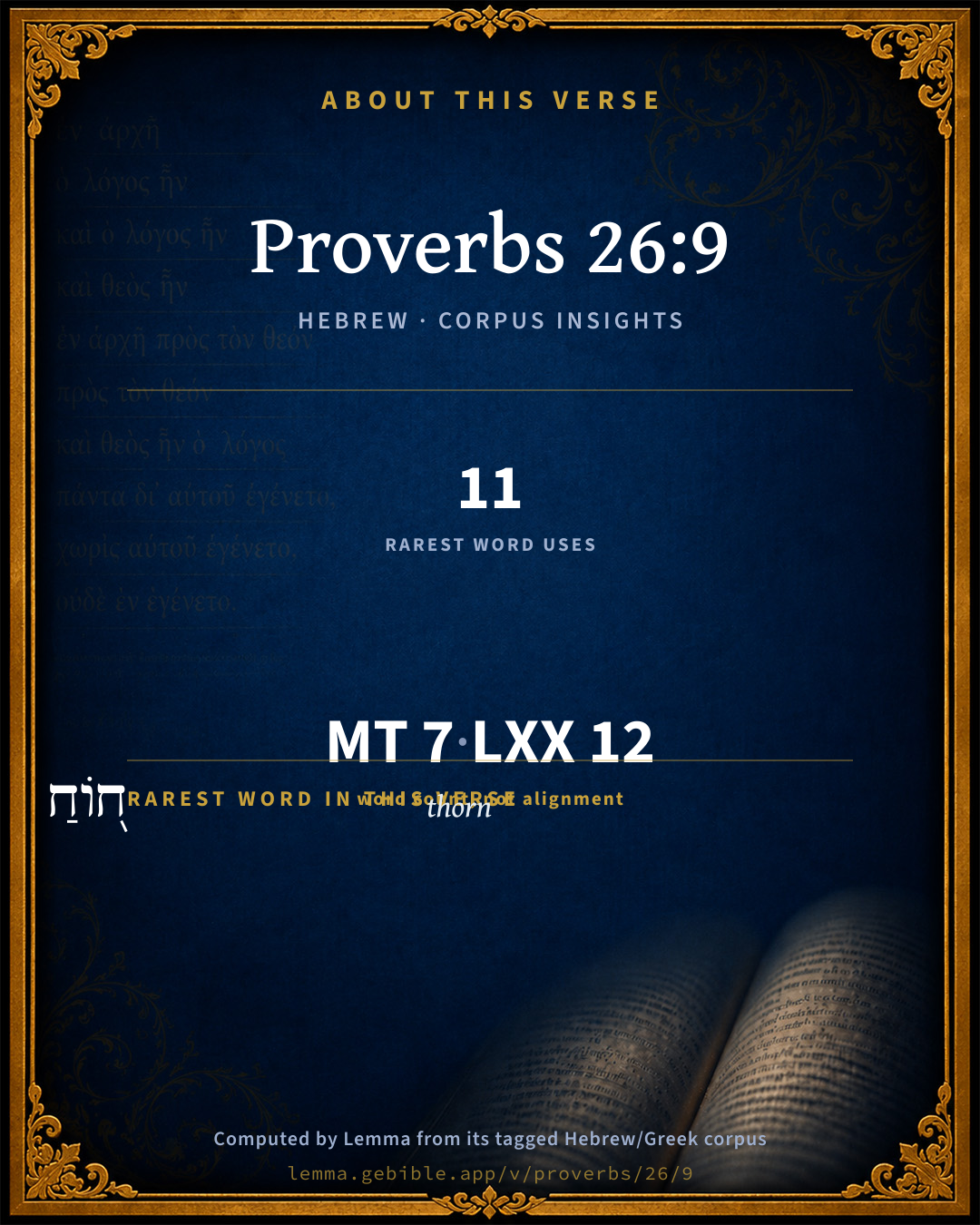
The rarest word here is ח֭וֹחַ thorn H2336 — appearing just 11 times in the whole Hebrew Bible.

Shared distinctive vocabulary

ח֭וֹחַ thorn H2336 occurs in 9 verses of the Hebrew Bible. Also found in:

Grammatical profile

  • 1 verb
  • 4 nouns
  • 2 adjectives

Verb forms

  • עָלָ֣ה Qal · Perfect

Hebrew & Septuagint length

In English translation the verse runs 20 words from the Hebrew and 15 from the Septuagint (LXX English) — closely comparable.

A rough comparison of the two English renderings, which tokenize alike — not a word-level alignment.

Word counts can differ between the Hebrew and the Greek without any difference in meaning — e.g. the Hebrew direct-object marker אֵת has no separate Greek word, and Greek often adds the article ὁ.

In the original languages it is 7 Hebrew tokens and 12 Greek tokens — but the two are counted differently (Hebrew bundles its prefixes and suffixes into one token; the Greek is in lemma form), so that isn’t a like-for-like length.

Cross-references

1

Topical passages linked to Proverbs 26:9 in the Treasury of Scripture Knowledge — connected by theme and wording, ordered by reader-vote popularity; previews shown in the World English Bible.

  • Proverbs 23:35 "They hit me, and I was not hurt; They beat me, and I don't feel it! When will I wake up? I can do it again. I can find another."

Cross-references courtesy of OpenBible.info (CC BY 4.0).

Hebrew and Greek witnesses Masoretic Hebrew ↔ Greek Septuagint

The same verse in the two great witnesses to the Old Testament, shown verse-for-verse.

These are two independent witnesses, not word-aligned to each other, and the Septuagint is shown in lemma (dictionary) form.

Hebrew Proverbs 26:9 Masoretic · Westminster Leningrad Codex

ח֭וֹחַ עָלָ֣ה בְיַד שִׁכּ֑וֹר וּ֝מָשָׁ֗ל בְּפִ֣י כְסִילִֽים

Like a thornbush that goes into the hand of a drunkard, So is a parable in the mouth of fools.

World English Bible · Public Domain

Greek LXX Proverbs 26:9 Septuagint · lemma form

ἄκανθα φύω ἐν χείρ ὁ μέθυσος δουλεία δέ ἐν χείρ ὁ ἄφρων

Thorns grow in the hand of a drunkard, and servitude in the hand of fools.

LXX2012 (modern English Septuagint) · Public Domain

On this verse, Haydock's Catholic Bible Commentary discusses the Septuagint’s reading. Read the note in Commentary ↓

Hebrew: Westminster Leningrad Codex (CC BY 4.0). Greek: Septuagint (public domain); English from LXX2012 (modern English Septuagint) (Public Domain). How the Septuagint differs from the Hebrew →

Commentary

Notes on Proverbs 26:9 from classic Christian and Jewish commentators (each source and its license shown beneath its notes). The classic Christian expositions comment on the surrounding passage and are grouped to its opening verse, so a note may address several verses; the Jewish commentaries on the Tanakh (Rashi and others) are per-verse, so they appear only where the commentator wrote on this verse.

Lemma curates 59 commentaries, every one of them public domain or Creative Commons licensed, each selected and text-cleaned for this edition rather than reprinted as found. About our sources →

Trapp's Complete Commentary

John Trapp

Pro 26:9 [As] a thorn goeth up into the hand of a drunkard, so [is] a parable in the mouth of fools.

Ver. 9. As a thorn goeth up into the hand, &c.] He handleth it hard, as if it were another kind of wood, and it runs into his hand. So do profane persons pervert and pollute the Holy Scriptures, to their own and other men’s destruction. By a parable here the Hebrews understand either these parables of Solomon or the whole book of God. At this day no people under heaven do so abuse Scripture as the Jews do. For commending, in their familiar epistles, some letter they have received, they say, Eloquia Domini, eloquia pura, - The words of my Lord are pure words. When they flatter their friends, Pateat, they say, accessus ad aditum sanctitatis tuae: {a} Let me have access to the sanctuary of thy holiness. When they would testify themselves thankful, Nomini tuo psallam, - I will sing praise to thy name. When they complain, friends forsake them, "Lord," say they, "thou goest not forth with our armies." When they invite their friends to a banquet or a wedding, "In thee have I trusted; let me not be put to confusion." Lo, thus do these witless, wicked wretches abuse God’s parables, and take his name in vain. Whereas the very heathen could say, Non loquendum de Deo sine lumine, - God is not to be talked of lightly, loosely, disrespectfully. "Thou shalt fear that glorious and fearful name, Jehovah thy God," saith Moses, their own lawgiver. {Deu 28:58}

{a} Weemse.

John Trapp, A Commentary or Exposition upon All the Books of the Old and New Testament (1647–1656) — public domain. Text from a community e-Sword module.

Joseph Benson's Commentary

Pro 26:9. As a thorn, &c. — “It is as dangerous for a fool to meddle with a proverb as for a drunkard to handle a thorn, wherewith he hurts himself: but the sharpest saying no more touches a fool with any compunction, though spoken by his own mouth, than the drunkard feels the thorn when it runs into his hand and gives him a grievous wound.” — Bishop Patrick.

Joseph Benson's Commentary on the Old and New Testaments (1811–1818) — public domain. Text from a community e-Sword module.

Tyndale Open Study Notes

Tyndale Open Resources

26:9 A proverb misapplied by a fool might actually cause harm. Cp. 26:7.

Tyndale Open Study Notes — © Tyndale Open Resources, licensed CC BY-SA 4.0. Text via the HelloAO Bible API.

Geneva Bible (1599)

Geneva Bible translators

Whereby he both hurteth himself and others.

Geneva Bible (1599) marginal notes — public domain. Text via Bolls.life.

Jamieson, Fausset & Brown

Robert Jamieson, A. R. Fausset & David Brown

As vexatious and unmanageable as a thorn in a drunkard's hand is a parable to a fool. He will be as apt to misuse is as to use it rightly.

Jamieson, Fausset & Brown — Commentary Critical and Explanatory on the Whole Bible (1871) — public domain (CC PDM 1.0). Text via the HelloAO Bible API.

Ellicott's Commentary for English Readers

(9) As a thorn goeth up into the hand of a drunkard.—Rather, (As) a thornbush (which) comes into the hand of a drunkard, so (is) a parable (which comes) into the mouth of fools. They know not how to use it, and only do themselves and others harm by it. (Comp. 2Pe_3:16.)

A Bible Commentary for English Readers, edited by Charles John Ellicott (1878–1897) — public domain. Text from a community e-Sword module.

The Cambridge Bible for Schools and Colleges

gen. ed. J. J. S. Perowne

9. As a thorn goeth up into the hand] i.e. as a thorn or thornbush taken up by a drunkard wounds himself.

This proverb carries the thought of Pro_26:7 a step further. A parable, or proverb, in the mouth of fools is not only useless but injurious. They take up a sharp, pointed saying, and instead of turning it to account, only injure themselves with it, as a drunkard pierces his own hand with the thorn which he grasps.

The Cambridge Bible for Schools and Colleges (gen. ed. J. J. S. Perowne; Cambridge University Press, 1878–1918) — public domain. Text from a community e-Sword module.

John Gill's Exposition

As a thorn goeth up into the hand of a drunkard,.... And he perceives it not; or being in his hand he makes an ill use of it, and hurts himself and others with it;

so is a parable in the mouth of fools, a proverbial sentence respecting religious matters; or a passage of holy Scripture which either he understands not, and has no spiritual perception of, any more than the drunkard has of the thorn in his hand; or which being used as a pun, or by way of jest, as it is the manner of some to pun upon or jest with the Scripture, hurts himself and others, wounds his own conscience, and ruins the souls of others; for it is dangerous meddling with edge tools, and hard to kick against the pricks; so to do is like a drunken man's handling thorns, which he does without judgment, and to his own prejudice and others. Gussetius (x) understands this of a fish hook coming up into the hand of a drunkard empty, without taking any thing by it, and so alike useless is what is said by a fool.

(x) Ebr. Comment. p. 244.

John Gill's Exposition of the Whole Bible (1746–1763) — public domain (CC PDM 1.0). Text via the HelloAO Bible API.

Albert Barnes' Notes on the Bible

Better: “As a thorn which is lifted up in the hand of the drunkard” etc. As such a weapon so used may do mischief to the man himself or to others, so may the sharp, keen-edged proverb when used by one who does not understand it.

Albert Barnes' Notes on the Bible (1834–1885) — public domain. Text from a community e-Sword/MySword module.

Haydock's Catholic Bible Commentary

If. Hebrew, "as a thorn goeth up into the," &c. (Protestants) (Haydock) --- If he attempt to handle or to extract one, he will wound himself the more, as the fool would render truth and wisdom contemptible. (Calmet) --- Parable. Septuagint, "but slavery in the hands of fools" groweth up. (Haydock)

George Leo Haydock (1774–1849), Haydock's Catholic Family Bible and Commentary, 1859 edition — public domain. Excludes Psalms (Douay-Rheims chapter numbering differs from Protestant) and Deuterocanonical books (Catholic canon only).

Matthew Poole's English Annotations

As a thorn is in a drunkard’s hand, which he cannot hold and manage cautiously, but employeth to his own and others’ hurt,

so is a parable in the mouth of fools; as improper and unprofitable, and, by accident, hurtful to himself and others. See Poole "Pro 26:7".

Matthew Poole's English Annotations on the Holy Bible (1683–1685) — public domain. Text from a community e-Sword/MySword module.

Whedon's Commentary on the Bible

Daniel D. Whedon

9. As a thorn goeth up (or is taken up) into the hand of a drunkard — One drunk.

So is a parable (or proverb) in the mouth of fools — They will hurt themselves or others with it. A sarcasm.

Daniel D. Whedon (gen. ed.), Commentary on the Old and New Testaments (1874–1909) — public domain. Text from a community e-Sword module.

The Pulpit Commentary

As a thorn goeth up into the hand of a drunkard. There is here no idea of the drunkard"s hand being pierced with a thorn while he is insensible to the pain, but rather of his being armed with it, and ripe for mischief. So it is best to render, "A thornbush cometh into the hand of a drunkard;" he somehow gets possession of it, and in his stupid excitement is liable to become dangerous. Some understand hl of the growth of the thorn; thus the Septuagint, "Thorns grow in the hand of a drunkard;" Vulgate, "As if a thorn grew in the hand of a drunkard." But one does not see the bearing of such an expression; and the translation given above is more appropriate. So is a parable, etc. (as ver. 7). In that passage the wise saying in a fool"s mouth was compared with something useless, here it is compared with something injurious. He employs it purposely to wound others; or by the ignorant use of some sharp-edged word he does much mischief. In this hemistich the LXX has read l with a different vocalization, and renders, "servitude (douleia ) in the hand of fools." This seems to mean that it comes natural to fools to be manacled and restrained by force.

The Pulpit Commentary (1880–1919), ed. H.D.M. Spence-Jones & Joseph S. Exell — public domain. Text from a community e-Sword module.

John Wesley's Explanatory Notes

A thorn - As a thorn is in a drunkard's hand, which he cannot manage cautiously, but employs to his own and others hurt. So - As unprofitable, and, by accident, hurtful to himself and others.

John Wesley, Explanatory Notes Upon the Whole Bible (1754–1765) — public domain. Text via the GEBible commentary corpus.

Keil & Delitzsch

C. F. Keil & F. Delitzsch

9 A thorn goeth into the hand of a drunkard,

And a proverb in a fool's mouth;

i.e., if a proverb falls into a fool's mouth, it is as if a thorn entered into the hand of a drunken man; the one is as dangerous as the other, for fools misuse such a proverb, which, rightly used, instructs and improves, only to the wounding and grieving of another, as a drunken man makes use of the pointed instrument which he has possession of for coarse raillery, and as a welcome weapon of his strife. The lxx, Syr. (Targ.?), and Jerome interpret עלה in the sense of shooting up, i.e., of growing; Bttcher also, after Pro 24:31 and other passages, insists that the thorn which has shot up may be one that has not grown to perfection, and therefore not dangerous. But thorns grow not in the hand of any one; and one also does not perceive why the poet should speak of it as growing in the hand of a drunken man, which the use of the hand with it would only make worse. We have here עלה בידי, i.e., it has come into my hand, commonly used in the Mishna, which is used where anything, according to intention, falls into one's hands, as well as where it comes accidentally and unsought for, e.g., Nazir 23a, מי שׁנתכוון לעלות בידו בשׂר חזיר ועלה בידו בשׂר טלה, he who designs to obtain swine's flesh and (accidentally) obtains lamb's flesh. Thus rightly Heidenheim, Lwenstein, and the Venet.: ἄκανθα ἀνέβη εἰς χεῖρα μεθύοντος. חוח signifies a thorn bush, Kg2 14:9,

(Note: The plur. חוחים, Sa1 13:6, signifies not thorn bushes, but rock-splitting; in Damascus, chôcha means a little gate in the wing of a large door; vid., Wetstein's Nordarabien, p. 23.)

as well as a thorn, Sol 2:2, but where not the thorns of the rose, and indeed no rose at all, is meant. Luther thinks of the rose with the thorn when he explains: "When a drunkard carries and brandishes in his hand a thorn bush, he scratches more with it than allows the roses to be smelled - so a fool with the Scriptures, or a right saying, often does more harm than good." This paraphrase of Luther's interprets עלה ביד more correctly than his translation does; on the other hand, the latter more correctly is satisfied with a thorn twig (as a thorn twig which pierces into the hand of a drunken man); the roses are, however, assumed contrary to the text. This holds good also against Wessely's explanation: "the Mashal is like a rose not without thorns, but in the mouth of a fool is like a thorn without a rose, as when a drunken man seeks to pluck roses and gains by his effort nothing but being pierced by thorns." The idea of roses is to be rejected, because at the time when this proverb was formed there were no roses in Palestine. The proverb certainly means that a right Mashal, i.e., an ingenious excellent maxim, is something more and better than a חוח (the prick as of the Jewish thorn, Zizyphus vulgaris, or the Christus-thorn, the Ziz spina Christi); but in the mouth of a fool such a maxim becomes only a useless and a hurtful thing; for the fool so makes use of it, that he only embarrasses others and recklessly does injury to them. The lxx translates משׁל by δουλεία, and the Aram. by שׁטיוּתא; how the latter reached this "folly" is not apparent; but the lxx vocalized משׁל, according to which Hitzig, at the same time changing שׁכּור into שׂכוּר, translates: "thorns shoot up by the hand of the hireling, and tyranny by the mouth of fools." Although a hired labourer, yet, on this account, he is not devoid of conscience; thus 9a so corrected has something in its favour: one ought, as far as possible, to do all with his own hand; but the thought in 9b is far-fetched, and if Hitzig explains that want of judgment in the state councils creates despotism, so, on the other hand, Pro 24:7 says that the fool cannot give counsel in the gate, and therefore he holds his mouth.

Keil & Delitzsch — Biblical Commentary on the Old Testament (1861–1891) — public domain (CC PDM 1.0). Text via the HelloAO Bible API. (Old Testament only.)

unfoldingWord translationNotes

Door43 World Missions Community

Like a thorn ... is a proverb in the mouth of fools

How the two are alike can be stated clearly. AT: "A proverb in the mouth of fools is as dangerous as a thorn that goes into the hand of a drunkard" (See: Simile)

a thorn that goes into the hand of a drunkard

Possible meanings are 1) if a drunk person holds a thornbush, a thorn will prick his hand, or 2) if a drunk person is angry, he will pick up a thornbush and swing it at people. For the second meaning, the word "thorn" represents a thornbush. (See: Synecdoche)

in the mouth of fools

Here "mouth" is a metonym for speaking. AT: "in the speech of fools" or "that fools say" (See: Metonymy)

hires a fool

"gives a job to a fool"

translationWords

drunk

proverb

fool

archer

unfoldingWord translationNotes — © Distant Shores Media and the Door43 World Missions Community, licensed CC BY-SA 4.0. Source: git.door43.org/Door43/en_tn.

Rashi

Rabbi Shlomo Yitzchaki (Rashi)

A thorn came up in a drunkard’s hand Just like a thorn that is stuck to a drunkard’s hand, so is the parable stated below stuck in the mouth of a fool to be for him as a thorn—yea, a painful thorn. Now what is the parable?...

Rashi on the Tanakh — English translations: “The Judaica Press complete Tanach with Rashi, translated by A. J. Rosenberg” (CC BY 4.0); “Pentateuch with Rashi's commentary by M. Rosenbaum and A.M. Silbermann, 1929-1934” (public domain); “The Metsudah Tanach series, Lakewood, N.J” (CC BY 4.0); and “The Book of Joshua, Metsudah Publications, 1997” (CC BY 4.0). Text via Sefaria.

Lesson kit

Teaching starters — assembled from the data on this page, not authored interpretation. Every prompt links to the verse data it draws on. Edit before teaching.

Proverbs, in the Wisdom, opens this verse with 7 words (7 distinct Hebrew lemmas). Its most distinctive word is chôwach (“thorn”). A historical commentator’s framing appears above. Read the whole chapter for the surrounding context.

Discussion questions

  1. What does “thorn” (chôwach) contribute to the verse as a whole?
  2. 2 Kings 14:9 shares the word «thorn» with this verse. How do the two illuminate each other?
  3. These translations render this verse differently; the difference is in the English rendering, not the original. What questions does that raise?
  4. The verb «עָלָ֣ה» is Qal Perfect. How does its form color the action?
  5. Reading how Trapp's Complete Commentary and Joseph Benson's Commentary read this verse, where do the two commentators agree and where do they part?

Things to notice

Reading settings

Reading text

Shown beneath each verse's original-language words.

Old Testament
Old Testament edition

Read the OT as the Masoretic Hebrew (MT) or the Greek Septuagint (LXX).

English shown for the Greek Septuagint (in the Hebrew ↔ Greek comparison).

Comparing translations? Open the Compare panel on any verse page to stack up to four side by side.