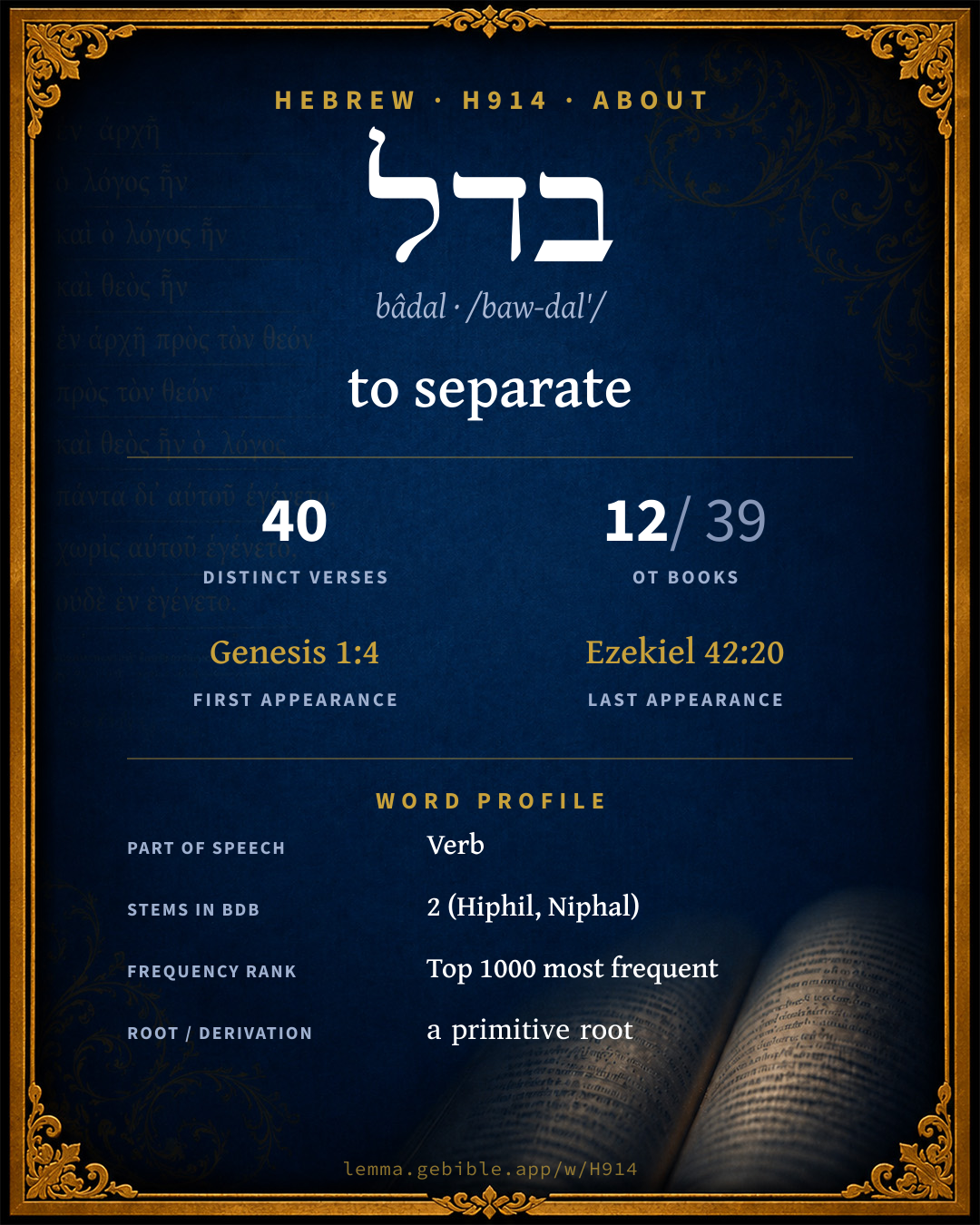
בָּדַל
to separate
‘to separate’ is one of 11 main senses fuller range ↓
Full lexicon entry — Brown-Driver-Briggs (BDB)
From Brown-Driver-Briggs (BDB)
Where this word appears
See every Hiphil verb in the Hebrew Bible →
Grammar key — what these labels mean
Part of speech
- Verb
- An action or state-of-being word.
Stem
- Hiphil
- The causative active stem (“he caused / brought about”). Here: ‘divide’
- Niphal
- Usually the simple passive or reflexive of the Qal (“he was written”). Here: ‘be separated’
Form
- Sequential Imperfect
- An imperfect with prefixed waw — the standard past-narrative form (waw-consecutive imperfect).
- Infinitive Construct
- A bound verbal noun, frequently with prepositions (“to write / in writing”).
- Imperfect
- An incomplete, ongoing, or future action (“he will / would write”).
- Perfect
- A completed action or state — Hebrew marks aspect (completeness) more than strict tense (“he wrote”).
- Imperative
- A direct command (“write!”).
- Sequential Perfect
- A perfect with prefixed waw continuing a preceding imperfect or command (waw-consecutive perfect).
- Participle Active
- A verbal adjective expressing ongoing or characteristic action (“writing / one who writes”).
- Participle Passive
- A verbal adjective expressing action received (“written”).
- Infinitive Absolute
- An unbound verbal noun, often intensifying or standing in for a finite verb.
State
- Absolute
- The independent form of a noun, not bound to a following word.
Person
- 3rd Person
- The one spoken about (“he / she / it / they”).
- 2nd Person
- The one addressed (“you”).
- 1st Person
- The speaker (“I / we”).
Gender
- Masculine
- Grammatically masculine.
- Common
- Either gender — not distinguished for this form.
- Feminine
- Grammatically feminine.
Number
- Singular
- One.
- Plural
- More than one (in Hebrew, generally three or more).
Grammatical forms 25 distinct
- Verb, Hiphil, Infinitive Construct 5 times (12%)
- Verb, Hiphil, Sequential Imperfect, 3rd Person, Masculine, Singular 4 times (10%)
- Verb, Hiphil, Imperfect, 3rd Person, Masculine, Singular 4 times (10%)
- Verb, Niphal, Sequential Imperfect, 3rd Person, Masculine, Plural 2 times (5%)
- Verb, Niphal, Perfect, 3rd Person, Common, Plural 2 times (5%)
- Verb, Hiphil, Imperfect, 2nd Person, Masculine, Singular 2 times (5%)
- Verb, Hiphil, Perfect, 1st Person, Common, Singular 2 times (5%)
- Verb, Hiphil, Perfect, 3rd Person, Masculine, Singular 2 times (5%)
+17 more forms (19 occurrences)
Parsed forms decoded from the imported morphology (morphhb / Westminster Leningrad Codex — WLC text public domain, morphhb tagging CC BY 4.0), counted across 42 parsed occurrences — not distinct verses.
Every verse where H914 appears — 40 distinct verses across 12 books. Click any verse to open its interlinear word-by-word view. Verse text shown in the World English Bible for context — . Each verse’s Hebrew form is shown with its reference; the English is not keyword-highlighted, since the data carries no word-level English alignment. Use “Compare translations” on any verse to read it across multiple English versions. This concordance covers the Hebrew Bible; Septuagint (Greek Old Testament) occurrences are not indexed here.
Genesis 5 verses
- Genesis 1:4 וַ/יַּבְדֵּ֣ל conj + Hiphil wimpf 3ms God saw the light, and saw that it was good. God divided the light from the darkness.
- Genesis 1:6 מַבְדִּ֔יל Hiphil ptcp.act ms God said, "Let there be an expanse in the midst of the waters, and let it divide the waters from the waters."
- Genesis 1:7 וַ/יַּבְדֵּ֗ל conj + Hiphil wimpf 3ms God made the expanse, and divided the waters which were under the expanse from the waters which were above the expanse, and it was so.
- Genesis 1:14 לְ/הַבְדִּ֕יל prep + Hiphil inf.cs God said, "Let there be lights in the expanse of sky to divide the day from the night; and let them be for signs, and for seasons, and for days and years;
- Genesis 1:18 וּֽ/לֲ/הַבְדִּ֔יל conj + prep + Hiphil inf.cs and to rule over the day and over the night, and to divide the light from the darkness. God saw that it was good.
Exodus 1 verse
Leviticus 7 verses
- Leviticus 1:17 יַבְדִּיל֒ Hiphil impf 3ms He shall tear it by its wings, but shall not divide it apart. The priest shall burn it on the altar, on the wood that is on the fire. It is a burnt offering, an offering made by fire, of a sweet savor to Yahweh.
- Leviticus 5:8 יַבְדִּֽיל Hiphil impf 3ms He shall bring them to the priest, who shall first offer the one which is for the sin offering, and wring off its head from its neck, but shall not sever it completely.
- Leviticus 10:10 וּֽ/לֲ/הַבְדִּ֔יל conj + prep + Hiphil inf.cs and that you are to make a distinction between the holy and the common, and between the unclean and the clean;
- Leviticus 11:47 לְ/הַבְדִּ֕יל prep + Hiphil inf.cs to make a distinction between the unclean and the clean, and between the living thing that may be eaten and the living thing that may not be eaten.'"
- Leviticus 20:24 הִבְדַּ֥לְתִּי Hiphil pf 1cs But I have said to you, "You shall inherit their land, and I will give it to you to possess it, a land flowing with milk and honey." I am Yahweh your God, who has separated you from the peoples.
- Leviticus 20:25 וְ/הִבְדַּלְתֶּ֞ם הִבְדַּ֥לְתִּי conj + Hiphil wpf 2mp Hiphil pf 1cs "'You shall therefore make a distinction between the clean animal and the unclean, and between the unclean fowl and the clean: and you shall not make yourselves abominable by animal, or by bird, or by anything with which the ground teems, which I have separated from you as unclean for you.
- Leviticus 20:26 וָ/אַבְדִּ֥ל conj + Hiphil wimpf 1cs You shall be holy to me: for I, Yahweh, am holy, and have set you apart from the peoples, that you should be mine.
Numbers 3 verses
- Numbers 8:14 וְ/הִבְדַּלְתָּ֙ conj + Hiphil wpf 2ms Thus you shall separate the Levites from among the children of Israel, and the Levites shall be mine.
- Numbers 16:9 הִבְדִּיל֩ Hiphil pf 3ms [seems it but] a small thing to you, that the God of Israel has separated you from the congregation of Israel, to bring you near to himself, to do the service of the tent of Yahweh, and to stand before the congregation to minister to them;
- Numbers 16:21 הִבָּ֣דְל֔וּ Niphal impv 2mp Separate yourselves from among this congregation, that I may consume them in a moment.
Deuteronomy 5 verses
- Deuteronomy 4:41 יַבְדִּ֤יל Hiphil impf 3ms Then Moses set apart three cities beyond the Jordan toward the sunrise;
- Deuteronomy 10:8 הִבְדִּ֤יל Hiphil pf 3ms At that time Yahweh set apart the tribe of Levi, to bear the ark of the covenant of Yahweh, to stand before Yahweh to minister to him, and to bless in his name, to this day.
- Deuteronomy 19:2 תַּבְדִּ֣יל Hiphil impf 2ms you shall set apart three cities for you in the midst of your land, which Yahweh your God gives you to possess it.
- Deuteronomy 19:7 תַּבְדִּ֥יל Hiphil impf 2ms Therefore I command you, saying, You shall set apart three cities for you.
- Deuteronomy 29:21 וְ/הִבְדִּיל֤/וֹ conj + Hiphil wpf 3ms + sfx pers 3ms Yahweh will set him apart to evil out of all the tribes of Israel, according to all the curses of the covenant that is written in this book of the law.
1 Kings 1 verse
1 Chronicles 3 verses
- 1 Chronicles 12:8 נִבְדְּל֣וּ Niphal pf 3cp Of the Gadites there separated themselves to David to the stronghold in the wilderness, mighty men of valor, men trained for war, that could handle shield and spear; whose faces were like the faces of lions, and they were as swift as the roes on the mountains;
- 1 Chronicles 23:13 וַ/יִּבָּדֵ֣ל conj + Niphal wimpf 3ms The sons of Amram: Aaron and Moses; and Aaron was separated, that he should sanctify the most holy things, he and his sons, forever, to burn incense before Yahweh, to minister to him, and to bless in his name, forever.
- 1 Chronicles 25:1 וַ/יַּבְדֵּ֣ל conj + Hiphil wimpf 3ms Moreover, David and the captains of the host set apart for the service certain of the sons of Asaph, and of Heman, and of Jeduthun, who should prophesy with harps, with psalteries, and with cymbals: and the number of those who did the work according to their service was:
2 Chronicles 1 verse
Ezra 6 verses
- Ezra 6:21 הַ/נִּבְדָּ֛ל ptcl def.art + Niphal ptcp.pass ms The children of Israel who had come again out of the captivity, and all such as had separated themselves to them from the filthiness of the nations of the land, to seek Yahweh, the God of Israel, ate,
- Ezra 8:24 וָ/אַבְדִּ֛ילָ/ה conj + Hiphil wimpf 1cs + sfx h Then I set apart twelve of the chiefs of the priests, even Sherebiah, Hashabiah, and ten of their brothers with them,
- Ezra 9:1 נִבְדְּל֞וּ Niphal pf 3cp Now when these things were done, the princes drew near to me, saying, The people of Israel, and the priests and the Levites, have not separated themselves from the peoples of the lands, [doing] according to their abominations, even of the Canaanites, the Hittites, the Perizzites, the Jebusites, the Ammonites, the Moabites, the Egyptians, and the Amorites.
- Ezra 10:8 יִבָּדֵ֖ל Niphal impf 3ms and that whoever didn't come within three days, according to the counsel of the princes and the elders, all his substance should be forfeited, and himself separated from the assembly of the captivity.
- Ezra 10:11 וְ/הִבָּֽדְלוּ֙ conj + Niphal impv 2mp Now therefore make confession to Yahweh, the God of your fathers, and do his pleasure; and separate yourselves from the peoples of the land, and from the foreign women.
- Ezra 10:16 וַ/יִּבָּדְלוּ֩ conj + Niphal wimpf 3mp The children of the captivity did so. Ezra the priest, [with] certain heads of fathers' [houses], after their fathers' houses, and all of them by their names, were set apart; and they sat down in the first day of the tenth month to examine the matter.
Nehemiah 3 verses
- Nehemiah 9:2 וַ/יִּבָּֽדְלוּ֙ conj + Niphal wimpf 3mp The seed of Israel separated themselves from all foreigners, and stood and confessed their sins, and the iniquities of their fathers.
- Nehemiah 10:28 הַ/נִּבְדָּ֞ל ptcl def.art + Niphal ptcp.act ms The rest of the people, the priests, the Levites, the porters, the singers, the Nethinim, and all those who had separated themselves from the peoples of the lands to the law of God, their wives, their sons, and their daughters, everyone who had knowledge, and understanding;
- Nehemiah 13:3 וַ/יַּבְדִּ֥ילוּ conj + Hiphil wimpf 3mp It came to pass, when they had heard the law, that they separated from Israel all the mixed multitude.
Isaiah 2 verses
- Isaiah 56:3 הַבְדֵּ֧ל יַבְדִּילַ֛/נִי Hiphil inf.abs Hiphil impf 3ms + sfx pers 1cs Neither let the foreigner, who has joined himself to Yahweh, speak, saying, Yahweh will surely separate me from his people; neither let the eunuch say, Behold, I am a dry tree.
- Isaiah 59:2 מַבְדִּלִ֔ים Hiphil ptcp.act mp but your iniquities have separated between you and your God, and your sins have hidden his face from you, so that he will not hear.
Ezekiel 3 verses
- Ezekiel 22:26 הִבְדִּ֔ילוּ Hiphil pf 3cp Her priests have done violence to my law, and have profaned my holy things: they have made no distinction between the holy and the common, neither have they caused men to discern between the unclean and the clean, and have hid their eyes from my Sabbaths, and I am profaned among them.
- Ezekiel 39:14 יַבְדִּ֨ילוּ֙ Hiphil impf 3mp They shall set apart men of continual employment, who shall pass through the land, and, with those who pass through, those who bury those who remain on the surface of the land, to cleanse it: after the end of seven months shall they search.
- Ezekiel 42:20 לְ/הַבְדִּ֕יל prep + Hiphil inf.cs He measured it on the four sides: it had a wall round about, the length five hundred, and the breadth five hundred, to make a separation between that which was holy and that which was common.
About this entry
At a glance — auto-summarized from this page’s data, not written by a person. Every figure links to its source below. This summary describes the numbers; it doesn’t interpret them.
The Hebrew verb בדל centers on the idea of “to separate.” Where the King James Version says “separated,” newer translations reach for “and” (unfoldingWord Literal Text); the renderings breakdown has the detail. The Hebrew Bible uses it across 40 verses — moderately common. First canonically at Genesis 1:4, it enters the text early. Across 2 stems, its meaning turns on the binyan (Hiphil, Niphal). Dig into 40-verse concordance and the renderings breakdown below.
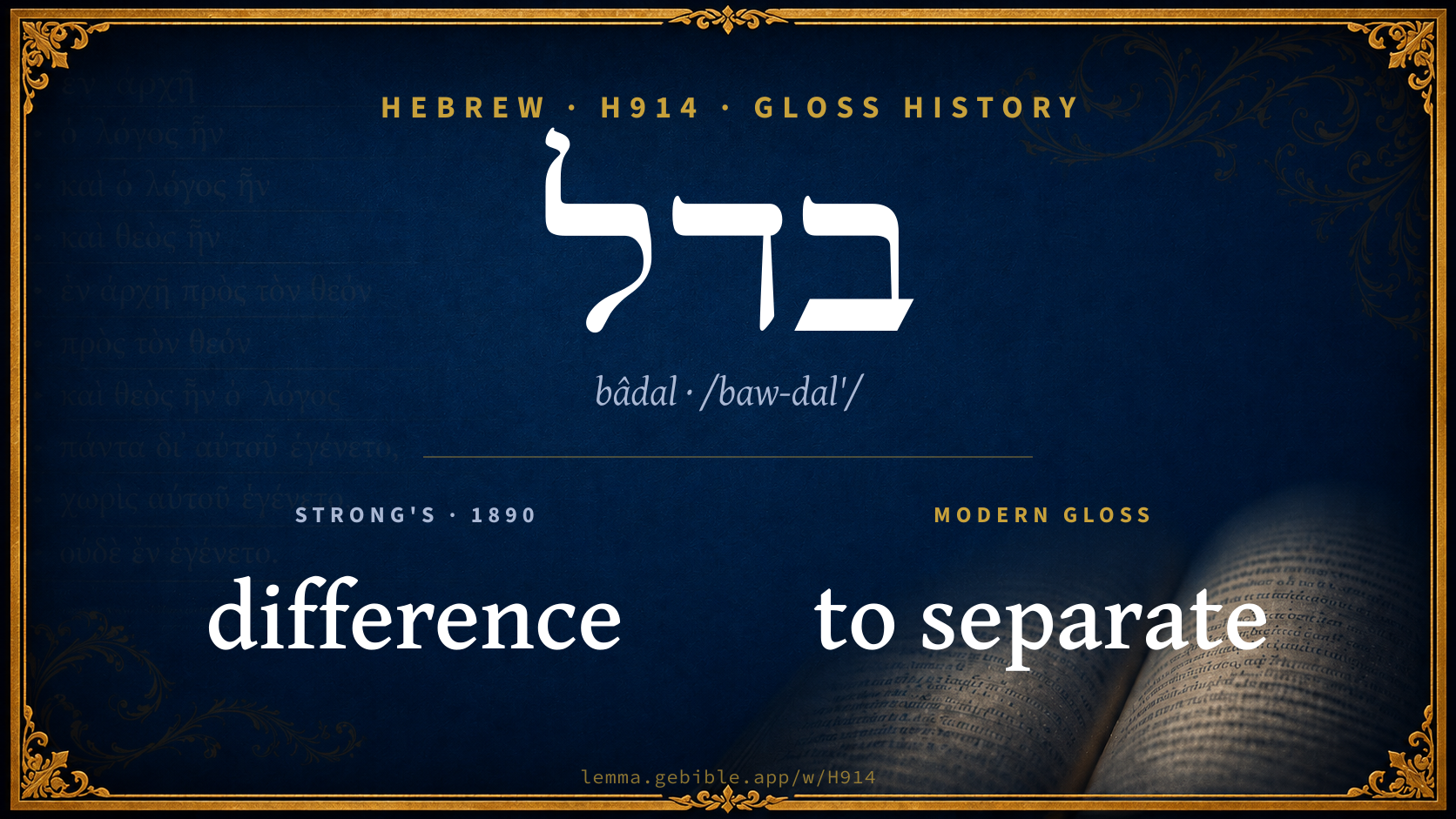
Gloss history
Strong's 1890 vs modern scholarship
About this word
Strong's H914 catalogs a Hebrew word from the Hebrew Old Testament.
These counts are not copied from any lexicon or concordance. They are computed here, from the morphology-tagged Hebrew Old Testament. What Lemma adds →
- 40
- distinct verses
- The word appears in 40 distinct verses.
- 12 / 39
- OT books
- The word appears in 12 of 39 Old Testament books.
- #864
- by frequency
- Top 1000 most frequent Hebrew words (rank 864 of 8,640 Hebrew words by occurrence).
View all 40 occurrences in the concordance →
By section of the Old Testament
By traditional corpus
Conventional, traditional groupings — biblical authorship is debated, so this is a traditional corpus grouping, not an authorship claim. Each share is this word’s portion of its verses in that division of the Hebrew canon. Each figure is a share of the word’s 40 distinct verses.
- Torah (Pentateuch) 21 verses · 53%
- Writings (Ketuvim) 13 verses · 33%
- Prophets (Nevi'im) 6 verses · 15%
How translations render this word
Counts come from each version’s own published word-to-Strong’s tagging or interlinear alignment — an approximate guide to how each version renders this word, not a word-level alignment the data otherwise carries. Because each total is that version’s own tagged count, the per-version totals vary from one another and need not match the appearance or distinct-verse counts above. These counts may also differ from a printed concordance because Lemma counts each distinctly tagged rendering and does not collapse phrase taggings into a single head-word total. This is a fixed set of word-tagged versions (KJV, ASV, BSB, ULT) and does not change with the reading translation you choose elsewhere. Each version’s license is shown beside its name below (and on Sources).
- King James Version: Separated 6×, Divide 2×, Divided 2×
- American Standard Version: Separate 3×, Separated 3×, Set apart 3×
- Berean Standard Bible: Separate 4×, Had separated themselves 2×, Separated 2×
- unfoldingWord Literal Text: And 7×, Separate 5×, Separated 4×
King James Version Public Domain
Renders H914 across 42 tagged occurrences — most commonly:
Plus 26 renderings that appear only once — usually multi-word phrases or single function words the recovered tagging swept in, not distinct renderings.
American Standard Version Public Domain
Renders H914 across 42 tagged occurrences — most commonly:
Plus 27 renderings that appear only once — usually multi-word phrases or single function words the recovered tagging swept in, not distinct renderings.
Berean Standard Bible Public Domain
Renders H914 across 41 tagged occurrences — most commonly:
Plus 29 renderings that appear only once — usually multi-word phrases or single function words the recovered tagging swept in, not distinct renderings. Not rendered by a distinct English word in 1 further occurrence.
unfoldingWord Literal Text CC BY-SA 4.0
Renders H914 across 57 tagged occurrences — most commonly:
Plus 25 renderings that appear only once — usually multi-word phrases or single function words the recovered tagging swept in, not distinct renderings.
7 senses and sub-senses in the full BDB
Hebrew verbs can shift meaning by stem (binyan): Qal is the basic action, Niphal is often passive or reflexive, Piel often intensifies or makes it factitive, and Hiphil is typically causative. The senses below are grouped under the stem BDB assigns to each.
What do BDB’s symbols mean?
BDB uses these scholarly abbreviations:
| Symbol | Meaning |
|---|---|
| 𝔊 | the Septuagint (the ancient Greek translation, LXX) |
| 𝔙 | the Vulgate (the Latin translation) |
| 𝔖 | the Syriac version (the Peshitta) |
| 𝔗 | the Targum (the Aramaic translation) |
| ψ | the Psalms |
| √ | root (the underlying root or stem) |
| ‖ | parallel passage (a synonymous or contrasted parallel) |
| † | the dagger: every passage where the word occurs is cited |
The 7 senses and sub-senses the full Brown-Driver-Briggs lexicon distinguishes for this word, in lexicon order (not ranked by frequency), with BDB’s own verbatim wording and sub-sense lettering. Shown in Hebrew script with BDB’s own scholarly abbreviations. The condensed entry is in the Lexicon Entry tab. See also the Forms in the corpus table below.
Hiphil
- . divide, separate
- 1. divide, separate, subj. God
- 2. separate, set apart
- 3. make a distinction between clean and unclean, holy and profane
- 4. divide into parts
Niphal
- 1. (reflex. of Hiph. 2)
- 2. pass. be separated
Senses from the full Brown-Driver-Briggs lexicon (Brown, Driver, Briggs; Oxford 1906 — public domain), digitized via Sefaria, supplemented by the OpenScriptures HebrewLexicon (CC BY 4.0). Full attribution on Sources.
Word origin
[ בָּדַל ] vb. be divided, separate
— Brown-Driver-Briggs (Oxford 1906, public domain), digitized via Sefaria, supplemented by the OpenScriptures HebrewLexicon (CC BY 4.0). See Sources.
Origin: a primitive root
Jastrow Dictionary
A second Hebrew/Aramaic lexicon for comparison, covering Aramaic and post-biblical (Talmudic, Targumic, Midrashic) usage that the biblical-Hebrew BDB does not. Matched by lemma rather than by Strong’s number, so a lemma may carry more than one Jastrow headword (shown separately below), and the entries cover usage well beyond the Bible.
בָּדַל
- (√בד, v. בדד) to separate, divide, distinguish; (neut. v.) בָּדֵל to keep aloof. Pes. 87ᵇ בְּדוֹל עצמך וכ׳ withdraw thyself from (touching) her. Y. Ḥag. II, 78ᵇ top כדי שיהא בָּדֵל מן התרומה in order that he may be careful in handling T’rummah. B. Mets. 59ᵇ it seems to me שחברים בְּדֵילִים וכ׳ that the colleagues hold themselves aloof from thee (i.e. thou art excommunicated). Ib. 89ᵃ ב׳ בתמרים to separate (with a tool) dates which stick together (cmp. Rashi a. l.); Y. Maasr. II, 50ᵃ top הבדיל בתמרים (read הבודל). Ber. 5ᵃ יסורין בְּדֵילִין וכ׳ pains will stay away from him; a. fr.
- 1. to sever, set apart, distinguish. Ḥull. 21ᵇ מולק ואינו מַבְדִּיל he nips the bird’s neck but must not sever a limb or cut with his nail deeper than required (Lev. I, 17). Ib. I, 7 המבדיל בין וכ׳ He who established distinctions between (the) sanctity (of the Sabbath) and (the) sanctity (of the Festivals); a. fr. e.g. Leviticus 1:17
- 2. (denom. of אַבְדָּלָה or הַבְדָּלָה) to recite the benediction Hammabdil on the exit of the Sabbath or Festival, to say Habdalah. Ibid. כיצד מבדילין what formula must you use (at the exit of the Sabbath and the simultaneous beginning of a Festival)? a. fr.—Part. Hof. מוּבְדָּל separated, distinguished. Num. R. s. 10 beg. מוּבְדָּלִים וכ׳ are different from the doings of other nations. Naz. 7ᵃ מוּבְדָּלוֹת זו מזו are separated one from another. Tosef. Peah III, 5; a. fr.
בְּדַל
- 1. as h. Kal. (neut.) Ḥull. 116ᵇ וכ׳ בדלינן we abstain from them. Ib. לא בדילי וכ׳ do not abstain; a. e.
- 2. (as foreg. Hif. 2) to say Habdalah. Erub. 40ᵇ מי בדלת hast thou said Habd.? … אין בדילנא yes, I have &c.
A Dictionary of the Targumim, the Talmud Babli and Yerushalmi, and the Midrashic Literature (Marcus Jastrow; London, Luzac, 1903) — Public Domain. Digitized via Sefaria. Digitized via Sefaria. Full attribution on Sources.
Forms in the corpus
The 37 distinct written forms H914 takes in the Hebrew Bible, most frequent first — each parse links to that stem’s occurrences in the concordance. Hebrew forms include their vowel points and cantillation, so a single lemma takes many written forms.
Same root — word family
Other BDB entries built from the same root as H914, grouped by Strong’s listed origin. These share a root / origin per the lexicon — not necessarily a shared meaning. Each links to that word’s own entry.
Derived from this word
- בדיל bᵉdîyl H913 tin
- בדל bâdâl H915 piece
- בדלח bᵉdôlach H916 bdellium
- מבדלה mibdâlâh H3995 separate place
Compare all same-root words → Showing 4 of 5 — not the complete family. They share a root, not necessarily a meaning.
Septuagint verse parallels
This word appears in 37 verses that also exist in the Greek Old Testament (Septuagint), out of the 40 Hebrew verses it occurs in. You can read those verses in Greek by switching the Old Testament edition to the Septuagint.
Read these verses in the Septuagint
- Genesis 1:4
- Exodus 26:33
- Leviticus 1:17
- Numbers 8:14
- Deuteronomy 4:41
- 1 Kings 8:53
- 1 Chronicles 12:8
- 2 Chronicles 25:10
- Ezra 6:21
- Isaiah 56:3
- Ezekiel 22:26
This is a verse-level parallel only — the same verses exist in both the Hebrew and Greek Old Testaments. No word-level Hebrew↔Greek correspondence is claimed: the data carries no such alignment, so no Greek word is shown as this Hebrew word’s translation. Coverage is not total — the Septuagint omits the deuterocanon and renumbers the Psalms, so some Hebrew verses have no direct Greek parallel.