

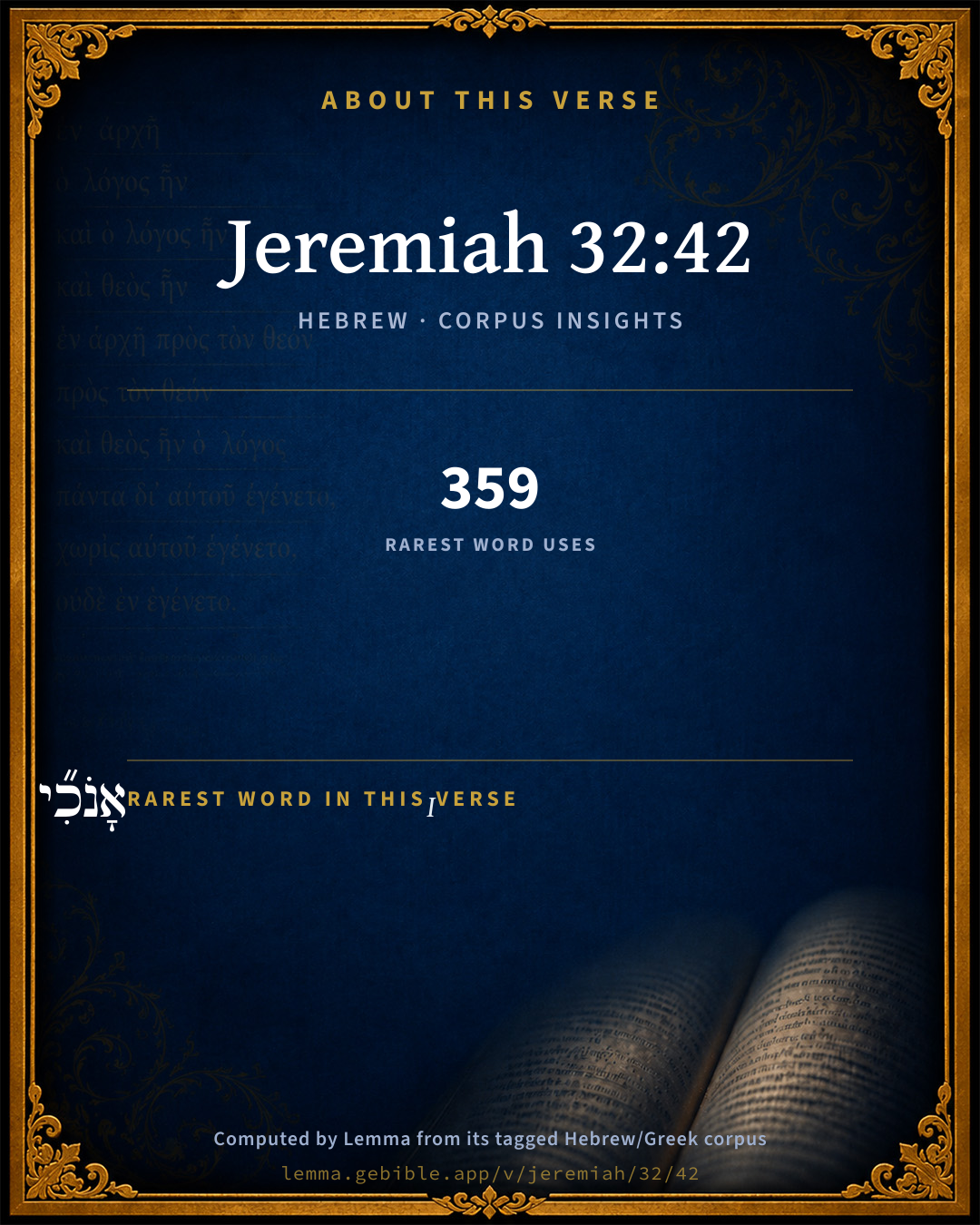
Jeremiah 32:42

Hebrew (Westminster Leningrad Codex) Jeremiah 32:42 appears in the Hebrew Old Testament. The text above is from the Westminster Leningrad Codex. Each word links to its Strong’s number, a concise gloss, and parsing drawn from the Open Scriptures Hebrew Bible morphology. Click any word for its full Brown-Driver-Briggs (BDB) entry.
Download image
Cite this verse

Jeremiah 32:42 (World English Bible). Public Domain. Lemma interlinear Bible study tool, https://lemma.gebible.app/v/jeremiah/32/42.

Show BibTeX & RIS
BibTeX
RIS
English Translation
For thus says Yahweh: Like as I have brought all this great evil on this people, so will I bring on them all the good that I have promised them.
World English Bible · Public Domain
Download a study sheet

One document with this verse’s original text, its word-by-word gloss line, the meaning frame, cross-references with their text, attributed commentary, and full source and license credits — printable, and it pastes into notes with its structure intact.

This verse Autodidact and up

Study sheet (.html) Plain text (.txt)

A passage Seminary Student

Up to 50 verses in one chapter. A passage sheet keeps up to 6 commentary sources and 12 cross-references per verse, in the order this page ranks them, and says so on the sheet whenever that leaves anything out. Ask for a single verse and you get the Autodidact verse sheet above.

Everything on this page stays free to read, with no account — the sheet is a download of what is already on screen, not access to it.

Want to remove ads? Support Godless Engineer
Compare translations 3

The same verse in 3 English versions, stacked beneath the original-language interlinear above. Click any original word for its lexicon entry.

Each is an independent rendering of the whole verse — the interlinear is not word-aligned to these translations.

Highlighted words mark where these versions differ — a whole-verse word diff, not a word-by-word alignment.

  • World English Bible Public Domain
    For thus says Yahweh: Like as I have brought all this great evil on this people, so will I bring on them all the good that I have promised them.
  • King James Version Public Domain
    For thus saith the LORD; Like as I have brought all this great evil upon this people, so will I bring upon them all the good that I have promised them.
  • unfoldingWord Literal Text CC BY-SA 4.0
    For Yahweh says this, ‘Just as I have brought all this great disaster on this people, so I will bring on them all the good things that I have said I would do for them.

unfoldingWord Literal Text — © unfoldingWord, licensed CC BY-SA 4.0. Word-aligned USFM3 via Door43 (git.door43.org/unfoldingWord/en_ult).

Versions to compare (up to 4)

3 of 4 selected

Show all 18 translations

Every available English version of this verse, each an independent rendering of the whole verse.

  • World English Bible Public Domain
    For thus says Yahweh: Like as I have brought all this great evil on this people, so will I bring on them all the good that I have promised them.
  • Berean Standard Bible Public Domain
    For this is what the LORD says: Just as I have brought all this great disaster on this people, so I will bring on them all the good I have promised them.
  • Majority Standard Bible Public Domain
    For this is what the LORD says: Just as I have brought all this great disaster on this people, so I will bring on them all the good I have promised them.
  • King James Version Public Domain
    For thus saith the LORD; Like as I have brought all this great evil upon this people, so will I bring upon them all the good that I have promised them.
  • American Standard Version (1901) Public Domain
    For thus saith Jehovah: Like as I have brought all this great evil upon this people, so will I bring upon them all the good that I have promised them.
  • Revised Version (1885) Public Domain
    For thus saith the LORD: Like as I have brought all this great evil upon this people, so will I bring upon them all the good that I have promised them.
  • Geneva Bible (1599) Public Domain
    For thus sayth the Lord, Like as I haue brought all this great plague vpon this people, so wil I bring vpon them all the good that I haue promised them.
  • Douay-Rheims (1899) Public Domain
    For thus saith the Lord: As I have brought upon this people all this great evil: so will I bring upon them all the good that I now speak to them.
  • Young's Literal Translation Public Domain
    `For thus said Jehovah: As I brought in unto this people all this great evil, so I am bringing in on them all the good that I am speaking concerning them;
  • Literal Standard Version CC BY-SA 4.0
    For thus said YHWH: “As I brought to this people all this great calamity, so I am bringing on them all the good that I am speaking concerning them;
  • Unlocked Literal Bible CC BY-SA 4.0
    For Yahweh says this, 'Just as I have brought all this great disaster on this people, so I will bring on them all the good things that I have said I would do for them.
  • unfoldingWord Literal Text CC BY-SA 4.0
    For Yahweh says this, ‘Just as I have brought all this great disaster on this people, so I will bring on them all the good things that I have said I would do for them.
  • Darby Bible Public Domain
    For thus saith Jehovah: Like as I have brought all this great evil upon this people, so will I bring upon them all the good that I have spoken concerning them.
  • World Messianic Bible Public Domain
    For the LORD says: “Just as I have brought all this great evil on this people, so I will bring on them all the good that I have promised them.
  • Webster's Bible Public Domain
    For thus saith the LORD; As I have brought all this great evil upon this people, so will I bring upon them all the good that I have promised them.
  • Free Bible Version CC BY-SA 4.0
    This is what the Lord says: Just as certainly as I have brought this whole disaster down on my people, so I'm going to give to them all the good things I have promised.
  • Bible in Basic English Public Domain
    For the Lord has said: As I have made all this great evil come on this people, so I will send on them all the good which I said about them.
  • JPS Tanakh (1917) Public Domain
    For thus saith the LORD: Like as I have brought all this great evil upon this people, so will I bring upon them all the good that I have promised them.

Literal Standard Version (2020), Covenant Press — licensed CC BY-SA 4.0. Text via the HelloAO Bible API (eBible.org). Unlocked Literal Bible (unfoldingWord) — licensed CC BY-SA 4.0. Text via the HelloAO Bible API (eBible.org). unfoldingWord Literal Text — © unfoldingWord, licensed CC BY-SA 4.0. Word-aligned USFM3 via Door43 (git.door43.org/unfoldingWord/en_ult). Free Bible Version, Dr. Jonathan Gallagher — licensed CC BY-SA 4.0. Text via the HelloAO Bible API (eBible.org).

Word by word

More ways to search: Search by grammar → Find every occurrence → Compare this word →

Practice this passage: Drill this verse → Learn its vocabulary →

אָנֹכִ֞י
ʼânôkîy
H595
“I”
Pronoun, Personal, 1st Person, Common, Singular
Part of Speech
Pronoun
Type
Personal
Person
1st Person
Gender
Common
Number
Singular
Full BDB Definition

Origin: a primitive pronoun

TWOT: 130

I (first person singular)
  1. כִּֽי kîy H3588 “that” Conjunction
  2. כֹה֙ kôh H3541 “thus” Adverb
  3. אָמַ֣ר ʼâmar H559 “to say” Verb, Qal, Perfect, 3rd Person, Masculine, Singular
  4. יְהוָ֔ה Yᵉhôvâh H3068 “LORD” Noun, Proper
  5. כַּאֲשֶׁ֤ר ʼăsher H834 “like/as · which” Preposition + Particle, Relative
  6. הֵבֵ֨אתִי֙ bôwʼ H935 “to enter” Verb, Hiphil, Perfect, 1st Person, Common, Singular
  7. אֶל ʼêl H413 “to” Preposition
  8. הָעָ֣ם ʻam H5971 “the · people” Particle, Definite Article + Noun, Common, Masculine, Singular, Absolute
  9. הַזֶּ֔ה zeh H2088 “the · this” Particle, Definite Article + Pronoun, Demonstrative, Masculine, Singular
  10. אֵ֛ת ʼêth H853 “-” Particle, Direct Object
  11. כָּל kôl H3605 “all of” Noun, Common, Masculine, Singular, Construct
  12. הָרָעָ֥ה raʻ H7451 “the · evil” Particle, Definite Article + Noun, Common, Feminine, Singular, Absolute
  13. הַגְּדוֹלָ֖ה gâdôwl H1419 “the · great” Particle, Definite Article + Adjective, Adjective, Feminine, Singular, Absolute
  14. הַזֹּ֑את zôʼth H2063 “the · this” Particle, Definite Article + Pronoun, Demonstrative, Feminine, Singular
  15. כֵּ֣ן kên H3651 “thus” Particle, Demonstrative
  16. מֵבִ֤יא bôwʼ H935 “entering” Verb, Hiphil, Participle Active, Masculine, Singular, Absolute
  17. עֲלֵיהֶם֙ ʻal H5921 “upon · them” Preposition + Suffix, Personal, 3rd Person, Masculine, Plural
  18. אֶת ʼêth H853 “-” Particle, Direct Object
  19. כָּל kôl H3605 “all of” Noun, Common, Masculine, Singular, Construct
  20. הַטּוֹבָ֔ה ṭôwb H2896 “the · good” Particle, Definite Article + Adjective, Adjective, Feminine, Singular, Absolute
  21. אֲשֶׁ֥ר ʼăsher H834 “which” Particle, Relative
  22. אָנֹכִ֖י ʼânôkîy H595 “I” Pronoun, Personal, 1st Person, Common, Singular
  23. דֹּבֵ֥ר dâbar H1696 “speaking” Verb, Qal, Participle Active, Masculine, Singular, Absolute
  24. עֲלֵיהֶֽם ʻal H5921 “upon · them” Preposition + Suffix, Personal, 3rd Person, Masculine, Plural

About this verse

These counts appear in no published source. They are computed here, from the morphology-tagged text and Lemma’s own curated glosses. What Lemma adds →

25
words
19
distinct lemmas
Prophets
section

Grammatical profile

  • 4 verbs
  • 5 nouns
  • 2 adjectives
  • 4 pronouns
  • 3 prepositions
  • 1 conjunction
  • 1 adverb
  • 5 particles

Verb forms

  • אָמַ֣ר Qal · Perfect
  • הֵבֵ֨אתִי֙ Hiphil · Perfect
  • מֵבִ֤יא Hiphil · Participle Active
  • דֹּבֵ֥ר Qal · Participle Active

Repetition

Words recur within this verse — often emphatic in Hebrew:

  • הֵבֵ֨אתִי֙ to enter H935 ×2
  • כָּל all H3605 ×2
  • עֲלֵיהֶם֙ upon H5921 ×2
  • כַּאֲשֶׁ֤ר which H834 ×2
  • אָנֹכִ֞י I H595 ×2

Cross-references

5

Topical passages linked to Jeremiah 32:42 in the Treasury of Scripture Knowledge — connected by theme and wording, ordered by reader-vote popularity; previews shown in the World English Bible.

  • Jeremiah 31:28 It shall happen that, like as I have watched over them to pluck up and to break down and to overthrow and to destroy and to afflict, so will I watch over them to build and to plant, says Yahweh.
  • Joshua 23:14–15 Behold, this day I am going the way of all the earth: and you know in all your hearts and in all your souls, that not one thing has failed of all the good things which Yahweh your God spoke concerning you; all are happen to you, not one thing has failed of it.
  • Jeremiah 33:10–11 Thus says Yahweh: Yet again there shall be heard in this place, about which you say, It is waste, without man and without animal, even in the cities of Judah, and in the streets of Jerusalem, that are desolate, without man and without inhabitant and without animal,
  • Zechariah 8:14–15 For thus says Yahweh of hosts: "As I thought to do evil to you, when your fathers provoked me to wrath," says Yahweh of Hosts, "and I didn't repent;
  • Matthew 24:35 Heaven and earth will pass away, but my words will not pass away.

Cross-references courtesy of OpenBible.info (CC BY 4.0).

Hebrew and Greek witnesses Masoretic Hebrew ↔ Greek Septuagint

The same verse in the two great witnesses to the Old Testament, shown verse-for-verse.

These are two independent witnesses, not word-aligned to each other, and the Septuagint is shown in lemma (dictionary) form.

Hebrew Jeremiah 32:42 Masoretic · Westminster Leningrad Codex

כִּֽי כֹה֙ אָמַ֣ר יְהוָ֔ה כַּאֲשֶׁ֤ר הֵבֵ֨אתִי֙ אֶל הָעָ֣ם הַזֶּ֔ה אֵ֛ת כָּל הָרָעָ֥ה הַגְּדוֹלָ֖ה הַזֹּ֑את כֵּ֣ן אָנֹכִ֞י מֵבִ֤יא עֲלֵיהֶם֙ אֶת כָּל הַטּוֹבָ֔ה אֲשֶׁ֥ר אָנֹכִ֖י דֹּבֵ֥ר עֲלֵיהֶֽם

For thus says Yahweh: Like as I have brought all this great evil on this people, so will I bring on them all the good that I have promised them.

World English Bible · Public Domain

Greek LXX Structure differs

In the Septuagint, Jeremiah is about an eighth shorter than the Hebrew and arranges its material differently — the Oracles Against the Nations (Hebrew chapters 46–51) appear in the middle of the Greek book, after 25:13. Because the chapter and verse boundaries do not line up, a verse-for-verse comparison with the Hebrew is not shown.

A verse-for-verse comparison isn’t shown here because the chapters and verses don’t line up. Switch to the LXX edition with the MT / LXX toggle above to read the Greek directly.

On this verse, John Gill's Exposition discusses the Septuagint’s reading. Read the note in Commentary ↓

Hebrew: Westminster Leningrad Codex (CC BY 4.0). Greek: Septuagint (public domain); English from a public-domain English Septuagint. How the Septuagint differs from the Hebrew →

Targum (Aramaic paraphrase)

1

The Targum is the ancient Jewish Aramaic paraphrase of the Hebrew Scriptures — an interpretive translation, not the Hebrew text itself. Onkelos (literal) and Pseudo-Jonathan (expansive) render the Torah, and Jonathan the Prophets. Coverage is partial: where no permissively-licensed English translation exists for a verse, only the Aramaic is shown. This is verse-level text, not a word-by-word alignment to the Hebrew.

  1. Targum Jonathan Prophets (Joshua–Malachi)
    אֲרֵי כִדְנַן אֲמַר יְיָ כְּמָה דְאַיְתֵיתִי עַל עַמָא הָדֵין יַת כָּל בִּישְׁתָא רַבְּתָא הָדָא כֵּן אֲנָא מַיְתִי עֲלֵיהוֹן יַת כָּל טַבְתָא דַאֲנָא מְמַלֵיל עֲלֵיהוֹן:

    (no public-domain English translation for this verse)

    Targum Jonathan — Aramaic: “Mikraot Gedolot” (public domain). English: “Sefaria Community Translation” (CC0 1.0 (public-domain dedication)); “London "Chaldee Paraphrase," 1871” (public domain). Text via Sefaria.

Commentary

Notes on Jeremiah 32:42 from classic Christian and Jewish commentators (each source and its license shown beneath its notes). The classic Christian expositions comment on the surrounding passage and are grouped to its opening verse, so a note may address several verses; the Jewish commentaries on the Tanakh (Rashi and others) are per-verse, so they appear only where the commentator wrote on this verse.

Lemma curates 59 commentaries, every one of them public domain or Creative Commons licensed, each selected and text-cleaned for this edition rather than reprinted as found. About our sources →

Trapp's Complete Commentary

John Trapp

Jer 32:42 For thus saith the LORD; Like as I have brought all this great evil upon this people, so will I bring upon them all the good that I have promised them.

Ver. 42. So will I bring upon them.] Jer 29:10; Jer 31:28.

John Trapp, A Commentary or Exposition upon All the Books of the Old and New Testament (1647–1656) — public domain. Text from a community e-Sword module.

The Biblical Illustrator

Joseph S. Exell

Jer_32:42

All the good that I have promised.

The religion, of the promise

(with Num_10:29):--Obeying a true instinct, the Church of Christ has from the beginning understood the whole story of the transfer of the chosen people from the land of bondage to the land of promise as possessing, over and above its historical value, the preciousness of a divinely-planned allegory. For us, to-day, just as really as for them in days of old, the stimulus continues to be simply this--a promise. Heaven cannot be demonstrated. We merely take Gods Word for it. Not enough, in our times, is said--soberly and intelligently said, I mean--about heaven. Very many people have the feeling that the old-fashioned heaven of their childhoods thoughts and hopes has been explained away by the progress ex discovery. It seems to them as if heaven were pushed farther and farther off, just in proportion as the telescope penetrates farther and farther into space. The gates of pearl recede with the enlargement of the object-glass, and the search for tee Paradise of God, like that for the earthly Eden, seems to become more hopeless, the more accurate our knowledge of the map. The primitive Christians found it comparatively easy to think of heaven as a place just above the stars. To us, who have learned to think of the sun itself as but a star seen near at hand, and of the stars as suns, such localisation of the dwelling-place of the Most Highest is far from easy. Another, and a very different reason for keeping heaven, as it were, in the background, holding the mention of it in reserve, comes from those who believe that there is such a danger as that of cheapening and vulgarising sacred things by too much fluency in talking about them. It cannot be denied that there is a certain amount of reason for this fastidiousness, some strength in this protest. An indulgent rhetoric may throw open the gates with a freedom so careless as to make us wonder why there should be any gates at all; and lips to which the common prose speech of the real heaven would perhaps come hard, were they compelled to try it, can sing of Jerusalem the Golden, and of the Paradise for which tis weary waiting here with a glibness at which possibly the angels stand aghast. This is a second reason, a very different reason from the first, but still a reason, for observing reticence about heaven. And yet, m the face of both of these reasons, I think it is a sad pity, our hearing so little as we do about the hope of heaven as a motive power in human life. For after all that has been said, or can be said, these two facts remain indisputable; they stare us in the face: first, that this life of ours, however we may account for it, does bear a certain resemblance to a journey, in that the one is a movement through time, as the other is a movement through space; secondly, that any journey which lacks a destination is, and must of necessity be a dismal thing. Human nature being what it is, we need the attractive power of something to look forward to, as we say, to keep our strength and courage up to the living standard. Christians are men with a hope, men who have been called to inherit a blessing. Nor is the Old Testament lacking in this element of promise. It runs through the whole Bible. What book anywhere can you point to so forward-looking as that Book? As we watch the worthies of many generations pass in long procession onwards, from the day when the promise was first given of the One who should come and bruise the serpents head, down to the day when the aged Simeon in the Temple took the Child Jesus into his arms and blessed Him, we seem to see upon every forehead a glow of light. These men have a hope. They are looking for something, and they look as those look who expect in due time to find. If this be true of the general tone of the Old Testament Scriptures, doubly, trebly is it true of the New Testament. The coming of Christ has only quickened and made more intense in us that instinct of hope which the old prophecies of His coming first inspired. For when He came, He brought in larger hopes, and opened to us far-reaching vistas of promise, such as had never been dreamed of before. A solemn joy pervades the atmosphere in which apostle and evangelist move before our eyes. They are as men who, in the face of the wreck of earthly hopes, have yet no inclination to tears, because there has been opened to them a vision of things unseen, and granted to them a foretaste of the peace eternal. The glory that shall be revealed; the things eye hath not seen, prepared for those who love God; the house not made with hands, waiting for occupancy; the crown of righteousness, laid up--you remember how prominent a place these hold in the persuasive oratory of St. Paul. The complaint that the progress of human knowledge has made it difficult to think and speak of heaven as believing men used to think and speak of it, is a complaint to which we ought to return for a few moments; for, from our leaving it as we did, the impression may have been conveyed to some minds that the difficulty is insuperable. Let me observe, then, that while there is a certain grain of reasonableness in this argument for silence with respect to heaven and the things of heaven, there is by no means so much weight to be attached to it as many people seem to suppose. For after all, when we come to think of it, this changed conception of what heaven may be like is not traceable so much to any marvellous revolution that has come over the whole character of human thought since you and I were children, as it is to the changes which have taken place in our own several minds, and which necessarily take place in every mind in its progress from infancy to maturity. The really serious blow at old-time notions upon the subject was dealt long before any of us were born, when the truth was established beyond serious doubts that this planet is not the centre about which all else in the universe revolves. But the explanation of our personal sense of grievance at being robbed of the heaven we were used to believe in is to be sought in the familiar saying, When I was a child, I spake as a child, &c. We instinctively, and without knowing it, project this childish way of looking at things upon the whole thinking world that was contemporary with our childhood, and infer from the change that has come over our own mind that corresponding change has been going on in the mind of the world at large. This fallacy is the more easily fallen into, because it is a fact that, if we go back far enough in the history of thought, we do find even the mature minds seeing things much as we ourselves saw them in our early childhood. But let me try to strike closer home and meet the difficulty in a more direct and helpful way. I do it by asking whether we ought not to feel ashamed of ourselves, thus to talk about having been robbed of the promise simply because the Father of heaven has been showing us, lust as fast as our poor minds could bear the strain, to how immeasurable an area the Fatherhood extends. Instead of repining because we cannot dwarf Gods universe so as to make it fit perfectly the smallness of our notions, let us turn all our energies to seeking to enlarge the capacity of our faith so that it shall be able to hold more. What all this means is, that we are to believe better things of God, not worse things. It may turn out,--who can tell?--that heaven lies nearer to us than even in our childhood we ever ventured to suppose; that it is not only nearer than the sky, but nearer than the clouds. The reality of heaven, happily, is not dependent on the ability of our five senses to discover its whereabouts. Doubtless a sixth or seventh sense might speedily reveal much, very much of which the five we now have take no notice. Be this as it may, the reasonableness of our believing in Christs promise, that in the world whither He went He would prepare a place for us, is in nowise impugned by anything that the busy wit of man has yet found out, or is likely to find out. There is no period of life from which we can afford to spare the presence of this heavenly hope. We need it in youth, to give point and purpose and direction to the newly launched life. We need it in middle life to help us cover patiently that long stretch which parts youth from old age--the time of the fading out of illusions in the dry light of experience; the time when we discover the extent of our personal range, and the narrow limit of our possible achievement. Above all shall we find such a hope the staff of old age, should the pilgrimage last so long. But let us not imagine that we can postpone believing until then. Faith is a habit of the soul, and old men would be the first to warn us against the notion that it is a habit that may be acquired in a day. Those of us who are wise will take up the matter now, at whatever point of age the word may happen to have found us. (W. R. Huntington, D. D.)

.

The Biblical Illustrator, edited by Joseph S. Exell (c. 1880s–1900s) — public domain. Text from a community e-Sword module.

Tyndale Open Study Notes

Tyndale Open Resources

32:42-43 God’s promises for good were just as certain as the judgments that were being carried out as the Babylonians laid siege to Jerusalem.

Tyndale Open Study Notes — © Tyndale Open Resources, licensed CC BY-SA 4.0. Text via the HelloAO Bible API.

Jamieson, Fausset & Brown

Robert Jamieson, A. R. Fausset & David Brown

(Jer 31:28). The restoration from Babylon was only a slight foretaste of the grace to be expected by Israel at last through Christ.

Jamieson, Fausset & Brown — Commentary Critical and Explanatory on the Whole Bible (1871) — public domain (CC PDM 1.0). Text via the HelloAO Bible API.

Adam Clarke's Commentary

Verse 42. Will I bring upon them all the good that I have promised] God's word cannot fail. The Jews have never yet received the good that God has promised. Nothing like the fulfilment of these promises took place after their return from Babylon; therefore there remaineth yet a rest for these ancient people of God; and it is under the Christian dispensation that they are to have it.

Adam Clarke's Commentary on the Bible (1810–1826) — public domain. Text from a community e-Sword/MySword module.

John Calvin's Commentaries

God shews here again to his Prophet that exile would be temporary as to the remnant; for we know that the greater part of the people had been wholly rejected; but it pleased the Lord, that his Church should survive, though very small in number. Then this promise is not to be extended indiscriminately to all the twelve tribes, but refers especially to the elect, as the event sufficiently proved, and Paul also is a most faithful interpreter of this truth. And this ought to be carefully borne in mind, because hypocrites always steal for themselves whatever God promises to his faithful people, while yet they falsely pretend his name. Let us then understand the design of God, even that his purpose was to support with strong confidence his chosen, lest despair should close up the avenue to prayer. Since, then, a portion of the people remained, that the Church might not wholly be cut off, this promise was fulfilled; and as we can never embrace the promise of mercy, except repentance and acknowledgment of sin precede, the two things are here referred to by the Prophet.

He says that God had made to come, or had brought, a dreadful calamity; and it then follows, that he would bring on them all the good that he had promised. By these words God intimates that what he had before promised would not be difficult for him to accomplish, because he could heal the wound which he had inflicted. Had the Chaldeans, as it had been said elsewhere, taken the city according to their own will, the remedy might have been difficult; but as God had employed the Chaldeans, and as they had fought, as it were, under his banner, it was an easy thing for him to restore the city, and to recall from exile those whom his righteous vengeance had banished.

We must notice especially what is said, I will render to them all the good which I have spoken concerning them. For God shews on what support the faithful were to rely in hoping for their liberation; he bids them to depend on his own mouth; for whatever men may promise is evanescent and without fruit. If, then, we would have our hope to be firmly fixed, so that it may not disappoint us, let us learn to rely on God’s promises, so that no one of us may presumptuously dream of this or that, as we thus often deceive ourselves; but let us acquiesce in the word of God. But when the evidence of God’s grace fails us, we may have recourse to many confidences, but it will be without profit. We now perceive why the Prophet expressly added this particular respecting God’s word. It follows, —

John Calvin's Commentaries (1540-1563) — public domain. Text from the Calvin Translation Society English edition (1840s-50s) via the Christian Classics Ethereal Library (ccel.org). Calvin's coverage is partial (roughly two-thirds of the Bible); uncommented books and verses are honest gaps, never fabricated. The 19th-century editor's footnotes and remarks are omitted so the notes are faithfully Calvin's own voice.

John Gill's Exposition

Men shall buy fields for money,.... They shall have plenty of money, and they shall lay it out in land, and carry on husbandry, cultivate the ground, which had lain long untilled, but now should be manured for public as well as private good. This some understand of particular churches planted in Judea, and out of it, throughout the whole world; and of men's gathering and joining themselves to them by a profession of that faith which is more precious than gold or silver:

and subscribe evidences, and seal them, and take witnesses; as Jeremiah had done before, when he bought the field of his uncle's son, Jer 32:10. This is spiritually understood by some of the word of God laid hold on by faith; of the sealing of the Spirit, and of the ordinances of the Gospel:

in the land of Benjamin; where Anathoth was, and Jeremiah's field lay; and where the same should be done by others as was done by him:

and in the places about Jerusalem; in the suburbs of it, and in the villages round about it:

and in the cities of Judah; throughout the whole country, divided into the three following parts:

and in the cities of the mountains; in the hilly country of Judea, where was Hebron, and other cities, Luk 1:39;

and in the cities of the valley. The Septuagint retains the Hebrew word "sephela", or the plain, in which were Emmaus, Lydda, Sharon, places mentioned in the New Testament:

and in the cities of the south; or Nagab, the south part of Judea, which led to Gaza, Act 8:26. This division of Judea into the mountains, valley, and south, exactly agrees with the account of it in Jos 15:21. Some understand this of the Gospel going out of Jerusalem after the day of Pentecost, not only to the places near that city, but to Samaria, and the cities of the south towards Egypt, and so into all the world:

for I will cause their captivity to return, saith the Lord; their temporal captivity from Babylon, and their spiritual captivity from sin, Satan, and the law.

Next: Jeremiah Chapter 33

John Gill's Exposition of the Whole Bible (1746–1763) — public domain (CC PDM 1.0). Text via the HelloAO Bible API.

Matthew Poole's English Annotations

You shall find me as true to my promises as you have found me to my threatenings.

Matthew Poole's English Annotations on the Holy Bible (1683–1685) — public domain. Text from a community e-Sword/MySword module.

The Pulpit Commentary

Like as I have brought, etc. The prophet still has in his mind the thought expressed in Jer_31:28, that the brighter part of his revelations must as surely be accomplished as the darker.

The ratio of sorrow and joy.

I THERE IS SUCH RATIO. Sorrow and joy are not flung down at haphazard into this world at the caprice of the Ruler of all, and irrespective one of the other, only that for the mass of men the sorrow is far greater and more pervading than the joy. But the relations between these two it is the glory of Scripture and of the gospel especially to reveal.

II SCRIPTURE TEACHES IT. Here in this verse; cf. also Psalm 90, "Make us glad according to the days," etc.; Job_2:10, "Shall we receive good at the hand of God, and shall we not also receive evil?" parable of Dives and Lazarus: "Thou in thy lifetime receivedst thy good things, and likewise Lazarus evil things; but now he is comforted, and thou art tormented". (Lu 16)

III NATURE ILLUSTRATES IT. It is said that on the Scotch lakes the depth of the lake is almost always the same as the height of the surrounding hills. And is it not the same with the great depths of ocean and the lofty mountains of the world? They have long, long winter in the Northern climes, but when the light does come back, the day so stretches out that you can read by the light of the midnight sun. And if we look into the faces of men, those indices of the soul within, it will be found that the looks of sorrow and of joy are about equally distributed. God is not a partial, unjust Father, petting one and neglecting others of his children. Sometimes we think so, but a larger survey will lead to truer thought.

IV IT IS A TRUTH FULL OF COMFORT. For it teaches:

1. That if sorrow be sent, joy is not far off. "If I had been a little child among the Israelites, I think I should have known, when father set the bitter herbs upon the table, that the lamb was roasting somewhere, and would be set out too bitter herbs shall ye eat it and so if there be bitter herbs, the dainty dish is near" (Spurgeon).

2. That the two come from the same hand. If there be a designed proportion then, not two independent minds are at work, but one only; ratio and proportion ever argue unity of mind. There is not an evil god who hurls sorrow upon men, and another a gracious God who sends only joy. That was the old Manichaean heresy, which is not dead yet. But the truth is that there is a likeness, a proportion between the good which God sends upon his people and the evil he has brought upon them. From one hand both come. But

V THE RATIO IS NOT EQUAL FOR THE CHILD OF GOD. "Our light affliction, which is but for a moment, worketh for us a far more exceeding and eternal weight of glory." The proportion of the evil we suffer to the good we shall enjoy is not that of equals, but that of the very little to the infinitely great.

VI THE RELATIONSHIP ALSO IS THAT OF MOTHER AND CHILD. Sorrow is the mother of joy. Cf. our Lord"s own metaphor: "A woman when she is in travail hath sorrow, because her hour is come: but as soon as she is delivered of the child she remembereth no more the anguish, for joy that a man is born into the world." "Weeping may endure for a night, but joy cometh in the morning." Cf, also above: "Our light affliction... worketh for us," etc., so that joy is begotten of sorrow.

VII BUT THIS CAN ONLY BE FOR THE CHILD OF GOD. ThereforeHelp, Lord, that we may come To thy saints" happy home, Where a thousand years As one day appears; Nor go Where one day appears As a thousand years For wee! C.

Evil the measure of good.

I WITH REGARD TO CERTAINTY. Here is evil actually upon the city and country. Evil that has come, not in some inexplicable, unexpected way, but in correspondence with prophetic announcements, extending over a long time and frequently repeated. And now out of the very perceived certainty of this evil, God takes occasion to create ground of hope and encouragement for the people. He who without fail has sent chastisement for the disobedient will equally without fail keep all his promises to the obedient. It is the principle of sowing and reaping. The harvest will assuredly be according to the seed that is sown. We have the choice of alternatives, and only of alternatives. Either by our negligence we shall lay ourselves open to have God bring great evils upon us, or by our obedience and regard we shall receive all that great good which God promises to those who obey..

II WITH REGARD TO AGENCY. The emphasis of the verse is especially upon the agent. Those who fail to see that it is God who has brought all this great evil will fail to get much comfort from his most comprehensive and gracious promises. Behind the unseen instruments we must see the unseen Director and Controller. We must try to trace out the wrath of God in manifestation against the unrighteousness of men. As we trace the miseries that come from human selfishness and self-indulgence, we must learn to see God in them God as well as man; we must recognize righteous law as well as wicked folly. We are not to depend for the best things upon uncertain man, but upon God, with his unvarying love, his exhaustless power.

III WITH REGARD TO EXTENT. One would not wish for its own sake to measure the height, and depth, the breadth, and length, of human misery, but we have to do it to estimate its cause and bring about its cure. And always the peril is to look upon it superficially and hastily. Now, by this very superficiality and haste we miss a great source of gladness. For our estimate of possible good must have for one of its elements our experience of actual evil. A man must sink low if he would rise high. We do not mean, of course, that he must sink low by an exceptionally depraved and vicious life; that would be to recommend what Paul denounces sinning in order that grace may abound. We must sink low in our estimate of ourselves. We must see that, unless we also repent, a great evil will inevitably come upon us, whereas, if we are wisely obedient, we shall be the recipients of a splendid good a good which ever has its forerunners in the gracious promises of God. Y.

The Pulpit Commentary (1880–1919), ed. H.D.M. Spence-Jones & Joseph S. Exell — public domain. Text from a community e-Sword module.

Lesson kit

Teaching starters — assembled from the data on this page, not authored interpretation. Every prompt links to the verse data it draws on. Edit before teaching.

Jeremiah, in the Prophets, opens this verse with 25 words (19 distinct Hebrew lemmas). Its most distinctive word is ʼânôkîy (“I”). A historical commentator’s framing appears above. Read the whole chapter for the surrounding context.

Discussion questions

  1. The word ʼânôkîy carries the sense “I.” How does it shape the verse?
  2. Jeremiah 31:28 shares this passage’s theme. How do the two illuminate each other?
  3. “to enter” occurs 2× in this one verse. What is the effect of the repetition?
  4. These translations render this verse differently. What is at stake in choosing one wording over another?
  5. The verb «אָמַ֣ר» is Qal Perfect. How does its form color the action?
  6. Reading how Trapp's Complete Commentary and The Biblical Illustrator read this verse, where do the two commentators agree and where do they part?

Things to notice

Reading settings

Reading text

Shown beneath each verse's original-language words.

Old Testament
Old Testament edition

Read the OT as the Masoretic Hebrew (MT) or the Greek Septuagint (LXX).

English shown for the Greek Septuagint (in the Hebrew ↔ Greek comparison).

Comparing translations? Open the Compare panel on any verse page to stack up to four side by side.