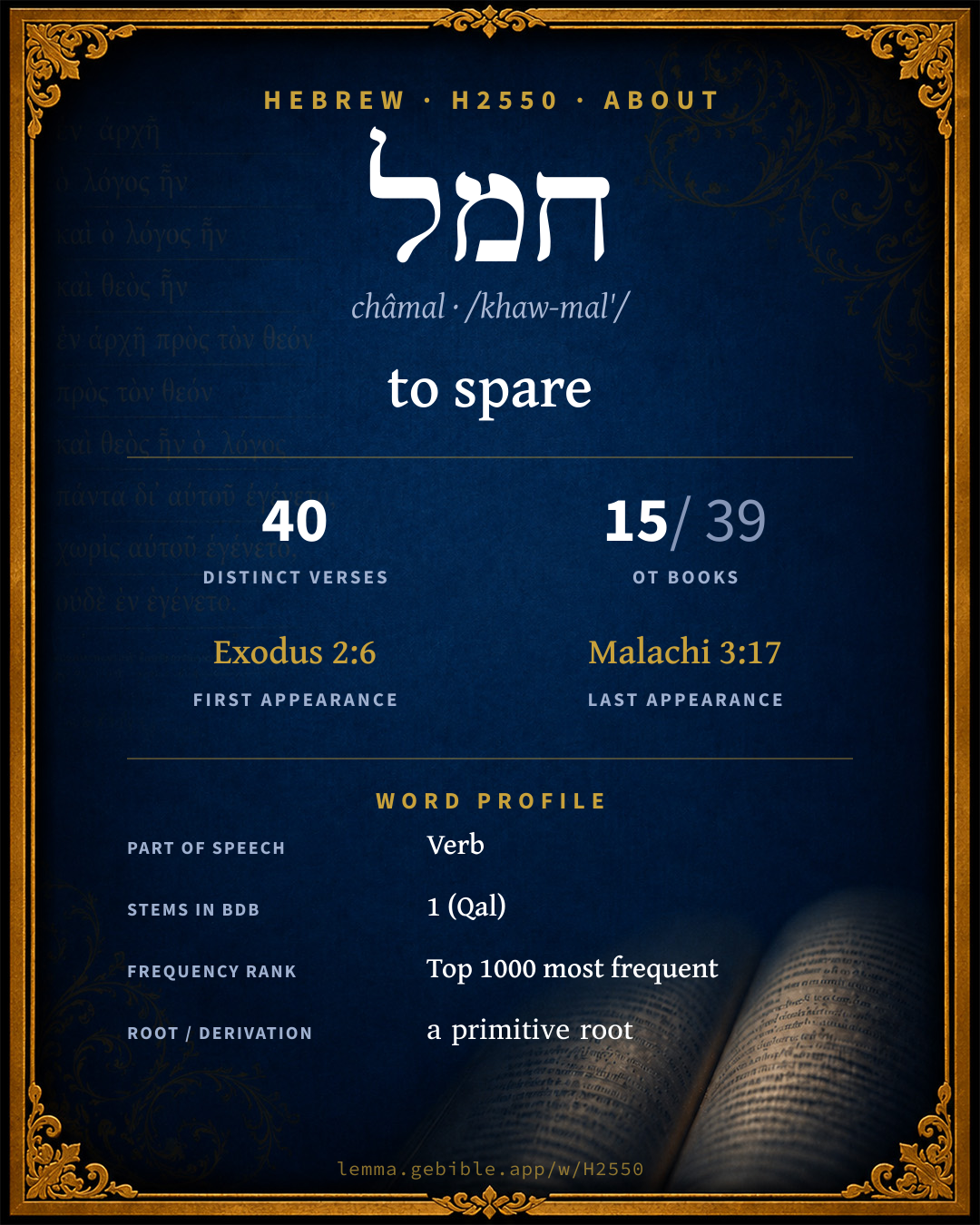
חָמַל
to spare
Full lexicon entry — Brown-Driver-Briggs (BDB)
From Brown-Driver-Briggs (BDB)
Where this word appears
Grammar key — what these labels mean
Part of speech
- Verb
- An action or state-of-being word.
Noun type
- Common
- A common noun — a general class of person, place, or thing (“king,” “city,” “water”), not a specific name.
Stem
- Qal
- The basic, simple active stem — the plain form of the verb (“he wrote”).
Form
- Imperfect
- An incomplete, ongoing, or future action (“he will / would write”).
- Perfect
- A completed action or state — Hebrew marks aspect (completeness) more than strict tense (“he wrote”).
- Sequential Imperfect
- An imperfect with prefixed waw — the standard past-narrative form (waw-consecutive imperfect).
- Jussive
- A third- or second-person volitional form expressing wish or command (“let him write”).
- Sequential Perfect
- A perfect with prefixed waw continuing a preceding imperfect or command (waw-consecutive perfect).
State
- Absolute
- The independent form of a noun, not bound to a following word.
Person
- 3rd Person
- The one spoken about (“he / she / it / they”).
- 1st Person
- The speaker (“I / we”).
- 2nd Person
- The one addressed (“you”).
Gender
- Masculine
- Grammatically masculine.
- Common
- Either gender — not distinguished for this form.
- Feminine
- Grammatically feminine.
Number
- Singular
- One.
- Plural
- More than one (in Hebrew, generally three or more).
Grammatical forms 14 distinct
- Verb, Qal, Imperfect, 3rd Person, Masculine, Singular 11 times (27%)
- Verb, Qal, Imperfect, 1st Person, Common, Singular 7 times (17%)
- Verb, Qal, Perfect, 3rd Person, Masculine, Singular 6 times (15%)
- Verb, Qal, Sequential Imperfect, 3rd Person, Masculine, Singular 4 times (10%)
- Verb, Qal, Imperfect, 2nd Person, Masculine, Singular 2 times (5%)
- Verb, Qal, Jussive, 2nd Person, Masculine, Plural 2 times (5%)
- Verb, Qal, Perfect, 2nd Person, Masculine, Singular 2 times (5%)
- Verb, Qal, Sequential Perfect, 1st Person, Common, Singular 1 time (2%)
+6 more forms (6 occurrences)
Parsed forms decoded from the imported morphology (morphhb / Westminster Leningrad Codex — WLC text public domain, morphhb tagging CC BY 4.0), counted across 41 parsed occurrences — not distinct verses.
Every verse where H2550 appears — 40 distinct verses across 15 books. Click any verse to open its interlinear word-by-word view. Verse text shown in the World English Bible for context — . Each verse’s Hebrew form is shown with its reference; the English is not keyword-highlighted, since the data carries no word-level English alignment. Use “Compare translations” on any verse to read it across multiple English versions. This concordance covers the Hebrew Bible; Septuagint (Greek Old Testament) occurrences are not indexed here.
Exodus 1 verse
Deuteronomy 1 verse
1 Samuel 4 verses
- 1 Samuel 15:3 תַחְמֹ֖ל Qal impf 2ms Now go and strike Amalek, and utterly destroy all that they have, and don't spare them; but kill both man and woman, infant and suckling, ox and sheep, camel and donkey.
- 1 Samuel 15:9 וַ/יַּחְמֹל֩ conj + Qal wimpf 3ms But Saul and the people spared Agag, and the best of the sheep, and of the oxen, and of the fatlings, and the lambs, and all that was good, and wouldn't utterly destroy them: but everything that was vile and refuse, that they destroyed utterly.
- 1 Samuel 15:15 חָמַ֤ל Qal pf 3ms Saul said, They have brought them from the Amalekites: for the people spared the best of the sheep and of the oxen, to sacrifice to Yahweh your God; and the rest we have utterly destroyed.
- 1 Samuel 23:21 חֲמַלְתֶּ֖ם Qal pf 2mp Saul said, Blessed be you of Yahweh; for you have had compassion on me.
2 Samuel 3 verses
- 2 Samuel 12:4 וַ/יַּחְמֹ֗ל conj + Qal wimpf 3ms A traveler came to the rich man, and he spared to take of his own flock and of his own herd, to dress for the wayfaring man who had come to him, but took the poor man's lamb, and dressed it for the man who had come to him."
- 2 Samuel 12:6 חָמָֽל Qal pf 3ms He shall restore the lamb fourfold, because he did this thing, and because he had no pity!"
- 2 Samuel 21:7 וַ/יַּחְמֹ֣ל conj + Qal wimpf 3ms But the king spared Mephibosheth, the son of Jonathan the son of Saul, because of Yahweh's oath that was between them, between David and Jonathan the son of Saul.
2 Chronicles 2 verses
- 2 Chronicles 36:15 חָמַ֥ל Qal pf 3ms Yahweh, the God of their fathers, sent to them by his messengers, rising up early and sending, because he had compassion on his people, and on his dwelling-place:
- 2 Chronicles 36:17 חָמַ֛ל Qal pf 3ms Therefore he brought on them the king of the Chaldeans, who killed their young men with the sword in the house of their sanctuary, and had no compassion on young man or virgin, old man or gray-headed: he gave them all into his hand.
Job 4 verses
- Job 6:10 יַחְמ֑וֹל Qal impf 3ms Be it still my consolation, Yes, let me exult in pain that doesn't spare, That I have not denied the words of the Holy One.
- Job 16:13 יַחְמ֑וֹל Qal impf 3ms His archers surround me. He splits my kidneys apart, and does not spare. He pours out my gall on the ground.
- Job 20:13 יַחְמֹ֣ל Qal impf 3ms Though he spare it, and will not let it go, But keep it still within his mouth;
- Job 27:22 יַחְמֹ֑ל Qal impf 3ms For it hurls at him, and does not spare, As he flees away from his hand.
Proverbs 1 verse
Isaiah 2 verses
- Isaiah 9:19 יַחְמֹֽלוּ Qal impf 3mp Through the wrath of Yahweh of hosts is the land burnt up; and the people are as the fuel of fire: no man spares his brother.
- Isaiah 30:14 יַחְמֹ֑ל Qal impf 3ms He shall break it as a potter's vessel is broken, breaking it in pieces without sparing; so that there shall not be found among the pieces of it a broken piece with which to take fire from the hearth, or to dip up water out of the cistern."
Jeremiah 5 verses
- Jeremiah 13:14 אֶחְמ֧וֹל Qal impf 1cs I will dash them one against another, even the fathers and the sons together, says Yahweh: I will not pity, nor spare, nor have compassion, that I should not destroy them.
- Jeremiah 15:5 יַחְמֹ֤ל Qal impf 3ms For who will have pity on you, Jerusalem? or who will bemoan you? or who will turn aside to ask of your welfare?
- Jeremiah 21:7 יַחְמֹ֖ל Qal impf 3ms Afterward, says Yahweh, I will deliver Zedekiah king of Judah, and his servants, and the people, even such as are left in this city from the pestilence, from the sword, and from the famine, into the hand of Nebuchadrezzar king of Babylon, and into the hand of their enemies, and into the hand of those who seek their life: and he shall strike them with the edge of the sword; he shall not spare them, neither have pity, nor have mercy.
- Jeremiah 50:14 תַּחְמְל֖וּ Qal juss 2mp Set yourselves in array against Babylon round about, all you who bend the bow; shoot at her, spare no arrows: for she has sinned against Yahweh.
- Jeremiah 51:3 תַּחְמְלוּ֙ Qal impf 2mp Against [him who] bends let the archer bend his bow, and against [him who] lifts himself up in his coat of mail: and don't you spare her young men; destroy you utterly all her host.
Lamentations 4 verses
- Lamentations 2:2 חָמַ֗ל Qal pf 3ms The Lord has swallowed up all the habitations of Jacob, and has not pitied: He has thrown down in his wrath the strongholds of the daughter of Judah; He has brought them down to the ground; he has profaned the kingdom and the princes of it.
- Lamentations 2:17 חָמָ֑ל Qal pf 3ms Yahweh has done that which he purposed; he has fulfilled his word that he commanded in the days of old; He has thrown down, and has not pitied: He has caused the enemy to rejoice over you; he has exalted the horn of your adversaries.
- Lamentations 2:21 חָמָֽלְתָּ Qal pf 2ms The youth and the old man lie on the ground in the streets; My virgins and my young men are fallen by the sword: You have killed them in the day of your anger; you have slaughtered, [and] not pitied.
- Lamentations 3:43 חָמָֽלְתָּ Qal pf 2ms You have covered with anger and pursued us; you have killed, you have not pitied.
Ezekiel 8 verses
- Ezekiel 5:11 אֶחְמֽוֹל Qal impf 1cs Therefore, as I live, says the Lord Yahweh, surely, because you have defiled my sanctuary with all your detestable things, and with all your abominations, therefore will I also diminish [you]; neither shall my eye spare, and I also will have no pity.
- Ezekiel 7:4 אֶחְמ֑וֹל Qal impf 1cs My eye shall not spare you, neither will I have pity; but I will bring your ways on you, and your abominations shall be in the midst of you: and you shall know that I am Yahweh.
- Ezekiel 7:9 אֶחְמ֑וֹל Qal impf 1cs My eye shall not spare, neither will I have pity: I will bring on you according to your ways; and your abominations shall be in the midst of you; and you shall know that I, Yahweh, do strike.
- Ezekiel 8:18 אֶחְמֹ֑ל Qal impf 1cs Therefore will I also deal in wrath; my eye shall not spare, neither will I have pity; and though they cry in my ears with a loud voice, yet will I not hear them.
- Ezekiel 9:5 תַּחְמֹֽלוּ Qal juss 2mp To the others he said in my hearing, Go you through the city after him, and strike: don't let your eye spare, neither have you pity;
- Ezekiel 9:10 אֶחְמֹ֑ל Qal impf 1cs As for me also, my eye shall not spare, neither will I have pity, but I will bring their way on their head.
- Ezekiel 16:5 לְ/חֻמְלָ֣ה prep + n c fs No eye pitied you, to do any of these things to you, to have compassion on you; but you were cast out in the open field, for that your person was abhorred, in the day that you were born.
- Ezekiel 36:21 וָ/אֶחְמֹ֖ל conj + Qal wimpf 1cs But I had regard for my holy name, which the house of Israel had profaned among the nations, where they went.
Joel 1 verse
Habakkuk 1 verse
Zechariah 2 verses
- Zechariah 11:5 יַחְמ֖וֹל Qal impf 3ms Their buyers slaughter them, and go unpunished. Those who sell them say, 'Blessed be Yahweh, for I am rich;' and their own shepherds don't pity them.
- Zechariah 11:6 אֶחְמ֥וֹל Qal impf 1cs For I will no more pity the inhabitants of the land," says Yahweh; "but, behold, I will deliver the men everyone into his neighbor's hand, and into the hand of his king. They will strike the land, and out of their hand I will not deliver them."
Malachi 1 verse
About this entry
At a glance — auto-summarized from this page’s data, not written by a person. Every figure links to its source below. This summary describes the numbers; it doesn’t interpret them.
חמל (châmal) is a Hebrew verb most often rendered “to spare.” It first appears in Exodus 2:6. With 40 verses in 15 books, it is a moderately common word in the Hebrew Bible. It clusters with חמלה, מחמל and חמול under a shared root. For the data behind this summary, explore the sense tree and the renderings breakdown below.
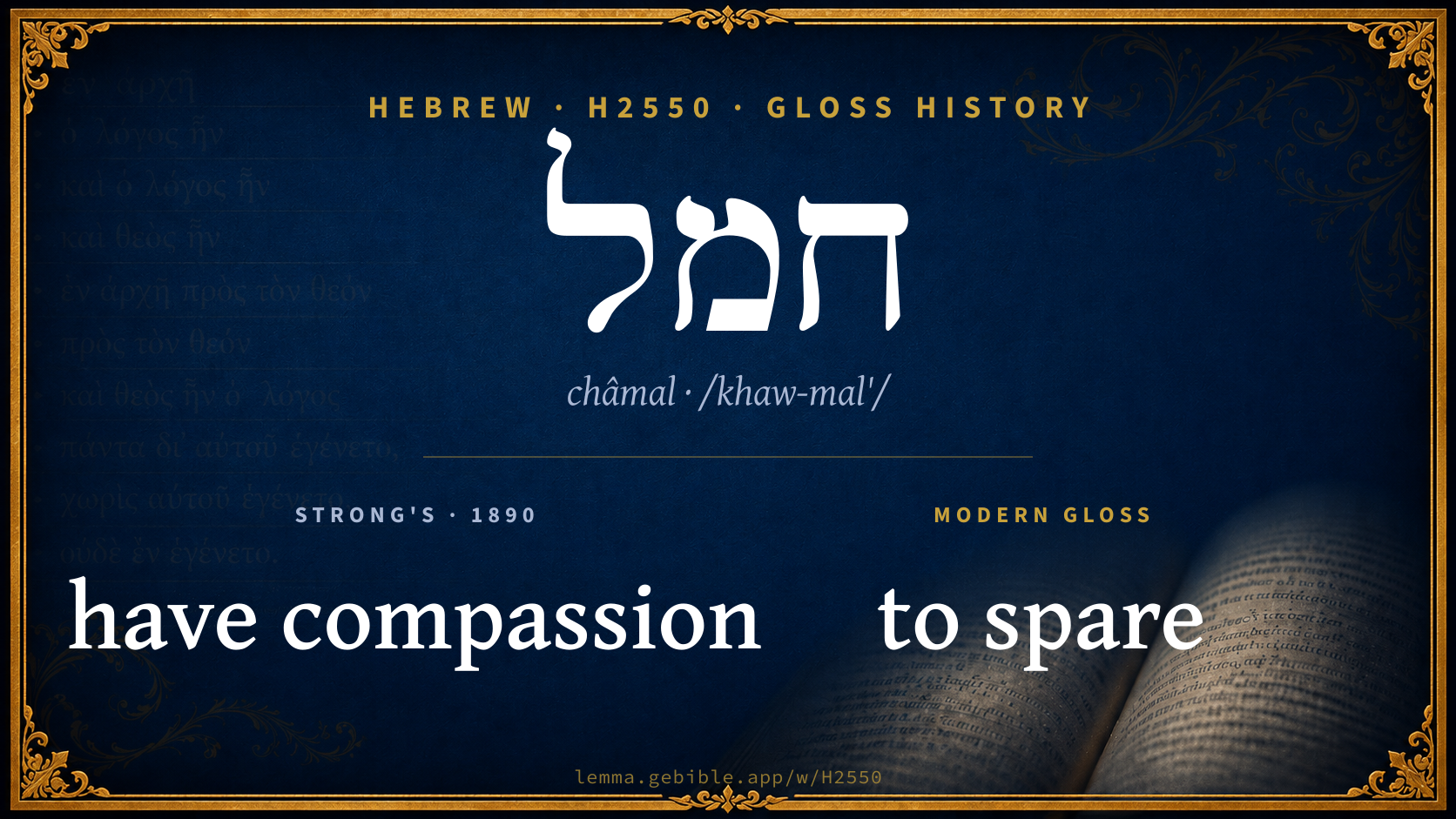
Gloss history
Strong's 1890 vs modern scholarship
About this word
Strong's H2550 catalogs a Hebrew word from the Hebrew Old Testament.
These counts are not copied from any lexicon or concordance. They are computed here, from the morphology-tagged Hebrew Old Testament. What Lemma adds →
- 40
- distinct verses
- The word appears in 40 distinct verses.
- 15 / 39
- OT books
- The word appears in 15 of 39 Old Testament books.
- #891
- by frequency
- Top 1000 most frequent Hebrew words (rank 891 of 8,640 Hebrew words by occurrence).
View all 40 occurrences in the concordance →
By section of the Old Testament
By traditional corpus
Conventional, traditional groupings — biblical authorship is debated, so this is a traditional corpus grouping, not an authorship claim. Each share is this word’s portion of its verses in that division of the Hebrew canon. Each figure is a share of the word’s 40 distinct verses.
- Prophets (Nevi'im) 27 verses · 68%
- Writings (Ketuvim) 11 verses · 28%
- Torah (Pentateuch) 2 verses · 5%
How translations render this word
Counts come from each version’s own published word-to-Strong’s tagging or interlinear alignment — an approximate guide to how each version renders this word, not a word-level alignment the data otherwise carries. Because each total is that version’s own tagged count, the per-version totals vary from one another and need not match the appearance or distinct-verse counts above. These counts may also differ from a printed concordance because Lemma counts each distinctly tagged rendering and does not collapse phrase taggings into a single head-word total. This is a fixed set of word-tagged versions (KJV, ASV, BSB, ULT) and does not change with the reading translation you choose elsewhere. Each version’s license is shown beside its name below (and on Sources).
BDB lists this Strong’s number as 2 distinct words (homographs). Each count above pools all of them and is not split by sense — see the Senses section below. A low-frequency rendering may belong to a different one of those words, not the primary meaning.
- King James Version†: Spare 4×, Spared 3×, Will i have pity 3×
- American Standard Version†: Spared 3×, Will i have pity 3×, Hath not pitied 2×
- Berean Standard Bible†: Mercy 5×, Pity 4×, Spare 4×
- unfoldingWord Literal Text†: Spare 11×, Pity 4×, Had compassion 3×
King James Version Public Domain
Renders H2550 across 41† tagged occurrences — most commonly:
Plus 27 renderings that appear only once — usually multi-word phrases or single function words the recovered tagging swept in, not distinct renderings.
American Standard Version Public Domain
Renders H2550 across 41† tagged occurrences — most commonly:
Plus 29 renderings that appear only once — usually multi-word phrases or single function words the recovered tagging swept in, not distinct renderings.
Berean Standard Bible Public Domain
Renders H2550 across 38† tagged occurrences — most commonly:
Plus 14 renderings that appear only once — usually multi-word phrases or single function words the recovered tagging swept in, not distinct renderings. Not rendered by a distinct English word in 3 further occurrences.
unfoldingWord Literal Text CC BY-SA 4.0
Renders H2550 across 56† tagged occurrences — most commonly:
Plus 22 renderings that appear only once — usually multi-word phrases or single function words the recovered tagging swept in, not distinct renderings.
Senses in the full BDB
What do BDB’s symbols mean?
BDB uses these scholarly abbreviations:
| Symbol | Meaning |
|---|---|
| 𝔊 | the Septuagint (the ancient Greek translation, LXX) |
| 𝔙 | the Vulgate (the Latin translation) |
| 𝔖 | the Syriac version (the Peshitta) |
| 𝔗 | the Targum (the Aramaic translation) |
| ψ | the Psalms |
| √ | root (the underlying root or stem) |
| ‖ | parallel passage (a synonymous or contrasted parallel) |
| † | the dagger: every passage where the word occurs is cited |
The 1 sense the full Brown-Driver-Briggs lexicon distinguishes for this word, in lexicon order (not ranked by frequency), with BDB’s own verbatim wording and sub-sense lettering. Shown in Hebrew script with BDB’s own scholarly abbreviations. The condensed entry is in the Lexicon Entry tab. See also the Forms in the corpus table below.
Qal
- Pf. ח׳ 1 S 15:15 + 3 times; חָמָ֑ל 2 S 12:6; La 2:17; חָמָ֑לְתָּ La 2:21; 3:43; וְחָמַלְתִּ֫י Mal 3:17; Impf. יַחְמֹל Jb 16:13 + 6 times; יַחְמוֹל Jb 6:10 + 3 times; וַיַּחְמֹל 1 S 15:9 + 3 times; 3 fs. וַתַּחְמֹל Ex 2:6; 2 ms. תַּחְמֹל Dt 13:9 1 S 15:3; אֶחְמֹל Ez 8:18; 9:10; אֶחְמוֹל Je 13:14 + 4 times; וָאֶחְמֹל Ez 36:21; יַחְמֹ֑לוּ Is 9:18; תַּחְמְלוּ Je 50:14; 51:3; תַּחְמֹ֑לוּ Ez 9:5; Inf. cstr. חֻמְלָה Ez 16:5 (Ges§ 45. 1. b);—spare, have compassion, c. על Ex 2:6 (E), 1 S 15:3, 9, 15; 23:21; 2 S 21:7; 2 Ch 36:15, 17; Je 15:5; Ez 16:5; 36:21; Jb 20:13; Zc 11:5, 6; Mal 3:17(×2) Jo 2:18; Dt 13:9 (‖ חוס sq. על), Je 21:7 (‖ חוס sq. על + רתם), Ez 9:10 (‖ חוס sq. על according to 𝔖 𝔗 Co); sq. אֶל־ Je 51:3; Is 9:18; note poet. אַל־תַּחְ׳ אֶל־חֵץ = spare no arrow Je 50:14; sq. Inf. 2 S 12:4; abs. 2 S 12:6; Is 30:14; La 2:17, 21, also v 2 where appar. sq. acc., 3:43; Jb 6:10; 16:13; 27:22; Pr 6:34; Hb 1:17; ‖ חוס Ez 5:11; 7:4 (del. Co as doubl. of v 9), 7:9; 8:18; 9:5; Jer 13:14 (‖ אחוס and ארחם). e.g. 1 Samuel 15:15
Senses from the full Brown-Driver-Briggs lexicon (Brown, Driver, Briggs; Oxford 1906 — public domain), digitized via Sefaria, supplemented by the OpenScriptures HebrewLexicon (CC BY 4.0). Full attribution on Sources.
Word origin
vb. spare (Arabic حَمَلَ is bear, become responsible; Aramaic ܚܡܰܠ comportavit, congessit);—
— Brown-Driver-Briggs (Oxford 1906, public domain), digitized via Sefaria, supplemented by the OpenScriptures HebrewLexicon (CC BY 4.0). See Sources.
Origin: a primitive root
Jastrow Dictionary
A second Hebrew/Aramaic lexicon for comparison, covering Aramaic and post-biblical (Talmudic, Targumic, Midrashic) usage that the biblical-Hebrew BDB does not. Matched by lemma rather than by Strong’s number, so a lemma may carry more than one Jastrow headword (shown separately below), and the entries cover usage well beyond the Bible.
חָמַל
- (b. h.) [to be warm,] to have compassion. Men. 53ᵇ (play on המולה, Jer. XI, 16) חָמַלְתִּי עליהם I had mercy on them. e.g. Jeremiah 11:16
A Dictionary of the Targumim, the Talmud Babli and Yerushalmi, and the Midrashic Literature (Marcus Jastrow; London, Luzac, 1903) — Public Domain. Digitized via Sefaria. Digitized via Sefaria. Full attribution on Sources.
Forms in the corpus
The 35 distinct written forms H2550 takes in the Hebrew Bible, most frequent first — each parse links to that stem’s occurrences in the concordance. Hebrew forms include their vowel points and cantillation, so a single lemma takes many written forms.
| Form | Parsing | Example | Uses |
|---|---|---|---|
| אֶחְמ֑וֹל | Verb, Qal, Imperfect, 1st Person, Common, Singular | Ezekiel 7:4 | 2 |
| אֶחְמֹ֑ל | Verb, Qal, Imperfect, 1st Person, Common, Singular | Ezekiel 8:18 | 2 |
| חָמָֽלְתָּ | Verb, Qal, Perfect, 2nd Person, Masculine, Singular | Lamentations 2:21 | 2 |
| יַחְמ֑וֹל | Verb, Qal, Imperfect, 3rd Person, Masculine, Singular | Job 6:10 | 2 |
| יַחְמֹ֑ל | Verb, Qal, Imperfect, 3rd Person, Masculine, Singular | Isaiah 30:14 | 2 |
| יַחְמֹ֣ל | Verb, Qal, Imperfect, 3rd Person, Masculine, Singular | Job 20:13 | 2 |
| אֶחְמ֥וֹל | Verb, Qal, Imperfect, 1st Person, Common, Singular | Zechariah 11:6 | 1 |
| אֶחְמ֧וֹל | Verb, Qal, Imperfect, 1st Person, Common, Singular | Jeremiah 13:14 | 1 |
| אֶחְמֽוֹל | Verb, Qal, Imperfect, 1st Person, Common, Singular | Ezekiel 5:11 | 1 |
| וְ/חָמַלְתִּ֣י | Verb, Qal, Sequential Perfect, 1st Person, Common, Singular | Malachi 3:17 | 1 |
| וַ/יַּחְמֹ֖ל | Verb, Qal, Sequential Imperfect, 3rd Person, Masculine, Singular | Joel 2:18 | 1 |
| וַ/יַּחְמֹ֗ל | Verb, Qal, Sequential Imperfect, 3rd Person, Masculine, Singular | 2 Samuel 12:4 | 1 |
| וַ/יַּחְמֹ֣ל | Verb, Qal, Sequential Imperfect, 3rd Person, Masculine, Singular | 2 Samuel 21:7 | 1 |
| וַ/יַּחְמֹל֩ | Verb, Qal, Sequential Imperfect, 3rd Person, Masculine, Singular | 1 Samuel 15:9 | 1 |
| וַ/תַּחְמֹ֣ל | Verb, Qal, Sequential Imperfect, 3rd Person, Feminine, Singular | Exodus 2:6 | 1 |
| וָ/אֶחְמֹ֖ל | Verb, Qal, Sequential Imperfect, 1st Person, Common, Singular | Ezekiel 36:21 | 1 |
| חֲמַלְתֶּ֖ם | Verb, Qal, Perfect, 2nd Person, Masculine, Plural | 1 Samuel 23:21 | 1 |
| חָמַ֗ל | Verb, Qal, Perfect, 3rd Person, Masculine, Singular | Lamentations 2:2 | 1 |
| חָמַ֛ל | Verb, Qal, Perfect, 3rd Person, Masculine, Singular | 2 Chronicles 36:17 | 1 |
| חָמַ֤ל | Verb, Qal, Perfect, 3rd Person, Masculine, Singular | 1 Samuel 15:15 | 1 |
| חָמַ֥ל | Verb, Qal, Perfect, 3rd Person, Masculine, Singular | 2 Chronicles 36:15 | 1 |
| חָמָ֑ל | Verb, Qal, Perfect, 3rd Person, Masculine, Singular | Lamentations 2:17 | 1 |
| חָמָֽל | Verb, Qal, Perfect, 3rd Person, Masculine, Singular | 2 Samuel 12:6 | 1 |
| יַ֝חְמ֗וֹל | Verb, Qal, Imperfect, 3rd Person, Masculine, Singular | Proverbs 6:34 | 1 |
| יַחְמ֖וֹל | Verb, Qal, Imperfect, 3rd Person, Masculine, Singular | Zechariah 11:5 | 1 |
| יַחְמֹ֖ל | Verb, Qal, Imperfect, 3rd Person, Masculine, Singular | Jeremiah 21:7 | 1 |
| יַחְמֹ֤ל | Verb, Qal, Imperfect, 3rd Person, Masculine, Singular | Jeremiah 15:5 | 1 |
| יַחְמֹֽלוּ | Verb, Qal, Imperfect, 3rd Person, Masculine, Plural | Isaiah 9:19 | 1 |
| יַחְמֽוֹל | Verb, Qal, Imperfect, 3rd Person, Masculine, Singular | Habakkuk 1:17 | 1 |
| לְ/חֻמְלָ֣ה | Noun, Common, Feminine, Singular, Absolute | Ezekiel 16:5 | 1 |
| תַחְמֹ֖ל | Verb, Qal, Imperfect, 2nd Person, Masculine, Singular | 1 Samuel 15:3 | 1 |
| תַחְמֹ֥ל | Verb, Qal, Imperfect, 2nd Person, Masculine, Singular | Deuteronomy 13:8 | 1 |
| תַּחְמְל֖וּ | Verb, Qal, Jussive, 2nd Person, Masculine, Plural | Jeremiah 50:14 | 1 |
| תַּחְמְלוּ֙ | Verb, Qal, Imperfect, 2nd Person, Masculine, Plural | Jeremiah 51:3 | 1 |
| תַּחְמֹֽלוּ | Verb, Qal, Jussive, 2nd Person, Masculine, Plural | Ezekiel 9:5 | 1 |
Same root — word family
Other BDB entries built from the same root as H2550, grouped by Strong’s listed origin. These share a root / origin per the lexicon — not necessarily a shared meaning. Each links to that word’s own entry.
Derived from this word
Proper names from this root
People and places named from this root — a name, not an additional meaning of the word.
Compare all same-root words → 1 of the same-root words is a proper name (a person or place). They share a root, not necessarily a meaning.
Septuagint verse parallels
This word appears in 39 verses that also exist in the Greek Old Testament (Septuagint), out of the 40 Hebrew verses it occurs in. You can read those verses in Greek by switching the Old Testament edition to the Septuagint.
Read these verses in the Septuagint
- Exodus 2:6
- Deuteronomy 13:8
- 1 Samuel 15:3
- 2 Samuel 12:4
- 2 Chronicles 36:15
- Job 6:10
- Proverbs 6:34
- Isaiah 9:19
- Jeremiah 13:14
- Lamentations 2:2
- Ezekiel 5:11
- Joel 2:18
This is a verse-level parallel only — the same verses exist in both the Hebrew and Greek Old Testaments. No word-level Hebrew↔Greek correspondence is claimed: the data carries no such alignment, so no Greek word is shown as this Hebrew word’s translation. Coverage is not total — the Septuagint omits the deuterocanon and renumbers the Psalms, so some Hebrew verses have no direct Greek parallel.