1 Kings 15:4

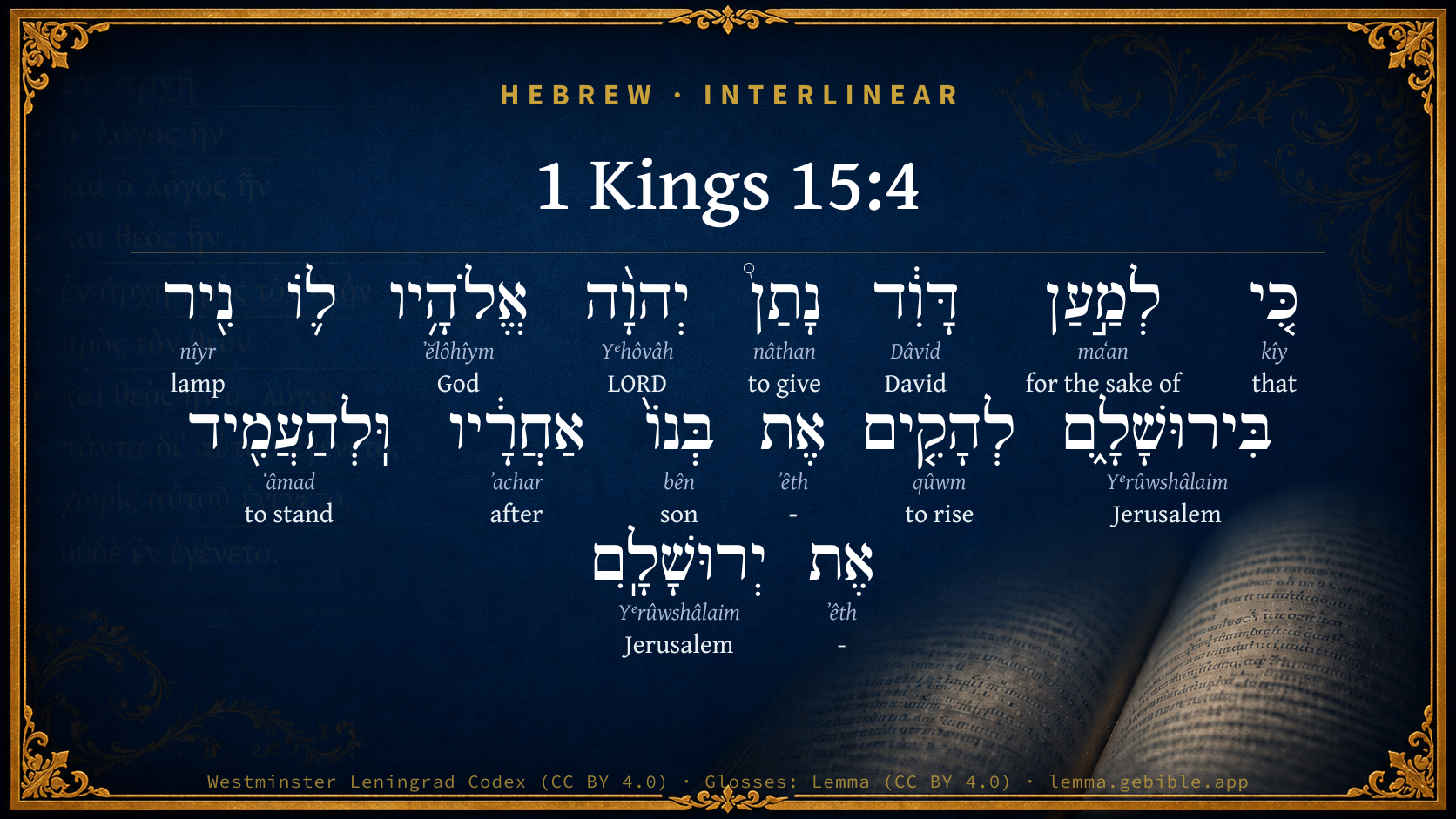
Hebrew (Westminster Leningrad Codex) 1 Kings 15:4 appears in the Hebrew Old Testament. The text above is from the Westminster Leningrad Codex. Each word links to its Strong’s number, a concise gloss, and parsing drawn from the Open Scriptures Hebrew Bible morphology. Click any word for its full Brown-Driver-Briggs (BDB) entry.
Download image
Cite this verse

1 Kings 15:4 (World English Bible). Public Domain. Lemma interlinear Bible study tool, https://lemma.gebible.app/v/1-kings/15/4.

Show BibTeX & RIS
BibTeX
RIS
English Translation
Nevertheless for David's sake did Yahweh his God give him a lamp in Jerusalem, to set up his son after him, and to establish Jerusalem;
World English Bible · Public Domain
Download a study sheet

One document with this verse’s original text, its word-by-word gloss line, the meaning frame, cross-references with their text, attributed commentary, and full source and license credits — printable, and it pastes into notes with its structure intact.

This verse Autodidact and up

Study sheet (.html) Plain text (.txt)

A passage Seminary Student

Up to 50 verses in one chapter. A passage sheet keeps up to 6 commentary sources and 12 cross-references per verse, in the order this page ranks them, and says so on the sheet whenever that leaves anything out. Ask for a single verse and you get the Autodidact verse sheet above.

Everything on this page stays free to read, with no account — the sheet is a download of what is already on screen, not access to it.

Want to remove ads? Support Godless Engineer
Compare translations 3

The same verse in 3 English versions, stacked beneath the original-language interlinear above. Click any original word for its lexicon entry.

Each is an independent rendering of the whole verse — the interlinear is not word-aligned to these translations.

Highlighted words mark where these versions differ — a whole-verse word diff, not a word-by-word alignment.

  • World English Bible Public Domain
    Nevertheless for David's sake did Yahweh his God give him a lamp in Jerusalem, to set up his son after him, and to establish Jerusalem;
  • King James Version Public Domain
    Nevertheless for David's sake did the LORD his God give him a lamp in Jerusalem, to set up his son after him, and to establish Jerusalem:
  • unfoldingWord Literal Text CC BY-SA 4.0
    But for the sake of David, Yahweh his God gave to him a lamp in Jerusalem by raising up his son after him, and by making Jerusalem stand,

unfoldingWord Literal Text — © unfoldingWord, licensed CC BY-SA 4.0. Word-aligned USFM3 via Door43 (git.door43.org/unfoldingWord/en_ult).

Versions to compare (up to 4)

3 of 4 selected

Show all 18 translations

Every available English version of this verse, each an independent rendering of the whole verse.

  • World English Bible Public Domain
    Nevertheless for David's sake did Yahweh his God give him a lamp in Jerusalem, to set up his son after him, and to establish Jerusalem;
  • Berean Standard Bible Public Domain
    Nevertheless, for the sake of David, the LORD his God gave him a lamp in Jerusalem by raising up a son to succeed him and to make Jerusalem strong.
  • Majority Standard Bible Public Domain
    Nevertheless, for the sake of David, the LORD his God gave him a lamp in Jerusalem by raising up a son to succeed him and to make Jerusalem strong.
  • King James Version Public Domain
    Nevertheless for David's sake did the LORD his God give him a lamp in Jerusalem, to set up his son after him, and to establish Jerusalem:
  • American Standard Version (1901) Public Domain
    Nevertheless for David's sake did Jehovah his God give him a lamp in Jerusalem, to set up his son after him, and to establish Jerusalem;
  • Revised Version (1885) Public Domain
    Nevertheless for David’s sake did the LORD his God give him a lamp in Jerusalem, to set up his son after him, and to establish Jerusalem:
  • Geneva Bible (1599) Public Domain
    But for Dauids sake did the Lord his God giue him a light in Ierusalem, and set vp his sonne after him, and established Ierusalem,
  • Douay-Rheims (1899) Public Domain
    But for David's sake the Lord his God gave him a lamp in Jerusalem, to set up his son after him, and to establish Jerusalem:
  • Young's Literal Translation Public Domain
    but for David's sake hath Jehovah his God given to him a lamp in Jerusalem, to raise up his son after him, and to establish Jerusalem,
  • Literal Standard Version CC BY-SA 4.0
    but for David’s sake his God YHWH has given to him a lamp in Jerusalem, to raise up his son after him, and to establish Jerusalem,
  • Unlocked Literal Bible CC BY-SA 4.0
    Nevertheless, for David's sake, Yahweh his God gave him a lamp in Jerusalem by raising up his son after him in order to strengthen Jerusalem.
  • unfoldingWord Literal Text CC BY-SA 4.0
    But for the sake of David, Yahweh his God gave to him a lamp in Jerusalem by raising up his son after him, and by making Jerusalem stand,
  • Darby Bible Public Domain
    But for David's sake Jehovah his God gave him a lamp in Jerusalem, setting up his son after him, and establishing Jerusalem;
  • World Messianic Bible Public Domain
    Nevertheless for David’s sake, the LORD his God gave him a lamp in Jerusalem, to set up his son after him and to establish Jerusalem;
  • Webster's Bible Public Domain
    Nevertheless, for David's sake the LORD his God gave him a lamp in Jerusalem, to set up his son after him, and to establish Jerusalem:
  • Free Bible Version CC BY-SA 4.0
    Even so, for David's sake, the Lord his God let his descendants continue to rule like a lamp, a son to rule after him and to make Jerusalem strong.
  • Bible in Basic English Public Domain
    But because of David, the Lord gave him a light in Jerusalem, making his sons king after him, so that Jerusalem might be safe;
  • JPS Tanakh (1917) Public Domain
    Nevertheless for David's sake did the LORD his God give him a lamp in Jerusalem, to set up his son after him, and to establish Jerusalem;

Literal Standard Version (2020), Covenant Press — licensed CC BY-SA 4.0. Text via the HelloAO Bible API (eBible.org). Unlocked Literal Bible (unfoldingWord) — licensed CC BY-SA 4.0. Text via the HelloAO Bible API (eBible.org). unfoldingWord Literal Text — © unfoldingWord, licensed CC BY-SA 4.0. Word-aligned USFM3 via Door43 (git.door43.org/unfoldingWord/en_ult). Free Bible Version, Dr. Jonathan Gallagher — licensed CC BY-SA 4.0. Text via the HelloAO Bible API (eBible.org).

Word by word

More ways to search: Search by grammar → Find every occurrence → Compare this word →

Practice this passage: Drill this verse → Learn its vocabulary →

נִ֖יר
nîyr
H5216
“lamp”
Noun, Common, Masculine, Singular, Absolute
Part of Speech
Noun
Type
Common
Gender
Masculine
Number
Singular
State
Absolute
Full BDB Definition

Origin: from a primitive root [see H5214 ; H5135 ] properly, meaning to glisten

TWOT: 1333b

lamp
  1. כִּ֚י kîy H3588 “that” Conjunction
  2. לְמַ֣עַן maʻan H4616 “for the sake of” Preposition
  3. דָּוִ֔ד Dâvid H1732 “David” Noun, Proper
  4. נָתַן֩ nâthan H5414 “to give” Verb, Qal, Perfect, 3rd Person, Masculine, Singular
  5. יְהוָ֨ה Yᵉhôvâh H3068 “LORD” Noun, Proper
  6. אֱלֹהָ֥יו ʼĕlôhîym H430 “God(s) · his” Noun, Common, Masculine, Plural, Construct + Suffix, Personal, 3rd Person, Masculine, Singular
  7. בִּירוּשָׁלִָ֑ם Yᵉrûwshâlaim H3389 “in/at · Jerusalem” Preposition + Noun, Proper
  8. לְהָקִ֤ים qûwm H6965 “to rise” Preposition + Verb, Hiphil, Infinitive Construct
  9. אֶת ʼêth H853 “-” Particle, Direct Object
  10. בְּנוֹ֙ bên H1121 “son · his” Noun, Common, Masculine, Singular, Construct + Suffix, Personal, 3rd Person, Masculine, Singular
  11. אַחֲרָ֔יו ʼachar H310 “after · him” Preposition + Suffix, Personal, 3rd Person, Masculine, Singular
  12. וּֽלְהַעֲמִ֖יד ʻâmad H5975 “and · to stand” Conjunction + Preposition + Verb, Hiphil, Infinitive Construct
  13. אֶת ʼêth H853 “-” Particle, Direct Object
  14. יְרוּשָׁלִָֽם Yᵉrûwshâlaim H3389 “Jerusalem” Noun, Proper

About this verse

These counts appear in no published source. They are computed here, from the morphology-tagged text and Lemma’s own curated glosses. What Lemma adds →

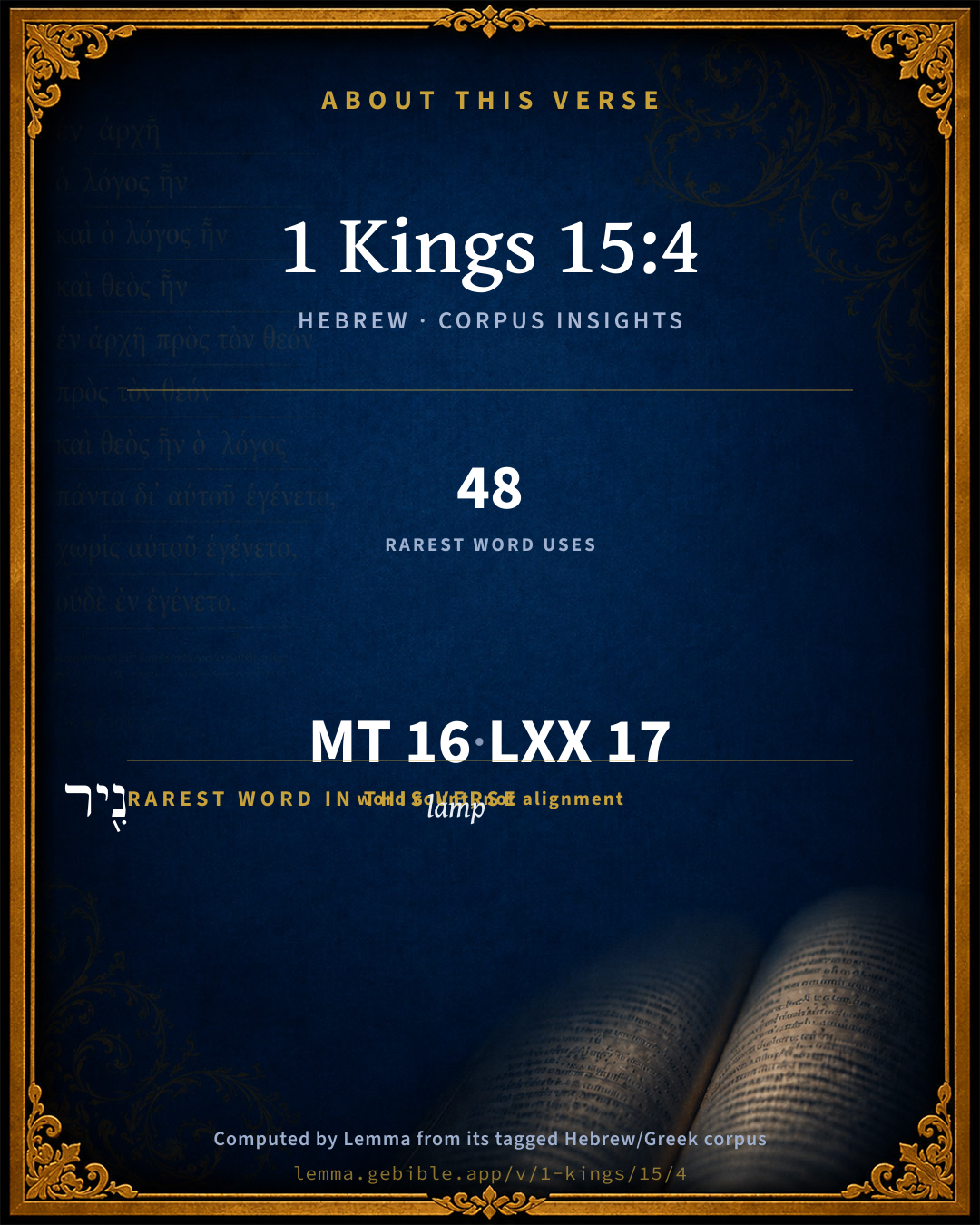
16
words
13
distinct lemmas
Historical
section

Shared distinctive vocabulary

נִ֖יר lamp H5216 occurs in 42 verses of the Hebrew Bible. Also found in:

Grammatical profile

  • 3 verbs
  • 7 nouns
  • 3 prepositions
  • 1 conjunction
  • 2 particles

Verb forms

  • נָתַן֩ Qal · Perfect
  • לְהָקִ֤ים Hiphil · Infinitive Construct
  • וּֽלְהַעֲמִ֖יד Hiphil · Infinitive Construct

Repetition

A word recurs within this verse — often emphatic in Hebrew:

  • בִּירוּשָׁלִָ֑ם Jerusalem H3389 ×2

Hebrew & Septuagint length

In English translation the verse runs 25 words from the Hebrew and 22 from the Septuagint (LXX English) — closely comparable.

A rough comparison of the two English renderings, which tokenize alike — not a word-level alignment.

Word counts can differ between the Hebrew and the Greek without any difference in meaning — e.g. the Hebrew direct-object marker אֵת has no separate Greek word, and Greek often adds the article ὁ.

In the original languages it is 16 Hebrew tokens and 17 Greek tokens — but the two are counted differently (Hebrew bundles its prefixes and suffixes into one token; the Greek is in lemma form), so that isn’t a like-for-like length.

Cross-references

26

Topical passages linked to 1 Kings 15:4 in the Treasury of Scripture Knowledge — connected by theme and wording, ordered by reader-vote popularity; previews shown in the World English Bible.

  • 1 Kings 11:36 To his son will I give one tribe, that David my servant may have a lamp always before me in Jerusalem, the city which I have chosen me to put my name there.
  • 2 Chronicles 21:7 However Yahweh would not destroy the house of David, because of the covenant that he had made with David, and as he promised to give a lamp to him and to his children always.
  • Genesis 12:2 I will make of you a great nation. I will bless you, and make your name great. You will be a blessing.
  • 2 Samuel 7:12–16 When your days are fulfilled, and you shall sleep with your fathers, I will set up your seed after you, who shall proceed out of your bowels, and I will establish his kingdom.
  • 1 Kings 11:12 Notwithstanding in your days I will not do it, for David your father's sake: but I will tear it out of the hand of your son.
  • 1 Kings 11:32 (but he shall have one tribe, for my servant David's sake and for Jerusalem's sake, the city which I have chosen out of all the tribes of Israel);
  • Psalms 18:28 For you will light my lamp, Yahweh. My God will light up my darkness.
  • Psalms 132:17 There I will make the horn of David to bud. I have ordained a lamp for my anointed.
  • Isaiah 37:35 For I will defend this city to save it, for my own sake, and for my servant David's sake.
  • Genesis 19:29 It happened, when God destroyed the cities of the plain, that God remembered Abraham, and sent Lot out of the midst of the overthrow, when he overthrew the cities in which Lot lived.
  • Genesis 26:5 because Abraham obeyed my voice, and kept my charge, my commandments, my statutes, and my laws."
  • Deuteronomy 4:37 Because he loved your fathers, therefore he chose their seed after them, and brought you out with his presence, with his great power, out of Egypt;
  • 2 Samuel 21:17 But Abishai the son of Zeruiah helped him, and struck the Philistine, and killed him. Then the men of David swore to him, saying, You shall go no more out with us to battle, that you don't quench the lamp of Israel.
  • Psalms 87:5 Yes, of Zion it will be said, "This one and that one was born in her;" The Most High himself will establish her.
  • Isaiah 9:7 Of the increase of his government and of peace there shall be no end, on the throne of David, and on his kingdom, to establish it, and to uphold it with justice and with righteousness from henceforth even forever. The zeal of Yahweh of Hosts will perform this.
  • Isaiah 14:32 What then shall one answer the messengers of the nation? That Yahweh has founded Zion, and in her shall the afflicted of his people take refuge.
  • Isaiah 62:7 and give him no rest, until he establish, and until he make Jerusalem a praise in the earth.
  • Jeremiah 33:2 Thus says Yahweh who does it, Yahweh who forms it to establish it; Yahweh is his name:
  • Jeremiah 33:20–26 Thus says Yahweh: If you can break my covenant of the day, and my covenant of the night, so that there shall not be day and night in their season;
  • Micah 4:1–2 But in the latter days, It will happen that the mountain of Yahweh's temple will be established on the top of the mountains, And it will be exalted above the hills; And peoples will stream to it.
  • Matthew 16:18 I also tell you that you are Peter, and on this rock I will build my assembly, and the gates of Hades will not prevail against it.
  • Luke 1:69–79 And has raised up a horn of salvation for us in the house of his servant David
  • Luke 2:32 A light for revelation to the Gentiles, And the glory of your people Israel."
  • John 8:12 Again, therefore, Jesus spoke to them, saying, "I am the light of the world. He who follows me will not walk in the darkness, but will have the light of life."
  • Romans 11:28 Concerning the Gospel, they are enemies for your sake. But concerning the election, they are beloved for the fathers' sake.
  • Revelation 22:16 I, Jesus, have sent my angel to testify these things to you for the assemblies. I am the root and the offspring of David; the Bright and Morning Star."

Cross-references courtesy of OpenBible.info (CC BY 4.0).

Hebrew and Greek witnesses Masoretic Hebrew ↔ Greek Septuagint

The same verse in the two great witnesses to the Old Testament, shown verse-for-verse.

These are two independent witnesses, not word-aligned to each other, and the Septuagint is shown in lemma (dictionary) form.

Hebrew 1 Kings 15:4 Masoretic · Westminster Leningrad Codex

כִּ֚י לְמַ֣עַן דָּוִ֔ד נָתַן֩ יְהוָ֨ה אֱלֹהָ֥יו ל֛וֹ נִ֖יר בִּירוּשָׁלִָ֑ם לְהָקִ֤ים אֶת בְּנוֹ֙ אַחֲרָ֔יו וּֽלְהַעֲמִ֖יד אֶת יְרוּשָׁלִָֽם

Nevertheless for David's sake did Yahweh his God give him a lamp in Jerusalem, to set up his son after him, and to establish Jerusalem;

World English Bible · Public Domain

Greek LXX 1 Kings 15:4 Septuagint · lemma form

ὅτι διά δαυίδ δίδωμι αὐτός κύριος κατάλειμμα ἵνα ἵστημι τέκνον αὐτός μετά αὐτός καί ἵστημι ὁ ἰερουσαλήμ

Howbeit for David's sake the Lord gave him a remnant, that he might establish his children after him, and might establish Jerusalem.

LXX2012 (modern English Septuagint) · Public Domain

On this verse, The Cambridge Bible for Schools and Colleges discusses the Septuagint’s reading. Read the note in Commentary ↓

Hebrew: Westminster Leningrad Codex (CC BY 4.0). Greek: Septuagint (public domain); English from LXX2012 (modern English Septuagint) (Public Domain). How the Septuagint differs from the Hebrew →

Targum (Aramaic paraphrase)

1

The Targum is the ancient Jewish Aramaic paraphrase of the Hebrew Scriptures — an interpretive translation, not the Hebrew text itself. Onkelos (literal) and Pseudo-Jonathan (expansive) render the Torah, and Jonathan the Prophets. Coverage is partial: where no permissively-licensed English translation exists for a verse, only the Aramaic is shown. This is verse-level text, not a word-by-word alignment to the Hebrew.

  1. Targum Jonathan Prophets (Joshua–Malachi)
    אֲרֵי בְּדִיל דָוִד יְהַב יְיָ אֱלָהֵיהּ לֵיהּ מַלְכוּ בִּירוּשְׁלֵם לַאֲקָמָא יַת בְּרֵיהּ תְּחוֹתוֹהִי וּלְקַיָמָא יַת יְרוּשְׁלֵם:

    (no public-domain English translation for this verse)

    Targum Jonathan — Aramaic: “Mikraot Gedolot” (public domain). English: “Sefaria Community Translation” (CC0 1.0 (public-domain dedication)); “London "Chaldee Paraphrase," 1871” (public domain). Text via Sefaria.

Commentary

Notes on 1 Kings 15:4 from classic Christian and Jewish commentators (each source and its license shown beneath its notes). The classic Christian expositions comment on the surrounding passage and are grouped to its opening verse, so a note may address several verses; the Jewish commentaries on the Tanakh (Rashi and others) are per-verse, so they appear only where the commentator wrote on this verse.

Lemma curates 59 commentaries, every one of them public domain or Creative Commons licensed, each selected and text-cleaned for this edition rather than reprinted as found. About our sources →

Trapp's Complete Commentary

John Trapp

1Ki 15:4 Nevertheless for David’s sake did the LORD his God give him a lamp in Jerusalem, to set up his son after him, and to establish Jerusalem:

Ver. 4. Did the Lord his God give him a lamp.] That is, A royal glory in a successor.

John Trapp, A Commentary or Exposition upon All the Books of the Old and New Testament (1647–1656) — public domain. Text from a community e-Sword module.

Joseph Benson's Commentary

1Ki 15:4. And the Lord gave him a lamp — A son and successor, to perpetuate his name and memory, which otherwise had gone into obscurity. Jerusalem — That he might maintain that city, and temple, and worship, as a witness for himself in the world, against the Israelites and heathen world.

Joseph Benson's Commentary on the Old and New Testaments (1811–1818) — public domain. Text from a community e-Sword module.

Geneva Bible (1599)

Geneva Bible translators

Meaning, a son to reign over Judah.

Geneva Bible (1599) marginal notes — public domain. Text via Bolls.life.

Jamieson, Fausset & Brown

Robert Jamieson, A. R. Fausset & David Brown

for David's sake did the Lord his God give him a lamp--"A lamp" in one's house is an Oriental phrase for continuance of family name and prosperity. Abijam was not rejected only in consequence of the divine promise to David (see on 1Ki. 11:13-36).

Jamieson, Fausset & Brown — Commentary Critical and Explanatory on the Whole Bible (1871) — public domain (CC PDM 1.0). Text via the HelloAO Bible API.

Adam Clarke's Commentary

Verse 4. The Lord - give him a lamp] That is, a son to succeed him; see 1Kg 11:36.

Adam Clarke's Commentary on the Bible (1810–1826) — public domain. Text from a community e-Sword/MySword module.

Ellicott's Commentary for English Readers

(4) Give him a lamp in Jerusalem.—There is here a brief allusion to the victory recorded in the Chronicles, which obviously was the turning-point in the struggle, saving the “lamp” of the house of David from extinction, and “establishing” Jerusalem in security. “For David’s sake” is, of course, for the fulfilment of the promise to David (2Sa_7:12-16). In virtue of the continuity of human history, the Divine law always ordains that, in respect of consequences, the good deeds as well as the sins of fathers are “visited on their children.”

A Bible Commentary for English Readers, edited by Charles John Ellicott (1878–1897) — public domain. Text from a community e-Sword module.

The Cambridge Bible for Schools and Colleges

gen. ed. J. J. S. Perowne

4. a lamp] Cf. above on 1Ki_11:36. The LXX. gives κατάλειμμα here = a remnant, thus expressing the sense of the original, instead of translating. Similarly in 1Ki_11:36 the rendering is θέσις = a position.

The Cambridge Bible for Schools and Colleges (gen. ed. J. J. S. Perowne; Cambridge University Press, 1878–1918) — public domain. Text from a community e-Sword module.

John Gill's Exposition

Because David did that which was right in the eyes of the Lord,.... With respect to worship: and turned not aside from anything that he commanded him all the days of his life; especially in matters of religion, nor even in his moral walk and conversation, deliberately, studiously, and with design:

save only in the matter of Uriah the Hittite; the killing of him, and other sins which led on to it, and were in connection with it; Abarbinel thinks, because the affair of Bathsheba is not mentioned, that was not reckoned to David as a sin; but no doubt it was, and is included here.

John Gill's Exposition of the Whole Bible (1746–1763) — public domain (CC PDM 1.0). Text via the HelloAO Bible API.

Albert Barnes' Notes on the Bible

To set up his son - The idolatry of Abijam deserved the same punishment as that of Jeroboam 1Ki 14:10-14, of Baasha 1Ki 16:2-4, or of Zimri 1Ki 16:19, the cutting off of his seed, and the transfer of the crown to another family. That these consequences did not follow in the kingdom of Judah, was owing to the “faithfulness” of David (see the marginal reference), which brought a blessing on his posterity. Few things are more remarkable and more difficult to account for on mere grounds of human reason, than the stability of the succession in Judah, and its excessive instability in the sister kingdom. One family in Judah holds the throne from first to last, during a space but little short of four centuries, while in Israel there are nine changes of dynasty within two hundred and fifty years.

Albert Barnes' Notes on the Bible (1834–1885) — public domain. Text from a community e-Sword/MySword module.

Haydock's Catholic Bible Commentary

Lamp, son; (chap. xi. 36.) though he deserved to have his family exterminated. (Calmet) --- He is preserved for his father’s sake. (Worthington)

George Leo Haydock (1774–1849), Haydock's Catholic Family Bible and Commentary, 1859 edition — public domain. Excludes Psalms (Douay-Rheims chapter numbering differs from Protestant) and Deuterocanonical books (Catholic canon only).

Matthew Poole's English Annotations

A lamp, i.e. a son and successor to perpetuate his name and memory, which otherwise had gone into obscurity. The same phrase is used above, 1Ki 11:36; 2Ki 8:19; 2Ch 21:7.

To establish Jerusalem, i.e. that he might maintain that city, and temple, and worship, as a witness for God in the world against the Israelites and heathen world, who should have inquired after it, and embraced the true religion there established and set up, as a beacon upon a high hill, that all men might take notice of it.

Matthew Poole's English Annotations on the Holy Bible (1683–1685) — public domain. Text from a community e-Sword/MySword module.

Whedon's Commentary on the Bible

Daniel D. Whedon

4. A lamp in Jerusalem — A light sacredly preserved in the person of the successive kings of Jerusalem to attract the gaze of men, and shine out a constant evidence of the promise to David, and a standing prophecy of the coming Messiah, the light of the world. See note on 1Ki_11:36.

Daniel D. Whedon (gen. ed.), Commentary on the Old and New Testaments (1874–1909) — public domain. Text from a community e-Sword module.

The Pulpit Commentary

Nevertheless yKi but, sed, sondern, Gesen. 393 for David"s sake did the Lord his God give him a lamp Better than margin, candle. The word is "always used figuratively of progeny." (See note on 1Ki_2:26; 2Sa_21:17; Job_18:5, Job_18:6; Psa_132:17) in Jerusalem, to set up his son after him, and to establish Jerusalem But for David"s piety, that is to say, his family would have been dethroned, if not destroyed, as was that of Jeroboam, (1Ki_14:10) of Baasha, (1Ki_16:2) of Ahab, (2Ki_10:11) etc. Abijah was the third prince of that line who had permitted idolatrous worship, so that that dynasty had richly deserved to forfeit its position. The stability of the family of David on the throne for nearly 400 years, amid all the changes and chances of that period, and whilst in Israel there were "nine changes of dynasty within 250 years" is, as Rawlinson remarks, very "difficult to account for on mere grounds of human reason":

The Pulpit Commentary (1880–1919), ed. H.D.M. Spence-Jones & Joseph S. Exell — public domain. Text from a community e-Sword module.

John Wesley's Explanatory Notes

A lamp - A son and successor to perpetuate his name and memory, which otherwise had gone into obscurity. Jerusalem - That he might maintain that city, and temple, and worship, as a witness for God, in the world, against the Israelites and heathen world.

John Wesley, Explanatory Notes Upon the Whole Bible (1754–1765) — public domain. Text via the GEBible commentary corpus.

unfoldingWord translationNotes

Door43 World Missions Community

gave him a lamp in Jerusalem

The word "lamp" here represents a descendant who would be king as David was. AT: "gave David a descendant to rule in Jerusalem" (See: Metaphor)

by raising up his son after him

"by raising up Abijah's son after him" or "by giving Abijah a son"

what was right in his eyes

The eyes here represent seeing, and seeing represents thoughts or judgment. AT: "what Yahweh judges to be right" or "what Yahweh considers to be right" (See:Metaphor)

for all the days of his life

"the whole time that David lived" or "throughout David's whole life"

he had not turned away from anything that he commanded him

Turning away from a command represents disobeying it. AT: "David did not disobey anything that God commanded him" (See: Metaphor)

except only in the matter of Uriah the Hittite

This is a general way to refer to the situation with Uriah. It can be stated more clearly what this matter was. AT: "except for what he did to Uriah the Hittite" or "except when he caused Uriah the Hittite to be killed" (See: Assumed Knowledge and Implicit Information)

between Rehoboam and Jeroboam

These kings represent themselves and their armies. Rehoboam was Abijah's father. AT: "between the armies of Rehoboam and Jeroboam" (See: Synecdoche)

all the days of Abijah's life

"the whole time that Abijah lived"

translationWords

lamp

raise

life

turn

command

Uriah

Hittite

Rehoboam

unfoldingWord translationNotes — © Distant Shores Media and the Door43 World Missions Community, licensed CC BY-SA 4.0. Source: git.door43.org/Door43/en_tn.

Lesson kit

Teaching starters — assembled from the data on this page, not authored interpretation. Every prompt links to the verse data it draws on. Edit before teaching.

1 Kings, in the Historical, opens this verse with 16 words (13 distinct Hebrew lemmas). Its most distinctive word is nîyr (“lamp”). A historical commentator’s framing appears above. Read the whole chapter for the surrounding context.

Discussion questions

  1. What does “lamp” (nîyr) contribute to the verse as a whole?
  2. How does Exodus 25:37, which shares the word «lamp», read alongside this verse?
  3. What does the repetition of “Jerusalem” (2× in this one verse) do in this verse?
  4. The translations on this page render this verse differently — a whole-verse word diff, not a word-by-word alignment. What might account for the different wordings?
  5. «נָתַן֩» is a Qal Perfect verb. How does that grammatical form shape the action described?
  6. Compare how Trapp's Complete Commentary and Joseph Benson's Commentary read this verse. Where do they agree or differ?

Things to notice

Reading settings

Reading text

Shown beneath each verse's original-language words.

Old Testament
Old Testament edition

Read the OT as the Masoretic Hebrew (MT) or the Greek Septuagint (LXX).

English shown for the Greek Septuagint (in the Hebrew ↔ Greek comparison).

Comparing translations? Open the Compare panel on any verse page to stack up to four side by side.