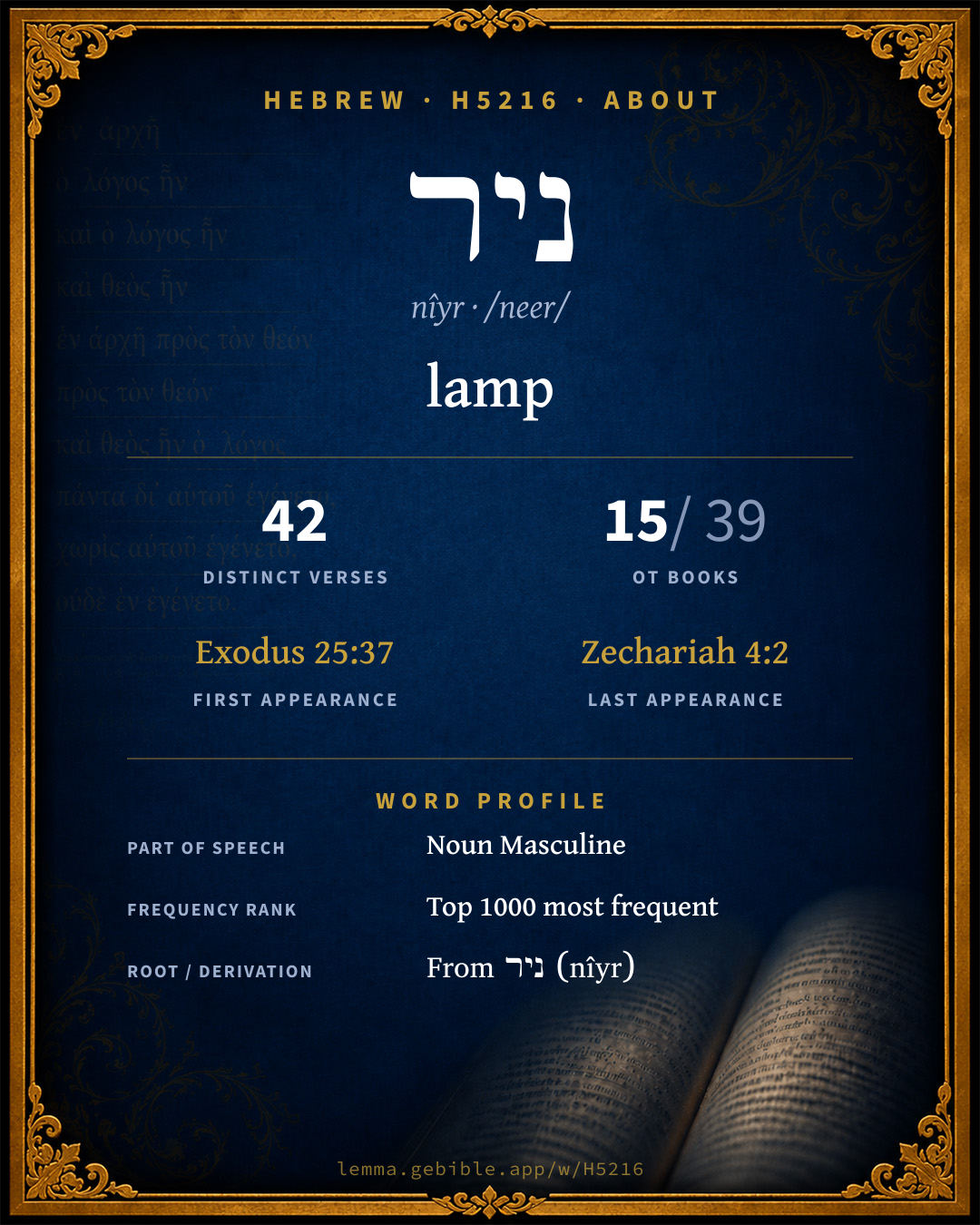
נִיר
lamp
Full lexicon entry — Brown-Driver-Briggs (BDB)
From Brown-Driver-Briggs (BDB)
Where this word appears
See every Construct-state word in the Hebrew Bible →
Grammar key — what these labels mean
Part of speech
- Noun
- A naming word — a person, place, thing, or idea.
Noun type
- Common
- A common noun — a general class of person, place, or thing (“king,” “city,” “water”), not a specific name.
State
- Construct
- A noun bound to a following noun in a possessive / “of” relationship (the construct chain).
- Absolute
- The independent form of a noun, not bound to a following word.
Gender
- Masculine
- Grammatically masculine.
Number
- Plural
- More than one (in Hebrew, generally three or more).
- Singular
- One.
Grammatical forms
- Noun, Common, Masculine, Plural, Construct 15 times (31%)
- Noun, Common, Masculine, Singular, Construct 13 times (27%)
- Noun, Common, Masculine, Plural, Absolute 11 times (23%)
- Noun, Common, Masculine, Singular, Absolute 9 times (19%)
Parsed forms decoded from the imported morphology (morphhb / Westminster Leningrad Codex — WLC text public domain, morphhb tagging CC BY 4.0), counted across 48 parsed occurrences — not distinct verses.
Every verse where H5216 appears — 42 distinct verses across 15 books. Click any verse to open its interlinear word-by-word view. Verse text shown in the World English Bible for context — . Each verse’s Hebrew form is shown with its reference; the English is not keyword-highlighted, since the data carries no word-level English alignment. Use “Compare translations” on any verse to read it across multiple English versions. This concordance covers the Hebrew Bible; Septuagint (Greek Old Testament) occurrences are not indexed here.
Exodus 9 verses
- Exodus 25:37 נֵרֹתֶ֖י/הָ נֵ֣רֹתֶ֔י/הָ n c mp cs + sfx pers 3fs n c mp cs + sfx pers 3fs You shall make its lamps seven, and they shall light its lamps to give light to the space in front of it.
- Exodus 27:20 נֵ֖ר n c ms cs "You shall command the children of Israel, that they bring to you pure olive oil beaten for the light, to cause a lamp to burn continually.
- Exodus 30:7 הַ/נֵּרֹ֖ת ptcl def.art + n c mp Aaron shall burn incense of sweet spices on it every morning. When he tends the lamps, he shall burn it.
- Exodus 30:8 הַ/נֵּרֹ֛ת ptcl def.art + n c mp When Aaron lights the lamps at evening, he shall burn it, a perpetual incense before Yahweh throughout your generations.
- Exodus 35:14 נֵרֹתֶ֑י/הָ n c mp cs + sfx pers 3fs the lampstand also for the light, with its vessels, its lamps, and the oil for the light;
- Exodus 37:23 נֵרֹתֶ֖י/הָ n c mp cs + sfx pers 3fs He made its seven lamps, and its snuffers, and its snuff dishes, of pure gold.
- Exodus 39:37 נֵרֹתֶ֗י/הָ נֵרֹ֛ת n c mp cs + sfx pers 3fs n c mp cs the pure lampstand, its lamps, even the lamps to be set in order, all its vessels, the oil for the light,
- Exodus 40:4 נֵרֹתֶֽי/הָ n c mp cs + sfx pers 3fs You shall bring in the table, and set in order the things that are on it. You shall bring in the lampstand, and light the lamps of it.
- Exodus 40:25 הַ/נֵּרֹ֖ת ptcl def.art + n c mp He lit the lamps before Yahweh, as Yahweh commanded Moses.
Leviticus 2 verses
Numbers 3 verses
- Numbers 4:9 נֵ֣רֹתֶ֔י/הָ n c mp cs + sfx pers 3fs They shall take a blue cloth, and cover the lampstand of the light, and its lamps, and its snuffers, and its snuff dishes, and all its oil vessels, with which they minister to it.
- Numbers 8:2 הַ/נֵּרֹ֔ת הַ/נֵּרֽוֹת ptcl def.art + n c mp ptcl def.art + n c mp "Speak to Aaron, and tell him, 'When you light the lamps, the seven lamps shall give light in front of the lampstand.'"
- Numbers 8:3 נֵרֹתֶ֑י/הָ n c mp cs + sfx pers 3fs Aaron did so. He lit its lamps to light the area in front of the lampstand, as Yahweh commanded Moses.
1 Samuel 1 verse
2 Samuel 2 verses
- 2 Samuel 21:17 נֵ֥ר n c ms cs But Abishai the son of Zeruiah helped him, and struck the Philistine, and killed him. Then the men of David swore to him, saying, You shall go no more out with us to battle, that you don't quench the lamp of Israel.
- 2 Samuel 22:29 נֵירִ֖/י n c ms cs + sfx pers 1cs For you are my lamp, Yahweh; Yahweh will lighten my darkness.
1 Kings 3 verses
- 1 Kings 7:49 וְ/הַ/נֵּרֹ֛ת conj + ptcl def.art + n c mp and the lampstands, five on the right side, and five on the left, before the oracle, of pure gold; and the flowers, and the lamps, and the tongs, of gold;
- 1 Kings 11:36 נִ֣יר n c ms To his son will I give one tribe, that David my servant may have a lamp always before me in Jerusalem, the city which I have chosen me to put my name there.
- 1 Kings 15:4 נִ֖יר n c ms Nevertheless for David's sake did Yahweh his God give him a lamp in Jerusalem, to set up his son after him, and to establish Jerusalem;
2 Kings 1 verse
1 Chronicles 1 verse
2 Chronicles 5 verses
- 2 Chronicles 4:20 וְ/נֵרֹתֵי/הֶ֗ם conj + n c mp cs + sfx pers 3mp and the lampstands with their lamps, to burn according to the ordinance before the oracle, of pure gold;
- 2 Chronicles 4:21 וְ/הַ/נֵּר֛וֹת conj + ptcl def.art + n c mp and the flowers, and the lamps, and the tongs, of gold, and that perfect gold;
- 2 Chronicles 13:11 וְ/נֵרֹתֶ֨י/הָ֙ conj + n c mp cs + sfx pers 3fs and they burn to Yahweh every morning and every evening burnt offerings and sweet incense: the show bread also [set they] in order on the pure table; and the lampstand of gold with the lamps of it, to burn every evening: for we keep the charge of Yahweh our God; but you have forsaken him.
- 2 Chronicles 21:7 נִ֛יר n c ms However Yahweh would not destroy the house of David, because of the covenant that he had made with David, and as he promised to give a lamp to him and to his children always.
- 2 Chronicles 29:7 הַ/נֵּר֔וֹת ptcl def.art + n c mp Also they have shut up the doors of the porch, and put out the lamps, and have not burned incense nor offered burnt offerings in the holy place to the God of Israel.
Job 3 verses
- Job 18:6 וְ֝/נֵר֗/וֹ conj + n c ms cs + sfx pers 3ms The light shall be dark in his tent, His lamp above him shall be put out.
- Job 21:17 נֵר n c ms cs "How often is it that the lamp of the wicked is put out? That their calamity comes on them? That God distributes sorrows in his anger?
- Job 29:3 נֵ֭ר/וֹ n c ms cs + sfx pers 3ms When his lamp shone on my head, And by his light I walked through darkness;
Psalms 3 verses
- Psalms 18:28 נֵרִ֑/י n c ms cs + sfx pers 1cs For you will light my lamp, Yahweh. My God will light up my darkness.
- Psalms 119:105 נֵר n c ms Your word is a lamp to my feet, And a light for my path.
- Psalms 132:17 נֵ֝֗ר n c ms There I will make the horn of David to bud. I have ordained a lamp for my anointed.
Proverbs 6 verses
- Proverbs 6:23 נֵ֣ר n c ms For the commandment is a lamp, And the law is light. Reproofs of instruction are the way of life,
- Proverbs 13:9 וְ/נֵ֖ר conj + n c ms cs The light of the righteous shines brightly, But the lamp of the wicked is snuffed out.
- Proverbs 20:20 נֵ֝ר֗/וֹ n c ms cs + sfx pers 3ms Whoever curses his father or his mother, His lamp shall be put out in blackness of darkness.
- Proverbs 20:27 נֵ֣ר n c ms cs The spirit of man is Yahweh's lamp, Searching all his innermost parts.
- Proverbs 24:20 נֵ֖ר n c ms cs For there will be no reward to the evil man; And the lamp of the wicked shall be snuffed out.
- Proverbs 31:18 נֵרָֽ/הּ n c ms cs + sfx pers 3fs She perceives that her merchandise is profitable. Her lamp doesn't go out by night.
Jeremiah 1 verse
Zephaniah 1 verse
Zechariah 1 verse
About this entry
At a glance — auto-summarized from this page’s data, not written by a person. Every figure links to its source below. This summary describes the numbers; it doesn’t interpret them.
ניר — transliterated nîyr — is a Hebrew noun carrying the sense “lamp.” Debuting at Exodus 25:37, it then recurs through the corpus. Spanning 42 verses in 15 books, it ranks among the moderately common words of the Hebrew Bible. From the same root come ניר, מנור and ניר. See the sense tree, 42-verse concordance, and the renderings breakdown below.
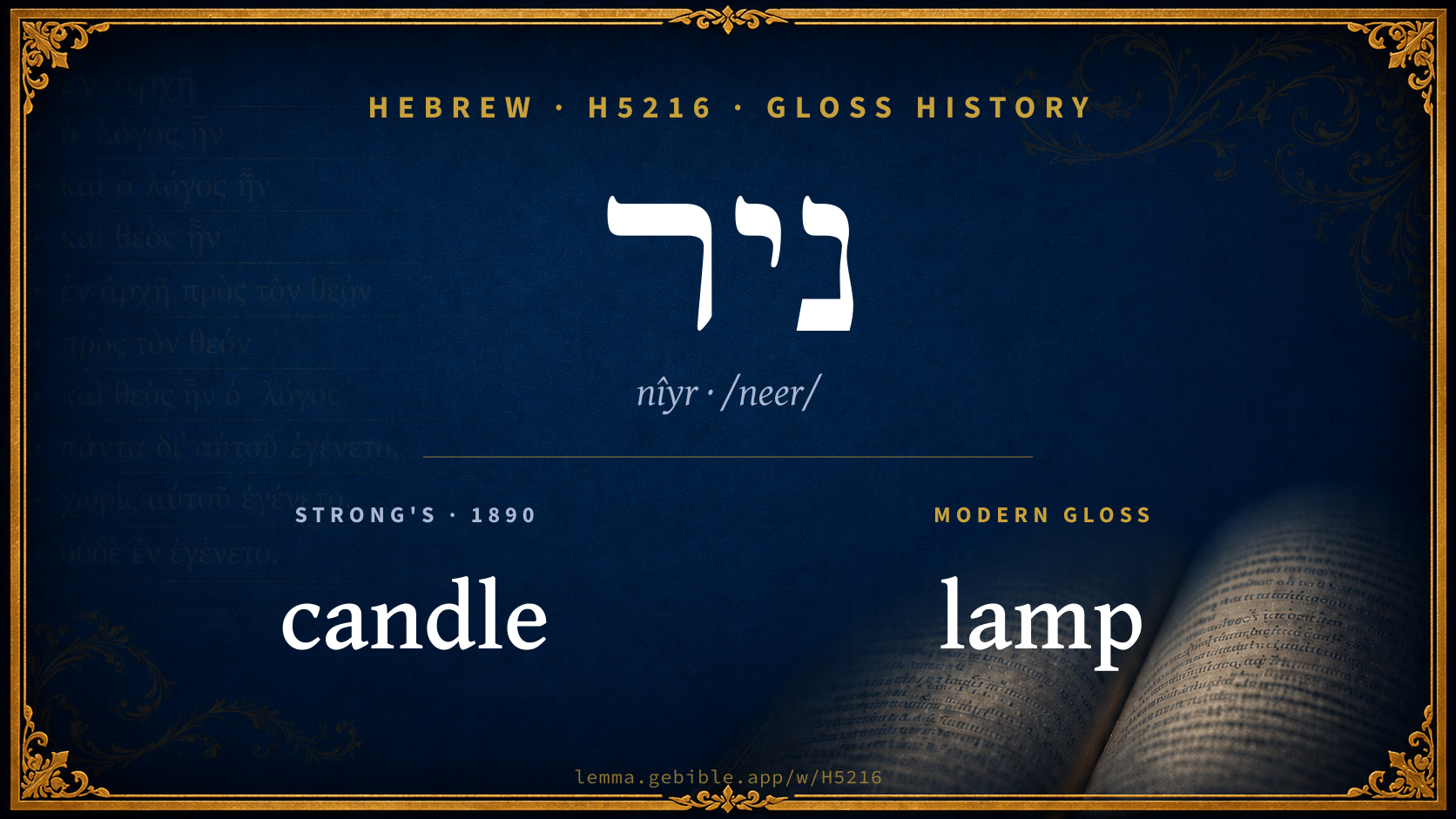
Gloss history
Strong's 1890 vs modern scholarship
About this word
Strong's H5216 catalogs a Hebrew word from the Hebrew Old Testament.
These counts are not copied from any lexicon or concordance. They are computed here, from the morphology-tagged Hebrew Old Testament. What Lemma adds →
- 42
- distinct verses
- The word appears in 42 distinct verses.
- 15 / 39
- OT books
- The word appears in 15 of 39 Old Testament books.
- #767
- by frequency
- Top 1000 most frequent Hebrew words (rank 767 of 8,640 Hebrew words by occurrence).
View all 42 occurrences in the concordance →
Most concentrated in
- Exodus 9 verses 21%
- Proverbs 6 verses 14%
- 2 Chronicles 5 verses 12%
By section of the Old Testament
By traditional corpus
Conventional, traditional groupings — biblical authorship is debated, so this is a traditional corpus grouping, not an authorship claim. Each share is this word’s portion of its verses in that division of the Hebrew canon. Each figure is a share of the word’s 42 distinct verses.
- Writings (Ketuvim) 18 verses · 43%
- Torah (Pentateuch) 14 verses · 33%
- Prophets (Nevi'im) 10 verses · 24%
How translations render this word
Counts come from each version’s own published word-to-Strong’s tagging or interlinear alignment — an approximate guide to how each version renders this word, not a word-level alignment the data otherwise carries. Because each total is that version’s own tagged count, the per-version totals vary from one another and need not match the appearance or distinct-verse counts above. These counts may also differ from a printed concordance because Lemma counts each distinctly tagged rendering and does not collapse phrase taggings into a single head-word total. This is a fixed set of word-tagged versions (KJV, ASV, BSB, ULT) and does not change with the reading translation you choose elsewhere. Each version’s license is shown beside its name below (and on Sources).
BDB lists this Strong’s number as 5 distinct words (homographs). Each count above pools all of them and is not split by sense — see the Senses section below. A low-frequency rendering may belong to a different one of those words, not the primary meaning.
- King James Version†: Lamps 24×, Candle 5×, Lamp 4×
- American Standard Version†: Lamps 21×, Lamp 13×, Cause a lamp 2×
- Berean Standard Bible†: Lamps 22×, Lamp 16×, Is a lamp 2×
- unfoldingWord Literal Text†: Lamps 25×, Lamp 14×, Lamp of 5×
King James Version Public Domain
Renders H5216 across 48† tagged occurrences — most commonly:
Plus 10 renderings that appear only once — usually multi-word phrases or single function words the recovered tagging swept in, not distinct renderings.
American Standard Version Public Domain
Renders H5216 across 48† tagged occurrences — most commonly:
Plus 12 renderings that appear only once — usually multi-word phrases or single function words the recovered tagging swept in, not distinct renderings.
Berean Standard Bible Public Domain
Renders H5216 across 47† tagged occurrences — most commonly:
Plus 5 renderings that appear only once — usually multi-word phrases or single function words the recovered tagging swept in, not distinct renderings. Not rendered by a distinct English word in 2 further occurrences.
unfoldingWord Literal Text CC BY-SA 4.0
Renders H5216 across 55† tagged occurrences — most commonly:
Plus 7 renderings that appear only once — usually multi-word phrases or single function words the recovered tagging swept in, not distinct renderings.
Senses in the full BDB
What do BDB’s symbols mean?
BDB uses these scholarly abbreviations:
| Symbol | Meaning |
|---|---|
| 𝔊 | the Septuagint (the ancient Greek translation, LXX) |
| 𝔙 | the Vulgate (the Latin translation) |
| 𝔖 | the Syriac version (the Peshitta) |
| 𝔗 | the Targum (the Aramaic translation) |
| ψ | the Psalms |
| √ | root (the underlying root or stem) |
| ‖ | parallel passage (a synonymous or contrasted parallel) |
| † | the dagger: every passage where the word occurs is cited |
The 3 senses and sub-senses the full Brown-Driver-Briggs lexicon distinguishes for this word, in lexicon order (not ranked by frequency), with BDB’s own verbatim wording and sub-sense lettering. Shown in Hebrew script with BDB’s own scholarly abbreviations. The condensed entry is in the Lexicon Entry tab. See also the Forms in the corpus table below.
ניר I
- 1. father of Abner 1 S 14:50, 51; 26:5, 14 2 S 2:8, 12; 3:23, 25, 28, 37 1 K 2:5, 32; 1 Ch 26:28. e.g. 1 Samuel 14:50
- 2. father of Kish 1 Ch 8:33; 9:36, 39. e.g. 1 Chronicles 8:33
ניר II [m.] lamp
ניר III break up, freshly till
Qal
- Imv. mpl. נִ֫ירוּ, c. acc. cogn. נִיר Ho 10:12 Je 4:3. e.g. Hosea 10:12
ניר IV [m.] the tillable, untilled or fallow ground
Senses from the full Brown-Driver-Briggs lexicon (Brown, Driver, Briggs; Oxford 1906 — public domain), digitized via Sefaria, supplemented by the OpenScriptures HebrewLexicon (CC BY 4.0). Full attribution on Sources.
Word origin
I. n.m. Ex 25:37 lamp;—נ׳ abs. Ex 27:20 +, cstr. 1 S 3:3 +; sf. נֵרִי ψ 18:29, †נֵירִי ‖ 2 S 22:29, etc.; pl. נֵרוֹת abs. Lv 24:4 +; cstr. Ex 39:37; sf. נֵרֹתֶיהָ Ex 25:37(×2) +, נֵרֹתֵיהֶם 1 Ch 28:15 2 Ch 4:20;—lamp in shrine at Shiloh 1 S 3:3; especially of lamps in temple 1 K 7:49 + 7 times Ch, and in tabern. Ex 25:37(×2) + 15 times P; cf. in Zech.’s vision Zc 4:2(×2) as token of merrymaking Je 25:10; used in search Zp 1:12, cf. (fig.) נֵר י׳ נִשְׁמַת אָדָם Pr 20:27; used in household work Pr 31:18; fig. of prosperity נ׳ יִשְׂרָאֵל 2 S 21:17 (embodied in David); also Jb 18:6; 21:17; 29:3 ψ 18:29 = 2 S 22:29, ψ 132:17 Pr 13:9; 20:20; 24:20; of God’s word as a guide ψ 119:105, cf. Pr 6:23.
I. n.[m.] lamp;—always fig. לְמַעַן הֱיוֹת־נ׳ לְדָוִיד 1 K 11:36, i.e. that his family may remain on the throne; cf. 15:4; 2 K 8:19 = 2 Ch 21:7; = happiness, delight (cstr.) נִר רְשָׁעִים Pr 21:4 (so Vrss Thes Buhl Now Wild, > Ew Del SS Frankenb = ii. נִיר sub i. [נִיר] infr.).
II. vb. break up, freshly till;—
III. n.[m.] the tillable, untilled or fallow ground;—נ׳ abs. as acc. cogn. נִירוּ לָכֶם נִ֑יר Ho 10:12; Je 4:3 till you the untilled ground (fig. of unaccustomed moral action); cstr. only רָב־אֹכֶל נִיר רָאשִׁים Pr 13:23 abundant food (yields) the fallow ground of poor men (i.e. with י׳’s blessing).—i. נִיר v. נור.
— Brown-Driver-Briggs (Oxford 1906, public domain), digitized via Sefaria, supplemented by the OpenScriptures HebrewLexicon (CC BY 4.0). See Sources.
Derived from ניר (nîyr) (H5214) — to plow.
Jastrow Dictionary
A second Hebrew/Aramaic lexicon for comparison, covering Aramaic and post-biblical (Talmudic, Targumic, Midrashic) usage that the biblical-Hebrew BDB does not. Matched by lemma rather than by Strong’s number, so a lemma may carry more than one Jastrow headword (shown separately below), and the entries cover usage well beyond the Bible.
נִיר I
- v. Del. Proleg., p. 98, sq.) [to conquer,] to break ground, clear. Tosef. Men. IX, 3 נָרָהּ שנה ראשונה ושנייה חורשה וכ׳ he breaks the field the first year, the second year he ploughs it &c.; Men. 85ᵃ. Arakh. IX, 1 (29ᵇ) נָרָהּ if he broke it (without planting). Tosef. B. Mets. IX, 7 לא יהא נָר … אלא נָאר וכ׳ (Var. נָר) he must not plough it over entirely one year and plant the next, but plough one half &c. Ib. 8 והיה נָרָהּ וכ׳ and he ploughed all of it one year &c. Ib. 26 נאר (Var. נָיֵיר, נָר); a. fr.—Part. pass. נִיר; f. נִירָה. Ib. 29 מניחה לפניו נ׳ when he surrenders the field to him cleared, opp. שֶׁלֶף.—[Men. 85ᵇ ניר חציה, Ms. M. נָר.]
- to plough over repeatedly. Part. pass. מְנוֹנָר (= מְנוּרְנָר; cmp. מְטוֹטֶלֶת a. מְטוּלְטֶלֶת); f. מְנוֹנֶרֶת, pl. מְנוֹנָרוֹת. Men. 85ᵃ שדות … והמ׳ לכך (Ms. M. הנונרות לבד, corr. acc. or הנִינָּרוֹת Nif.) fields … repeatedly ploughed over for that purpose; Tosef. ib. IX, 3 הגינירות, Var. הניטרות, read הנִינָּרוֹת or הנִינּוֹרוֹת).
- (cmp. נִידּוֹן fr. דִּין) to be broken, v. supra.
נִיר
- Targ. I Sam. VIII, 12 לְמֵינָר (ed. Wil. למִינַר).
נִיר II
- preced.)
- 1. clearing, ploughing over. Tosef. B. Mets. IX, 24 בשעת הנ׳ (read: בשנת) in the year during which he cleared the land.
- 2. newly broken land. Peah II, 1 הבור והנ׳ fallow land or newly broken land. Y. Naz. VII, 56ᵇ top; a. e.—Pl. נִירִין. Shebi. IV, 3.
נִיר ²
- Targ. I Sam. VIII, 12.
נִיר III
- (preced. wds.; Assyr. nîru) yoke; servitude. Targ. Deut. XXI, 3. Targ. Num. XIX, 2.—Targ. Jer. XXVII, 8; a. fr.—Y. Sabb. V, end, 7ᶜ; Bab. Sabb. 54ᵇ, v. גִּימוֹן.—Pl. נִירִין. Targ. Jer. XXVII, 2. Ib. XXVIII, 13.
נִיר IV
- (v. preced.; cmp. jugum a. ζυγόν, v. Sm. Ant. s. v. Tela) cross-beam of the loom, also the cross-rod under the cross-beam (liciatorium) to which the ends of the leashes are fastened; trnsf (mostly pl.) נִירִים, נִירִין the leashes or thrums to which the threads of the warp are fastened; also the warp. Gen. R. s. 94, v. פָּתַל. B. Kam. 119ᵇ אין לוקחין … ולא נ׳ you must not buy from the weaver remnants of woof or of warp threads. Kel. XXI, 1 הנוגע בנ׳ … he who touches the upper beam … or the rods, contrad. to קֵירוֹס.—בית נ׳ that portion of the web produced by passing the spool with the woof across the warp, mesh, slip. Sabb. XIII, 2 (105ᵃ) העושה שני בתי נ׳ בנִירַיִּים וכ׳ Ms. M. (ed. בנירין) he who starts a web by making two meshes, attaching them either to the cross-pieces or to the slips (קֵירוֹס). Ib. 105ᵃ ברוחב ג׳ בתי נ׳ within a distance of three meshes; (Tosef. ib. XII (XIII), 1 על ג׳ בתים). Y. ib. VII, 10ᶜ שני נ׳ בחף … בניר אחד two sets of warp threads fastened to one old border web (licium) or two borders fastened to one set of warp threads. Shek. VIII, 5 על ע"ב נ׳ וכ׳ Ms. M. a. Ar. (ed. נימין; v. Rabb. D. S. a. l., p. לד, note) the curtain was woven on seventy-two leashes, and each twist of the warp (נִימָה) contained twenty four threads; Ḥull. 90ᵇ; Tam. 29ᵇ נימין; Num. R. s. 4 נימין; Tanḥ. Vayaḳh. 7 נימין; ed. Bub. 10 נירים.
A Dictionary of the Targumim, the Talmud Babli and Yerushalmi, and the Midrashic Literature (Marcus Jastrow; London, Luzac, 1903) — Public Domain. Digitized via Sefaria. Digitized via Sefaria. Full attribution on Sources.
Forms in the corpus
The 39 distinct written forms H5216 takes in the Hebrew Bible, most frequent first — each parse links to that state’s occurrences in the concordance. Hebrew forms include their vowel points and cantillation, so a single lemma takes many written forms.
Same root — word family
Other BDB entries built from the same root as H5216, grouped by Strong’s listed origin. These share a root / origin per the lexicon — not necessarily a shared meaning. Each links to that word’s own entry.
Derives from
Shares the same root
Derived from this word
Proper names from this root
People and places named from this root — a name, not an additional meaning of the word.
Compare all same-root words → Showing 4 of 8 — not the complete family. 2 of the same-root words are proper names (people or places). They share a root, not necessarily a meaning.
Septuagint verse parallels
This word appears in 36 verses that also exist in the Greek Old Testament (Septuagint), out of the 42 Hebrew verses it occurs in. You can read those verses in Greek by switching the Old Testament edition to the Septuagint.
Read these verses in the Septuagint
- Exodus 25:37
- Leviticus 24:2
- Numbers 4:9
- 1 Samuel 3:3
- 2 Samuel 21:17
- 1 Kings 7:49
- 2 Kings 8:19
- 1 Chronicles 28:15
- 2 Chronicles 4:20
- Job 18:6
- Proverbs 6:23
- Jeremiah 25:10
This is a verse-level parallel only — the same verses exist in both the Hebrew and Greek Old Testaments. No word-level Hebrew↔Greek correspondence is claimed: the data carries no such alignment, so no Greek word is shown as this Hebrew word’s translation. Coverage is not total — the Septuagint omits the deuterocanon and renumbers the Psalms, so some Hebrew verses have no direct Greek parallel.