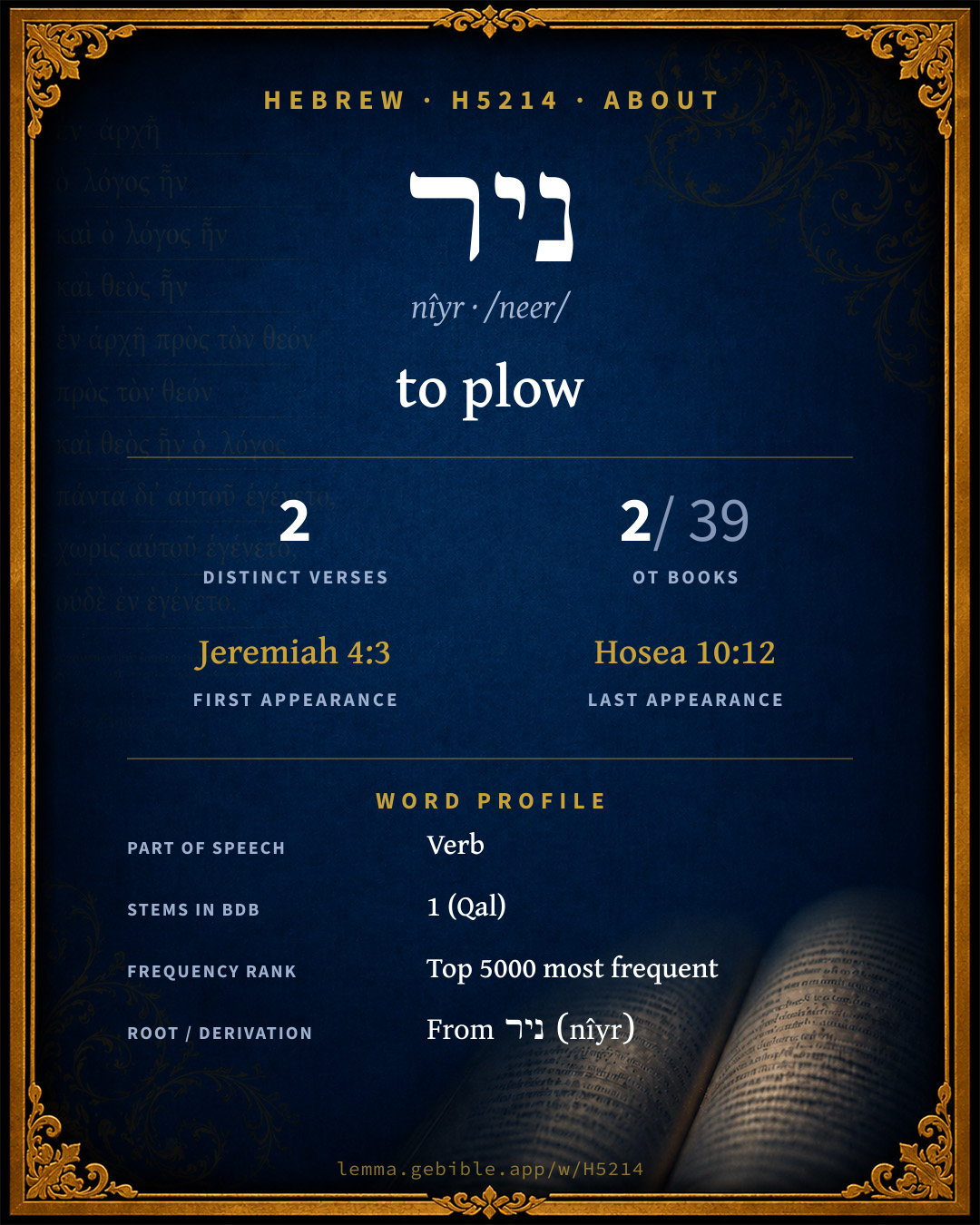
נִיר
to plow
Full lexicon entry — Brown-Driver-Briggs (BDB)
From Brown-Driver-Briggs (BDB)
Where this word appears
Grammar key — what these labels mean
Part of speech
- Verb
- An action or state-of-being word.
Stem
- Qal
- The basic, simple active stem — the plain form of the verb (“he wrote”).
Form
- Imperative
- A direct command (“write!”).
Person
- 2nd Person
- The one addressed (“you”).
Gender
- Masculine
- Grammatically masculine.
Number
- Plural
- More than one (in Hebrew, generally three or more).
Every verse where H5214 appears — 2 distinct verses across 2 books. Click any verse to open its interlinear word-by-word view. Verse text shown in the World English Bible for context — . Each verse’s Hebrew form is shown with its reference; the English is not keyword-highlighted, since the data carries no word-level English alignment. Use “Compare translations” on any verse to read it across multiple English versions. This concordance covers the Hebrew Bible; Septuagint (Greek Old Testament) occurrences are not indexed here.
Jeremiah 1 verse
Hosea 1 verse
About this entry
At a glance — auto-summarized from this page’s data, not written by a person. Every figure links to its source below. This summary describes the numbers; it doesn’t interpret them.
“to plow” is the headline sense of the Hebrew verb ניר (nîyr). It is rare — just 2 verses in the entire Hebrew Bible. It clusters heavily in Jeremiah, which alone accounts for 50% of its uses. First canonically at Jeremiah 4:3, it enters the text early. It clusters with ניר, נור and תנור under a shared root. The sections below give every sense, occurrence, and version rendering.
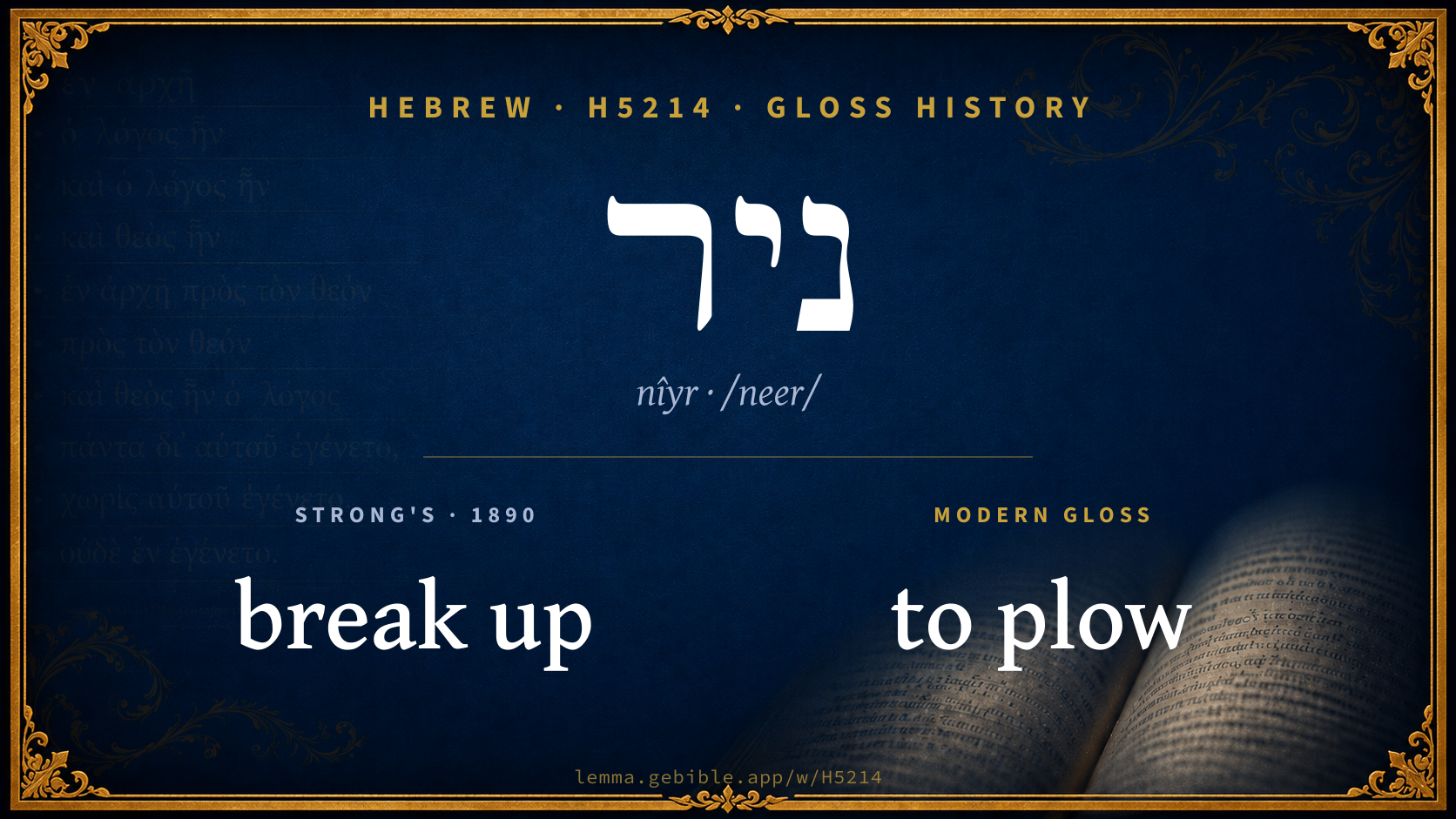
Gloss history
Strong's 1890 vs modern scholarship
About this word
Strong's H5214 catalogs a Hebrew word from the Hebrew Old Testament.
These counts are not copied from any lexicon or concordance. They are computed here, from the morphology-tagged Hebrew Old Testament. What Lemma adds →
- 2
- distinct verses
- The word appears in 2 distinct verses.
- 2 / 39
- OT books
- The word appears in 2 of 39 Old Testament books.
- #4,807
- by frequency
- Top 5000 most frequent Hebrew words (rank 4,807 of 8,640 Hebrew words by occurrence).
View all 2 occurrences in the concordance →
By traditional corpus
Conventional, traditional groupings — biblical authorship is debated, so this is a traditional corpus grouping, not an authorship claim. Each share is this word’s portion of its verses in that division of the Hebrew canon. Each figure is a share of the word’s 2 distinct verses.
- Prophets (Nevi'im) 2 verses · 100%
How translations render this word
Counts come from each version’s own published word-to-Strong’s tagging or interlinear alignment — an approximate guide to how each version renders this word, not a word-level alignment the data otherwise carries. Because each total is that version’s own tagged count, the per-version totals vary from one another and need not match the appearance or distinct-verse counts above. These counts may also differ from a printed concordance because Lemma counts each distinctly tagged rendering and does not collapse phrase taggings into a single head-word total. This is a fixed set of word-tagged versions (KJV, ASV, BSB, ULT) and does not change with the reading translation you choose elsewhere. Each version’s license is shown beside its name below (and on Sources).
BDB lists this Strong’s number as 3 distinct words (homographs). Each count above pools all of them and is not split by sense — see the Senses section below. A low-frequency rendering may belong to a different one of those words, not the primary meaning.
- King James Version†: Break up 2×
- American Standard Version†: Break up 2×
- Berean Standard Bible†: Break up 2×
- unfoldingWord Literal Text†: Break up 1×, Till 1×
King James Version Public Domain
Renders H5214 across 2† tagged occurrences — most commonly:
American Standard Version Public Domain
Renders H5214 across 2† tagged occurrences — most commonly:
Berean Standard Bible Public Domain
Renders H5214 across 2† tagged occurrences — most commonly:
unfoldingWord Literal Text CC BY-SA 4.0
Renders H5214 across 2† tagged occurrences — most commonly:
Senses in the full BDB
What do BDB’s symbols mean?
BDB uses these scholarly abbreviations:
| Symbol | Meaning |
|---|---|
| 𝔊 | the Septuagint (the ancient Greek translation, LXX) |
| 𝔙 | the Vulgate (the Latin translation) |
| 𝔖 | the Syriac version (the Peshitta) |
| 𝔗 | the Targum (the Aramaic translation) |
| ψ | the Psalms |
| √ | root (the underlying root or stem) |
| ‖ | parallel passage (a synonymous or contrasted parallel) |
| † | the dagger: every passage where the word occurs is cited |
The 1 sense the full Brown-Driver-Briggs lexicon distinguishes for this word, in lexicon order (not ranked by frequency), with BDB’s own verbatim wording and sub-sense lettering. Shown in Hebrew script with BDB’s own scholarly abbreviations. The condensed entry is in the Lexicon Entry tab.
ניר I [m.] lamp
ניר II break up, freshly till
Qal
- Imv. mpl. נִ֫ירוּ, c. acc. cogn. נִיר Ho 10:12 Je 4:3. e.g. Hosea 10:12
ניר III [m.] the tillable, untilled or fallow ground
Senses from the full Brown-Driver-Briggs lexicon (Brown, Driver, Briggs; Oxford 1906 — public domain), digitized via Sefaria, supplemented by the OpenScriptures HebrewLexicon (CC BY 4.0). Full attribution on Sources.
Word origin
I. n.[m.] lamp;—always fig. לְמַעַן הֱיוֹת־נ׳ לְדָוִיד 1 K 11:36, i.e. that his family may remain on the throne; cf. 15:4; 2 K 8:19 = 2 Ch 21:7; = happiness, delight (cstr.) נִר רְשָׁעִים Pr 21:4 (so Vrss Thes Buhl Now Wild, > Ew Del SS Frankenb = ii. נִיר sub i. [נִיר] infr.).
II. vb. break up, freshly till;—
III. n.[m.] the tillable, untilled or fallow ground;—נ׳ abs. as acc. cogn. נִירוּ לָכֶם נִ֑יר Ho 10:12; Je 4:3 till you the untilled ground (fig. of unaccustomed moral action); cstr. only רָב־אֹכֶל נִיר רָאשִׁים Pr 13:23 abundant food (yields) the fallow ground of poor men (i.e. with י׳’s blessing).—i. נִיר v. נור.
— Brown-Driver-Briggs (Oxford 1906, public domain), digitized via Sefaria, supplemented by the OpenScriptures HebrewLexicon (CC BY 4.0). See Sources.
Derived from ניר (nîyr) (H5216) — lamp.
Jastrow Dictionary
A second Hebrew/Aramaic lexicon for comparison, covering Aramaic and post-biblical (Talmudic, Targumic, Midrashic) usage that the biblical-Hebrew BDB does not. Matched by lemma rather than by Strong’s number, so a lemma may carry more than one Jastrow headword (shown separately below), and the entries cover usage well beyond the Bible.
נִיר I
- v. Del. Proleg., p. 98, sq.) [to conquer,] to break ground, clear. Tosef. Men. IX, 3 נָרָהּ שנה ראשונה ושנייה חורשה וכ׳ he breaks the field the first year, the second year he ploughs it &c.; Men. 85ᵃ. Arakh. IX, 1 (29ᵇ) נָרָהּ if he broke it (without planting). Tosef. B. Mets. IX, 7 לא יהא נָר … אלא נָאר וכ׳ (Var. נָר) he must not plough it over entirely one year and plant the next, but plough one half &c. Ib. 8 והיה נָרָהּ וכ׳ and he ploughed all of it one year &c. Ib. 26 נאר (Var. נָיֵיר, נָר); a. fr.—Part. pass. נִיר; f. נִירָה. Ib. 29 מניחה לפניו נ׳ when he surrenders the field to him cleared, opp. שֶׁלֶף.—[Men. 85ᵇ ניר חציה, Ms. M. נָר.]
- to plough over repeatedly. Part. pass. מְנוֹנָר (= מְנוּרְנָר; cmp. מְטוֹטֶלֶת a. מְטוּלְטֶלֶת); f. מְנוֹנֶרֶת, pl. מְנוֹנָרוֹת. Men. 85ᵃ שדות … והמ׳ לכך (Ms. M. הנונרות לבד, corr. acc. or הנִינָּרוֹת Nif.) fields … repeatedly ploughed over for that purpose; Tosef. ib. IX, 3 הגינירות, Var. הניטרות, read הנִינָּרוֹת or הנִינּוֹרוֹת).
- (cmp. נִידּוֹן fr. דִּין) to be broken, v. supra.
נִיר
- Targ. I Sam. VIII, 12 לְמֵינָר (ed. Wil. למִינַר).
נִיר II
- preced.)
- 1. clearing, ploughing over. Tosef. B. Mets. IX, 24 בשעת הנ׳ (read: בשנת) in the year during which he cleared the land.
- 2. newly broken land. Peah II, 1 הבור והנ׳ fallow land or newly broken land. Y. Naz. VII, 56ᵇ top; a. e.—Pl. נִירִין. Shebi. IV, 3.
נִיר ²
- Targ. I Sam. VIII, 12.
נִיר III
- (preced. wds.; Assyr. nîru) yoke; servitude. Targ. Deut. XXI, 3. Targ. Num. XIX, 2.—Targ. Jer. XXVII, 8; a. fr.—Y. Sabb. V, end, 7ᶜ; Bab. Sabb. 54ᵇ, v. גִּימוֹן.—Pl. נִירִין. Targ. Jer. XXVII, 2. Ib. XXVIII, 13.
נִיר IV
- (v. preced.; cmp. jugum a. ζυγόν, v. Sm. Ant. s. v. Tela) cross-beam of the loom, also the cross-rod under the cross-beam (liciatorium) to which the ends of the leashes are fastened; trnsf (mostly pl.) נִירִים, נִירִין the leashes or thrums to which the threads of the warp are fastened; also the warp. Gen. R. s. 94, v. פָּתַל. B. Kam. 119ᵇ אין לוקחין … ולא נ׳ you must not buy from the weaver remnants of woof or of warp threads. Kel. XXI, 1 הנוגע בנ׳ … he who touches the upper beam … or the rods, contrad. to קֵירוֹס.—בית נ׳ that portion of the web produced by passing the spool with the woof across the warp, mesh, slip. Sabb. XIII, 2 (105ᵃ) העושה שני בתי נ׳ בנִירַיִּים וכ׳ Ms. M. (ed. בנירין) he who starts a web by making two meshes, attaching them either to the cross-pieces or to the slips (קֵירוֹס). Ib. 105ᵃ ברוחב ג׳ בתי נ׳ within a distance of three meshes; (Tosef. ib. XII (XIII), 1 על ג׳ בתים). Y. ib. VII, 10ᶜ שני נ׳ בחף … בניר אחד two sets of warp threads fastened to one old border web (licium) or two borders fastened to one set of warp threads. Shek. VIII, 5 על ע"ב נ׳ וכ׳ Ms. M. a. Ar. (ed. נימין; v. Rabb. D. S. a. l., p. לד, note) the curtain was woven on seventy-two leashes, and each twist of the warp (נִימָה) contained twenty four threads; Ḥull. 90ᵇ; Tam. 29ᵇ נימין; Num. R. s. 4 נימין; Tanḥ. Vayaḳh. 7 נימין; ed. Bub. 10 נירים.
A Dictionary of the Targumim, the Talmud Babli and Yerushalmi, and the Midrashic Literature (Marcus Jastrow; London, Luzac, 1903) — Public Domain. Digitized via Sefaria. Digitized via Sefaria. Full attribution on Sources.
Same root — word family
Other BDB entries built from the same root as H5214, grouped by Strong’s listed origin. These share a root / origin per the lexicon — not necessarily a shared meaning. Each links to that word’s own entry.
Derives from
Shares the same root
Derived from this word
Proper names from this root
People and places named from this root — a name, not an additional meaning of the word.
Compare all same-root words → Showing 4 of 8 — not the complete family. 2 of the same-root words are proper names (people or places). They share a root, not necessarily a meaning.
Septuagint verse parallels
This word appears in 2 verses that also exist in the Greek Old Testament (Septuagint), out of the 2 Hebrew verses it occurs in. You can read those verses in Greek by switching the Old Testament edition to the Septuagint.
Read these verses in the Septuagint
This is a verse-level parallel only — the same verses exist in both the Hebrew and Greek Old Testaments. No word-level Hebrew↔Greek correspondence is claimed: the data carries no such alignment, so no Greek word is shown as this Hebrew word’s translation. Coverage is not total — the Septuagint omits the deuterocanon and renumbers the Psalms, so some Hebrew verses have no direct Greek parallel.