Ephesians 4:32

Greek (Tischendorf 8th ed.) Ephesians 4:32 appears in the Greek New Testament. The text above is from the Tischendorf 8th edition. Each word links to its Strong’s number and a concise gloss. Click any word for its full Thayer’s Greek Lexicon entry.
Download image
Cite this verse

Ephesians 4:32 (World English Bible). Public Domain. Lemma interlinear Bible study tool, https://lemma.gebible.app/v/ephesians/4/32.

Show BibTeX & RIS
BibTeX
RIS
English Translation
And be kind to one another, tenderhearted, forgiving each other, just as God also in Christ forgave you.
World English Bible · Public Domain
Highlights
  • 1 first appearance in the Greek New Testament
Full analysis ↓
Download a study sheet

One document with this verse’s original text, its word-by-word gloss line, the meaning frame, cross-references with their text, attributed commentary, and full source and license credits — printable, and it pastes into notes with its structure intact.

This verse Autodidact and up

Study sheet (.html) Plain text (.txt)

A passage Seminary Student

Up to 50 verses in one chapter. A passage sheet keeps up to 6 commentary sources and 12 cross-references per verse, in the order this page ranks them, and says so on the sheet whenever that leaves anything out. Ask for a single verse and you get the Autodidact verse sheet above.

Everything on this page stays free to read, with no account — the sheet is a download of what is already on screen, not access to it.

Want to remove ads? Support Godless Engineer
Compare translations 3

The same verse in 3 English versions, stacked beneath the original-language interlinear above. Click any original word for its lexicon entry.

Each is an independent rendering of the whole verse — the interlinear is not word-aligned to these translations.

Highlighted words mark where these versions differ — a whole-verse word diff, not a word-by-word alignment.

  • World English Bible Public Domain
    And be kind to one another, tenderhearted, forgiving each other, just as God also in Christ forgave you.
  • King James Version Public Domain
    And be ye kind one to another, tenderhearted, forgiving one another, even as God for Christ's sake hath forgiven you.
  • unfoldingWord Literal Text CC BY-SA 4.0
    Instead, be kind to each other, tenderhearted, forgiving one another, just as God in Christ also forgave you.

unfoldingWord Literal Text — © unfoldingWord, licensed CC BY-SA 4.0. Word-aligned USFM3 via Door43 (git.door43.org/unfoldingWord/en_ult).

Versions to compare (up to 4)

3 of 4 selected

Show all 19 translations

Every available English version of this verse, each an independent rendering of the whole verse.

  • World English Bible Public Domain
    And be kind to one another, tenderhearted, forgiving each other, just as God also in Christ forgave you.
  • Berean Standard Bible Public Domain
    Be kind and tenderhearted to one another, forgiving each other just as in Christ God forgave you.
  • Majority Standard Bible Public Domain
    Be kind and tenderhearted to one another, forgiving each other just as in Christ God forgave us.
  • King James Version Public Domain
    And be ye kind one to another, tenderhearted, forgiving one another, even as God for Christ's sake hath forgiven you.
  • American Standard Version (1901) Public Domain
    and be ye kind one to another, tenderhearted, forgiving each other, even as God also in Christ forgave you.
  • Revised Version (1885) Public Domain
    and be ye kind one to another, tenderhearted, forgiving each other, even as God also in Christ forgave you.
  • Geneva Bible (1599) Public Domain
    Be ye courteous one to another, and tender hearted, freely forgiuing one another, euen as God for Christes sake, freely forgaue you.
  • Douay-Rheims (1899) Public Domain
    And be ye kind one to another; merciful, forgiving one another, even as God hath forgiven you in Christ.
  • Young's Literal Translation Public Domain
    and become one to another kind, tender-hearted, forgiving one another, according as also God in Christ did forgive you.
  • Literal Standard Version CC BY-SA 4.0
    and become kind to one another, tender-hearted, forgiving one another, according as God also forgave you in Christ.
  • Unlocked Literal Bible CC BY-SA 4.0
    Be kind to each other, tenderhearted, forgiving one another, just as God in Christ forgave you.
  • unfoldingWord Literal Text CC BY-SA 4.0
    Instead, be kind to each other, tenderhearted, forgiving one another, just as God in Christ also forgave you.
  • Darby Bible Public Domain
    and be to one another kind, compassionate, forgiving one another, so as God also in Christ has forgiven you.
  • World Messianic Bible Public Domain
    And be kind to one another, tender hearted, forgiving each other, just as God also in Messiah forgave you.
  • Webster's Bible Public Domain
    And be ye kind one to another, tender-hearted, forgiving one another, even as God for Christ's sake hath forgiven you.
  • Free Bible Version CC BY-SA 4.0
    Be kind and compassionate to each other, forgiving one another, just as God in Christ forgave you.
  • Bible in Basic English Public Domain
    And be kind to one another, full of pity, having forgiveness for one another, even as God in Christ had forgiveness for you.
  • Text-Critical English NT CC BY 4.0
    Be kind and compassionate to one another, forgiving one another, just as God in Christ has forgiven us.
  • Tyndale New Testament (1534) Public Domain
    Be ye courteouse one to another and mercifull forgevynge one another even as god for Christes sake forgave you.

Literal Standard Version (2020), Covenant Press — licensed CC BY-SA 4.0. Text via the HelloAO Bible API (eBible.org). Unlocked Literal Bible (unfoldingWord) — licensed CC BY-SA 4.0. Text via the HelloAO Bible API (eBible.org). unfoldingWord Literal Text — © unfoldingWord, licensed CC BY-SA 4.0. Word-aligned USFM3 via Door43 (git.door43.org/unfoldingWord/en_ult). Free Bible Version, Dr. Jonathan Gallagher — licensed CC BY-SA 4.0. Text via the HelloAO Bible API (eBible.org).

Word by word

More ways to search: Search by grammar → Find every occurrence → Compare this word →

Practice this passage: Drill this verse → Learn its vocabulary →

εὔσπλαγχνοι
eúsplanchnos
G2155
“compassionate”
Adjective, Nominative, Plural, Masculine
Part of Speech
Adjective
Case
Nominative
Number
Plural
Gender
Masculine
Full Thayer's Definition

Origin: from G2095 and G4698

TDNT: 16:08,1

1. having strong bowels 2. compassionate, tender hearted
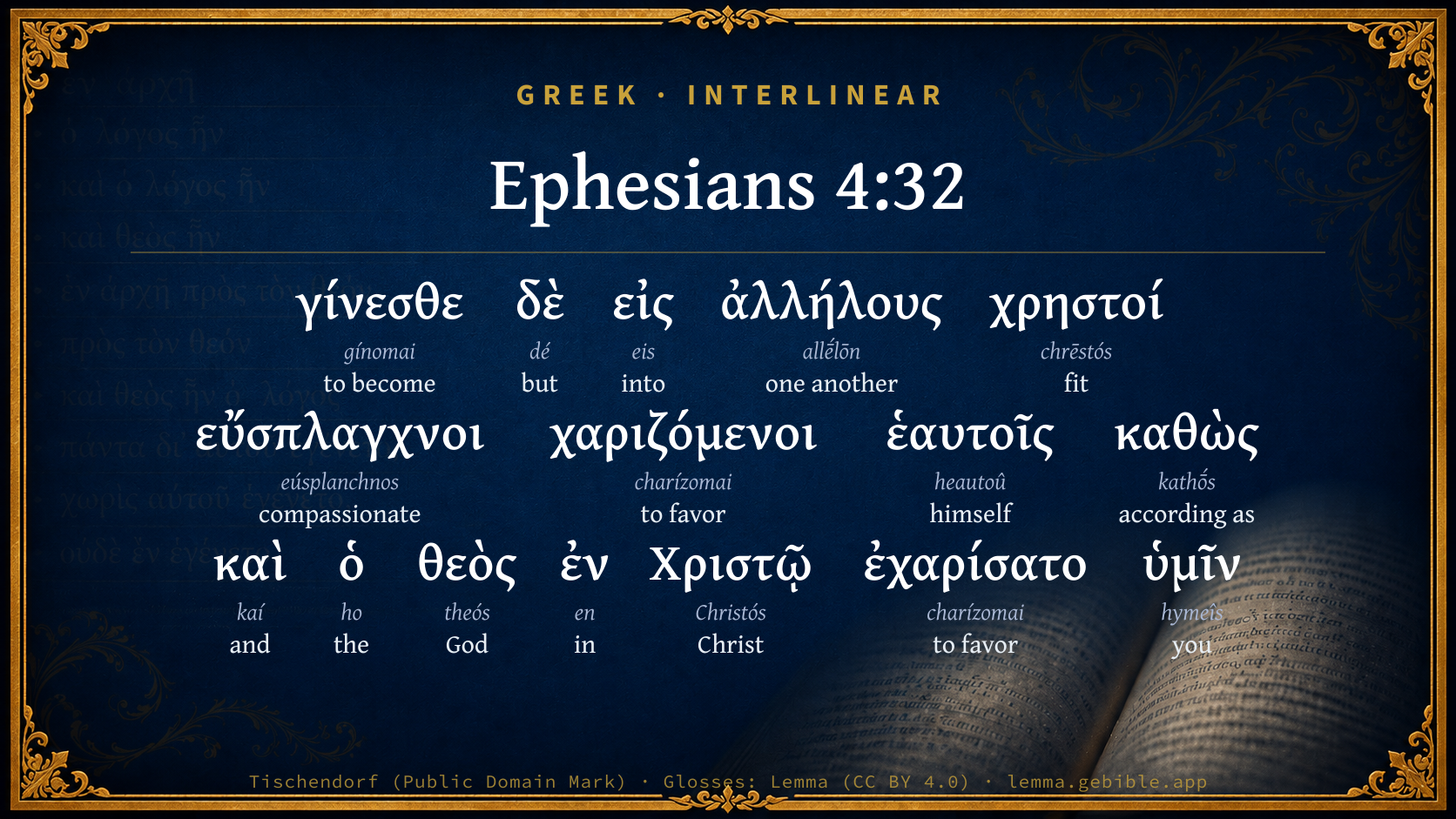
  1. γίνεσθε gínomai G1096 “to become” Verb, Present, Middle or Passive deponent, Imperative, 2nd person, Plural
  2. δὲ dé G1161 “but” Conjunction
  3. εἰς eis G1519 “into” Preposition
  4. ἀλλήλους allḗlōn G240 “one another” Reciprocal pronoun, Accusative, Plural, Masculine
  5. χρηστοί chrēstós G5543 “fit” Adjective, Nominative, Plural, Masculine
  6. χαριζόμενοι charízomai G5483 “to favor” Verb, Present, Middle or Passive deponent, Participle, Nominative, Plural, Masculine
  7. ἑαυτοῖς heautoû G1438 “himself” Reflexive pronoun, 2nd person, Dative, Plural, Masculine
  8. καθὼς kathṓs G2531 “according as” Adverb
  9. καὶ kaí G2532 “and” Conjunction
  10. ὁ ho G3588 “the” Article, Nominative, Singular, Masculine
  11. θεὸς theós G2316 “God” Noun, Nominative, Singular, Masculine
  12. ἐν en G1722 “in” Preposition
  13. Χριστῷ Christós G5547 “Christ” Noun, Dative, Singular, Masculine
  14. ἐχαρίσατο charízomai G5483 “to favor” Verb, Aorist, Middle deponent, Indicative, 3rd person, Singular
  15. ὑμῖν hymeîs G5210 “you” Personal pronoun, 2nd person, Dative, Plural

About this verse

These counts appear in no published source. They are computed here, from the morphology-tagged text and Lemma’s own curated glosses. What Lemma adds →

16
words
15
distinct lemmas
Pauline Epistles
section

Notable vocabulary

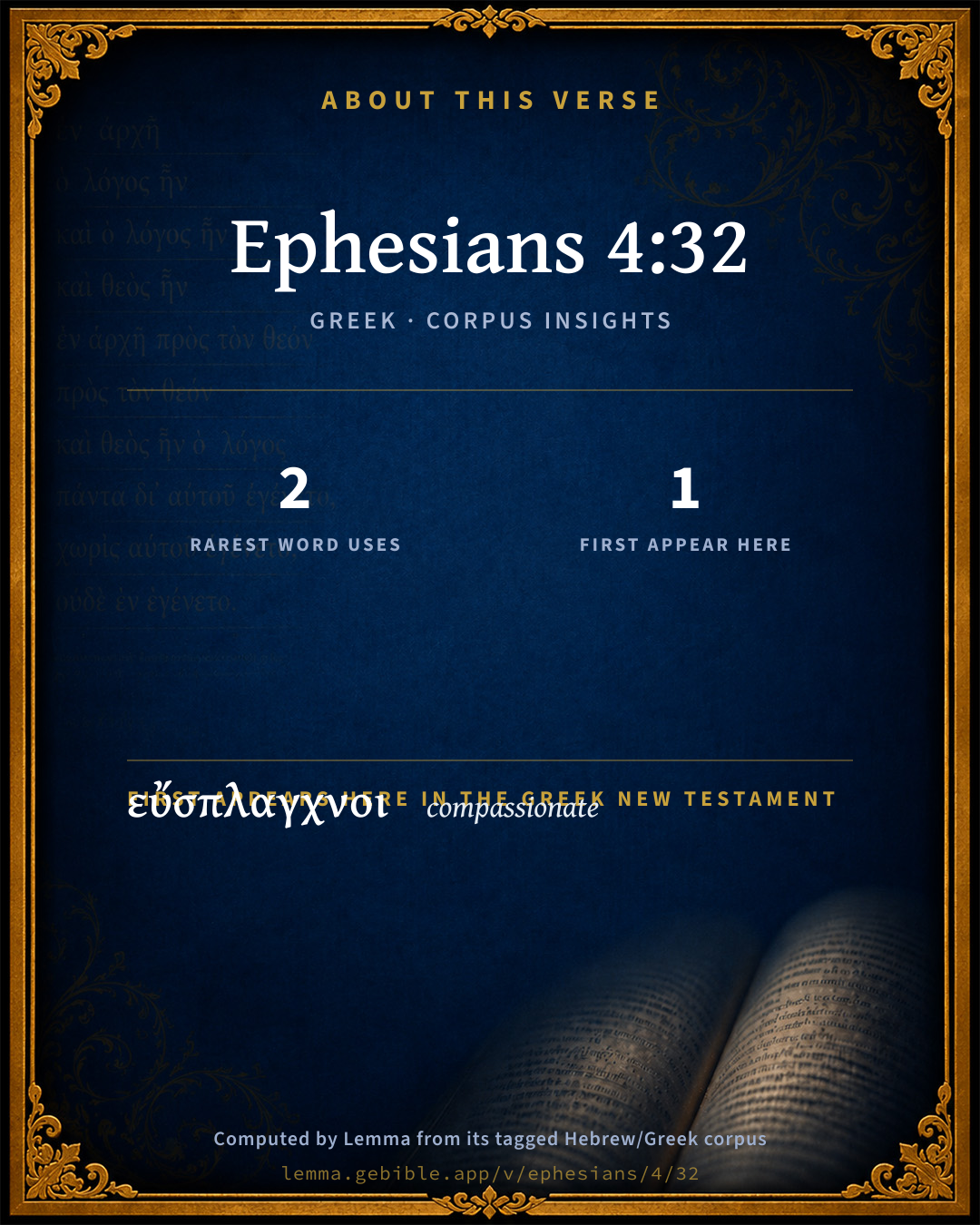
The rarest word here is εὔσπλαγχνοι compassionate G2155 — appearing just 2 times in the whole Greek New Testament.

First appearance in Scripture

This word makes its first canonical appearance in the Greek New Testament here:

  • εὔσπλαγχνοι compassionate G2155

Shared distinctive vocabulary

εὔσπλαγχνοι compassionate G2155 occurs in 2 verses of the Greek New Testament. Also found in:

Repetition

A word recurs within this verse:

  • χαριζόμενοι to favor G5483 ×2

Cross-references

31

Topical passages linked to Ephesians 4:32 in the Treasury of Scripture Knowledge — connected by theme and wording, ordered by reader-vote popularity; previews shown in the World English Bible.

  • Colossians 3:12–13 Put on therefore, as God's chosen ones, holy and beloved, a heart of compassion, kindness, lowliness, humility, and perseverance;
  • Matthew 6:14–15 "For if you forgive men their trespasses, your heavenly Father will also forgive you.
  • Mark 11:25 Whenever you stand praying, forgive, if you have anything against anyone; so that your Father, who is in heaven, may also forgive you your transgressions.
  • 1 Peter 3:8–9 Finally, be all like-minded, compassionate, loving as brothers, tenderhearted, courteous,
  • 2 Corinthians 2:10 Now I also forgive whomever you forgive anything. For if indeed I have forgiven anything, I have forgiven that one for your sakes in the presence of Christ,
  • Ephesians 5:1 Be therefore imitators of God, as beloved children.
  • Luke 6:35 But love your enemies, and do good, and lend, expecting nothing back; and your reward will be great, and you will be children of the Most High; for he is kind toward the unthankful and evil.
  • Luke 6:37 Don't judge, And you won't be judged. Don't condemn, And you won't be condemned. Set free, And you will be set free.
  • Matthew 6:12 Forgive us our debts, as we also forgive our debtors.
  • Luke 17:4 If he sins against you seven times in the day, and seven times returns, saying, 'I repent,' you shall forgive him."
  • 1 Corinthians 13:4 Love is patient and is kind; love doesn't envy. Love doesn't brag, is not proud,
  • Psalms 145:9 Yahweh is good to all. His tender mercies are over all his works.
  • Romans 12:10 In love of the brothers be tenderly affectionate one to another; in honor preferring one another;
  • Romans 12:20–21 Therefore "If your enemy is hungry, feed him. If he is thirsty, give him a drink. For in doing so, you will heap coals of fire on his head."
  • 1 John 2:12 I write to you, little children, because your sins are forgiven you for his name's sake.
  • Psalms 112:4–5 Light dawns in the darkness for the upright, Gracious, merciful, and righteous.
  • Matthew 18:21–35 Then Peter came and said to him, "Lord, how often shall my brother sin against me, and I forgive him? Until seven times?"
  • 1 John 1:9 If we confess our sins, he is faithful and righteous to forgive us the sins, and to cleanse us from all unrighteousness.
  • 2 Corinthians 2:7 so that on the contrary you should rather forgive him and comfort him, lest by any means such a one should be swallowed up with his excessive sorrow.
  • Genesis 50:17–18 "So you shall tell Joseph, 'Now please forgive the disobedience of your brothers, and their sin, because they did evil to you.' Now, please forgive the disobedience of the servants of the God of your father." Joseph wept when they spoke to him.
  • James 5:11 Behold, we call them blessed who endured. You have heard of the patience of Job, and have seen the Lord in the outcome, and how the Lord is full of compassion and mercy.
  • Proverbs 19:22 That which makes a man to be desired is his kindness. A poor man is better than a liar.
  • Luke 1:78 Because of the tender mercy of our God, Whereby the dawn from on high will visit us,
  • Ruth 2:20 Naomi said to her daughter-in-law, Blessed be he of Yahweh, who has not left off his kindness to the living and to the dead. Naomi said to her, The man is a close relative to us, one of our near kinsmen.
  • Psalms 112:9 He has dispersed, he has given to the poor. His righteousness endures forever. His horn will be exalted with honor.
  • Proverbs 12:10 A righteous man regards the life of his animal, But the tender mercies of the wicked are cruel.
  • Luke 11:4 Forgive us our sins, For we ourselves also forgive everyone who is indebted to us. Bring us not into temptation, But deliver us from the evil one.'"
  • 2 Corinthians 6:6 in pureness, in knowledge, in patience, in kindness, in the Holy Spirit, in sincere love,
  • Isaiah 57:1 The righteous perishes, and no man lays it to heart; and merciful men are taken away, none considering that the righteous is taken away from the evil [to come].
  • Acts 28:2 The natives showed us uncommon kindness; for they kindled a fire, and received us all, because of the present rain, and because of the cold.
  • 2 Peter 1:7 and in godliness brotherly affection; and in brotherly affection, love.

Cross-references courtesy of OpenBible.info (CC BY 4.0).

Where the printed editions differ

1 variant

Places in this verse where the major printed Greek editions disagree on the wording in a way that affects the translation — a comparison of editions, not a manuscript-by-manuscript collation. The editions are the modern critical texts (Nestlé-Aland 28/27, SBL, Westcott-Hort, Tregelles, Tyndale House) and the traditional texts behind the KJV (the Textus Receptus and the Byzantine/Majority text). It is not a claim about which reading is original.

  1. Different wording
    ὑμῖν.¶

    “you.”

    In NA28NA27SBLWHTregTR Not in TynByz

    ἡμῖν (hēmin) 'us' occurs in a few manuscripts (Tyn+Byz) instead of ὑμῖν.¶ (humin) 'you.' in older manuscripts (NA28+NA27+SBL+WH+Treg+TR)

Textual data: Translators Amalgamated Greek New Testament (STEPBible TAGNT) · CC BY 4.0.

Commentary

Notes on Ephesians 4:32 from classic Christian and Jewish commentators (each source and its license shown beneath its notes). The classic Christian expositions comment on the surrounding passage and are grouped to its opening verse, so a note may address several verses; the Jewish commentaries on the Tanakh (Rashi and others) are per-verse, so they appear only where the commentator wrote on this verse.

Lemma curates 59 commentaries, every one of them public domain or Creative Commons licensed, each selected and text-cleaned for this edition rather than reprinted as found. About our sources →

Tyndale Open Study Notes

Tyndale Open Resources

4:32 Forgiving fellow believers is a natural and good response to experiencing God’s forgiving grace in Christ (cp. Col 3:12-13; 1 Jn 4:19).

Tyndale Open Study Notes — © Tyndale Open Resources, licensed CC BY-SA 4.0. Text via the HelloAO Bible API.

Bengel's Gnomon

Johann Albrecht Bengel

Eph 4:32. Ἐχαρίσατο, has forgiven) He has shown Himself kind, merciful, forgiving.

Bengel's Gnomon of the New Testament — English translation (T&T Clark, Edinburgh, 1860) — public domain. Text from a community e-Sword module.

Expositor's Greek Testament

ed. W. Robertson Nicoll

Eph 4:32 . γίνεσθε δὲ εἰς ἀλλήλους χρηστοί : but become ye kind one to another . The δέ is omitted by [478] , k , 177, Clem., etc., while οὖν is substituted for it in [479] 1 [480] , 114. It is bracketed by WH and by Tr marg., and is omitted by [481] . But it is quite in place, having its combined connecting and opposing force; cf. on Eph 4:15 above. γίνεσθε (not ἐστέ ), = “become ye,” or “show yourselves,” rather than “be ye”. The idea is that they had to abandon one mental condition and make their way, beginning there and then, into its opposite. χρηστοί , = kind, benignant , used of God (Luk 6:35 ; Rom 2:4 ; 1Pe 2:3 ), but here (its only occurrence in the Epistles) of ηνη εὔσπλαγχνοι : tender-hearted . There could be no better rendering. In Col 3:12 the same disposition is expressed by σπλάγχνα οἰκτιρμοῦ . It is only in Scripture and in eccles. Greek that the adject. conveys the idea of compassion ( Pray. of Manass., 7; Test. XII. Patr., Test. Zab. , § 9). χαριζόμενοι ἑαυτοῖς : forgiving each other . Partic. co-ordinate with the χρηστοί , εὔσπλαγχνοι , denoting one special form in which the kindness and tender-heartedness were to show themselves. χαρίζομαι means either to give graciously (Luk 7:21 ; Rom 8:32 ; Phi 2:9 , etc.), or to forgive (Luk 7:42 ; 2Co 2:7 ; 2Co 2:10 ; 2Co 12:13 ; Col 2:13 ; Col 3:13 ). Some adopt the former sense here (Vulg., donantes ; Eras., largientes ). But the second is more in harmony with the context. For the use of ἑαυτοῖς as = ἀλλήλοις in classical Greek ( e.g. , Soph., Antig. , 145) see Kühner, Greek Gram. , ii., p. 497; Jelf, Greek Gram. , § 54, 2. In the NT the same use prevails (1Co 6:7 ; Col 3:13 ; Col 3:16 , etc.). The two forms are often conjoined in the same paragraph or sentence, both in classical Greek (Xen., Mem. , ii., 7, iii., 5, 16, etc.) and in the NT (as here, Col 3:13 ; 1Pe 4:8 , etc.). If there is any distinction between them, it is that the idea of fellowship or corporate unity is more prominent in ἑαυτοῖς ; cf. Blass, Gram. of N. T. Greek , pp. 169, 170; Light. and Ell. on Col 3:13 . καθὼς καὶ ὁ Θεὸς ἐν χριστῷ ἐχάρισατο ὑμῖν : even as also God in Christ forgave you . καθὼς points to the Divine example; καὶ places the two instances, the Divine and the human, over against each other; the reference and the comparison indicate the supreme reason or motive for our fulfilment of the injunction. ἐν χριστῷ is not “for Christ’s sake” (AV) or per Christum (Calv.), but “ in Christ” as in 2Co 5:19 ; the God who forgives being the God who manifests Himself and acts in the suffering, reconciling Christ. The aor. should be rendered did forgive with Wicl., Tynd., Gen., Bish., RV (not “hath forgiven” as in AV, etc.), the point being the forgiveness effected when Christ died. The reading ὑμῖν , supported by [482] [483] [484] [485] , 37, Sah., Boh., Vulg., Goth., Eth., etc. is to be preferred on the whole to ἡμῖν which appears in [486] [487] [488] , 17, 47, Syr., Arm., etc., L gives ἡμῖν in text; TrWHRV give it in margin.

[478] Codex Vaticanus (sæc. iv.), published in photographic facsimile in 1889 under the care of the Abbate Cozza-Luzi.

[479] Codex Claromontanus (sæc. vi.), a Græco-Latin MS. at Paris, edited by Tischendorf in 1852.

[480] Codex Augiensis (sæc. ix.), a Græco-Latin MS., at Trinity College, Cambridge, edited by Scrivener in 1859. Its Greek text is almost identical with that of G, and it is therefore not cited save where it differs from that MS. Its Latin version, f, presents the Vulgate text with some modifications.

[481] Codex Angelicus (sæc. ix.), at Rome, collated by Tischendorf and others.

[482] Codex Sinaiticus (sæc. iv.), now at St. Petersburg, published in facsimile type by its discoverer, Tischendorf, in 1862.

[483] Codex Alexandrinus (sæc. v.), at the British Museum, published in photographic facsimile by Sir E. M. Thompson (1879).

[484] Codex Boernerianus (sæc. ix.), a Græco-Latin MS., at Dresden, edited by Matthæi in 1791. Written by an Irish scribe, it once formed part of the same volume as Codex Sangallensis ( δ ) of the Gospels. The Latin text, g, is based on the O.L. translation.

[485] Codex Porphyrianus (sæc. ix.), at St. Petersburg, collated by Tischendorf. Its text is deficient for chap. Eph 2:13-16 .

[486] Codex Claromontanus (sæc. vi.), a Græco-Latin MS. at Paris, edited by Tischendorf in 1852.

[487] Codex Mosquensis (sæc. ix.), edited by Matthæi in 1782.

[488] Codex Angelicus (sæc. ix.), at Rome, collated by Tischendorf and others.

The Expositor's Greek Testament, edited by W. Robertson Nicoll (1897–1910) — public domain. Text from a community e-Sword module.

International Critical Commentary

32. γίνεσθε δέ, “become, show yourselves.” Corresponding to ἀρθήτω ἀφʼ ὑμῶν on the other side. χρηστοί, “kind.” This is the only place in the Epistles where the adjective occurs; it is used of God in Luk 6:35; so the substantive, ch. 2:7; Tit 3:4, etc.

εὔσπλαγχνοι, “tender-hearted,” in this sense only in biblical and ecclesiastical writers. Hippocrates has it in the physical sense, “having healthy bowels.” Euripides uses the substantive εὐσπλαγχνία in the sense “firmness of heart.” The adjective occurs in the same sense as here in the Prayer of Manasses, 7, and in Test. 12 Patr., of God. Comp. the parallel Col 3:12, σπλάγχνα οἰκτιρμοῦ.

χαριζόμενοι ἑατοῖς = Col 3:13. Origen presses ἑαυτοῖς as indicating that what was done to another was really done to themselves, διὰ τὸ συσσώμους ἠμᾶς εἶναι; Meyer and Alford think it implies that the forgiveness they are to show to others has as its pattern that which was shown to them as a body in Christ, ἐαυτοῖς being thus emphatic. In Col 3:12, also, we have ἀνεχόμενοι ἀλλήλων καὶ χαριζόμενοι ἑαυτοῖς and again, 1Pe 4:8-10,τὴν εἰς ἑαυτοὺς ἀγάπην ἐκτενῆ ἔχοντες … φιλόξενοι εἰς ἀλλήλους … εἰς ἑαυτοὺς [τὸ χάρισμα] διακονοῦντες. We are not justified in putting so much into the word as Meyer’s explanation supposes; but so much is true, that ἑαυτοῖς suggests, more than ἀλλήλοις, that they are addressed as members of one corporate body. This use of the word is quite classical. Demosthenes has βούλεσθε…περιίοντες αὑτῶν πυνθάεσθαι (p. 43, 10). Comp. also Xen. Mem. iii. 5. 16 (quoted by Lightfoot on Col.), ἀντὶ μὲν τοῦ συνεργεῖν ἑαυτοῖς τὰ συμφέροντα, ἐπηρεάζουσιν ἀλλήλοις, καὶ φθονοῦσιν ἐαυτοῖς μᾶλλον ἢ τοῖς ἄλλοις ἀνθρώποις … καὶ προαιροῦνται μᾶλλον οὕτω κερδαίνειν ἀπʼ ἀλλήλων ἢ σύωφελοῦντες αὑτοῦς. Also Dem. Mid. 101, p. 547.

The Vulgate has erroneously “donantes,” and Erasmus, “largientes,” but the following context shows that the word must mean “forgiving.”

καθὼς καί, the same motive that is appealed to in the Parable of the Unforgiving Servant.

ὁ Θεὸς ἐν Χριστῷ. “In Christ,” not “for Christ’s sake,” as AV., for which there is no justification. The sense is the same as in 2Co 5:19, “God was in Christ, reconciling the world unto Himself.” Not “per Christum” (Calvin), nor even μετὰ τοῦ κινδύνου τοῦ υἱοῦ αὐτοῦ καὶ τῆς σφαγῆ αὐτοῦ (Theoph.), of which there is no hint in the ἐν; but, as in the passage in 2 Cor., God manifesting Himself in, acting in (not “through”), Christ. Hence in Col 3:13 it is ὁ Κύριος ἐχαρίσατο ὑμῖν.

ἐχαρίσατο ὑμῖν. The readings here and in ch. 5:2 vary between the second and the first person.

In 4:32 ὑμῖν is read by א A G P 37, Vulg. (Clem.) Goth., Sah., Boh., Eth. ἡμῖν by D K L 17, 47, both Syr., Arm.

In 5:2 ὑμᾶς by אc A B P 37, Sah. Eth. ἡμῶ by א D G K L 17 47, Vulg., Syr. (both), Boh., Goth., Arm.

ib. ὑμῶν by B 37, Sah., Eth. ἡμῶν by א A D G K L P 17 47, Vulg., Syr. (both), Boh., Goth., Arm.

Or, to put it otherwise, we have —

ἡμ. in all three places, D K L 17 47, Syr. Arm.

ὑμ. in all three, Sah. Eth.

ὑμ. ὑμ. ἡμ., א A P.

ὑμ. ἡμ. ἡμ., אC Vulg., Goth.

ἡμ. ὑμ. ὑμ., B.

Critics differ in their judgment. Lachmann (judging in the absence of א) reads ἡμ. in all three places. Tischendorf (8th ed.) and Tregelles adopt ὑμ. ὑμ. ἡμ (Treg., however, in 4:32, giving ἡμῖν a place in the margin). So WH. (who place ἡμ. in the margin in the first and third places). So v. Soden and RV. (with ἡμ. in the mg. in the first place and ὑμ. in the third). Alford, Ellicott, and Eadie prefer ὑμ. ἡμ. ἡμ. The confusion of the two pronouns is very frequent. As far as documentary evidence is concerned, the reading adopted in RV. seems to have the advantage. The evidence for ὑμῶν in the third place is comparatively small, and it is very natural that St. Paul, while using the second person in close connexion with the precepts χαριζόμενοι, περιπατεῖτε ἐν ἀγάπῃ should pass from that to the more general statement in the first person. Indeed, it is perhaps not going too far to say that while “God forgave you,” “Christ loved you,” are perfectly natural, it would not seem so natural to say, “Christ gave Himself for you,” although the individual believer may say, “He gave Himself for me,” Gal 2:20.

ἐχαρίσατο, “forgave,” as referring to a past historical fact. Note that in Col 3:13 it is ὀΚύριος, with ὁ Χριστός in some texts.

Arm Armenian.

Boh Bohairic. Cited by Tisch. as “Coptic,” by Tregelles as “Memphitic,” by WH. as “me.”

Eth Ethiopic.

Syr-Pesh The Peshitto Syriac.

Ell Ellicott.

WH Westcott and Hort.

1 “Except after verbs of saying, thinking, etc., the aorist in the infinitive has no preterite signification, and differs from the present only in this, that it expresses a single transient action; and even this bye-signification often falls away.”—Madvig.

Alf Alford.

It Old Latin.

Sah The Sahidic or Thebaic (“the.” WH).

Treg. Tregelles.

International Critical Commentary — older volumes (1896–1929), various authors — public domain. Text from a community e-Sword module.

Hodge's Commentary on Romans, Ephesians & First Corinthians

Charles Hodge

Eph_4:32

Exhortation to the opposite virtues. We are required to be χρηστοί. The word properly means useful; then disposed to do good. Thus God is said to be χρηστός, kind or benignant, to the unthankful and the evil, Luk_6:35. Tenderhearted, εὔσπλαγχνοι, which in the parallel passage, Col_3:12, is expressed by bowels of compassion, that is, pity, compassion towards the suffering. Forgiving one another, χαριζόμενοι ἑαυτοῖς. The verb means to give as a matter of favor, then to forgive, to pardon freely, Even as, i.e. because God in Christ hath freely forgiven you. This is the motive which should constrain us to forgive others. Gods forgiveness towards us is free; it precedes even our repentance and is the cause of it. It is exercised notwithstanding the number, the enormity and the long continuance of our transgressions. He forgives us far more than we can ever be called upon to forgive others. God forgives us in Christ. Out of Christ he is, in virtue of his holiness and justice, a consuming fire; but in him, he is long-suffering, abundant in mercy, and ready to forgive.

Charles Hodge — Commentary on Romans (1835), First Corinthians (1857), and Ephesians (1856) — public domain. Text from a community e-Sword module.

Geneva Bible (1599)

Geneva Bible translators

An argument taken from the example of Christ, most grave and vehement, both for pardoning of those injuries which have been done unto us by our greatest enemies, and much more for having consideration of the miserable, and using moderation and gentle behavior towards all men.

Geneva Bible (1599) marginal notes — public domain. Text via Bolls.life.

Jamieson, Fausset & Brown

Robert Jamieson, A. R. Fausset & David Brown

(Luk 7:42; Col 3:12).

even as--God hath shown Himself "kind, tender-hearted, and forgiving to you"; it is but just that you in turn shall be so to your fellow men, who have not erred against you in the degree that you have erred against God (Mat 18:33).

God for Christ's sake--rather as Greek, "God in Christ" (Co2 5:19). It is in Christ that God vouchsafes forgiveness to us. It cost God the death of His Son, as man, to forgive us. It costs us nothing to forgive our fellow man.

hath forgiven--rather as Greek, "forgave you." God has, once for all, forgiven sin in Christ, as a past historical fact.

Next: Ephesians Chapter 5

Jamieson, Fausset & Brown — Commentary Critical and Explanatory on the Whole Bible (1871) — public domain (CC PDM 1.0). Text via the HelloAO Bible API.

Adam Clarke's Commentary

Verse 32. Be ye kind one to another] γινεσθε χρηστοι. Be kind and obliging to each other; study good breeding and gentleness of manners. A Christian cannot be a savage, and he need not be a boor. Never put any person to needless pain.

Tender-hearted] ευσπλαγχνοι. Compassionate; having the bowels easily moved (as the word implies) to commiserate the state of the wretched and distressed.

Forgiving one another] Should you receive any injury from a brother, or from any man, be as ready to forgive him, on his repentance and acknowledgment, as God was, for Christ's sake, to forgive you when you repented of your sins, and took refuge in his mercy.

1. THE exhortations given in this chapter, if properly attended to, have the most direct tendency to secure the peace of the individual, the comfort of every family, and the welfare and unity of every Christian society. That God never prohibits any thing that is useful to us, is an unshaken truth. And that he never commands what has not the most pointed relation to our present and eternal welfare, is not less so. How is it, then, that we do not glory in his commandments and rejoice in his prohibitions? If the gratification of our fleshly propensities could do us good, that gratification had never been forbidden. God plants thorns in the way that would lead us to death and perdition.

2. From the provision which God has made for the soul's salvation, we may see the nature, and in some sense the extent, of the salvation provided. Much on this subject has been said in the preceding chapter, and the same subject is continued here. God requires that the Church shall be holy, so that it may be a proper habitation for himself; and he requires that each believer should be holy, and that he should, under the influences of his grace, arrive at the measure of the stature of the fulness of Christ! Eph 4:13. This is astonishing; but God is able to make all grace abound towards us.

3. It is the will of God that Christians should be well instructed; that they should become wise and intelligent; and have their understandings well cultivated and improved. Sound learning is of great worth, even in religion; the wisest and best instructed Christians are the most steady, and may be the most useful. If a man be a child in knowledge, he is likely to be tossed to and fro, and carried about with every wind of doctrine; and often lies at the mercy of interested, designing men: the more knowledge he has, the more safe is his state. If our circumstances be such that we have few means of improvement, we should turn them to the best account. "Partial knowledge is better than total ignorance; he who cannot get all he may wish, must take heed to acquire all that he can." If total ignorance be a bad and dangerous thing, every degree of knowledge lessens both the evil and the danger. It must never be forgotten that the Holy Scriptures themselves are capable of making men wise unto salvation, if read and studied with faith in Christ.

4. Union among the followers of Christ is strongly recommended. How can spiritual brethren fall out by the way? Have they not all one Father, all one Head? Do they not form one body, and are they not all members of each other? Would it not be monstrous to see the nails pulling out the eyes, the hands tearing off the flesh from the body, the teeth biting out the tongue, c., c.? And is it less so to see the members of a Christian society bite and devour each other, till they are consumed one of another? Every member of the mystical body of Christ should labour for the comfort and edification of the whole, and the honour of the Head. He that would live a quiet life, and keep the unity of the Spirit in the bond of peace, must be as backward to take offence as to give it. Would all act on this plan (and surely it is as rational as it is Christian) we should soon have glory to God in the highest, and on earth peace and good will among men.

5. A roughness of manners is to some unavoidable it is partly owing to the peculiar texture of their mind, and partly to their education. But there are others who glory in, and endeavour to cultivate, this ungentle disposition under this is often concealed a great degree of spiritual pride, and perhaps some malignity; for they think that this roughness gives them a right to say grating, harsh, and severe things. They should be taught another lesson; and if they will not demean themselves as they ought, they should be left to themselves, and no man should associate with them. They are not Christians, and they act beneath the character of men.

Adam Clarke's Commentary on the Bible (1810–1826) — public domain. Text from a community e-Sword/MySword module.

John Calvin's Commentaries

32. And be ye kind one to another. With bitterness he contrasts kindness, or gentleness of countenance, language, and manners. And as this virtue will never reign in us, unless attended by compassion, (ουμπάθεια,) he recommends to us to be tender-hearted This will lead us not only to sympathize with the distresses of our brethren, as if they were our own, but to cultivate that true humanity which is affected by everything that happens to them, in the same manner as if we were in their situation. The contrary of this is the cruelty of those iron-hearted, barbarous men, by whom the sufferings of others are beheld without any concern whatever.

Forgiving one another. The Greek word here rendered forgiving, (χαριζόμενοι ἑαυτοῖς,) is supposed by to mean beneficence. Erasmus, accordingly, renders it (largientes) bountiful. Though the word admits of that meaning, yet the context induces me to prefer the other view, that we should be ready to forgive It may sometimes happen, that men are kind and tender-hearted, and yet, when they receive improper treatment, do not so easily forgive injuries. That those whose kindness of heart in other respects disposes them to acts of humanity, may not fail in their duty through the ingratitude of men, he exhorts them to discover a readiness to lay aside resentment. To give his exhortation the greater weight, he holds out the example of God, who has forgiven to us, through Christ, far more than any mortal man can forgive to his brethren.

John Calvin's Commentaries (1540-1563) — public domain. Text from the Calvin Translation Society English edition (1840s-50s) via the Christian Classics Ethereal Library (ccel.org). Calvin's coverage is partial (roughly two-thirds of the Bible); uncommented books and verses are honest gaps, never fabricated. The 19th-century editor's footnotes and remarks are omitted so the notes are faithfully Calvin's own voice.

Ellicott's Commentary for English Readers

(32) Kind . . . tenderhearted.—“Kindness” is gentleness in bearing with wrong (Luk_6:35; Rom_11:22; Eph_2:7; 1Pe_2:3). “Tenderheartedness” (see 1Pe_3:8) is more positive warmth of sympathy and love. Both issue in free “forgiveness,” after the model of the universal and unfailing forgiveness “of God in Christ” to us—the only model we dare to follow, suggested by our Saviour Himself in the Lord’s Prayer, and expressly enjoined in Luk_6:36. It is a forgiveness which in us, as in Him, does not imply condonation of evil, or even the withholding of needful chastisement, but which absolutely ignores self, conquers man’s selfish anger, and knows no limit, even up to “seventy times seven.”

A Bible Commentary for English Readers, edited by Charles John Ellicott (1878–1897) — public domain. Text from a community e-Sword module.

The Cambridge Bible for Schools and Colleges

gen. ed. J. J. S. Perowne

32. be] Lit., become; shew yourselves, in the actions and developments of life.

kind] The Gr. word (noun or adj.) occurs in similar contexts, Luk_6:35; Rom_2:4; Rom_11:22 (“goodness”); 2Co_6:6; Gal_5:22; Col_3:12. Its primitive meaning is “useful”; hence “helpful,” and so “kindly.”—It is the original of “easy” in Mat_11:30; the Lord’s “yoke” is a real yoke, but instinct with the lovingkindness of Him who imposes it.

tender-hearted] The same Gr. word as in 1Pe_3:8 (A.V., “pitiful”). It occurs nowhere else in N.T. Kind-hearted may perhaps be a better rendering, as somewhat wider. The word carries the idea of the previous word a little more into life and detail.

forgiving one another] Lit., “forgiving yourselves.” Usage and common sense alike fully justify the rendering of A.V. and R.V. (which reads, somewhat needlessly, “each other”). The “yourselves,” as a grammatical fact, indicates the solidarity of the body within which the reciprocity takes place; though this fine shade of meaning must not be exaggerated.

For a close parallel to the precept see Col_3:13. The holy duty of heartfelt forgiveness, entire and unreserved, is prominent in the Lord’s teaching; cp. especially the Lord’s Prayer (Mat_6:12; Luk_11:4); Mat_18:21, &c. No duty is more readily owned in the abstract, none more repugnant to the will in many a case in the concrete. But the law of Christ knows no exceptions, and grace is able to meet every demand for fulfilment.—It is humbling and instructive to see here, as in the Lord’s Prayer, that the abiding need for mutual forgiveness is assumed.

even as] The Divine pardon is at once supreme example and sacred motive. Cp. just below, ch. Eph_5:2.

God] The Father, “Fount of Deity,” and as such styled often simply God where Christ is also and distinctively named (Joh_17:3; 2Co_5:19; 2Co_13:13; Judges 21). The Son has also Deity, but as in the Stream, not in the Fountain. See Pearson, On the Creed, Art. 1.

for Christ’s sake] Lit. and better, in Christ. The reason of pardon, and the process of it, are alike summed up “in Christ,” “in” Whom the Father reveals Himself as God of Peace: “in” Whom resides the immediate atoning reason of Peace; and “in” Whom, by grace and faith, are the human objects of pardon, “very members incorporate” of Him Who is eternally the Accepted One of the Father.—Cp. Eph_1:7.

hath forgiven] Lit., and better, did forgive; ideally and in covenant, “before the world was”; historically, when the Son was accepted and glorified as the perfect Propitiation, raised from the dead; in individual experience, when each person believed (Rom_5:1, &c.) It is important to observe how the Apostle bids them deal with Divine forgiveness not as a hope but as a fact. Cp. 1Jn_2:12.

you] There is considerable, but not preponderating, evidence for a reading “us”. The question between the two readings is not of practical importance.

The Cambridge Bible for Schools and Colleges (gen. ed. J. J. S. Perowne; Cambridge University Press, 1878–1918) — public domain. Text from a community e-Sword module.

Trapp's Complete Commentary

John Trapp

32 And be ye kind one to another, tenderhearted, forgiving one another, even as God for Christ’s sake hath forgiven you.

Ver. 32. And be ye kind] χρηστοι. Sweet natured, facile, and fair conditioned; as Cranmer, whose gentleness in pardoning wrongs was such, as it grew to a common proverb, Do my Lord of Canterbury a displeasure, and then you may be sure to have him your friend while he liveth. He never raged so far with any of his household servants, as once to call the meanest of them varlet or knave in anger, much less to reprove a stranger with any reproachful word. Homo Φιλοξενος, nec minus Φιλολογος, saith Tremelius of him, and much more in praise of his courtesy and piety.

John Trapp, A Commentary or Exposition upon All the Books of the Old and New Testament (1647–1656) — public domain. Text from a community e-Sword module.

Albert Barnes' Notes on the Bible

And be ye kind one to another - Benignant, mild, courteous, “polite” - χρηστοὶ chrēstoi. 1Pe 3:8. Christianity produces true courteousness, or politeness. It does not make one rough, crabby, or sour; nor does it dispose its followers to violate the proper rules of social contact. The secret of true politeness is “benevolence,” or a desire to make others happy; and a Christian should be the most polite of people. There is no religion in a sour, misanthropic temper; none in rudeness, stiffness, and repulsiveness; none in violating the rules of good breeding. There is a hollow-hearted politeness, indeed, which the Christian is not to aim at or copy. His politeness is to be based on “kindness;” Col 3:12. His courtesy is to be the result of love, good-will, and a desire of the happiness of all others; and this will prompt to the kind of conduct that will render his conversation. with others agreeable and profitable.

Tender-hearted - Having a heart disposed to pity and compassion, and especially disposed to show kindness to the faults of erring brethren; for so the connection demands.

Forgiving one another - see the notes on Mat 6:12.

As God for Christ’s sake hath forgiven you - As God, on account of what Christ has suffered and done, has pardoned you. He has done it:

(1) “freely” - without merit on your part - when we were confessedly in the wrong.

(2) “fully;” he has forgiven “every” offence.

(3) “Liberally;” he has forgiven “many” offences, for our sins have been innumerable.

This is to be the rule which we are to observe in forgiving others. We are to do it “freely, fully, liberally.” The forgiveness is to be entire, cordial, constant. We are not to “rake up” old offences, and charge them again upon them; we are to treat them as though they had not offended, for so God treats us Learn:

(1) That the forgiveness of an offending brother is a duty which we are not at liberty to neglect.

(2) The peace and happiness of the church depend on it. All are liable to offend their brethren, as all are liable to offend God; all need forgiveness of one another, as we all need it of God.

(3) There is no danger of carrying it too far. Let the rule be observed, “As God has forgiven you, so do you forgive others.” Let a man recollect his own sins and follies; let him look over his life, and see how often he has offended God; let him remember that all has been forgiven; and then, fresh with this feeling, let him go and meet an offending brother, and say, “My brother, I forgive you. I do it frankly, fully, wholly. So Christ has forgiven me; so I forgive you. The offence shall be no more remembered. It shall not be referred to in our contact to harrow up your feelings; it shall not diminish my love for you; it shall not prevent my uniting with you in doing good. Christ treats me, a poor sinner, as a friend; and so I will treat you.”

Albert Barnes' Notes on the Bible (1834–1885) — public domain. Text from a community e-Sword/MySword module.

Matthew Poole's English Annotations

And be ye kind; sweet, amiable, facile in words and conversation, Luk 6:35.

Tender-hearted; merciful, quickly moved to compassion: so we have bowels of mercies, Col 3:12.

Forgiving one another, even as God for Christ’s sake hath forgiven you; be placable, and ready to forgive, therein resembling God, who for Christ’s sake hath forgiven you more than you can forgive to one another.

Matthew Poole's English Annotations on the Holy Bible (1683–1685) — public domain. Text from a community e-Sword/MySword module.

Whedon's Commentary on the Bible

Daniel D. Whedon

32. The and shows that this verse, together with Eph_5:1-2, is the completion of 31, as 30 is of 29. The therefore of the next verse, Eph_5:1, does not imply transition to a new paragraph.

Be ye— Rather, become ye. Thisdoes not imply, as Alford and Braune (Schaff’s Lange) imply, any particular late transgression in these respects by the Ephesian Christians, but only that their transition from Gentilism to a perfect Christianity was a perfecting process, a becoming.

Kind—The Greek word that so nearly resembled Christ (Chrestos) that pagans confounded it and Christians boasted it. Note on Act_18:2.

As God— All in common had been forgiven, and could, therefore, mutually forgive. And in the two following verses St. Paul carries out into striking detail this following our divine model, God.

Daniel D. Whedon (gen. ed.), Commentary on the Old and New Testaments (1874–1909) — public domain. Text from a community e-Sword module.

The Pulpit Commentary

But be ye kind one to another, tender-hearted, forgiving one another (opposed to bitterness, wrath, anger; Bengel). Kind (crhstoi), sweet, amiable in disposition, subduing all that is harsh and hasty, encouraging all that is gentle and good; tender-hearted (eusplagcnoi), denoting a specially compassionate feeling, such as may arise from the thought of the infirmities, griefs, and miseries to which more or less all are subject; these emotional conditions to bear the practical fruit of forgiveness, and the forgiveness to be mutual (carizomenoi eJautoiv), as if under the feeling that what you give today you require to ask tomorrow, net being too hard on the faults of others, remembering that you have your own. Even as God in Christ also forgave you. The A.V rendering, "for Christ"s sake," is objectionable every way: it is not literal; it omits the characteristic feature of the Epistle, "in Christ," losing the force of the consideration that the forgiveness was dispensed by the Father, acting with or wholly one with the Son; and it gives a shade of countenance to the great error that the Father personally was not disposed to forgive till he was prevailed on to do so by the interposition of the Son. The aorist, forgave," is more literal and better than the perfect, "hath forgiven;" it points to a definite time when forgiveness was bestowed, viz. the moment of real belief in Christ, and hearty acceptance of his grace. The vague atmosphere in which many envelop the question of their forgiveness is very hurtful; it checks their thanksgivings, dulls their joy, quenches hope, and dilutes the great dynamic power of the gospel the power that impels us to forgive our brother, as well as to abound in the work of the Lord with a tender conscience, the sense of forgiveness urges to the most full and hearty doing of God"s will; but when hypocrites, with seared consciences claim to be forgiven, they steal what is not their own, and become more abandoned to wickedness.

The benevolent and forgiving temper.

Instead of bitterness, there ought to be kindness; instead of wrath, anger, clamor, and evil-speaking, there ought to be tender-heartedness; instead of malice, a loving and hearty forgiveness.

I KINDNESS. It is a suggestive idea that our English word "kind" is derived from kinned, as marking the affection of kindred.

1. Consider how it is to be manifested.

1. By desiring one another"s good; (1Ti_2:1)

2. by rejoicing in one another"s prosperity; (Rom_12:15)

3. by pitying one another"s miseries; (Rom_12:15)

4. by helping one another"s necessities. (1Jn_3:17, 1Jn_3:18)

1. The motives to kindness.

1. The example of God himself, who is said to be "kind to the unthankful and evil"; (Luk_6:35)

2. it is a commanded duty;

3. we are brethren both in the flesh and in the spirit. A kindly spirit without a touch of censoriousness or harshness greatly recommends true religion.

II TENDER-HEARTEDNESS. This expression is in the original closely allied to "bowels of mercy". (Col_3:12) It implies a compassionate sense of the miseries and infirmities of others. It is to interpret in the best sense the injunction of the apostle: "Look not every man on his own things, but every man also on the things of others". (Php_2:4) The ties of nature are not cancelled by Christianity, but strengthened by it. We ought to be ready at all times to soothe the sorrows, to remove the miseries, to solve the doubts, of our neighbors. It is a temper highly recommended in Scripture (Luk_6:36; 1Pe_3:8) An unmerciful spirit is declared to be inconsistent with the love of God in the soul: Whoso... shutteth his bowels of compassion ... how dwelleth the love of God in him?". (1Jn_3:17) We ought to follow the example of our heavenly Father, who is rich in mercy, and whose tender mercies are over all his works; and of his dear Son Jesus Christ, who was often moved with compassion, (Mat_9:36) and, as the High Priest of our profession, cannot but be touched with the feeling of our infirmities. (Heb_6:15)

III THE FORGIVING SPIRIT. "Forgiving one another, even as God also in Christ forgave you." These words imply:

1. That Christians will often do to one another much that needs forgiveness. They are "of like passions with other men," beset by infirmities of temper, or apt to come into collision with others either in a way of opinion or of interest. Faults will be committed, offence will be given.

2. That it is a Christian. duty to forgive others. Our Lord gave repeated injunctions respecting it (Mat_6:14; Luk_17:4)

3. Our forgiving our brethren must be a certain factor in our own prayer for Divine forgiveness.

4. The motive or measure of our forgiveness is to be the very forgiveness of God himself. Note:

(1) It is God who forgives; it is an act of his grace. (Eph_1:7)

(2) He does it in Christ, not merely for his sake, but in him as our Mediator.

(3) It is a past act. Believers are forgiven in Christ in the very moment of their conversion.

(4) How miserable we should be without it! God angry with us; hell under our feet; the very blessings of life a curse to us.

(5) How happy we are with this forgiveness! God will never condemn you nor remember your sins; all things will be blessed to you; the love of God the guarantee of your final glorification. T.C.

The Pulpit Commentary (1880–1919), ed. H.D.M. Spence-Jones & Joseph S. Exell — public domain. Text from a community e-Sword module.

John Wesley's Explanatory Notes

As God, showing himself kind and tenderhearted in the highest degree, hath forgiven you.

John Wesley, Explanatory Notes Upon the Whole Bible (1754–1765) — public domain. Text via the GEBible commentary corpus.

Cambridge Greek Testament for Schools and Colleges

32. St Paul passes from the discord to sketch in a few pregnant lines the nature and the ground of the Christian harmony.

γίνεσθε. ‘Show yourselves in thought and word and deed,’ ‘live according to your true nature.’ No doubt in a real sense the character is acquired (we win our souls, Luk 21:19) as the habit of living in accordance with it is formed by repeated acts. But the result is never represented in the N.T. as the reward of effort self-directed and self-supported. That would be to make it what St Paul describes as a ‘righteousness of our own rooted in law’ Php 3:9. It is always the appropriation of what is already ours by the free gift of God in and through Jesus Christ. So we are told to ‘become’ sons of our Father in Heaven by following the laws of His action Mat 5:45. Cf. the use of γίνεσθαι in 1Pe 1:15; 1Pe 3:6 with Hort’s note.

χρηστοί, kindness shown in helpful action, a constant attribute of God both in O. and N.T.

εὔσπλαγχνοι. According to its biblical sense ‘tender-hearted’ = σπλάγχνα οἰκτιρμοῦ, Col 3:12.

χαριζόμενοι ‘forgiving.’ The final antithesis to the spirit of bitterness.

ἑαυτοῖς. The change from εἰς ἀλλήλους in the opening phrase should be noticed, but as Robinson shows (after Blass, Gr. N.T. § 48, 49) too much must not be made of it. The same change is found in Col 3:13; Col 3:16; 1Pe 4:8; 1Pe 4:10 and Luk 23:12. Certainly in this last passage the change can only be due to the love of variety.

καθὼς καὶ ὁ θεὸς. St Paul here writes out at length the thought implied in κατὰ θεὸν in Eph 4:24. The Divine Example as the ultimate standard and as a constraining motive in the Christian life, appears in its clearest form in the Sermon on the Mount (Mat 5:48; Luk 6:36). The Gospel of St John helps us to realize the character of a life lived continuously in submission to this law. For the O.T. background for the thought and the Gentile aspirations in the same direction, see Hort on 1Pe 1:15. For the special application of the example to the duty of forgiveness cf. Mat 18:32 f. and Luk 6:35. The sight of Stephen praying for his murderers must have been St Paul’s first introduction to this side of the activity of the Christian Spirit.

ἐν Χριστῷ. See pp. lxii–lxxvi. Christ is both the message and: the reality of God’s forgiveness for men.

Cambridge Greek Testament for Schools and Colleges (Cambridge University Press, 1896; 21 vols, various authors incl. Carr, Maclear, Plummer, Farrar, Lumby, Moule, M. R. James, Simcox) — public domain. Text from a community e-Sword module.

Alford’s Greek Testament

Henry Alford

32.] but be ye (it is very difficult to mark the distinction between γίνεσθε and ἐστέ in a translation. Become ye (Ellic.) is certainly too far off the time present; be ye, too immediately belonging to it. The difficulty is best seen in such a command as that in Joh 20:27, μὴ γίνου ἄπιστος ἀλλὰ πιστός) towards one another kind (see note, Gal 5:22), tender-hearted (“εὔσπλ. profanis animosum, fortem, cordatum notat (see Eurip. Rhes. 192). At res ipsa docet h. l. esse, misericordem, benignum (ref.). In testament. xii. patriarch. p. 644, de Deo dicitur: ἐλεήμων ἐστὶ καὶ εὔσπλαγχνος, ibid. paulo post; piis ἴασις κ. εὐσπλαγχνία, ‘salus et misericordia futura’ dicitur, ibid. p. 641, ἔχετε εὐσπλαγχνίαν κατὰ παντὸς ἀνθρώπου.” Kypke. So also in the prayer of Manasseh, 6, εὔσπλαγχνος, μακρόθυμος κ. πολυέλεος; see also the parallel, Col 3:12), forgiving (see Luk 7:42. Bengel notices that the three, χρηστοί, εὔσπλαγχνοι, χαριζόμενοι ἑαυτοῖς, are opposed respectively to πικρία, θυμός, and ὀργή) each other (this idiom is found in classical Greek—καθʼ αὑτοῖν δικρατεῖς λόγχας στήσαντʼ ἔχετον κοινοῦ θανάτου μέρος ἄμφω, Soph. Antig. 145. See Matthiæ, Gr. § 489. See remarks on its especial propriety as distinguished from ἀλλήλοις, on ref. Col.), even as (argument from His example whom we ought to resemble—also from the mingled motives of justice and gratitude, as Mat 18:33, οὐκ ἔδει καί σε ἐλεῆσαι τὸν σύνδουλόν σου, ὡς κἀγώ σε ἠλέησα;) God in Christ (not ‘for Christ’s sake,’ as E. V., see 2Co 5:19, 2Co 5:20. God in Christ, manifested in Him, in all He has done, and suffered: Christ is the sphere, the conditional element in which this act took place. Chrys. appears to take ἐν as ‘at the cost of,’ as (?) Jos 6:26; Mat 17:21: for he says, ἵνα σοι συγγνῷ, τὸν υἱὸν ἔθυσε) forgave you (not ‘has forgiven’ (κεχάρισται), as E. V. It is the historical fact of Christ once for all putting away sin by the sacrifice of Himself, which is alluded to. So that we are not 1) to attempt to change the meaning into a future (“even as thou, Lord, for Christ’s sake, hast promised to forgive us.” Family Prayers by Bishop Blomfield, p. 43): nor 2) to render χαριζόμενοι and ἐχαρίσατο, with Erasmus, ‘largientes’ and ‘largitus est,’ a meaning clearly at variance with the context).

Henry Alford, The Greek Testament (1849–1861) — public domain. Text from a community e-Sword module.

Vincent's Word Studies in the New Testament

Marvin R. Vincent

Be ye [γινεσθε] . Lit., become, as following the putting away of anger, etc.

Kind [χρηστοι] . See on easy, Mt 11:30; gracious, 1Pe 2:3. Each other [εαυτοις] Lit., yourselves. See on Col 3:13. "Doing as a body for yourselves that which God did once for you all" (Alford).

Marvin R. Vincent, Word Studies in the New Testament (1887–1900) — public domain. Text from a community e-Sword/MySword module.

Lesson kit

Teaching starters — assembled from the data on this page, not authored interpretation. Every prompt links to the verse data it draws on. Edit before teaching.

Ephesians, in the Pauline Epistles, opens this verse with 16 words (15 distinct Greek lemmas). Its most distinctive word is eúsplanchnos (“compassionate”). A historical commentator’s framing appears above. Read the whole chapter for the surrounding context.

Discussion questions

  1. What does “compassionate” (eúsplanchnos) contribute to the verse as a whole?
  2. This is the first place “compassionate” appears in Scripture (first appears here). What does its debut here establish?
  3. How does 1 Peter 3:8, which shares the word «compassionate», read alongside this verse?
  4. What does the repetition of “to favor” (2× in this one verse) do in this verse?
  5. The translations on this page render this verse differently — a whole-verse word diff, not a word-by-word alignment. What might account for the different wordings?
  6. Compare how Tyndale Open Study Notes and Bengel's Gnomon read this verse. Where do they agree or differ?

Things to notice

  • 1 word makes its first canonical appearance in Scripture here.
  • These translations choose different wording for 11 words in this verse.
  • “to favor” occurs 2× in this single verse.
  • 15 distinct Greek lemmas span 16 words in this verse.

Reading settings

Reading text

Shown beneath each verse's original-language words.

Old Testament
Old Testament edition

Read the OT as the Masoretic Hebrew (MT) or the Greek Septuagint (LXX).

English shown for the Greek Septuagint (in the Hebrew ↔ Greek comparison).

Comparing translations? Open the Compare panel on any verse page to stack up to four side by side.