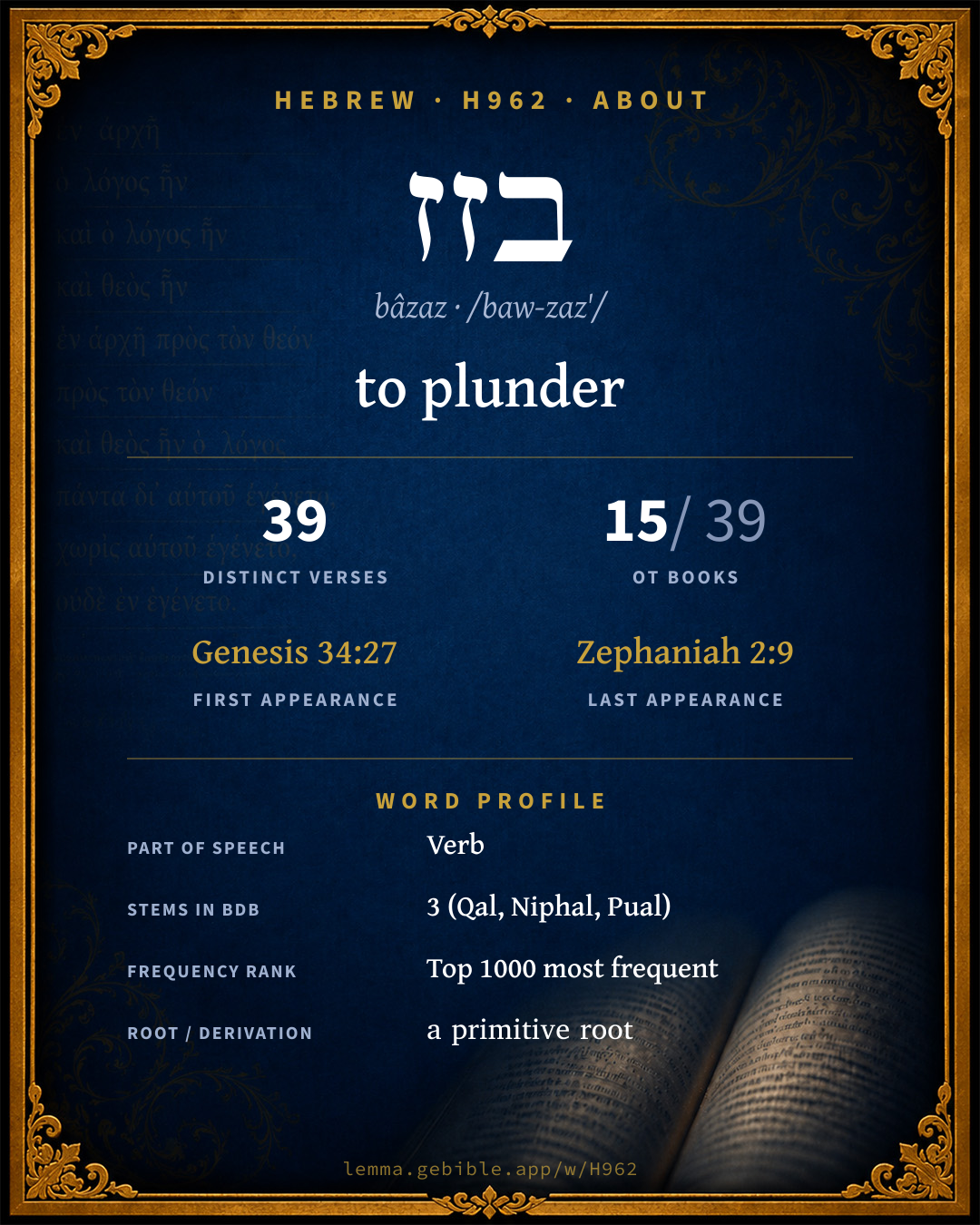
בָּזַז
to plunder
‘to plunder’ is one of 4 main senses fuller range ↓
Full lexicon entry — Brown-Driver-Briggs (BDB)
From Brown-Driver-Briggs (BDB)
Where this word appears
See every Qal verb in the Hebrew Bible →
Grammar key — what these labels mean
Part of speech
- Verb
- An action or state-of-being word.
Stem
- Qal
- The basic, simple active stem — the plain form of the verb (“he wrote”). Here: ‘spoil’
- Niphal
- Usually the simple passive or reflexive of the Qal (“he was written”).
- Pual
- The passive counterpart of the Piel.
Form
- Perfect
- A completed action or state — Hebrew marks aspect (completeness) more than strict tense (“he wrote”).
- Sequential Imperfect
- An imperfect with prefixed waw — the standard past-narrative form (waw-consecutive imperfect).
- Infinitive Construct
- A bound verbal noun, frequently with prepositions (“to write / in writing”).
- Sequential Perfect
- A perfect with prefixed waw continuing a preceding imperfect or command (waw-consecutive perfect).
- Imperfect
- An incomplete, ongoing, or future action (“he will / would write”).
- Imperative
- A direct command (“write!”).
- Infinitive Absolute
- An unbound verbal noun, often intensifying or standing in for a finite verb.
- Cohortative
- A first-person volitional form expressing wish or resolve (“let me / let us write”).
- Participle Active
- A verbal adjective expressing ongoing or characteristic action (“writing / one who writes”).
- Participle Passive
- A verbal adjective expressing action received (“written”).
State
- Absolute
- The independent form of a noun, not bound to a following word.
- Construct
- A noun bound to a following noun in a possessive / “of” relationship (the construct chain).
Person
- 3rd Person
- The one spoken about (“he / she / it / they”).
- 1st Person
- The speaker (“I / we”).
- 2nd Person
- The one addressed (“you”).
Gender
- Common
- Either gender — not distinguished for this form.
- Masculine
- Grammatically masculine.
- Feminine
- Grammatically feminine.
Number
- Plural
- More than one (in Hebrew, generally three or more).
- Singular
- One.
36 distinct verses where H962 appears in the Qal stem, across 14 books. Filtered view — show all forms. Click any verse to open its interlinear word-by-word view. Verse text shown in the World English Bible for context — . Each verse’s Hebrew form is shown with its reference; the English is not keyword-highlighted, since the data carries no word-level English alignment. Use “Compare translations” on any verse to read it across multiple English versions. This concordance covers the Hebrew Bible; Septuagint (Greek Old Testament) occurrences are not indexed here.
Genesis 2 verses
- Genesis 34:27 וַ/יָּבֹ֖זּוּ conj + Qal wimpf 3mp Jacob's sons came on the dead, and plundered the city, because they had defiled their sister.
- Genesis 34:29 וַ/יָּבֹ֑זּוּ conj + Qal wimpf 3mp and all their wealth. They took captive all their little ones and their wives, and took as plunder everything that was in the house.
Numbers 3 verses
- Numbers 31:9 בָּזָֽזוּ Qal pf 3cp The children of Israel took captive the women of Midian and their little ones; and all their cattle, and all their flocks, and all their goods, they took for a prey.
- Numbers 31:32 בָּזְז֖וּ Qal pf 3cp Now the prey, over and above the booty which the men of war took, was six hundred seventy-five thousand sheep,
- Numbers 31:53 בָּזְז֖וּ Qal pf 3cp ([For] the men of war had taken booty, every man for himself.)
Deuteronomy 3 verses
- Deuteronomy 2:35 בָּזַ֣זְנוּ Qal pf 1cp only the cattle we took for a prey to ourselves, with the spoil of the cities which we had taken.
- Deuteronomy 3:7 בַּזּ֥וֹנוּ Qal pf 1cp But all the cattle, and the spoil of the cities, we took for a prey to ourselves.
- Deuteronomy 20:14 תָּבֹ֣ז Qal impf 2ms but the women, and the little ones, and the cattle, and all that is in the city, even all the spoil of it, shall you take for a prey to yourself; and you shall eat the spoil of your enemies, which Yahweh your God has given you.
Joshua 3 verses
- Joshua 8:2 תָּבֹ֣זּוּ Qal impf 2mp You shall do to Ai and her king as you did to Jericho and her king: only the spoil of it, and the cattle of it, shall you take for a prey to yourselves: set you an ambush for the city behind it.
- Joshua 8:27 בָּזְז֥וּ Qal pf 3cp Only the cattle and the spoil of that city Israel took for prey to themselves, according to the word of Yahweh which he commanded Joshua.
- Joshua 11:14 בָּזְז֥וּ Qal pf 3cp All the spoil of these cities, and the cattle, the children of Israel took for a prey to themselves; but every man they struck with the edge of the sword, until they had destroyed them, neither left they any who breathed.
1 Samuel 1 verse
2 Kings 1 verse
2 Chronicles 4 verses
- 2 Chronicles 14:14 וַ/יָּבֹ֨זּוּ֙ conj + Qal wimpf 3mp They struck all the cities round about Gerar; for the fear of Yahweh came on them: and they despoiled all the cities; for there was much spoil in them.
- 2 Chronicles 20:25 לָ/בֹ֣ז בֹּזְזִ֥ים prep + Qal inf.cs Qal ptcp.act mp When Jehoshaphat and his people came to take the spoil of them, they found among them in abundance both riches and dead bodies, and precious jewels, which they stripped off for themselves, more than they could carry away: and they were three days in taking the spoil, it was so much.
- 2 Chronicles 25:13 וַ/יָּבֹ֖זּוּ conj + Qal wimpf 3mp But the men of the army whom Amaziah sent back, that they should not go with him to battle, fell on the cities of Judah, from Samaria even to Beth Horon, and struck of them three thousand, and took much spoil.
- 2 Chronicles 28:8 בָּזְז֣וּ Qal pf 3cp The children of Israel carried away captive of their brothers two hundred thousand, women, sons, and daughters, and took also away much spoil from them, and brought the spoil to Samaria.
Esther 2 verses
- Esther 3:13 לָ/בֽוֹז prep + Qal inf.cs Letters were sent by posts into all the king's provinces, to destroy, to kill, and to cause to perish, all Jews, both young and old, little children and women, in one day, even on the thirteenth [day] of the twelfth month, which is the month Adar, and to take the spoil of them for a prey.
- Esther 8:11 לָ/בֽוֹז prep + Qal inf.cs in which the king granted the Jews who were in every city to gather themselves together, and to stand for their life, to destroy, to kill, and to cause to perish, all the power of the people and province that would assault them, [their] little ones and women, and to take the spoil of them for a prey,
Psalms 1 verse
Isaiah 7 verses
- Isaiah 10:2 יָבֹֽזּוּ Qal impf 3mp to turn aside the needy from justice, and to rob the poor of my people of their right, that widows may be their spoil, and that they may make the fatherless their prey!
- Isaiah 10:6 וְ/לָ/בֹ֣ז conj + prep + Qal inf.cs I will send him against a profane nation, and against the people of my wrath will I give him a charge, to take the spoil, and to take the prey, and to tread them down like the mire of the streets.
- Isaiah 11:14 יָבֹ֣זּוּ Qal impf 3mp They shall fly down on the shoulder of the Philistines on the west; together shall they despoil the children of the east: they shall put forth their hand on Edom and Moab; and the children of Ammon shall obey them.
- Isaiah 17:14 לְ/בֹזְזֵֽי/נוּ prep + Qal ptcp.act mp cs + sfx pers 1cp At evening, behold, terror; [and] before the morning they are no more. This is the portion of those who despoil us, and the lot of those who rob us.
- Isaiah 33:23 בָּ֥זְזוּ Qal pf 3cp Your rigging is untied; they could not strengthen the foot of their mast, they could not spread the sail: then was the prey of a great spoil divided; the lame took the prey.
- Isaiah 42:22 בָּז֣וּז Qal ptcp.pass ms But this is a people robbed and plundered; they are all of them snared in holes, and they are hid in prison-houses: they are for a prey, and none delivers; for a spoil, and none says, Restore.
- Isaiah 42:24 לְ/בֹזְזִ֖ים prep + Qal ptcp.act mp Who gave Jacob for a spoil, and Israel to the robbers? Didn't Yahweh? he against whom we have sinned, and in whose ways they would not walk, neither were they obedient to his law.
Jeremiah 2 verses
- Jeremiah 20:5 וּ/בְזָזוּ/ם֙ conj + Qal wpf 3cp + sfx pers 3mp Moreover I will give all the riches of this city, and all the gains of it, and all the precious things of it, yes, all the treasures of the kings of Judah will I give into the hand of their enemies; and they shall make them a prey, and take them, and carry them to Babylon.
- Jeremiah 30:16 בֹּזְזַ֖יִ/ךְ Qal ptcp.act mp cs + sfx pers 2fs Therefore all those who devour you shall be devoured; and all your adversaries, everyone of them, shall go into captivity; and those who despoil you shall be a spoil, and all who prey on you will I give for a prey.
Ezekiel 5 verses
- Ezekiel 26:12 וּ/בָֽזְזוּ֙ conj + Qal wpf 3cp They shall make a spoil of your riches, and make a prey of your merchandise; and they shall break down your walls, and destroy your pleasant houses; and they shall lay your stones and your timber and your dust in the midst of the waters.
- Ezekiel 29:19 וּ/בָזַ֣ז conj + Qal wpf 3ms Therefore thus says the Lord Yahweh: Behold, I will give the land of Egypt to Nebuchadrezzar king of Babylon; and he shall carry off her multitude, and take her spoil, and take her prey; and it shall be the wages for his army.
- Ezekiel 38:12 וְ/לָ/בֹ֣ז conj + prep + Qal inf.cs to take the spoil and to take the prey; to turn your hand against the waste places that are [now] inhabited, and against the people who are gathered out of the nations, who have gotten cattle and goods, who dwell in the middle of the earth.
- Ezekiel 38:13 הֲ/לָ/בֹ֥ז ptcl inter + prep + Qal inf.cs Sheba, and Dedan, and the merchants of Tarshish, with all the young lions of it, shall tell you, Are you come to take the spoil? have you assembled your company to take the prey? to carry away silver and gold, to take away cattle and goods, to take great spoil?
- Ezekiel 39:10 וּ/בָֽזְזוּ֙ בֹּ֣זְזֵי/הֶ֔ם conj + Qal wpf 3cp Qal ptcp.act mp cs + sfx pers 3mp so that they shall take no wood out of the field, neither cut down any out of the forests; for they shall make fires of the weapons; and they shall plunder those who plundered them, and rob those who robbed them, says the Lord Yahweh.
Nahum 1 verse
Zephaniah 1 verse
About this entry
At a glance — auto-summarized from this page’s data, not written by a person. Every figure links to its source below. This summary describes the numbers; it doesn’t interpret them.
“to plunder” is the headline sense of the Hebrew verb בזז (bâzaz). Older and newer Bibles part ways — “take” in the King James Version, “plunder” (Berean Standard Bible) in modern versions. See the renderings breakdown. It turns up in 39 verses across 15 books, a moderately common footprint. Its earliest occurrence is Genesis 34:27. As a verb its force shifts by stem, across 3 stems (Qal, Niphal, and more). The sections below give every sense, occurrence, and version rendering.
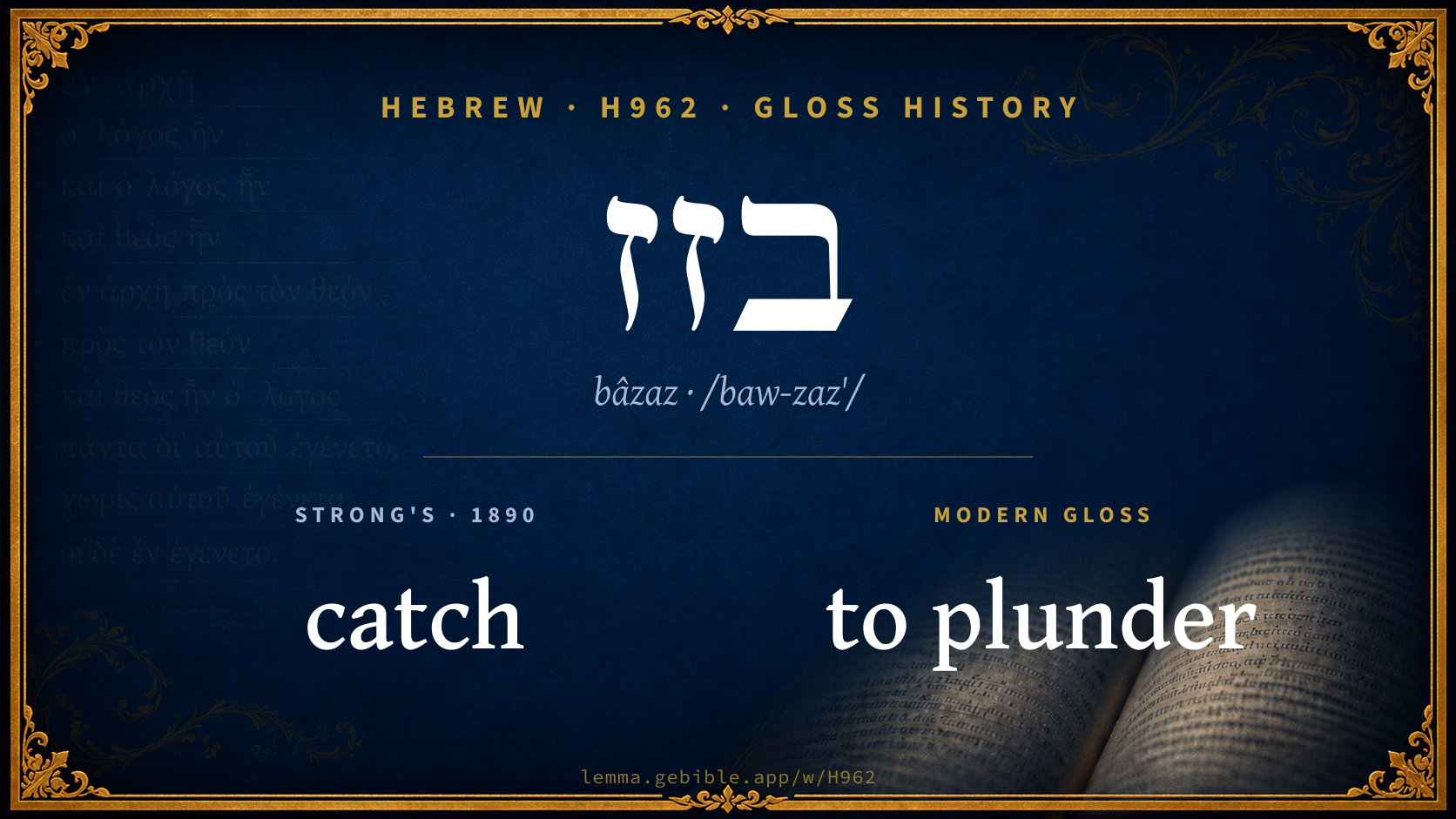
Gloss history
Strong's 1890 vs modern scholarship
About this word
Strong's H962 catalogs a Hebrew word from the Hebrew Old Testament.
These counts are not copied from any lexicon or concordance. They are computed here, from the morphology-tagged Hebrew Old Testament. What Lemma adds →
- 39
- distinct verses
- The word appears in 39 distinct verses.
- 15 / 39
- OT books
- The word appears in 15 of 39 Old Testament books.
- #837
- by frequency
- Top 1000 most frequent Hebrew words (rank 837 of 8,640 Hebrew words by occurrence).
View all 39 occurrences in the concordance →
Most concentrated in
- Isaiah 8 verses 21%
- Ezekiel 5 verses 13%
- 2 Chronicles 4 verses 10%
By section of the Old Testament
By traditional corpus
Conventional, traditional groupings — biblical authorship is debated, so this is a traditional corpus grouping, not an authorship claim. Each share is this word’s portion of its verses in that division of the Hebrew canon. Each figure is a share of the word’s 39 distinct verses.
- Prophets (Nevi'im) 24 verses · 62%
- Torah (Pentateuch) 8 verses · 21%
- Writings (Ketuvim) 7 verses · 18%
How translations render this word
Counts come from each version’s own published word-to-Strong’s tagging or interlinear alignment — an approximate guide to how each version renders this word, not a word-level alignment the data otherwise carries. Because each total is that version’s own tagged count, the per-version totals vary from one another and need not match the appearance or distinct-verse counts above. These counts may also differ from a printed concordance because Lemma counts each distinctly tagged rendering and does not collapse phrase taggings into a single head-word total. This is a fixed set of word-tagged versions (KJV, ASV, BSB, ULT) and does not change with the reading translation you choose elsewhere. Each version’s license is shown beside its name below (and on Sources).
- King James Version: Take 5×, Spoiled 4×, Prey 2×
- American Standard Version: Take 4×, Prey 3×, Took 3×
- Berean Standard Bible: Plunder 8×, Plundered 3×, They plundered 3×
- unfoldingWord Literal Text: Plunder 9×, Plundered 7×, They plundered 5×
King James Version Public Domain
Renders H962 across 43 tagged occurrences — most commonly:
Plus 20 renderings that appear only once — usually multi-word phrases or single function words the recovered tagging swept in, not distinct renderings.
American Standard Version Public Domain
Renders H962 across 42 tagged occurrences — most commonly:
Plus 30 renderings that appear only once — usually multi-word phrases or single function words the recovered tagging swept in, not distinct renderings.
Berean Standard Bible Public Domain
Renders H962 across 42 tagged occurrences — most commonly:
Plus 26 renderings that appear only once — usually multi-word phrases or single function words the recovered tagging swept in, not distinct renderings. Not rendered by a distinct English word in 1 further occurrence.
unfoldingWord Literal Text CC BY-SA 4.0
Renders H962 across 44 tagged occurrences — most commonly:
Plus 21 renderings that appear only once — usually multi-word phrases or single function words the recovered tagging swept in, not distinct renderings.
Senses in the full BDB
Hebrew verbs can shift meaning by stem (binyan): Qal is the basic action, Niphal is often passive or reflexive, Piel often intensifies or makes it factitive, and Hiphil is typically causative. The senses below are grouped under the stem BDB assigns to each. This entry also uses Pual (the passive of Piel).
What do BDB’s symbols mean?
BDB uses these scholarly abbreviations:
| Symbol | Meaning |
|---|---|
| 𝔊 | the Septuagint (the ancient Greek translation, LXX) |
| 𝔙 | the Vulgate (the Latin translation) |
| 𝔖 | the Syriac version (the Peshitta) |
| 𝔗 | the Targum (the Aramaic translation) |
| ψ | the Psalms |
| √ | root (the underlying root or stem) |
| ‖ | parallel passage (a synonymous or contrasted parallel) |
| † | the dagger: every passage where the word occurs is cited |
The 3 senses and sub-senses the full Brown-Driver-Briggs lexicon distinguishes for this word, in lexicon order (not ranked by frequency), with BDB’s own verbatim wording and sub-sense lettering. Shown in Hebrew script with BDB’s own scholarly abbreviations. The condensed entry is in the Lexicon Entry tab. See also the Forms in the corpus table below.
Qal
- spoil
Niphal
- . be spoiled, plundered
Pual
- . be taken as spoil
Senses from the full Brown-Driver-Briggs lexicon (Brown, Driver, Briggs; Oxford 1906 — public domain), digitized via Sefaria, supplemented by the OpenScriptures HebrewLexicon (CC BY 4.0). Full attribution on Sources.
Word origin
בָּזַז vb. spoil, plunder
— Brown-Driver-Briggs (Oxford 1906, public domain), digitized via Sefaria, supplemented by the OpenScriptures HebrewLexicon (CC BY 4.0). See Sources.
Origin: a primitive root
Jastrow Dictionary
A second Hebrew/Aramaic lexicon for comparison, covering Aramaic and post-biblical (Talmudic, Targumic, Midrashic) usage that the biblical-Hebrew BDB does not. Matched by lemma rather than by Strong’s number, so a lemma may carry more than one Jastrow headword (shown separately below), and the entries cover usage well beyond the Bible.
בָּזַז
- √בז to divide, to distribute, to make spoil. Y. Macc. II, 31ᵈ bot. היה בוֹזֵז made booty.—Part. pass. בָּזוּז, f. בְּזוּזָה robbed, illegitimately conquered. Gen. R. s. 1 ב׳ היא בידכם it is robbery what ye possess (ye have no title).
בְּזַז I
- ch. (בַּז) same. Targ. Hos. VII, 9; X, 2; a. fr.—Esth. R. to I, 10, v. בּוּז. Cant. R. to VII, 7 (prov.) take presents from an heir ולא מן דבַזִּין ליה but not from one for whom they make spoil (king).
- same. *Num. R. s. 12 דהוא בזיז וכ׳ he robs (the youths of) the noon-day lessons (transl. ישוד Ps. XCI, 6); v. גְּזַז e.g. Psalms 91:6
- to cause to be plundered. Targ. Is. XXIV, 1 מַבֵּיז (Var. מֵבִיז).
- to be robbed. Ib. 3; a. e.—Ib. 16 מִתְבַּזִּין = מתבזזין.
*בְּזַז II
- to be shy, v. כְּזַז.
A Dictionary of the Targumim, the Talmud Babli and Yerushalmi, and the Midrashic Literature (Marcus Jastrow; London, Luzac, 1903) — Public Domain. Digitized via Sefaria. Digitized via Sefaria. Full attribution on Sources.
Forms in the corpus
The 37 distinct written forms H962 takes in the Hebrew Bible, most frequent first — each parse links to that stem’s occurrences in the concordance. Hebrew forms include their vowel points and cantillation, so a single lemma takes many written forms.
Same root — word family
Other BDB entries built from the same root as H962, grouped by Strong’s listed origin. These share a root / origin per the lexicon — not necessarily a shared meaning. Each links to that word’s own entry.
Derived from this word
Compare all same-root words → They share a root, not necessarily a meaning.
Septuagint verse parallels
This word appears in 37 verses that also exist in the Greek Old Testament (Septuagint), out of the 39 Hebrew verses it occurs in. You can read those verses in Greek by switching the Old Testament edition to the Septuagint.
Read these verses in the Septuagint
- Genesis 34:27
- Numbers 31:9
- Deuteronomy 2:35
- Joshua 8:2
- 1 Samuel 14:36
- 2 Kings 7:16
- 2 Chronicles 14:14
- Esther 3:13
- Isaiah 10:2
- Jeremiah 20:5
- Ezekiel 26:12
- Amos 3:11
This is a verse-level parallel only — the same verses exist in both the Hebrew and Greek Old Testaments. No word-level Hebrew↔Greek correspondence is claimed: the data carries no such alignment, so no Greek word is shown as this Hebrew word’s translation. Coverage is not total — the Septuagint omits the deuterocanon and renumbers the Psalms, so some Hebrew verses have no direct Greek parallel.