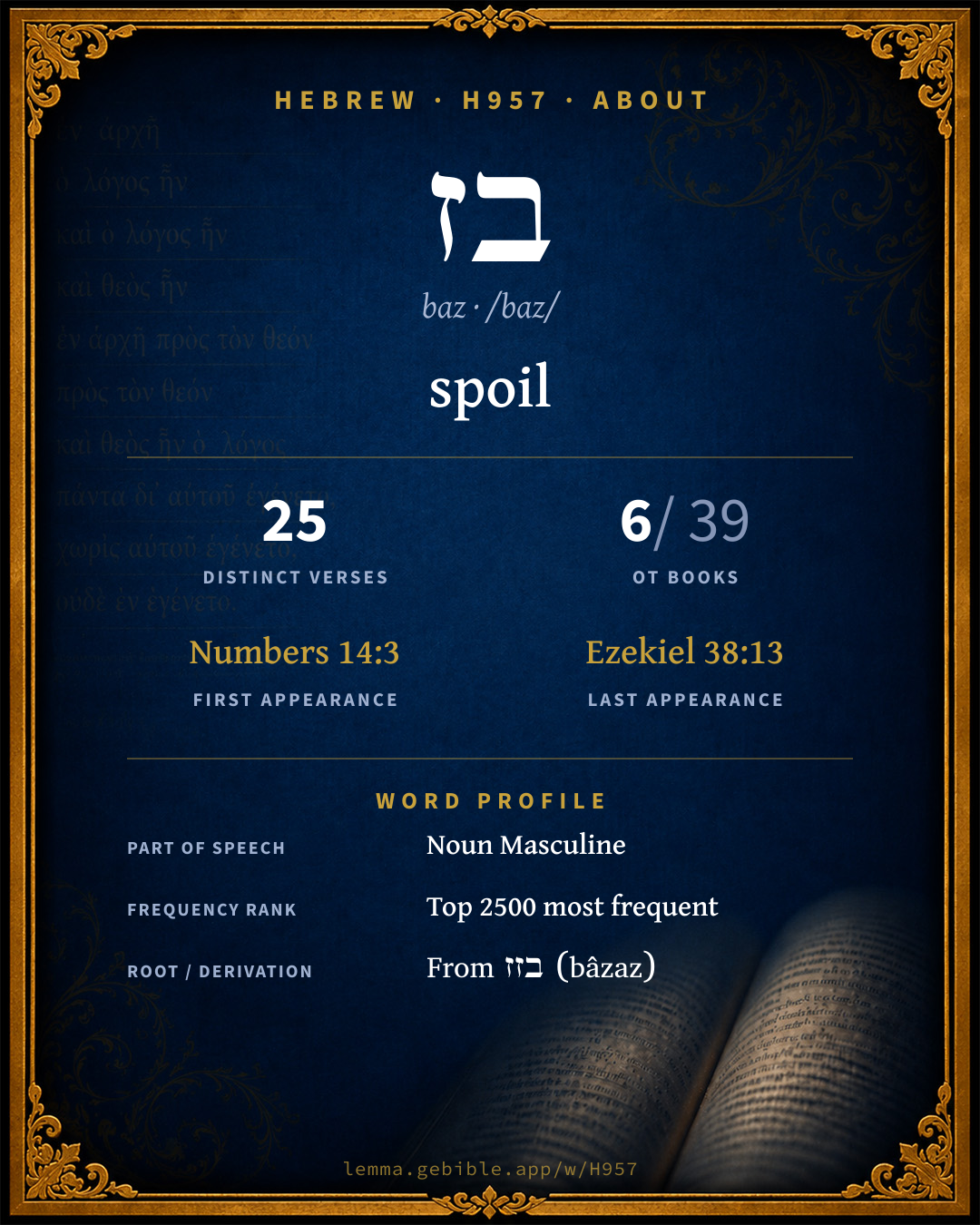
בַּז
spoil
Full lexicon entry — Brown-Driver-Briggs (BDB)
From Brown-Driver-Briggs (BDB)
Where this word appears
See every Absolute-state word in the Hebrew Bible →
Grammar key — what these labels mean
Part of speech
- Noun
- A naming word — a person, place, thing, or idea.
Noun type
- Common
- A common noun — a general class of person, place, or thing (“king,” “city,” “water”), not a specific name.
State
- Absolute
- The independent form of a noun, not bound to a following word.
- Construct
- A noun bound to a following noun in a possessive / “of” relationship (the construct chain).
Gender
- Masculine
- Grammatically masculine.
Number
- Singular
- One.
Grammatical forms
- Noun, Common, Masculine, Singular, Absolute 24 times (96%)
- Noun, Common, Masculine, Singular, Construct 1 time (4%)
Parsed forms decoded from the imported morphology (morphhb / Westminster Leningrad Codex — WLC text public domain, morphhb tagging CC BY 4.0), counted across 25 parsed occurrences — not distinct verses.
Every verse where H957 appears — 25 distinct verses across 6 books. Click any verse to open its interlinear word-by-word view. Verse text shown in the World English Bible for context — . Each verse’s Hebrew form is shown with its reference; the English is not keyword-highlighted, since the data carries no word-level English alignment. Use “Compare translations” on any verse to read it across multiple English versions. This concordance covers the Hebrew Bible; Septuagint (Greek Old Testament) occurrences are not indexed here.
Numbers 3 verses
- Numbers 14:3 לָ/בַ֑ז prep + n c ms Why does Yahweh bring us to this land, to fall by the sword? Our wives and our little ones will be a prey: wouldn't it be better for us to return into Egypt?
- Numbers 14:31 לָ/בַ֣ז prep + n c ms But your little ones, that you said should be a prey, them will I bring in, and they shall know the land which you have rejected.
- Numbers 31:32 הַ/בָּ֔ז ptcl def.art + n c ms Now the prey, over and above the booty which the men of war took, was six hundred seventy-five thousand sheep,
Deuteronomy 1 verse
2 Kings 1 verse
Isaiah 3 verses
- Isaiah 10:6 בַּ֔ז n c ms I will send him against a profane nation, and against the people of my wrath will I give him a charge, to take the spoil, and to take the prey, and to tread them down like the mire of the streets.
- Isaiah 33:23 בַֽז n c ms Your rigging is untied; they could not strengthen the foot of their mast, they could not spread the sail: then was the prey of a great spoil divided; the lame took the prey.
- Isaiah 42:22 לָ/בַז֙ prep + n c ms But this is a people robbed and plundered; they are all of them snared in holes, and they are hid in prison-houses: they are for a prey, and none delivers; for a spoil, and none says, Restore.
Jeremiah 5 verses
- Jeremiah 2:14 לָ/בַֽז prep + n c ms Is Israel a servant? is he a home-born [slave]? why is he become a prey?
- Jeremiah 15:13 לָ/בַ֥ז prep + n c ms Your substance and your treasures will I give for a spoil without price, and that for all your sins, even in all your borders.
- Jeremiah 17:3 לָ/בַ֣ז prep + n c ms My mountain in the field, I will give your substance and all your treasures for a spoil, [and] your high places, because of sin, throughout all your borders.
- Jeremiah 30:16 לָ/בַֽז prep + n c ms Therefore all those who devour you shall be devoured; and all your adversaries, everyone of them, shall go into captivity; and those who despoil you shall be a spoil, and all who prey on you will I give for a prey.
- Jeremiah 49:32 לָ/בַ֗ז prep + n c ms Their camels shall be a booty, and the multitude of their cattle a spoil: and I will scatter to all winds those who have the corners [of their hair] cut off; and I will bring their calamity from every side of them, says Yahweh.
Ezekiel 12 verses
- Ezekiel 7:21 לָ/בַ֔ז prep + n c ms I will give it into the hands of the strangers for a prey, and to the wicked of the earth for a spoil; and they shall profane it.
- Ezekiel 23:46 וְ/לָ/בַֽז conj + prep + n c ms For thus says the Lord Yahweh: I will bring up a company against them, and will give them to be tossed back and forth and robbed.
- Ezekiel 25:7 לְ/בַז֙ prep + n c ms therefore, behold, I have stretched out my hand on you, and will deliver you for a spoil to the nations; and I will cut you off from the peoples, and I will cause you to perish out of the countries: I will destroy you; and you shall know that I am Yahweh.
- Ezekiel 26:5 לְ/בַ֖ז prep + n c ms She shall be a place for the spreading of nets in the midst of the sea; for I have spoken it, says the Lord Yahweh; and she shall become a spoil to the nations.
- Ezekiel 29:19 בִּזָּ֔/הּ n c ms cs + sfx pers 3fs Therefore thus says the Lord Yahweh: Behold, I will give the land of Egypt to Nebuchadrezzar king of Babylon; and he shall carry off her multitude, and take her spoil, and take her prey; and it shall be the wages for his army.
- Ezekiel 34:8 לָ/בַ֡ז prep + n c ms As I live, says the Lord Yahweh, surely because my sheep became a prey, and my sheep became food to all the animals of the field, because there was no shepherd, neither did my shepherds search for my sheep, but the shepherds fed themselves, and didn't feed my sheep;
- Ezekiel 34:22 לָ/בַ֑ז prep + n c ms therefore will I save my flock, and they shall no more be a prey; and I will judge between sheep and sheep.
- Ezekiel 34:28 בַּז֙ n c ms They shall no more be a prey to the nations, neither shall the animals of the earth devour them; but they shall dwell securely, and none shall make them afraid.
- Ezekiel 36:4 לְ/בַז֙ prep + n c ms therefore, you mountains of Israel, hear the word of the Lord Yahweh: Thus says the Lord Yahweh to the mountains and to the hills, to the watercourses and to the valleys, to the desolate wastes and to the cities that are forsaken, which are become a prey and derision to the residue of the nations that are round about;
- Ezekiel 36:5 לָ/בַֽז prep + n c ms therefore thus says the Lord Yahweh: Surely in the fire of my jealousy have I spoken against the residue of the nations, and against all Edom, that have appointed my land to themselves for a possession with the joy of all their heart, with despite of soul, to cast it out for a prey.
- Ezekiel 38:12 בַּ֑ז n c ms to take the spoil and to take the prey; to turn your hand against the waste places that are [now] inhabited, and against the people who are gathered out of the nations, who have gotten cattle and goods, who dwell in the middle of the earth.
- Ezekiel 38:13 בַּ֖ז n c ms Sheba, and Dedan, and the merchants of Tarshish, with all the young lions of it, shall tell you, Are you come to take the spoil? have you assembled your company to take the prey? to carry away silver and gold, to take away cattle and goods, to take great spoil?
About this entry
At a glance — auto-summarized from this page’s data, not written by a person. Every figure links to its source below. This summary describes the numbers; it doesn’t interpret them.
בז (baz) is a Hebrew noun most often rendered “spoil.” Its English rendering has broadened — “prey” classically, “plunder” (Berean Standard Bible) in modern versions; see the renderings breakdown. Spanning 25 verses in 6 books, it ranks among the uncommon words of the Hebrew Bible. Ezekiel dominates its distribution — 12 of 25 verses. It first appears in Numbers 14:3. For the data behind this summary, explore the sense tree and the renderings breakdown below.
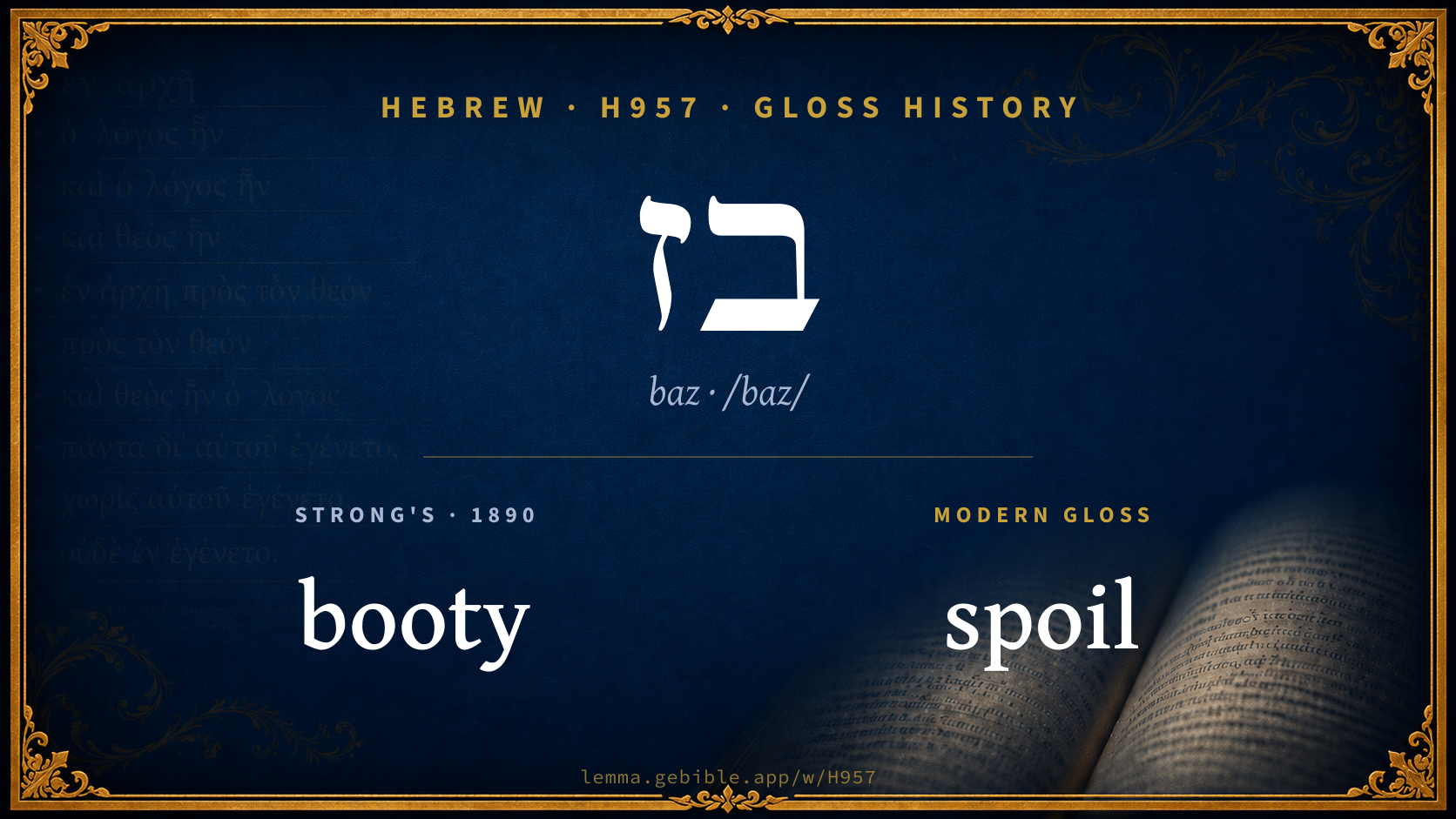
Gloss history
Strong's 1890 vs modern scholarship
About this word
Strong's H957 catalogs a Hebrew word from the Hebrew Old Testament.
These counts are not copied from any lexicon or concordance. They are computed here, from the morphology-tagged Hebrew Old Testament. What Lemma adds →
- 25
- distinct verses
- The word appears in 25 distinct verses.
- 6 / 39
- OT books
- The word appears in 6 of 39 Old Testament books.
- #1,282
- by frequency
- Top 2500 most frequent Hebrew words (rank 1,282 of 8,640 Hebrew words by occurrence).
View all 25 occurrences in the concordance →
By section of the Old Testament
By traditional corpus
Conventional, traditional groupings — biblical authorship is debated, so this is a traditional corpus grouping, not an authorship claim. Each share is this word’s portion of its verses in that division of the Hebrew canon. Each figure is a share of the word’s 25 distinct verses.
- Prophets (Nevi'im) 21 verses · 84%
- Torah (Pentateuch) 4 verses · 16%
How translations render this word
Counts come from each version’s own published word-to-Strong’s tagging or interlinear alignment — an approximate guide to how each version renders this word, not a word-level alignment the data otherwise carries. Because each total is that version’s own tagged count, the per-version totals vary from one another and need not match the appearance or distinct-verse counts above. These counts may also differ from a printed concordance because Lemma counts each distinctly tagged rendering and does not collapse phrase taggings into a single head-word total. This is a fixed set of word-tagged versions (KJV, ASV, BSB, ULT) and does not change with the reading translation you choose elsewhere. Each version’s license is shown beside its name below (and on Sources).
BDB lists this Strong’s number as 2 distinct words (homographs). Each count above pools all of them and is not split by sense — see the Senses section below. A low-frequency rendering may belong to a different one of those words, not the primary meaning.
- King James Version†: Prey 9×, Should be a prey 3×, Became a prey 2×
- American Standard Version†: Prey 8×, Should be a prey 2×, Spoil 2×
- Berean Standard Bible†: Plunder 12×, Prey 4×
- unfoldingWord Literal Text†: Plunder 18×, Spoil 2×
King James Version Public Domain
Renders H957 across 25† tagged occurrences — most commonly:
Plus 7 renderings that appear only once — usually multi-word phrases or single function words the recovered tagging swept in, not distinct renderings.
American Standard Version Public Domain
Renders H957 across 25† tagged occurrences — most commonly:
Plus 11 renderings that appear only once — usually multi-word phrases or single function words the recovered tagging swept in, not distinct renderings.
Berean Standard Bible Public Domain
Renders H957 across 21† tagged occurrences — most commonly:
Plus 5 renderings that appear only once — usually multi-word phrases or single function words the recovered tagging swept in, not distinct renderings. Not rendered by a distinct English word in 3 further occurrences.
unfoldingWord Literal Text CC BY-SA 4.0
Renders H957 across 22† tagged occurrences — most commonly:
Plus 2 renderings that appear only once — usually multi-word phrases or single function words the recovered tagging swept in, not distinct renderings.
Senses in the full BDB
What do BDB’s symbols mean?
BDB uses these scholarly abbreviations:
| Symbol | Meaning |
|---|---|
| 𝔊 | the Septuagint (the ancient Greek translation, LXX) |
| 𝔙 | the Vulgate (the Latin translation) |
| 𝔖 | the Syriac version (the Peshitta) |
| 𝔗 | the Targum (the Aramaic translation) |
| ψ | the Psalms |
| √ | root (the underlying root or stem) |
| ‖ | parallel passage (a synonymous or contrasted parallel) |
| † | the dagger: every passage where the word occurs is cited |
The 2 senses and sub-senses the full Brown-Driver-Briggs lexicon distinguishes for this word, in lexicon order (not ranked by frequency), with BDB’s own verbatim wording and sub-sense lettering. Shown in Hebrew script with BDB’s own scholarly abbreviations. The condensed entry is in the Lexicon Entry tab. See also the Forms in the corpus table below.
- 1. spoiling, robbery, לְב׳ i.e. to be plundered, despoiled Ez 7:21 (of temple ‖ שָׁלָל) 23:46. e.g. Ezekiel 7:21
- 2. spoil, booty, plunder Is 10:6; 33:23 Ez 29:19; 38:12, 13 (all acc. cogn. ‖ שָׁלָל); cf. Nu 31:32 Je 15:13; 17:3; in phr. הָיָה לָבַז Je 49:32 (of camels) Ez 36:4 cf. v 5; also of human beings Nu 14:3, 31 Dt 1:39 Je 2:14 (all היה לב׳) + 2 K 21:14 (‖ מְשִׁסָּה) Is 42:22 (‖ id.) Je 2:14, cf. 30:16 (‖ מְשִׁסָּה); also Ez 25:7 Qr, 26:5 (היה לב׳; both in personif.); fig. of Isr. as sheep Ez 34:8, 22 (both היה לב׳) v 28 היה בז (no לְ). On Is 8:1, 3 מַהֵר שָׁלָל חָשׁ בַּז v. מהר. e.g. Isaiah 10:6
Senses from the full Brown-Driver-Briggs lexicon (Brown, Driver, Briggs; Oxford 1906 — public domain), digitized via Sefaria, supplemented by the OpenScriptures HebrewLexicon (CC BY 4.0). Full attribution on Sources.
Word origin
n.[m.] spoiling, robbery; spoil, booty—בּ׳ abs. Nu 14:3 +; so also Ez 25:7 Qr (Kt בג meaningless); בַּ֑ז Je 2:14 +; but הַבָּ֔ז Nu 31:32 v. d. H.; sf. בִּזָּהּ Ez 29:19;—
— Brown-Driver-Briggs (Oxford 1906, public domain), digitized via Sefaria, supplemented by the OpenScriptures HebrewLexicon (CC BY 4.0). See Sources.
Derived from בזז (bâzaz) (H962) — to plunder.
Jastrow Dictionary
A second Hebrew/Aramaic lexicon for comparison, covering Aramaic and post-biblical (Talmudic, Targumic, Midrashic) usage that the biblical-Hebrew BDB does not. Matched by lemma rather than by Strong’s number, so a lemma may carry more than one Jastrow headword (shown separately below), and the entries cover usage well beyond the Bible.
בַּז
- , v. בָּזַז, בְּזַז.
A Dictionary of the Targumim, the Talmud Babli and Yerushalmi, and the Midrashic Literature (Marcus Jastrow; London, Luzac, 1903) — Public Domain. Digitized via Sefaria. Digitized via Sefaria. Full attribution on Sources.
Forms in the corpus
The 19 distinct written forms H957 takes in the Hebrew Bible, most frequent first — each parse links to that state’s occurrences in the concordance. Hebrew forms include their vowel points and cantillation, so a single lemma takes many written forms.
Same root — word family
Other BDB entries built from the same root as H957, grouped by Strong’s listed origin. These share a root / origin per the lexicon — not necessarily a shared meaning. Each links to that word’s own entry.
Derives from
Derived from this word
Compare all same-root words → They share a root, not necessarily a meaning.
Septuagint verse parallels
This word appears in 23 verses that also exist in the Greek Old Testament (Septuagint), out of the 25 Hebrew verses it occurs in. You can read those verses in Greek by switching the Old Testament edition to the Septuagint.
Read these verses in the Septuagint
This is a verse-level parallel only — the same verses exist in both the Hebrew and Greek Old Testaments. No word-level Hebrew↔Greek correspondence is claimed: the data carries no such alignment, so no Greek word is shown as this Hebrew word’s translation. Coverage is not total — the Septuagint omits the deuterocanon and renumbers the Psalms, so some Hebrew verses have no direct Greek parallel.